
- Home
- »
- Electronic Devices
- »
-
ATM Market Size, Share And Growth Report, 2026-2033GVR Report cover

ATM Market (2026 - 2033)
Size, Share & Trends Analysis Report By Solution (Deployment (Onsite ATM, Offsite ATM, Worksite ATM, Mobile ATM), Managed Services), By Region (North America, Europe, Asia Pacific, Latin America, MEA) , And Segment Forecasts
Market Size, 2025
$26.5BMarket Estimate, 2026
$27.8BMarket Forecast, 2033
$34.3BCAGR, 2026–2033
3.1%ATM Market Summary
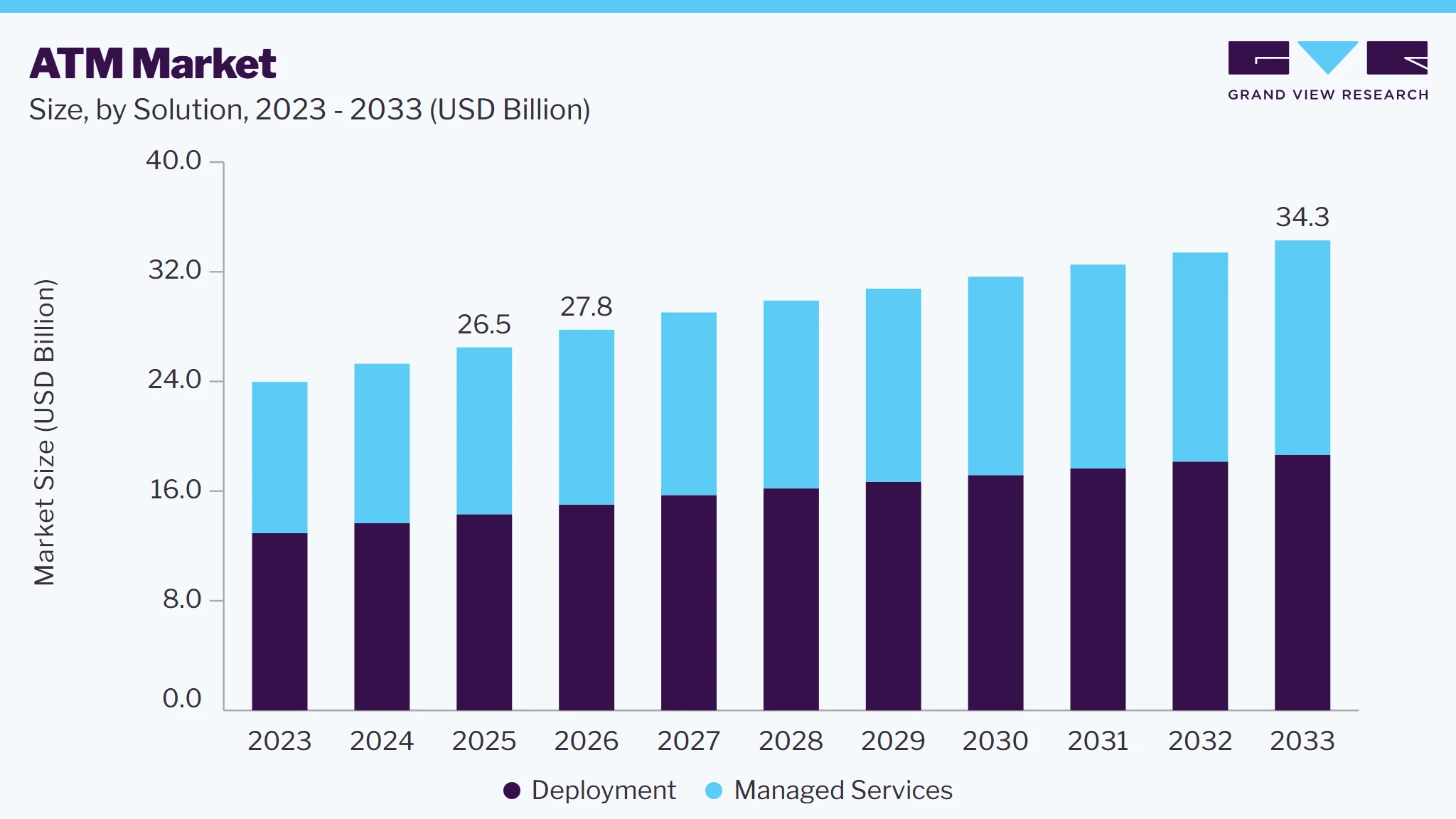
The global ATM market size was valued at USD 26.5 billion in 2025 and is projected to grow from USD 27.8 billion in 2026 to USD 34.3 billion by 2033, at a CAGR of 3.1% from 2026 to 2033. North America dominated the market, accounting for the largest revenue share of 33.9% in 2025. Automated teller machines (ATMs) offer a reliable easy interface for cash withdrawal and features such as ease of fund transfer, withdrawal, deposit, and 24x7 availability of cash.
 Source: Grand View Research, IR Documents, Primary Interviews, Paid DatabasesTo learn more about this report,
 Download Free Sample Report
Key Market Trends & Insights
- By solution: Deployment segment dominated the market, with a revenue share of 54.2% in 2025
Regional Highlights
- Largest regional market: North America (33.9% revenue share, 2025)
- Fastest-growing regional market: Asia Pacific (highest CAGR, 2026-2033)
- By country: The U.S. held the largest market share in 2025.
Market Size & Forecast
- Market size in 2025: USD 26.5 Billion
- Estimated market size in 2026: USD 27.8 Billion
- Projected market size by 2033: USD 34.3 Billion
- CAGR (2026-2033): 3.1%
Three ways to get this report
Buy it, customize it, or ask a question.Ask an Analyst
Analyst response in 1 business day
- AccessReport author, directly
- Reply timeWithin 1 working day
- No sales callDirect answer only
- FormatEmail reply
- CostFree, no cost
Get the Full Report
What the study covers
- FormatsPDF · Excel · Dashboard
- Timeline2026–2033 annual, 2025 base
- Coverage20+ countries, 5 regions
- Companies10+ key players profiled
Customize the Report
20% free customization
- IncludeCountries, segments, points
- TailorTo your product definition
- ExtendDeeper competitor detail
- OrA fully bespoke study
- Turnaround5–10 working days
With advancements in technology, customers seek secure, faster, more convenient, and reliable means of accessing cash, favoring the widespread adoption of ATMs globally. Furthermore, improved security measures, including biometric and one-time password authentication systems to prevent fraud, and the advent of Smart ATMs for users with special needs contribute to market growth. The increase in demand for automation in the banking sector in several developed and emerging countries is also expected to fuel the demand for ATMs.
 To learn more about this report, Download Free Sample Report
The COVID-19 pandemic had significantly disrupted ATM manufacturing operations and supply chains, impacting the overall ATM market. While the stringent restrictions on movement and varying degrees of lockdowns across several countries affected business activities, many people shifted toward digital platforms for banking transactions. However, the demand for ATMs is expected to rise after the pandemic is over owing to the high demand in rural areas of developing countries such as China and India.
With the rise of cyber threats and ATM fraud, enhanced security features are becoming a top priority for the ATM market. Financial institutions are increasingly implementing advanced security measures, such as biometric authentication, end-to-end encryption, and real-time monitoring systems. These innovations aim to protect sensitive customer data and mitigate fraud risks, instilling greater confidence among users. Thus, the integration of improved security mechanisms such as fingerprint, biometrics, and double authentication adds an additional security layer to technologically advanced ATMs, which is expected to help prevent fraud and drive the adoption of ATMs.
The easy flow of cash, rising number of transactional benefits, easy withdrawal, quick and prompt service, and the viability of offline shopping have powered the usage of ATMs across the world, which positively reflects on the promising growth prospects of the global market. Growing urbanization, in both developed and emerging economies, is the primary factor driving the growth of the market. Furthermore, the 24X7 availability of cash, along with the provision of fund transfer and bill payment features are driving the demand for ATMs globally. An increase in installation base and maintenance activities has impacted revenue generation significantly.
Technological advancements such as digital convergence, integration of IoT data analysis, and biometrics & cybersecurity are expected to fuel the market growth. Technological advancement has also allowed for the introduction of contactless ATM kiosks, which have been marketed as a safer and risk-free way of withdrawing cash amid the COVID-19 pandemic. Contactless ATM kiosks allow users to withdraw cash from the ATM by scanning a QR code on the screen without touching the interface. The number of ATMs that offer contactless cash withdrawals has been on the rise globally.
Market Dynamics
The ATM market continues to evolve as financial institutions modernize self service banking infrastructure while balancing digital banking adoption with the need for secure cash access. Growing demand for intelligent ATMs, cash recycling systems, remote monitoring, and software driven ATM management is reshaping the competitive landscape. Banks are increasingly investing in multifunctional ATMs capable of supporting deposits, withdrawals, bill payments, cardless transactions, and digital authentication. Meanwhile, managed services, cloud-based monitoring platforms, and AI-enabled predictive maintenance are improving operational efficiency and extending ATM network lifecycles.
The demand for convenient banking services is driving the growth of the ATM market. Although digital payments have expanded rapidly, cash remains an essential payment method across many economies, particularly in developing countries and rural regions. Consumers expect 24/7 access to banking services without depending on branch operating hours. At the same time, banks are under pressure to reduce branch operating costs while maintaining customer service standards, encouraging greater deployment of advanced self-service banking infrastructure.
Modern ATM solutions address these requirements by offering multifunctional capabilities beyond cash withdrawals, including cash deposits, account transfers, bill payments, PIN management, cardless withdrawals, and biometric authentication. Intelligent ATMs equipped with remote monitoring, predictive maintenance, and cash recycling technologies improve operational efficiency while lowering maintenance and cash replenishment costs. These capabilities enable banks to expand service availability with lower operating expenses, thereby accelerating investments in next-generation ATM networks and managed ATM services.
The increasing adoption of digital payment platforms, mobile banking applications, and contactless payment technologies is reducing reliance on traditional cash transactions. Consumers are increasingly choosing digital wallets, instant payment platforms, and QR-code-based payments for everyday purchases, particularly in urban markets. As transaction volumes shift toward digital channels, financial institutions are becoming more cautious about expanding conventional ATM networks, especially where cash usage is declining.
This trend has resulted in slower ATM deployment across several mature economies with highly developed electronic payment infrastructure. Markets in North America, Western Europe, and parts of East Asia have experienced ATM rationalization as banks optimize physical infrastructure. Manufacturers focused primarily on conventional cash dispensing ATMs face greater competitive pressure, while vendors offering software upgrades, managed services, and multifunctional smart ATMs are better positioned. The shift toward digital banking therefore moderates overall hardware demand and slows long term market expansion.
Growing investments in intelligent banking infrastructure present a significant opportunity for the ATM market. Financial institutions are increasingly replacing legacy ATMs with smart self service terminals capable of cash recycling, biometric authentication, video banking, and digital service integration. Regulatory initiatives supporting financial inclusion, branch transformation strategies, and increasing demand for operational efficiency are further encouraging the modernization of ATM fleets across both developed and emerging markets.
Smart ATM deployments create substantial growth opportunities for equipment manufacturers, software providers, and managed service vendors. Cash recycling technology reduces cash handling expenses while improving cash availability across ATM networks. AI-driven monitoring platforms enhance uptime through predictive maintenance and remote diagnostics, increasing operational efficiency. Vendors with comprehensive hardware, software, and lifecycle management portfolios are well positioned to benefit as banks accelerate digital branch transformation and self service banking investments.
Analyst Perspective
The ATM market is transitioning from conventional cash dispensing to intelligent, software enabled self service banking platforms that support a broader range of financial services. Banks continue to invest in ATM modernization to improve operational efficiency, enhance the customer experience, and optimize branch networks through automation. Technologies such as cash recycling, biometric authentication, AI-based predictive maintenance, cloud based ATM management, and cardless transactions are reshaping competitive differentiation. Furthermore, investments are expected to focus on multifunctional smart ATMs and managed services. At the same time, vendors increasingly compete by offering integrated hardware, software, and lifecycle services rather than standalone ATM equipment.
Solution Insights
Based on solution, the automated teller machine (ATM) market is segmented into deployment and managed service. The deployment segment led the market with the largest revenue share of 54.2% in 2025. The segment is expected to grow at the fastest CAGR over the forecast period. The deployment of an ATM consists of installing, setting up, testing, running, and implementing an ATM. The segment is further bifurcated into onsite, offsite, worksite, and mobile ATMs.
Onsite ATMs are located in or beside the bank, where both the physical branch and the ATM can be used. These ATMs reduce the work pressure of bank employees, avoiding long queues in bank premises for withdrawals, cash deposits, and transfers. These ATMs also reduce the probability of errors with withdrawals and deposits and allow banks to have smooth financial transactions. These factors are estimated to increase the demand for onsite ATMs in the near future.
The mobile ATM segment is anticipated to witness a notable CAGR from 2025 to 2030. A mobile ATM is a movable ATM system that is strategically placed to reduce traffic in high-volume locations such as trade fairs, social gatherings, and sports events. Mobile ATMs provide flexibility and enhance branding & promotion for banking institutions.
Managed services allow financial institutions to move their non-core activities to a specialized and trained service provider and concentrate on their core financial businesses. Various industry participants such as NCR Corporation and Diebold Nixdorf provide managed services at low costs. Managed services contribute significantly toward strengthening the infrastructure of financial institutions for multichannel delivery and better customer retention, acquisition, and cross-selling opportunities. Outsourcing managed services to a service provider offers benefits such as reduced operational and infrastructure investment costs, improved operational profits, compliance with new regulatory policies, and simplified network operations and services.
Regional Insights
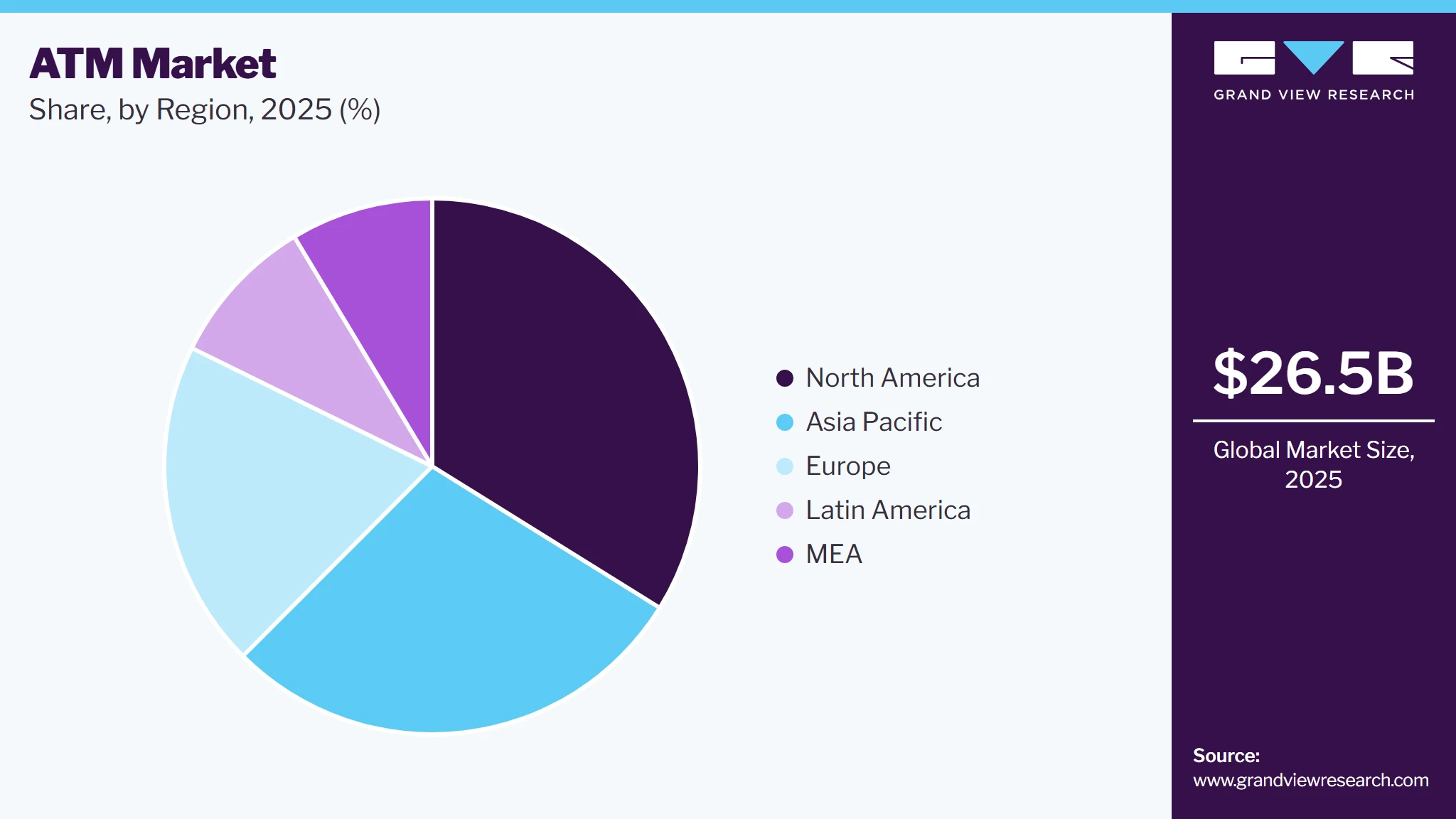
North America dominated the global ATM market with the largest revenue share of 33.9% in 2025. The growth is attributed to a number of factors, including the high demand for cash, the growth of e-commerce, the increased use of mobile banking, and the upgrade of existing ATMs. The region is expected to continue to grow in the coming years, as these factors continue to drive demand for ATMs.
 To learn more about this report, Download Free Sample Report
U.S. ATM Market Trends
The ATM market in the U.S. held the largest share in the North America region in 2025. The growth of the market can be attributed to the rising demand for enhanced customer experiences and the integration of advanced technologies, such as contactless payments and biometric authentication. Financial institutions are upgrading their ATM networks to offer a wider range of services, including cash recycling, cardless transactions, and remote video assistance. The shift toward digital banking and the need to provide seamless access to cash in both urban and rural areas are also influencing the deployment of modern ATMs.
Europe ATM Market Trends
The Europe ATM market was identified as a lucrative region in 2024. The growth of the market is driven by the increasing emphasis on digital transformation and the need for integrated financial solutions. The region’s diverse regulatory landscape necessitates sophisticated software that can adapt to different compliance requirements across countries. Furthermore, the aging population in many European countries is driving demand for wealth preservation and retirement planning tools, thereby driving the market’s growth.
The UK ATM market held a substantial market share in 2024. The increasing demand for cash recycling machines and multifunctional ATMs that offer a variety of banking services, such as deposits, transfers, and bill payments, is one of the key factors driving the UK ATM market. Furthermore, several companies in the UK are focusing on launching multi-bank deposit ATMs to provide better access to cash to their consumers. For instance, in June 2024, NCR Atleos, an ATM solution provider, launched its first line of multi-bank deposit ATMs in the UK, addressing the critical need for cash access among UK consumers.
The Germany ATM market is expected to grow at a considerable growth rate during the forecast period. German consumers have a strong preference for cash, which keeps the demand for traditional ATM services high. The continued high demand for cash transactions and the need to provide reliable banking services across both urban and rural areas is a major factor contributing to the growth of the market.
Asia Pacific ATM Market Trends
The Asia Pacific ATM market is anticipated to grow at a significant CAGR during the forecast period. The growth of the regional market is attributed to the rising deployment of ATMs, predominantly in developing countries such as China and India. Lack of awareness about digital payment solutions in most economies in the region also strengthens the role of ATMs for cash-based and other financial transactions in this region. Of the over three million ATMs installed globally, the maximum is installed in Asia Pacific. Furthermore, the need to serve the large unbanked population across countries such as China, India, and Japan, as well as emerging markets across Vietnam and Indonesia is expected to fuel the demand for ATMs in the region.
The Japan ATM Market is expected to register a moderate growth rate during the forecast period. Digitalization in Japan is playing a crucial role in the evolution of ATMs, leading to the greater demand for ATMs with features such as biometric authentication, remote cash dispensing, and integration with online banking services. Furthermore, the aging population in Japan is influencing ATM design and functionality, with a focus on accessibility and ease of use for older individuals, thereby driving the market’s growth.
The ATM market in China held a substantial market share in 2024. The demand for advanced self-service solutions and a focus on financial inclusion, particularly in rural and underserved areas, are key factors driving market growth. In addition, the rise of digital payments is positively impacting the sector, as financial institutions increasingly integrate multifunctional capabilities into ATMs.
Key ATM Company Insights
Some of the key companies in the ATM market include Diebold Nixdorf, Incorporated, NCR Atleos, and FUJITSU and others. Organizations are focusing on integrating advanced technologies into their offerings to maintain competitive advantages. Therefore, key players are taking several strategic initiatives, such as new product launches, mergers and acquisitions, and partnerships, among others.
-
Diebold Nixdorf, Incorporated emerged as the most prominent player in the ATM market. The company designs, develops, and delivers innovative self-service technologies, particularly in the banking and retail sectors. It specializes in ATMs, Point-of-Sale (POS) systems, and software solutions that enhance transaction efficiency and security.
-
NCR Atleos specializes in financial technology and ATM solutions. NCR Atleos offers a comprehensive suite of solutions encompassing traditional ATMs and advanced self-service technologies, catering to the evolving needs of financial institutions and retail businesses.
Key ATM Companies:
The following key companies have been profiled for this study on the ATM market.
-
Diebold Nixdorf, Incorporated
-
FUJITSU
-
G4S Limited
-
GRGBanking
-
Hitachi Channel Solutions, Corp.
-
NCR Atleos
-
Oki Electric Industry Co., Ltd.
-
Guangzhou Yuyin Technology Co., Ltd.
Competitive Benchmarking
Category
Operating Strategies
Competitive Edge
Weakness
Established Players (Diebold Nixdorf, Incorporated; NCR Atleos; GRGBanking; Hyosung TNS Inc.)
- These players are focused on global ATM deployments, continuous product innovation, software-driven ATM platforms, cash recycling technologies, managed services, strategic banking partnerships, and long-term service contracts.
- These players have extensive global presence, comprehensive ATM portfolios, strong R&D capabilities, integrated hardware-software solutions, established banking relationships, and broad service networks.
- High operating expenses resulting from extensive manufacturing, service, and support networks can impact profitability. Slower market growth in regions with widespread digital payment adoption reduces demand for new ATM deployments, while complex organizational structures may delay technology adoption and responsiveness to evolving customer requirements.
Emerging Players (Hitachi Channel Solutions, Corp.; Guangzhou Yuyin Technology Co., Ltd.; GENMEGA, INC.)
- These players expand through regional banking partnerships, cost-effective ATM offerings, niche deployments, customized solutions, and selective geographic expansion.
- Competitive pricing, flexibility in customer requirements, strong regional presence, and growing product capabilities in selected markets.
- Limited global presence and smaller service networks can restrict access to large banking contracts and international expansion opportunities. Lower brand recognition and less comprehensive managed service capabilities may also reduce competitiveness when serving financial institutions seeking end to end ATM solutions.
Recent Developments
-
In May 2024, Diebold Nixdorf, Incorporated partnered with Bankart to modernize its payment processing platform across Southeast Europe, marking a significant upgrade in the region's financial technology landscape. This collaboration involves transitioning Bankart's outdated payment processing system to Diebold Nixdorf's Vynamic Transaction Middleware, a cloud-native solution designed to enhance payment capabilities for ATMs, POS terminals, and e-commerce systems in 20 banks in six countries. The upgrade aims to replace the legacy Base24 platform, providing Bankart the flexibility and scalability needed to introduce new products and services efficiently.
-
In June 2023, NCR Corporation, a provider of corporate technology, partnered with Members ATM Alliance (MAA) to deliver ATM as a service (ATMaaS) to credit unions. MAA is a Credit Union Service Organization (CUSO) that provides support to credit unions in the management and processing of ATMs. By adopting NCR ATM as a Service, MAA will have the capability to simplify its managed services portfolio, encompassing operations, deployment, transaction processing, cash management, and software management.
-
In February 2023, NCR Corporation, a provider of corporate technology renewed and expanded its long-term partnership with Walgreens, a leading global drugstore operator. NCR continues to supply ATM services in nearly all Walgreens shops in the U.S., Puerto Rico, and the District of Columbia under the new deal.
ATM Market Report Scope
Report Attribute
Details
Market size in 2025
USD 26.5 billion
Estimated market size in 2026
USD 27.8 billion
Projected market size by 2033
USD 34.3 billion
Growth rate
CAGR of 3.1% from 2026 to 2033
Base year for estimation
2025
Historical data
2021 - 2024
Forecast period
2026 - 2033
Quantitative units
Revenue in USD billion and CAGR from 2026 to 2033
Report coverage
Revenue forecast, company market share, competitive landscape, growth factors, and trends
Segments covered
Solution, region
Regional scope
North America; Europe; Asia Pacific; Latin America; MEA
Country scope
U.S.; Canada; Mexico; Germany; U.K.; France; China; Japan; India; South Korea; Australia; Brazil; Saudi Arabia; UAE; South Africa
Key companies profiled
Diebold Nixdorf, Incorporated; FUJITSU; G4S Limited; GRGBanking; Hitachi Channel Solutions, Corp.; NCR Atleos; Oki Electric Industry Co., Ltd.; Guangzhou Yuyin Technology Co., Ltd., Hyosung TNS Inc., GENMEGA, INC.
Customization scope
Free report customization (equivalent up to 8 analysts' working days) with purchase. Addition or alteration to country, regional & segment scope.
Pricing and purchase options
Avail customized purchase options to meet your exact research needs. Explore purchase options
Global ATM Market Report Segmentation
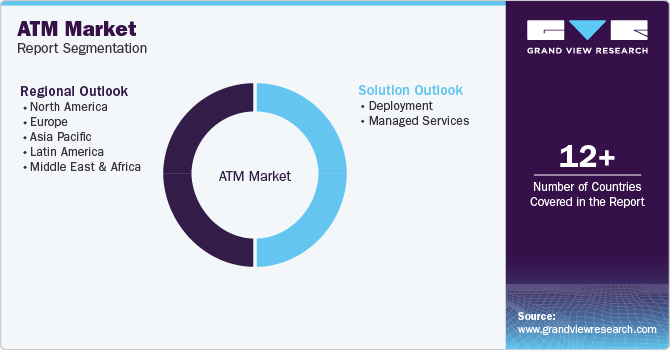
This report forecasts revenue growth at global, regional, and country levels and provides an analysis of the latest industry trends in each of the sub-segments from 2021 to 2033. For this study, Grand View Research has segmented the global ATM market report based on solution and region:
 To learn more about this report, Download Free Sample Report
-
Solution Outlook (Revenue, USD Million, 2021 - 2033)
-
Deployment
-
Onsite ATM
-
Offsite ATM
-
Worksite ATM
-
Mobile ATM
-
-
Managed Services
-
-
Regional Outlook (Revenue, USD Million, 2021 - 2033)
-
North America
-
U.S.
-
Canada
-
Mexico
-
-
Europe
-
Germany
-
UK
-
France
-
-
Asia Pacific
-
China
-
Japan
-
India
-
South Korea
-
Australia
-
-
Latin America
-
Brazil
-
-
Middle East and Africa (MEA)
-
KSA
-
UAE
-
South Africa
-
-
Research Methodology
The ATM market figures in this report are based on a proven research process that combines executive interviews with secondary research from proprietary databases, company filings, and recognized regulatory and institutional sources. Market size is built through value-chain sizing - reconciling supply-side and demand-side estimates - and triangulated with bottom-up and top-down approaches. Every estimate passes multiple levels of expert validation before publication, with each ATM segment quantified using the revenue-capture definitions in the table below.
Segment Definition
Segment - Solution
Revenue capture definition
Deployment
Revenue generated from the deployment and installation of ATMs across different locations, including ATM hardware, embedded software, deployment, installation, system integration, configuration, and commissioning revenues associated with new ATM deployments and replacements. The segment includes deployment such as Onsite ATM, Offsite ATM, Worksite ATM, and Mobile ATM.
-
Onsite ATM: Revenue generated from ATM hardware installed within bank branches, including ATM sales, installation, software licensing, maintenance contracts, upgrades, cash recycling modules, and related support services.
-
Offsite ATM: Revenue generated from ATMs deployed at retail stores, shopping malls, fuel stations, transportation hubs, hospitals, airports, and other public locations, including deployment, managed services, monitoring, maintenance, and transaction related service contracts.
-
Worksite ATM: Revenue generated from ATMs installed within corporate offices, factories, educational institutions, government facilities, and business campuses, including hardware deployment, maintenance agreements, managed cash services, and enterprise banking contracts.
-
Mobile ATM: Revenue generated from portable or vehicle mounted ATM solutions deployed during festivals, sporting events, disaster relief operations, military applications, temporary banking services, and remote locations, including leasing, deployment, maintenance, and operational support services.
Managed Services
Revenue generated from outsourced ATM lifecycle management, including remote monitoring, cash replenishment coordination, predictive maintenance, field services, software management, security management, help desk services, ATM network management, and compliance support.
Estimation Model
Layer Name
Key Question
Description
ATM Infrastructure Base
What is the installed base and deployment potential of ATMs across regions?
The layer estimates the total installed ATM base across banking institutions, independent deployers, and financial service providers. It evaluates replacement cycles, new ATM installations, branch expansion, and financial inclusion initiatives. Regional banking penetration, cash usage patterns, and ATM density are considered to establish the addressable market.
Solution Adoption Analysis
Which ATM solutions are being deployed and upgraded?
This layer evaluates adoption across onsite, offsite, worksite, and mobile ATM deployments together with managed services. It measures migration toward intelligent ATMs, cash recyclers, biometric authentication, cardless transactions, and software-driven self-service banking solutions. Deployment trends differ across developed and emerging economies based on banking infrastructure maturity.
Revenue Modeling
How is revenue generated across ATM solutions and services?
Revenue estimation incorporates ATM hardware sales, software licensing, installation, maintenance, managed services, security solutions, upgrades, and lifecycle management. Average selling prices, replacement rates, service contracts, and recurring software revenues are evaluated. Both capital expenditure and recurring operational revenue streams contribute to market estimation.
Market Validation & Forecast
What factors influence future ATM market growth?
This layer validates market estimates using banking investments, financial inclusion programs, cash circulation trends, regulatory developments, and digital banking adoption. Competitive strategies, regional deployment patterns, technological innovation, and macroeconomic conditions are incorporated into forecasting. This layer ensures realistic long-term revenue projections across all ATM market segments.
Delivered Customizations
This report has been delivered with the following In-depth customizations
Client Request
Customization Delivered
Value Adds
Regional ATM Market Opportunity Assessment
Country/region-wise market sizing and forecasts
Analysis of demand, adoption trends, and regulatory landscape
Identification of high-growth regions and investment hotspots
Identified region-specific growth opportunities
Supported expansion and go-to-market strategy
Enabled informed regional investment decisions
Cross-Segmentation Analysis for the ATM Market
Criss-cross market analysis by solution
Demand and adoption assessment across key segments
Segment attractiveness and growth potential benchmarking
Identified high-potential market segments
Supported targeted product positioning and marketing strategy
Improved customer and segment prioritization
Competitive Benchmarking and Strategic Positioning in the ATM Market
Benchmarking of key competitors across products, pricing, partnerships, and innovation
Comparative assessment of market share, capabilities, and strategies
Analysis of competitive strengths, gaps, and differentiation areas
Identified competitive white spaces and growth gaps
Supported strategic positioning and differentiation
Enabled data-driven competitive strategy development
Frequently Asked Questions About This Report
The global ATM market size was valued at USD 26.5 billion in 2025 and is estimated at USD 27.8 billion for 2026.
Deployment segment dominated the market, with a revenue share of 54.2% in 2025. Banks are increasingly modernizing their branch networks by deploying ATMs across onsite, offsite, worksite, and mobile locations to improve customer accessibility while reducing dependence on staffed branches.
Some key players operating in the ATM market include Diebold Nixdorf, Incorporated.; Fujitsu; G4S Limited.; GRGBanking.; Hitachi Channel Solutions, Corp.; NCR Corporation.; OKI Electric Industry Co., Ltd.; and Guangzhou KingTeller Technology Co., Ltd. among others
Automated teller machines (ATMs) offer a reliable, easy interface for cash withdrawal and features such as ease of fund transfer, withdrawal, deposit, and 24x7 availability of cash.
North America dominated the global market with the largest revenue share of 33.9% in 2025. The growth is attributed to a number of factors, including the high demand for cash, the growth of e-commerce, the increased use of mobile banking, and the upgrade of existing ATMs.
Asia Pacific is the fastest-growing region over the forecast period.
The U.S. held the largest market share in 2025.
Onsite ATM segment dominated the market, with a revenue share of 36.8% in 2025, and it is the fastest-growing segment over the forecast period.
The global automated teller machines (ATM) market is expected to grow at a CAGR of 3.1% from 2026 to 2033, reaching USD 34.3 billion by 2033.
About the Author(s)
Electronic Devices Research Team
Semiconductors & Electronics · Electronic DevicesThis report was authored by the electronic devices research team at Grand View Research - comprising two research analysts, one senior research analyst, and one industry expert - with specialized expertise in the electronic devices segment of the semiconductors & electronics industry. All findings are based on proprietary semiconductors & electronics databases, executive interviews, and regulatory analysis, subject to internal peer review prior to publication.
Last Updated:
Speak to Analyst

Customize this report to your needs - add regions, segments, or data points, with 20% free customization.
Or view our licence options:


ISO 9001:2015 & 27001:2022 Certified
We are GDPR and CCPA compliant! Your transaction & personal information is safe and secure. For more details, please read our privacy policy.


