
- Home
- »
- Advanced Interior Materials
- »
-
Atmospheric Plasma Technology Market Size Report, 2033GVR Report cover

Atmospheric Plasma Technology Market (2026 - 2033)
Size, Share & Trends Analysis Report By Application (Surface Cleaning, Surface Activation, Surface Coating, Etching & Patterning, Sterilization), By Type (Cold, Thermal), By End Use, By Region, And Segment Forecasts
Market Size, 2025
$2.5BMarket Estimate, 2026
$2.7BMarket Forecast, 2033
$4.1BCAGR, 2026–2033
6.5%Market Size & Trends
The global atmospheric plasma technology market size was valued at USD 2.5 billion in 2025 and is projected to grow from USD 2.7 billion in 2026 to USD 4.1 billion by 2033, at a CAGR of 6.5% from 2026 to 2033. Asia Pacific dominated the market, accounting for a revenue share of 46.7% in 2025. The market is rapidly growing due to rising demand for eco-friendly surface treatment solutions across industries like electronics, automotive, and healthcare.
 Source: Grand View Research, IR Documents, Primary Interviews, Paid DatabasesTo learn more about this report,
 Download Free Sample Report
Key Market Trends & Insights
- By type: Cold segment led the market with the largest revenue share of 72.8% in 2025.
- By application: Surface coating segment led the market with the largest revenue share of 40.4% in 2025.
- By end use: Electronics & semiconductors segment led the market with the largest revenue share of 23.5% in 2025.
Regional Highlights
- Largest regional market: Asia Pacific (46.7% revenue share, 2025)
- By country: China held the largest market share in 2025.
Market Size & Forecast
- Market size in 2025: USD 2.5 Billion
- Estimated market size in 2026: USD 2.7 Billion
- Projected market size by 2033: USD 4.1 Billion
- CAGR (2026-2033): 6.5%
Three ways to get this report
Buy it, customize it, or ask a question.Ask an Analyst
Analyst response in 1 business day
- AccessReport author, directly
- Reply timeWithin 1 working day
- No sales callDirect answer only
- FormatEmail reply
- CostFree, no cost
Get the Full Report
What the study covers
- FormatsPDF · Excel · Dashboard
- Timeline2026–2033 annual, 2025 base
- Coverage20+ countries, 5 regions
- Companies10+ key players profiled
Customize the Report
20% free customization
- IncludeCountries, segments, points
- TailorTo your product definition
- ExtendDeeper competitor detail
- OrA fully bespoke study
- Turnaround5–10 working days
Its ability to enhance adhesion, cleaning, and sterilization without chemicals, along with advancements in cold plasma and automation, is driving broader adoption and market expansion. Moreover, growing focus on miniaturization in electronics, increased demand for high-performance materials, and regulatory pressure to reduce harmful emissions are further accelerating adoption. As industries seek more precise, cost-effective, and eco-friendly alternatives, atmospheric plasma technology are becoming integral to modern manufacturing and surface engineering.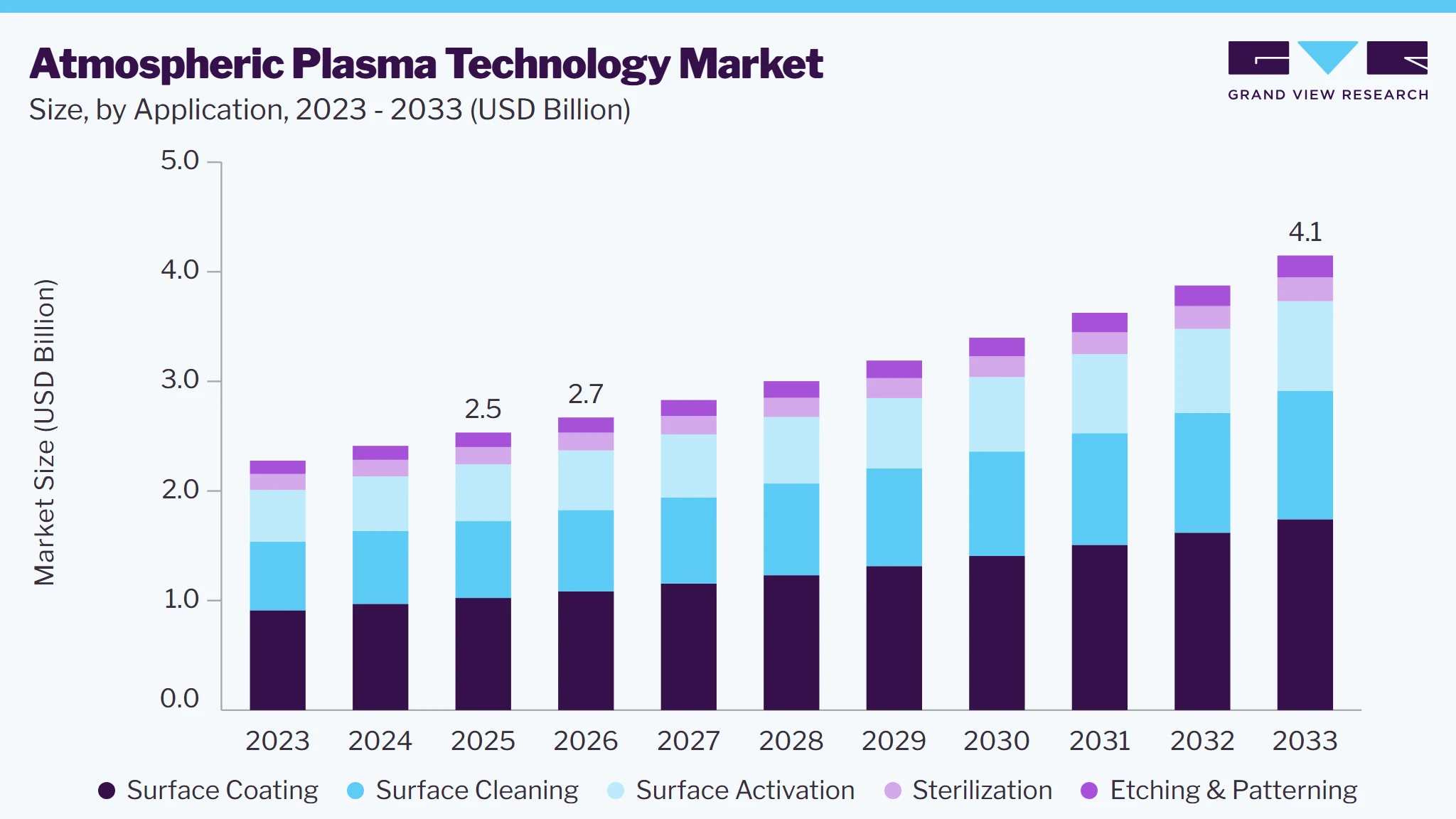 To learn more about this report, Download Free Sample Report
Market Dynamics
The atmospheric plasma technology market is expanding due to increasing demand for advanced surface treatment solutions across electronics, automotive, medical devices, packaging, and semiconductor industries. The technology enhances adhesion, cleaning, coating, and surface activation without requiring chemical treatments, supporting sustainable manufacturing practices. Growing automation, precision manufacturing, and stricter quality standards further encourage adoption. However, high equipment costs and technical integration challenges influence purchasing decisions, while continuous innovation creates opportunities across emerging industrial and healthcare applications.
Growing demand for environmentally friendly and high-performance surface treatment processes is driving the atmospheric plasma technology market. Manufacturers increasingly adopt atmospheric plasma systems to improve surface cleaning, activation, bonding, and coating without using hazardous chemicals. The technology supports enhanced product quality, reduced environmental impact, and compliance with sustainability regulations. Expanding applications in automotive, electronics, medical devices, and packaging industries continue to strengthen market demand worldwide.
High initial investment requirements and integration complexity restrain the adoption of atmospheric plasma technology. Advanced plasma systems require specialized equipment, process optimization, and skilled personnel to ensure consistent performance across manufacturing lines. Small and medium-sized manufacturers may delay investments due to budget limitations and uncertain return on investment. Additionally, integrating plasma systems into existing production processes can increase implementation time and operational costs.
Increasing use of atmospheric plasma technology in medical device manufacturing, electronics assembly, and semiconductor production presents significant market opportunities. The technology improves surface cleanliness, adhesion, sterilization, and coating performance while supporting precision manufacturing requirements. Rising investments in advanced electronics, wearable devices, and healthcare technologies are expected to accelerate adoption. Continuous development of compact, automated plasma systems further broadens commercial opportunities across high-value industrial applications.
Market Concentration & Characteristics
The global atmospheric plasma technology industry is moderately fragmented, with a mix of large multinational companies and regional players competing for market share. Leading manufacturers emphasize innovation in plasma equipment tailored for industrial uses like surface treatment, materials processing, and electronics production. With sustainability and energy efficiency as core priorities, companies are developing technologies that lower energy use and boost environmental performance. Significant investments in R&D aim to enhance the precision, reliability, and scalability of plasma systems. To extend their market reach and diversify applications, companies are also expanding internationally and forming strategic partnerships across key industries, including automotive, aerospace, and healthcare.
The development of portable and compact atmospheric plasma devices, such as handheld or benchtop units, has revolutionized application flexibility. These innovations allow plasma treatment to be performed directly at the point of use, making them ideal for medical device manufacturing, electronics repair, and on-site industrial tasks. Their small size, ease of use, and efficiency enable broader adoption across sectors, particularly where mobility, precision, and space-saving solutions are essential.
 To learn more about this report, Download Free Sample Report
While opportunities are abundant, the atmospheric plasma technology industry also faces competition from established conventional methods. Traditional surface treatment methods, such as wet chemical processes, mechanical treatments, or thermal treatments, have been in use for decades, and industries heavily rely on them. These conventional methods are often well-understood and integrated into existing manufacturing processes. As a result, atmospheric plasma technology growth is hampered. Companies are less likely to switch to newer, more complex technologies like plasma, especially when the benefits of plasma treatments are not immediately obvious or require substantial initial investment to implement.
Analyst Perspective
The atmospheric plasma technology market is expected to witness growth, driven by increasing demand for high-precision, chemical-free surface treatment solutions across electronics, automotive, medical, packaging, and aerospace industries. Growing automation, miniaturization of electronic components, and stringent quality requirements are accelerating technology adoption. Continuous advancements in plasma process control, energy-efficient systems, and inline manufacturing integration are expected to expand application opportunities. Companies focusing on product innovation, industrial partnerships, and customized plasma solutions are likely to strengthen their competitive position in the market.
Application Insights
Based on application, the surface coating segment led the market with the largest revenue share of 40.4% in 2025, due to its widespread use in enhancing adhesion, durability, and performance of materials. Industries like automotive, electronics, and packaging rely on plasma treatments to prepare surfaces for coatings. Its eco-friendly, efficient, and non-toxic process makes it a preferred choice over traditional chemical-based methods.
The surface cleaning segment is expected to grow at the fastest CAGR during the forecast period, due to its effectiveness in removing contaminants like oils, dust, and residues without using harsh chemicals. Its eco-friendly, non-damaging process is widely adopted in industries such as electronics, automotive, and medical devices, where high precision and cleanliness are critical for performance and reliability.
Type Insights
Based on type, the cold segment led the market with the largest revenue share of 72.8% in 2025, due to its versatility, energy efficiency, and suitability for treating heat-sensitive materials. It enables precise surface modification without thermal damage, making it ideal for applications in electronics, medical devices, and textiles. Its eco-friendly nature, eliminating the need for chemicals, aligns with global sustainability goals. In addition, advancements in cold plasma technology are expanding its use across diverse industrial sectors, further driving its market leadership. For instance, in February 2025, Viromed Medical AG collaborated with a multinational corporation, securing a European license for the use of cold atmospheric pressure plasma in medicine.
The thermal segment is expected to grow at the fastest CAGR during the forecast period, due to its high-temperature capabilities, enabling efficient processing of materials like metals and ceramics. Applications in aerospace, automotive, and energy sectors drive demand for thermal plasma systems, particularly in coating and surface cleaning. Technological advancements and increasing industrial adoption are expected to propel this segment's expansion further.
End Use Insights
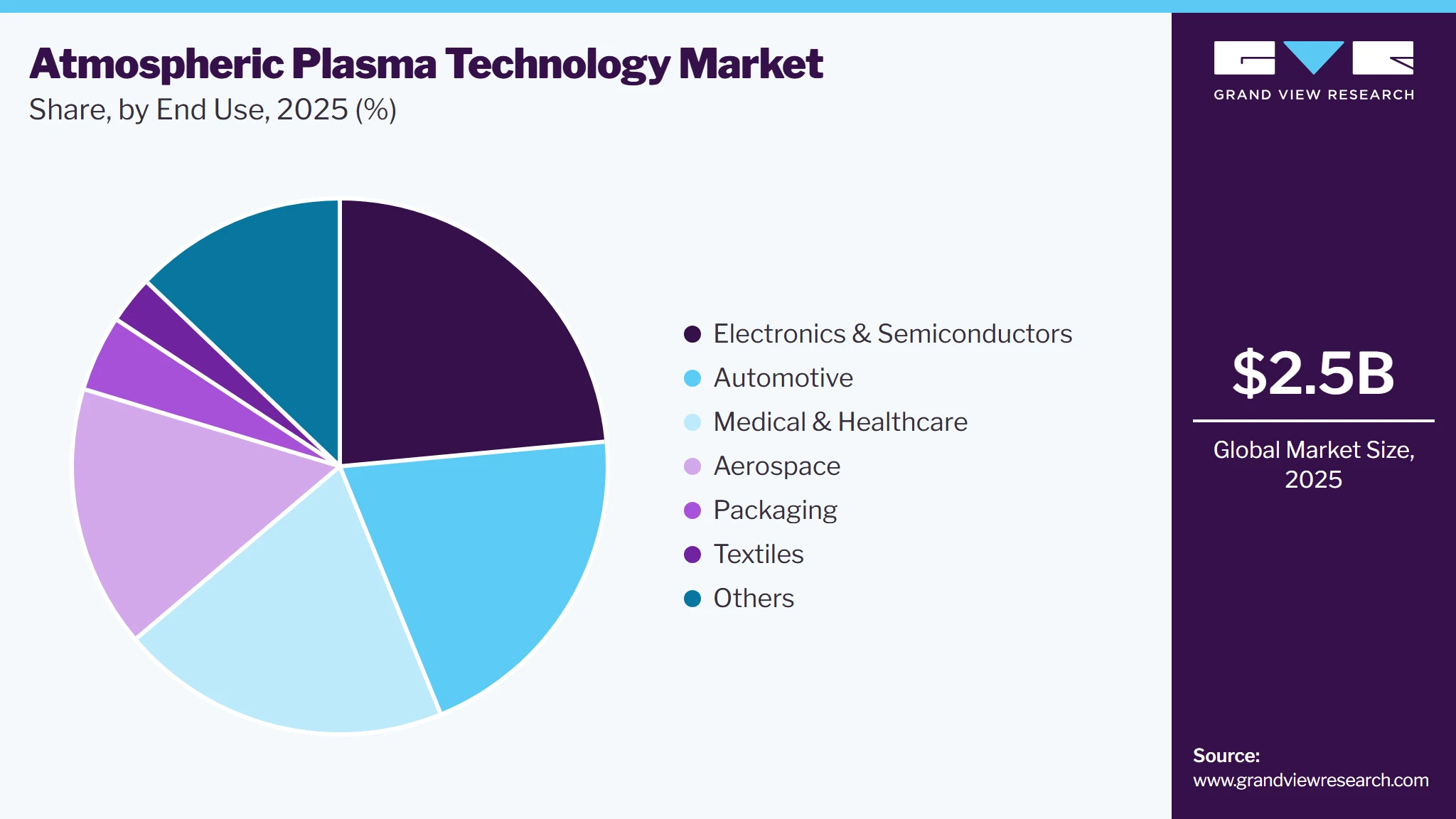
Based on end use, the electronics & semiconductors segment led the market with the largest revenue share of 23.5% in 2025. Atmospheric plasma is increasingly used in semiconductor manufacturing for surface cleaning, activation, and modification, improving adhesion and removing contaminants. As demand for miniaturized, high-performance electronic components rises, the need for precise, efficient plasma solutions in this sector is driving market expansion.
 To learn more about this report, Download Free Sample Report
The automotive segment is anticipated to grow at the fastest CAGR during the forecast period, due to its effectiveness in surface cleaning, activation, and coating. Plasma treatment enhances paint adhesion, improves corrosion resistance, and supports the use of lightweight materials in vehicle manufacturing. These benefits align with the automotive industry's focus on sustainability, performance, and cost efficiency, driving the adoption of atmospheric plasma technology technologies.
Regional Insights
The atmospheric plasma technology market in North America is driven by its robust industrial base and increasing demand for advanced surface treatment technologies. Sectors such as electronics, automotive, and healthcare are adopting atmospheric plasma technology solutions for applications like cleaning, coating, and sterilization, aligning with sustainability and performance goals.
U.S. Atmospheric Plasma Technology Market Trends
The atmospheric plasma technology market in the U.S. is projected to expand at a significant CAGR of 6.5% over the forecast period, owing to its strong manufacturing sector and technological advancements. This expansion is further supported by the CHIPS and Science Act, which promotes domestic semiconductor research and manufacturing. It fuels innovation in plasma-based processes critical for advanced chip production, strengthening U.S. technological leadership.
Asia Pacific Atmospheric Plasma Technology Market Trends
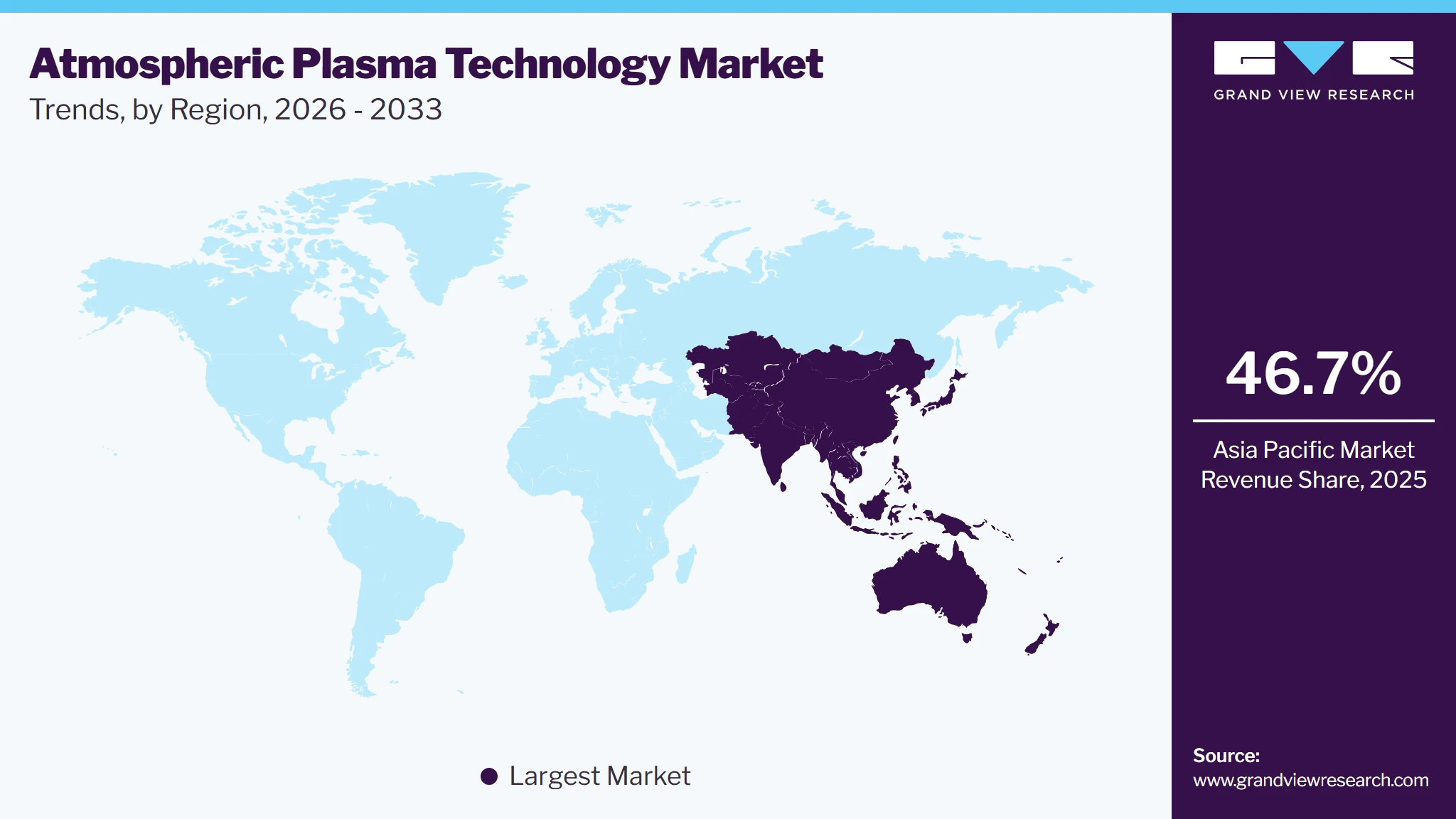
Asia Pacific dominated the atmospheric plasma technology market with the largest revenue share of 46.7% in 2025, driven by increasing industrialization, demand for advanced manufacturing processes, and the region's focus on sustainability. The automotive, electronics, and healthcare sectors are major contributors to this demand for plasma technology.
 To learn more about this report, Download Free Sample Report
The atmospheric plasma technology market in the China held the largest share in the Asia Pacific region in 2025. China’s rapid industrialization and focus on high-tech manufacturing are key drivers of atmospheric plasma technology growth. The government’s push for green, sustainable technologies encourages industries to adopt cleaner, more efficient plasma processes.
The India atmospheric plasma technology market is projected to grow at the fastest CAGR of 8.2% over the forecast period, as industries like automotive. Plasma treatments are being used to enhance surface properties of automotive components, improving adhesion and corrosion resistance. This technology supports the shift toward more durable, high-performance materials while reducing the use of harmful chemicals. The growing automotive manufacturing sector is driving the demand for plasma-based solutions to improve efficiency, sustainability, and product quality.
Europe Atmospheric Plasma Technology Market Trends
The atmospheric plasma technology market in Europe is propelled by strong demand for eco-friendly surface treatment technologies across industries like automotive, electronics, and healthcare. The region’s commitment to sustainability and innovation encourages the adoption of plasma systems as an alternative to conventional chemical-based processes. In addition, SMEs are focusing on niche applications like surface treatment, healthcare, and food safety, enabling faster adoption of advanced plasma technologies. Their agility and collaboration with research institutions fuel market growth and innovation.
The France atmospheric plasma technology market is expected to grow at a rapid CAGR of 6.2% over the forecast period, due to its advanced manufacturing landscape and strong presence in industries such as automotive and aerospace. The French government supports this growth through regulations that promote safety, innovation, and environmental sustainability, such as the REACH and Industrial Emissions Directives, fostering widespread adoption of plasma technologies.
In atmospheric plasma technology market in Italy is expected to grow at a rapid CAGR of 5.9% over the forecast period, as key industries like automotive, fashion, packaging, and electronics adopt plasma technologies for improved surface treatment. The country’s emphasis on quality manufacturing and sustainable practices is helping drive the adoption of atmospheric plasma technology solutions in both traditional and high-tech sectors.
Latin America Atmospheric Plasma Technology Market Trends
The atmospheric plasma technology market in Latin America is experiencing significant market growth, driven by increasing industrialization and the adoption of advanced manufacturing technologies. Countries like Brazil and Argentina are leading this expansion, with rising demand for surface treatment solutions in sectors such as electronics, automotive, and healthcare.
The Argentina atmospheric plasma technology market is projected to grow at a substantial CAGR of 4.4% over the forecast period, fueled by its expanding industrial base and emphasis on technological innovation. The country's growing industrialization is spurring demand for plasma-based surface treatment solutions, with applications ranging from semiconductor manufacturing to medical sterilization, positioning atmospheric plasma as a key innovation.
Middle East & Africa Atmospheric Plasma Technology Market Trends
The atmospheric plasma technology market in Middle East and Africa is driven by industrial advancements and the increasing demand for sustainable surface treatment technologies. Increasing demand for eco-friendly and efficient solutions, combined with investments in research and development, is fueling adoption across the region.
The Saudi Arabia atmospheric plasma technology market is projected to grow at a significant CAGR of 5.6% over the forecast period, supported by the country’s Vision 2030 initiative, which encourages technological innovation. Vision 2030 emphasizes the development of smart technologies, sustainability, and modernization of various sectors, fostering widespread adoption of advanced solutions.
Key Atmospheric Plasma Technology Company Insights
Some of the key players operating in the market include Plasmatreat and OC Oerlikon Management AG, among others.
-
Plasmatreat GmbH is a provider of plasma surface treatment solutions. The company pioneered the Openair-Atmospheric Plasma Technology, enabling efficient surface activation, cleaning, and coating without the need for vacuum chambers. Plasmatreat's innovative systems are utilized across various industries, including automotive, electronics, packaging, and life sciences.
-
OC Oerlikon Management AG is a global technology company specializing in surface solutions and advanced materials. Operating through brands like Oerlikon Balzers and Oerlikon Metco, the company provides high-performance coatings, materials, and services to industries such as aerospace, automotive, energy, and medical.
Key Atmospheric Plasma Technology Companies
The following key companies have been profiled for this study on the atmospheric plasma technology market.
-
OC Oerlikon Management AG
-
Plasmatreat
-
relyon plasma GmbH
-
Diener electronic GmbH & Co. KG
-
Enercon Asia Pacific
-
Bodycote
-
Henniker
-
P2i Ltd
-
Oxford Instruments
-
Atmospheric Plasma Technology Solutions
-
Sulzer Ltd
-
AcXys Technologies
-
Tri-Star Technologies
-
Plasma Etch, Inc.
-
Plasmawerk GmbH
Competitive Benchmarking
Category
Operating Strategies
Competitive Edge
Weakness
Established Players (e.g. OC Oerlikon Management AG; Plasmatreat; relyon plasma GmbH; Diener electronic GmbH & Co. KG; Bodycote; Oxford Instruments; Sulzer Ltd)
- Focus on expanding comprehensive atmospheric plasma technology portfolios covering surface cleaning, surface activation, surface coating, etching & patterning, and sterilization applications across electronics, automotive, medical, packaging, and aerospace industries.
- Invest in advanced plasma sources, process automation, digital monitoring, precision control systems, and energy-efficient plasma technologies to improve production quality and throughput.
- Strengthen partnerships with OEMs, electronics manufacturers, automotive suppliers, medical device companies, research institutions, and industrial automation providers to support large-scale manufacturing projects.
- Strong engineering expertise in plasma surface treatment, precision manufacturing, and advanced material processing technologies.
- Broad technology portfolios with high process accuracy, customization capabilities, and compliance with international industrial and quality standards.
- Well-established global manufacturing, technical support, distribution, and after-sales service networks with strong brand recognition and long-term customer relationships.
- High research, manufacturing, and equipment development costs associated with advanced plasma technologies.
- Dependence on capital investments in high-value manufacturing industries and industrial automation projects.
- Long qualification cycles and complex integration requirements may delay customer adoption and purchasing decisions.
Emerging & Regional Players (e.g Enercon Asia Pacific; Henniker; P2i Ltd; Atmospheric Plasma Technology Solutions; AcXys Technologies; Tri-Star Technologies; Plasma Etch, Inc.; Plasmawerk GmbH.)
- Focus on specialized and application-specific atmospheric plasma systems for electronics, medical devices, packaging, textiles, research laboratories, and industrial manufacturing.
- Expand market presence through customized equipment development, regional distribution partnerships, and technical support services tailored to local customer requirements.
- Emphasize cost-effective system designs, modular configurations, flexible integration, and responsive customer service for small and medium-sized manufacturers.
- Competitive pricing and greater flexibility in delivering customized plasma treatment solutions for niche industrial applications.
- Ability to address customer-specific processing requirements, regional manufacturing standards, and specialized production environments.
- Agile operations enable faster product customization, shorter development cycles, and rapid response to evolving manufacturing and surface engineering requirements.
- Limited financial resources for large-scale research, global expansion, and advanced technology development.
- Smaller manufacturing capacity, distribution channels, and service networks compared with global plasma technology leaders.
- Lower participation in large multinational manufacturing projects due to limited international presence and brand recognition.
Recent Developments
-
In December 2024, Ushio launched “Lamina 5,” an atmospheric pressure plasma irradiation unit featuring a compact design achieved through a unique electrode structure. This innovation enables installation in limited spaces and is ideal for processing large substrates. It also reduces power consumption and eliminates the need for water cooling, enhancing efficiency.
-
In July 2024, FUJI Corporation introduced the ATOM atmospheric pressure plasma unit, which operates using air instead of requiring a nitrogen generator. This innovation significantly lowers equipment costs, making plasma technology more accessible. Its versatility enables broader application across various industries, supporting cost-effective and efficient surface treatment processes.
Atmospheric Plasma Technology Market Report Scope
Report Attribute
Details
Market size in 2025
USD 2.5 billion
Estimated market size in 2026
USD 2.7 billion
Projected market size by 2033
USD 4.1 billion
Growth rate
CAGR of 6.5% from 2026 to 2033
Base year for estimation
2025
Historical data
2021 - 2024
Forecast period
2026 - 2033
Quantitative units
Revenue in USD billion and CAGR from 2026 to 2033
Report coverage
Revenue forecast, company ranking, competitive landscape, growth factors, and trends
Segments covered
Type, application, end use, region
Regional scope
North America; Europe; Asia Pacific; Latin America; Middle East & Africa
Country scope
U.S., Canada, Mexico, Germany, France, UK, Italy, Spain, China, India, Japan, South Korea, Australia, Brazil, Argentina, South Africa, Saudi Arabia, UAE
Key companies profiled
OC Oerlikon Management AG; Plasmatreat; relyon plasma GmbH; Diener electronic GmbH & Co. KG; Enercon Asia Pacific; Bodycote; Henniker; P2i Ltd; Oxford Instruments; Atmospheric Plasma Technology Solutions; Sulzer Ltd; AcXys Technologies; Tri-Star Technologies; Plasma Etch, Inc.; and Plasmawerk GmbH.
Customization scope
Free report customization (equivalent up to 8 analysts' working days) with purchase. Addition or alteration to country, regional & segment scope.
Pricing and purchase options
Avail customized purchase options to meet your exact research needs. Explore purchase options
Global Atmospheric Plasma Technology Market Report Segmentation
This report forecasts revenue growth at global, regional & country levels and provides an analysis on the industry trends in each of the sub-segments from 2021 to 2033. For this study, Grand View Research has segmented the global atmospheric plasma technology market report based on the application, type, end use, and region:
 To learn more about this report, Download Free Sample Report
-
Application Outlook (Revenue, USD Million, 2021 - 2033)
-
Surface Cleaning
-
Surface Activation
-
Surface Coating
-
Etching & Patterning
-
Sterilization
-
-
Type Outlook (Revenue, USD Million, 2021 - 2033)
-
Cold
-
Thermal
-
-
End Use Outlook (Revenue, USD Million, 2021 - 2033)
-
Electronics & Semiconductors
-
Automotive
-
Medical & Healthcare
-
Packaging
-
Textiles
-
Aerospace
-
Others
-
-
Regional Outlook (Revenue, USD Million, 2021 - 2033)
-
North America
-
U.S.
-
Canada
-
Mexico
-
-
Europe
-
Germany
-
UK
-
France
-
Italy
-
Spain
-
-
Asia Pacific
-
China
-
India
-
Japan
-
South Korea
-
Australia
-
-
Latin America
-
Brazil
-
Argentina
-
-
Middle East & Africa
-
Saudi Arabia
-
UAE
-
South Africa
-
-
Research Methodology
The atmospheric plasma technology market figures in this report are based on a proven research process that combines executive interviews with secondary research from proprietary databases, company filings, and recognized regulatory and institutional sources. Market size is built through value-chain sizing - reconciling supply-side and demand-side estimates - and triangulated with bottom-up and top-down approaches. Every estimate passes multiple levels of expert validation before publication, with each atmospheric plasma technology segment quantified using the revenue-capture definitions in the table below.
Segment Definition
Segment - Application
Revenue Capture Definition
Surface Cleaning
Revenue is derived from the sale of atmospheric plasma systems used for removing dust, oils, contaminants, and residues from surfaces before manufacturing and assembly processes.
Surface Activation
Revenue is generated from the sale of atmospheric plasma equipment used to improve surface energy, adhesion, wettability, bonding, printing, and coating performance across industries.
Surface Coating
Revenue is earned from the sale of plasma systems deployed for applying functional surface coatings that enhance corrosion resistance, wear resistance, and barrier performance.
Etching & Patterning
Revenue is captured from the sale of atmospheric plasma systems utilized for precision etching, micro-patterning, and surface structuring in electronics, semiconductor, and industrial manufacturing applications.
Sterilization
Revenue is gained from the sale of atmospheric plasma equipment used for sterilizing medical devices, healthcare products, laboratory instruments, and packaging materials without chemical disinfectants.
Segment - Type
Revenue Capture Definition
Cold
Revenue is derived from the sale of cold atmospheric plasma systems designed for temperature-sensitive materials used in electronics, healthcare, packaging, textiles, and surface treatment applications.
Thermal
Revenue is generated from the sale of thermal atmospheric plasma systems used for high-temperature cleaning, coating, material modification, and industrial surface engineering applications.
Segment - End Use
Revenue Capture Definition
Electronics & Semiconductors
Revenue is earned from the sale of atmospheric plasma systems supplied for cleaning, activation, coating, and etching of semiconductor devices, electronic components, and printed circuit boards.
Automotive
Revenue is captured from the sale of plasma equipment utilized for surface preparation, adhesive bonding, coating, sealing, and component cleaning during vehicle manufacturing and assembly.
Medical & Healthcare
Revenue is gained from the sale of atmospheric plasma systems used for sterilization, surface modification, and cleaning of medical devices, implants, and healthcare equipment.
Packaging
Revenue is generated from the sale of atmospheric plasma equipment deployed to improve surface adhesion for printing, labeling, laminating, coating, and sealing packaging materials.
Textiles
Revenue is derived from the sale of atmospheric plasma systems used for textile surface modification, functional finishing, dyeability enhancement, and water-repellent treatments.
Aerospace
Revenue is earned from the sale of atmospheric plasma equipment used for surface cleaning, bonding preparation, coating, and treatment of aerospace structures and composite components.
Others
Revenue is captured from the sale of atmospheric plasma systems supplied for research laboratories, renewable energy, consumer goods manufacturing, and other specialized industrial surface treatment applications.
Estimation Model
Layer Name
Key Question
Description
Manufacturing Activity and Industrial Demand Layer
Which sectors generate demand for atmospheric plasma technology?
The estimation begins by evaluating manufacturing activity across electronics, semiconductors, automotive, medical devices, packaging, textiles, aerospace, and other industrial sectors. Demand is supported by increasing automation, precision manufacturing, surface engineering requirements, stringent quality standards, sustainable production practices, and growing adoption of chemical-free surface treatment technologies.
Technology Type and Application Layer
Which technology types drive market demand?
This layer refines demand by assessing the adoption of cold and thermal atmospheric plasma technologies across surface cleaning, surface activation, surface coating, etching & patterning, and sterilization applications. Process efficiency, material compatibility, production speed, energy efficiency, automation trends, and technological advancements influence technology adoption across industries.
End-user Deployment Layer
What determines atmospheric plasma technology installations?
Market demand is estimated through the deployment of atmospheric plasma systems across electronics and semiconductor manufacturing facilities, automotive production plants, medical device manufacturers, packaging companies, textile processing facilities, aerospace manufacturers, and research institutions. Facility expansion, production line automation, quality improvement initiatives, equipment replacement, and increasing demand for advanced surface treatment solutions further support technology installations.
Revenue Layer
How is total market revenue calculated?
Revenue is estimated by aggregating sales of atmospheric plasma technology across technology types, applications, end-use industries, and regional markets. Manufacturing output, industrial investments, equipment pricing, automation adoption, replacement demand, regulatory compliance requirements, and manufacturer revenues are incorporated to validate the total market size.
Delivered Customizations
This report has been delivered with the following In-depth customizations
Client Request
Customization Delivered
Value Adds
Regional Segmentation
Detailed regional analysis covered North America, Europe, Asia Pacific, Latin America, and the Middle East & Africa, with country-level assessment of key markets. The study evaluated manufacturing output, electronics and semiconductor production, automotive manufacturing, medical device manufacturing, packaging industry growth, aerospace production, industrial automation trends, and investments in advanced manufacturing technologies influencing atmospheric plasma technology demand.
Helped identify high-growth regions, country-specific opportunities, and evolving manufacturing trends, supporting market entry strategies, regional expansion planning, and identification of emerging advanced manufacturing and industrial automation hubs.
Competitive Benchmarking
Comprehensive benchmarking assessed major participants based on product portfolio, plasma treatment technologies, surface processing capabilities, automation features, process precision, manufacturing strength, regional presence, pricing strategies, aftermarket services, technical support, and distribution networks. The study also compared established and emerging players operating in the atmospheric plasma technology market.
Assisted clients in evaluating competitor positioning, technological capabilities, and market gaps while supporting strategic planning, partnership opportunities, product differentiation, and investment decisions across electronics, automotive, medical devices, packaging, aerospace, and industrial manufacturing applications.
Opportunity Assessment
In-depth opportunity assessment analyzed Industry 4.0 adoption, smart manufacturing initiatives, semiconductor capacity expansion, medical device innovation, sustainable surface treatment technologies, industrial automation investments, and precision manufacturing requirements. The study identified emerging opportunities in AI-enabled plasma systems, automated inline surface treatment, energy-efficient plasma technologies, and advanced material processing solutions designed to improve product quality, manufacturing efficiency, and operational performance.
Enabled clients to identify high-growth investment areas, prioritize regional expansion, and evaluate future revenue opportunities while supporting product development, technology adoption, and long-term growth strategies in the atmospheric plasma technology market.
Frequently Asked Questions About This Report
The global atmospheric plasma technology market size was estimated at USD 2.5 billion in 2025 and is projected to grow from USD 2.7 billion in 2026.
The global atmospheric plasma technology market, in terms of revenue, is expected to grow at a compound annual growth rate of 6.5% from 2026 to 2033 to reach USD 4.1 billion by 2033.
Some of the key players operating in the market are OC Oerlikon Management AG, Plasmatreat, relyon plasma GmbH, Diener electronic GmbH & Co. KG, Enercon Asia Pacific, Bodycote, Henniker, P2i Ltd, Oxford Instruments, Atmospheric Plasma Technology Solutions, Sulzer Ltd, AcXys Technologies, Tri-Star Technologies, Plasma Etch, Inc., and Plasmawerk GmbH.
Key factors driving the atmospheric plasma technology market include rising demand for eco-friendly and efficient surface treatment solutions, advancements in electronics and miniaturized devices, and increased applications in industries like automotive, healthcare, and packaging.
Based on type, the cold segment led the market with the largest revenue share of 72.8% in 2025.
The surface coating segment led the market with the largest revenue share of 40.4% in 2025.
Based on end use, the electronics & semiconductors segment dominated the market with the largest revenue share of 23.5% in 2025.
Asia Pacific dominated the atmospheric plasma technology market with the largest revenue share of 46.7% in 2025.
About the Author(s)
Advanced Interior Materials Research Team
Advanced Materials · Advanced Interior MaterialsThis report was authored by the advanced interior materials research team at Grand View Research - comprising two research analysts, one senior research analyst, and one industry expert - with specialized expertise in the advanced interior materials segment of the advanced materials industry. All findings are based on proprietary advanced materials databases, executive interviews, and regulatory analysis, subject to internal peer review prior to publication.
Last Updated:
Speak to Analyst

Customize this report to your needs - add regions, segments, or data points, with 20% free customization.
Or view our licence options:


ISO 9001:2015 & 27001:2022 Certified
We are GDPR and CCPA compliant! Your transaction & personal information is safe and secure. For more details, please read our privacy policy.


