
- Home
- »
- Next Generation Technologies
- »
-
Audiobooks Market Size, Share & Growth Report, 2026-2033GVR Report cover

Audiobooks Market (2026 - 2033)
Size, Share & Trends Analysis Report By Genre (Fiction, Non-fiction), By Preferred Device (Smartphones, Personal Digital Assistants & Voice-enabled Speakers ), By Distribution Channel, By Target Audience, By Region, And Segment Forecasts
Market Size, 2025
$11.0BMarket Estimate, 2026
$13.9BMarket Forecast, 2033
$58.5BCAGR, 2026–2033
22.7%Audiobooks Market Summary
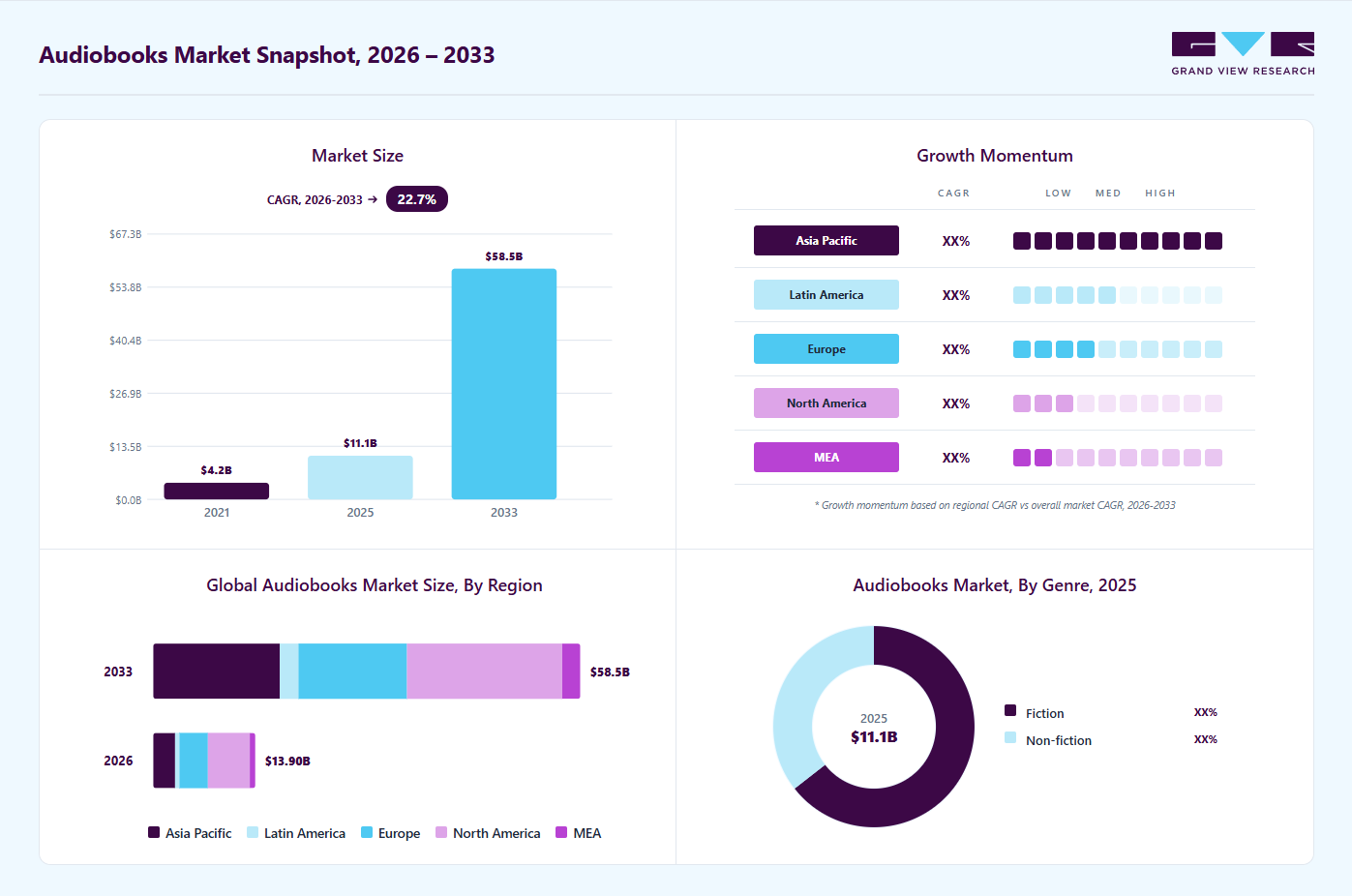
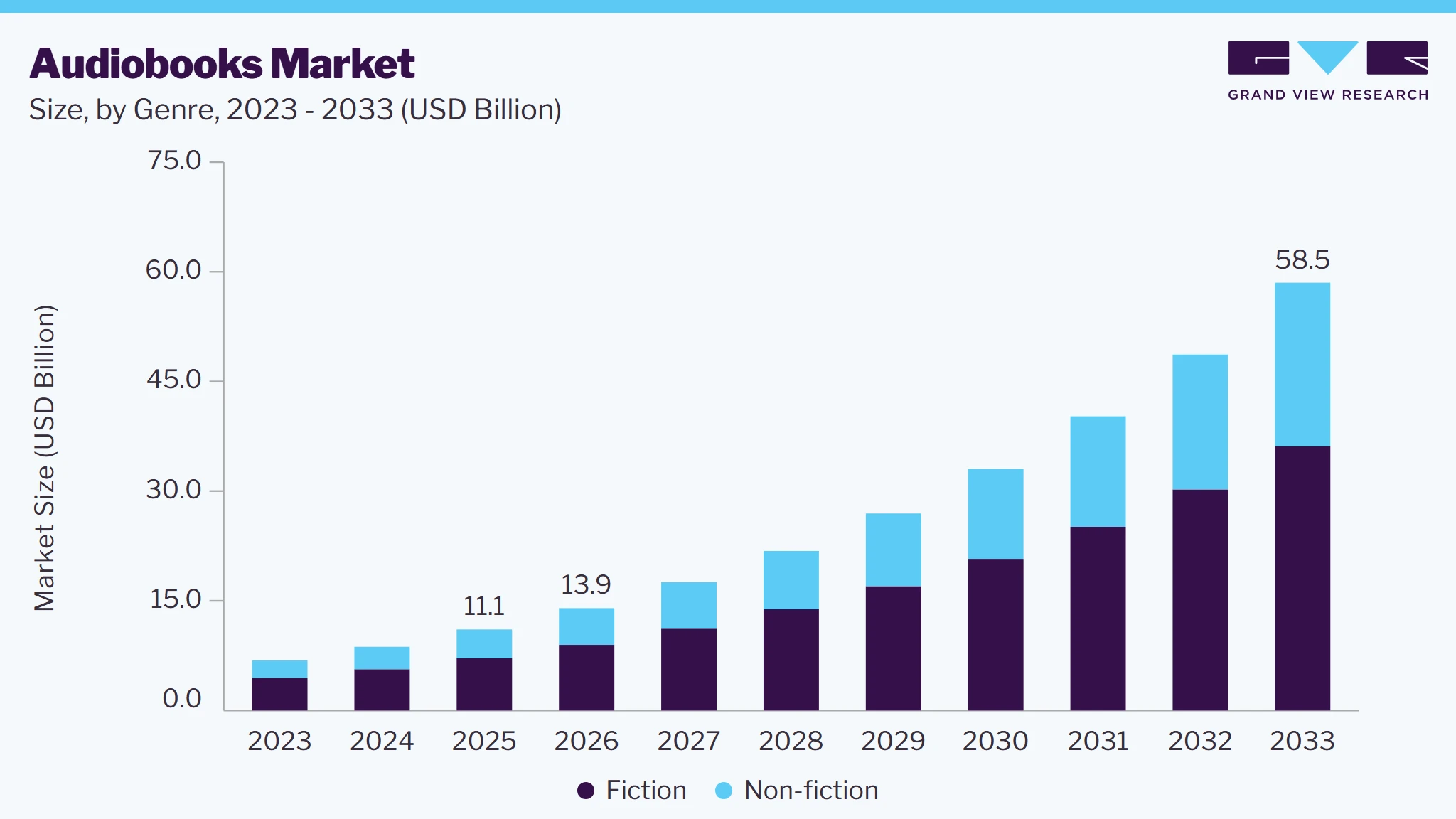
The global audiobooks market size was valued at USD 11.0 billion in 2025 and is projected to grow from USD 13.9 billion in 2026 to USD 58.5 billion by 2033, at a CAGR of 22.7% from 2026 to 2033. North America dominated the global market with a revenue share of 39.6% in 2025. The growing adoption of smartphones, tablets, and voice assistants has significantly contributed to the popularity of audiobooks, enabling on-demand access from anywhere, at any time.
 Source: Grand View Research, IR Documents, Primary Interviews, Paid DatabasesTo learn more about this report,
 Download Free Sample Report
 Key Market Trends & Insights
- By genre: Fiction held the largest market share of 64.5% in 2025.
- By preferred device: Smartphone held the largest revenue share of 44.7% in 2025.
- By distribution channel: One-time download held the largest share of 53.9% in 2025.
- By target audience: Adults held the largest revenue share of 79.0% in 2025.
Regional Highlights
- Largest regional market: North America (39.6% revenue share, 2025)
- Fastest-growing regional market: Asia Pacific (highest CAGR, 2026-2033)
- By country: The U.S. held the largest share of North America in 2025.
Market Size & Forecast
- Market size in 2025: USD 11.0 Billion
- Estimated market size in 2026: USD 13.9 Billion
- Projected market size by 2033: USD 58.5 Billion
- CAGR (2026-2033): 22.7%
Three ways to get this report
Buy it, customize it, or ask a question.Ask an Analyst
Analyst response in 1 business day
- AccessReport author, directly
- Reply timeWithin 1 working day
- No sales callDirect answer only
- FormatEmail reply
- CostFree, no cost
Get the Full Report
What the study covers
- FormatsPDF · Excel · Dashboard
- Timeline2026–2033 annual, 2025 base
- Coverage20+ countries, 5 regions
- Companies10+ key players profiled
Customize the Report
20% free customization
- IncludeCountries, segments, points
- TailorTo your product definition
- ExtendDeeper competitor detail
- OrA fully bespoke study
- Turnaround5–10 working days
Additionally, the growing popularity of the freemium model for audiobook platforms is also supporting market growth. Advancements in digital technology have significantly improved access to audiobooks through online platforms and mobile devices, supporting the continued expansion of the market. Increasing internet penetration has further broadened the consumer base by enabling users to access audiobook content across a wider range of devices and locations. These developments are expected to create additional opportunities for market growth over the coming years.
 To learn more about this report, Download Free Sample Report
 Ongoing digital transformation is also driving innovation across the audiobook value chain, influencing how content is produced, distributed, and consumed. Technologies such as the Internet of Things (IoT) and Artificial Intelligence (AI) are improving content accessibility and enabling more personalized listening experiences. AI-powered systems can analyze user preferences, listening behavior, and consumption patterns to provide tailored content recommendations, helping platforms improve user engagement and retention.
Key market participants are increasingly adopting technology-driven strategies to enhance customer engagement and deliver personalized experiences. By analyzing listening histories and user preferences through AI-based algorithms, audiobook platforms can recommend content that aligns with individual interests. For instance, in September 2024, Audible, Inc. began testing AI-powered features designed to improve audiobook discovery, including AI-generated tags based on customer feedback to support more personalized recommendations.
The growing popularity of audiobooks among younger audiences is another factor supporting market expansion. Younger consumers are increasingly incorporating audio content into their daily routines and are attracted to the convenience and immersive nature of narrated books. Professional narrators and celebrity voices can further enhance storytelling and engagement, making audiobooks an increasingly appealing alternative to traditional print formats.
In addition, the growing emphasis on diverse and inclusive content is contributing to the expansion of audiobook catalogs. Publishers and content providers are increasingly featuring a broader range of authors, cultures, languages, and perspectives to address growing demand for greater representation in media. This trend is expanding the availability of content that reflects varied backgrounds and experiences, including stories from historically underrepresented communities. The continued diversification of audiobook catalogs is expected to broaden the listener base and support audiobooks industry’s growth in the coming years.
Market Dynamics
The audiobooks market is being driven by the growing preference for convenient, on-the-go content consumption. Consumers are increasingly adopting audiobooks as a flexible way to access books while commuting, exercising, performing household activities, or multitasking. The widespread adoption of smartphones, wireless earphones, and connected devices has further improved the accessibility and convenience of audiobook listening. In addition, the expansion of subscription-based streaming platforms is increasing the availability and diversity of audiobook content while facilitating content discovery. These developments are attracting a broader consumer base across age groups and supporting the continued market growth.
The rapid growth in smartphone adoption worldwide has significantly increased access to audiobook content, enabling consumers to listen anytime and from virtually anywhere. Modern smartphones seamlessly incorporate audiobook applications, allowing users to efficiently discover, download, and stream content. Improvements in mobile internet connectivity are further enhancing accessibility, enabling consumers to access extensive audiobook libraries without relying on physical media or dedicated audio devices.
The increasing adoption of wireless earbuds, headphones, smart speakers, and connected in-car infotainment systems is further expanding audiobook consumption. These devices enable hands-free listening during commuting, exercising, household activities, and travel, aligning with increasingly mobile and multitasking lifestyles. The combination of widespread smartphone penetration and the expanding ecosystem of connected audio devices is increasing listening frequency, enhancing user engagement, and supporting sustained growth of the audiobooks market.
Producing high-quality audiobooks requires substantial investment in professional narrators, recording studios, audio engineering, editing, and post-production. Production costs can be significantly higher than for digital e-books, particularly for long-form content or content requiring multiple voice actors. Maintaining consistent audio quality, accurate pronunciation, and engaging narration further increases operational expenses. These financial requirements can pose challenges for independent authors and small publishers operating with limited budgets.
As a result, content creators may be selective in converting titles into audiobook formats, limiting the diversity and availability of content. The need to recover production investments may also contribute to higher audiobook prices or subscription fees, potentially discouraging some consumers from purchasing premium titles. Furthermore, producing content in multiple languages increases production complexity and costs, which restricts the expansion of audiobook offerings across regional and multilingual markets.
The increasing adoption of AI-powered narration technologies is creating significant opportunities for audiobook publishers to expand their content catalogs while reducing production costs and turnaround times. AI-generated voices enable publishers to convert a broader range of titles, including backlist books and niche publications, into audiobook formats more efficiently. As voice synthesis technologies continue to advance, acceptance of AI-generated narration is increasing, particularly for educational, informational, and general entertainment content. These developments are enabling publishers to scale production more efficiently, expand content availability across genres, and address a broader range of consumer preferences.
Additionally, multilingual AI narration is creating new opportunities for audiobook providers to access diverse linguistic markets. Publishers can localize content into multiple languages in less time and with lower production requirements than traditional voice-recording processes. This capability is particularly valuable in linguistically diverse regions, where demand for native-language content is increasing. The expansion of multilingual audiobook catalogs can improve content accessibility, broaden audience reach, and support market growth across international markets.
Market Concentration & Characteristics
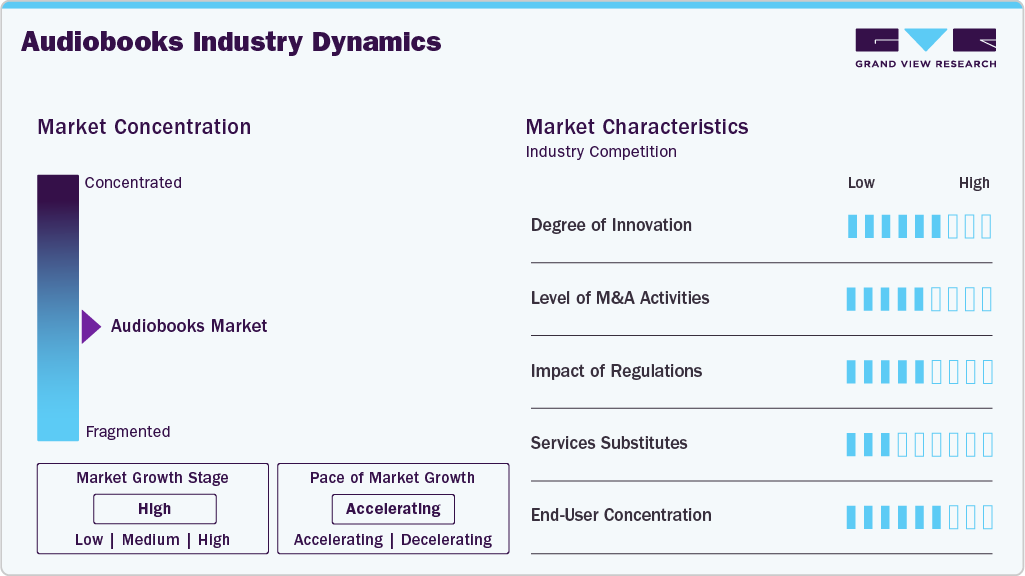
The audiobooks market is characterized by a high level of innovation, supported by advancements in AI-powered narration, voice synthesis, personalized content recommendations, and immersive audio technologies. Market players are increasingly leveraging AI to streamline audiobook production and reduce costs and development timelines while maintaining high-quality listening experiences. Innovations in multilingual narration, interactive audio formats, and integration with smart speakers and connected devices are further enhancing accessibility and user engagement. In addition, data-driven personalization enables platforms to analyze listener preferences and recommend relevant content, supporting customer retention and increasing listening time across diverse user segments.
 To learn more about this report, Download Free Sample Report
 The audiobooks industry faces competition from various alternative forms of digital entertainment and learning content, including podcasts, e-books, music streaming services, video streaming platforms, and short-format content applications. Consumers have limited leisure time and may allocate it across multiple content formats, creating substitution pressure for audiobook providers. However, audiobooks offer a distinct blend of storytelling, education, and convenience through hands-free listening, allowing users to consume content while commuting, exercising, or engaging in other activities. This differentiated consumption experience helps maintain demand despite competition from alternative digital media formats.
Analyst Perspective
The audiobooks market’s growth is being driven by rising demand for on-the-go content, growing adoption of subscriptions, and integration with broader multi-format content ecosystems. As audiobooks compete with video, music, and podcasts for consumer attention, platforms are expanding beyond traditional book audiences into entertainment, education, and professional learning. Competitive differentiation increasingly depends on extensive content libraries, personalized discovery, multilingual offerings, and seamless cross-device experiences. These capabilities can strengthen engagement, increase listening frequency, and convert occasional users into long-term subscribers. As subscription-based consumption expands, platforms can enhance customer retention, lifetime value, and recurring revenue beyond individual title purchases.
Genre Insights
The fiction segment accounted for the largest revenue share of 64.5% in 2025. Growth is primarily driven by increasing consumer demand for immersive storytelling and convenient entertainment formats. Audiobooks offer listeners a flexible way to access popular fiction genres, including fantasy, romance, and thriller, while professional narrators and celebrity voices can further enhance the listening experience. In addition, the expansion of subscription-based audiobook platforms has increased access to diverse fiction catalogs, supporting continued demand for the segment.
The non-fiction segment is projected to grow at the fastest CAGR of 23.8% from 2026 to 2033, supported by rising demand for educational, professional, and self-improvement content. Consumers with busy lifestyles are increasingly using audiobooks to access information on topics such as business, personal development, health, and history in a convenient format. The ability to listen during commutes, workouts, and other daily activities further supports adoption. Moreover, the growing availability of professional and business-focused audiobooks is attracting consumers seeking continuous learning, knowledge enhancement, and skill development, contributing to segment growth.
Preferred Device Insights
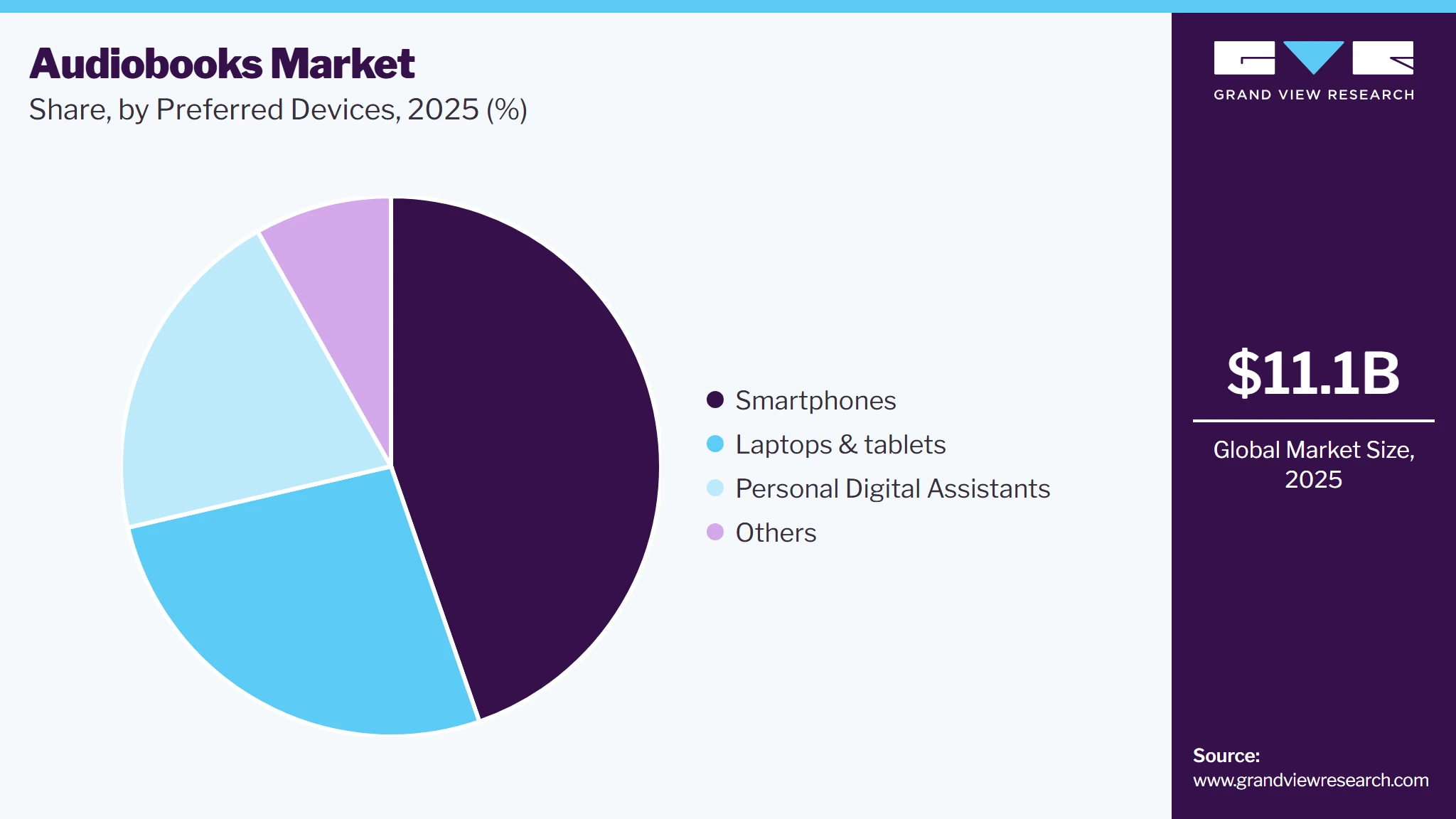
The smartphones segment accounted for the largest revenue share of 44.7% in 2025, supported by widespread smartphone adoption and the increasing use of mobile devices for entertainment and educational content. Easy access to audiobook platforms such as Audible, Inc., Google Play Books, and Apple Books enables consumers to stream and download content conveniently while on the move. In addition, advancements in smartphone capabilities, including longer battery life, improved audio quality, and enhanced display performance, are supporting audiobook consumption. The growing prevalence of multitasking and on-the-go content consumption during activities such as commuting and exercising is further contributing to segment growth.
 To learn more about this report, Download Free Sample Report
 The personal digital assistants and voice-enabled speakers segment is projected to grow at the fastest CAGR of 25.8% from 2026 to 2033. The increasing adoption of voice-enabled technologies, including Amazon Alexa, Google Assistant, and Apple Siri, is enabling users to access audiobook content through voice commands. The growing penetration of smart speakers in households, combined with rising demand for hands-free and on-demand entertainment, is supporting segment expansion. Integration of audiobook services with voice assistants allows users to listen to content without directly interacting with a screen, enhancing convenience and accessibility and further driving adoption.
Distribution Channel Insights
The one-time download segment dominated the audiobooks industry, accounting for a revenue share of 53.9% in 2025, driven by consumer preference for purchasing and retaining individual audiobook titles rather than subscribing to ongoing services. This model is particularly appealing to occasional listeners and consumers seeking specific titles, as it provides access to content without recurring subscription fees. The ability to permanently download and own audiobooks, along with the convenience offered by platforms such as Audible and Google Play, further supports the segment’s leading position among consumers who prefer a straightforward purchase model.
The subscription-based segment is expected to grow at the fastest CAGR of 23.9% from 2026 to 2033, supported by the growing adoption of Streaming Books-On-Demand (SBOD) models. Subscription services provide consumers with access to diverse audiobook catalogs through bundled or recurring plans, enhancing content accessibility and encouraging regular consumption. In addition, leading market participants are increasingly offering unlimited subscription packages to strengthen their competitive positioning and attract and retain subscribers, further supporting segment growth.
Target Audience Insights
The adults segment dominated the audiobooks market, accounting for the largest revenue share of 79.0% in 2025, supported by the wide variety of genres and titles tailored to adult listeners. The segment has expanded significantly in recent years as audiobook platforms have broadened their content offerings to address diverse interests, preferences, and listening habits. In addition, the increasing introduction of region-specific and community-focused audiobooks by market participants is helping companies attract targeted consumer groups, strengthen audience engagement, and enhance their competitive positioning, thereby supporting segment growth.
The kids segment is projected to grow at the fastest CAGR of 25.3% from 2026 to 2033, driven primarily by the increasing use of audiobooks for educational and learning purposes. Publishers and content providers are also expanding children's audiobook offerings for entertainment, creating a broader range of age-appropriate content. Audiobooks can support children's vocabulary development, imagination, listening skills, and understanding of narrative structures, thereby contributing to improved reading comprehension. Growing awareness of these educational and developmental benefits is expected to create significant growth opportunities for the segment over the forecast period.
Regional Insights
North America accounted for the largest share of the global audiobooks market, representing 39.6% of total revenue in 2025. Market growth is supported by high adoption of digital content, widespread internet connectivity, and increasing use of smartphones and smart speakers. Consumers across the region are increasingly turning to audiobooks for convenient, on-the-go entertainment and learning, particularly as multitasking and flexible content consumption become more prevalent. The expansion of subscription-based platforms, including Audible, Inc., has further improved access to audiobook content across a broad range of genres, such as self-help, business, and fiction. These factors, combined with growing consumer preference for convenient and flexible media formats, are supporting the continued expansion of the North American market.
 To learn more about this report, Download Free Sample Report
 The U.S. audiobooks market accounted for the largest share of North America in 2025, supported by widespread adoption of smartphones, tablets, and digital content platforms such as Audible, Inc. The increasing demand for on-demand and portable content is driving audiobook consumption, with strong interest in entertainment, fiction, and self-help categories. In addition, growing consumer engagement with podcasts and audio-based learning is contributing to the broader adoption of spoken-word content and supporting the growth of the U.S. market.
Europe Audiobooks Market Trends
The Europe audiobooks industry is projected to grow at a CAGR of 21.1% from 2025 to 2033, driven by the growing popularity of digital media and the increasing shift toward audio-based content consumption. Widespread adoption of smartphones, tablets, and e-readers is improving access to audiobooks and supporting their integration into consumers’ daily routines. Europe’s strong literary and storytelling culture further contributes to sustained demand for audio content. The availability of audiobooks in multiple local languages is helping publishers and platforms address the region’s diverse linguistic landscape, while the expansion of subscription-based services is improving accessibility and encouraging recurring consumption. In addition, increasing interest in education and personal development is driving demand across educational, self-help, and children’s content categories.
The UK audiobooks market is expected to witness significant growth over the forecast period, supported by the country’s well-established literary culture and rising consumer preference for audio-based content. Strong demand for fiction, crime, and historical fiction is contributing to market expansion. Furthermore, the growing use of audiobooks for educational purposes is driving additional demand, particularly among students and lifelong learners, thereby supporting the continued development of the UK market.
Asia Pacific Audiobooks Market Trends
The Asia Pacific audiobooks industry is projected to grow at the fastest CAGR of 28.5% from 2026 to 2033, driven by rising smartphone penetration, expanding internet access, and increasing consumer acceptance of digital entertainment formats. The region’s large young population and growing middle class are contributing to increased demand for educational and learning-oriented audiobooks, particularly in countries such as China, Japan, and India. The integration of audiobooks with e-learning platforms and the growing demand for regional and vernacular-language content are further supporting market expansion.
The China audiobooks market is experiencing rapid growth, supported by widespread smartphone adoption and the increasing availability of platforms offering Chinese-language audio content. The growing adoption of digital learning and audio-based entertainment, particularly among younger consumers, is contributing to market growth. In addition, rising demand for audiobooks in local dialects and regional languages is broadening the reach of digital audio content and creating new growth opportunities in the country.
Key Audiobooks Company Insights
Some key players operating in the market include Amazon.com, Inc. and Spotify AB.
-
Amazon.com, Inc. (Amazon Music) is a streaming service offering a vast library of music, podcasts, and other audio content. It provides users with access to millions of songs across various genres, available through different subscription tiers, including Amazon Music Unlimited and Amazon Prime Music. Amazon Music is integrated into Amazon's broader ecosystem, allowing users to enjoy seamless playback across devices, including Echo smart speakers. Beyond music, Amazon Music is expanding its offerings to include podcasts and audiobooks, strengthening its position in the audio entertainment market.
-
Spotify AB offers a selection of audiobooks and spoken word content, positioning itself as a competitor to traditional audiobook platforms. Spotify’s audiobook offering is integrated with its music streaming service, providing users seamless access to music and audio content. As part of its strategy to diversify its offerings, Spotify continues to invest in expanding its audiobook library to capture a broader audience through free and premium subscription models.
Downpour.com & Storytel are some of the emerging market participants.
-
Downpour.com offers a wide range of digital audiobooks for purchase or rental. The platform provides audiobooks across various genres, from bestsellers to niche titles, and operates on both a pay-per-title and subscription-based model. Downpour is known for offering competitive pricing and a straightforward, user-friendly interface, catering to audiophiles looking for an alternative to larger audiobook services.
-
Storytel AB is an audiobook and e-book streaming service that operates in multiple countries, including Sweden, India, and other European markets. The company offers a subscription-based service that provides unlimited access to a vast library of audiobooks and e-books across various genres. Storytel’s extensive catalog includes both international bestsellers and localized content in several languages.
Key Audiobooks Companies
The following key companies have been profiled for this study on the audiobooks market.
-
PLAYSTER (SOFTONIC INTERNATIONAL S.A.)
-
VoiceVerse
Recent Developments
-
In February 2026, Spotify introduced the Page Match feature, allowing users a seamless transition from physical books to audiobooks. Users can scan the page they are reading to continue the same title in audio format, creating a more integrated reading-and-listening experience.
-
In March 2025, Amazon.com, Inc. announced the integration of Audible's extensive audiobook catalog into its Unlimited subscription service, expanding access to audiobooks for subscribers in the U.S., UK, Canada, France, Australia, and New Zealand.
-
In October 2024, Spotify AB expanded its Audiobook service to France, Belgium, the Netherlands, and Luxembourg, offering over 200,000 titles to Premium subscribers. The service includes 12 hours of free audiobook listening per month, with additional listening time available for purchase.
-
In January 2024, RBmedia expanded its audiobook catalog by acquiring Berrett-Koehler's audiobook publishing company. This acquisition included a diverse range of titles, strengthening RBmedia's position in the educational and professional audiobook segments.
Audiobooks Market Report Scope
Report Attribute
Details
Market size in 2025
USD 11.0 billion
Estimated market size in 2026
USD 13.9 billion
Projected market size by 2033
USD 58.5 billion
Growth rate
CAGR of 22.7% from 2026 to 2033
Base year for estimation
2025
Historical data
2021 - 2024
Forecast period
2026 - 2033
Quantitative units
Revenue in USD billion and CAGR from 2026 to 2033
Report coverage
Revenue forecast, company market position analysis, competitive landscape, growth factors, and trends
Segments covered
Genre, preferred device, distribution channel, target audience, region
Regional scope
North America; Europe; Asia Pacific; Latin America; Middle East & Africa
Country scope
U.S.; Canada; Mexico; Germany; UK; France; Italy; Spain; Russia; Nordic; China; Japan; India; South Korea; Australia; Brazil; Argentina; Chile; Saudi Arabia; South Africa; UAE
Key companies profiled
Amazon.com, Inc.; Apple Inc.; Audible, Inc.; Barnes & Noble Booksellers, Inc.; Downpour; Google LLC; PLAYSTER (SOFTONIC INTERNATIONAL S.A.); Rakuten Group, Inc.; VoiceVerse; Storytel AB; Spotify AB.
Customization scope
Free report customization (equivalent to up to 8 analysts working days) with purchase. Addition or alteration to country, regional & segment scope.
Pricing and purchase options
Avail of customized purchase options to meet your exact research needs. Explore purchase options
Global Audiobooks Market Report Segmentation
This report forecasts revenue growth at the global, regional & country levels and provides an analysis of the latest industry trends in each of the sub-segments from 2021 to 2033. For this study, Grand View Research has segmented the global audiobooks market report based on genre, preferred device, distribution channel, target audience, and region:
-
Genre Outlook (Revenue, USD Billion, 2021 - 2033)
-
Fiction
-
Non-Fiction
-
-
Preferred Device Outlook (Revenue, USD Billion, 2021 - 2033)
-
Smartphones
-
Laptops & Tablets
-
Personal Digital Assistants & Voice-Enabled Speakers
-
Others
-
-
Distribution Channel Outlook (Revenue, USD Billion, 2021 - 2033)
-
One-time download
-
Subscription-Based
-
-
Target Audience Outlook (Revenue, USD Billion, 2021 - 2033)
-
Kids
-
Adults
-
-
Regional Outlook (Revenue, USD Billion, 2021 - 2033)
-
North America
-
U.S.
-
Canada
-
-
Europe
-
UK
-
Germany
-
France
-
Italy
-
Spain
-
Russia
-
Nordic Countries
-
-
Asia Pacific
-
China
-
Australia
-
Japan
-
India
-
South Korea
-
-
Latin America
-
Brazil
-
Mexico
-
Argentina
-
Chile
-
-
Middle East & Africa
-
South Africa
-
Saudi Arabia
-
UAE
-
Egypt
-
Turkey
-
-
Scope & Research Methodology
The market study on the audiobooks market has been developed using a structured, multi-stage research framework designed to ensure accuracy, consistency, and reliability of the market size estimates and forecasts.
The audiobooks market is segmented into four levels, namely, genre, preferred device, distribution channel, target audience, and region. In the first level, the market has been split by genre, as follows:
• Fiction: As the largest genre segment, revenue for the fiction segment is generated through audiobooks based on novels, mystery, romance, and other narrative-driven literary works. This segment captures spending from consumers seeking entertainment-focused audio content through subscription services, individual title purchases, and digital audiobook libraries.
• Non-fiction: Revenue for the non-fiction segment is derived from audiobooks covering biographies, self-improvement, business, finance, and other factual content categories. The segment includes revenue generated from professional learning, personal development, and informational listening across subscription platforms, direct purchases, and institutional distribution channels.
Based on preferred device, the market has been segmented into smartphones, laptops & tablets, personal digital assistants & voice-enabled speakers, and others:
• Smartphones: Smartphones account for the largest revenue share in the audiobooks market due to their widespread adoption, constant internet connectivity, and integration with audiobook streaming applications. The convenience of mobile listening during daily activities supports high user engagement and subscription revenues.
• Laptops & tablets: Laptops and tablets contribute a notable share of audiobook revenues, particularly among users who consume long-form content in home or workplace environments. Larger screens, extended battery life, and seamless access to digital content ecosystems support audiobook purchases and subscription usage on these devices.
• Personal Digital Assistants & Voice-Enabled Speakers: Personal digital assistants and voice-enabled speakers represent a growing revenue segment as consumers increasingly access audiobooks through smart home ecosystems. Voice-controlled playback, hands-free listening, enhance content accessibility, and encourage longer listening sessions.
• Others: The others segment includes devices such as smartwatches, in-car infotainment systems, smart TVs, and dedicated audio players used for audiobook consumption. Revenue generation is supported by the expanding availability of connected devices and the increasing integration of audiobook services across multiple digital platforms.
Based on distribution channel, the market has been segmented into one-time download and subscription-based:
• One-time download: Revenue from the one-time download segment is generated through the purchase of individual audiobook titles, where users pay a fixed price to gain permanent access to specific content. This model is commonly preferred by consumers seeking ownership of premium, educational, or niche audiobooks without committing to recurring subscription fees.
• Subscription-based: Revenue is derived from recurring monthly or annual payments that provide users with access to a broad audiobook library or a predefined number of audiobook credits. The model supports predictable revenue for platform providers while encouraging higher content consumption through unlimited or flexible access options.
Based on target audience, the market has been segmented into below kids and adults:
• Kids: The kids’ mode segment captures revenue through age-appropriate educational content, interactive learning titles, and family-oriented subscription plans. Demand is supported by increasing parental preference for screen-free entertainment and audio-based learning solutions that combine education with engagement.
• Adults: The adult segment accounts for the largest share of audiobook revenue, driven by demand for fiction, non-fiction, self-development, business, and educational content. Revenue generated by subscription-based listening models, growing audiobook consumption, and expanding access through smartphones and connected audio devices.
Based on region, the market has been segmented into North America, Europe, Asia Pacific, Latin America, and Middle East & Africa:
• North America: The North America regional market includes the markets of the U.S. and Canada.
• Europe: The Europe regional market includes the markets of the UK, Germany, France, Italy, Spain, Russia, and the Nordic countries.
• Asia Pacific: The Asia Pacific regional market includes the markets of China, India, Japan, Australia, and South Korea.
• Latin America: The Latin America market includes the markets of Brazil, Mexico, Argentina, and Chile.
• Middle East & Africa: The MEA regional market includes the markets of the UAE, Saudi Arabia, South Africa, Egypt, and Turkey.
Estimation Model
Layer Name
Key Question
Description
Audience Layer
Audience Layer
Identify digital consumers across connected devices. Assess the population engaged in reading, learning, and development activities that form the potential audiobook audience.
Adoption Layer
Who uses audiobook services?
Apply audiobook penetration rates across digital content consumers. Evaluate adoption for subscription-based services, library-based audiobook access, and individual audiobook purchases.
Consumption Layer
How much content is consumed?
Measure audiobook listening frequency, average listening hours, subscription utilization, and purchase behavior among active users - quantifies content consumption levels and platform engagement.
Monetization Layer
How much revenue is generated?
Apply average revenue per user (ARPU) and aggregate revenues across consumer subscriptions, one-time purchases, and enterprise or institutional channels to estimate total revenue.
Delivered Customizations
This report has been delivered with the following In-depth customizations
Client Request
Customization Delivered
Value Adds
Market Entry & Expansion Assessment
Regional demand sizing and forecasting
Customer segmentation and buying behavior analysis
Competitive landscape benchmarking
Regulatory and distribution channel assessment
Identified high-growth market opportunities
Supported go-to-market strategy development
Highlighted investment priorities and risks
Enabled data-driven expansion planning
Technology & Innovation Assessment
Emerging technology trend analysis
Innovation pipeline
Technology adoption readiness assessment
Ecosystem and partnership mapping
Identified future growth areas
Supported innovation roadmap planning
Evaluated commercialization potential
Strengthened strategic partnership decisions
Product Positioning & Competitive Intelligence
Product benchmarking and feature comparison
Pricing and value proposition analysis
Brand perception and customer preference study
Competitor strategy evaluation
Improved product differentiation strategy
Supported pricing optimization
Identified unmet customer needs
Enhanced competitive positioning
Frequently Asked Questions About This Report
The global audiobooks market size was estimated at USD 11.0 billion in 2025 and is expected to reach USD 13.9 billion in 2026.
The global audiobooks market is expected to grow at a compound annual growth rate of 22.7% from 2026 to 2033 to reach USD 58.5 billion by 2033.
Key factors that are driving the availability of the internet and various IoT devices provide easier ways for consumers to listen to audiobooks, increasingly popularity among younger age groups and growing users.
Asia Pacific is the fastest-growing region over the forecast period.
The fiction segment led with a 64.5% revenue share in 2025, while non-fiction is the fastest growing segment.
The Smartphones segment led with a 44.7% revenue share in 2025, while Personal Digital Assistants/Voice enabled speakers is the fastest growing segment.
The North America region observed the highest revenue share of over 39.6% in 2025 and is anticipated to dominate the market in the forecast period. This is due to the early and quick technological adoption to improve user experience.
Some key players operating in the audiobooks market include Amazon.com, Inc.; Apple Inc.; Audible, Inc; Barnes & Noble Booksellers, Inc.; Downpour; Google LLC; PLAYSTER (SOFTONIC INTERNATIONAL S.A.); Rakuten Group, Inc.; Storytel AB; and Spotify AB.
Adults held the largest revenue share of 79.0% in 2025, while kids is the fastest growing segment.
About the Author(s)
Next Generation Technologies Research Team
Technology · Next Generation TechnologiesThis report was authored by the next generation technologies research team at Grand View Research - comprising two research analysts, one senior research analyst, and one industry expert - with specialized expertise in the next generation technologies segment of the technology industry. All findings are based on proprietary technology databases, executive interviews, and regulatory analysis, subject to internal peer review prior to publication.
Last Updated:
Speak to Analyst

Customize this report to your needs - add regions, segments, or data points, with 20% free customization.
Or view our licence options:


ISO 9001:2015 & 27001:2022 Certified
We are GDPR and CCPA compliant! Your transaction & personal information is safe and secure. For more details, please read our privacy policy.


