
- Home
- »
- Sensors & Controls
- »
-
Automotive Sensor Market Size & Share Report, 2026-2033GVR Report cover

Automotive Sensor Market (2026 - 2033)
Size, Share & Trends Analysis Report By Sensors (Temperature, Position, Pressure, NOx), By Application (Engine & Drivetrain, Emission Control), By Vehicle, By Region, And Segment Forecasts
Market Size, 2025
$48.5BMarket Estimate, 2026
$54.2BMarket Forecast, 2033
$119.1BCAGR, 2026–2033
11.9%Automotive Sensor Market Summary
The global automotive sensor market size was valued at USD 48.5 billion in 2025 and is projected to grow from USD 54.2 billion in 2026 to USD 119.1 billion by 2033, growing at a CAGR of 11.9% from 2026 to 2033. Asia Pacific dominated the market, accounting for a revenue share of 44.0% in 2025. The increasing demand for advanced driver-assistance systems (ADAS) and autonomous vehicles is the key market driver.
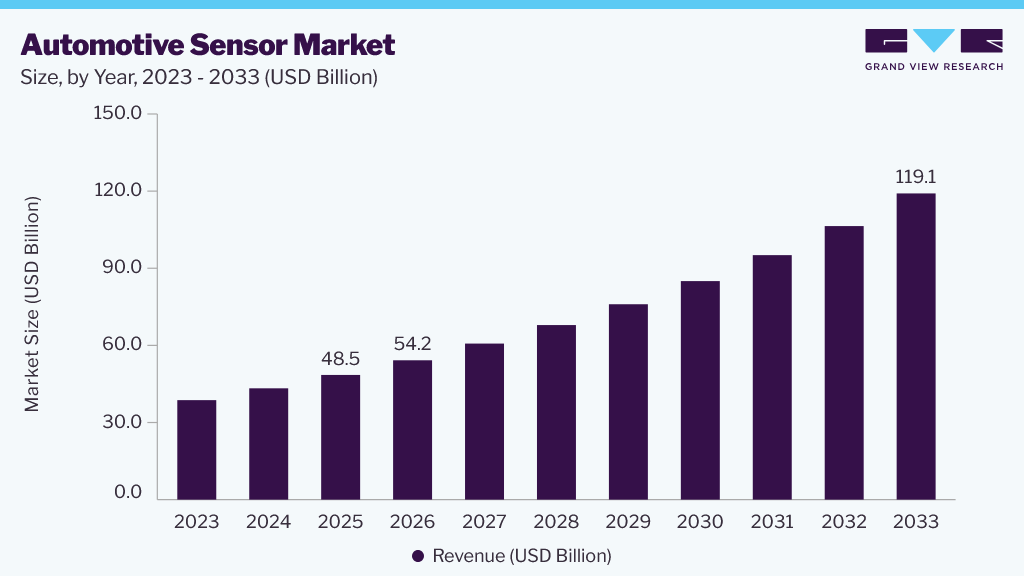 Source: Grand View Research, IR Documents, Primary Interviews, Paid DatabasesTo learn more about this report,
 Download Free Sample Report
Key Market Trends & Insights
- By sensors: The temperature sensor segment dominated the market, with a revenue share of about 34.0% in 2025.
- By vehicle: The passenger cars segment held the largest market revenue share of about 53.0% in 2025.
- By application: The engine & drivetrain segment dominated the market, with a revenue share of about 33.0% in 2025.
Regional Highlights
- Largest regional market: Asia Pacific (44.0% revenue share, 2025)
- Fastest-growing regional market: North America (highest CAGR, 2026-2033)
Market Size & Forecast
- Market size in 2025: USD 48.5 Billion
- Estimated market size in 2026: USD 54.2 Billion
- Projected market size by 2033: USD 119.1 Billion
- CAGR (2026-2033): 11.9%
Three ways to get this report
Buy it, customize it, or ask a question.Ask an Analyst
Analyst response in 1 business day
- AccessReport author, directly
- Reply timeWithin 1 working day
- No sales callDirect answer only
- FormatEmail reply
- CostFree, no cost
Get the Full Report
What the study covers
- FormatsPDF · Excel · Dashboard
- Timeline2026–2033 annual, 2025 base
- Coverage20+ countries, 5 regions
- Companies10+ key players profiled
Customize the Report
20% free customization
- IncludeCountries, segments, points
- TailorTo your product definition
- ExtendDeeper competitor detail
- OrA fully bespoke study
- Turnaround5–10 working days
ADAS features such as blind-spot monitoring, lane departure warning, and automatic emergency braking largely rely on various automotive sensors such as LiDAR, radar, temperature, and positioning sensors. Self-driving cars require more extensive sensor suites, including video cameras, ultrasonic sensors, radio detection and ranging (RADAR), and light detection and ranging (LiDAR), creating massive demand for automotive sensors.Advancements in sensor technology are making sensors more efficient and affordable. This enables broader sensor integration for various functionalities, such as fleet management, vehicle condition monitoring, and vehicle movement tracking. Furthermore, the rise in demand for electric vehicles (EVs) requires a more robust suite of sensors for safety features such as parking assistance and collision avoidance. The growth of EVs creates a new market for safety and security sensors.
Governments worldwide are implementing stricter regulations on safety features for commercial vehicles and passenger vehicles. This has led to the inclusion of advanced driver-assistance systems (ADAS) in HCVs, such as automatic emergency braking, lane departure warning, and blind-spot monitoring. These ADAS features rely mostly on automotive sensors, including LiDAR, radar, and cameras. Pedestrian detection and automatic emergency braking rely heavily on advanced automotive sensors. Therefore, for safety and security purposes, the demand for these sensors is expected to rise in the future as well.
Analyst Perspective
The market is expected to grow rapidly over the forecast period, driven by the adoption of advanced driver assistance systems (ADAS), vehicle electrification, and the increasing integration of connected and autonomous driving technologies. The number of sensors used in modern vehicles to detect vehicle performance, battery management, passenger safety, and surroundings is on the rise. The increase in government rules and regulations pertaining to safety, emission management, and fuel efficiency is projected to further favor the market growth. Moreover, improvements in technologies such as radar, LiDAR, cameras, MEMS, temperature sensors, and pressure sensors are enhancing the performance, dependability, and economics of sensors. The production of electric and software-defined vehicles, and the need for predictive maintenance and automated driving, are anticipated to create opportunities for automotive sensor manufacturers.
Sensor Insights
The temperature sensor segment dominated the market, accounting for about 34.0% of revenue in 2025. Temperature sensors are a well-established, mature technology; they are relatively simple and inexpensive to manufacture compared to more complex sensors. Temperature sensors are used in various automotive applications, including seat heating, air conditioning, and battery management systems. The wide range of applications of temperature sensors across multiple vehicle types, such as passenger cars, heavy commercial vehicles (HCVs), light commercial vehicles (LCVs), and others, further strengthens their dominance in the market.
The position sensors segment is anticipated to grow at the fastest CAGR over the forecast period. Various features of autonomous vehicles and advanced driver assistance systems (ADAS) require position sensors to track vehicle movement. Position sensors play a crucial role in safety and comfort features. The increasing emphasis on safety and driver comfort continues to drive the growth of the position sensor segment. Developments in sensor technology are making position sensors more accurate and reliable. This allows for their integration into a wider range of applications. For instance, in April 2025, TDK introduced the Micronas HAL/HAR 35xy family of Hall-effect 2D position sensors for automotive applications. The new ASIL C-ready sensor family is designed for safety-critical applications such as steering angle detection, accelerator and brake pedal position sensing, valve position detection, transmission position sensing, and chassis height measurement. The sensors are designed for safety-sensitive applications, including angle measurements of the steering wheel, positioning of the brake and accelerator pedals, valves, and chassis, highlighting the growing demand for advanced position-sensing technologies in modern vehicles.
Vehicle Insights
The passenger cars segment held the largest market revenue share of about 53.0% in 2025. Passenger car sales are much higher than those of commercial vehicles. Higher passenger car sales volumes generate high demand for automotive sensors. A wide range of sensors is used in passenger vehicles for different purposes. For instance, advanced driver assistance systems use sensors such as radar, LiDAR, and cameras. Sensors such as ultrasonic sensors and cameras are used in parking assistance systems, while additional sensors enhance comfort and convenience. The sensors used in passenger cars cater to a wide range of functionalities, ultimately leading to a higher revenue share for the segment.
The heavy commercial vehicles (HCV) segment is expected to grow at a significant CAGR over the forecast period. The e-commerce sector and demand for goods delivery services are rising, requiring heavy commercial vehicles for transportation. Technologically advanced sensors are used in heavy commercial vehicles to support fleet management and predictive maintenance. In addition, governments across the globe are implementing stringent rules and regulations on safety features for heavy commercial vehicles.
Application Insights
The engine & drivetrain segment dominated the market, with a revenue share of about 33.0% in 2025, as it is an essential part of a vehicle, responsible for generating power and crucial to the vehicle's basic functionality. The engine and drivetrain are a progressing sector. Advancements in emission control, fuel efficiency, and power output drive the demand for upgraded engines and drivetrain components. Engines and drivetrain components require replacement after a certain period; therefore, the demand for replacement drives the segment. Even though electric vehicles (EVs) are becoming popular, there is still high demand for traditional gasoline-powered cars, which rely largely on engines and drivetrains for operation.
The safety and security segment is projected to grow at the fastest CAGR over the forecast period. With the safety & security of customers in mind, demand for advanced driver assistance systems (ADAS) is increasing. ADAS relies on various automotive sensors, such as cameras, radar, and LiDAR; hence, demand for these sensors is growing. The development of autonomous and self-driving cars requires sensors to gather information about the environment. The government is more concerned with people's safety and is enforcing strict regulations on vehicle safety features. Therefore, the demand for safety sensors is increasing in the market.
Regional Insights
The Asia Pacific automotive sensor market dominated the global market, accounting for approximately 44.0% of global revenue in 2025. The Asia Pacific region is a major car manufacturing hub. The mass production of vehicles generated more demand for automotive sensors in the region. The number of tech-savvy consumers has increased in the region in recent years. Consumers are demanding advanced features such as driver assistance systems and connected car technologies; these technologies highly rely on various automotive sensors. In addition, the government is imposing strict regulations on vehicle safety and emissions standards, and automotive sensors such as airbags, emission control systems, and anti-lock braking systems (ABS) are in high demand.
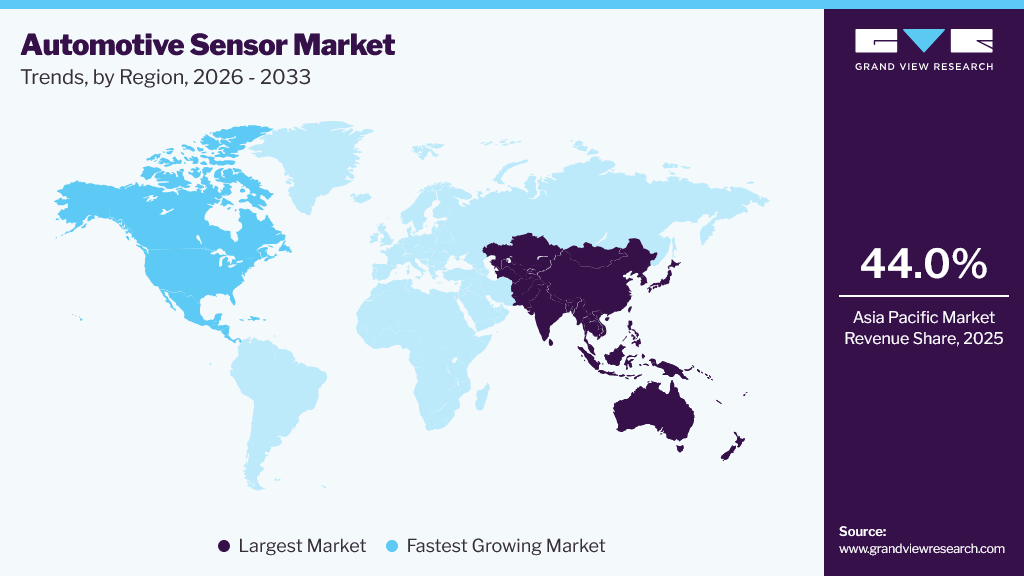 To learn more about this report, Download Free Sample Report
China Automotive Sensor Market Trends
The automotive sensor market in China is the largest in the Asia-Pacific region. China is a global leader in car manufacturing, and there is a high demand for such vehicle sensors. The production cost of automotive components is relatively low in China, owing to low labor costs and mass production, thereby boosting demand for automotive sensors in the market.
North America Automotive Sensor Market Trends
The automotive sensor market in North America is expected to grow significantly for several reasons. As North America is a highly advanced market, it focuses on developing vehicles equipped with the latest, most efficient sensors. The growing electric vehicle market in the region requires more sensors. North America has a large vehicle fleet requiring sensor replacements, contributing to the region's market expansion. According to the IEA Global EV Outlook 2025 report, electric car sales grew at a strong pace in 2024, with the U.S. one of the world's largest EV markets. The sensors required in each EV are far more than those in an ICEV, including battery management, temperature, current, ADAS (radar/LIDAR), and powertrain sensors.
Canada automotive sensor market is expected to experience the highest CAGR in North America, as the government is actively promoting vehicle safety and adopting new technologies. They promote electric vehicles (EVs) and vehicles with advanced driver assistance systems (ADAS). The government has strict regulations on carbon emissions. Therefore, demand for various emission-control sensors has increased in the market.
Europe Automotive Sensor Market Trends
The automotive sensor market in Europe was identified as a lucrative segment of the industry. Europe has a strong automotive industry with leading car manufacturers such as BMW and Volkswagen. The regulatory body enforces strict safety standards for vehicle manufacturers and makes it mandatory to include automotive sensors for features such as ABS, driving sensors, airbags, and Electronic stability control.
Germany automotive sensor market held a substantial market share in 2025. Germany is a major car manufacturing market, driving high demand for automotive sensors domestically. Germany has major sensor manufacturers, making the country a global leader in automotive sensor manufacturing.
Key Automotive Sensor Company Insights
The key automotive sensor companies in the market focus on increasing their customer base by adopting technologies such as ADAS & autonomous vehicles. The key players engaged in strategic initiatives such as partnerships, mergers, and acquisitions with other companies to stay abreast of the competition.
Key Automotive Sensor Companies
The following key companies have been profiled for this study on the automotive sensor market:
-
Robert Bosch GmbH
-
Continental AG
-
DENSO Corporation
-
Infineon Technologies AG
-
NXP Semiconductors N.V.
-
STMicroelectronics N.V.
-
Sensata Technologies Holding plc
-
TE Connectivity plc
-
Allegro MicroSystems, Inc.
-
Texas Instruments Incorporated
-
Analog Devices, Inc.
-
Aptiv PLC
Recent Developments
-
In October 2025, DENSO announced newly developed electrification products for Toyota's new bZ4X, including a Cell Supervising Circuit and Shunt Current Sensor for battery management systems. These innovations enable more accurate measurement of battery and current conditions with fewer monitoring circuits.
-
In June 2025, Infineon Technologies AG introduced the XENSIV TLE4802SC16-S0000, an inductive sensor designed to enhance the performance of automotive chassis systems. The inductive sensor enables precise measurement of torque and angle while ensuring robust stray-field performance via digital output using SENT or SPC protocols.
-
In June 2025, Continental AG developed A new sensing technology that can measure the temperature of the interior of permanently excited synchronous motors of electric vehicles (EVs) directly in the rotor region.
Automotive Sensor Market Report Scope
Report Attribute
Details
Market size in 2025
USD 48.5 billion
Estimated market size in 2026
USD 54.2 billion
Projected market size by 2033
USD 119.1 billion
Growth rate
CAGR of 11.9% from 2026 to 2033
Actual data
2021 - 2025
Forecast period
2026 - 2033
Quantitative units
Revenue in USD billion, and CAGR from 2026 to 2033
Report coverage
Revenue forecast, company ranking, competitive landscape, growth factors, and trends
Segments Covered
Sensors, vehicle, application, region
Regional Scope
North America; Europe; Asia Pacific; Latin America; MEA
Country Scope
U.S.; Canada; Mexico; Germany; UK; France; China; Japan; India; South Korea; Australia; Brazil; Saudi Arabia; UAE; South Africa
Key companies profiled
Robert Bosch GmbH; Continental AG; DENSO Corporation; Infineon Technologies AG; NXP Semiconductors N.V.; STMicroelectronics N.V.; Sensata Technologies Holding plc; TE Connectivity plc; Allegro MicroSystems, Inc.; Texas Instruments Incorporated; Analog Devices, Inc.; Aptiv PLC
Customization scope
Free report customization (equivalent to up to 8 analysts working days) with purchase. Addition or alteration to country, regional & segment scope.
Pricing and purchase options
Avail of customized purchase options to meet your exact research needs. Explore purchase options
Global Automotive Sensor Market Report Segmentation
This report forecasts revenue growth at global, regional, and country levels and provides an analysis of the latest industry trends and opportunities in each of the sub-segments from 2021 to 2033. For this study, Grand View Research has segmented the global automotive sensor market report based on sensors, vehicle, application, and region:
- Sensors Outlook (Revenue, USD Billion, 2021 - 2033)
- Temperature Sensors
- Position Sensors
- Pressure Sensors
- NOx Sensors
- Radar Sensors
- Others
- Vehicle Outlook (Revenue, USD Billion, 2021 - 2033)
- Passenger Car
- Light Commercial Vehicles (LCV)
- Heavy Commercial Vehicles (HCV)
- Others
- Application Outlook (Revenue, USD Billion, 2021 - 2033)
- Engine & Drivetrain
- Safety & Security
- Emission Control
- Others
- Regional Outlook (Revenue, USD Billion, 2021 - 2033)
- North America
- U.S.
- Canada
- Mexico
- Europe
- Germany
- UK
- France
- Asia Pacific
- China
- Japan
- India
- South Korea
- Australia
- Latin America
- Brazil
- Middle East and Africa (MEA)
- Saudi Arabia
- UAE
- South Africa
- North America
Frequently Asked Questions About This Report
The global automotive sensor market size was valued at USD 48.5 billion in 2025 and is estimated at USD 54.2 billion in 2026.
The global automotive sensor market is expected to grow at a CAGR of 11.9% from 2026 to 2033, reaching USD 119.1 billion.
The temperature sensor segment dominated the market, accounting for about 34.0% of revenue in 2025.
Asia Pacific dominated with an approximately 44.0% revenue share in 2025.
Key players in the market include Robert Bosch GmbH, Continental AG, DENSO Corporation, Infineon Technologies AG, NXP Semiconductors N.V., STMicroelectronics N.V., Sensata Technologies Holding plc, TE Connectivity plc, Allegro MicroSystems, Inc., Texas Instruments Incorporated, Analog Devices, Inc., Aptiv PLC, and others.
About the Author(s)
Sensors & Controls Research Team
Semiconductors & Electronics · Sensors & ControlsThis report was authored by the sensors & controls research team at Grand View Research - comprising two research analysts, one senior research analyst, and one industry expert - with specialized expertise in the sensors & controls segment of the semiconductors & electronics industry. All findings are based on proprietary semiconductors & electronics databases, executive interviews, and regulatory analysis, subject to internal peer review prior to publication.
Last Updated:
Speak to Analyst

Customize this report to your needs - add regions, segments, or data points, with 20% free customization.
Or view our licence options:


ISO 9001:2015 & 27001:2022 Certified
We are GDPR and CCPA compliant! Your transaction & personal information is safe and secure. For more details, please read our privacy policy.


