
- Home
- »
- Plastics, Polymers & Resins
- »
-
Automotive Textiles Market Size & Share Report, 2026-2033GVR Report cover

Automotive Textiles Market (2026 - 2033)
Size, Share & Trends Analysis Report By Type (Woven, Composites), By Application (Upholstery, Safety Devices), By Region (North America, Europe, Asia Pacific), And Segment Forecasts
Market Size, 2025
$32.8BMarket Estimate, 2026
$33.9BMarket Forecast, 2033
$42.4BCAGR, 2026–2033
3.3%Automotive Textiles Market Summary
The global automotive textiles market size was valued at USD 32.8 billion in 2025 and is projected to grow from USD 33.9 billion in 2026 to USD 42.4 billion by 2033, at a CAGR of 3.3% from 2026 to 2033. Asia Pacific dominated the automotive textiles market with the largest revenue share of 48.6% in 2025. Growth in automobile production, coupled with the increasing focus on safety devices, is expected to propel the market growth.
 Source: Grand View Research, IR Documents, Primary Interviews, Paid DatabasesTo learn more about this report,
 Download Free Sample Report
 Key Market Trends & Insights
- By type: Composites segment held the largest market share of 39.4% in 2025.
- By application: Upholstery segment held the largest market share of 55.7% in 2025.
Regional Highlights
- Largest regional market: Asia Pacific (48.6% revenue share, 2025)
- By country: China held the largest market share in 2025
Market Size & Forecast
- Market size in 2025: USD 32.8 Billion
- Estimated market size in 2026: USD 33.9 Billion
- Projected market size by 2033: USD 42.4 Billion
- CAGR (2026-2033): 3.3%
Three ways to get this report
Buy it, customize it, or ask a question.Ask an Analyst
Analyst response in 1 business day
- AccessReport author, directly
- Reply timeWithin 1 working day
- No sales callDirect answer only
- FormatEmail reply
- CostFree, no cost
Get the Full Report
What the study covers
- FormatsPDF · Excel · Dashboard
- Timeline2026–2033 annual, 2025 base
- Coverage20+ countries, 5 regions
- Companies10+ key players profiled
Customize the Report
20% free customization
- IncludeCountries, segments, points
- TailorTo your product definition
- ExtendDeeper competitor detail
- OrA fully bespoke study
- Turnaround5–10 working days
In addition, increased vehicle production, rising disposable incomes, and urbanization is further expected to drive the markets growth. Automotive textiles refer to the materials used in the interior and exterior components of vehicles, including seating, upholstery, and safety systems like airbags and seat belts. As consumers' disposable income and living standards continue to rise, there is a growing demand for advanced safety features in vehicles, such as airbags and seat belts. This demand is one of the key drivers behind the expansion of the automotive textiles market.
 To learn more about this report, Download Free Sample Report
 In addition, government-imposed safety regulations, which mandate the inclusion of airbags, seat belts, and anti-lock braking systems (ABS) in all vehicles, have also significantly benefited the automotive sector. These regulations, particularly in developing regions, have made safety features standard in vehicles, further boosting the need for automotive textiles. With the rise in consumer awareness of vehicle safety, the demand for textile materials required for various safety components continues to grow.
Furthermore, the automotive textiles market is the increasing preference for eco-friendly materials. Fabrics such as recyclable polyester are gaining popularity due to their cost-effectiveness and sustainability. Moreover, the demand for nonwoven fabrics, especially for applications such as vehicle floor coverings and carpets, is on the rise. The use of recycled polyethylene terephthalate (PET) for manufacturing nonwoven carpets helps reduce environmental impact, supports sustainability, and enhances resource efficiency. This growing focus on eco-friendly solutions is expected to significantly drive the market's revenue growth in the coming years.
Market Dynamics
The automotive textiles market is experiencing steady growth, driven by rising vehicle production, increasing demand for passenger comfort and safety, and the growing use of lightweight materials to improve fuel efficiency and reduce emissions. Advancements in sustainable and high-performance textiles, along with the expanding adoption of electric vehicles, are creating new growth opportunities across vehicle interiors and safety applications. Moreover, stringent safety standards and consumer preference for premium interior aesthetics continue to support market expansion, although raw material price volatility remains a key challenge.
One of the primary drivers of the automotive textiles market is the increasing adoption of lightweight materials by vehicle manufacturers to enhance fuel efficiency and reduce overall vehicle weight. Automotive textiles are widely used in seats, carpets, headliners, door panels, airbags, and other interior components because they offer a favorable strength-to-weight ratio compared to traditional materials. As automakers strive to comply with stringent fuel economy and emission regulations, the demand for advanced textile solutions that contribute to vehicle lightweighting continues to grow.
The transition toward electric vehicles is further accelerating this trend, as reducing vehicle weight helps extend battery range and improve energy efficiency. Manufacturers are increasingly investing in innovative textile materials, including high-performance synthetic fibers, nonwovens, and recycled fabrics, to achieve weight reduction without compromising durability, safety, or comfort. Consequently, lightweight automotive textiles have become a critical component in modern vehicle design, supporting both sustainability goals and enhanced vehicle performance.
A significant restraint for the automotive textiles market is the volatility in raw material prices, particularly for synthetic fibers such as polyester, nylon, and polypropylene, which are widely used in automotive applications. Fluctuations in the prices of petrochemical-based feedstocks, coupled with supply chain disruptions and changing trade policies, can increase production costs for textile manufacturers. These cost uncertainties often put pressure on profit margins and make it challenging for companies to maintain competitive pricing, potentially limiting market growth and investment in new textile innovations.
The growing focus on sustainability and circular economy practices presents a significant opportunity for the bulk chemical packaging drums for agrochemicals market. Agrochemical manufacturers and distributors are increasingly seeking reusable, recyclable, and reconditioned drum solutions to reduce packaging waste, lower transportation costs, and meet evolving environmental regulations. This trend is encouraging packaging suppliers to invest in advanced drum reconditioning services, recycled material integration, and eco-friendly packaging innovations. As sustainability becomes a key purchasing criterion across the agricultural value chain, demand for environmentally responsible bulk packaging solutions is expected to create new growth opportunities for market participants.
Analyst Perspective
The Automotive Textiles Market is entering a phase of structural transformation, where innovation in material engineering and evolving automotive design requirements are reshaping product demand across the value chain. Market growth is increasingly supported by the industry's focus on vehicle lightweighting, enhanced occupant safety, premium interior differentiation, and sustainability, particularly as electric vehicle production expands globally. From an analyst's perspective, manufacturers that invest in advanced technical textiles, recycled and bio-based materials, and high-value functional fabrics are expected to strengthen their competitive positioning, while ongoing regulatory developments and OEM demand for performance-driven solutions will continue to influence market dynamics over the forecast period.
Type insights
Based on type, the composites segment led the market with the largest revenue share of 39.4% in 2025. This growth can be attributed to their better mechanical properties in comparison to other automotive textiles. Their ability to enhance vehicle performance, reduce weight, and provide design flexibility further contributes to their increasing adoption in automotive components such as interiors and exterior parts.
Non-woven segment is expected to grow at a CAGR of 3.2% over the forecast period, owing to their cost-effectiveness, versatility, and ability to meet automotive requirements for noise reduction, insulation, and interior aesthetics. In addition, they are lightweight, offer excellent durability, and can be used in a variety of applications such as upholstery, insulation, and soundproofing. Furthermore, the growing demand for more sustainable and efficient materials is also fueling the adoption of non-woven in automotive textiles.
Application Insights
Based on application, the upholstery segment led the market with the largest revenue share of 55.7% in 2025. Upholstery dominated the North American automotive textiles application market, owing to higher market penetration, which is related to the growing popularity of automotive textiles in the upholstery application. Furthermore, the demand for automotive textiles in tire applications, as a result of the rising production and sales of autonomous vehicles with highly automated driving capabilities for tire manufacturing, is predicted to fuel the growth of the upholstery application category.
 To learn more about this report, Download Free Sample Report
 The safety devices application segment is expected to grow at a CAGR of 3.8% over the forecast period, owing to the increase in the amount of textile used in in-vehicle safety standards. In addition, safety rules requiring the installation of airbags, seat belts, and anti-lock brake systems in every vehicle have a favorable impact on the automobile business. Furthermore, key automotive textile applications include safety devices and engine components.
Regional Insights
Asia Pacific dominated the automotive textiles market with the largest revenue share of 48.6% in 2025, primarily driven by increased population, urbanization, and the expansion of key players’ operations in these regions. Furthermore, there have been stricter vehicular rules and standards regarding the use of airbags and safety belts.
 To learn more about this report, Download Free Sample Report
 China Automotive Textiles Market Trends
The automotive textiles market in China held the largest share in the Asia Pacific region in 2025, driven by its large population and continued economic development. Growing demand for safety devices, such as airbags, is significantly contributing to market expansion. In addition, increased construction spending is also expected to positively influence market growth as it supports the overall economy and related industries. Furthermore, changes in family size and an aging population are impacting related sectors and indirectly affecting the need for automotive textiles through broader economic shifts.
North America Automotive Textiles Market Trends
The North America automotive textiles market is expected to grow at a CAGR of 3.1% over the forecast period, owing to increased vehicle production and sales. In addition, growing urbanization also supports market expansion in the region. Furthermore, the popularity of using automotive textiles in upholstery is a key element, driving demand within this application. Moreover, the consistent demand for vehicles and the increasing urbanization of the region creates consistent demand for the market to grow.
The automotive textiles market in the U.S. led the North American market with the highest revenue share in 2024, driven by the Increased car sales in the U.S. in addition, the consistent demand and sales in upholstery applications also contribute, due to the growing popularity of these materials. Furthermore, safety regulations that mandate the implementation of airbags and seat belts are expected to positively influence market growth as manufacturers adhere to these standards.
Europe Automotive Textiles Market Trends
Europe region is anticipated to grow significantly over the forecast period owing to the increasing gains from rising usage of automotive textiles in upholstery applications with growing industrialization and urbanization. In addition, the expansion is expected to be encouraged by the massive manufacture of automobiles. Furthermore, consumer preference for safer and more comfortable vehicles also drives market growth.
Key Automotive Textiles Company Insights
Key companies in the global automotive textiles industry include Johnson Controls, Acme Mills, Aunde SA, and others. The market is characterized by the presence of various small- and large-scale players, resulting in a moderate level of concentration in the market. To serve a larger customer base, they are also trying to expand their product portfolio by focusing on developing cost-effective composites with enhanced properties. A large number of manufacturers are focused on backward integration to keep the product quality under control. The industry participants emphasize expanding their product portfolio by developing innovative solutions and cheaper products with superior properties to cater to the increasing consumer demand.
-
Lear Corporation manufactures a wide range of products, including seats, seat structures, and electrical components such as wiring harnesses. The company also provides advanced textile solutions for automotive applications, focusing on fabric technology for seat covers, trims, and interior upholstery. Lear’s expertise in automotive textiles helps enhance vehicle comfort, safety, and aesthetic appeal.
-
Borgers AG manufactures high-quality textile-based solutions for vehicle interiors, combining functionality with design. The company also focuses on advanced materials to enhance noise reduction and comfort within automobiles, serving a wide range of global automotive manufacturers. Their textiles contribute to improved passenger experience and vehicle performance.
Key Automotive Textiles Companies
The following key companies have been profiled for this study on the automotive textiles market.
-
Lear Corporation
-
Johnson Controls
-
Acme Mills
-
Aunde SA
-
Toyota Boshoku Corporation
-
International Textile Group
-
Autoneum Holding AG
-
Dupont
-
Autotech Nonwovens
-
Suminoe Textile Co. Ltd.
-
CMI Enterprises Inc.
-
ASGLAWO Technofibre GmbH
-
Sage Automotive Interiors, Inc.
-
Baltex Inc.
-
Reliance Industries Limited
-
Auto Textiles S.A.
-
Global Safety Textile GmbH
-
SMS Auto Fabrics
-
Autoliv Inc.
Recent Developments
-
In January 2023, Autoneum announced the acquisition of Borgers Automotive. This acquisition strengthens Autoneum's position in the market, with Borgers' product lines, including automotive textiles such as wheelhouse outer liners, trunk trim, and sustainable products, complementing Autoneum's portfolio. The deal was expected to generate positive earnings per share from the start, with renegotiated commercial agreements ensuring sustained profitability.
Automotive Textiles Market Report Scope
Report Attribute
Details
Market size in 2025
USD 32.8 billion
Estimated market size in 2026
USD 33.9 billion
Projected market size by 2033
USD 42.4 billion
Growth rate
CAGR of 3.3% from 2026 to 2033
Base year for estimation
2025
Historical data
2021 - 2024
Forecast period
2026 - 2033
Quantitative units
Revenue in USD million/billion and CAGR from 2026 to 2033
Report coverage
Revenue forecast, company ranking, competitive landscape, growth factors, and trends
Segments covered
Type, application, region
Regional scope
North America; Europe; Asia Pacific; Latin America; MEA
Country scope
U.S.; Canada; Mexico; Germany; UK; France; Italy; Spain; China; Japan; India; South Korea; Australia; Brazil; Argentina; Saudi Arabia; South Africa; UAE
Key companies profiled
Lear Corporation; Johnson Controls; Acme Mills; Aunde SA; Toyota Boshoku Corporation; International Textile Group; Borgers AG; Dupont; Autotech Nonwovens; Suminoe Textile Co. Ltd.; CMI Enterprises Inc.; ASGLAWO Technofibre GmbH; Sage Automotive Interiors, Inc.; Baltex Inc.; Reliance Industries Limited; Auto Textiles S.A.; Global Safety Textile GmbH; SMS Auto Fabrics; Autoliv Inc.
Customization scope
Free report customization (equivalent up to 8 analysts' working days) with purchase. Addition or alteration to country, regional & segment scope.
Pricing and purchase options
Avail customized purchase options to meet your exact research needs. Explore purchase options
Global Automotive Textiles Market Report Segmentation
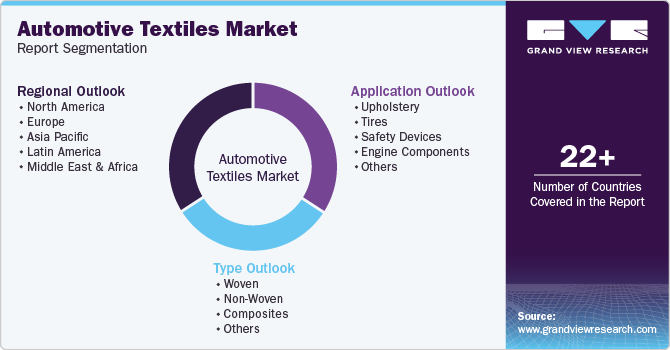
This report forecasts revenue growth at global, regional, and country levels and analyzes the latest industry trends in each sub-segment from 2021 to 2033. For this study, Grand View Research has segmented the global automotive textiles market report based on type, application, and region.
 To learn more about this report, Download Free Sample Report
 -
Type Outlook (Volume, Kilotons; Revenue, USD Million, 2021 - 2033)
-
Woven
-
Non-Woven
-
Composites
-
Others
-
-
Application Outlook (Volume, Kilotons; Revenue, USD Million, 2021 - 2033)
-
Upholstery
-
Tires
-
Safety Devices
-
Engine Components
-
Others
-
-
Regional Outlook (Volume, Kilotons; Revenue, USD Million, 2021 - 2033)
-
North America
-
U.S.
-
-
Europe
-
Germany
-
Spain
-
France
-
-
Asia Pacific
-
China
-
Japan
-
-
Latin America
-
Brazil
-
-
Middle East and Africa
-
Competitive Benchmarking
Operating Strategies
Competitive Edge
Weaknesses
Established Players (Lear Corporation, Johnson Controls, Toyota Boshoku Corporation, Aunde SA, International Textile Group, Autoneum Holding AG, DuPont, Suminoe Textile Co. Ltd., Sage Automotive Interiors, Inc., Reliance Industries Limited, Global Safety Textile GmbH, and Autoliv Inc.)
- Maintain long-term supply agreements with global automotive OEMs while leveraging vertically integrated manufacturing and sourcing networks.
- Invest heavily in R&D for lightweight, sustainable, high-performance, and safety-enhancing textile solutions to meet evolving vehicle requirements.
- Strong global production footprint, extensive customer relationships, and established brand credibility enable consistent contract wins and market leadership.
- Significant financial resources and technical expertise support innovation, economies of scale, and compliance with stringent automotive standards.
- Large operational structures can reduce flexibility and slow response times to emerging market trends and niche customer demands.
- High fixed costs associated with global manufacturing facilities and workforce management can pressure profitability during industry downturns.
Emerging Players (Acme Mills, Autotech Nonwovens, CMI Enterprises Inc., ASGLAWO Technofibre GmbH, Baltex Inc., Auto Textiles S.A., and SMS Auto Fabrics)
- Focus on specialized automotive textile applications, customized solutions, and niche market segments to differentiate from larger competitors.
- Expand through strategic partnerships, regional OEM collaborations, and investments in advanced textile technologies.
- Greater operational agility allows faster adaptation to changing customer requirements and technological developments.
- Strong specialization in selected product categories enables targeted innovation and customized offerings for specific automotive applications.
- Limited financial resources and production capacity may restrict large-scale expansion and global market penetration.
- Dependence on a smaller customer base and regional operations increases vulnerability to demand fluctuations and competitive pressures.
Research Methodology
The automotive textiles market figures in this report are based on a proven research process that combines executive interviews with secondary research from proprietary databases, company filings, and recognized regulatory and institutional sources. Market size is built through value-chain sizing-reconciling supply-side and demand-side estimates-and triangulated with bottom-up and top-down approaches. Every estimate passes multiple levels of expert validation before publication, with each automotive textiles segment quantified using the revenue-capture definitions in the table below.
Segment Definition
Segment - Type
Revenue capture definition
Wovens
Revenue generated from the sale of woven automotive textiles manufactured through interlacing yarns to provide high strength, durability, and dimensional stability. This segment includes fabrics used in seat covers, door panels, headliners, carpets, and other interior applications requiring enhanced wear resistance and aesthetics.
Non-wovens
Revenue generated from the sale of non-woven automotive textiles produced through mechanical, thermal, or chemical bonding processes. This segment includes materials used in insulation, carpeting, trunk liners, headliners, filtration systems, and acoustic components due to their lightweight and cost-effective properties.
Composites
Revenue generated from the sale of textile-reinforced composite materials designed to deliver superior strength, lightweight performance, and durability. This segment includes advanced textile composites used in structural components, interior parts, underbody shields, and lightweight vehicle applications.
Others
Revenue generated from the sale of specialty automotive textiles, including knitted fabrics, coated textiles, and hybrid materials used in niche automotive applications. This segment covers customized textile solutions developed for comfort, performance, protection, and aesthetic enhancement.
Segment - Application
Revenue capture definition
Upholstery
Revenue generated from the sale of automotive textiles used in seating systems, door trims, headliners, armrests, and other interior trim components. This segment includes fabrics designed to provide comfort, durability, aesthetics, and stain resistance in vehicle interiors.
Tires
Revenue generated from the sale of textile reinforcement materials used in tire manufacturing to improve strength, flexibility, dimensional stability, and overall performance. This segment includes tire cords and reinforcement fabrics made from polyester, nylon, rayon, and other high-performance fibers.
Safety Devices
Revenue generated from the sale of automotive textiles used in airbags, seat belts, and other occupant protection systems. This segment includes high-strength technical fabrics engineered to meet stringent automotive safety and regulatory requirements.
Engine Components
Revenue generated from the sale of automotive textiles used in engine compartments and under-the-hood applications requiring thermal resistance, filtration, insulation, and protective performance. This segment includes textile materials utilized in belts, hoses, filters, heat shields, and related components.
Others
Revenue generated from the sale of automotive textiles used in additional vehicle applications, including acoustic insulation, cargo liners, battery protection systems, convertible roofs, and exterior textile components. This segment encompasses specialized textile solutions not classified under the above categories.
Estimation Model
Layer Name
Key Question
Description
Vehicle Production Demand Layer
What forms the demand base?
Identify global vehicle production volumes across passenger vehicles and commercial vehicles. Assess automotive textile consumption per vehicle, including upholstery fabrics, carpets, headliners, airbags, seat belts, tire cords, insulation materials, and other textile-based components. This layer establishes the total addressable demand for automotive textiles across major automotive manufacturing regions.
Textile Penetration Layer
Where are automotive textiles utilized?
Estimate the penetration of textile materials across vehicle systems, including interiors, tires, safety devices, engine components, and acoustic applications. Evaluate the adoption of woven, non-woven, composite, and specialty textiles in conventional, hybrid, and electric vehicles across developed and emerging markets.
Material Consumption Intensity Layer
How much automotive textile volume is consumed?
Analyze average textile consumption per vehicle, by vehicle type, application, and material category. Assess factors such as lightweighting requirements, safety regulations, comfort standards, durability specifications, and sustainability initiatives that influence textile usage intensity across automotive platforms.
Revenue Layer
How is market revenue generated?
Market revenue is quantified through the sale of automotive textiles categorized by type (wovens, non-wovens, composites, and others) and their utilization across upholstery, tires, safety devices, engine components, and other automotive applications. Revenue generation is influenced by vehicle production volumes, textile content per vehicle, material pricing, adoption of lightweight and sustainable textile solutions, and increasing demand for enhanced safety, comfort, and interior aesthetics.
Delivered Customizations
This report has been delivered with the following In-depth customizations
Client Request
Customization Delivered
Value Adds
Regional Segmentation Analysis
Detailed market sizing, growth forecasts, demand trends, and adoption analysis across North America, Europe, Asia Pacific, Central & South America, and Middle East & Africa. Assessment includes automotive production trends, textile consumption patterns, regulatory developments, and demand outlook for automotive textile applications across each region.
Enables identification of high-growth regions, investment hotspots, regional demand variations, and market expansion opportunities.
Cross-Segmentation Analysis
Comprehensive analysis across key market segments, including Type (Wovens, Non-wovens, Composites, Others) and Application (Upholstery, Tires, Safety Devices, Engine Components, Others), with regional and country-level breakdowns. Market size, growth rates, and attractiveness analysis provided for each segment combination.
Supports targeted product development, segment prioritization, resource allocation, and identification of high-potential application areas and material categories.
Opportunity Assessment
Identification of emerging opportunities across high-performance composites, lightweight textile solutions, sustainable and recycled materials, advanced upholstery fabrics, tire reinforcement textiles, and safety device applications. Opportunity mapping is provided by region, type, and application segment.
Enables strategic investment planning, product innovation, market expansion initiatives, and long-term growth strategy development.
Frequently Asked Questions About This Report
The global automotive textiles market size was valued at USD 32.8 billion in 2025 and is estimated at USD 33.9 billion for 2026.
The global automotive textiles market is expected to grow at a CAGR of 3.3% from 2026 to 2033, reaching USD 42.4 billion by 2033.
The composites segment led the automotive textiles market with a 39.4% revenue share in 2025.
Key factors driving the automotive textiles market include increasing vehicle production, growing demand for lightweight and fuel-efficient vehicles, increasing focus on passenger comfort and safety, expanding electric vehicle adoption, and increasing use of sustainable and high-performance textile materials.
Asia Pacific dominated the automotive textiles market with a 48.6% revenue share in 2025.
Asia Pacific is the fastest-growing region in the automotive textiles market with a CAGR of 3.6% over the forecast period.
The upholstery segment led the automotive textiles market with a 55.7% revenue share in 2025.
Safety devices is the fastest-growing application segment in the automotive textiles market with a CAGR of 3.8% over the forecast period.
Key players in the automotive textiles market include Lear Corporation; Johnson Controls; Acme Mills; Aunde SA; Toyota Boshoku Corporation; International Textile Group; Borgers AG; Dupont; Autotech Nonwovens; Suminoe Textile Co. Ltd.; CMI Enterprises Inc.; ASGLAWO Technofibre GmbH; Sage Automotive Interiors, Inc.; Baltex Inc.; Reliance Industries Limited; Auto Textiles S.A.; Global Safety Textile GmbH; SMS Auto Fabrics; Autoliv Inc.
About the Author(s)
Plastics, Polymers & Resins Research Team
Bulk Chemicals · Plastics, Polymers & ResinsThis report was authored by the plastics, polymers & resins research team at Grand View Research - comprising two research analysts, one senior research analyst, and one industry expert - with specialized expertise in the plastics, polymers & resins segment of the bulk chemicals industry. All findings are based on proprietary bulk chemicals databases, executive interviews, and regulatory analysis, subject to internal peer review prior to publication.
Last Updated:
Speak to Analyst

Customize this report to your needs - add regions, segments, or data points, with 20% free customization.
Or view our licence options:


ISO 9001:2015 & 27001:2022 Certified
We are GDPR and CCPA compliant! Your transaction & personal information is safe and secure. For more details, please read our privacy policy.


