
- Home
- »
- Advanced Interior Materials
- »
-
Ballast Water Treatment Systems Market Report, 2033GVR Report cover

Ballast Water Treatment Systems Market (2026 - 2033)
Size, Share & Trends Analysis Report By Vessel Type (Bulk Carriers, Oil Tankers, Container Ships, General Cargo Ships, Gas Carriers), By System Type, By Application, By Capacity, By Geography, And Segment Forecasts
Market Size, 2025
$7.5BMarket Estimate, 2026
$7.9BMarket Forecast, 2033
$14.4BCAGR, 2026–2033
9.1%Ballast Water Treatment Systems Market Summary
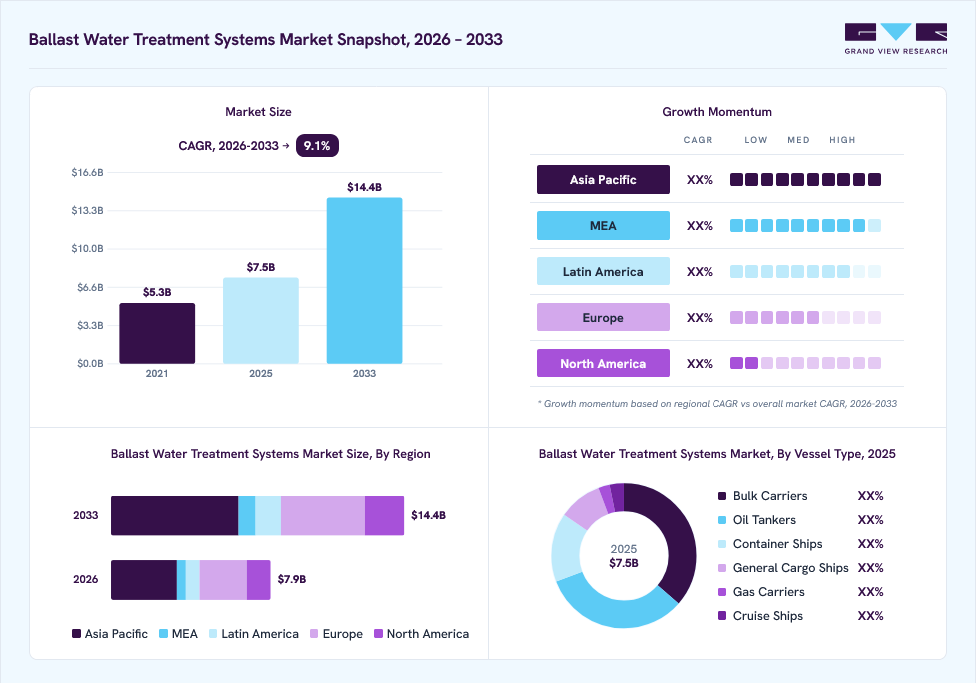
The global ballast water treatment systems market size was estimated at USD 7.5 billion in 2025 and is projected to grow from USD 7.9 billion in 2026 to USD 14.4 billion by 2033, growing at a CAGR of 9.1% from 2026 to 2033. The global ballast water treatment systems industry’s growth is driven by increasing environmental regulations, particularly the International Maritime Organization's (IMO) Ballast Water Management Convention, which requires ships to treat ballast water to prevent the spread of invasive species.
 Source: Grand View Research, IR Documents, Primary Interviews, Paid DatabasesTo learn more about this report,
 Download Free Sample Report
Key Market Trends & Insights
- By vessel type: Bulk carriers segment led the market with the largest revenue share of 36.3% in 2025.
- By capacity: 250 -500 m3/hr segment led the market with the largest revenue share of 28.3% in 2025.
- By system type: Filtration segment led the market with the largest revenue share of 31.5% in 2025.
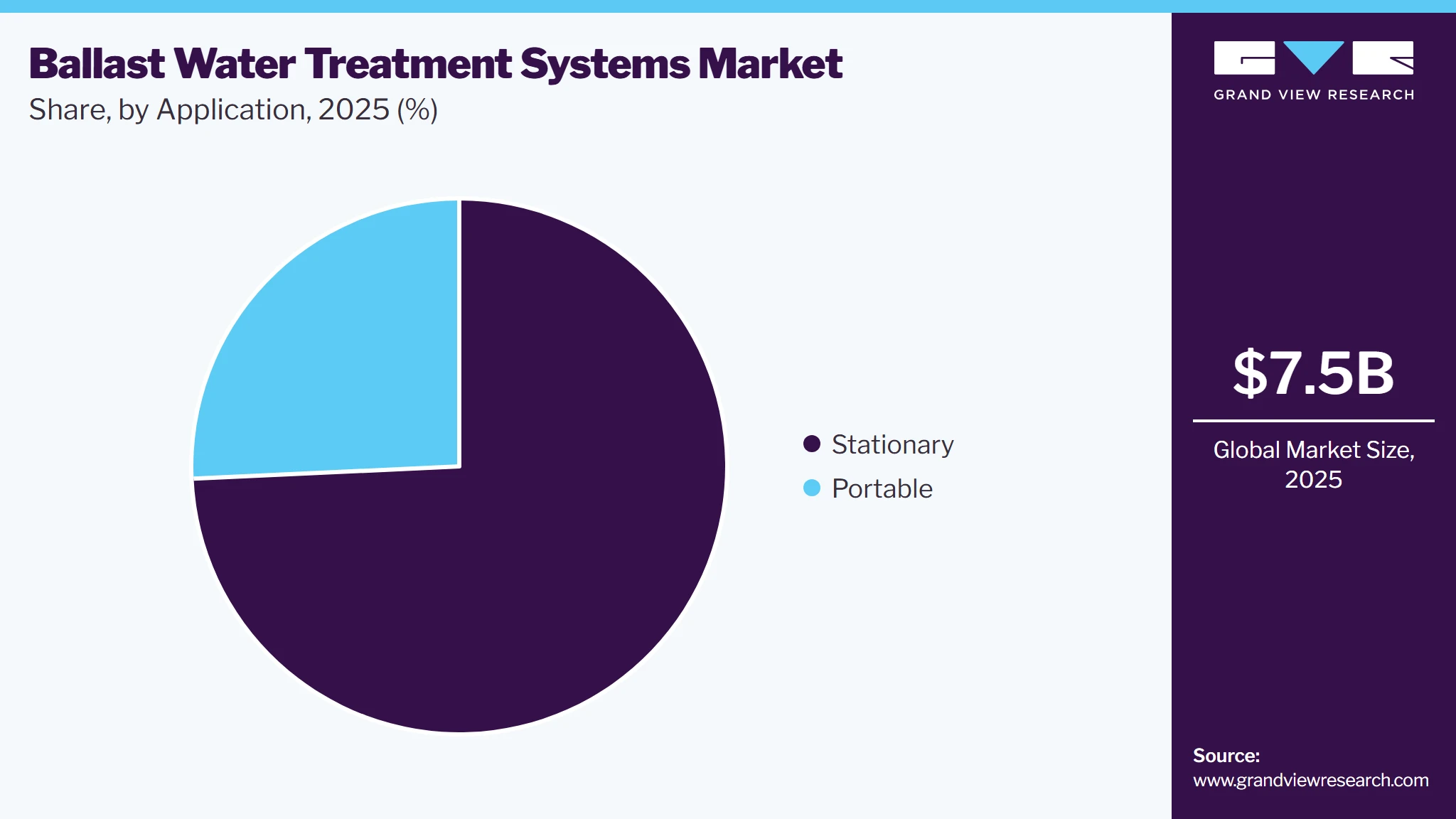
- By application: Stationary segment led the market with the largest revenue share of 74.3% in 2025.
Regional Highlights
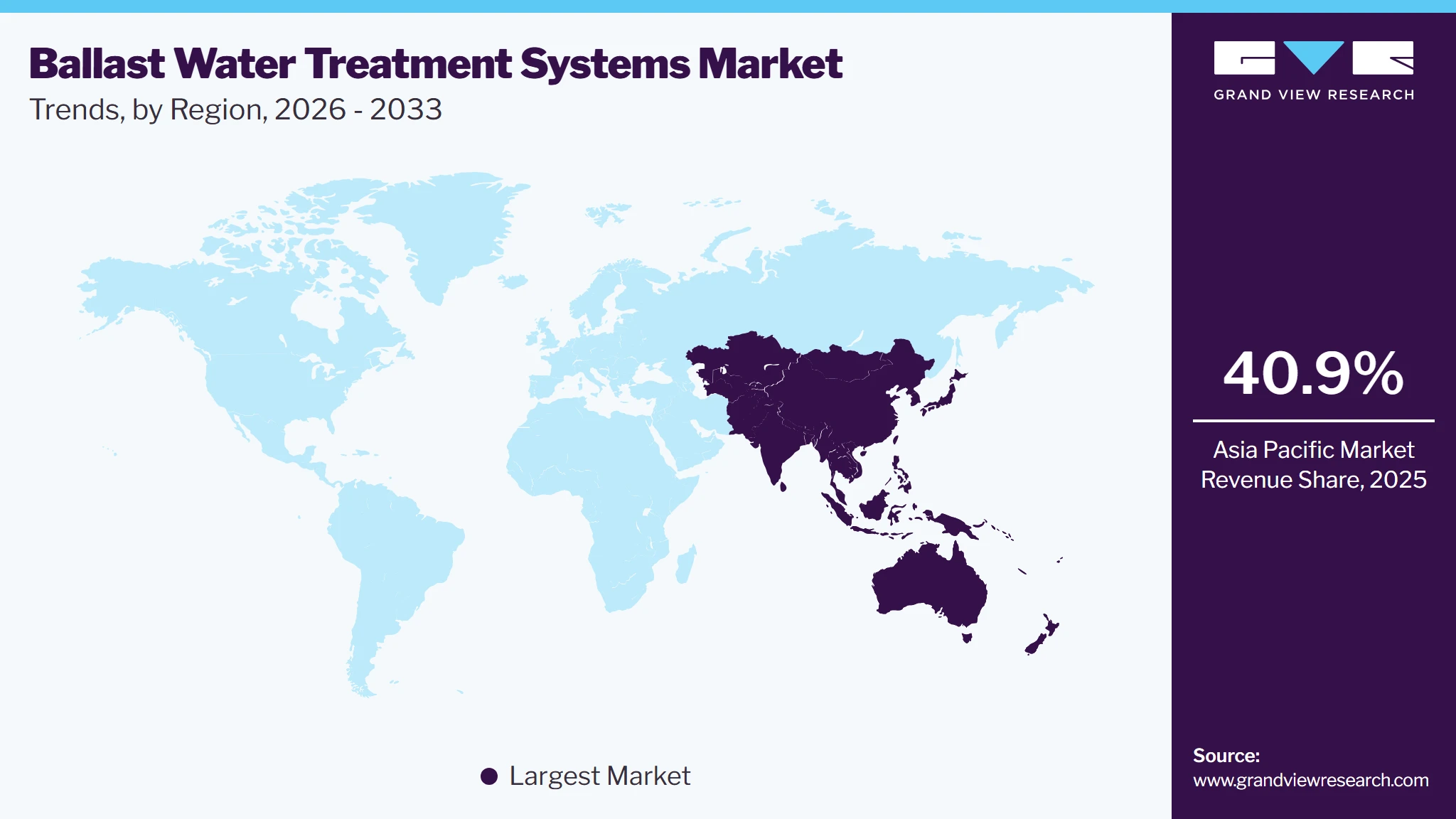
- Largest regional market: Asia Pacific (40.9% revenue share, 2025)
- By country: The China held the largest market share in 2025.
Market Size & Forecast
- Market size in 2025: USD 7.5 Billion
- Estimated market size in 2026: USD 7.9 Billion
- Projected market size by 2033: USD 14.4 Billion
- CAGR (2026-2033): 9.1%
Prism AI by Grand View Research Free to tryAsk a question about the ballast water treatment systems marketTry asking✓Every figure cited from GVR research Prefer the report? Download free sample →
Growing awareness of environmental sustainability and the need for cleaner oceans are also driving demand for advanced ballast water treatment technologies. The Ballast Water Management Convention (BWM Convention), adopted by the International Maritime Organization (IMO) in 2004, aims to prevent the spread of harmful aquatic organisms and pathogens by regulating the management of ballast water and sediments on ships.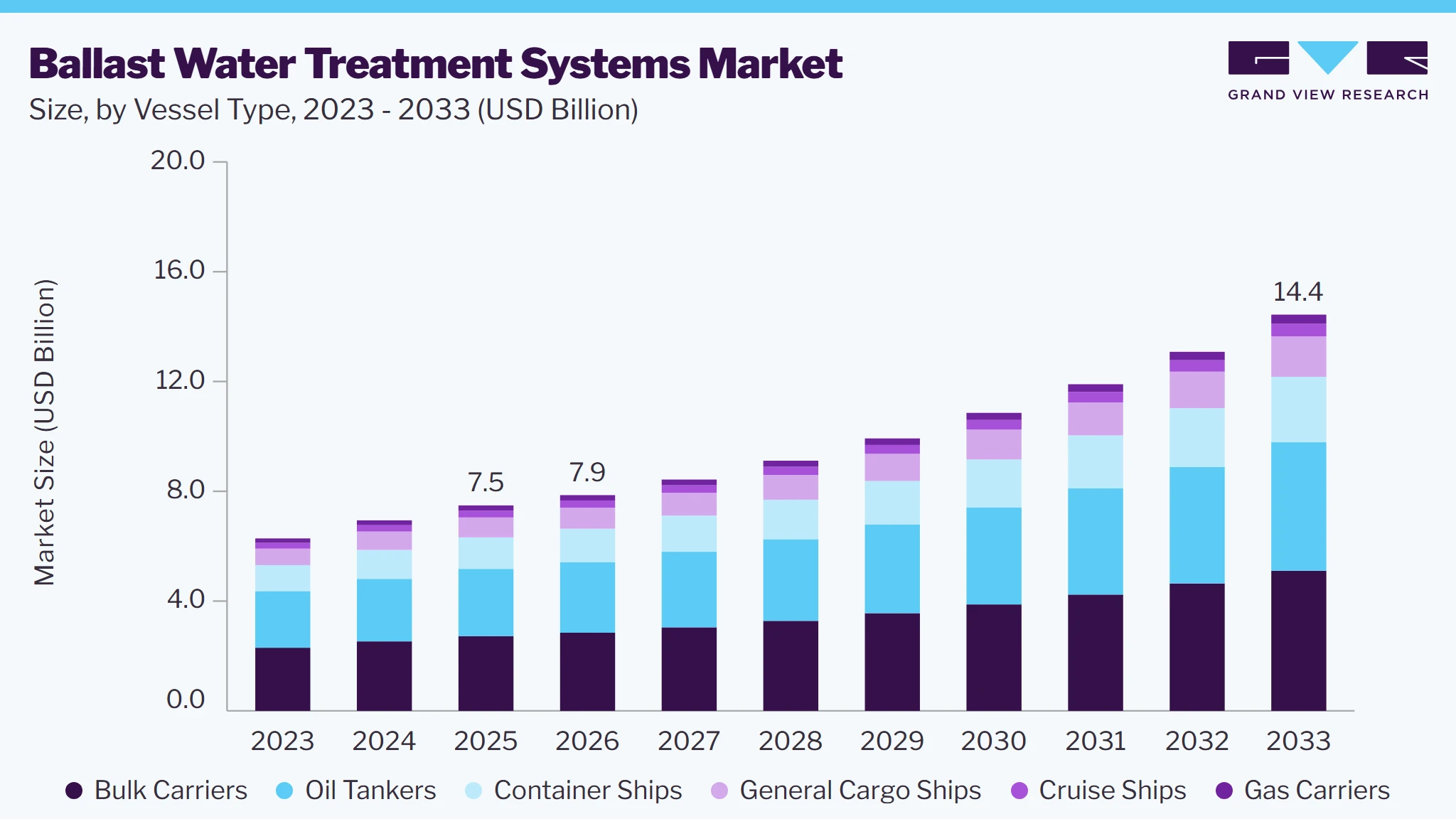 To learn more about this report, Download Free Sample Report
As of July 15, 2021, the Convention has been ratified by 86 countries, representing 91.12% of the global merchant fleet's gross tonnage. The Convention came into force on September 8, 2017, and mandates that all ships in international traffic manage ballast water and sediments according to specific standards, with these standards being phased in over time. The ultimate requirement is for all ships to install approved ballast water treatment systems to ensure compliance.
 To learn more about this report, Download Free Sample Report
The impact of the BWM Convention on the global ballast water treatment systems industry has been profound, driving substantial growth and innovation in the industry. The treaty has created a strong demand for compliant ballast water treatment solutions as shipping companies worldwide must retrofit or install new systems to meet these international standards. With enforcement of the Convention increasing, shipowners and operators are investing in advanced, reliable, and cost-effective treatment technologies to avoid penalties and ensure sustainable operations. This regulatory pressure continues to fuel innovation, prompting manufacturers to develop systems that are more efficient, environmentally friendly, and adaptable to diverse water conditions. As the global fleet works to comply with the BWM Convention, the ballast water treatment systems market is experiencing sustained growth, spurred by both regulatory compliance and a heightened focus on environmental sustainability.
Market Dynamics
The ballast water treatment systems market is witnessing steady growth, driven by increasingly stringent environmental regulations governing ballast water discharge and the global shipping industry's commitment to sustainable maritime operations. Growing international seaborne trade, expansion of commercial shipping fleets, and the continued retrofitting of existing vessels to comply with ballast water management standards are supporting market demand. Technological advancements, including compact UV-based treatment systems, advanced filtration technologies, and automated monitoring solutions, are improving treatment efficiency while reducing operational complexity.
The implementation of mandatory ballast water management regulations has become the primary driver for the ballast water treatment systems market. Governments and international maritime authorities have introduced strict discharge standards to prevent the spread of invasive aquatic species and protect marine biodiversity. Compliance with these regulations requires both newly built vessels and existing ships to install certified ballast water treatment systems, creating sustained demand for advanced treatment technologies across the global shipping industry.
In addition, port authorities and maritime regulators are strengthening inspection procedures and compliance enforcement, encouraging shipowners to invest in reliable and certified ballast water treatment solutions. As shipping companies seek to avoid operational delays, penalties, and non-compliance risks, demand for efficient, low-maintenance systems such as UV and electrochlorination technologies continues to rise. This regulatory landscape is expected to remain a key factor supporting long-term market expansion.
The high capital investment required for purchasing, installing, and integrating ballast water treatment systems remains a significant restraint for the market. Retrofitting older vessels often involves extensive engineering modifications, downtime, and compatibility challenges, increasing overall project costs. In addition, ongoing maintenance, periodic replacement of critical components, crew training, and system certification contribute to higher lifecycle expenses, making adoption more challenging for small and medium-sized ship operators with limited financial resources.
The increasing investment in fleet modernization and environmentally sustainable shipbuilding presents a significant opportunity for the ballast water treatment systems market. Shipowners are replacing aging vessels with technologically advanced ships designed to meet evolving environmental regulations while improving fuel efficiency and operational performance. This trend is creating strong demand for integrated ballast water treatment systems that are compact, energy-efficient, and easy to operate. As global shipbuilding activity continues to expand and maritime decarbonization initiatives gain momentum, manufacturers offering next-generation treatment technologies with digital monitoring and reduced operating costs are expected to benefit from substantial growth opportunities.
Market Concentration & Characteristics
The global ballast water treatment system market is consolidated, with a few large multinational companies holding significant market share. This concentration is driven by the high capital investment and specialized technology required to meet the stringent environmental regulations imposed by the International Maritime Organization (IMO) and other national authorities. These major players dominate the market due to their ability to develop and deploy advanced, cost-effective, and regulatory-compliant treatment systems for both new ships and retrofitting existing vessels.
Innovation in the ballast water treatment system industry is primarily focused on improving system efficiency, reducing operational costs, and ensuring compliance with international regulations. As environmental concerns over invasive species and marine biodiversity grow, leading manufacturers are investing in new technologies that offer better performance in varying water conditions and enhanced environmental sustainability. This innovation is crucial for companies looking to stay competitive and maintain their market position in a highly regulated and evolving industry.
 To learn more about this report, Download Free Sample Report
Despite the dominance of large players, regional suppliers are finding success in niche markets, particularly in emerging economies where the demand for ballast water treatment systems is growing. These smaller players often offer more affordable solutions and cater to specific regional needs. However, the complexity of the systems and the regulatory requirements act as barriers to entry for new companies. To maintain their competitive advantage, the leading players in the market must continue innovating and adapting to regulatory changes, ensuring their systems are both efficient and environmentally friendly.
Analyst Perspective
The ballast water treatment systems market is expected to witness sustained growth over the forecast period, primarily driven by stricter environmental regulations, increasing retrofit activities, and continued expansion of the global commercial shipping fleet. While regulatory compliance remains the primary purchasing factor, shipowners are increasingly prioritizing treatment systems that offer lower energy consumption, simplified maintenance, and seamless integration with onboard automation systems. In addition, rising investments in fleet modernization, digital vessel management, and sustainable maritime operations are encouraging manufacturers to develop compact, intelligent, and highly efficient treatment systems. Companies that combine regulatory expertise, global service capabilities, and advanced treatment technologies will be well positioned to strengthen their market presence as the shipping industry continues to focus on environmental compliance and operational efficiency.
Drivers, Opportunities & Restraints
The ballast water treatment system market is primarily driven by increasing global trade and shipping activity, which has led to a greater need for efficient systems to prevent the spread of invasive species through ballast water. The International Maritime Organization (IMO) Ballast Water Management Convention, which mandates that vessels treat their ballast water before discharge, has been a significant driver for the adoption of these systems.
The high initial cost of installing ballast water treatment systems and the complexity of retrofitting existing vessels can act as a restraint for the market. Additionally, concerns about system performance under various water conditions and operational challenges could slow adoption rates in certain regions or fleets.
There are significant opportunities in the development of advanced, cost-effective, and energy-efficient ballast water treatment technologies. As international regulations tighten and enforcement becomes more stringent, the need for innovative and compliant systems will grow. Additionally, the expansion of the maritime industry in emerging markets presents opportunities for market growth in regions where shipping and trade are increasing.
Vessel Type Insights
Based on vessel type, bulk carriers segment led the market with the largest revenue share of 36.3% in 2025. driven by the global rise in trade of bulk commodities like coal, iron ore, and grain. As bulk carriers frequently travel long distances, the need to comply with the Ballast Water Management Convention (BWM Convention) ensures they adopt effective treatment solutions to prevent the spread of invasive species.
Container ships are crucial to global trade, and with increasing traffic in international shipping lanes, regulatory pressure on ballast water management is intensifying. The demand for treatment systems on container ships is driven by the need to comply with environmental regulations like the IMO's BWM Convention, which necessitates the installation of treatment systems to prevent the transfer of harmful aquatic species.
System Type Insights
Based on system type, filtration segment led the market with the largest revenue share of 31.5% in 2025. Filtration systems for ballast water treatment are in demand due to their ability to effectively remove suspended solids and microorganisms from ballast water, making them a key component of compliant ballast water management. As regulations tighten and the need for efficient and reliable treatment solutions rises, filtration systems offer a cost-effective, low-maintenance option for many vessel operators, especially for ships operating in cleaner water conditions or with lower levels of contamination.
Deoxygenation systems, which remove oxygen from ballast water to prevent the survival of invasive species, are increasingly sought after due to their efficiency in preventing biological contamination. Particularly effective in certain water conditions, these systems are seen as vital for vessels operating in sensitive or environmentally protected areas. The growing emphasis on eco-friendly solutions, coupled with strict regulatory requirements, is pushing vessel operators to adopt deoxygenation systems that offer high performance in minimizing invasive species threats.
Capacity Insights
Based on capacity, 250 -500 m3/hr segment led the market with the largest revenue share of 28.3% in 2025. driven by the need for medium-sized vessels, such as general cargo ships, to meet regulatory standards while maintaining operational efficiency. This capacity range is suitable for a wide variety of vessels, offering a balance of treatment performance and cost-effectiveness. With rising global trade and the need for more ships to comply with ballast water management regulations, demand for systems in this capacity range is growing rapidly.
Ballast water treatment systems with a capacity of below 250 cubic meters per hour are in demand for smaller vessels and those operating in niche markets. This capacity range is particularly attractive for vessels with limited ballast water volumes, such as smaller freighters, fishing vessels, and cruise ships, where a compact and efficient treatment solution is essential. Regulatory pressure, coupled with the need to adhere to international standards, drives the adoption of these smaller-scale systems.
Application Insights
Based on application, stationary segment led the market with the largest revenue share of 74.3% in 2025. Stationary ballast water treatment systems are favored for vessels that operate in controlled and consistent environments, such as large cargo ships or oil tankers. These systems are designed for permanent installation, offering high capacity and operational efficiency for long-term use. The growing number of vessels requiring retrofits and upgrades to meet global environmental standards has led to an increase in demand for stationary systems that offer long-term reliability and compliance with the Ballast Water Management Convention.
 To learn more about this report, Download Free Sample Report
Portable ballast water treatment systems are gaining traction due to their flexibility, cost-effectiveness, and ease of installation on various vessel types. These systems allow for the retrofitting of smaller vessels or ships operating on less frequent international trade routes, where permanent installations may not be required. As shipping companies seek more adaptable and scalable solutions to meet regulatory requirements without incurring high installation costs, portable systems are becoming an increasingly popular choice.
Regional Insights
Asia Pacific dominated the ballast water treatment systems market with the largest revenue share of 40.9% in 2025. The region is experiencing rapid growth in shipping activity, with countries like China, Japan, and South Korea being major maritime hubs. Increasing regulatory pressure and the region’s rising environmental concerns are driving demand for ballast water treatment systems. The growing maritime industry in countries such as India, along with expanding trade routes, presents a significant opportunity for market growth in this region.
 To learn more about this report, Download Free Sample Report
The ballast water treatment systems market in the China held the largest share in the Asia Pacific region in 2025. China, as the largest shipping hub in the world, presents enormous potential for ballast water treatment system growth. The country is gradually increasing its compliance with international maritime regulations, including ballast water management. With a booming maritime trade industry and growing environmental awareness, China is expected to see strong market demand for ballast water treatment systems.
The ballast water treatment systems market in Singapore is projected to grow at a CAGR of 10% over the forecast period. The market is growing rapidly, driven by the country’s strategic position as a global shipping hub. As a key maritime nation, Singapore has stringent environmental regulations in line with the IMO's Ballast Water Management Convention, which compels ships operating in its ports to adopt compliant treatment systems.
North America Ballast Water Treatment Systems Market Trends
In North America, the ballast water treatment systems industry’s growth is driven by strict environmental regulations and the increasing focus on sustainable maritime practices. The United States, in particular, has implemented regulations that align with international standards, leading to a rising demand for ballast water treatment systems. As shipping volumes continue to increase, the market is expected to grow further, with both Filtration fleets and government vessels adopting cleaner technologies to meet compliance.
North America Ballast Water Treatment Systems Market Trends
The U.S. ballast water management industry is projected to expand at a CAGR of 6.7% over the forecast period. The country's market is driven by its stringent regulatory framework and large maritime industry. The U.S. Coast Guard has been actively involved in enforcing ballast water management regulations, prompting shipping companies to invest in compliance technologies. As the market shifts towards more sustainable practices, demand for ballast water treatment systems is expected to increase.
Europe Ballast Water Treatment Systems Market Trends
Europe is a significant player in the ballast water treatment system industry, with its growth driven by the region’s proactive environmental policies and sustainability goals. The European Union’s stringent environmental standards and maritime regulations compel shipping companies to adopt advanced treatment systems. As a result, there is a strong push for compliance, innovation, and the development of eco-friendly technologies across European countries.
The Germany ballast water treatment systems market is projected to expand at a CAGR of 8.6% over the forecast period. German shipping companies are investing in advanced ballast water treatment technologies to comply with both national and international regulations. Germany’s position as a maritime leader in Europe drives significant demand for efficient and eco-friendly solutions.
The ballast water treatment systems market in Greece is expected to grow at a CAGR of 8.3% over the forecast period due to the country’s prominent position in global shipping. Greece has one of the largest merchant fleets in the world, which is subject to stringent international regulations, including the IMO's Ballast Water Management Convention.
Middle East & Africa Ballast Water Treatment Systems Market Trends
In the Middle East and Africa, the ballast water treatment systems industry growth is fueled by the region’s strategic position in global shipping routes and its growing investment in port infrastructure. The adoption of international ballast water treatment regulations is gradually increasing, leading to more widespread implementation of treatment systems in the shipping sector. However, the market may face challenges due to inconsistent enforcement of environmental standards across the region.
The Saudi Arabian ballast water treatment systems market is projected to expand at a CAGR of 9.6% over the forecast period. The nation’s strategic position in global shipping routes and its investment in maritime infrastructure are driving demand for ballast water treatment systems. As the country looks to enhance its environmental standards in line with international regulations, the market for ballast water treatment systems is expected to grow, particularly in the shipping and oil sectors.
Latin America Ballast Water Treatment Systems Market Trends
Latin America is witnessing growth in its ballast water treatment system industry due to expanding shipping routes and increasing international trade. However, some countries in the region are still in the early stages of implementing stringent environmental regulations, creating a gap in demand. As regulatory frameworks strengthen, the market for ballast water treatment systems is expected to expand.
The ballast water treatment systems market in Brazil is projected to grow at a CAGR of 8.8% over the forecast period. Brazil’s growing role in the global shipping network, particularly in the export of commodities like soybeans, iron ore, and oil, has led to higher scrutiny on ballast water management in its ports. As Brazil aligns with the IMO’s Ballast Water Management Convention, there is a rising demand for treatment systems to ensure compliance with international regulations.
Key Ballast Water Treatment Systems Company Insights
Some of the key players operating in the market include Alfa Laval. and Veolia among others.
-
Alfa Laval is a global company engaged in providing specialized products and solutions in heat transfer, separation, and fluid handling. The company operates across three main divisions: Energy, Food & Water, and Marine. It serves various industries including chemicals, oil & gas, food, and wastewater treatment.
-
Veolia is a multinational company engaged in the designing and distribution of water, waste, and energy management solutions. It operates through three business segments, namely water management, waste management, and energy management.
Key Ballast Water Treatment Systems Companies
The following key companies have been profiled for this study on the ballast water treatment systems market.
-
Wärtsilä
-
ALFA LAVAL
-
Evac
-
Auramarine Ltd
-
Veolia
-
Coldharbour Marine Ltd.
-
GenSys GmbH
-
Damen Shipyards Group
-
Hyde Marine Inc.
-
MH Systems Inc.
-
NEI Treatment Systems
-
Optimarin AS
Competitive Benchmarking
Category
Operating Strategies
Competitive Edge
Weakness
Established Players (e.g., Wärtsilä, ALFA LAVAL, Optimarin AS, Veolia, ERMA FIRST ESK Engineering S.A., PANASIA CO., LTD.)
- Focus on continuous product innovation with IMO and USCG type-approved ballast water treatment systems.
- Strengthen global service, retrofit, and maintenance capabilities through extensive partner and service networks.
- Collaborate with major shipyards and fleet operators to secure newbuild and retrofit contracts.
- Strong global brand recognition and a large installed base across commercial shipping fleets.
- Comprehensive product portfolios covering UV, electrochlorination, and hybrid treatment technologies.
- Extensive regulatory expertise and worldwide after-sales support.
- High system and installation costs compared to regional competitors.
- Slower response to niche market requirements due to large organizational structures.
- Revenue is influenced by fluctuations in global shipbuilding and retrofit cycles.
Emerging & Regional Players (e.g., Coldharbour Marine Ltd., Auramarine Ltd, GenSys GmbH, MH Systems Inc., NEI Treatment Systems, Ecochlor.)
- Develop specialized and energy-efficient ballast water treatment technologies for targeted vessel segments.
- Expand market presence through regional distributors, technology partnerships, and retrofit opportunities.
- Focus on cost-effective and compact systems to address customer-specific requirements.
- Greater flexibility in product customization and project execution.
- Faster commercialization of innovative treatment technologies.
- Competitive pricing that appeals to regional shipowners and smaller fleets.
- Limited global distribution, service infrastructure, and customer reach.
- Lower brand visibility compared to leading multinational manufacturers.
- Smaller financial resources may restrict large-scale R&D investments and international expansion.
Recent Developments
-
In January 2025, Scienco/FAST and UniBallast B.V. introduced the InTankFITT Container, a containerized version of their filterless Ballast Water Treatment System (BWTS), InTank. This portable system is designed to ensure regulatory compliance and operational efficiency, housing a preassembled treatment system within a standard shipping container, making it suitable for shared use across multiple vessels or for temporary applications.
-
In July 2023, Wärtsilä introduced its Aquarius UV Ballast Water Management System (BWMS) with a brand-new filtration solution. Developed in collaboration with their partner Filtersafe Automatic Screen Filtration, the Manta filter incorporates a unique OneMotion scanner that cleans the screen with just one rotation. Tests have demonstrated that the 'Manta' filter effectively cleans the screen quickly and efficiently, even when faced with high dirt loads.
Ballast Water Treatment Systems Market Report Scope
Report Attribute
Details
Market size in 2025
USD 7.5 billion
Estimated market size in 2026
USD 7.9 billion
Projected market size by 2033
USD 14.4 billion
Growth rate
CAGR of 9.1% from 2026 to 2033
Base year for estimation
2025
Historical data
2021 - 2024
Forecast period
2026 - 2033
Quantitative units
Revenue in USD billion and CAGR from 2026 to 2033
Report coverage
Revenue forecast, company ranking, competitive landscape, growth factors, and trends
Segments covered
Vessel type, system type, capacity, application, region.
Regional scope
North America; Europe; Asia Pacific; Latin America; Middle East & Africa
Country scope
U.S.; Canada; Mexico; Greece; UK; Germany; France; Italy; Spain; China; India; Japan; Singapore; South Korea; Australia; Brazil; Argentina; South Africa; Saudi Arabia; UAE
Key companies profiled
Wärtsilä; ALFA LAVAL; Evac; Auramarine Ltd; Veolia; Coldharbour Marine Ltd.; GenSys GmbH; Damen Shipyards Group; Hyde Marine Inc.; MH Systems Inc.; NEI Treatment Systems; Optimarin AS; ERMA FIRST ESK Engineering S.A.; PANASIA CO., LTD.; Ecochlor.
Customization scope
Free report customization (equivalent up to 8 analysts' working days) with purchase. Addition or alteration to country, regional & segment scope.
Pricing and purchase options
Avail customized purchase options to meet your exact research needs. Explore purchase options
Global Ballast Water Treatment Systems Market Report Segmentation
This report forecasts revenue growth at global, regional & country levels and provides an analysis on the industry trends in each of the sub-segments from 2021 to 2033. For this study, Grand View Research has segmented the global ballast water treatment systems market report based on vessel type, system type, capacity, application, and region:
-
Vessel Type Outlook (Revenue, USD Million, 2021 - 2033)
-
Bulk Carriers
-
Oil Tankers
-
Container Ships
-
General Cargo Ships
-
Gas Carriers
-
Cruise Ships
-
-
System Type Outlook (Revenue, USD Million, 2021 - 2033)
-
Filtration
-
Chemical Disinfection
-
UV Treatment
-
Deoxygenation
-
Heat Treatment
-
Ultrasonic Treatment
-
Others
-
-
Capacity Outlook (Revenue, USD Million, 2021 - 2033)
-
Below 250 cubic meters per hour
-
250 -500 cubic meters per hour
-
501-750 cubic meters per hour
-
751-1000 cubic meters per hour
-
Above 1000 cubic meters per hour
-
-
Application (Revenue, USD Million, 2021 - 2033)
-
Stationary
-
Portable
-
-
Regional Outlook (Revenue, USD Million, 2021 - 2033)
-
North America
-
U.S.
-
Canada
-
Mexico
-
-
Europe
-
UK
-
Spain
-
France
-
Germany
-
Italy
-
Greece
-
-
Asia Pacific
-
China
-
India
-
Japan
-
South Korea
-
Singapore
-
Australia
-
-
Latin America
-
Brazil
-
Argentina
-
-
Middle East & Africa
-
South Africa
-
Saudi Arabia
-
UAE
-
-
Research Methodology
The ballast water treatment systems market figures in this report are based on a proven research process that combines executive interviews with secondary research from proprietary databases, company filings, and recognized regulatory and institutional sources. Market size is built through value-chain sizing-reconciling supply-side and demand-side estimates-and triangulated with bottom-up and top-down approaches. Every estimate passes multiple levels of expert validation before publication, with each ballast water treatment systems segment quantified using the revenue-capture definitions in the table below.
Segment Definition
Vessel Type
Revenue Capture Definition
Bulk Carriers
Revenue generated from the sale of ballast water treatment systems, filtration units, control systems, and related equipment installed on bulk carriers transporting commodities such as coal, iron ore, grains, and minerals. Revenue includes both new vessel installations and retrofit projects for regulatory compliance.
Oil Tankers
Revenue generated from the sale of ballast water treatment systems designed for crude oil and petroleum product carriers, including high-capacity treatment units, automation systems, monitoring equipment, and associated onboard components supplied for newbuild and retrofit vessels.
Container Ships
Revenue generated from the sale of ballast water treatment systems supplied for container ships operating on international shipping routes. This includes integrated treatment equipment, monitoring systems, and associated hardware required to meet ballast water discharge regulations.
General Cargo Ships
Revenue generated from the sale of ballast water treatment systems installed on general cargo vessels carrying packaged goods, machinery, steel products, and breakbulk cargo. Revenue includes complete treatment packages and system integration components.
Gas Carriers
Revenue generated from the sale of ballast water treatment systems engineered for LNG, LPG, and other gas carriers requiring reliable, high-performance, and safety-compliant ballast water management solutions.
Cruise Ships
Revenue generated from the sale of ballast water treatment systems supplied for passenger vessels, including energy-efficient treatment technologies, automated monitoring systems, and environmentally compliant equipment designed for continuous onboard operation.
Capacity
Revenue Capture Definition
Below 250 m3/hr
Revenue generated from the sale of low-capacity ballast water treatment systems below 250 m3/hr, designed for small commercial vessels, offshore support vessels, research ships, fishing vessels, and other marine applications requiring relatively low ballast water flow rates.
250 -500 m3/hr
Revenue generated from the sale of medium-capacity ballast water treatment systems 250-500 m3/hr, widely used across bulk carriers, tankers, general cargo ships, and medium-sized commercial vessels requiring balanced treatment performance and installation efficiency.
501-750 m3/hr
Revenue generated from the sale of medium-to-high-capacity ballast water treatment systems 501-750 m3/hr, supplied for large commercial vessels with higher ballast water processing requirements during cargo operations.
751-1000 m3/hr
Revenue generated from the sale of high-capacity ballast water treatment systems 751-1000 m3/hr, for large tankers, container ships, and bulk carriers requiring continuous treatment of substantial ballast water volumes.
Above 1000 m3/hr
Revenue generated from the sale of very high-capacity ballast water treatment systems above 1000 m3/hr, designed for ultra-large commercial vessels, including VLCCs, Capesize bulk carriers, and ultra-large container ships with significant ballast water handling requirements.
System Type
Revenue Capture Definition
Filtration
Revenue generated from the sale of filtration equipment, used to remove sediments, suspended solids, and larger aquatic organisms before the disinfection process for various vessel types.
Chemical Disinfection
Revenue generated from the sale of chemical ballast water treatment systems, including electrochlorination systems, chemical dosing units, oxidant generation equipment, neutralization systems, monitoring instruments, and automated control systems designed to disinfect ballast water by eliminating microorganisms and invasive species.
UV Treatment
Revenue generated from the sale of ultraviolet (UV) ballast water treatment systems, including UV reactors, UV lamps, quartz sleeves, power supply units, sensors, and automated control systems used to inactivate microorganisms without the addition of chemicals.
Deoxygenation
Revenue generated from the sale of ballast water deoxygenation systems, inert gas generators, vacuum-based treatment equipment, and related technologies that eliminate dissolved oxygen to prevent the survival of aquatic organisms in ballast water.
Heat Treatment
Revenue generated from the sale of thermal ballast water treatment systems, including heat exchangers, heating units, temperature monitoring devices, circulation equipment, and associated control systems that disinfect ballast water through controlled heat exposure.
Ultrasonic Treatment
Revenue generated from the sale of ultrasonic ballast water treatment systems that use high-frequency acoustic waves, electronic controllers, and transducers to control or deactivate microorganisms in ballast water.
Others
Revenue generated from the sale of alternative ballast water treatment technologies, including ozone-based systems, advanced oxidation processes, hybrid treatment solutions, and other emerging technologies designed to meet international discharge standards.
Application
Revenue Capture Definition
Stationary
Revenue generated from the sale of stationary ballast water treatment systems integrated into a vessel's ballast water management infrastructure, including treatment equipment, piping integration, automation systems, monitoring devices, and associated onboard components.
Portable
Revenue generated from the sale of mobile/portable ballast water treatment units designed for temporary deployment, vessel retrofits, testing, emergency operations, maintenance activities, and specialized marine applications where permanent installation is not practical.
Estimation Model
Layer No.
Layer Name
Key Question
Description
01
Vessel Fleet Assessment
Which vessel categories require ballast water treatment systems and what is their installation potential?
Estimate the addressable market by analyzing the global fleet of bulk carriers, oil tankers, container ships, general cargo ships, gas carriers, cruise ships, and other commercial vessels requiring ballast water management systems.
02
Technology & Installation Analysis
Which treatment technologies and installation types are witnessing the highest adoption?
Assess demand across UV treatment, chemical disinfection, filtration, deoxygenation, heat treatment, ultrasonic treatment, and other technologies while evaluating newbuild installations and retrofit opportunities across vessel fleets.
03
Regional Adoption & Regulatory Compliance
Which regions and maritime regulations are driving system deployment?
Evaluate adoption based on regional shipping activity, shipbuilding capacity, retrofit programs, and compliance with IMO Ballast Water Management Convention and USCG ballast water discharge standards across major maritime regions.
04
Revenue Estimation
What is the total revenue generated from ballast water treatment system sales?
Estimate market revenue based on technology adoption trends, product pricing, retrofit and newbuild demand, replacement cycles, technology mix, and regional demand patterns.
Delivered Customizations
This report has been delivered with the following In-depth customizations
Client Request
Customization Delivered
Value Adds
Regional Segmentation
Delivered a comprehensive regional assessment covering North America, Europe, Asia Pacific, Latin America, and the Middle East & Africa, along with detailed country-level analysis of major maritime economies. The report evaluated fleet size, shipbuilding activities, ballast water management regulations, retrofit demand, port infrastructure, and regional technology adoption trends to identify high-growth markets.
Enabled stakeholders to identify priority investment regions, understand country-specific regulatory landscapes, evaluate regional growth opportunities, and develop targeted market entry and expansion strategies.
Competitive Benchmarking
Delivered an in-depth competitive assessment of leading ballast water treatment system manufacturers, including product portfolios, technology platforms, strategic developments, regional presence, competitive positioning, operating strategies, strengths, and market differentiation across established and emerging players.
Helped clients benchmark competitors, identify technology leaders, evaluate partnership and acquisition opportunities, understand competitive gaps, and formulate effective product positioning and business growth strategies.
Opportunity Assessment
Delivered a detailed evaluation of current and future growth opportunities across vessel categories, treatment technologies, retrofit installations, new shipbuilding projects, digital monitoring solutions, and evolving environmental compliance requirements. The assessment also highlighted emerging market trends, investment hotspots, and long-term demand drivers shaping the industry.
Supported strategic decision-making by identifying high-growth investment areas, technology adoption trends, untapped customer segments, and future revenue opportunities, enabling clients to prioritize product development and long-term business expansion.
Frequently Asked Questions About This Report
The global ballast water treatment systems market size was estimated at USD 7.5 billion in 2025 and is projected to grow from USD 7.9 billion in 2026.
The global ballast water treatment systems market, in terms of revenue, is expected to grow at a compound annual growth rate of 9.1% from 2026 to 2033 to reach USD 14.4 billion by 2033.
Asia Pacific dominated the global market with the largest revenue share of 40.9% in 2025, supported by its strong shipbuilding industry, expanding commercial shipping fleet, major international ports, and stringent adoption of ballast water management regulations.
Asia Pacific is projected to be the fastest-growing regional market, driven by increasing investments in new shipbuilding, rising retrofit activities, expanding maritime trade, and stricter environmental compliance across major shipping nations such as China, South Korea, Japan, and India.
The bulk carriers segment dominated the market, accounting for 36.3% of the global revenue share in 2025. The large global fleet of bulk carriers and their frequent ballast water operations for transporting commodities such as coal, iron ore, and grain have driven strong demand for ballast water treatment systems.
The filtration segment led the market with a 31.5% revenue share in 2025. Filtration serves as the primary treatment stage in most ballast water treatment systems by removing sediments and larger marine organisms before secondary disinfection.
The stationary segment accounted for the largest revenue share of 74.3% in 2025. Permanently installed systems are preferred by commercial ship operators due to their long-term reliability, regulatory compliance, and continuous onboard operation.
Some of the key players operating in the ballast water treatment systems market are Wärtsilä; ALFA LAVAL; Evac; Auramarine Ltd; Veolia; Coldharbour Marine Ltd.; GenSys GmbH; Damen Shipyards Group; Hyde Marine Inc.; MH Systems Inc.; NEI Treatment Systems; Optimarin AS; ERMA FIRST ESK Engineering S.A.; PANASIA CO., LTD.; Ecochlor.
The market is primarily driven by stringent international ballast water management regulations, particularly the IMO Ballast Water Management Convention, which requires ships to install approved ballast water treatment systems to prevent the spread of invasive aquatic species and protect marine ecosystems.
About the Author(s)
Advanced Interior Materials Research Team
Advanced Materials · Advanced Interior MaterialsThis report was authored by the advanced interior materials research team at Grand View Research - comprising two research analysts, one senior research analyst, and one industry expert - with specialized expertise in the advanced interior materials segment of the advanced materials industry. All findings are based on proprietary advanced materials databases, executive interviews, and regulatory analysis, subject to internal peer review prior to publication.
Last Updated:
Speak to Analyst

Customize this report to your needs - add regions, segments, or data points, with 20% free customization.
Or view our licence options:


ISO 9001:2015 & 27001:2022 Certified
We are GDPR and CCPA compliant! Your transaction & personal information is safe and secure. For more details, please read our privacy policy.


