
- Home
- »
- Next Generation Technologies
- »
-
Bancassurance Market Size And Share Report, 2026-2033GVR Report cover
![Bancassurance Market (2026 - 2033)Report]()
Bancassurance Market (2026 - 2033)
Size, Share & Trends Analysis Report By Type (Life Insurance, Non-Life Insurance), By Model Type (Pure Distributor Model, Strategic Alliance Model, Joint Venture Model), By End Use, By Region, And Segment Forecasts
Market Size, 2025
$1,367.1BMarket Estimate, 2026
$1,435.9BMarket Forecast, 2033
$2,216.3BCAGR, 2026–2033
6.4%Bancassurance Market Summary
The global bancassurance market size was valued at USD 1,367.1 billion in 2025 and is projected to grow from USD 1,435.9 billion in 2026 to USD 2,216.3 billion by 2033, at a CAGR of 6.4% from 2026 to 2033. The market in Asia Pacific dominated with a revenue share of 45.5% in 2025. The rising demand for life and health protection is driving the growth of the bancassurance market.

Key Market Trends & Insights
- By type: Life insurance segment led the market and accounted for 66.0% of the global revenue in 2025 and is projected to grow at the fastest CAGR over the forecast period
- By model type: Strategic alliance model segment led the market and accounted for 39.5% of the global revenue in 2025.
- By end use: Personal segment accounted for the largest share of global revenue in 2025 and is projected to grow at the fastest CAGR over the forecast period.
Regional Highlights
- Largest regional market: Asia Pacific (45.5% revenue share, 2025)
- By country: China held the largest market share in 2025.
Market Size & Forecast
- Market Size in 2025: USD 1,367.1 Billion
- Estimated Market Size in 2026: USD 1,435.9 Billion
- Projected Market Size by 2033: USD 2,216.3 Billion
- CAGR (2026-2033): 6.4%
The rising demand for integrated financial services is accelerating market growth. Customers are increasingly seeking convenient access to multiple financial products through a single trusted institution. Bancassurance enables banks to offer insurance alongside banking, savings, investment, and retirement products. This reduces the need for customers to approach separate financial service providers for different needs. Banks can also use existing customer relationships to recommend insurance products based on individual financial requirements. This is driving demand for integrated financial services, which is supporting the adoption of bancassurance channels.The growing integration of insurance into digital banking platforms is trending in the market. Banks are increasingly integrating insurance products into mobile banking applications and online banking platforms. This enables customers to explore, purchase, renew, and manage insurance policies through familiar banking channels. Digital platforms also allow banks to offer insurance alongside loans, savings, investments, and payment services. This improves convenience and enables banks to reach a larger customer base without relying only on physical branches. This trend is supporting the expansion of bancassurance by making insurance distribution faster and more accessible.

The growing volume of insurance transactions and the increasing digital insurance sales are driving the need for stronger market regulation. These regulations provide proper maintenance and sharing of information among insurers and other regulated entities. This improves transparency and supports better regulatory oversight. Banks and insurers are strengthening their information management practices. This supports the adoption of more reliable and compliant bancassurance services.
Data Privacy and Security Concerns poses a restraint in the market. The increasing use of customer data for insurance distribution raises concerns regarding data protection and unauthorized access. Banks and insurers need to ensure secure handling of customer information across sales and service activities. These concerns may limit customer trust and hinder the adoption of digital bancassurance channels.
Market Dynamics
The bancassurance market is being driven by increasing demand for convenient insurance distribution, wider banking access, and growing digitalization of financial services. Banks are increasingly using branches, internet banking, and mobile banking platforms to distribute insurance products to existing customers. Digital channels are improving the convenience of purchasing and managing insurance policies. At the same time, insurers are using banking networks to expand customer reach and reduce dependence on traditional insurance distribution channels.
The increasing adoption of insurance through banking channels is driving the growth of the market. Banks maintain regular relationships with customers through savings accounts, loans, credit cards, investments, and other financial services. These relationships provide banks with opportunities to identify customers who may require insurance protection. Customers can also purchase insurance through a financial institution they already use, reducing the need to approach a separate insurance provider. This makes banking channels an important channel for increasing insurance penetration, particularly for customers seeking simple, convenient access to insurance products.
Bancassurance enables banks to offer insurance products through branches, relationship managers, internet banking, and mobile applications. This allows banks to reach a large customer base without developing a separate insurance distribution network. Insurance providers also benefit from access to established banking relationships and broader customer groups. The combination of existing customer relationships and multiple distribution channels support higher insurance sales and contributes to growth in the Bancassurance Market.
Limited customer awareness is a restraint in the bancassurance market because some customers are unaware that insurance products are available through banking channels. Customers may continue to purchase insurance directly from insurers, agents, or other traditional channels due to established buying habits. This reduces the number of customers who consider banks an insurance distribution channel.
Limited awareness can restrict cross-selling opportunities and reduce insurance sales through bank branches and digital banking platforms. The impact can be stronger in developing markets where insurance penetration and financial awareness remain relatively low. Banks and insurers may therefore need to invest more in customer education and product communication, increasing the effort required to expand bancassurance adoption.
The increasing digitalization of banking services is creating new opportunities for the bancassurance market. Customers are increasingly using mobile banking applications and online banking platforms for financial activities, creating additional points where insurance products can be offered. Digital channels can simplify insurance applications, payments, policy servicing, and customer communication. This enables bancassurance providers to extend insurance distribution beyond traditional bank branches.
Digital bancassurance can increase cross-selling opportunities and enable insurance products to be offered in line with customers' financial needs and existing banking relationships. It can also reduce reliance on physical branches and improve access to insurance in markets with high levels of digital banking usage. Providers with strong digital banking capabilities, broad customer bases, and diverse insurance portfolios are well positioned to benefit from this opportunity. Increasing investment in digital platforms and integrated financial services is therefore expected to support future market expansion.
Market Concentration & Characteristics
The bancassurance market is moderately consolidated, with a limited number of large financial institutions holding strong competitive positions, while a broader group of regional and smaller players participates through distribution agreements, strategic alliances, and other partnership models. The market is not fully concentrated because insurance distribution is spread across banks and other financial institutions, each with different geographic coverage, customer bases, and insurance capabilities. However, established players have an advantage due to their large customer networks, strong brand recognition, established banking relationships, broad insurance offerings, and ability to invest in digital distribution platforms. These factors create relatively high barriers to entry for new participants, as building customer trust, regulatory capabilities, banking relationships, and an effective insurance distribution network requires significant time and investment.
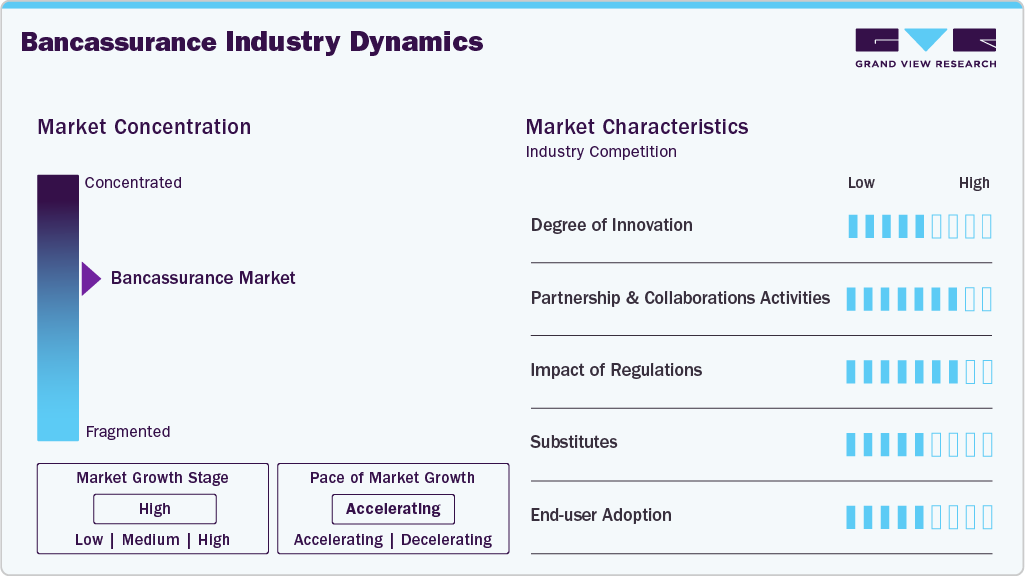
The market characteristics further indicate high industry competition, medium innovation, high partnership and collaboration activity, high regulatory impact, medium substitutes, and medium end-user adoption. Competition remains high as financial institutions compete to increase insurance sales, strengthen customer relationships, and expand their product portfolios. Partnerships are particularly important because banks and insurers often work together to combine customer access with insurance expertise, and innovation is increasingly driven by digital banking, online policy purchases, automated services, and integrated financial platforms. Regulations have a high impact because insurance distribution, customer protection, licensing, and sales practices are closely regulated. At the same time, customers can use alternative channels such as insurance agents, brokers, and direct digital platforms, resulting in a medium level of substitution. Moreover, the combination of strong established players, active partnerships, regulatory requirements, and moderate customer adoption supports the classification of the bancassurance market as moderately consolidated.
Analyst Perspective
The bancassurance market is positioned for continued growth as banks increasingly use their established customer relationships and digital channels to distribute insurance products. Growing demand for convenient access to insurance and increasing use of digital banking are driving market expansion. Digital platforms are reshaping insurance sales by making product discovery, purchasing, payments, and policy servicing more convenient. The market is also moving toward integrated banking and insurance offerings that increase cross-selling opportunities and improve customer engagement. Furthermore, investment is expected to focus on digital distribution platforms, customer data capabilities, integrated insurance services, and broader product portfolios.
Type Insights
Based on type, the life insurance segment accounted for 66.0%, the largest share of global revenue in 2025 and is projected to grow at the fastest CAGR over the forecast period. Banks widely distribute life insurance products due to their strong customer relationships and established financial planning channels. Products such as term, savings, retirement, and investment-linked policies are commonly offered through banking networks. The segment benefits from banks' ability to cross-sell long-term insurance products to existing customers.
The non-life insurance segment is projected to grow at a significant CAGR over the forecast period. Banks distribute products such as health, motor, home, travel, and personal accident insurance through branch and digital channels. Growing demand for financial protection is encouraging banks to expand their non-life insurance offerings. The segment is also supported by the increasing integration of insurance products into digital banking platforms.
Model Type Insights
Based on model type, the strategic alliance model segment accounted for 39.5%, the largest share of global revenue in 2025. Under this model, banks and insurance companies maintain separate operations while working closely on product distribution and customer acquisition. The model enables insurers to access established banking networks while allowing banks to expand their financial product portfolios. Long-term cooperation between banks and insurers continues to support the dominance of this model.
The pure distributor model segment is projected to grow at the fastest CAGR over the forecast period. The pure distributor model enables banks to offer insurance products through their existing branches and digital banking channels without taking ownership of the insurance business. Banks can provide customers with products from different insurers based on their financial and protection needs. This approach expands insurance access while allowing insurers to leverage the bank's established customer base. The simplicity and flexibility of this arrangement are supporting its rapid adoption in the bancassurance market.
End Use Insights
Based on end use, the personal segment led the market and accounted for the global revenue in 2025 and is projected to grow at the fastest CAGR over the forecast period. Banks primarily distribute insurance products to individual customers through branches, mobile applications, and online banking platforms. Life, health, motor, home, and travel insurance are among the key products offered to retail customers. The large customer base of banks and increasing demand for personal financial protection support the growth of this segment.

The business segment is projected to grow at the significant CAGR over the forecast period Banks distribute insurance products to SMEs and corporate customers to address risks related to employees, property, operations, and business activities. Products such as group health, group life, commercial property, and liability insurance are commonly relevant to this segment. The growing use of banks as a single point for financial and insurance services is supporting business insurance distribution through bancassurance channels.
Regional Insights
Asia Pacific bancassurance market led and accounted for 45.5% of the global revenue in 2025 and is projected to grow at the fastest CAGR over the forecast period, as insurance awareness and financial service penetration continue to increase. Banks are incorporating insurance into mobile applications, online platforms, and traditional branch services. Life, health, retirement, and protection products are gaining greater attention among customers across the region. Strategic cooperation between banks and insurers is creating new distribution opportunities in both developed and emerging economies.

China held a dominant share in the Asia Pacific bancassurance. China has a large bancassurance customer base, with commercial banks playing an important role in insurance distribution. Banks offer life insurance, annuities, health insurance, and other products through branches and digital financial platforms. Rising interest in financial protection and long-term savings is creating opportunities for insurance sales through banking channels. Regulatory changes are also encouraging greater focus on product suitability and customer protection.
Japan bancassurance is expected to grow at a significant CAGR over the forecast period. Japan has a well-developed bancassurance market, particularly for life insurance, annuities, and healthcare-related products. Banks provide customers with access to insurance through branches, financial advisory services, and digital platforms. Demand for retirement planning and healthcare protection is creating opportunities for insurance distribution through banking networks. The country's strong savings culture and aging customer base further increase the relevance of long-term insurance products.
North America Bancassurance Market Trends
North America Bancassurance held a significant share in the market, supported by the strong presence of banks, insurers, and established financial service networks. Banks increasingly use digital platforms and established customer relationships to distribute insurance products. The region is also witnessing greater integration of insurance with wealth management, lending, and other financial services. Increasing digital adoption and demand for convenient financial solutions are supporting the expansion of bancassurance across the region.
The U.S. Bancassurance held the largest market share in 2025, driven by the extensive customer base and digital infrastructure of major financial institutions. Banks and financial institutions distribute life, property, auto, travel, and other insurance products through subsidiaries, partnerships, and affiliated channels. Increasing demand for integrated financial services is encouraging financial institutions to expand insurance distribution. However, differences between banking and insurance regulations and strong competition from direct and digital insurance channels influence market development.
Europe Bancassurance Market Trends
The Europe Bancassurance market is expected to grow at a significant CAGR over the forecast period. with the model being particularly well established across several Western European countries. Banks have developed strong insurance distribution capabilities through partnerships, subsidiaries, and integrated financial groups. Life insurance and savings-related products remain important within bank-based distribution, supported by customers' preference for established financial institutions. Regulatory focus on customer protection, product suitability, and insurance distribution continues to shape the regional market.
The UK is gaining momentum in the bancassurance market, supported by the extensive customer reach of major banking groups and the growing use of digital financial services. Banks distribute insurance products through banking platforms, partnerships, and affiliated insurance businesses. Demand for home, motor, life, and protection products supports insurance distribution through banking channels. Increasing regulatory focus on customer outcomes and responsible insurance distribution is also influencing the market.
The Germany held a substantial share in the Europe Bancassurance. Germany has a well-established bancassurance ecosystem supported by cooperation between banks and insurance providers. Financial institutions distribute life, pension, health, property, and other insurance products through branches and digital channels. Strong customer relationships and demand for long-term savings and protection products support bank-based insurance distribution. The market is also supported by integrated financial groups that combine banking and insurance services.
Key Bancassurance Company Insights
Key players operating in the Bancassurance include Allianz, BNP Paribas, HSBC Group, Crédit Mutuel, CRÉDIT AGRICOLE, INTESA SANPAOLO, Standard Chartered, Lloyds Banking Group plc, Scotiabank., ABN AMRO Bank N.V. Key players in the Bancassurance are focusing on expanding insurance product portfolios, strengthening digital distribution capabilities, developing personalized insurance solutions, and increasing customer reach through banking networks. Companies also emphasize strategic partnerships, cross-selling initiatives, digital platforms, and integrated financial services to strengthen their competitive position.
-
Allianz is an integrated financial services provider. The company offers insurance and asset management products and services to individual and corporate customers. The company focuses on risk management, strategic investments, partnerships, and sustainable financial solutions across its global operations. Allianz provides car, home, travel, life, business, leisure, and third-party insurance products for individual and business customers.
-
BNP Paribas is a European banking and financial services company. Its three main divisions are commercial, personal banking & services, and corporate & institutional banking. The investment & protection services division includes protection, savings, investment, and real estate services, making it relevant to the bancassurance market. The Group also focuses on technology, customer support, risk management, and sustainable finance.
Key Bancassurance Companies
The following key companies have been profiled for this study on the bancassurance market:
-
Allianz
-
BNP Paribas
-
HSBC Group
-
Crédit Mutuel
-
CRÉDIT AGRICOLE
-
INTESA SANPAOLO
-
Standard Chartered
-
Lloyds Banking Group plc
-
Scotiabank.
-
ABN AMRO Bank N.V.
Competitive Benchmarking
Operating Strategies
Competitive Edge
Weaknesses
Mature Players: BNP Paribas, HSBC Group, CRÉDIT AGRICOLE, INTESA SANPAOLO
- Mature players in the bancassurance are focus on expand bancassurance by using their large banking networks and offering insurance products alongside banking services. Partnerships with insurers also help broaden product offerings and customer reach.
- Mature players gain a competitive advantage through their large customer bases, established brands, and wide distribution networks enable them to reach more customers and offer multiple insurance products.
- These companies face challenges related to large and complex operations can make product changes and new partnerships slower compared with smaller players.
Emerging Players: Standard Chartered, Scotiabank., ABN AMRO Bank N.V.
- Emerging players in the bancassurance are focus on selected markets and use existing banking relationships to increase insurance sales. Partnerships help them provide a wider range of insurance products without building all capabilities internally.
- Emerging players gain market traction through strong customer relationships and established banking operations provide a ready channel for distributing insurance products.
- Emerging players face limitations due to limited geographic coverage and insurance offerings can restrict their scale compared with larger players.
Recent Developments
-
In April 2026, BNP Paribas renewed its long-term bancassurance partnership with Ageas, a major multinational insurance company, to distribute and provide insurance products in Belgium. The partnership covers savings, protection, and property and casualty insurance through BNP Paribas Fortis. BNP Paribas also increased its investment in Ageas, strengthening the relationship between the two companies. The partnership expands insurance offerings and strengthens BNP Paribas' presence in the Belgian bancassurance market.
-
In July 2026, Crédit Agricole Assurances launched Crédit Agricole Insurance Partners to expand insurance distribution partnerships in France and international markets. The initiative offers health, protection, savings, retirement, and property insurance products through partner networks. It helps businesses provide insurance products directly to their customers. The launch creates new opportunities to distribute insurance products through a wider range of partners and customer channels.
Bancassurance Market Report Scope
Report Attribute
Details
Market size in 2025
USD 1,367.1 billion
Estimated market size in 2026
USD 1,435.9 billion
Projected market size by 2033
USD 2,216.3 billion
Growth rate
CAGR of 6.4% from 2026 to 2033
Base year for estimation
2025
Historical data
2021 - 2024
Forecast period
2026 - 2033
Quantitative units
Revenue in USD billion and CAGR from 2026 to 2033
Report coverage
Revenue forecast, company ranking, competitive landscape, growth factors, and trends
Segments covered
Type, model type, end use, and region
Regional scope
North America; Europe; Asia Pacific; Latin America; MEA
Country scope
U.S.; Canada; Mexico; Germany; UK; France; China; Japan; India; South Korea; Australia; Brazil; Kingdom of Saudi Arabia (KSA); UAE; South Africa
Key companies profiled
Allianz; BNP Paribas; HSBC Group; Crédit Mutuel; CRÉDIT AGRICOLE; INTESA SANPAOLO; Standard Chartered; Lloyds Banking Group plc; Scotiabank.; ABN AMRO Bank N.V.
Customization scope
Free report customization (equivalent up to 8 analysts working days) with purchase. Addition or alteration to country, regional & segment scope.
Pricing and purchase options
Avail customized purchase options to meet your exact research needs. Explore purchase options
Global Bancassurance Market Report Segmentation
The report forecasts revenue growth at global, regional, and country levels and provides an analysis of the latest industry trends in each of the sub-segments from 2021 to 2033. For this study, Grand View Research has segmented the bancassurance market report based on type, model type, end use, and region.

-
Type Outlook (Revenue, USD Billion, 2021 - 2033)
-
Life Insurance
-
Non-Life Insurance
-
-
Model Type Outlook (Revenue, USD Billion, 2021 - 2033)
-
Pure Distributor Model
-
Strategic Alliance Model
-
Joint Venture Model
-
Financial Holding
-
-
End Use Outlook (Revenue, USD Billion, 2021 - 2033)
-
Personal
-
Business
-
-
Regional Outlook (Revenue, USD Billion, 2021 - 2033)
- North America
-
U.S.
-
Canada
-
Mexico
-
- Europe
-
Germany
-
UK
-
France
-
- Asia Pacific
-
China
-
India
-
Japan
-
South Korea
-
Australia
-
-
Latin America
-
Brazil
-
- Middle East & Africa (MEA)
-
UAE
-
Kingdom of Saudi Arabia (KSA)
-
South Africa
-
- North America
Research Methodology
The bancassurance market figures in this report are based on a proven research process that combines executive interviews with secondary research from proprietary databases, company filings, and recognized regulatory and institutional sources. Market size is built through value-chain sizing-reconciling supply-side and demand-side estimates-and triangulated with bottom-up and top-down approaches. Every estimate passes multiple levels of expert validation before publication, with each bancassurance segment quantified using the revenue-capture definitions in the table below.
Segment Definition
Type
Revenue capture definition
Life Insurance
The segment revenue is generated from life insurance products distributed through banking channels, including commissions, distribution fees, and other remuneration received by banks from life insurance sales. Products covered include protection, savings, retirement, and other life insurance policies.
Non-Life Insurance
The segment revenue is from non-life insurance products distributed through banking channels, including commissions, distribution fees, and other distribution-related income. Products covered include motor, property, travel, personal accident, health, commercial, and other general insurance policies.
Model Type
Revenue capture definition
Pure Distributor Model
A model in which the bank acts primarily as a distribution channel for insurance products provided by an external insurer. Revenue is primarily generated from commissions, distribution fees, and other payments associated with insurance policies sold through the bank.
Strategic Alliance Model
A model in which a bank and an insurance provider establish a long-term commercial relationship for distributing insurance products. Revenue can be generated through commissions, fees, performance-based payments, or profit-sharing arrangements.
Joint Venture Model
A model in which a bank and an insurance provider jointly establish or own an insurance business. Revenue can be captured through the jointly owned insurance business, including insurance-related income, profit allocation, dividends, and distribution activities.
Financial Holding
A model in which a banking group owns or controls an insurance business as part of its wider financial services structure. Revenue can be generated through insurance operations, insurance distribution, investment activities, and the financial contribution of the insurance subsidiary.
End Use
Revenue capture definition
Personal
The segment revenue is generated from insurance products distributed through banks to individual customers. Products include life, health, motor, property, travel, personal accident, protection, and savings insurance.
Business
The segment revenue is generated from insurance products distributed through banks to businesses and commercial customers. Products include commercial property, liability, business interruption, employee-related, credit-related, and other business insurance products.
Estimation Model
Layer Name
Key Question
Description
Total Insurance Revenue Pool
What is the overall insurance revenue opportunity?
This layer estimates the overall insurance revenue pool relevant to the Bancassurance Market. It includes life and non-life insurance products that can potentially be distributed through banking channels. The analysis considers insurance demand from personal and business customers. This establishes the broader market opportunity before determining the portion generated through bancassurance.
Bancassurance Penetration
What share of insurance distribution is handled through banks?
This layer estimates the percentage of insurance distribution taking place through banking channels. Penetration is assessed separately for life and non-life insurance because the importance of bancassurance differs across product categories. Differences in banking penetration, insurance distribution structures, customer preferences, and regulatory environments are considered when estimating the bancassurance share.
Bancassurance Revenue Pool
How much insurance business is generated through banking channels?
This layer applies the estimated bancassurance penetration to the relevant insurance revenue pool. It determines the value of insurance business distributed through banks. The calculation can be further divided by life and non-life insurance and by personal and business customers. This provides the core revenue pool associated with bancassurance distribution.
Bank Revenue Capture
How much revenue is captured by the banking channel?
This layer estimates the revenue retained by banks from distributing insurance products. It considers commissions, distribution fees, profit-sharing income, and other applicable payments received from insurance distribution. For integrated models, the calculation can also consider the financial contribution from insurance operations where applicable.
Delivered Customization
We have successfully delivered the following deep-dive customizations:
Client Request
Customization Delivered
Value Adds
Regional Bancassurance Market Opportunity Assessment
Country/region-wise market sizing and forecasts
Analysis of demand, adoption trends, and regulatory landscape
Identification of high-growth regions and investment hotspots
Identified region-specific growth opportunities
Supported expansion and go-to-market strategy
Enabled informed regional investment decisions
Cross-Segmentation Analysis for the Bancassurance Market
Criss-cross market analysis by type, model type end use
Demand and adoption assessment across key segments
Segment attractiveness and growth potential benchmarking
Identified high-potential market segments
Supported targeted model type positioning and marketing strategy
Improved customer and segment prioritization
Competitive Benchmarking and Strategic Positioning in the Bancassurance Market
Benchmarking of key competitors across model types, pricing, partnerships, and innovation
Comparative assessment of market share, capabilities, and strategies
Analysis of competitive strengths, gaps, and differentiation areas
Identified competitive white spaces and growth gaps
Supported strategic positioning and differentiation
Enabled data-driven competitive strategy development
Frequently Asked Questions About This Report
Some key players operating in the bancassurance market include Allianz, BNP Paribas, HSBC Group, Crédit Mutuel, CRÉDIT AGRICOLE, INTESA SANPAOLO, Standard Chartered, Lloyds Banking Group plc, Scotiabank., ABN AMRO Bank N.V.
Strategic alliance model segment accounted for 39.5%, the largest share of global revenue in 2025, while pure distributor model segment is projected to grow at the fastest CAGR over the forecast period
Personal segment led the market and accounted for the global revenue in 2025 and is projected to grow at the fastest CAGR over the forecast period.
China held the largest market share in the bancassurance market.
The rising demand for life and health protection is driving the growth of the bancassurance market.
The global bancassurance market is expected to grow at a CAGR of 6.4% from 2026 to 2033, reaching USD 2,216.3 billion by 2033.
Life insurance segment accounted for 66.0%, the largest share of global revenue in 2025 and is projected to grow at the fastest CAGR over the forecast period. Banks widely distribute life insurance products due to their strong customer relationships and established financial planning channels
The Asia Pacific Bancassurance led the global market and accounted for 45.5% of the global revenue in 2025 and is projected to grow at the fastest CAGR over the forecast period, as insurance awareness and financial service penetration continue to increase.
The global bancassurance market size was valued at USD 1,367.1 billion in 2025 and is estimated at USD 1,435.9 billion for 2026.
About the Author(s)
Next Generation Technologies Research Team
Technology · Next Generation TechnologiesThis report was authored by the next generation technologies research team at Grand View Research - comprising two research analysts, one senior research analyst, and one industry expert - with specialized expertise in the next generation technologies segment of the technology industry. All findings are based on proprietary technology databases, executive interviews, and regulatory analysis, subject to internal peer review prior to publication.
Last Updated:
Speak to Analyst


Customize this report to your needs — add regions, segments, or data points, with 20% free customization.
Or view our licence options:


ISO 9001:2015 & 27001:2022 Certified
We are GDPR and CCPA compliant! Your transaction & personal information is safe and secure. For more details, please read our privacy policy.


