
- Home
- »
- Next Generation Technologies
- »
-
Banking System Software Market Size Report, 2026-2033GVR Report cover
![Banking System Software Market (2026 - 2033)Report]()
Banking System Software Market (2026 - 2033)
Size, Share & Trends Analysis Report By Services (Core Banking System Software, Corporate Banking System Software), By Deployment, By Operating System, By Enterprise Size, By Application, By Region, And Segment Forecasts
Market Size, 2025
$41.8BMarket Estimate, 2026
$45.0BMarket Forecast, 2033
$82.4BCAGR, 2026–2033
9.0%Banking System Software Market Summary
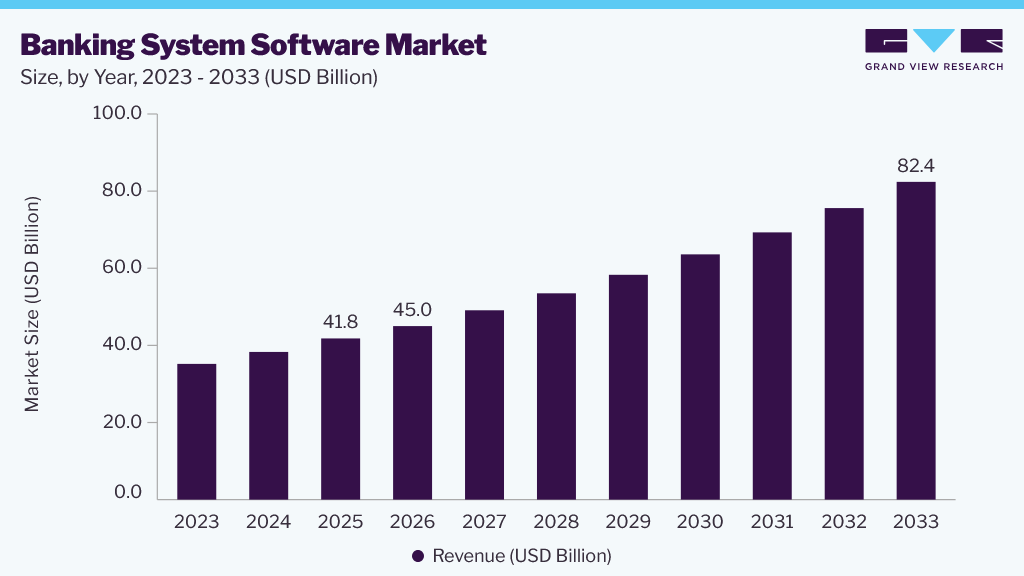
The global banking system software market size was valued at USD 41.8 billion in 2025 and is projected to grow from USD 45.0 billion in 2026 to USD 82.4 billion by 2033, at a CAGR of 9.0% from 2026 to 2033. North America dominated the market, accounting for a revenue share of 24.0% in 2025. The increasing smartphone adoption and internet penetration have resulted in growing demand for digital-first experiences, increasing inclination toward SaaS-based and cloud-based platforms, and inclusion of modern technologies such as AI.
Key Market Trends & Insights
- By software: Core banking system software segment dominated the market in 2025 with a revenue share of over 44.0%.
- By deployment: On-premise segment dominated the market in 2025 and accounted for a revenue share of over 58.0%.
- By operating system: Android segment led the market in 2025 and accounted for a revenue share of more than 36.0%.
- By enterprise size: Large enterprises segment led the market in 2025 and accounted for a revenue share of more than 63.0%.
- By application: Transaction management segment dominated the market in 2025 and accounted for a global revenue share of over 24.0%.
Regional Highlights
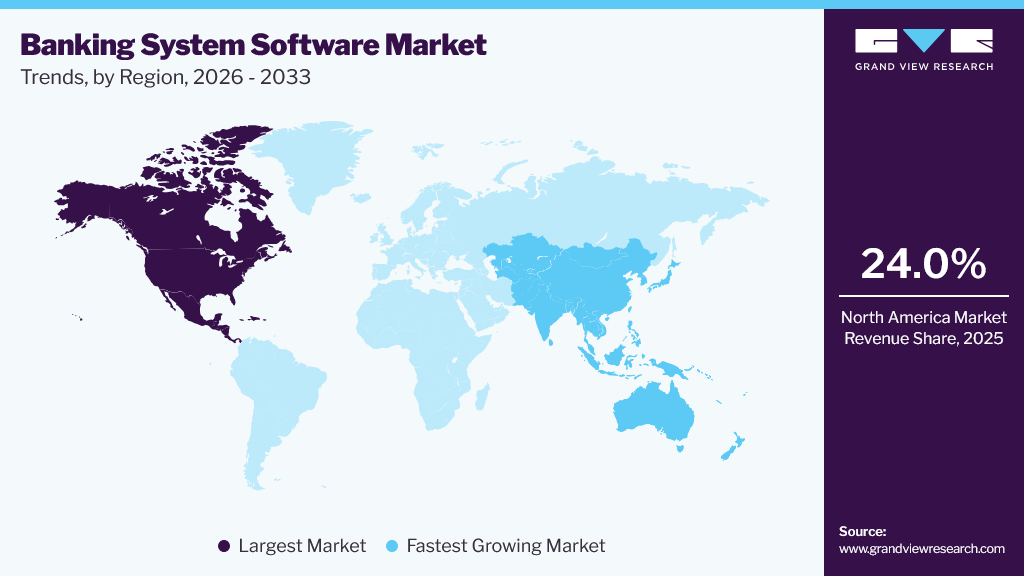
- Largest regional market: North America (24.0% revenue share, 2025)
- Fastest-growing regional market: Asia Pacific (highest CAGR, 2026-2033)
Market Size & Forecast
- Market size in 2025: USD 41.8 Billion
- Estimated market size in 2026: USD 45.0 Billion
- Projected market size by 2033: USD 82.4 Billion
- CAGR (2026-2033): 9.0%
Three ways to get this report
Buy it, customize it, or ask a question.Get the Full Report
What the study covers
- FormatsPDF · Excel · Dashboard
- Timeline2026–2033 annual, 2025 base
- Coverage20+ countries, 5 regions
- Companies10+ key players profiled
Customize the Report
20% free customization
- IncludeCountries, segments, points
- TailorTo your product definition
- ExtendDeeper competitor detail
- OrA fully bespoke study
- Turnaround5–10 working days
Ask an Analyst
A direct answer, usually in 1 working day
- AccessReport author, directly
- Reply timeWithin 1 working day
- No sales callDirect answer only
- FormatEmail reply
- CostFree, no cost
A large number of customers of banks and other financial institutions have been voicing their demand for real-time data-driven banking services across mobile and web platforms. Emergence of technologies such as digital payments, growing penetration of e-commerce and quick commerce, and personalized experiences facilitated by retailers has developed demand for instant funds transfers, hyper-personalized experiences via web and mobile apps for financial transactions, and insights for improved savings benefits.Market Dynamics:
The overall growth in demand for online banking services primarily contributes to the growth experienced by this market. Digital platforms are preferred by a significant share of customers for fund transfers, bill payments, loan processing, routine savings account balance inquiries, and more. This change in the customers’ approach and operations associated with the banking sector has stimulated an increasing inclination toward banking system software developments in recent years. In countries such as India, where the market is characterized by the presence of Unified Payments Interface (UPI) and smartphone penetration, the demand for sophisticated software solutions is growing every year.
Legacy systems and outdated frameworks pose challenges for banks in delivery of fast, hassle-free, and secure digital experience that align to current service expectations among users. In addition, cybersecurity has emerged as one of the most critical challenges faced by financial industry. According to the U.S. Federal Bureau of Investigation Internet Crime Complaint Center (IC3)’s Internet Crime Report 2025, the internet crime complaint center received 1,008,597 complaints in 2025, which marked significant increase from 791,790 complaints in 2020. This clearly highlights the security risks associated with reliance on internet-powered technology solutions including banking system software. Increasing security breaches, data thefts, and frauds initiated through banking platforms may act as restraint for this market in coming years.
Emergence of modern technologies such as Generative AI, rapid pace of shift from the shift from monolithic systems to cloud-native microservices, and increasing adoption of open banking are expected to present significant growth opportunities for this market in the coming years. Backed by real-time data sets, banks have been focusing on developing a unified customer view across all sorts of touchpoints, including mobile, web, and branch. Analysis of structured and unstructured data, gathered from such touchpoints and modern software capabilities, is projected to enable banks to anticipate user behaviors, estimate risk appetites, and provide specific financial recommendations.
Analyst Perspective
The emergence of modern technologies such as generative AI, rapid pace digital transition in finance industry, heavy investments in R&D and innovation-based product development, and partnership and collaborations among financial companies and technology providers are likely to change dynamics of this industry in coming years. Automation and integration of AI in software development as well as financial processes associated with banks and other financial organizations are expected to influence the growth trends in this market.
Software Insights
The core banking system software segment dominated the market in 2025 and accounted for a revenue share of more than 44.0%. One of the major factors contributing to the growth of the segment is the ability of core banking system software to streamline and automate a range of banking processes. Core banking system software can provide banks with a centralized platform for managing their operations, enabling them to automate manual processes, reduce errors, and improve efficiency. Innovation and new product developments are expected to positively influence further growth of this segment. For instance, in June 2026, DXC Technology Company announced the launch of DXC CoreIgnite. This newly designed cloud‑native revenue orchestration platform is developed to enable financial institutions with a single connection point to fintech ecosystems, while continuing their work through existing core systems.
It can result in cost savings for banks and help them provide a better customer experience by enabling real-time data access and faster transaction processing. Integrating advanced technologies, such as artificial intelligence and blockchain, into core banking system software also provides new opportunities for innovation and growth. As a result, the adoption of core banking system software is increasing among financial institutions, driving the segment's growth.
The investment banking system software segment is anticipated to register significant growth during the forecast period. The growth is attributable to its ability to enhance investment banks' overall performance and competitiveness. Investment banking system software can provide investment banks with a comprehensive view of their operations, enabling them to make informed decisions and respond quickly to changing market conditions. This can help investment banks increase profitability and improve their risk management capabilities.
Services Insights
The professional services segment dominated the market in 2025 and accounted for a revenue share of more than 57.0%. The professional services segment of the banking system software market is growing due to increasing demand for specialized consulting and support services from banks. Banks are facing a growing need for expert support in the implementation and integration of banking system software into their existing systems and processes. Moreover, banks require ongoing support and maintenance services to ensure the smooth operation of their software solutions and to resolve any issues that may arise.
The managed services segment is anticipated to register significant growth over the forecast period. The segment is growing due to increasing demand for outsourced IT support and maintenance services from banks. Banks are looking for ways to reduce their IT costs and improve the efficiency of their operations. By outsourcing their IT support and maintenance needs to managed service providers, banks can take advantage of their expertise and experience to reduce their operational costs and improve their overall IT infrastructure.
Deployment Insights
The on premise segment dominated the market in 2025 and accounted for a revenue share of over 58.0%. On-premise deployment is preferred due to the sensitive nature of banking data and the need for banks to maintain control over their IT infrastructure. With the on premise deployment, banks can store their data and software on their servers, providing them with complete control over their data and the ability to ensure its security and privacy. Moreover, the on premise deployment allows banks to customize their software solutions to meet their specific needs and requirements.
The cloud segment is projected to register the highest growth rate over the forecast period. The cloud deployment segment is growing due to its cost-effectiveness, scalability, and ease of use. With cloud deployment, banks can access software solutions and store their data on remote servers, reducing the need for on premise hardware and IT support. This can result in lower upfront costs and lower ongoing IT costs for banks. In addition, cloud deployment enables banks to scale their IT resources up or down as needed, providing them with greater flexibility to meet changing business needs.
Operating System Insights
The android segment led the market in 2025 and accounted for a revenue share of more than 36.0%. Android is one of the world's most widely used operating systems, with a large and growing user base. As a result, Android is an attractive platform for software developers, providing them with a large potential customer base. Moreover, Android is an open-source platform, which means that software developers have access to a wealth of resources and tools that they can use to build and deploy software solutions. This makes it easier and more cost-effective for developers to create high-quality, feature-rich banking system software that runs on Android.
The windows segment is anticipated to register significant growth over the forecast period. The growing use of cloud computing is driving demand for Windows-based banking system software. Cloud computing provides customers with the ability to access their financial data from anywhere and on any device, and Windows is a popular platform for cloud-based financial solutions. Moreover, Windows provides robust security and privacy features, which are critical for the safe and secure operation of financial systems.
Enterprise Size Insights
The large enterprises segment led the market in 2025 and accounted for a revenue share of more than 63.0%. Large enterprises use banking system software to improve efficiency, enhance competitiveness, and comply with regulatory requirements. With the growing complexity of financial operations and increasing regulatory requirements, large enterprises are turning to bank system software to ensure that they can manage their financial operations promptly and efficiently. Moreover, banking system software can help large enterprises to improve their risk management capabilities, enabling them to identify and mitigate potential risks in real-time.
The small & medium enterprises segment is expected to register significant growth during the forecast period. One of the primary factors contributing to the growth of the segment is that banking system software can be customized to meet the specific needs of small & medium enterprises. Unlike large enterprises, which typically have complex financial operations and strict regulatory requirements, small & medium enterprises have more flexible and streamlined financial operations. Banking system software can be customized to meet the specific needs and requirements of such enterprises, providing them with the ability to quickly adapt to changing market conditions and business needs.
Application Insights
The transaction management segment dominated the market in 2025 and accounted for a global revenue share of over 24.0%. One of the major factors is that transaction management is a critical function for financial institutions, as it ensures the accuracy, security, and efficiency of financial transactions. Moreover, transaction management gives financial institutions real-time visibility and control over their transactions, enabling them to quickly and easily monitor and manage their financial operations. This helps financial institutions identify and resolve any transaction-related issues and make informed decisions about how to optimize their operations.
The investment management segment is anticipated to register the fastest growth during the forecast period. The increasing sophistication and complexity of investment portfolios have created a growing demand for advanced investment management solutions. These solutions provide financial institutions with the tools they need to manage large and diverse portfolios and make informed investment decisions. Moreover, technological advances, such as big data and artificial intelligence, have made it possible to automate many of the manual processes involved in investment management, resulting in increased efficiency and reduced risk.
Regional Insights
North America dominated the banking system software market in 2025 and accounted for a revenue share of more than 24.0%. The presence of a large number of leading banking software companies in the region, such as JPMorgan Chase, Bank of America, and Citigroup, has contributed to the regional market's growth. These companies have a significant demand for advanced banking system software solutions to streamline their operations and improve their competitiveness. Furthermore, a large and well-established IT industry in North America has contributed to the growth of the banking software solutions.
Asia Pacific Banking System Software Market Trends
The Asia Pacific regional market is expected to emerge as the fastest-growing market during the forecast period. The regional market growth can be attributed to the rapidly growing economies in the region, such as China and India, leading to an increase in the demand for banking services, driving the growth of the banking system software industry. Furthermore, the growth of the financial sector in Asia Pacific has been driven by the increasing number of people entering the middle class, leading to a rise in disposable income and a higher demand for financial services. This has increased the need for advanced banking system software solutions to streamline operations and improve the customer experience.
Key Banking System Software Company Insights
Prominent banking software companies are aggressively investing in strategic initiatives, such as mergers and acquisitions, and partnerships to stay ahead of the competition and offer innovative solutions to their customers. For instance, In October 2025, Fujitsu, one of the Japanese information technology (IT) companies, partnered with Sony Bank, Inc. for integration of generative AI in Sony Bank’s development for new core banking system.
Key Banking System Software Companies:
The following key companies have been profiled for this study on the banking system software market:
-
Microsoft Corporation
-
International Business Machines (IBM) Corporation
-
Finastra
-
Fidelity National Information Services, Inc.
-
Fiserv, Inc.
-
SAP SE
-
Oracle Corporation
-
Infosys Limited
-
TATA Consultancy Services Limited
- Salesforce, Inc.
Recent Development
-
In June 2026, Volante Technologies announced launch of Vol360i Agentic AI, designed to upgrade its cloud-native core payments and Payments as a Service (PaaS) platform. This is set to automate back-office tasks and improving straight-through processing rates.
-
In April 2026, Oracle Financial Services announced expansion of its agentic AI platform to corporate banking. With this expansion, it started offering enterprise-grade suite comprising pre-built AI agents and AI-infused applications for trade finance, treasury, credit, and lending to corporate banks and financial institutions.
Banking System Software Market Report Scope
Report Attribute
Details
Market size in 2025
USD 41.8 billion
Estimated market size in 2026
USD 45.0 billion
Projected market size by 2033
USD 82.4 billion
Growth rate
CAGR of 9.0% from 2026 to 2033
Base year for estimation
2025
Historical data
2021 - 2024
Forecast period
2026 - 2033
Quantitative units
Revenue in USD billion, and CAGR from 2026 to 2033
Report coverage
Revenue forecast, company ranking, competitive landscape, growth factors, and trends
Segments covered
Software, deployment, operating system, enterprise size, application, region
Regional scope
North America; Europe; Asia Pacific; Latin America; Middle East & Africa
Country scope
U.S.; Canada; UK; Germany; France; Spain; Italy; China; Japan; Hong Kong; India; South Korea; Brazil; Mexico; Saudi Arabia; UAE
Key companies profiled
Microsoft; International Business Machines (IBM) Corporation; Finastra; Fidelity National Information Services, Inc.; Fiserv, Inc.; SAP SE; Oracle Corporation; Infosys Limited; TATA Consultancy Services Limited; Salesforce, Inc.
Customization scope
Free report customization (equivalent up to 8 analysts working days) with purchase. Addition or alteration to country, regional & segment scope.
Pricing and purchase options
Avail of customized purchase options to meet your exact research needs. Explore purchase options
Global Banking System Software Market Segmentation
The report forecasts revenue growth at global, regional, and country levels and provides an analysis of the latest industry trends in each of the sub-segments from 2021 to 2033. For this study, Grand View Research has segmented the global banking system software market report based on software, services, deployment, operating system, enterprise size, application, and region:
-
Software Outlook (Revenue, USD Billion, 2021 - 2033)
-
Core Banking System Software
-
Corporate Banking System Software
-
Investment Banking System Software
-
Others
-
-
Services Outlook (Revenue, USD Billion, 2021 - 2033)
-
Professional Services
-
Managed Services
-
-
Deployment Outlook (Revenue, USD Billion, 2021 - 2033)
-
On-premise
-
Cloud
-
-
Operating System Outlook (Revenue, USD Billion, 2021 - 2033)
-
Android
-
Windows
-
iOS
-
Others
-
-
Enterprise Size Outlook (Revenue, USD Billion, 2021 - 2033)
-
Large Enterprises
-
Small & Medium Enterprises
-
-
Application Outlook (Revenue, USD Billion, 2021 - 2033)
-
Transaction Management
-
Credit and Lending
-
Risk & Compliance
-
Customer Relationship Management
-
Investment Management
-
Others
-
-
Regional Outlook (Revenue, USD Billion, 2021 - 2033)
-
North America
-
U.S.
-
Canada
-
-
Europe
-
UK
-
Germany
-
France
-
Spain
-
Italy
-
-
Asia Pacific
-
China
-
Japan
-
Hong Kong
-
India
-
South Korea
-
-
Latin America
-
Brazil
-
Mexico
-
-
Middle East & Africa
-
Saudi Arabia
-
UAE
-
-
Frequently Asked Questions About This Report
The global banking system software market size was valued at USD 41.8 billion in 2025 and is estimated at USD 45.0 billion for 2026.
The global banking system software market is expected to grow at a CAGR of 9.0% from 2026 to 2033, reaching USD 82.4 billion.
North America dominated with a 24.0% revenue share in 2025.
Key players include Microsoft; International Business Machines (IBM) Corporation; Finastra; Fidelity National Information Services, Inc.; Fiserv, Inc.; SAP SE; Oracle Corporation; Infosys Limited; TATA Consultancy Services Limited; Salesforce, Inc.
Large enterprises dominated the banking system software market with a share of 63.0% in 2025.
About the Author(s)
Next Generation Technologies Research Team
Technology · Next Generation TechnologiesThis report was authored by the next generation technologies research team at Grand View Research - comprising two research analysts, one senior research analyst, and one industry expert - with specialized expertise in the next generation technologies segment of the technology industry. All findings are based on proprietary technology databases, executive interviews, and regulatory analysis, subject to internal peer review prior to publication.
Last Updated:
Speak to Analyst


Customize this report to your needs - add regions, segments, or data points, with 20% free customization.
Or view our licence options:


ISO 9001:2015 & 27001:2022 Certified
We are GDPR and CCPA compliant! Your transaction & personal information is safe and secure. For more details, please read our privacy policy.


