
- Home
- »
- Beauty & Personal Care
- »
-
Beauty Subscription Box Market Size & Share Report, 2033GVR Report cover

Beauty Subscription Box Market (2026 - 2033)
Size, Share & Trends Analysis Report By Product (Skincare, Haircare, Makeup, Fragrance, Nail Care), By Price Range (Budget, Moderate, Premium), By Region (North America, Europe, Asia Pacific), And Segment Forecasts
Market Size, 2025
$1.3BMarket Estimate, 2026
$1.5BMarket Forecast, 2033
$4.7BCAGR, 2026–2033
17.4%Beauty Subscription Box Market Summary
The global beauty subscription box market size was valued at USD 1.3 billion in 2025 and is projected to grow from USD 1.5 billion in 2026 to USD 4.7 billion by 2033, growing at a CAGR of 17.4% from 2026 to 2033. North America dominated the market, accounting for the largest global share of 41.7% in 2025. The beauty box subscription market has experienced substantial growth in recent years, driven by the increasing consumer demand for personalized beauty experiences and the convenience of receiving curated products delivered to their doorsteps.
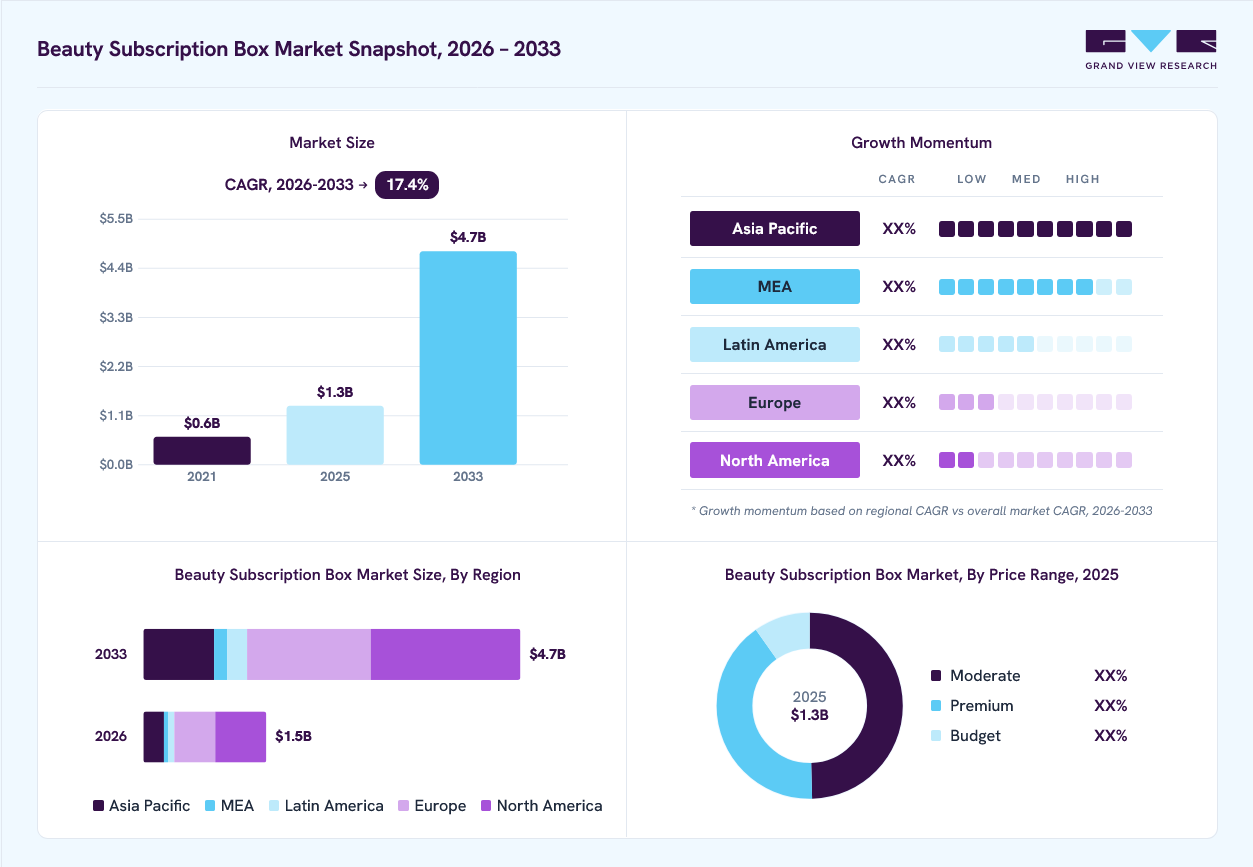 Source: Grand View Research, IR Documents, Primary Interviews, Paid DatabasesTo learn more about this report,
 Download Free Sample Report
Key Market Trends & Insights
- By product: Skincare products segment led the market with the largest share of 42.8% in 2025.
- By price range: Moderate price segment led the market with the largest share of 49.5% in 2025.
Regional Highlights
- Largest regional market: North America (41.7% revenue share, 2025)
- By country: The U.S. held the largest share of North America in 2025.
Market Size & Forecast
- Market size in 2025: USD 1.3 Billion
- Estimated market size in 2026: USD 1.5 Billion
- Projected market size by 2033: USD 4.7 Billion
- CAGR (2026-2033): 17.4%
Three ways to get this report
Buy it, customize it, or ask a question.Ask an Analyst
Analyst response in 1 business day
- AccessReport author, directly
- Reply timeWithin 1 working day
- No sales callDirect answer only
- FormatEmail reply
- CostFree, no cost
Get the Full Report
What the study covers
- FormatsPDF · Excel · Dashboard
- Timeline2026–2033 annual, 2025 base
- Coverage20+ countries, 5 regions
- Companies10+ key players profiled
Customize the Report
20% free customization
- IncludeCountries, segments, points
- TailorTo your product definition
- ExtendDeeper competitor detail
- OrA fully bespoke study
- Turnaround5–10 working days
This growth is mainly driven by the rising interest in beauty and skincare routines, particularly among millennials and Gen Z, who value the discovery of new products and brands through these subscription services. The beauty box market offers a wide range of subscription types such as monthly subscriptions, quarterly subscriptions, and biannual subscriptions to cater to diverse consumer preferences. Beauty subscription boxes often utilize surveys to personalize the product selection for each subscriber, ensuring that the items received align with individual preferences and needs.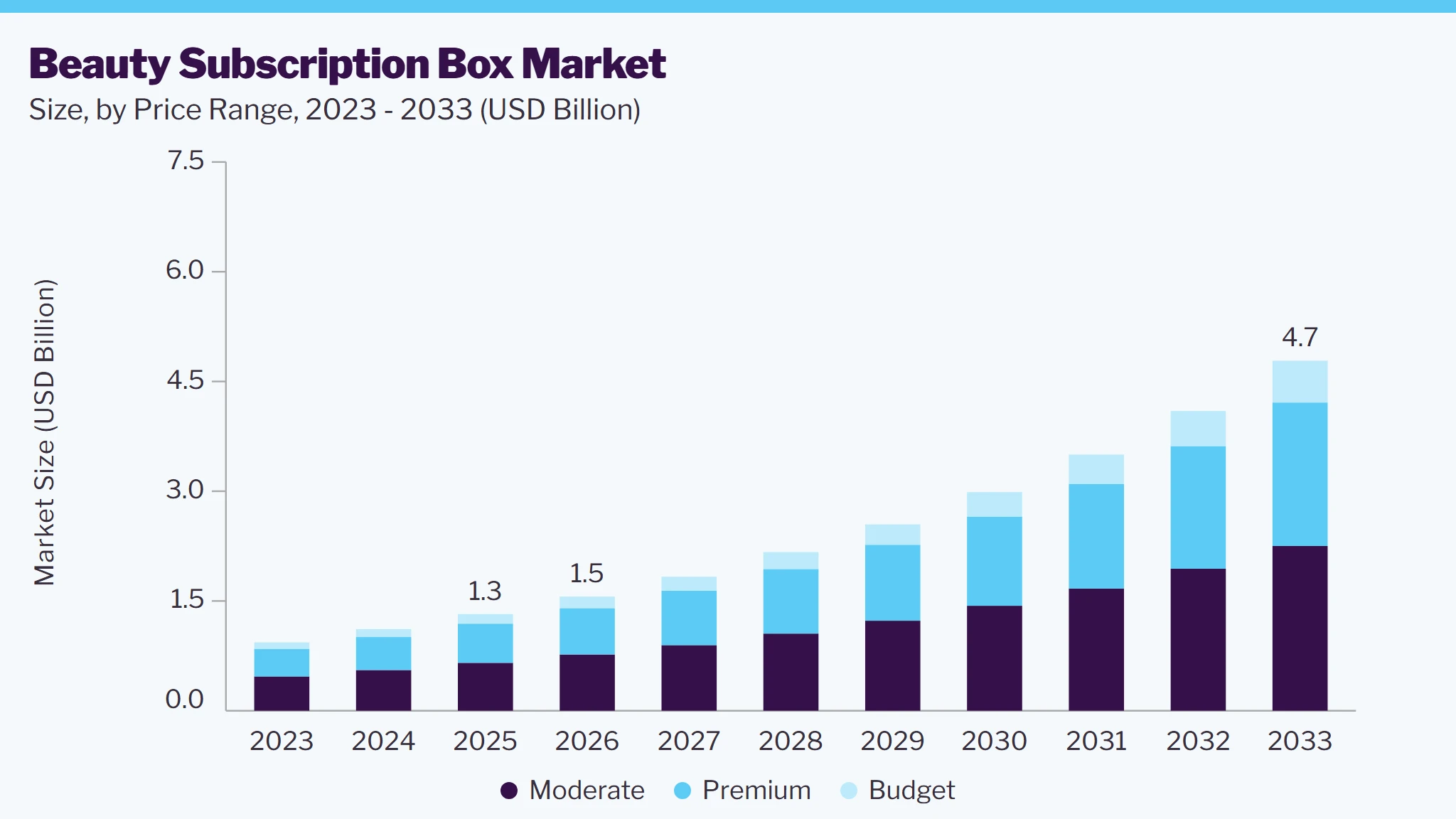 To learn more about this report, Download Free Sample Report
For example, Ipsy employs a detailed beauty quiz during the sign-up process, where subscribers provide information about their skin type, hair type, makeup preferences, and specific beauty concerns. This data is then used by Ipsy’s algorithm to tailor the monthly Glam Bag, a beauty box to include products that best match the subscriber's profile. The company continuously refines its personalization by encouraging users to rate the products they receive, allowing the algorithm to learn and adapt to changing preferences.
The rising trend of K-Beauty is driving demand for Korean skincare products in beauty boxes as consumers increasingly seek innovative, high-quality formulations. Subscription services such as Bomibox offer curated selections of popular K-Beauty items, making it easy for enthusiasts to discover and access authentic Korean skincare products. This growing interest in personalized skincare experiences and the influence of social media further amplify the appeal of K-Beauty products in the beauty subscription market.
Market Dynamics
Beauty subscription boxes are gaining traction as they offer personalized, curated selections of skincare, haircare, makeup, and fragrance products tailored to individual preferences and skin types. These services allow consumers to discover new brands and sample products before committing to full-size purchases and enjoy convenience through recurring home delivery. Growing interest in self-care routines, rising social media influence on beauty discovery, and demand for personalized product experiences are expected to continue supporting growth in the beauty subscription box market.
Consumers are increasingly seeking beauty products that reflect their individual skin type, hair texture, and lifestyle preferences rather than generic, one-size-fits-all offerings. Beauty subscription services address this shift by using intake quizzes, purchase history, and product feedback to curate monthly assortments suited to each subscriber. Brands such as Ipsy and Birchbox rely on this model to match products to individual profiles, while services like Curology extend personalization into treatment-specific skincare formulations. Younger consumers, particularly millennials and Gen Z, are driving much of this demand as they prioritize product discovery and tailored routines over routine retail shopping. Brands that recognize, remember, and provide them with relevant offers and recommendations. As beauty subscription providers adopt AI-driven quizzes and behavioral data to refine product matching over time, personalization is expected to remain a central pillar of subscriber acquisition and retention strategy.
Many beauty subscription boxes struggle to keep subscribers for long. It is easy to cancel, and the excitement of trying new products fades over time. Beauty items are not essential like food or household goods, so people cancel first when money is tight or when they feel they already have enough unused samples at home. At the same time, shipping costs, packaging costs, and the cost of partnering with brands keep rising. Companies also spend heavily on social media and influencer marketing to attract new subscribers, which adds further pressure on profits. Birchbox, one of the earliest companies in this space, shows how serious this problem can be. A 2018 Glossy report found that only a small number of subscribers went on to buy full-size versions of the products they sampled. This was not enough to support the business.
New AI tools are creating fresh opportunities for beauty subscription box companies. These tools can scan a person's skin, understand their skin type, and suggest products made just for them. This makes subscription boxes feel more useful and less random, which can help companies build stronger connections with their customers and keep them subscribed for longer. Big beauty companies are already investing in this kind of technology, using AI to study skin health more closely and offer smarter recommendations. L’Oréal partnered with OpenAI in 2026 to bring beauty tools directly into ChatGPT, so people can get skincare advice through AI chat. Some are also bringing AI chat tools into the shopping experience, so customers can ask questions and get beauty advice in a more conversational way. Consumers are also turning to AI more often when researching and shopping for beauty products. This shift gives subscription box companies a chance to use AI to build boxes that feel truly personal to each customer. Over time, this kind of personalization could improve customer satisfaction and reduce the number of people who cancel their subscriptions.
Analyst Perspective
The beauty subscription box market has real strengths, like consumers who enjoy discovering new products. But it also has weaknesses baked in. Customers can cancel easily, spending on beauty boxes is optional, and the excitement of a new box fades over time. Companies that survive long-term will not be the ones offering the most variety. They will be the ones who use customer data, like skin type and preferences, to make each box feel more personal over time. When a box feels tailored to someone's actual needs, it becomes harder to replace it with a regular store purchase, which builds real, lasting loyalty.
Product Insights
Based on product, the skincare products segment led the market with the largest revenue share of 42.8% in 2025, attributed to the growing consumer preference for personalized skincare routines and the convenience of regular product delivery. In addition, innovative brands are increasingly offering targeted solutions for specific skin concerns, creating a diverse range of options that appeal to a broad audience. Beauty subscriptions include a majority of skincare products owing to the high demand for personalized skincare solutions. Skincare's prominence in beauty routines also drives brands to prioritize it in their offerings. For instance, Birchbox offers skincare products based on a Beauty Quiz analyzing consumer’s complexion, skin tone, and beauty style, etc.
The haircare products segment is expected to grow at the fastest CAGR over the forecast period. There is a rising demand for personalized beauty solutions, with consumers seeking products that cater to their unique hair needs. The emergence of niche and indie brands that focus on specific hair types, such as textured or curly hair, is increasing product variety to cater to different hair needs. Brands such as Curlbox, the pioneering textured haircare subscription service founded in 2012, elevated the visibility of textured hair brands through its subscription boxes.
Some of the haircare products that are increasingly gaining demand among consumers include hair masks and hair care creams. BoxyCharm by Ipsy offers hair masks and hair creams in its July 2024 beauty boxes.
Price Range Insights
Based on price range, the moderate price segment led the market with the largest revenue share of 49.5% in 2025, as they offer a balance of affordability and quality, making them accessible to a broader audience. Consumers are increasingly drawn to options that provide value. This has led to the popularity of boxes such as Birchbox, Allure Beauty Box, BoxyCharm, and Ipsy. These subscriptions typically cost between USD 16 to USD 30 per beauty box, featuring a minimum of 5 product varieties in the box, allowing users to explore new brands and products.
The expenditure on budget beauty box subscriptions is expected to grow at a CAGR of 20.1% over the forecast period. This is mainly due to increasing consumer demand for affordable beauty solutions that allow experimenting with various products. The rising popularity of subscription models, combined with the expansion of value-driven brands offering high-quality items, makes these options appealing to a wider audience.
In addition, the convenience of regular delivery and curated selections enhances consumer loyalty and repeat subscriptions of budget beauty boxes. FabFitFun, Ipsy Glam Bags and perfume subscription boxes by ScentBox, Inc. are some of the budget beauty subscription options in the market.
Regional Insights
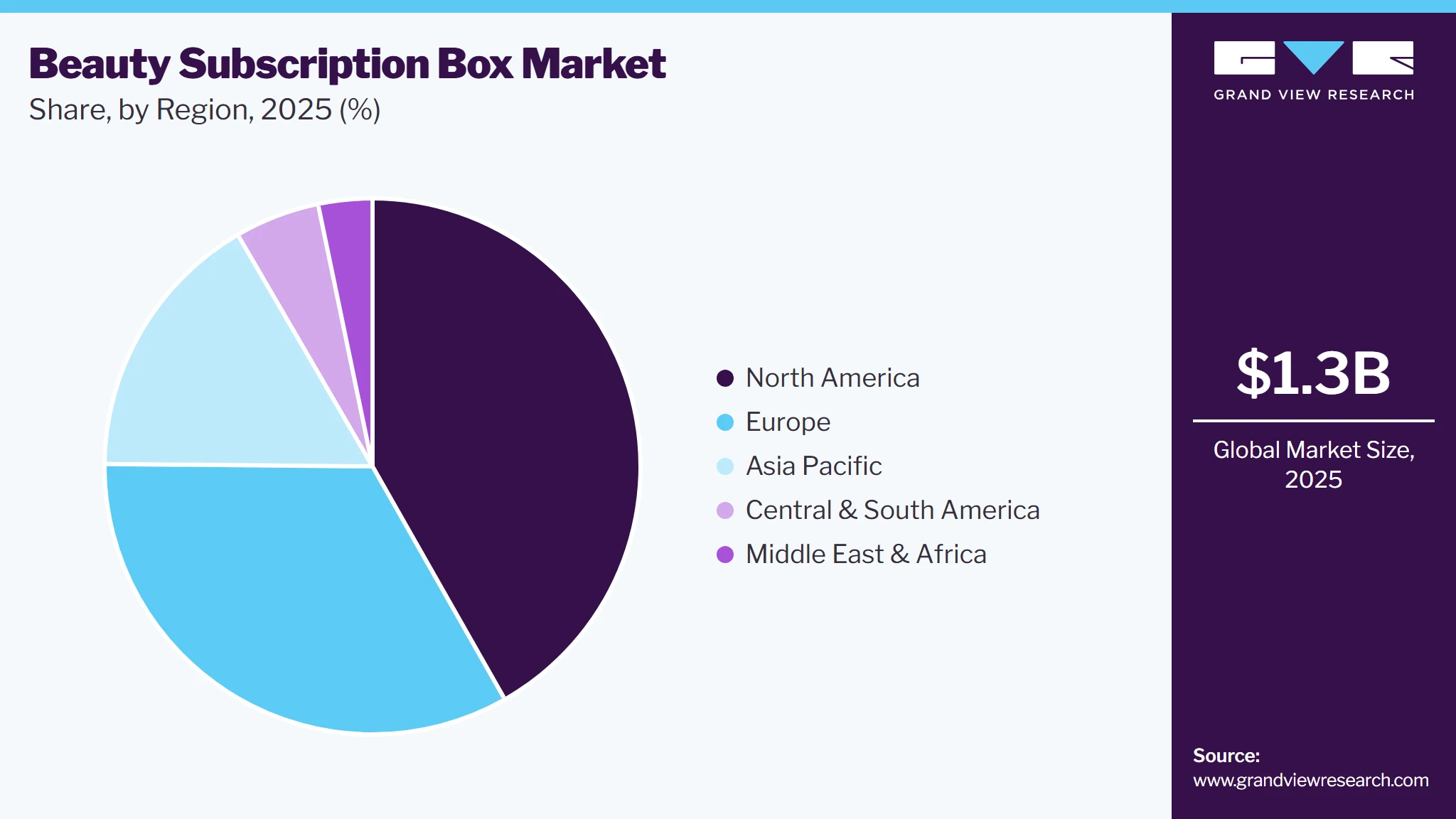
The North America dominated the beauty subscription box market with the largest revenue share of 41.7% in 2025. In 2021, beauty boxes captured 23% of subscription users in the U.S., outpacing food and drink at 19% and fashion at 15%, according to Emarsys. With 32% of U.S. consumers engaging in subscription services and an average monthly spend of USD 57, the North America beauty subscription market is expected to witness substantial growth.
 To learn more about this report, Download Free Sample Report
U.S. Beauty Subscription Box Market
Beauty subscription box market in the U.S. is expected to grow at a significant CAGR over the forecast period. While subscription services have expanded across various categories, beauty boxes continue to be the most popular choice among consumers. Data from Emarsys indicates that beauty boxes are the most subscribed services in the U.S. as of 2021. According to the same source, beauty box subscriptions surpassed the popularity of food and fashion subscription boxes in the U.S.
Europe Beauty Subscription Box Market
Beauty subscription box market in Europe accounted for a share of over 33.4% of the global market revenue in 2025, reflecting a strong consumer interest in personalized beauty experiences and a diverse range of high-quality skincare products. The presence of innovative local brands and collaborations with influencers have significantly boosted market visibility and subscriber engagement. In addition, European consumers value sustainability and cruelty-free options, driving brands to prioritize eco-friendly practices.
The UK beauty subscription box market is expected to grow at a significant CAGR over the forecast period. According to Whistl, in 2022, 11% of the UK shoppers opted for a health & beauty subscription box service. This highlights a strong demand for curated product selections that cater to individual preferences. According to PaySafe, 53% percent of UK consumers believe that subscriptions offer a more convenient way to pay for goods or services they use regularly, highlighting the appeal of automated, hassle-free purchasing. This trend supports the growth of subscription models across various industries, including beauty, as consumers value the ease and consistency that subscription services provide.
Asia Pacific Beauty Subscription Box Market
The Asia Pacific beauty subscription box market is expected to grow at a CAGR of 19.3% over the forecast period, indicating a rapidly expanding consumer base interested in trying new beauty trends and innovative products. The increasing popularity of K-beauty and J-beauty has led to a surge in demand for subscription services that offer curated selections. Furthermore, the region's young demographic is highly engaged with online shopping and beauty trends, supporting the growth of subscription models in beauty sector.
Key Beauty Subscription Box Company Insights
The beauty subscription box market is relatively fragmented due to the presence of numerous companies offering diverse products and personalized experiences to cater to various consumer preferences. Brands such as Ipsy, Birchbox, and Allure Beauty Box, each with their unique value propositions, are some of the key market participants.
Key Beauty Subscription Box Companies:
The following key companies have been profiled for this study on the beauty subscription box market.
- Birchbox
- Ipsy
- GLOSSYBOX
- Allure Beauty Box
- Petit Vour
- OK! Beauty Box
- FabFitFun
- LOOKFANTASTIC
- Beauty Box Korea
- Bomibox Korean Beauty Box
Competitive Benchmarking
Category
Operating Strategies
Competitive Edge
Weakness
Established Players (Ipsy, FabFitFun, Allure Beauty Box, LOOKFANTASTIC)
- Expand personalized curation through AI-driven beauty quizzes and data analytics to build tiered membership models (e.g., Ipsy Glam Bag and Glam Bag X); partner with well-known cosmetics and skincare brands for exclusive product drops that extend into lifestyle and wellness categories beyond core beauty
- Strong brand recognition, large existing subscriber base, and established relationships with beauty brands for product sourcing; broad marketing reach through influencer partnerships, and social media ability to negotiate favorable terms with suppliers due to order volume
- Rising customer acquisition and retention costs as competition increases, exposure to subscription fatigue and cancellation risk since switching costs are low pressure to constantly refresh curation to avoid subscriber boredom
Emerging Players (GLOSSYBOX, Petit Vour, Bomibox, OK! Beauty Box, Beauty Box Korea, Birchbox)
- Focus on niche positioning, such as cruelty-free and vegan beauty (Petit Vour), fragrance discovery, or fully customized formulations (Function of Beauty), build direct-to-consumer relationships without relying on third-party retail use quizzes and consumer data to create highly individualized product formulas rather than standard curated boxes
- Ability to serve underserved or specialized consumer segments with tailored offerings, closer, more direct relationships with a defined subscriber base, faster ability to adapt product formulations or curation based on subscriber feedback
- Smaller marketing budgets and lower brand recognition compared to established players limited negotiating power with suppliers and manufacturers; greater vulnerability to rising shipping, packaging, and production costs given smaller order volumes
Recent Developments
-
In July 2024, Allure Beauty Box launched a July Beauty Box Subscription that was packed with refreshing summer beauty treats, including a skin-cooling balm from Tula, a rum-inspired perfume oil from Malin + Goetz, and a gold-flecked primer from Yves Saint Laurent.
-
In May 2024, Lidl launched a new beauty box for just £2, containing over £70 worth of products. This trial offering included more than 20 full-size skincare, haircare, and fragrance items, such as Cien Myramaze Premium Face Day Cream and Suddenly Femelle Perfume. The beautifully packaged box is available since May 9 via lidlbeautybox.co.uk and is part of a limited trial.
-
Ipsy, the original beauty subscription service founded by Michelle Phan in 2012, strengthened its strategy by acquiring rival BoxyCharm in November 2020 for $500 million. Initially, both brands operated independently under Beauty for All Industries. This move was aimed to enhance personalization and offer a comprehensive beauty membership experience by combining Ipsy's AI-driven customization with BoxyCharm's brand curation.
Beauty Subscription Box Market Report Scope
Report Attribute
Details
Market size value in 2025
USD 1.3 billion
Market size value in 2026
USD 1.5 billion
Revenue forecast in 2033
USD 4.7 billion
Growth rate
CAGR of 17.4% from 2026 to 2033
Base year for estimation
2025
Historical data
2021 - 2024
Forecast period
2026 - 2033
Quantitative units
Revenue in USD million/billion, and CAGR from 2026 to 2033
Report coverage
Revenue forecast, company ranking, competitive landscape, growth factors, and trends
Segments covered
Product, price range, region
Regional scope
North America; Europe; Asia Pacific; CSA; MEA
Country scope
U.S; Canada; Mexico; Germany; UK; France; Italy; China; Japan; India; South Korea; Australia; Brazil; South Africa; UAE
Key companies profiled
Birchbox; Ipsy; GLOSSYBOX; Allure Beauty Box; Petit Vour; OK! Beauty Box; FabFitFun; LOOKFANTASTIC; Beauty Box Korea; Bomibox Korean Beauty Box
Customization scope
Free report customization (equivalent up to 8 analysts' working days) with purchase. Addition or alteration to country, regional & segment scope.
Pricing and purchase options
Avail customized purchase options to meet your exact research needs. Explore purchase options
Global Beauty Subscription Box Market Segmentation
This report forecasts revenue growth at the global, regional, and country levels and provides an analysis of the latest industry trends and opportunities in each of the sub-segments from 2021 to 2033. For the purpose of this study, Grand View Research has segmented the global beauty subscription box market on the basis of product, price range, and region.
-
Product Outlook (Revenue, USD Million, 2026 - 2033)
-
Skincare
-
Facial Skincare
-
Lotions, Face Creams, & Moisturizers
-
Cleansers & Face Wash
-
Facial Serums
-
Face Masks
-
Sunscreen/Sun Care
-
Others
-
-
Body Skincare
-
Hair Removal Products
-
Lotions, Creams, & Moisturizers
-
Body Sunscreen/Sun Care
-
Body Scrub
-
Others
-
-
-
Haircare
-
Shampoo
-
Conditioner
-
Oils
-
Serums
-
Others
-
-
Makeup
-
Fragrance
-
Nail Care
-
Others
-
-
Price Range Outlook (Revenue, USD Million, 2026 - 2033)
-
Budget
-
Moderate
-
Premium
-
-
Regional Outlook (Revenue, USD Million, 2026 - 2033)
-
North America
-
U.S.
-
Canada
-
Mexico
-
-
Europe
-
Germany
-
UK
-
France
-
Italy
-
-
Asia Pacific
-
China
-
Japan
-
India
-
South Korea
-
Australia
-
-
Central & South America
-
Brazil
-
-
Middle East & Africa
-
South Africa
-
UAE
-
-
Research Methodology
The beauty subscription box market figures in this report are based on a proven research process that combines executive interviews with secondary research from proprietary databases, company filings, and recognized regulatory and institutional sources. Market size is built through value-chain sizing - reconciling supply-side and demand-side estimates - and triangulated with bottom-up and top-down approaches. Every estimate passes multiple levels of expert validation before publication, with each beauty subscription box segment quantified using the revenue-capture definitions in the table below.
Segment Definition
Segment - Product
Revenue capture definition
Skincare
This segment covers the revenue generated through the sales of beauty subscription box markets such as skincare boxes, curated skincare samples, and personalized skincare subscriptions. This segment includes cleansers, moisturizers, serums, masks, and sunscreens delivered on a recurring basis, often selected based on a subscriber's skin type and concerns.
Haircare
This segment covers the revenue generated through the sales of beauty subscription box market, such as haircare boxes, personalized hair product subscriptions, and hair-type curated deliveries. This segment includes shampoos, conditioners, hair masks, and styling products tailored to different hair types and textures.
Makeup
This segment covers the revenue generated through the sales of beauty subscription box market, such as makeup boxes, cosmetics subscriptions, and beauty sample deliveries. This segment includes foundations, lipsticks, eyeshadows, and other cosmetic products delivered in sample or full-size formats.
Fragrance
This segment covers the revenue generated through the beauty subscription box market, such as fragrance boxes, perfume sampling subscriptions, and scent discovery services. This segment includes perfumes and colognes delivered in travel-sized or sample vials, allowing subscribers to try new scents before buying full-size bottles.
Nail Care
This segment covers the revenue generated through the sales of beauty subscription box market, such as nail care boxes, nail polish subscriptions, and nail art kits. This segment includes nail polishes, gel colors, stamping plates, and nail art accessories delivered on a recurring basis.
Others
This segment covers the revenue generated through the beauty subscription box market, such as wellness add-ons, bath and body products, and lifestyle items included in broader beauty boxes. This segment includes items like candles, supplements, skincare tools, and self-care accessories that are bundled alongside core beauty products.
Estimation Model
01
Demographic & Interest Layer02
Digital & E-commerce Access Layer03
Behavioural Layer04
Monetisation LayerWho is a relevant beauty consumer?
Who can be reached online?
Who actively subscribes to beauty boxes?
How much revenue is generated?
Identify the population segment most likely to engage with beauty products, typically women and beauty-interested consumers across defined age bands segmented by regional beauty spending habits, skincare/makeup usage frequency, and self-care routine engagement, to define the beauty-motivated user pool.
Apply region-specific internet penetration and e-commerce adoption rates to the eligible population, filtered by online shopping behavior and payment infrastructure access, to derive the digitally reachable addressable market for subscription commerce.
Apply subscription commerce adoption rates and beauty-box-specific conversion benchmarks to convert digitally reachable consumers into active, paying subscribers, factoring in category-specific behaviors such as personalization-seeking, product discovery interest, and willingness to commit to recurring purchases.
Multiply active subscribers by blended average revenue per subscriber (based on monthly subscription fees across budget, moderate, and premium tiers), and add supplementary revenue from add-on purchases, gifting subscriptions, and brand partnership/sponsorship channels where applicable.
Delivered Customizations
This report has been delivered with the following In-depth customizations
Client Request
Customization Delivered
Value Adds
Product Category & Personalization Trends
Conducted a focused analysis of beauty subscription boxes covering skincare curation, haircare personalization, makeup discovery, fragrance sampling, and nail care kits, including AI-driven quiz-based product matching and brand partnership models.
Helps stakeholders identify high-growth product categories, evaluate subscriber retention trends, and assess commercialization opportunities in personalized beauty platforms.
Price Range & Subscriber Adoption Trends
Evaluated adoption trends across budget, moderate, and premium price tiers, including subscription frequency tiered membership upgrades, and price-sensitive versus premium-seeking subscriber behavior.
Provides insights into emerging pricing trends, unmet subscriber needs, and commercially attractive price segments to support product positioning and retention strategies
Regional Market & Distribution Opportunity Assessment
Assessed demand for beauty subscription services across regions, evaluating e-commerce infrastructure, K-Beauty and regional product trends, cross-border shipping challenges, and local brand partnership opportunities.
Supports market entry and expansion strategies by identifying underserved regions, evaluating logistics readiness, and strengthening long-term growth opportunities in international beauty subscription commerce.
Frequently Asked Questions About This Report
The global beauty subscription box market size was valued at USD 1.3 billion in 2025 and is estimated at USD 1.5 billion for 2026.
Some of the key players operating in the beauty subscription box market include Birchbox, Ipsy, GLOSSYBOX, Allure Beauty Box, and Petit Vour.
The beauty box subscription market has experienced substantial growth in recent years, driven by the increasing consumer demand for personalized beauty experiences and the convenience of receiving curated products delivered to their doorsteps.
The skincare products segment led the market with the largest share of 42.8% in 2025.
The moderate price segment led the market with the largest share of 49.5% in 2025.
The global beauty subscription box market is expected to grow at a CAGR of 17.4% from 2026 to 2033, reaching USD 4.7 billion by 2033.
North America dominated with a revenue share of 41.7% in 2025.
About the Author(s)
Beauty & Personal Care Research Team
Consumer Goods · Beauty & Personal CareThis report was authored by the beauty & personal care research team at Grand View Research - comprising two research analysts, one senior research analyst, and one industry expert - with specialized expertise in the beauty & personal care segment of the consumer goods industry. All findings are based on proprietary consumer goods databases, executive interviews, and regulatory analysis, subject to internal peer review prior to publication.
Last Updated:
Speak to Analyst

Customize this report to your needs - add regions, segments, or data points, with 20% free customization.
Or view our licence options:


ISO 9001:2015 & 27001:2022 Certified
We are GDPR and CCPA compliant! Your transaction & personal information is safe and secure. For more details, please read our privacy policy.


