
- Home
- »
- Medical Devices
- »
-
Bench-top Dental Autoclaves Market Size Report, 2026-2033GVR Report cover

Bench-top Dental Autoclaves Market (2026 - 2033)
Size, Share & Trends Analysis Report By Product (Automatic, Semi-Automatic, Manual), By Class (Class B, Class N, Class S), By End Use (Hospitals and Clinics, Dental Laboratories), By Region, And Segment Forecasts
Market Size, 2025
$600.0MMarket Estimate, 2026
$700.0MMarket Forecast, 2033
$1,200.0MCAGR, 2026–2033
8.2%Bench-top Dental Autoclaves Market Summary
The global Bench-top Dental Autoclaves market size was valued at USD 600.0 million in 2025 and is projected to grow from USD 700.0 million in 2026 to USD 1200.0 million by 2033, at a CAGR of 8.2% from 2026 to 2033. North American dominated the market, accounting for a revenue share of 39.0% in 2025. The increasing prevalence of dental diseases, coupled with favorable government initiatives in the dental equipment and consumables markets, is a high-impact market growth driver.
Key Market Trends & Insights
- By product: The automatic segment held the largest revenue share of around 51.0% in 2025.
- By class: The Class B segment dominated the market, accounting for around 66.5% of revenue in 2025.
- By end use: Dental laboratories are expected to witness the highest growth rate of around 8.8% in the forecast period.
Regional Highlights
- Largest regional market: North America (39.0% revenue share, 2025)
- Fastest-growing regional market: Asia Pacific (highest CAGR, 2026-2033)
Market Size & Forecast
- Market size in 2025: USD 600.0 Million
- Estimated market size in 2026: USD 700.0 Million
- Projected market size by 2033: USD 1200.0 Million
- CAGR (2026-2033): 8.2%
Three ways to get this report
Buy it, customize it, or ask a question.Ask an Analyst
Analyst response in 1 business day
- AccessReport author, directly
- Reply timeWithin 1 working day
- No sales callDirect answer only
- FormatEmail reply
- CostFree, no cost
Get the Full Report
What the study covers
- FormatsPDF · Excel · Dashboard
- Timeline2026–2033 annual, 2025 base
- Coverage20+ countries, 5 regions
- Companies10+ key players profiled
Customize the Report
20% free customization
- IncludeCountries, segments, points
- TailorTo your product definition
- ExtendDeeper competitor detail
- OrA fully bespoke study
- Turnaround5–10 working days
These autoclaves also find application in cosmetic dental procedures, and demand is rapidly rising, especially in high-income countries such as North America and Europe. The rise in demand for cosmetic dental procedures is expected to increase the volume of dental procedures and, consequently, the demand for bench-top dental autoclaves. Hospital-acquired infections and post-procedure infections entail high healthcare expenditures and, therefore, pertinent establishments and government organizations are making constant endeavors to promote sterilization as an effective cost-cutting tool. Introduction and growing market penetration rates of technologically advanced automatic bench-top autoclaves are also expected to significantly boost market growth during the forecast period.Microorganisms in a patient’s saliva or blood can carry diseases and bacteria, such as herpes, hepatitis, strep, staph, and tuberculosis. These diseases and bacteria persist on surfaces and in the environment, increasing the risk of contamination. These diseases and bacteria can be transmitted to anyone who handles unsterilized tools. Moreover, certain bacteria, viruses, and diseases can persist on surfaces for hours, days, or even weeks. Contacting an exposed surface puts patients and other members at risk of contracting diseases. Thus, autoclaving is a sterilizing procedure adopted by medical professionals to reduce the risk of contamination.
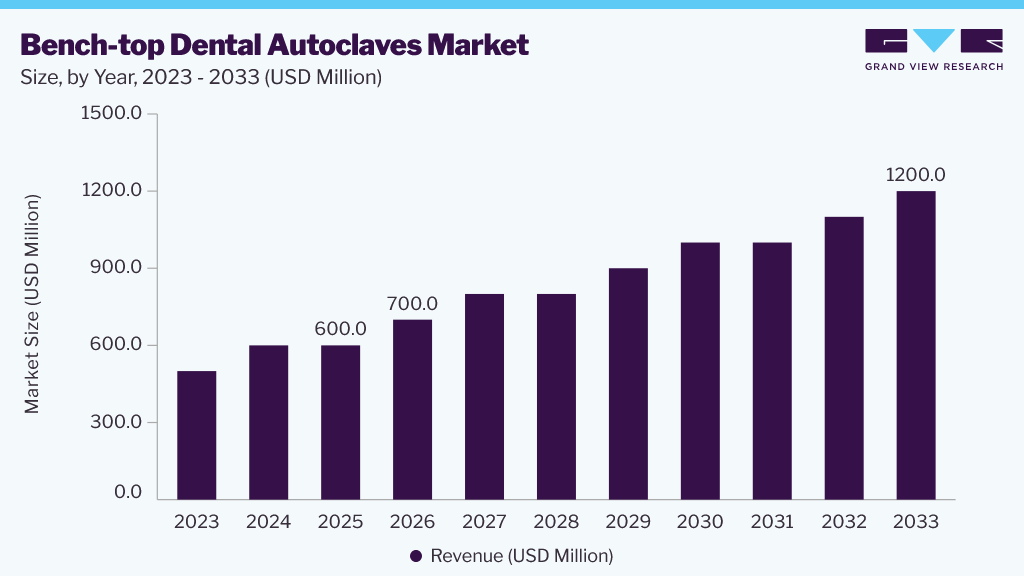 Source: Grand View Research, IR Documents, Primary Interviews, Paid DatabasesTo learn more about this report,
 Download Free Sample Report
The bench-top dental autoclaves should meet the safety standards and procedures established by the regulators, initially outlined in Italian Legislative Decree number 81 of 2008 (Consolidation Act for Occupational Health and Safety). The autoclave used in a dental facility is regulated by the FDA and is intended to render medical devices sterile. The FDA provides guidance on the use of autoclaves and requires sterile products to meet specific sterility requirements before introducing them to the market.
Market Dynamics
The rising rates of dental caries, gum disease, and tooth loss are major drivers of demand for bench-top dental autoclaves. As dental procedures increase worldwide, clinics and hospitals are focusing more on infection control and instrument sterilization to meet strict hygiene and safety standards. This focus is driving demand for dependable bench-top autoclaves. The World Health Organization (WHO) reports that oral diseases impact around 3.5 billion people worldwide, with untreated dental caries being the most prevalent health issue globally. The WHO also notes that the rise in oral diseases is linked to an aging population, urbanization, and high sugar intake, which heightens the demand for dental treatments and sterilization equipment. In addition, increased consumer spending on dental care is aiding market growth. According to the U.S. Bureau of Economic Analysis (BEA), consumer spending on dental services rose by 0.4% month-over-month, 3% from January to September 2025, 4% year-on-year, and 9% compared to pre-pandemic levels. This indicates ongoing growth in dental service usage. All these factors are expected to greatly increase the demand for bench-top dental autoclaves in dental care settings.The market faces challenges due to high upfront costs and ongoing expenses tied to these systems. After the initial purchase, dental clinics incur ongoing costs for routine calibration, validation testing, preventive maintenance, and replacement of essential parts such as seals, sensors, and heating elements. These are necessary to maintain effective sterilization and to meet regulatory requirements. Such recurring expenses can significantly increase the total cost of ownership, especially for small, independent dental practices operating on limited budgets. Industry evaluations show that annual servicing and compliance validation can range from several hundred to a few thousand dollars per unit. This makes frequent upgrades or equipment replacements difficult financially. Consequently, cost-sensitive dental clinics may postpone new purchases or extend the use of their existing equipment, thereby limiting overall market growth.The rising focus on infection control, regulatory compliance, and operational efficiency is creating significant opportunities for manufacturers to add IoT connectivity and smart features to bench-top dental autoclaves. Dental clinics and hospitals are increasingly using systems that provide real-time cycle monitoring, automated documentation, remote diagnostics, predictive maintenance, and cloud-based compliance tracking. These improvements aim to boost workflow efficiency and minimize equipment downtime. These features support better sterilization management, ensure regulatory compliance, and improve patient safety standards in dental care settings. For instance, Tuttnauer has created the T-Connect digital platform. This platform enables real-time monitoring of sterilization cycles, preventive maintenance tracking, and centralized equipment management through a single dashboard. This reflects the growing trend toward connected sterilization solutions that improve operational efficiency, ensure compliance, and enhance equipment reliability in dental practices worldwide.Analyst Perspective
The market is growing owing to the rising prevalence of dental disorders, increased dental procedures, and strict infection control guidelines in healthcare settings. Dental clinics and hospitals are focusing on improving sterilization to prevent cross-contamination and ensure patient safety. The growth of dental care infrastructure and the increasing use of modern dental technologies are also driving market demand. Furthermore, greater awareness of healthcare-related infections is prompting clinics to switch to better sterilization systems. The main opportunity for manufacturers is to create automated, IoT-enabled, and fast-cycle sterilization systems that improve operational efficiency, ensure compliance, and streamline workflow management in modern dental practices.
Product Insights
The automatic segment held the largest revenue share of around 51.0% in 2025 and is expected to register the fastest growth rate during the forecast period. The growing need for greater efficiency and reduced manual work in dental sterilization is driving the adoption of automatic bench-top dental autoclaves. These systems provide fully automated sterilization cycles, including pre-set programs, automatic pressure and temperature control, and self-diagnostic features. This reduces human error and improves workflow in busy dental clinics. Automatic autoclaves guarantee consistent sterilization quality and meet strict infection control standards, making them popular in modern dental practices. The increasing demand for quicker turnaround between patient treatments also drives the need for fully automated sterilization solutions.
The semi-automatic segment is expected to grow at around 9.5% over the forecast period. The growth can be attributed to the semi-automatic autoclave being an affordable sterilizer for various dental facilities, such as private clinics, that ensures safety, quality, and reliability. Semi-automatic autoclaves are simply plug-and-play devices. These sterilizer products are virtually maintenance-free after installation and have lower operating costs, as they are simple to use and don’t require specialized personnel to operate.
Class Insights
The class B segment held the largest revenue share of around 66.5% in 2025. Class B autoclaves are driving market growth due to their excellent sterilization capabilities. They can sterilize all kinds of instruments, including solid, hollow, porous, and wrapped, using both pre-vacuum and post-vacuum cycles. These systems are preferred in modern dental clinics and hospitals since they comply with strict European sterilization standards and provide the highest level of infection control. Growing awareness of patient safety and hospital-acquired infections is further promoting the use of Class B autoclaves. Their capacity for deep and reliable sterilization makes them the gold standard in advanced dental care.
The class S segment is expected to grow at approximately 9.0% during the forecast period. The Class S segment is growing steadily, as it effectively sterilizes specific types of unwrapped and solid instruments at a lower cost than Class B systems. These autoclaves are often used in smaller dental clinics with moderate sterilization needs. Their shorter cycle times, ease of use, and cost efficiency make them an attractive choice for practices with limited budgets. The rising number of small dental offices and outpatient clinics in emerging markets is also boosting demand for Class S bench-top autoclaves.
End Use Insights
Dental laboratories are expected to witness the highest growth rate of around 8.8% in the forecast period, as autoclave sterilizers are the most used in dental laboratories. Dental laboratories are increasingly using bench-top dental autoclaves to maintain sterile working environments and avoid cross-contamination during the fabrication of prosthetics and dental appliances. The rising demand for customized dental prosthetics, orthodontic devices, and implants is driving greater laboratory activity and higher sterilization requirements. In addition, strict hygiene standards and quality control regulations in dental manufacturing processes encourage the use of reliable sterilization equipment. The growth of digital dentistry and outsourced dental manufacturing services is also supporting this segment.
In hospitals, various tools and equipment are used for various surgical procedures, and it is critically important to sterilize them. The primary goal of hospital sterilization is to prevent the spread of contamination. The unknown bacteria and infections on hospital equipment & surgical tools can increase the risk of infection by exposing various parts of the body to potentially dangerous bacteria. Hospitals are a key end use segment driving demand for bench-top dental autoclaves due to high patient inflow and strict infection control protocols. Hospital dental departments need reliable, high-capacity sterilization equipment to manage large volumes of instruments used in complex dental procedures and surgeries. Hospital expansions, along with an increasing focus on patient safety and regulatory compliance, are driving the adoption of advanced autoclave systems. The integration of modern dental units in multi-specialty hospitals is also strengthening demand in this segment.
Regional Insights
North America witnessed the highest market share of around 39.0% in 2025. The rise of artificial intelligence (AI) and automation in dental practice management is a major driver of the market in North America. Using AI solutions improves efficiency, simplifies workflows, and boosts overall clinical management in dental networks. For instance, in April 2026, DentalXChange entered into a deal with Heartland Dental, the largest dental support organization (DSO) in the United States, to implement Eligibility AI and PortalPass credential management solutions across over 1,900 locations. This growing emphasis on automation and improved practice management is also increasing the need for effective, reliable sterilization equipment, such as bench-top dental autoclaves, to ensure smooth, compliant, and efficient dental care operations.
 To learn more about this report, Download Free Sample Report
Asia Pacific Bench-top Dental Autoclaves Market Trends
The bench-top dental autoclaves market in the Asia Pacific is expected to grow at the highest rate of 9.0% from 2026 to 2033. Improving healthcare infrastructure, consumer purchasing power, and patient awareness levels are some major factors expected to drive regional market growth during the forecast period. Moreover, the growing demand for dental tourism in emerging markets such as India and China is expected to increase the volume of dental procedures and, in turn, boost demand for bench-top dental autoclaves.
Key Bench-top Dental Autoclaves Company Insights
Market players are involved in manufacturing and developing high-quality sterilization products to capture a large market share. The market is price-sensitive, and therefore, competitors follow similar pricing strategies. Moreover, the availability of product differentiation options, coupled with rigorous price-based competition and the introduction of novel technologies such as dual microprocessors and automatic traceability systems, is expected to keep industry rivalry high throughout the forecast period. New product development and brand awareness campaigns are two of the most impactful sustainability strategies adopted by market players.
-
In January 2025, W&H Group displayed a new product lineup at IDS 2025. One highlight was the Synea Power Edition, designed for processing tough ceramic materials like zirconia. The company also launched the Lisa Mini sterilizer, a small Class B device that allows quick reprocessing of packaged instruments, including handpieces and contra-angle handpieces, in under 19 minutes. In addition, the W&H Oral Surgery Compass was introduced to improve precision and support a range of oral surgical procedures.
-
In July 2024, Flight Dental Systems launched the Clave45+ Steam Sterilizer, a high-capacity 45-liter sterilization system designed for dental clinics, laboratories, and other high-volume healthcare settings. The autoclave features programmable sterilization cycles, an intuitive LCD interface, rapid cycle times, and precise temperature and pressure controls, improving workflow efficiency and instrument turnaround. The launch highlights the industry's continued focus on developing advanced, high-performance sterilization solutions to meet growing infection control and compliance requirements.
Key Bench-top Dental Autoclaves Companies
The following key companies have been profiled for this study on the bench-top dental autoclaves market:
-
Belimed AG
-
Dentsply Sirona Inc.
-
Euronda S.p.A.
-
Getinge AB
-
MELAG Medizintechnik GmbH & Co. KG
-
Midmark Corporation
-
SciCan Ltd.
-
Shinva Medical Instrument Co., Ltd.
-
Tuttnauer Ltd.
-
W&H Dentalwerk Bürmoos GmbH
Bench-top Dental Autoclaves Market Report Scope
Report Attribute
Details
Market size in 2025
USD 600.0 million
Estimated market size in 2026
USD 700.0 million
Projected market size by 2033
USD 1200.0 million
Growth rate
CAGR of 8.2% from 2026 to 2033
Historical data
2021 - 2025
Forecast period
2026 - 2033
Quantitative units
Revenue in USD billion, and CAGR from 2026 to 2033
Report coverage
Revenue forecast, company ranking, competitive landscape, growth factors, and trends
Segments covered
Product, Class, End Use, Region
Regional scope
North America; Europe; Asia Pacific; Latin America; MEA
Country scope
U.S.; Canada; Germany; UK; France; Italy; Spain; Denmark; Sweden; Norway; China; India; Japan; South Korea; Australia; Thailand; Brazil; Mexico; Argentina; South Africa; Saudi Arabia; UAE; Kuwait
Key companies profiled
Belimed AG; Dentsply Sirona Inc.; Euronda S.p.A.; Getinge AB; MELAG Medizintechnik GmbH & Co. KG; Midmark Corporation; SciCan Ltd.; Shinva Medical Instrument Co., Ltd.; Tuttnauer Ltd.; W&H Dentalwerk Bürmoos GmbH
Customization scope
Free report customization (equivalent up to 8 analysts working days) with purchase. Addition or alteration to country, regional & segment scope.
Pricing and purchase options
Avail of customized purchase options to meet your exact research needs. Explore purchase options
Global Bench-top Dental Autoclaves Market Report Segmentation
This report forecasts revenue growth at the regional and country levels and provides an analysis on the latest industry trends and opportunities in each of the sub-segments from 2021 to 2033. For this study, Grand View Research has segmented the global bench-top dental autoclaves market report based on product, class, end use, and region:
-
Product Outlook (Revenue, USD Billion, 2021 - 2033)
-
Automatic
-
Semi-Automatic
-
Manual
-
-
Class Outlook (Revenue, USD Billion, 2021 - 2033)
-
Class B
-
Class N
-
Class S
-
-
End Use Outlook (Revenue, USD Billion, 2021 - 2033)
-
Hospitals and Clinics
-
Dental Laboratories
-
Academic and Research Institutes
-
-
Regional Outlook (Revenue, USD Billion, 2021 - 2033)
-
North America
-
U.S.
-
Canada
-
Mexico
-
-
Europe
-
Germany
-
France
-
UK
-
Italy
-
Spain
-
Denmark
-
Sweden
-
Norway
-
-
Asia Pacific
-
China
-
India
-
Japan
-
South Korea
-
Australia
-
Thailand
-
-
Latin America
-
Brazil
-
Argentina
-
Mexico
-
-
Middle East & Africa
-
Saudi Arabia
-
UAE
-
South Africa
-
Kuwait
-
-
Frequently Asked Questions About This Report
The global bench-top dental autoclaves market size was valued at USD 600.0 million in 2025 and is estimated at USD 700.0 million for 2026.
The global bench-top dental autoclaves market is expected to grow at a CAGR of 8.2% from 2026 to 2033, reaching USD 1,200.0 million.
Key players include Belimed AG; Dentsply Sirona Inc.; Euronda S.p.A.; Getinge AB; MELAG Medizintechnik GmbH & Co. KG; Midmark Corporation; SciCan Ltd.; Shinva Medical Instrument Co., Ltd.; Tuttnauer Ltd.; W&H Dentalwerk Bürmoos GmbH
North America dominated with a 39.0% revenue share in 2025.
Class B dominated the bench-top dental autoclaves market with a share of 66.5% in 2025.
About the Author(s)
Medical Devices Research Team
Healthcare · Medical DevicesThis report was authored by the medical devices research team at Grand View Research - comprising two research analysts, one senior research analyst, and one industry expert - with specialized expertise in the medical devices segment of the healthcare industry. All findings are based on proprietary healthcare databases, executive interviews, and regulatory analysis, subject to internal peer review prior to publication.
Last Updated:
Speak to Analyst

Customize this report to your needs - add regions, segments, or data points, with 20% free customization.
Or view our licence options:


ISO 9001:2015 & 27001:2022 Certified
We are GDPR and CCPA compliant! Your transaction & personal information is safe and secure. For more details, please read our privacy policy.


