
- Home
- »
- Agrochemicals & Fertilizers
- »
-
Biostimulants Market Size, Share, Trends Report, 2026-2033GVR Report cover

Biostimulants Market (2026 - 2033)
Size, Share & Trends Analysis Report By Active Ingredients (Acid Based, Microbial), By Crop Type (Row Crops And Cereals, Fruits And Vegetables, Turf And Ornamentals), By Application (Foliar, Soil Treatment), By Region, And Segment Forecasts
Market Size, 2025
$3.1BMarket Estimate, 2026
$3.4BMarket Forecast, 2033
$5.9BCAGR, 2026–2033
8.5%Biostimulants Market Summary
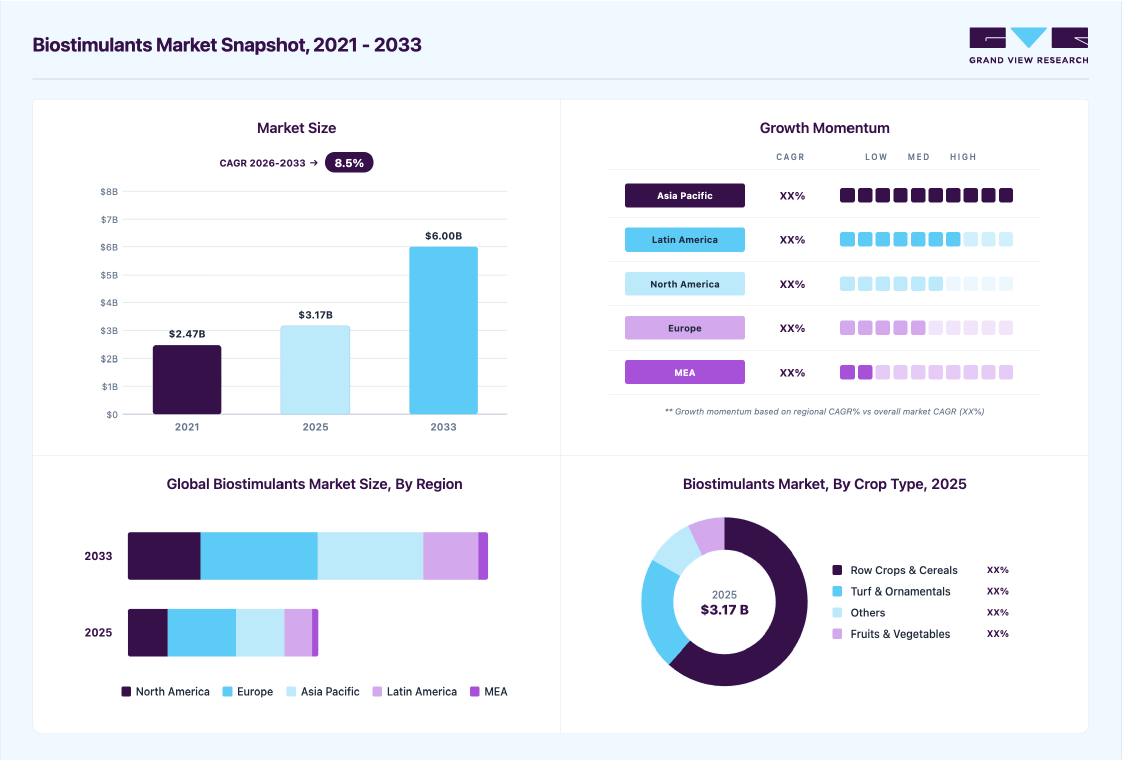
The global biostimulants market size was valued at USD 3.1 billion in 2025 and is projected to grow from USD 3.4 billion in 2026 to USD 5.9 billion by 2033, at a CAGR of 8.5% from 2026 to 2033. The Europe held the largest share of 36.0% of the global market in 2025. The industry is driven by the increasing focus on sustainable agriculture, as growers seek solutions that enhance plant growth, nutrient uptake, and soil health while minimizing the environmental impact of conventional agrochemicals.
 Source: Grand View Research, IR Documents, Primary Interviews, Paid DatabasesTo learn more about this report,
 Download Free Sample Report
 Key Market Trends & Insights
- By active ingredients: Acid-based segment held the largest market share of 47.2% in 2025.
- By crop type: Row crops & cereals segment held the largest market share of 61.7% in 2025.
- By application: Foliar treatment segment accounted for the largest revenue share of 78.6% in 2025.
Regional Highlights
- Largest regional market: Europe (36.0% revenue share, 2025)
- Fastest-growing regional market: Asia Pacific (highest CAGR, 2026-2033)
Market Size & Forecast
- Market size in 2025: USD 3.1 Billion
- Estimated market size in 2026: USD 3.4 Billion
- Projected market size by 2033: USD 5.9 Billion
- CAGR (2026-2033): 8.5%
Three ways to get this report
Buy it, customize it, or ask a question.Ask an Analyst
Analyst response in 1 business day
- AccessReport author, directly
- Reply timeWithin 1 working day
- No sales callDirect answer only
- FormatEmail reply
- CostFree, no cost
Get the Full Report
What the study covers
- FormatsPDF · Excel · Dashboard
- Timeline2026–2033 annual, 2025 base
- Coverage20+ countries, 5 regions
- Companies10+ key players profiled
Customize the Report
20% free customization
- IncludeCountries, segments, points
- TailorTo your product definition
- ExtendDeeper competitor detail
- OrA fully bespoke study
- Turnaround5–10 working days
Increasing climate variability, including droughts, heat stress, and soil salinity, is creating pressure on farmers to protect crop performance. Biostimulants help improve plant tolerance to abiotic stress and support consistent growth under challenging conditions. They also enhance root development and nutrient utilization, leading to more stable yields. As a result, growers are increasingly adopting biostimulants to safeguard productivity and reduce yield volatility.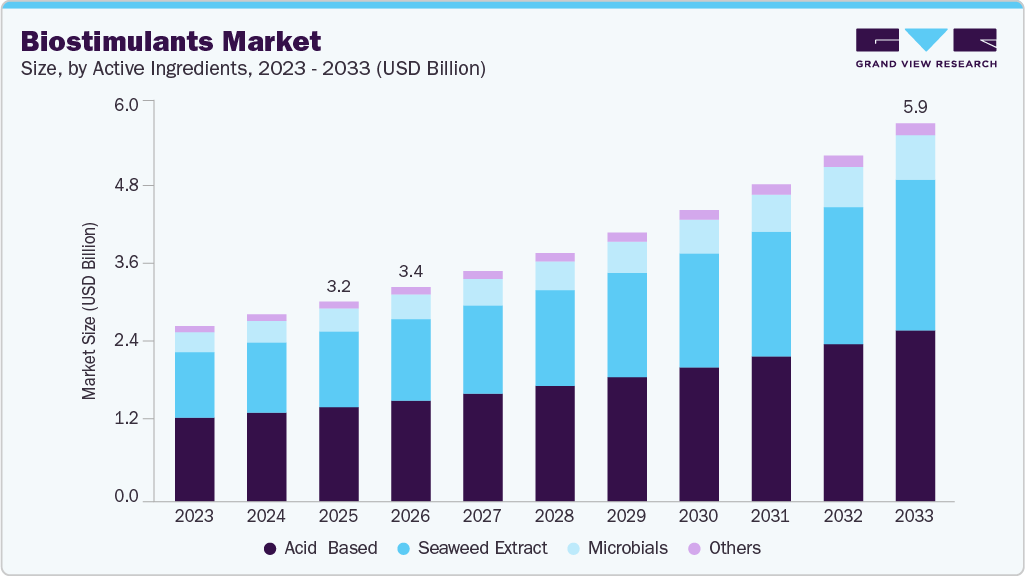 To learn more about this report, Download Free Sample Report
 The biostimulants market presents a strong growth opportunity through increasing adoption in precision farming and high-value specialty crops such as fruits, vegetables, and horticultural produce. As growers focus on maximizing yield quality, resource efficiency, and return on investment, biostimulants are being integrated with data-driven crop management practices to deliver targeted performance benefits. This trend is further supported by rising export standards, premium food demand, and technological advancements in formulation and application methods, creating new revenue avenues for market participants.
Market Dynamics
The growing focus on sustainable agricultural practices is a major driver of the global biostimulants market. Farmers and agricultural producers are increasingly adopting sustainable crop management solutions to improve productivity while minimizing the environmental impact associated with excessive use of synthetic fertilizers and agrochemicals. Biostimulants enhance nutrient uptake efficiency, improve soil health, stimulate plant growth, and increase crop tolerance to abiotic stressors such as drought, salinity, and temperature fluctuations. As agricultural land availability continues to decline and pressure on food production increases due to rising global population, growers are increasingly turning toward biostimulants to achieve higher yields and better crop quality through environmentally sustainable farming practices.
In addition, governments and regulatory bodies across several regions are promoting sustainable agriculture and integrated crop management practices to reduce chemical dependency and support long-term soil fertility. The growing adoption of organic farming, precision agriculture, regenerative agriculture, and climate-smart farming techniques is further accelerating demand for biostimulants across fruits & vegetables, cereals, row crops, and specialty crops. Increasing consumer preference for residue-free, sustainably produced food products is also encouraging growers to incorporate biological, naturally derived crop enhancement products into their agricultural practices. These factors collectively support the long-term growth potential of the biostimulants market.
Lack of awareness among farmers about the benefits, application methods, and long-term effectiveness of biostimulants remains a key restraint on market growth, particularly in developing agricultural economies. Many small and medium-scale farmers continue to rely heavily on conventional fertilizers and pesticides due to familiarity, lower perceived risk, and limited technical understanding of biological crop inputs. In several regions, inadequate training programs, limited field demonstrations, and insufficient extension support restrict product adoption. In addition, uncertainty regarding product performance under varying climatic and soil conditions may discourage growers from investing in biostimulant products, thereby limiting broader market penetration.
Market Concentration & Characteristics
The biostimulants industry is moderately fragmented, with the presence of a mix of global agrochemical companies, specialized biostimulant manufacturers, and emerging regional players. Large multinational firms leverage strong R&D capabilities, broad product portfolios, and established distribution networks to maintain competitive positions, while smaller players compete through niche formulations, biological innovations, and crop-specific solutions. Strategic partnerships, acquisitions, and product launches are common as companies seek to expand geographic reach and strengthen their biological input offerings.
The market is characterized by rapid innovation, regulatory evolution, and increasing customer awareness of biological crop inputs. Demand is largely driven by performance-based outcomes, such as yield improvement, stress tolerance, and crop quality enhancement, leading to strong emphasis on field validation and agronomic support.
 To learn more about this report, Download Free Sample Report
 Additionally, the market shows high adoption in high-value crops and regions with advanced farming practices, while pricing and product differentiation are influenced by formulation complexity, raw material sourcing, and proven efficacy.
Active Ingredients Insights
The acid-based segment dominated the industry with a revenue share of over 47.2% in 2025, due to its proven ability to improve soil structure, enhance nutrient availability, and support root development across a wide range of crops. Their broad applicability, cost-effectiveness, and consistent agronomic performance make them the preferred choice among farmers, particularly in large-scale and field crop applications.
Seaweed extract biostimulants are witnessing rapid growth with a projected CAGR of 9.2% from 2026 to 2033, driven by rising demand for natural, plant-based inputs that enhance stress tolerance and crop vigor. Rich in bioactive compounds such as hormones and polysaccharides, these products support yield quality and resilience, aligning well with organic farming trends and premium crop production requirements.
Crop Type Insights
Row crops & cereals dominated the market with a revenue share of over 61.7% in 2025, due to their large cultivation area and the increasing need to enhance yield stability and input efficiency in high-volume crop production. Farmers adopt biostimulants to improve nutrient uptake, root development, and stress tolerance, enabling better productivity and cost optimization in large-scale farming systems.
The fruits and vegetables segment is witnessing significant growth with a projected CAGR of 8.5%, driven by rising demand for high-quality, residue-free produce and improved shelf life. Biostimulants support crop quality, yield uniformity, and stress resistance, making them increasingly attractive for high-value horticultural crops and export-oriented production.
Application Insights
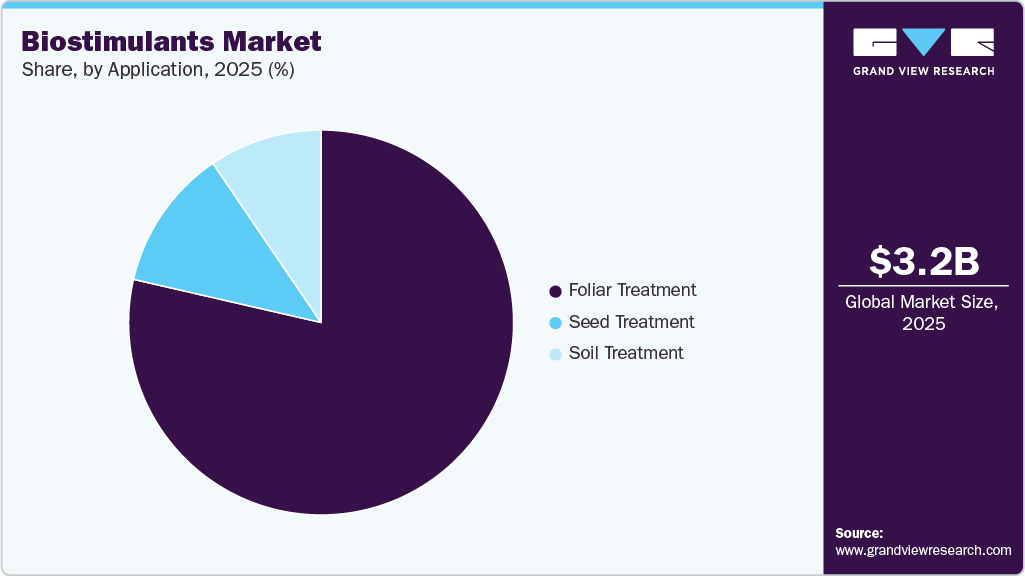
The foliar treatment application dominated the market with a revenue share of over 78.6% in 2025, due to its rapid nutrient absorption and immediate physiological response in plants. This method allows growers to quickly address nutrient deficiencies and stress conditions, making it widely adopted across diverse crops and growth stages.
 To learn more about this report, Download Free Sample Report
 Seed treatment is the fastest growing application segment with a CAGR of 10.2%, as farmers increasingly focus on early-stage crop vigor and uniform germination. Biostimulants applied at the seed level enhance root development and stress tolerance from the initial growth phase, offering cost-effective yield improvement and reduced input dependency.
Regional Insights
Europe Biostimulants Market Trends
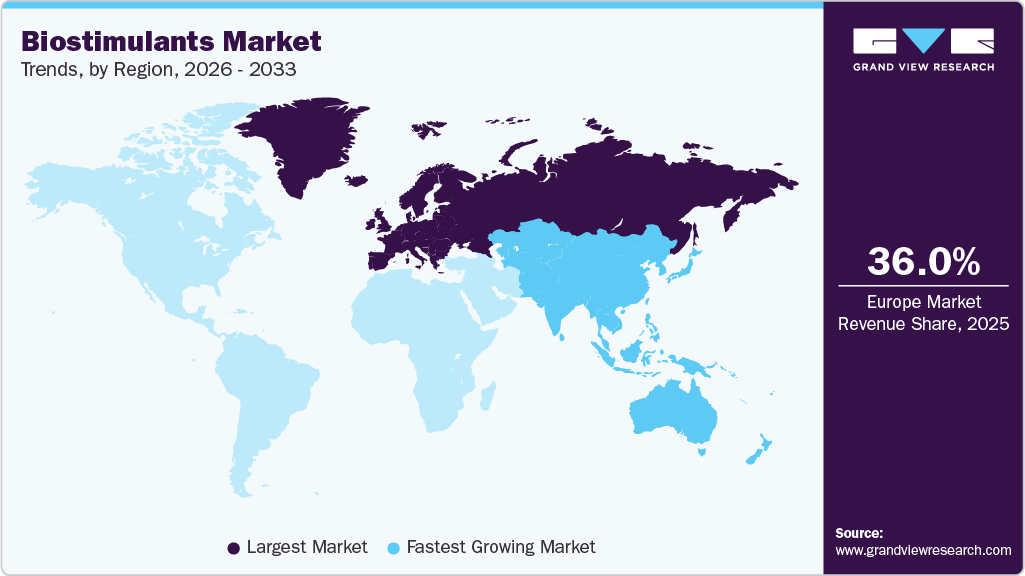
The biostimulants market in Europe dominated the global industry with a revenue share of 36.0% in 2025, due to strong regulatory support for sustainable agriculture and widespread adoption of biological crop inputs. Stringent restrictions on chemical fertilizers and pesticides, combined with high awareness among farmers, continue to drive consistent demand across major agricultural economies.
 To learn more about this report, Download Free Sample Report
 Germany’s biostimulants market is supported by strong regulatory emphasis on environmentally friendly agriculture and high penetration of organic farming. Farmers increasingly adopt biostimulants to comply with sustainability standards while maintaining crop productivity.
North America Biostimulants Market Trends
The biostimulants market in North America is driven by increasing adoption of advanced farming practices and growing focus on yield optimization and soil health. Large-scale commercial farming and rising interest in biological and organic inputs are supporting steady uptake of biostimulants.
U.S. Biostimulants Market Trends
The biostimulants market in the U.S. is driven by large-scale commercial agriculture and a growing focus on improving yield consistency and stress management. Integration of biostimulants into precision agriculture programs is further supporting adoption.
Asia Pacific Biostimulants Market Trends
The biostimulants market in Asia Pacific is expected to witness a CAGR of 10.6%, fueled by rising food demand, expanding agricultural production, and increasing awareness of yield-enhancing technologies. Government initiatives to promote sustainable farming and improve farmer access to modern agri-inputs are accelerating biostimulant adoption.
China’s biostimulants market is driven by government-led efforts to reduce chemical fertilizer usage and improve soil health. Rising adoption of sustainable inputs in high-intensity farming systems is supporting market expansion.
Latin America Biostimulants Market Trends
The biostimulants market in Latin America is driven by large-scale cultivation of row crops and export-oriented agriculture. Farmers increasingly use biostimulants to improve productivity, stress tolerance, and input efficiency under variable climatic conditions.
Middle East & Africa Biostimulants Market Trends
The biostimulants market in the Middle East & Africa is supported by the need to improve crop performance under water scarcity and challenging soil conditions. Biostimulants are gaining traction as tools to enhance stress resistance and optimize yields in arid and semi-arid regions.
Key Biostimulants Companies Insights
The competitive scenario of the biostimulants market involves consolidation, competitive advantage, and market penetration by various players. The industry is comparatively newer than other agrochemical industries. It is an emerging industry that is involved in developing a wide array of innovative products to cater to agronomic market needs arising from sustainable activities.
Key Biostimulants Companies:
The following key companies have been profiled for this study on the biostimulants market
- Isagro Group
- BASF SE
- Biolchim S.P.A.
- Sapec Agro S.A.
- Novonesis
- Valagro SpA
- Italpollina SAP
- Koppert B.V.
- Biostadt India Limited
Competitive Benchmarking
Operating Strategies
Competitive Edge
Weakness
Mature Players: BASF SE, Novonesis, Valagro SpA, Koppert B.V.
- Strong focus on biological crop solutions and sustainable agriculture.
- Extensive R&D initiatives for next-generation biostimulants.
- Strategic acquisitions and partnerships to strengthen the biological product portfolio.
- Expansion across precision agriculture and specialty crop applications.
- Emphasis on regulatory approvals and global distribution expansion.
- Strong global distribution network and geographic presence.
- Diversified biological and crop nutrition portfolio.
- Strong technical expertise and innovation capabilities.
- Robust financial strength supporting product development and acquisitions.
- Established relationships with commercial growers and distributors.
- Higher operational and regulatory compliance costs.
- Premium product pricing in price-sensitive agricultural markets.
- Slower penetration into highly localized farming communities.
- Dependence on developed agricultural economies for premium product demand.
Emerging Players: Isagro Group, SAPEC Agro S.A., Biolchim S.P.A., Italpollina S.p.A., Biostadt India Limited
- Strong focus on regional agricultural markets and crop-specific solutions.
- High emphasis on customized formulations and distributor partnerships.
- Expansion in organic farming and specialty crop segments.
- Aggressive product commercialization strategies across emerging agricultural economies.
- Strong foothold in regional and niche agricultural markets.
- Flexibility in catering to local crop requirements.
- Strong small and medium grower customer base.
- Competitive pricing strategies enabling penetration into untapped markets.
- Faster response to regional agricultural trends
- Limited geographical reach compared to multinational players.
- Lower financial capability for large-scale global expansion.
- Limited investment capacity for advanced biotechnology R&D.
- Dependence on regional regulatory approvals and distributor networks
Recent Developments
-
In December 2025, Valent BioSciences and Seipasa formed a strategic partnership to bring novel biostimulant products to the U.S. market, aiming to combine expertise and expand technological offerings in biostimulant solutions.
Biostimulants Market Report Scope
Report Attribute
Details
Market size in 2025
USD 3.1 billion
Estimated market size in 2026
USD 3.4 billion
Projected market size by 2033
USD 5.9 billion
Growth rate
CAGR of 8.5% from 2026 to 2033
Base year for estimation
2025
Historical data
2018 - 2024
Forecast period
2026 - 2033
Quantitative units
Volume in million-hectare; revenue in USD million/billion, and CAGR from 2026 to 2033
Report coverage
Volume & revenue forecast, company ranking, competitive landscape, growth factors, and trends
Segments covered
Active ingredients, crop type, application, region
Regional scope
North America; Europe; Asia Pacific; Latin America; Middle East & Africa
Country scope
U.S.; Canada; Mexico; Germany; UK; Italy; China; India; Japan; Australia; Brazil; Argentina; Saudi Arabia; South Africa
Key companies profiled
BASF SE; Isagro Group; Sapec Agro S.A.; Biolchim S.P.A.; Novonesis; A/S; Valagro SpA; Koppert B.V.; Italpollina SAP; Biostadt India Limited
Customization scope
Free report customization (equivalent up to 8 analysts working days) with purchase. Addition or alteration to country, regional & segment scope.
Pricing and purchase options
Avail customized purchase options to meet your exact research needs. Explore purchase options
Global Biostimulants Market Report Segmentation
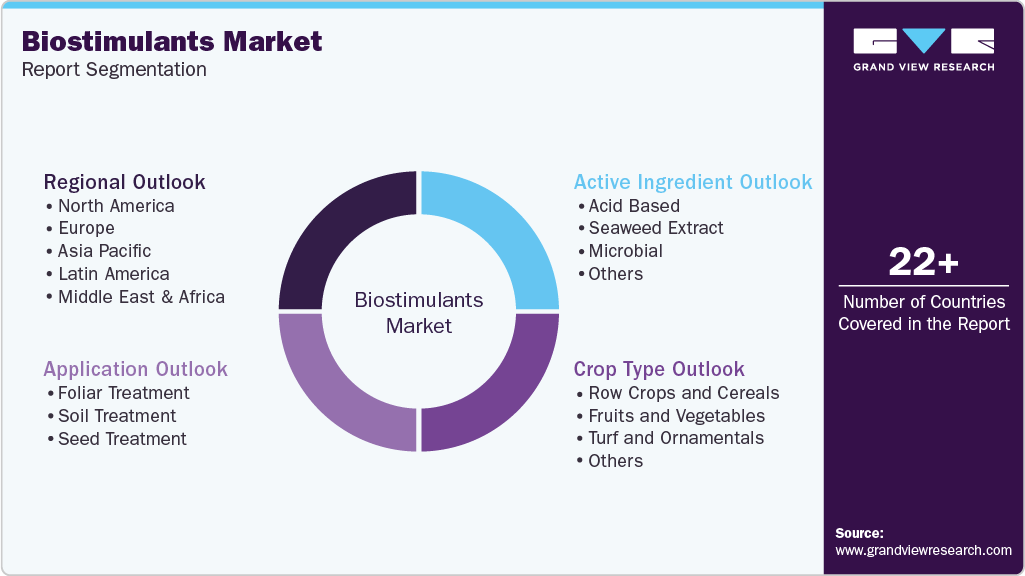
This report forecasts volume & revenue growth at global, regional, and country levels and provides an analysis of the latest industry trends in each of the sub-segments from 2018 to 2033. For this study, Grand View Research has segmented the global biostimulants market report on the basis of active ingredients, crop type, application, and region:
 To learn more about this report, Download Free Sample Report
 -
Active Ingredient Outlook (Volume, Million Hectare; Revenue, USD Million, 2018 - 2033)
-
Acid Based
-
Seaweed Extract
-
Microbial
-
Others
-
-
Crop Type Outlook (Volume, Million Hectare; Revenue, USD Million, 2018 - 2033)
-
Row Crops and Cereals
-
Fruits and Vegetables
-
Turf and Ornamentals
-
Others
-
-
Application Outlook (Volume, Million Hectare; Revenue, USD Million, 2018 - 2033)
-
Foliar Treatment
-
Soil Treatment
-
Seed Treatment
-
-
Regional Outlook (Volume, Million Hectare; Revenue, USD Million, 2018 - 2033)
-
North America
-
U.S.
-
Canada
-
Mexico
-
-
Europe
-
Germany
-
UK
-
Italy
-
-
Asia Pacific
-
China
-
India
-
Japan
-
Australia
-
-
Latin America
-
Brazil
-
Argentina
-
-
Middle East & Africa
-
South Africa
-
Saudi Arabia
-
-
Delivered Customizations
This report has been delivered with the following In-depth customizations
Client Request
Customization Delivered
Value Adds
Regional Segmentation
Assessment of global and regional biostimulants market dynamics, including production capacities, raw material availability (seaweed extracts, humic substances, amino acids, microbial ingredients, and plant extracts), import-export analysis, regulatory framework, and supply-demand trends across major regions such as North America, Europe, Asia Pacific, Latin America, and the Middle East & Africa. The customization can also include country-level analysis for key agricultural markets, such as Brazil, India, China, Spain, France, Australia, and South Africa, depending on the requirements. In addition, the analysis evaluates crop-specific demand trends across cereals & grains, fruits & vegetables, turf & ornamentals, oilseeds & pulses, and specialty crops applications.
Enable identification of high-growth agricultural markets, crop-specific demand hotspots, and regional adoption trends within the biostimulants industry. Support expansion planning, localization strategies, distributor identification, and procurement optimization through enhanced visibility into sustainable agriculture practices, organic farming trends, and crop productivity enhancement initiatives across key regions.
Competitive Benchmarking
Comparative assessment of key biostimulants manufacturers based on product portfolio, biological formulation specialization, manufacturing footprint, crop application focus, innovation capabilities, sustainability initiatives, distribution network, pricing positioning, agronomic support capabilities, and regional presence. Additional company profiling can be incorporated based on client requirements, including benchmarking across seaweed extracts, humic substances, amino acid-based biostimulants, microbial biostimulants, and specialty biological formulations.
Support supplier benchmarking and strategic evaluation by identifying leading biostimulants manufacturers, formulation capabilities, biological innovation strengths, and portfolio gaps across crop applications and regions. Enable informed decision-making related to supplier partnerships, product development strategies, sustainability positioning, procurement planning, and competitive assessment across the agricultural biologicals value chain.
Pricing Analysis
Detailed evaluation of emerging growth opportunities across sustainable agriculture, organic farming, precision agriculture, regenerative farming, abiotic stress management, and crop yield enhancement applications. The assessment includes analysis of regulatory support for biological agricultural inputs, increased adoption of environmentally sustainable farming practices, soil health management trends, climate change mitigation strategies, and evolving grower preferences toward residue-free crop solutions. It also highlights high-growth regional agricultural markets, evolving crop-nutrition requirements, and opportunities associated with biological crop-input innovation and sustainable food-production initiatives.
Enable prioritization of high-growth application areas and emerging investment opportunities across the biostimulants value chain. Support strategic planning, product diversification, sustainability positioning, and market entry initiatives through insights into evolving agricultural regulations, biological farming trends, climate-resilient agriculture practices, and future demand potential across global crop production systems.
Frequently Asked Questions About This Report
Some key players operating in the biostimulants market include BASF SE; Isagro Group; Sapec Agro S.A.; Biolchim S.P.A.; Novonesis; A/S; Valagro SpA; Koppert B.V.; Italpollina SAP; Biostadt India Limited
The market is driven by the increasing focus on sustainable agriculture, as growers seek solutions that enhance plant growth, nutrient uptake, and soil health while minimizing the environmental impact of conventional agrochemicals
The global biostimulants market size was valued at USD 3.1 billion in 2025 and is estimated at USD 3.4 billion for 2026.
The global biostimulants market is expected to grow at a CAGR of 8.5% from 2026 to 2033, reaching USD 5.9 billion by 2033.
Asia Pacific is the fastest-growing region over the forecast period.
The acid-based segment led with a 47.2% revenue share in 2025.
The row crops & cereals segment held the largest revenue share of 61.7% in 2025.
The foliar treatment segment held the largest revenue share in 2025, while seed treatment is the fastest-growing application segment.
Europe dominated the global biostimulants market with a 36.0% revenue share in 2025.
About the Author(s)
Agrochemicals & Fertilizers Research Team
Bulk Chemicals · Agrochemicals & FertilizersThis report was authored by the agrochemicals & fertilizers research team at Grand View Research - comprising two research analysts, one senior research analyst, and one industry expert - with specialized expertise in the agrochemicals & fertilizers segment of the bulk chemicals industry. All findings are based on proprietary bulk chemicals databases, executive interviews, and regulatory analysis, subject to internal peer review prior to publication.
Last Updated:
Speak to Analyst

Customize this report to your needs - add regions, segments, or data points, with 20% free customization.
Or view our licence options:


ISO 9001:2015 & 27001:2022 Certified
We are GDPR and CCPA compliant! Your transaction & personal information is safe and secure. For more details, please read our privacy policy.


