
- Home
- »
- Food Safety & Processing
- »
-
Bottling Line Machinery Market Size Report, 2026-2033GVR Report cover

Bottling Line Machinery Market (2026 - 2033)
Size, Share, & Trends Analysis Report By Technology (Automatic, Semi-Automatic), By Application (Beverages, Prepared Food, Pharmaceutical, Chemical, Cosmetics & Personal Care), By Region, And Segment Forecasts
Market Size, 2025
$4.9BMarket Estimate, 2026
$5.2BMarket Forecast, 2033
$7.5BCAGR, 2026–2033
5.5%Bottling Line Machinery Market Summary
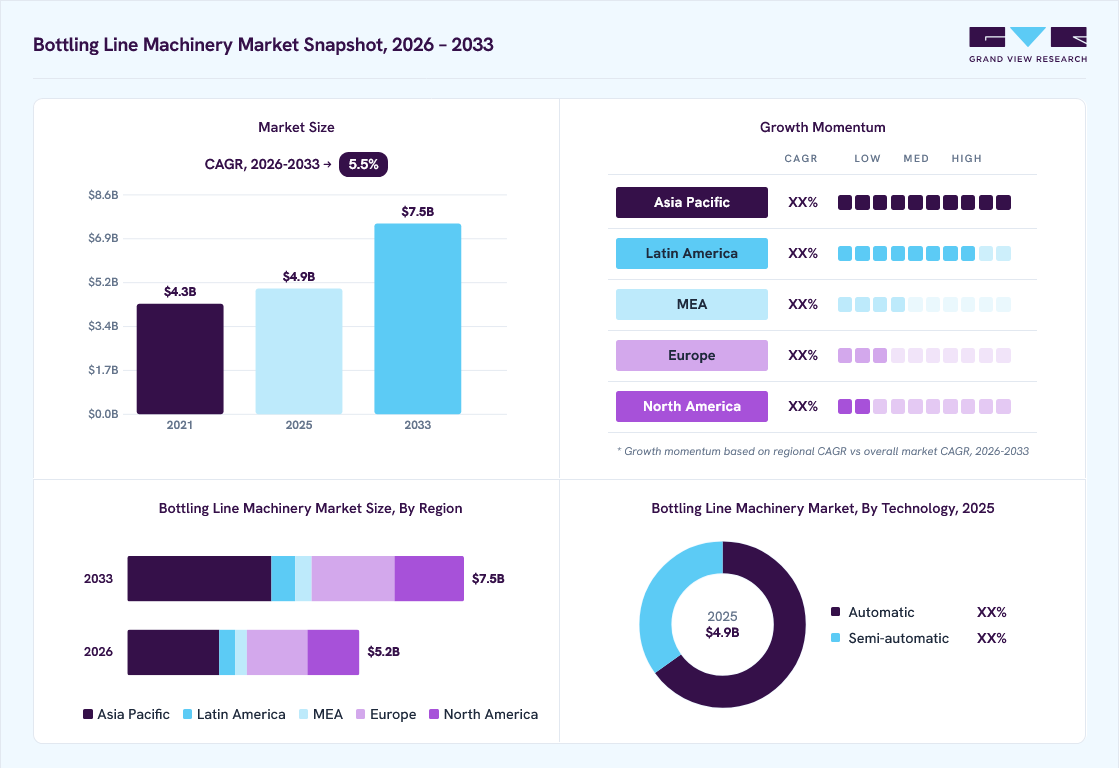
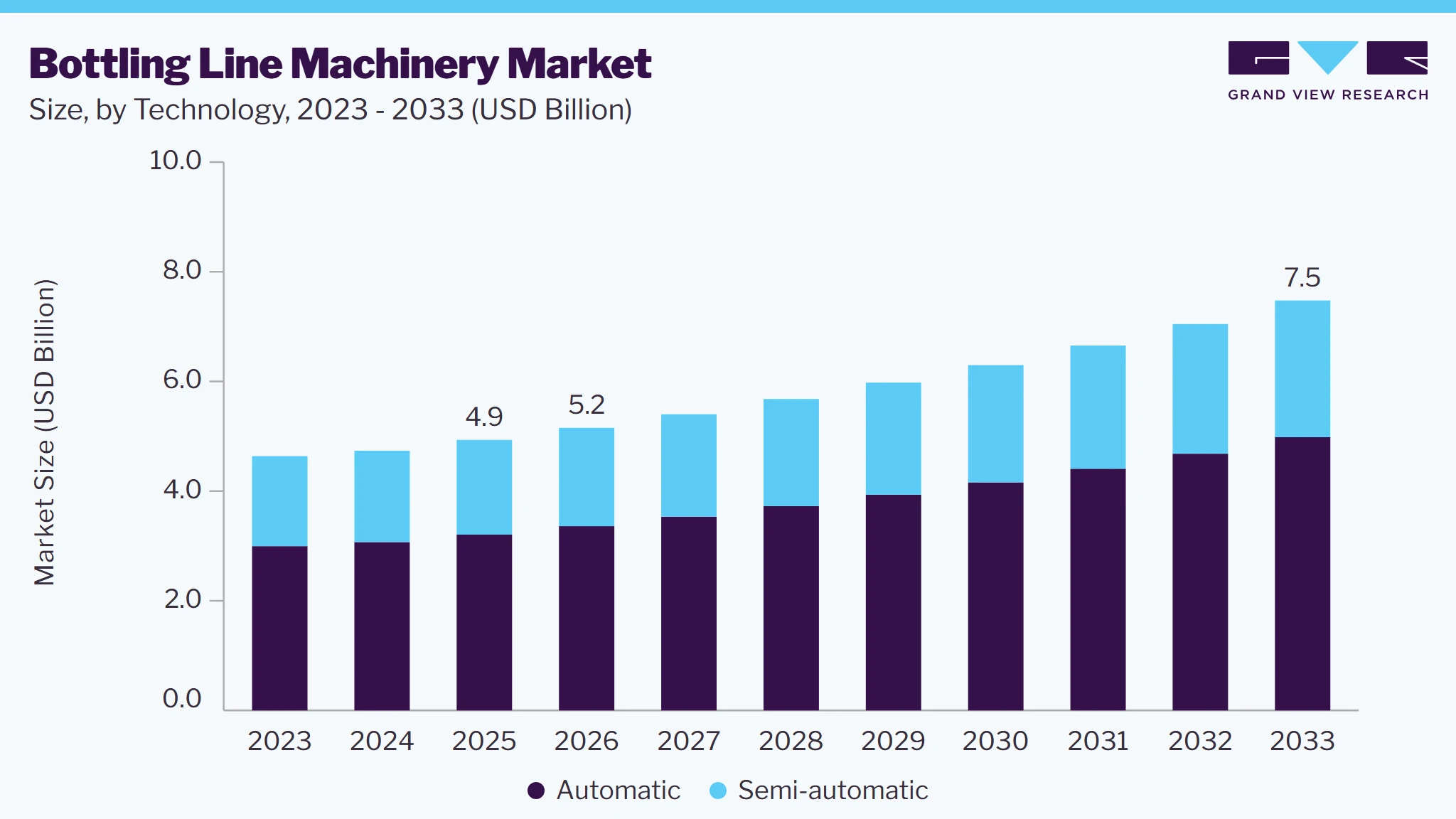
The global bottling line machinery market size was valued at USD 4.9 billion in 2025 and is projected to grow from USD 5.2 billion in 2026 to USD 7.5 billion by 2033, at a CAGR of 5.5% from 2026 to 2033. Asia Pacific dominated the market, accounting for a revenue share of 39.2% in 2025. The rising prominence of beverage products with unique tastes, colors, and textures is expected to boost the demand for bottling line machinery over the forecast period.
 Source: Grand View Research, IR Documents, Primary Interviews, Paid DatabasesTo learn more about this report,
 Download Free Sample Report
Key Market Trends & Insights
- By technology: Automatic segment held the largest market share of 65.0% in 2025.
- By application: Beverages segment held the largest market share of 25.6% in 2025.
Regional Highlights
- Largest regional market: Asia Pacific (39.2% revenue share, 2025)
- By country: China held the largest market share in 2025.
Market Size & Forecast
- Market size in 2025: USD 4.9 Billion
- Estimated market size in 2026: USD 5.2 Billion
- Projected market size by 2033: USD 7.5 Billion
- CAGR (2026-2033): 5.5%
Three ways to get this report
Buy it, customize it, or ask a question.Ask an Analyst
Analyst response in 1 business day
- AccessReport author, directly
- Reply timeWithin 1 working day
- No sales callDirect answer only
- FormatEmail reply
- CostFree, no cost
Get the Full Report
What the study covers
- FormatsPDF · Excel · Dashboard
- Timeline2026–2033 annual, 2025 base
- Coverage20+ countries, 5 regions
- Companies10+ key players profiled
Customize the Report
20% free customization
- IncludeCountries, segments, points
- TailorTo your product definition
- ExtendDeeper competitor detail
- OrA fully bespoke study
- Turnaround5–10 working days
In addition, increasing urbanization, and technological advancements in packaging including a growing focus on minimizing production costs, increasing industrial automation, and the expansion of the e-commerce industry are also contributing towards the markets’ growth.The increase in demand for healthy beverages and pharmaceuticals due to the COVID-19 pandemic had a positive impact on the market's growth. Companies operating in the beverages and pharmaceutical industries adopted new and automated lines to meet this growing demand for their products, thereby boosting machinery demand.
 To learn more about this report, Download Free Sample Report
Digital twin technology is emerging as a transformative force in the bottling line machinery sector, enabling the creation of virtual models that mirror physical processes for enhanced monitoring and analysis. This innovation facilitates simulation, testing, and optimization, leading to improved efficiency. The integration of automation, robotics, and artificial intelligence further refines bottling operations by boosting accuracy and speed. In addition, the growing urban population in the U.S. has influenced food preferences, which, in turn, favors the processing and packaging industry. Moreover, chemical industry players in the U.S. are keen on expanding and building capacity, creating demand for packaging. This is expected to positively impact the industry over the forecast period.
Food and beverage industry players are resorting to contract manufacturing because of advantages such as lower upfront investment for the client, minimum storage and warehouse needs, high industry expertise, and time and cost savings. Pharmaceutical industry players are incorporating technology in bottling lines to reduce costs and enhance profit margins, which is likely to increase the demand for bottling line machinery. Moreover, the rise of Industry 4.0 principles promotes real-time data analytics and predictive maintenance, minimizing downtime. As sustainability becomes increasingly crucial, manufacturers are focusing on eco-friendly solutions that reduce energy use and waste. Concurrently, the escalating demand for packaged beverages due to urbanization and changing lifestyles drives the need for efficient bottling lines.
Market Dynamics
The bottling line machinery market is being propelled by increasing investments in beverage processing infrastructure and the rising consumption of packaged liquids across the food, beverage, pharmaceutical, and personal care industries. Growing product diversification and shorter product life cycles are prompting manufacturers to adopt versatile bottling systems capable of accommodating multiple container formats and facilitating rapid changeovers. Rising emphasis on precision filling, contamination prevention, and product traceability is accelerating the integration of advanced inspection and quality assurance technologies. Capacity expansion initiatives by beverage producers and contract packaging companies are further driving the modernization of production facilities.
The growing consumption of bottled water, carbonated soft drinks, juices, dairy beverages, alcoholic beverages, and pharmaceutical liquid formulations is continuing to drive investments in bottling and packaging infrastructure worldwide. Manufacturers are expanding production capacities and upgrading existing facilities to accommodate evolving consumer preferences, rising product volumes, and increasing demand for premium and differentiated packaging formats.
In addition, the expansion of contract packaging operations and food and beverage processing facilities is reinforcing demand for high-speed bottling line machinery capable of delivering enhanced throughput, precision, and operational reliability.
High capital expenditure associated with the procurement and installation of complete bottling line systems remains a significant challenge for market growth. The deployment of filling, capping, labeling, conveying, and inspection equipment requires substantial upfront investment, while integration with existing production infrastructure often involves additional engineering modifications and temporary production disruptions.
Furthermore, ongoing maintenance requirements and the need for skilled technical personnel to operate and optimize advanced systems may constrain adoption, particularly among small and medium-sized manufacturers with limited financial resources.
The increasing emphasis on production efficiency, product traceability, and manufacturing flexibility is creating substantial opportunities for the bottling line machinery market. Equipment manufacturers are incorporating advanced sensing technologies, real-time performance monitoring, automated quality inspection, and predictive maintenance capabilities to enhance asset utilization and reduce unplanned downtime.
Moreover, the growing prevalence of product diversification and frequent SKU changes is accelerating demand for modular bottling systems capable of handling multiple container sizes and packaging formats. These technological advancements, coupled with rising investments in sustainable and resource-efficient manufacturing practices, are expected to create favorable growth opportunities for market participants over the forecast period.
Analyst Perspective
The bottling line machinery market is benefiting from the growing demand for high-speed, automated packaging solutions across the beverage, food, pharmaceutical, chemical, and personal care industries. As manufacturers seek to improve production efficiency, ensure product quality, and reduce labor dependency, investments in fully integrated bottling lines are steadily increasing. At the same time, rising consumption of packaged beverages and liquid products, coupled with stricter hygiene and traceability requirements, is driving the adoption of advanced filling, capping, and labeling technologies. Manufacturers offering flexible, energy-efficient, and digitally connected bottling solutions are well positioned to capitalize on the ongoing shift toward smart, high-throughput production environments.
Technology Insights
Based on technology, the automatic segment led the market with the largest revenue share of 65.0% in 2025. Increased compliance with legal and customer specifications coupled with rising efficient operations and consistency are some of the factors responsible for driving the demand for automatic segment over the forecast period. In addition, manufacturers of processed food products are presently adopting automated food technologies to enhance their conventional packaging technologies to deliver high-quality packaged products.
The semi-automatic segment is expected to grow at a CAGR of 4.8% from 2026 to 2033, owing to low initial capital and operational costs for making machinery with semi-automatic technology, suitable for labor-intensive countries such as China, Brazil, and India with easy availability of low-cost labor. In addition, the usage of semi-automatic machinery allows continuous improvements in processes that present an opportunity to change or upgrade a process as and when required. Furthermore, semi-automatic machinery offers operational flexibility and can manage a wide range of technology sizes and specifications, while automatic machinery is better in the production standard products.
Application Insights
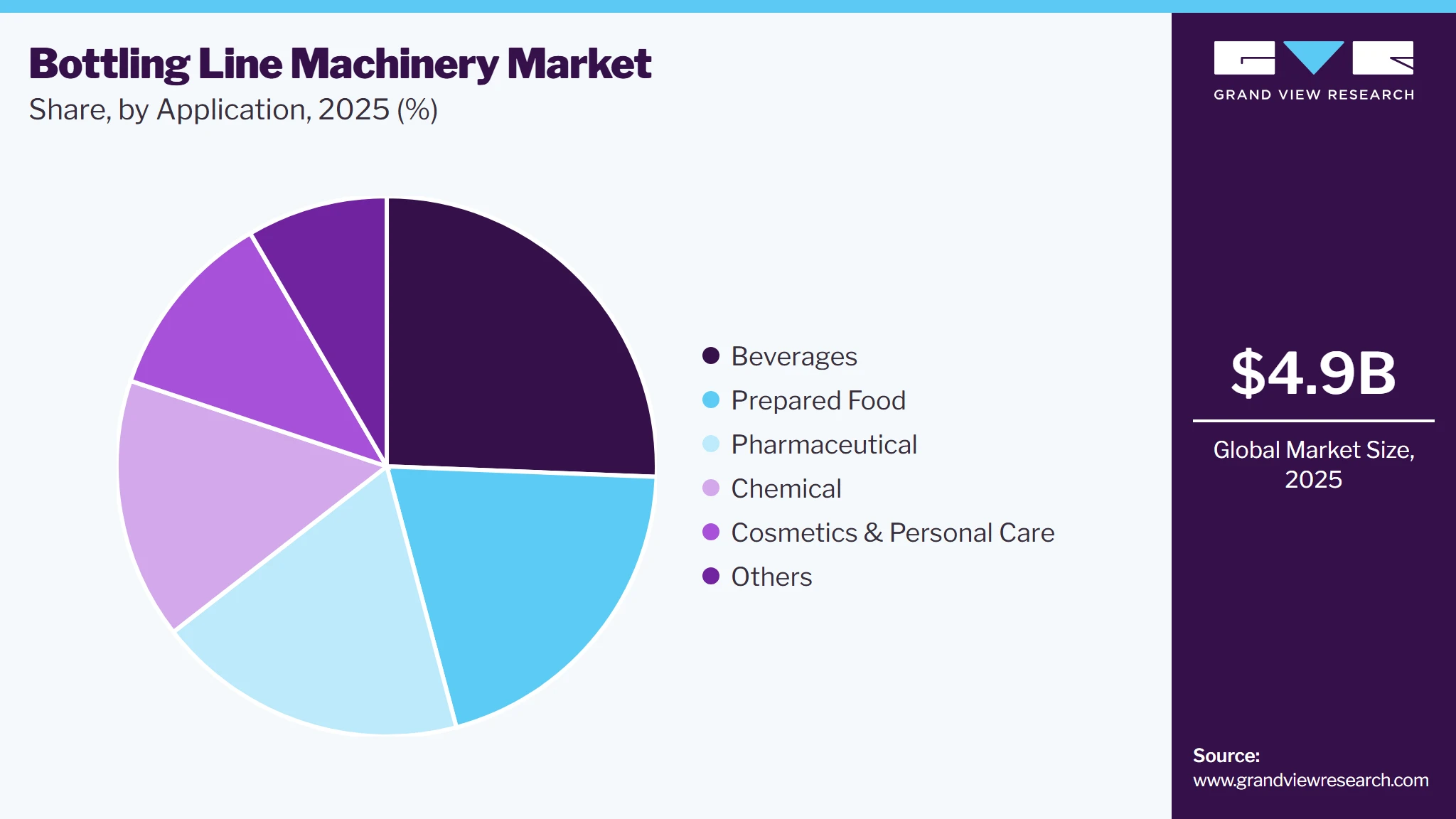
Based on application, the beverages segment led the market with the largest revenue share of 25.6% in 2025. This growth is attributed to the rising demand for various packaged drinks, including soft drinks, juices, and bottled water. In addition, as consumer preferences shift towards convenience and ready-to-drink options, manufacturers are compelled to enhance production efficiency. Moreover, this trend is further supported by urbanization and changing lifestyles, which increase the need for automated solutions that can handle diverse packaging formats while maintaining high production speeds.
 To learn more about this report, Download Free Sample Report
The pharmaceutical segment is expected to grow at a CAGR of 6.1% over the forecast period, owing to the rising demand for packaged medications and health products. The increasing focus on safety and efficiency in pharmaceutical manufacturing necessitates advanced bottling technologies that ensure precise filling and packaging. Furthermore, regulatory requirements for quality control and contamination prevention drive investments in automated systems. Moreover, as the global population grows and health awareness rises, the pharmaceutical industry’s need for reliable bottling solutions continues to propel market growth.
Regional Insights
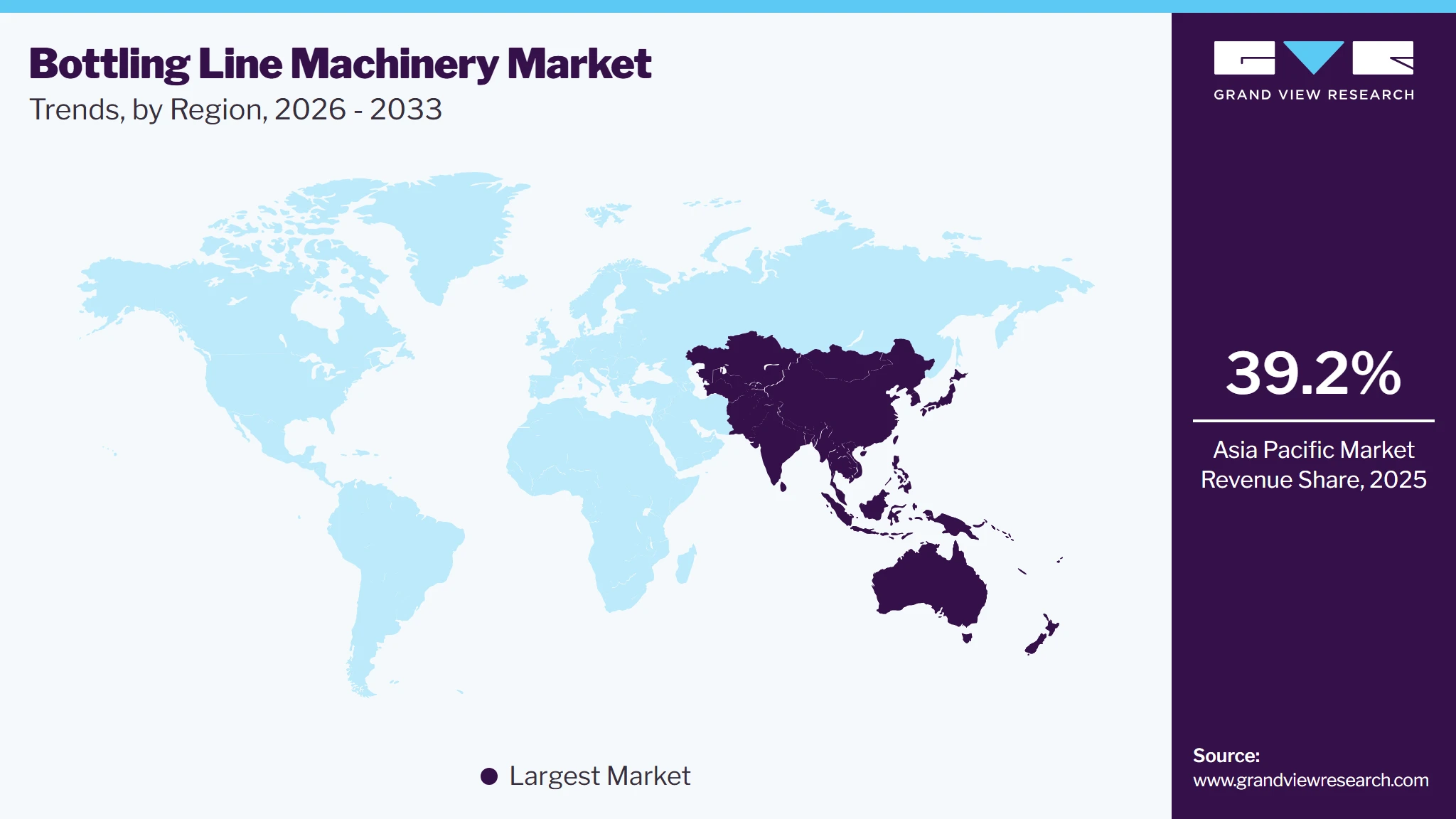
Asia Pacific dominated the bottling line machinery market with the largest revenue share of 39.2% in 2025. This growth is attributed to the rising food and beverage consumption and expanding pharmaceutical production in countries such as India, Vietnam, Malaysia, and Thailand. In addition, the region's large population and increasing demand for beverages, including milk and soft drinks, contribute significantly to market expansion. Furthermore, the growing popularity of premium bottled water further fuels this growth, prompting manufacturers to invest in advanced bottling technologies.
 To learn more about this report, Download Free Sample Report
China Bottling Line Machinery Market Trends
The bottling line machinery market in China held the largest share in the Asia Pacific region in 2025, driven by its vast population and a rising appetite for packaged beverages. In addition, increased domestic pharmaceutical production also drives market expansion as companies seek efficient bottling solutions. Furthermore, the demand for bottled water, innovative soft drinks, and other packaged beverages supports this trend, leading to significant investments in modern bottling technologies.
Latin America Bottling Line Machinery Market Trends
Latin America bottling line machinery market is expected to grow at a CAGR of 6.0% over the forecast period, owing to a burgeoning population, rising disposable incomes, and an increasing demand for packaged beverages. Furthermore, the expanding food and beverage industry necessitates more efficient bottling solutions to satisfy consumer preferences. Moreover, heightened health awareness and a growing need for pharmaceutical products contribute to the overall growth of the bottling line machinery market in this region.
North America Bottling Line Machinery Market Trends
The bottling line machinery market in the North Americais expected to grow significantly over the forecast period, primarily driven by a steady rise in the beverage industry due to increased consumption of both alcoholic and non-alcoholic drinks. Furthermore, consumers are spending more on alcoholic beverages, which necessitates advanced bottling technologies for production efficiency. Moreover, the demand for healthy juices and smoothies further drives the need for innovative bottling line solutions.
The U.S. bottling line machinery market led the North American market with the highest revenue share in 2025. This growth is attributed to the high consumption of alcoholic beverages such as vodka. To meet this growing demand, manufacturing companies are deploying advanced bottle filling machines that enhance production efficiency. Furthermore, the increasing popularity of various packaged beverages, including soft drinks and bottled water, contributes significantly to the expansion of the bottling line machinery market.
Europe Bottling Line Machinery Market Trends
The bottling line machinery market in the Europeis expected to be driven by the increased demand for innovative packaging solutions and technological advancements within the food and beverage sector. In addition, rising consumption of premium alcoholic products, alongside the introduction of healthy juices and smoothies, contributes to growth in the beverage industry. Furthermore, surge in production necessitates advanced and efficient bottling line solutions to keep pace with consumer preferences.
Key Bottling Line Machinery Company Insights
Key companies in the global bottling line machinery industry include Krones AG, ProMach, Syntegon Technology GmbH, and others. These businesses are adopting strategies focused on innovation and sustainability. They are investing in advanced automation technologies to enhance operational efficiency and reduce production costs. In addition, firms are developing eco-friendly packaging solutions to meet growing consumer demand for sustainable practices. Furthermore, collaborations and partnerships with technology providers are also common, enabling companies to integrate smart manufacturing capabilities.
-
Krones AG design and implement complete lines for beverages and food, covering each production process from product and container creation to filling, packaging, material flow, and container recycling. The company manufactures machines for filling, labeling, and packing glass and PET containers, as well as cans. They offer customized system solutions for every container type and beverage category, including machines for process engineering.
-
KHS Group specializes in developing innovative bottling and packaging systems for the beverage and food industries. Their product portfolio includes advanced machinery for filling, labeling, and packaging various types of containers such as bottles, cans, and cartons. KHS operates in the bottling line machinery segment, providing comprehensive solutions that enhance production efficiency and sustainability.
Key Bottling Line Machinery Companies:
The following key companies have been profiled for this study on the bottling line machinery market.
-
Krones AG
-
KHS Group
-
The Tetra Laval Group
-
SMI S.p.A.
-
OPTIMA packaging group GmbH
-
ProMach
-
Zhangjiagang King Machine Co., Ltd
-
Sacmi Imola S.C.
-
Coesia S.p.A.
-
Syntegon Technology GmbH
-
Hiemens Bottling Machines
-
APACKS
-
Barry-Wehmiller Group, Inc.
-
IC Filling Systems; Serac Group
Competitive Benchmarking
Category
Operating Strategies
Competitive Edge
Weakness
Established Players (e.g., Krones AG; KHS Group; The Tetra Laval Group; SMI S.p.A.; OPTIMA packaging group GmbH; ProMach; Sacmi Imola S.C.; Coesia S.p.A.; Syntegon Technology GmbH; Barry-Wehmiller Group, Inc.)
- Focus on turnkey bottling solutions and integrated packaging ecosystems.
- Expand global service networks and aftermarket capabilities to strengthen customer retention.
- Invest in automation, digitalization, and sustainable packaging technologies to support premium offerings.
- Extensive installed base and strong brand recognition across multiple end-use industries.
- Broad product portfolios covering filling, capping, labeling, conveying, and inspection systems.
- Strong engineering expertise and global manufacturing and support capabilities.
- Higher equipment and lifecycle costs may limit penetration among price-sensitive customers.
- Complex organizational structures can result in longer lead times and slower customization.
- Exposure to cyclical capital spending patterns in beverage and packaging industries.
Emerging & Regional Players (e.g., Zhangjiagang King Machine Co., Ltd; Hiemens Bottling Machines; APACKS; IC Filling Systems; Serac Group)
- Emphasize cost-competitive and application-specific bottling solutions tailored to regional markets.
- Pursue expansion through distributor partnerships and customized project execution.
- Target small and medium-scale manufacturers requiring flexible and modular equipment.
- Greater pricing flexibility and shorter project turnaround times.
- Ability to deliver customized solutions for niche applications and varying production capacities.
- Strong regional presence and responsiveness to local customer requirements.
- Limited global footprint and comparatively smaller aftermarket service networks.
- Narrower product portfolios relative to multinational competitors.
- Lower investment capacity for advanced automation and large-scale R&D initiatives.
Recent Developments
-
In October 2024, Syntegon and Azbil Corporation finalized Syntegon's acquisition of Telstar, expanding Syntegon’s pharmaceutical liquid filling and strengthening strategic growth. Telstar's workforce now joins Syntegon's Pharma Liquid Business Unit, creating a seamless technology and service portfolio for manufacturing antibiotics, vaccines, and biologics. This combination enhances Syntegon’s innovative technologies and expands global reach, providing complete bottling line machinery and solutions for pharmaceutical manufacturers and CMOs.
-
In October 2024, Krones launched a compact version of its Contipure AseptBloc, a sterile system integrating preform sterilization to sealing, ideal for bottling line machinery. Designed for outputs as low as 8,000 containers per hour, this system expands aseptic filling solutions to the low output range. This compact design utilizes a four-cavity blow-molding machine and a filler, requiring approximately 100 square meters of space. It's suited for juice, milk, or plant-based alternatives, offering material savings of around two grams per bottle compared to conventional aseptic processes. The advanced bottling line machinery is also designed for efficient lightweight containers.
Bottling Line Machinery Market Report Scope
Report Attribute
Details
Market size in 2025
USD 4.9 billion
Estimated market size in 2026
USD 5.2 billion
Projected market size by 2033
USD 7.5 billion
Growth rate
CAGR of 5.5% from 2026 to 2033
Base year for estimation
2025
Historical data
2021 - 2024
Forecast period
2026 - 2033
Quantitative units
Revenue in USD billion and CAGR from 2026 to 2033
Report coverage
Revenue forecast, company ranking, competitive landscape, growth factors, and trends
Segments covered
Application, technology, region
Regional scope
North America; Europe; Asia Pacific; Latin America; Middle East & Africa
Country scope
U.S.; Canada; Mexico; Germany; UK; France; Italy; Spain; Japan; China; India; Australia; South Korea; Brazil; Argentina;South Africa; UAE
Key companies profiled
Krones AG; KHS Group; The Tetra Laval Group; SMI S.p.A.; OPTIMA packaging group GmbH; ProMach; Zhangjiagang King Machine Co., Ltd; Sacmi Imola S.C.; Coesia S.p.A.; Syntegon Technology GmbH; Hiemens Bottling Machines; APACKS; Barry-Wehmiller Group, Inc.; IC Filling Systems; Serac Group.
Customization scope
Free report customization (equivalent up to 8 analysts' working days) with purchase. Addition or alteration to country, regional & segment scope.
Pricing and purchase options
Avail customized purchase options to meet your exact research needs. Explore purchase options
Global Bottling Line Machinery Market Report Segmentation
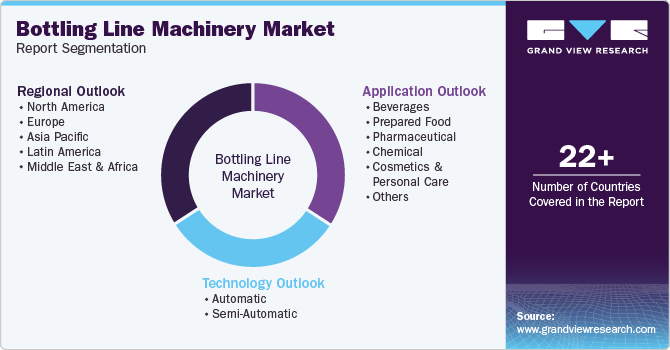
This report forecasts revenue growth at global, regional, and country levels and analyzes the latest industry trends in each sub-segment from 2021 to 2033. For this study, Grand View Research has segmented the global bottling line machinery market report based on technology, application, and region.
 To learn more about this report, Download Free Sample Report
-
Technology Outlook (Revenue, USD Million, 2021 - 2033)
-
Automatic
-
Semi-Automatic
-
-
Application Outlook (Revenue, USD Million, 2021 - 2033)
-
Beverages
-
Non-alcoholic
-
Alcoholic
-
-
Prepared Food
-
Pharmaceutical
-
Chemical
-
Cosmetics & Personal Care
-
Others
-
-
Regional Outlook (Revenue, USD Million, 2021 - 2033)
-
North America
-
U.S.
-
Canada
-
Mexico
-
-
Europe
-
France
-
Germany
-
Italy
-
Spain
-
UK
-
-
Asia Pacific
-
China
-
Japan
-
India
-
Australia
-
South Korea
-
-
Latin America
-
Brazil
-
Argentina
-
-
Middle East and Africa
-
South Africa
-
UAE
-
-
Research Methodology
The bottling line machinery market figures in this report are based on a proven research process that combines executive interviews with secondary research from proprietary databases, company filings, and recognized regulatory and institutional sources. Market size is built through value-chain sizing - reconciling supply-side and demand-side estimates - and triangulated with bottom-up and top-down approaches. Every estimate passes multiple levels of expert validation before publication, with each bottling line machinery segment quantified using the revenue-capture definitions in the table below.
Segment Definition
Segment - Technology
Revenue Capture Definition
Automatic
Revenue generated from the sale of fully automatic bottling line machinery designed to perform bottle filling, capping, labeling, rinsing, and packaging operations with minimal operator intervention across high-volume production facilities.
Semi-Automatic
Revenue generated from the sale of semi-automatic bottling line machinery requiring partial operator involvement for bottle handling and packaging operations across small- and medium-scale production facilities.
Segment - Application
Revenue Capture Definition
Beverages
Revenue generated from the sale of bottling line machinery supplied for beverage manufacturing facilities producing bottled drinks.
Prepared Food
Revenue generated from the sale of bottling line machinery used for filling and packaging liquid and semi-liquid food products including sauces, edible oils, syrups, dressings, condiments, and other prepared food products.
Pharmaceutical
Revenue generated from the sale of bottling line machinery supplied for packaging pharmaceutical products including liquid medicines, syrups, vaccines, nutraceuticals, and other healthcare products.
Chemical
Revenue generated from the sale of bottling line machinery used for packaging industrial chemicals, lubricants, agrochemicals, cleaning agents, and other liquid chemical products.
Cosmetics & Personal Care
Revenue generated from the sale of bottling line machinery supplied for packaging perfumes, shampoos, lotions, liquid soaps, creams, oils, and other cosmetic and personal care products..
Others
Revenue generated from the sale of bottling line machinery supplied for applications across household products, biotechnology, laboratory chemicals, and other industries not covered under the above application segments.
Estimation Model
Layer Name
Key Question
Description
Packaging Equipment Demand Layer
Where is bottling line machinery required?
Analyze demand across beverage, prepared food, pharmaceutical, chemical, cosmetics & personal care, and other liquid packaging industries. Assess production volumes of bottled products, packaging capacity, and manufacturing activity to establish the addressable demand for bottling line machinery.
Manufacturing Capacity Expansion Layer
Where is new equipment demand being created?
Evaluate investments in beverage production facilities, pharmaceutical manufacturing plants, food processing units, chemical processing facilities, and cosmetics manufacturing. Assess greenfield projects, production line expansions, automation upgrades, and equipment replacement initiatives that drive procurement of new bottling line machinery.
Technology Adoption Layer
Which bottling line technologies are being deployed?
Segment demand by technology and application. Apply adoption rates based on production throughput, packaging speed, labor optimization, product type, hygiene requirements, and manufacturing efficiency.
Revenue Conversion Layer
How is market revenue generated?
Estimate annual shipments of bottling line machinery by technology, application, and region. Quantify revenues generated exclusively from the sale of new bottling line machinery supplied to beverage manufacturers, food processors, pharmaceutical companies, chemical producers, and cosmetics manufacturers.
Delivered Customizations
This report has been delivered with the following In-depth customizations
Client Request
Customization Delivered
Value Adds
Competitive Benchmarking
Benchmarked leading bottling line machinery manufacturers based on product portfolio depth, automation capabilities, filling and packaging technologies, end-use industry focus, geographic presence, financial strength, and strategic positioning, while distinguishing established global suppliers from emerging and regional participants.
Provided a structured view of the competitive landscape, enabling the client to evaluate market positioning, identify areas of differentiation, and monitor competitive intensity across key application segments.
Regional Segmentation
Refined regional analysis by evaluating beverage production trends, packaged food consumption, pharmaceutical manufacturing activity, packaging investments, and industrial automation adoption across North America, Europe, Asia Pacific, Latin America, and the Middle East & Africa.
Enabled identification of high-growth markets, investment hotspots, and regional demand patterns, supporting market expansion strategies and resource allocation decisions.
Opportunity assessment
Assessed emerging growth opportunities across beverages, prepared food, pharmaceuticals, chemicals, and cosmetics & personal care applications, with emphasis on capacity expansion projects, flexible packaging requirements, smart bottling technologies, and aftermarket service opportunities.
Help prioritize the most attractive revenue pockets and investment areas by identifying segments characterized by strong capital spending and evolving packaging requirements.
Frequently Asked Questions About This Report
The global bottling line machinery market is expected to grow at a CAGR of 5.5% from 2026 to 2033, reaching USD 7.5 billion by 2033.
Asia Pacific dominated the bottling line machinery market with the largest revenue share of 39.2% in 2025.
Some of the key players operating in the bottling line machinery market include Krones AG, KHS Group, OPTIMA packaging group GmbH, ProMach, Sacmi Imola S.C., Coesia S.p.A., Syntegon Technology GmbH, Hiemens Bottling Machines
Asia Pacific is anticipated to be one of the fastest-growing regional markets over the forecast period, driven by expanding food and beverage production, increasing industrial automation, and rising investments in packaging infrastructure.
The automatic segment led the market with the largest revenue share of 65.0% in 2025.
The beverages segment accounted for the largest revenue share of 25.6% in 2025.
Key trends include increasing adoption of fully automated bottling lines, integration of smart manufacturing technologies, growing demand for flexible packaging equipment, and rising focus on energy-efficient and high-speed filling solutions.
The global bottling line machinery market size was valued at USD 4.9 billion in 2025 and is estimated at USD 5.2 billion for 2026.
The key factors that are driving the bottling line machinery market include a packaging equipment market boost due to the growing food and beverage industry, coupled with rapid technological advancements.
About the Author(s)
Food Safety & Processing Research Team
Consumer Goods · Food Safety & ProcessingThis report was authored by the food safety & processing research team at Grand View Research - comprising two research analysts, one senior research analyst, and one industry expert - with specialized expertise in the food safety & processing segment of the consumer goods industry. All findings are based on proprietary consumer goods databases, executive interviews, and regulatory analysis, subject to internal peer review prior to publication.
Last Updated:
Speak to Analyst

Customize this report to your needs - add regions, segments, or data points, with 20% free customization.
Or view our licence options:


ISO 9001:2015 & 27001:2022 Certified
We are GDPR and CCPA compliant! Your transaction & personal information is safe and secure. For more details, please read our privacy policy.


