
- Home
- »
- Homecare & Decor
- »
-
Boutique Hotel Market Size, Growth Report, 2026-2033GVR Report cover

Boutique Hotel Market (2026 - 2033)
Size, Share & Trends Analysis Report By Type (Luxury, Mid-Scale, Budget) By Traveler Type (Leisure Travelers, Business Travelers), By Booking Mode (Direct Booking, Travel Agents, Online Travel Agencies), By Region, And Segment Forecasts
Market Size, 2025
$28.5BMarket Estimate, 2026
$30.4BMarket Forecast, 2033
$50.5BCAGR, 2026–2033
7.5%Boutique Hotel Market Summary
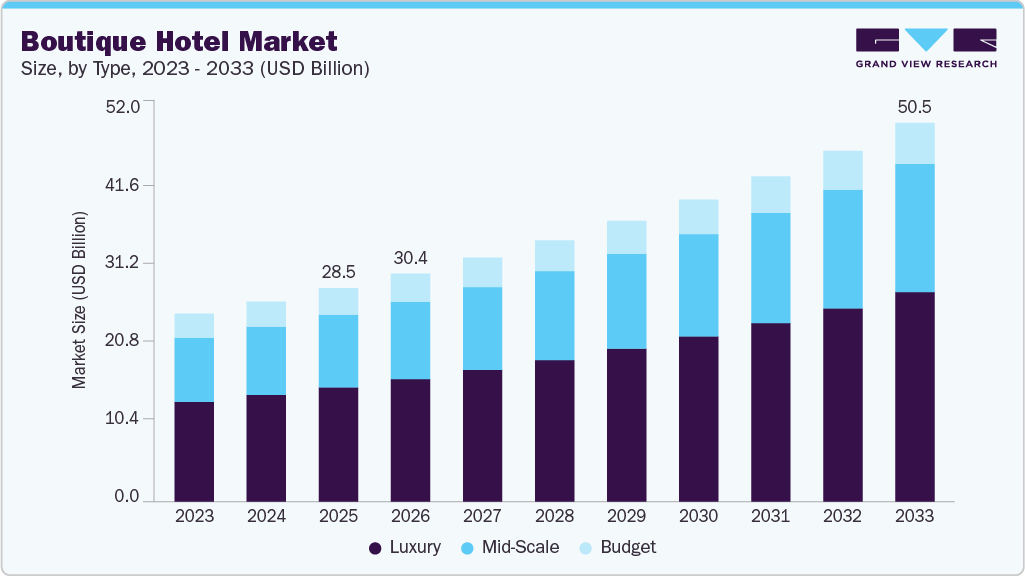
The global Boutique Hotel market size was valued at USD 28.5 billion in 2025 and is projected to grow from USD 30.4 billion in 2026 to USD 50.5 billion by 2033, at a CAGR of 7.5% from 2026 to 2033. North America dominated the global market, accounting for the largest revenue share of 36.4% in 2025. The boutique hotel industry is expanding steadily as consumers increasingly prefer experiential, design-led stays that emphasize individuality over standardization.
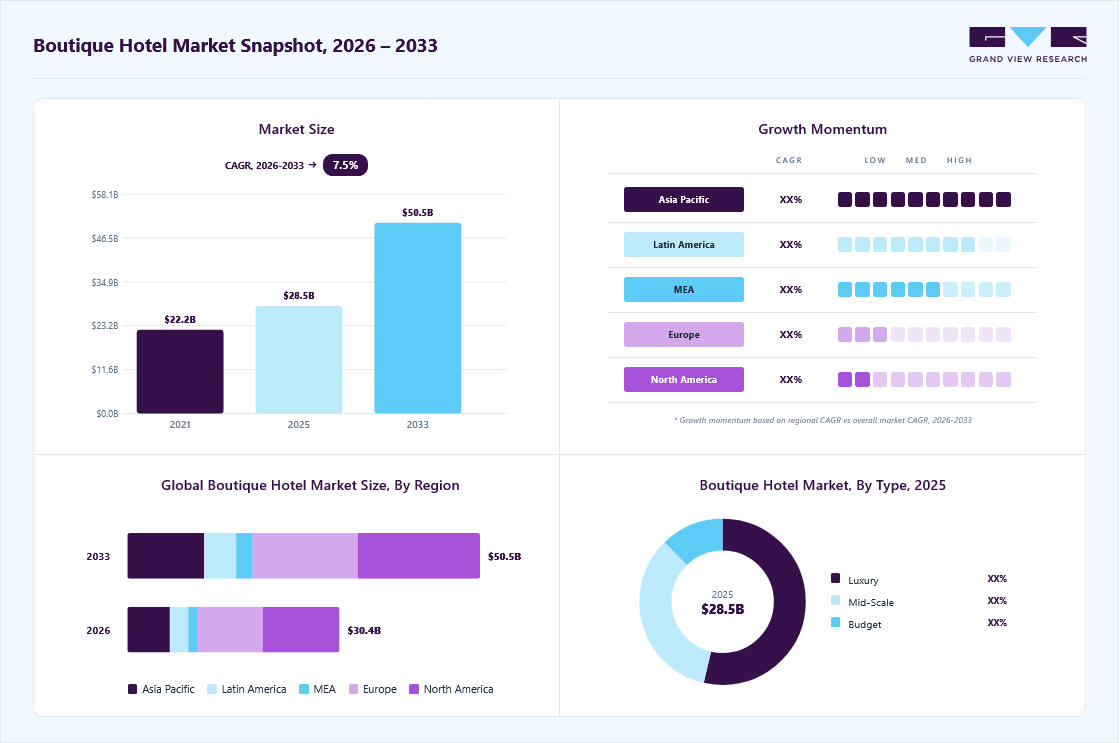 Source: Grand View Research, IR Documents, Primary Interviews, Paid DatabasesTo learn more about this report,
 Download Free Sample Report
 Key Market Trends & Insights
- By type: Luxury boutique hotel segment led the market with the largest revenue share of 53.5% in 2025.
- By traveler type: Leisure travelers segment led the market with the largest revenue share of 70.8% in 2025.
- By booking mode: Direct booking segment led the market with the largest revenue share of 41.31% in 2025.
Regional Highlights
- Largest regional market: North America (36.4% revenue share, 2025)
- Fastest-growing regional market: Asia Pacific (highest CAGR, 2026-2033)
- By country: The U.K. Boutique Hotel industry is a major contributor to the global market.
Market Size & Forecast
- Market size in 2025: USD 28.5 Billion
- Estimated market size in 2026: USD 30.4 Billion
- Projected market size by 2033: USD 50.5 Billion
- CAGR (2026-2033): 7.5%
Three ways to get this report
Buy it, customize it, or ask a question.Ask an Analyst
Analyst response in 1 business day
- AccessReport author, directly
- Reply timeWithin 1 working day
- No sales callDirect answer only
- FormatEmail reply
- CostFree, no cost
Get the Full Report
What the study covers
- FormatsPDF · Excel · Dashboard
- Timeline2026–2033 annual, 2025 base
- Coverage20+ countries, 5 regions
- Companies10+ key players profiled
Customize the Report
20% free customization
- IncludeCountries, segments, points
- TailorTo your product definition
- ExtendDeeper competitor detail
- OrA fully bespoke study
- Turnaround5–10 working days
Modern travelers increasingly view hotels as part of the travel experience rather than merely a place to sleep. As a result, properties that showcase distinctive architecture, strong interior narratives, and local cultural influence are gaining traction. Design-led boutique hotels often repurpose heritage buildings, integrate local art and craftsmanship, and create social spaces that blur the line between hospitality, lifestyle, and community engagement. This design differentiation supports higher room rates and positions boutique hotels as premium lifestyle assets rather than conventional accommodation providers.
Alongside design appeal, the increasing demand for personalized, high-touch service is a major growth driver for boutique hotels. Travelers, particularly affluent leisure travelers and frequent urban travelers, value recognition, flexibility, and tailored service. Boutique hotels benefit structurally from smaller room counts, allowing staff to engage more closely with guests and customize experiences across check-in, dining, wellness, and concierge services. This service intimacy strengthens emotional connection and repeat visitation, while also enabling hotels to adapt quickly to evolving guest expectations without the operational rigidity associated with large chain formats.
 To learn more about this report, Download Free Sample Report
 The boutique hotel industry is further supported by the expansion of leisure-driven and short-haul travel, which has increased the frequency of weekend trips, domestic tourism, and regional city breaks. Travelers taking shorter trips seek accommodations that deliver immediate experiential value, strong location advantages, and immersion into the local environment. Boutique hotels are well-positioned to capture this demand, given their concentration in city centers, cultural districts, and lifestyle-oriented neighborhoods. Their ability to offer curated local experiences within a limited stay makes them particularly attractive to travelers who prioritize the quality of the experience over the length of the trip.
In addition, rising interest in authenticity and sustainability is driving demand for boutique hotels. Consumers increasingly favor properties that reflect responsible design choices, local sourcing, and meaningful engagement with surrounding communities. Boutique hotels often adopt adaptive reuse, use sustainable materials, and partner with local suppliers, aligning with environmentally and socially conscious travel behavior.
Brand Market Share Insights
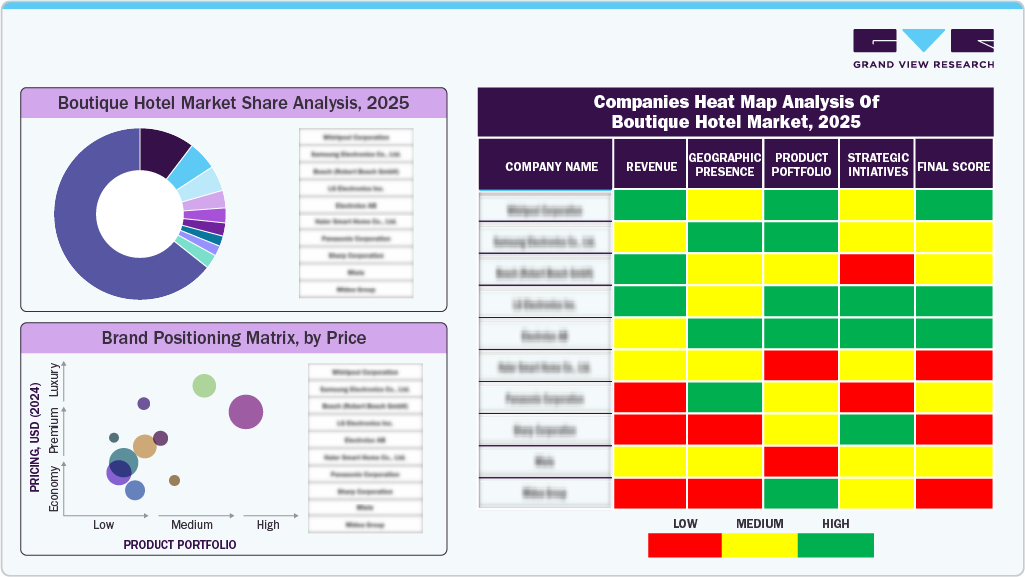
Key companies in the boutique hotel industry include major players like Marriott International, Hyatt Hotels Corporation, Accor Hotels, and Hilton Worldwide, all of which have expanded their portfolios to include upscale and boutique properties. In its 2024 expansion, Hilton added nearly 400 boutique hotels from the Small Luxury Hotels of the World (SLH) collection, enhancing its luxury portfolio with unique properties. In addition, boutique hotel brands like Graduate Hotels, Thompson, Ace Hotel, and The Hoxton are rapidly expanding globally. The Hoxton, now part of Accor, has expanded to 13 destinations, including Amsterdam, Chicago, and Barcelona, offering high-design lobbies and affordable rates.
 To learn more about this report, Download Free Sample Report
 Cosumer Insights
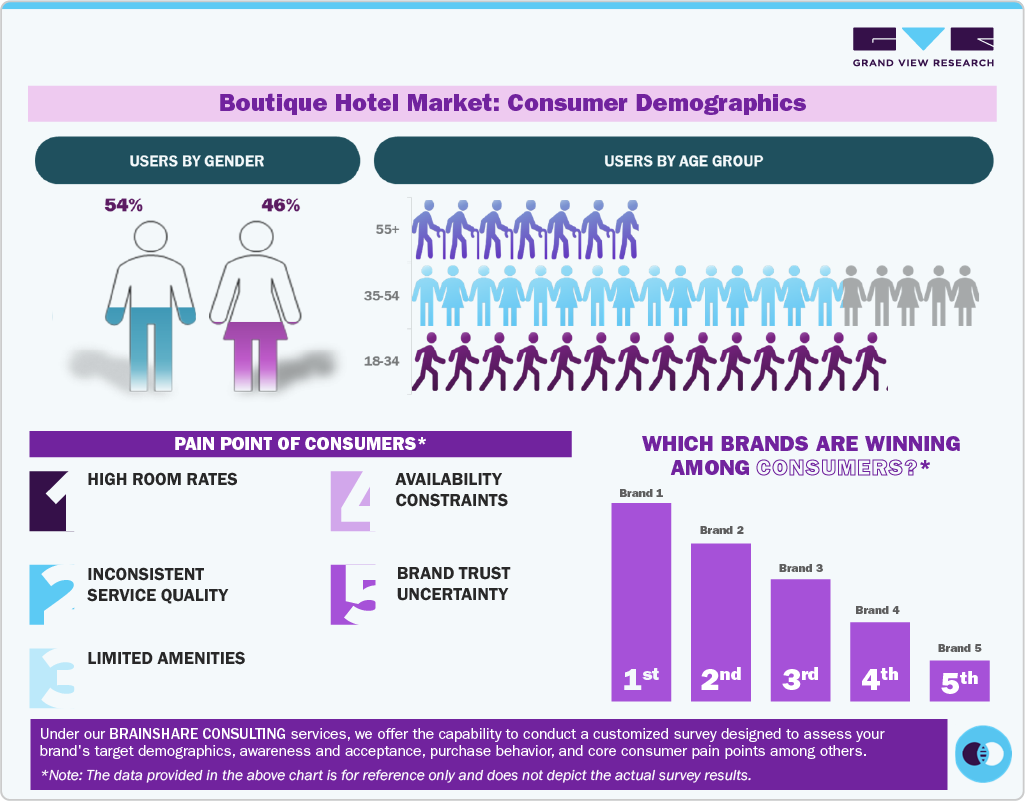
A growing share of travelers, particularly urban Millennials and Gen Z, select boutique hotels based on neighborhood identity and proximity to lifestyle nodes such as dining districts, cultural venues, nightlife clusters, or creative quarters. Booking decisions are often finalized after evaluating walkability, nearby cafés, and alignment with the local scene, rather than traditional criteria such as hotel amenities or room size. This has shifted demand toward boutique hotels embedded in mixed-use or culturally active districts, even when these properties offer fewer in-room services than upscale chain hotels.
Spending patterns indicate that boutique hotel guests allocate a higher share of their total trip expenditure to on-property and nearby experiences than to the room alone. Consumers are more willing to pay premium rates for rooms if the hotel integrates social spaces, destination dining, or experiential programming that reduces the need for off-site planning. This behavior supports stronger ancillary revenue performance in food & beverage, events, and collaborations with local brands, making boutique hotels less dependent on room-night volume compared to traditional hotels.
 To learn more about this report, Download Free Sample Report
 Booking behavior also reflects short decision cycles and strong visual influence. Boutique hotel guests frequently make reservations within shorter lead times, particularly for weekend and short-haul trips, driven by impulse travel and event-based demand. Digital touchpoints such as Instagram reels, Google Maps photos, and user-generated content often outweigh long-form reviews in influencing final booking decisions. This has increased sensitivity to real-time online perception, visual consistency, and social proof, making boutique hotels more exposed to demand volatility but also more responsive to viral visibility.
Type Insights
The luxury boutique hotels segment led the market with the largest revenue share of 53.5% in 2025 and is projected to grow at the fastest CAGR during the forecast period. Luxury boutique hotels attract affluent travelers who value exclusivity, low room density, and personalized service, enabling operators to monetize premium room categories, private experiences, destination dining, and wellness offerings. Their emphasis on distinctive architecture, curated interiors, and locally embedded luxury experiences supports longer stays and repeat visitation, while limited supply relative to demand sustains pricing power. As a result, luxury boutique hotels capture a disproportionate share of industry revenue despite representing a smaller portion of total room inventory.
The mid-scale boutique hotels segment is expected to grow at a significant CAGR of 7.4% from 2026 to 2033, attributed to the increasing demand for affordable yet distinctive lodging options that offer a unique experience without the high price tag of luxury properties. Mid-scale boutique hotels such as Hotel Indigo in various locations and Mama Shelter in cities like Paris and Los Angeles cater to a broad range of travelers seeking personalized service and stylish accommodations at a more accessible price point. The expanding middle class, combined with rising interest in unique travel experiences and local cultural immersion, is driving robust growth in this category.
Traveler Type Insights
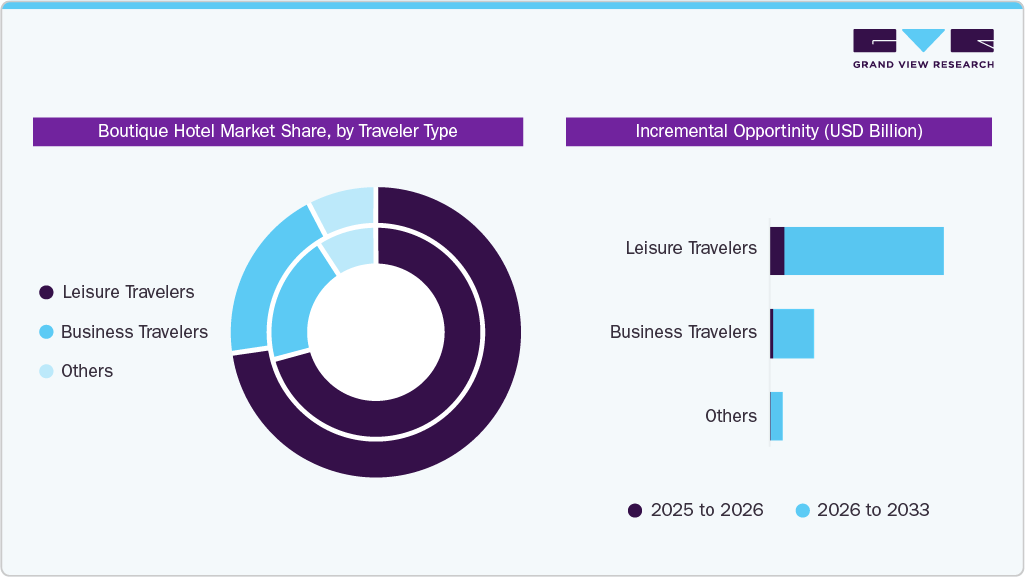
The leisure travelers segment led the market with the largest revenue share of 70.8% in 2025 and is projected to grow at the fastest CAGR during the forecast period.Leisure travelers increasingly allocate higher budgets to accommodation as hotels become a central part of the vacation experience rather than a functional expense. Spending growth is driven by interest in curated local experiences, wellness-oriented travel, and outdoor and urban leisure activities, encouraging travelers to choose boutique hotels that offer distinctive design, social spaces, and neighborhood immersion. As a result, higher per-trip spending and increased frequency of leisure trips continue to translate into a disproportionate revenue contribution from leisure travelers within the boutique hotel industry.
 To learn more about this report, Download Free Sample Report
 The business travelers segment is projected to grow at a significant CAGR of 7.3% from 2026 to 2033, owing to the increasing demand for personalized and distinctive lodging experiences that cater to the specific needs of corporate clients. Boutique hotels offer intimate atmospheres, advanced technological amenities like contactless services and virtual concierges, and unique local experiences that appeal to business travelers seeking comfort and efficiency beyond traditional accommodations.
Booking Mode Insights
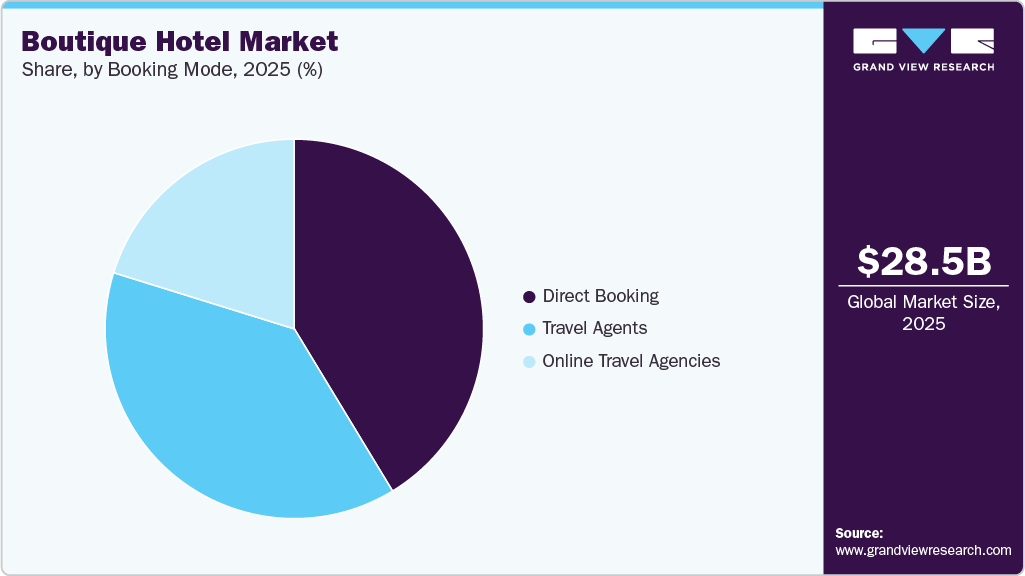
The direct booking segment led the market with the largest revenue share of 41.3% in 2025. Direct bookings often offer better rates and exclusive benefits, appealing to cost-conscious travelers who prefer bypassing third-party booking platforms. In addition, boutique hotels are leveraging their websites and direct booking channels to enhance guest relationships, offer personalized services, and provide a more seamless and direct booking experience. This shift also allows hotels to retain higher revenue margins by avoiding commission fees associated with third-party platforms.
 To learn more about this report, Download Free Sample Report
 The online travel agencies segment is expected to grow at the fastest CAGR of 8.3% from 2026 to 2033. Consumers increasingly rely on OTAs to discover design-led and independent properties that may lack strong brand visibility on direct channels. For boutique hotels, OTAs function as high-reach discovery platforms, offering neighborhood-based search, real-time availability, transparent pricing, and flexible cancellation terms that align with short-notice leisure travel behavior. The ability to compare boutique properties alongside larger hotel brands increases consumer confidence and supports higher conversion rates.
Growth is further supported by improvements in OTA merchandising and back-end technology, including dynamic pricing tools, targeted promotions, and algorithm-led visibility for high-performing properties. These capabilities allow boutique hotels to optimize occupancy during peak and shoulder periods without heavy marketing spend. In addition, expanding smartphone penetration and digital payment adoption are accelerating mobile-based bookings, particularly for weekend and regional travel.
Regional Insights
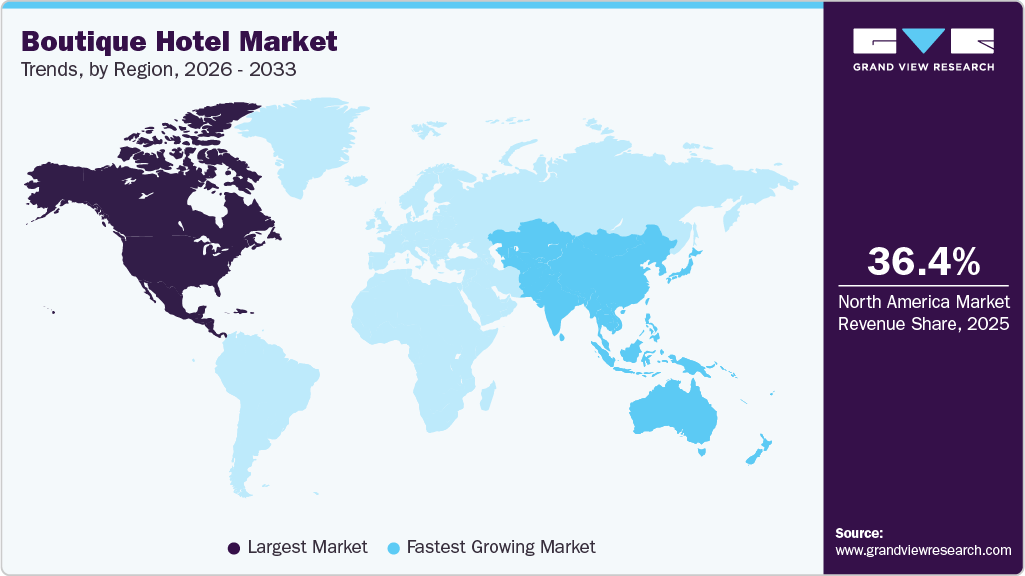
North America dominated the global boutique hotel market with the largest revenue share of 36.4% in 2025.Travelers in North America place high value on neighborhood character, walkability, and locally rooted experiences, which has increased demand for boutique properties located in cultural districts, downtown cores, and mixed-use urban areas. High domestic travel frequency, weekend getaways, and event-driven trips further support consistent occupancy for boutique hotels, even outside peak holiday seasons. Major urban destinations such as New York, Los Angeles, and Miami continue to anchor regional demand, driven by strong inflows of leisure and entertainment travelers, as well as international travelers seeking distinctive, high-end lodging options.
 To learn more about this report, Download Free Sample Report
 U.S. Boutique Hotel Market Trends
The boutique hotel market in the U.S. accounted for the largest market revenue share in North America in 2025. As of June 2025, U.S. boutique hotels have seen notable performance growth, with RevPAR (Revenue Per Available Room) returning to 2019 levels, up 7.4% year-over-year, according to a midyear report by The Highland Group. Occupancy rose by 4.2% and ADR (Average Daily Rate) increased by 0.4%, from USD 261.67 to USD 262.93 between June 2022 to June 2023. The report projects a significant rise in branded boutique hotel rooms under construction, from 19,001 rooms now to nearly 3 times that number by 2028, reflecting increased demand in the U.S.
Europe Boutique Hotel Market Trends
The boutique hotel market in Europe is anticipated to grow at a significant CAGR during the forecast period. Europe’s rich cultural heritage, historic urban fabric, and well-developed tourism infrastructure sustain demand for boutique hotels that blend architectural character with contemporary luxury. Travelers across the region actively seek accommodations that offer a strong sense of place, localized storytelling, and refined personalization, making boutique hotels a natural fit for both leisure and high-value business travel. Demand is further reinforced by frequent short-haul travel within Europe, city breaks, and cultural tourism, which favor centrally located, character-rich properties over large standardized hotels.
Asia Pacific Boutique Hotel Market Trends
The boutique hotel market in the Asia Pacific is expected to grow at the fastest CAGR of 8.8% from 2026 to 2033. The Asia Pacific boutique hotel industry is driven by rising disposable incomes, increased exposure to global travel trends, and a younger, digitally engaged traveler base is encouraging demand for boutique hotels that offer privacy, design individuality, and culturally resonant experiences. Growth is particularly strong in major urban hubs and tourism-driven cities where boutique hotels benefit from high domestic travel volumes, frequent short-stay trips, and growing preference for experiential accommodation over large chain hotels.
Central & South America Boutique Hotel Market Trends
The boutique hotel market in Central & South America is driven by an expanding base of middle- and upper-income travelers, increased international arrivals, and strong appeal of culturally rich destinations that favor small, design-led properties. Boutique hotels in the region benefit from travelers seeking authenticity, heritage architecture, and locally immersive stays rather than standardized chain accommodation. Growth is particularly pronounced in tourism-focused cities and leisure destinations across countries such as Brazil, Mexico, and Colombia, where boutique hotels align well with demand for short-haul travel, cultural exploration, and experiential lodging.
Middle East & Africa Boutique Hotel Market
The boutique hotel market in the Middle East & Africa is expected to grow at a substantial CAGR of 7.9% from 2026 to 2033. Growth for the Middle East & Africa industry is supported by high-spending international visitors and a growing base of affluent domestic travelers seeking privacy, exclusivity, and design-led stays that reflect local heritage. Boutique hotels in the region benefit from strong demand in key urban and resort destinations, where travelers favor intimate properties offering personalized service, architectural character, and curated cultural experiences over large standardized hotels. Increased government-led tourism development, luxury-focused hospitality investment, and rising short-stay leisure travel continue to strengthen the appeal of boutique hotels.
Key Boutique Hotel Companies:
The following key companies have been profiled for this study on the boutique hotel market.
- Marriott International, Inc.
- Accor
- Rosewood Hotel Group
- Kimpton Hotels & Restaurants
- The Hoxton
- Soho Boutique Hoteles
- Ace Hotel
- The Standard Hotels
- Hotel Indigo
- Joie de Vivre (Hyatt)
Recent Developments
-
In October 2025, Wyndham Hotels & Resorts launched Dazzler Select by Wyndham, a new brand aimed at independent hotels seeking a boutique-style identity with budget-conscious positioning. The concept allows properties to maintain their individuality while gaining access to Wyndham’s global distribution, loyalty network, and operational systems. This launch supports Wyndham’s strategy to grow through conversions and tap demand for affordable, design-forward stays that balance local character with brand-backed scale.
-
In October 2025, Hilton expanded its lifestyle portfolio with the launch of the Outset Collection, an upscale brand designed to bring distinctive, independent hotels under the Hilton platform. The collection targets travelers seeking locally inspired, experience-led stays while giving hotel owners flexibility through conversion-led growth. With a strong development pipeline already in place, the move reflects Hilton’s strategy to capture rising demand for boutique-style accommodation backed by global brand systems and loyalty reach.
-
In April 2025, Indian Hotels Company Limited introduced the Claridges Collection, a new boutique luxury portfolio focused on heritage-led, design-rich hotel experiences. The collection is positioned to serve travelers seeking understated luxury and historical character, with flagship legacy properties forming the foundation and selective expansion planned through curated additions. The move reflects IHCL’s strategy to capture rising demand for distinctive, experience-driven luxury stays alongside its existing premium brands.
Boutique Hotel Market Report Scope
Report Attribute
Details
Market size in 2025
USD 28.5 billion
Estimated Market size in 2026
USD 30.4 billion
Projected Market size by 2033
USD 50.5 billion
Growth rate
CAGR of 7.5% from 2026 to 2033
Base year for estimation
2025
Historical data
2021 - 2024
Forecast period
2026 - 2033
Quantitative units
Revenue in USD million/billion, and CAGR from 2026 to 2033
Report coverage
Revenue forecast, company ranking, competitive landscape, growth factors, and trends
Segments covered
Type, traveler type, booking mode, region
Regional scope
North America; Europe; Asia Pacific; Central & South America; Middle East & Africa
Country scope
U.S; Canada; Mexico; Germany; UK; France; Italy; Spain; China; Japan; India; Australia; Brazil; South Africa; UAE
Key companies profiled
Marriott International, Inc.; Accor; Rosewood Hotel Group; Kimpton Hotels & Restaurants; The Hoxton; Soho Boutique Hoteles; Ace Hotel; The Standard Hotels; Hotel Indigo; Joie de Vivre (Hyatt)
Customization
Free report customization (equivalent up to 8 analysts working days) with purchase. Addition or alteration to country, regional & segment scope.
Pricing and purchase options
Avail customized purchase options to meet your exact research needs. Explore purchase options
Global Boutique Hotel Market Report Segmentation
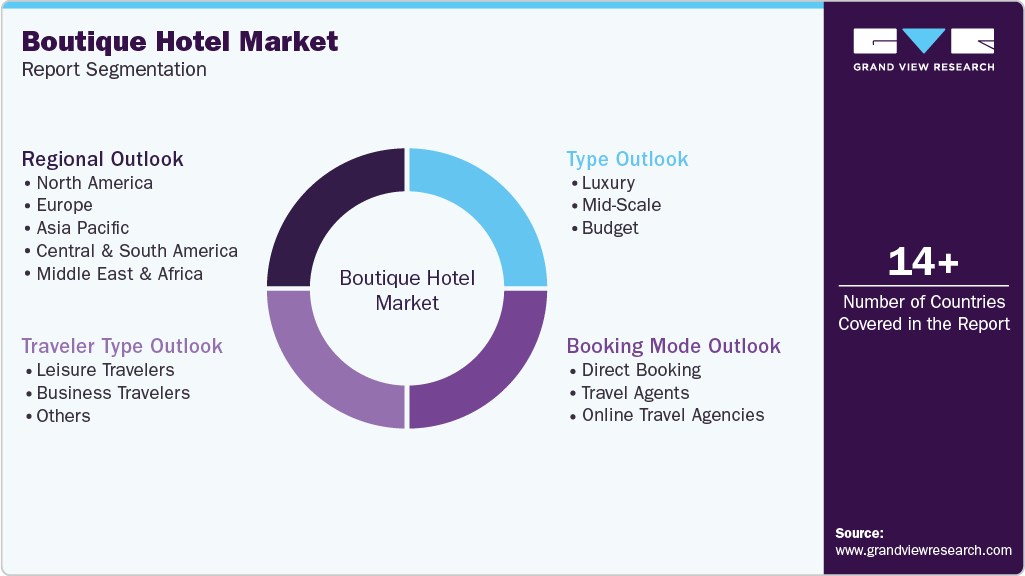
This report forecasts revenue growth at the global, regional, and country levels and provides an analysis of the latest industry trends and opportunities in each of the sub-segments from 2021 to 2033. For this study, Grand View Research has segmented the global boutique hotel market report based on the type, traveler type, booking mode, and region.
 To learn more about this report, Download Free Sample Report
 -
Type Outlook (Revenue, USD Billion, 2021 - 2033)
-
Luxury
-
Mid-Scale
-
Budget
-
-
Traveler Type Outlook (Revenue, USD Billion, 2021 - 2033)
-
Leisure Travelers
-
Business Travelers
-
Others
-
-
Booking Mode Outlook (Revenue, USD Billion, 2021 - 2033)
-
Direct Booking
-
Travel Agents
-
Online Travel Agencies
-
-
Regional Outlook (Revenue, USD Billion, 2021 - 2033)
-
North America
-
U.S.
-
Canada
-
Mexico
-
-
Europe
-
Germany
-
UK
-
France
-
Italy
-
Spain
-
-
Asia Pacific
-
China
-
Japan
-
India
-
Australia
-
-
Central & South America
-
Brazil
-
-
Middle East & Africa
-
South Africa
-
UAE
-
-
Frequently Asked Questions About This Report
Key players include Marriott International, Inc.; Accor; Rosewood Hotel Group; Kimpton Hotels & Restaurants; The Hoxton; Soho Boutique Hoteles; Ace Hotel; The Standard Hotels; Hotel Indigo; Joie de Vivre (Hyatt).
Key factors that are driving the boutique hotel market growth include increasing consumer preference for unique and personalized travel experiences, rising disposable incomes, and the expansion of boutique hotel chains globally.
The global boutique hotel market size was valued at USD 28.5 billion in 2025 and is estimated at USD 30.4 billion for 2026.
The global boutique hotel market is expected to grow at a CAGR of 7.5% from 2026 to 2033, reaching USD 50.5 billion by 2033.
North America dominated with a 36.4% revenue share in 2025 owing to presence of major tourist attractions in the region, cities like New York, Los Angeles, and Miami see high volumes of travelers seeking unique and high-end lodging options.
Asia Pacific is the fastest-growing region over the forecast period.
The luxury boutique hotels segment led with a 53.5% revenue share in 2025 and is the fastest-growing type.
The direct booking segment led with a 41.3% revenue share in 2025, while online travel agencies is the fastest-growing mode.
Leisure travelers segment held the largest share (over 70.0%) in 2025 and is the fastest-growing traveler type.
About the Author(s)
Homecare & Decor Research Team
Consumer Goods · Homecare & DecorThis report was authored by the homecare & decor research team at Grand View Research - comprising two research analysts, one senior research analyst, and one industry expert - with specialized expertise in the homecare & decor segment of the consumer goods industry. All findings are based on proprietary consumer goods databases, executive interviews, and regulatory analysis, subject to internal peer review prior to publication.
Last Updated:
Speak to Analyst

Customize this report to your needs - add regions, segments, or data points, with 20% free customization.
Or view our licence options:


ISO 9001:2015 & 27001:2022 Certified
We are GDPR and CCPA compliant! Your transaction & personal information is safe and secure. For more details, please read our privacy policy.


