
- Home
- »
- Automotive & Transportation
- »
-
Bunkering Services Market Size, Share, Growth Report, 2033GVR Report cover

Bunkering Services Market (2026 - 2033)
Size, Share & Trends Analysis Report By Fuel Type (Heavy Fuel Oil, Very Low Sulfur Fuel Oil, Marine Gas Oil / Marine Diesel Oil, Liquefied Natural Gas) , By Service Type, By Vessel Type, By End User, By Region, And Segment Forecasts
Market Size, 2025
$204.9BMarket Estimate, 2026
$213.9BMarket Forecast, 2033
$338.0BCAGR, 2026–2033
6.8%Bunkering Services Market Summary
The global bunkering services market size was valued at USD 204.9 billion in 2025 and is projected to grow from USD 213.9 billion in 2026 to USD 338.0 billion by 2033, at a CAGR of 6.8% from 2026 to 2033. Asia Pacific dominated the market, accounting for the largest revenue share of 43.0% in 2025. Rising demand for marine fuel across commercial shipping fleets is driving the bunkering services industry’s growth.
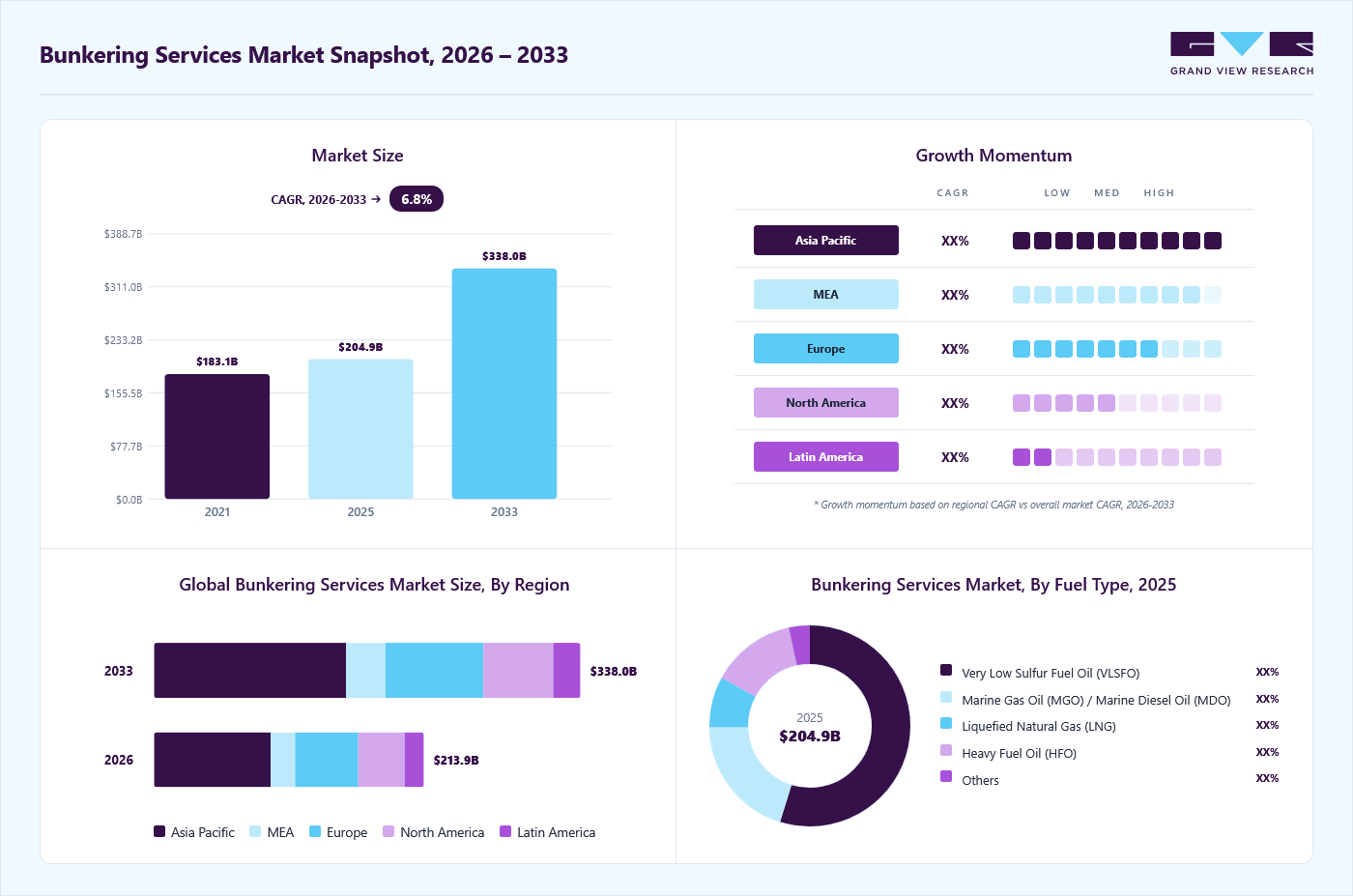 Source: Grand View Research, IR Documents, Primary Interviews, Paid DatabasesTo learn more about this report,
 Download Free Sample Report
 Key Market Trends & Insights
- By fuel type: Very low sulfur fuel oil (VLSFO) held the largest revenue share of 54.7% in 2025
- By service type: Ship-to-ship (STS) bunkering held the largest share of 61.5% in 2025
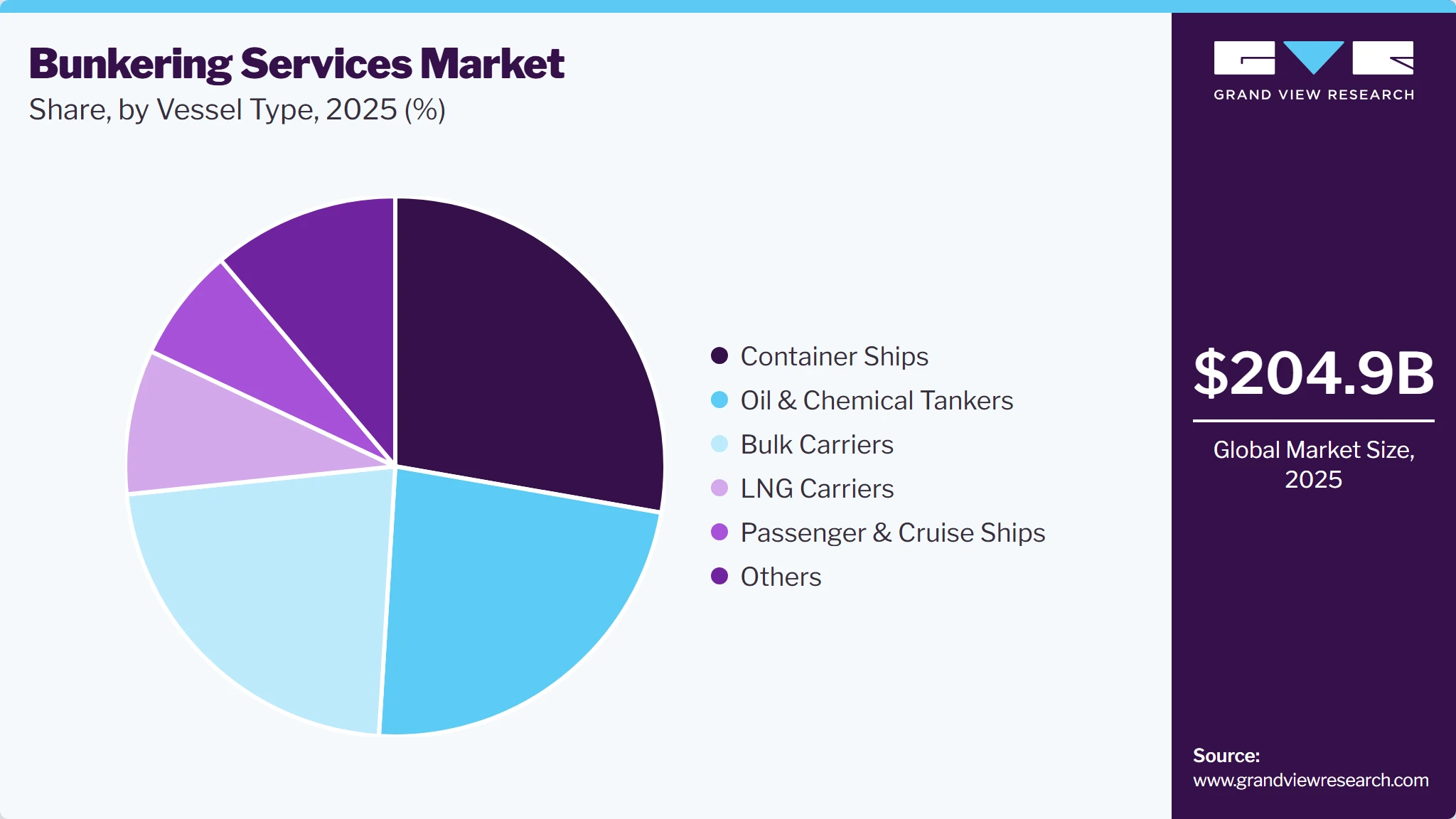
- By vessel type: Container ships held the largest revenue share of 27.7% in 2025
- By end user: Commercial shipping held the largest revenue share in 2025
Regional Highlights
- Largest regional market: Asia Pacific (43.0% revenue share, 2025)
- By country: China held the largest market share in 2025
Market Size & Forecast
- Market size in 2025: USD 204.9 Billion
- Estimated market size in 2026: USD 213.9 Billion
- Projected market size by 2033: USD 338.0 Billion
- CAGR (2026-2033): 6.8%
Three ways to get this report
Buy it, customize it, or ask a question.Ask an Analyst
A direct answer, usually in 1 working day
- AccessReport author, directly
- Reply timeWithin 1 working day
- No sales callDirect answer only
- FormatEmail reply
- CostFree, no cost
Get the Full Report
What the study covers
- FormatsPDF · Excel · Dashboard
- Timeline2026–2033 annual, 2025 base
- Coverage20+ countries, 5 regions
- Companies10+ key players profiled
Customize the Report
20% free customization
- IncludeCountries, segments, points
- TailorTo your product definition
- ExtendDeeper competitor detail
- OrA fully bespoke study
- Turnaround5–10 working days
The increasing expansion of global commercial shipping fleets is driving market growth in the bunkering services market as shipping companies continue investing in additional vessels to accommodate rising international cargo movement. Every newly deployed vessel requires regular marine fuel replenishment throughout its operational lifecycle, creating recurring demand for efficient bunkering services across major ports. Fleet expansion also increases the number of scheduled port calls, requiring suppliers to maintain dependable fuel availability while improving operational responsiveness. Higher vessel density along international trade routes increases fuel transaction volumes across maritime logistics networks. Continuous fleet growth contributes to market growth by expanding the long-term customer base for bunkering providers.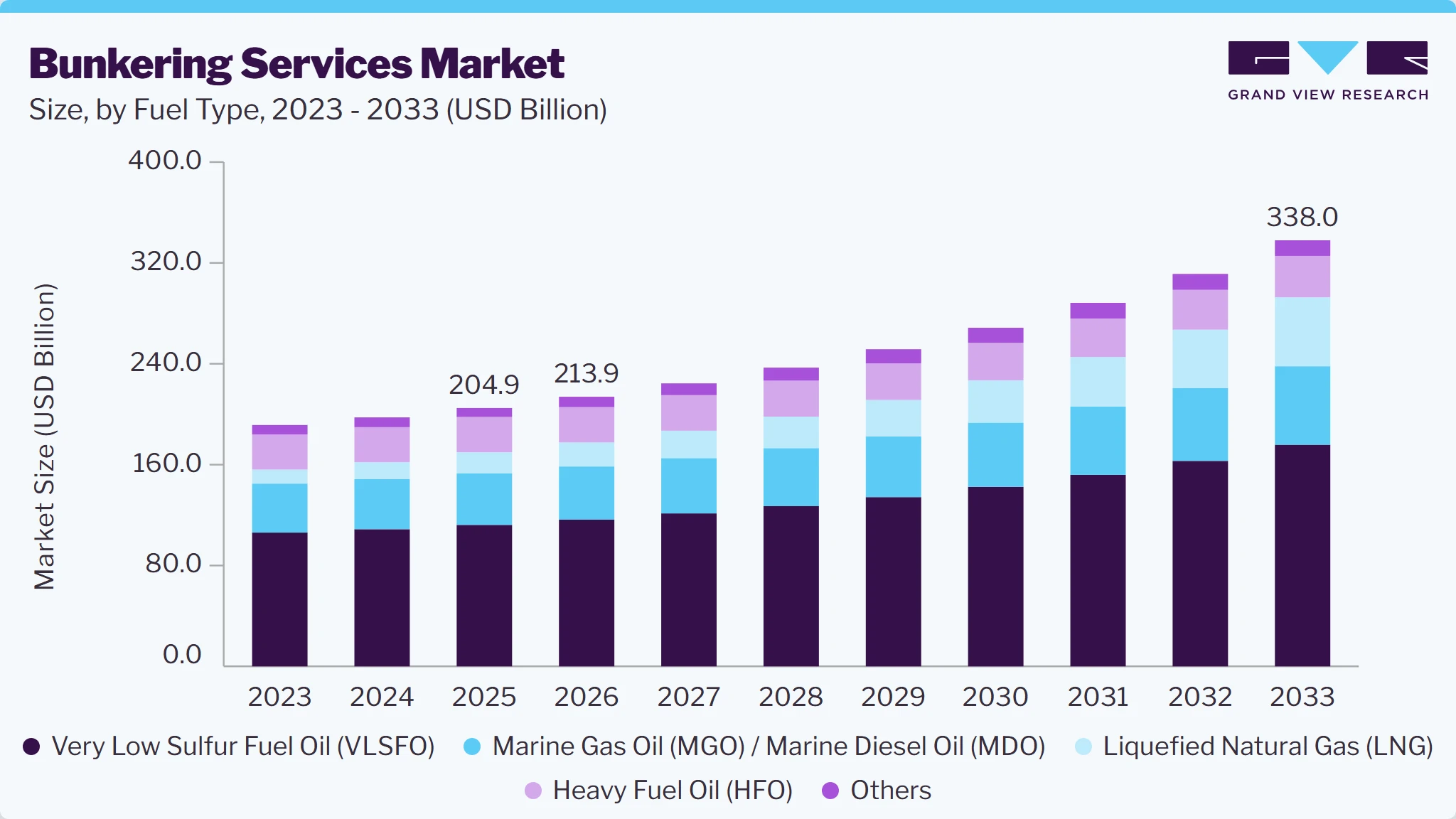 To learn more about this report, Download Free Sample Report
 The growing importance of minimizing vessel turnaround time is driving market growth, as shipping operators increasingly prioritize operational efficiency across international port operations. Commercial vessels are more profitable when they spend more time at sea transporting cargo rather than idling at port. Bunkering providers therefore invest in faster fueling operations, improved scheduling systems, specialized fuel barges, and coordinated logistics that reduce fueling delays while maintaining service quality. More efficient bunkering directly supports fleet productivity by allowing vessels to resume voyages more quickly. This operational focus strengthens demand for advanced bunkering services across major maritime hubs.
The increasing specialization of maritime transportation is driving market growth as different vessel categories require highly coordinated fueling operations suited to their operational profiles. Container ships, bulk carriers, oil tankers, liquefied gas carriers, offshore support vessels, cruise ships, and vehicle carriers each operate under unique scheduling requirements, increasing the need for flexible bunkering services. Marine fuel suppliers increasingly customize fueling operations to support different vessel sizes, voyage durations, cargo fuel types, and operational priorities. Greater specialization broadens the commercial scope of bunkering businesses while improving the quality of customer service. Diversified maritime transportation creates sustained demand across multiple shipping segments.
The growing use of digital fleet management systems is propelling market growth by improving coordination between vessel operators and bunkering service providers. Shipping companies increasingly integrate voyage planning, fuel procurement, operational scheduling, and fleet monitoring into unified digital platforms that simplify bunkering coordination throughout international shipping routes. Marine fuel suppliers that integrate with these digital operational systems improve scheduling accuracy while reducing administrative delays and communication inefficiencies. Better digital connectivity enhances customer experience while supporting more efficient fueling operations. Digital maritime management continues to create favorable conditions for the expansion of bunkering services.
Market Dynamics
The bunkering services market is being driven by the steady expansion of global maritime trade and the continuous movement of cargo, container, tanker, and bulk carrier fleets across international shipping routes. Ship operators are increasingly prioritizing reliable fuel supply, efficient refueling operations, and compliance with evolving environmental regulations to minimize operational disruptions and optimize voyage planning. The implementation of stricter marine fuel emission standards has accelerated the transition toward cleaner marine fuels, including very low sulfur fuel oil (VLSFO), liquefied natural gas (LNG), and other alternative bunker fuels. Additionally, investments in major port infrastructure, strategic bunkering hubs, and digital fuel management solutions are supporting the modernization and growth of the bunkering services market.
The increasing deployment of larger commercial vessels is propelling market growth, as modern shipping companies introduce ships with greater cargo capacities that consume significantly more marine fuel during extended voyages. Large container ships and bulk carriers require carefully coordinated bunkering operations that can supply substantial fuel quantities within tight port turnaround schedules. This operational requirement increases demand for advanced bunkering infrastructure, specialized fuel barges, and high-capacity storage facilities that improve fueling efficiency. Faster, more reliable fuel delivery helps shipping operators maintain tight schedules while minimizing operational delays. Fleet expansion toward higher-capacity vessels strengthens long-term demand for bunkering services.
Volatility in global marine fuel prices creates a major restraint for the bunkering services market by making long-term pricing strategies increasingly difficult for both fuel suppliers and shipping companies. Bunkering service providers often struggle to maintain stable profit margins when procurement costs fluctuate sharply over short periods, while customers hesitate to commit to long-term fuel-purchasing agreements amid uncertain pricing. Frequent price swings complicate inventory planning, contract negotiations, and financial forecasting across the marine fuel supply chain. Suppliers may be forced to adjust fuel prices repeatedly, reducing pricing transparency and increasing commercial uncertainty for vessel operators.
The growing development of green shipping corridors is driving growth in the bunkering services market by creating new demand for specialized fueling infrastructure to support vessels operating on cleaner marine fuels. These designated maritime routes encourage ports to modernize bunkering capabilities by introducing facilities for alternative fuels alongside conventional marine fuel supply operations. Bunkering companies gain opportunities to diversify their service portfolios as shipping operators transition toward lower-emission fleet operations. Expanding fuel availability across strategic trade corridors strengthens the commercial value of advanced marine fueling services. The continued establishment of green shipping routes contributes to market growth by accelerating investment in next-generation bunkering capabilities.
Analyst Perspective
The bunkering services market is increasingly influenced by shifts in marine fuel regulations and the ongoing transition toward low-carbon shipping rather than fuel supply capacity alone. Competitive advantage is being shaped by suppliers' ability to ensure fuel availability across key maritime routes, maintain transparent fuel quality standards, and adapt their infrastructure to accommodate multiple fuel types as vessel fleets diversify. As shipowners seek to balance regulatory compliance with operating costs, demand is expected to favor bunkering providers that offer flexible fueling options, efficient turnaround times, and dependable supply chain networks. Over the long term, the market is likely to evolve from a conventional fuel-delivery business into a diversified marine energy services industry that supports the shipping sector's decarbonization objectives.
Fuel Type Insights
The very low sulfur fuel oil (VLSFO)segment dominated the bunkering services industry, accounting for the largest share of 54.7% in 2025. The increasing use of digitally managed fuel procurement contributes to market growth by improving the efficiency of VLSFO purchasing throughout global shipping operations. Shipping companies increasingly utilize digital procurement platforms that simplify fuel ordering, supplier selection, operational scheduling, inventory planning, and transaction management across multiple international ports. Bunkering providers offering digitally integrated VLSFO supply services improve customer convenience while strengthening operational transparency throughout fuel delivery processes. Better procurement efficiency supports faster commercial decision-making across international shipping networks. Digital fuel management strengthens long-term demand for VLSFO bunkering services.
The liquefied natural gas (LNG) segment is anticipated to grow at the fastest CAGR during the forecast period. The growing investment in cryogenic fuel handling infrastructure is propelling market growth as ports modernize their facilities to safely store, transport, and deliver liquefied natural gas to commercial vessels. LNG requires specialized storage tanks, insulated transfer equipment, advanced safety systems, and dedicated bunkering vessels capable of maintaining extremely low temperatures throughout fueling operations. These infrastructure investments create opportunities for bunkering providers to establish specialized service capabilities while expanding operational capacity in strategic maritime locations. Better infrastructure improves fueling reliability and increases confidence among shipping operators utilizing LNG-powered vessels.
Service Type Insights
The ship-to-ship (STS) bunkering segment dominated the bunkering services market, accounting for the largest share of 61.5% in 2025. The growing congestion at major international ports is propelling market growth by increasing demand for alternative fueling solutions that reduce dependence on traditional terminal infrastructure. As vessel traffic continues to expand across global trade routes, waiting periods for berth allocation and fueling operations are becoming increasingly challenging for shipping companies attempting to maintain strict voyage schedules. Ship-to-ship bunkering enables fuel delivery outside crowded terminals, improving operational efficiency and reducing delays caused by heavy port activity. Shipping operators increasingly recognize the value of offshore fueling flexibility when managing complex international logistics networks.
The pipeline-to-ship (PTS) bunkering segment is expected to grow at a significant CAGR from 2026 to 2033. The growing need to optimize berth utilization is driving market growth, as shipping companies increasingly prioritize rapid cargo handling and fueling within limited docking schedules. Pipeline-based fuel delivery eliminates many logistical activities associated with mobile bunkering operations, allowing fueling to proceed efficiently while vessels remain securely berthed for cargo loading or unloading. Better coordination between terminal activities improves overall operational productivity without extending vessel port stays. Improved berth efficiency enhances commercial performance for both shipping operators and port authorities. Higher terminal productivity contributes to the sustained expansion of the pipeline-to-ship bunkering market.
Vessel Type Insights
The container ships segment accounted for the largest market share of 27.7% in 2025. The increasing frequency of scheduled liner services contributes to market growth, as container shipping companies maintain regular sailing schedules that connect major global ports via predictable trade routes. These fixed schedules require highly dependable bunkering operations that consistently deliver fuel within narrow operational windows while avoiding voyage delays. Marine fuel suppliers that can meet strict timetable requirements strengthen long-term commercial relationships with container shipping operators. Reliable fueling performance improves fleet utilization while supporting efficient cargo transportation throughout international logistics networks. Expanding liner operations continue to reinforce demand for professional bunkering services.
 To learn more about this report, Download Free Sample Report
 The LNG carriers segment is expected to grow at the fastest CAGR from 2026 to 2033. The increasing modernization of LNG carrier fleets is propelling market growth as shipping operators replace older vessels with advanced carriers designed for improved fuel efficiency and lower operational emissions. New-generation LNG carriers incorporate sophisticated propulsion technologies, optimized fuel management systems, and enhanced voyage efficiency, creating demand for technically advanced bunkering support. Fuel suppliers with specialized LNG handling capabilities can serve these modern vessels through efficient and safe fueling operations. Fleet modernization improves vessel performance while increasing the importance of reliable LNG fuel infrastructure.
End User Insights
The commercial shipping segment dominated the bunkering services market, accounting for the largest share of 71.1% in 2025. The rising adoption of alternative marine fuels within commercial shipping is propelling market growth as operators explore cleaner fuel options to improve environmental performance while maintaining operational efficiency. Commercial shipping companies are increasingly evaluating LNG, low-sulfur fuels, biofuels, and other lower-emission alternatives as part of their fleet transition strategies. Bunkering providers are investing in specialized infrastructure, storage facilities, and technical capabilities to support multiple fuel categories across commercial ports. Greater availability of alternative fuel solutions improves flexibility for shipping operators as they manage evolving regulatory and operational requirements. The transition toward diversified marine fuel systems contributes to market expansion.
The offshore oil & gas segment is anticipated to grow at a significant CAGR during the forecast period. The growing development of deepwater and ultra-deepwater oil and gas projects is driving market growth by increasing the operational requirements of offshore fleets working in distant maritime locations. Deepwater projects require specialized vessels, floating production systems, drilling equipment, and marine logistics networks that depend on consistent fuel supply throughout complex project lifecycles. Bunkering providers with offshore fueling capabilities can serve these operations through flexible delivery models designed for remote environments. Greater offshore project complexity increases the need for dependable and technically capable fuel suppliers. Expansion of deepwater exploration activities continues to support demand for offshore bunkering services.
Regional Insights
Asia Pacific dominated the bunkering services market, accounting for 43.0% revenue share in 2025.The rising volume of energy transportation activities is contributing to market growth as Asia Pacific countries increasingly rely on maritime networks the move crude oil, refined petroleum products, LNG, and other energy resources. Tankers and specialized energy vessels require reliable fueling support during the transport of energy commodities between production regions, storage facilities, and consumption markets. Bunkering providers located near energy trading routes gain opportunities to serve high-frequency vessel operations. Increasing energy logistics activity strengthens demand for marine fuel availability across strategic maritime corridors. Expansion of energy transportation networks continues to support regional market growth.
 To learn more about this report, Download Free Sample Report
 China Bunkering Services Market Trends
The bunkering services market in China is projected to grow significantly during the forecast period. The rising expansion of container shipping activities is driving market growth as China remains a critical hub for manufacturing exports and international supply chain operations. High volumes of manufactured goods transported through Chinese ports require consistent vessel operations and dependable marine fuel availability. Shipping companies operating frequent liner services depend on efficient bunkering solutions to maintain strict schedules across global trade routes. Bunkering providers benefit from recurring fuel demand generated by regular container vessel movements. Growth in containerized trade continues to strengthen the commercial foundation of China’s market.
The India bunkering services market is projected to grow significantly during the forecast period. The increasing development of coastal shipping and inland water transportation is driving market growth as India promotes greater utilization of maritime routes for domestic cargo movement. Coastal vessels transporting industrial materials, construction goods, agricultural commodities, and petroleum products require regular access to marine fuel supplies across multiple locations. The expansion of domestic maritime transportation creates new opportunities for bunkering providers beyond international shipping. Fuel suppliers with broader regional coverage can support growing vessel operations in emerging coastal markets. Increased domestic maritime activity contributes to the diversification and expansion of the market.
North America Bunkering Services Market Trends
The North America bunkering services industry is projected to grow significantly during the forecast period. The rising development of green maritime initiatives is contributing to market growth as North American shipping companies and ports explore cleaner energy pathways and sustainable marine logistics solutions. Environmental programs encourage investment in alternative-fuel infrastructure, emissions-reduction technologies, and efficient bunkering practices. Service providers capable of supporting the adoption of low-carbon marine fuels gain opportunities to meet evolving customer requirements. Increased focus on sustainable shipping improves demand for innovative fueling solutions across commercial and industrial fleets.
The U.S. bunkering services industry is projected to grow significantly during the forecast period. The growing development of coastal shipping and domestic maritime transportation is contributing to market growth as U.S. companies increasingly utilize marine routes for regional cargo movement. Coastal vessels transporting petroleum products, agricultural commodities, construction materials, and industrial goods require frequent refueling support at various maritime locations. Expansion of domestic shipping networks creates additional demand for flexible bunkering solutions beyond international trade operations. Fuel suppliers with broad geographic coverage can serve vessel operators across multiple coastal regions. Growth in domestic maritime transportation supports wider adoption of bunkering services throughout the U.S.
Europe Bunkering Services Market Trends
The bunkering services industry in Europe is anticipated to grow steadily from 2026 to 2033. The continuous expansion of short-sea shipping activities across Europe is driving market growth as regional maritime transportation becomes increasingly important for moving goods between neighboring countries. Short-sea shipping operations involving feeder vessels, coastal carriers, and regional cargo fleets require frequent access to marine fuel supplies at multiple ports. Bunkering providers benefit from increasing vessel frequency and recurring fueling requirements across regional trade networks. Improved maritime connectivity encourages greater utilization of coastal shipping routes as part of broader logistics strategies. Expansion of short-sea shipping contributes to the long-term development of the European market.
The UK bunkering services market is expected to grow significantly during the forecast period. The growing development of major UK ports is propelling market growth by improving the availability and efficiency of marine fuel distribution infrastructure. Ports such as those serving container shipping, energy transportation, and industrial logistics are enhancing terminal capabilities, fuel storage capacity, and vessel service operations. These improvements enable bunkering providers to deliver fuel more efficiently and support faster vessel turnaround times. Stronger port infrastructure increases the ability of the UK maritime sector to handle growing shipping activity. Continuous port advancement contributes to market growth by strengthening the foundation of bunkering operations.
The bunkering services market in Germany is expected to grow significantly during the forecast period. The growing modernization of German ports is propelling market growth by improving the efficiency and capacity of marine fuel supply infrastructure. Major ports are investing in advanced terminals, digital logistics systems, improved storage facilities, and integrated maritime services to handle increasing vessel operations. Enhanced port capabilities enable bunkering companies to provide faster, more reliable fuel delivery while supporting efficient vessel turnarounds. Stronger port infrastructure improves Germany’s competitiveness as a regional shipping and logistics center. Continuous port development contributes to market growth by creating stronger opportunities for marine fuel service providers.
Key Bunkering Services Company Insights
Some prominent players in the bunkering services market include TotalEnergies Marine Fuels and Minerva Bunkering.
-
TotalEnergies Marine Fuels is the marine fuel division of TotalEnergies. TotalEnergies Marine Fuels specializes in providing marine energy solutions to shipping companies, vessel operators, and maritime customers worldwide. Its activities include marine fuel supply, bunker operations, fuel management, and support services that help ship operators optimize fuel usage, operational efficiency, and sustainability performance.
-
Minerva Bunkering is a global marine fuel supplier specializing in bunkering services, fuel trading, and energy solutions for the maritime industry. The company operates as a marine fuels provider serving shipowners, operators, and commercial fleets by supplying a wide range of conventional and alternative marine fuel products. The company supports the evolving requirements of the shipping industry by combining traditional marine fuel expertise with solutions designed to address changing environmental regulations and decarbonization goals.
Key Bunkering Services Companies
The following key companies have been profiled for this study of the bunkering services market.
-
Bunker Holding
-
CLARKSON PLC
-
Crowley Services
-
Dan-Bunkering
-
Monjasa
-
Peninsula Yacht Services
-
Ramos Oil Company
-
Rix Maritime Bunkering
-
Seaside LNG
-
Springer Eubank Company
-
Straits Bunkering
-
Taylor Oil Company
-
TotalEnergies Marine Fuels
-
World Kinect Corporation
Competitive Benchmarking
Operating Strategies
Competitive Edge
Weakness
Mature Players: World Kinect Corporation; Minerva Bunkering; TotalEnergies Marine Fuels
- Mature players focus on building extensive global bunkering networks by securing long-term fuel supply agreements, expanding operations across major ports, and offering both conventional and alternative marine fuels.
- They invest in digital fuel procurement platforms, supply chain optimization, and regulatory compliance to ensure reliable fuel availability and transparent bunker transactions.
- Strong global port coverage, established supplier relationships, and significant fuel procurement capabilities enable these companies to provide reliable and uninterrupted marine fuel services.
- Their financial strength, operational scale, and experience in international maritime regulations enhance customer confidence and long-term contract retention.
- Managing fuel price volatility, maintaining inventory across multiple ports, and complying with evolving environmental regulations increase operational complexity and costs.
- Dependence on global shipping activity and geopolitical disruptions can also affect fuel demand and profitability.
Emerging Players: Monjasa; CLARKSON PLC; Dan-Bunkering; Straits Bunkering; Dan-Bunkering
- Emerging players focus on expanding regional bunkering operations, strengthening alternative fuel capabilities, and adopting digital trading platforms to improve service efficiency.
- They prioritize flexible supply models, strategic partnerships with port operators, and investments in LNG, biofuels, and methanol bunkering to address changing maritime fuel requirements.
- Agile business models, faster decision-making, and growing expertise in alternative marine fuels enable these companies to respond quickly to changing customer and regulatory requirements.
- Their regional specialization and customer-focused services help build strong relationships with shipping operators seeking flexible fuel supply solutions.
- Smaller global supply networks and limited financial resources can reduce competitiveness against larger multinational fuel suppliers.
- Scaling alternative fuel infrastructure and expanding operations across additional ports requires substantial investment and long-term strategic partnerships.
Recent Developments
-
In July 2026, Peninsula and Itochu Corporation formed the joint venture I&P Marine Ammonia to accelerate the commercialization of ammonia as a marine bunker fuel across key ports in Europe and the Mediterranean. The venture is dedicated to expanding the supply infrastructure and promoting the adoption of ammonia as a next-generation, zero-carbon marine fuel at strategically important ports throughout the region.
-
In May 2026, Minerva Bunkering expanded its operations into Mauritania by launching a new bunkering service following the issuance of a license from the National Hydrocarbons Commission (CNHY). This expansion strengthens the company's footprint in West Africa, establishing its presence across Mauritanian waters and key national ports. Operations will initially focus on Nouadhibou and Nouakchott, from which Minerva Bunkering will provide marine fuel supply services to commercial vessels and offshore oil and gas installations operating in the region.
Bunkering Services Market Report Scope
Report Attribute
Details
Market size value in 2026
USD 204.9 billion
Estimated market size in 2026
USD 213.9 billion
Projected market size by 2033
USD 338.0 billion
Growth rate
CAGR of 6.8% from 2026 to 2033
Actual data
2021 - 2025
Forecast period
2026 - 2033
Quantitative units
Revenue in USD million/billion and CAGR from 2026 to 2033
Report coverage
Revenue forecast, company share, competitive landscape, growth factors, and trends
Segments covered
Fuel type, service type, vessel type, end user, region
Regional scope
North America; Europe; Asia Pacific; Latin America; MEA
Country scope
U.S.; Canada; Mexico; UK; Germany; France; China; India; Japan; Australia; South Korea; Brazil; UAE; Saudi Arabia; South Africa
Key companies profiled
Bunker Holding; CLARKSON PLC; Crowley Services; Dan-Bunkering; Monjasa; Peninsula Yacht Services; Ramos Oil Company; Rix Maritime Bunkering; Seaside LNG; Springer Eubank Company; Straits Bunkering; Taylor Oil Company; TotalEnergies Marine Fuels; World Kinect Corporation; World Fuel Services; Minerva Bunkering
Customization scope
Free report customization (equivalent to 8 analysts working days) with purchase. Addition or alteration to country, regional & segment scope.
Pricing and purchase options
Avail customized purchase options to meet your exact research needs. Explore purchase options
Global Bunkering Services Market Report Segmentation
This report forecasts revenue growth at the global, regional, and country levels and provides an analysis of the latest industry trends in each of the sub-segments from 2021 to 2033. For this study, Grand View Research has segmented the global bunkering services market report based on fuel type, service type, vessel type, end user, and region:
-
Fuel Type Outlook (Revenue, USD Million/Billion, 2021 - 2033)
-
Heavy Fuel Oil
-
Very Low Sulfur Fuel Oil
-
Marine Gas Oil / Marine Diesel Oil
-
Liquefied Natural Gas
-
Others
-
-
Service Type Outlook (Revenue, USD Million/Billion, 2021 - 2033)
-
Ship-to-Ship Bunkering
-
Truck-to-Ship Bunkering
-
Pipeline-to-Ship Bunkering
-
-
Vessel Type Outlook (Revenue, USD Million/Billion, 2021 - 2033)
-
Container Ships
-
Bulk Carriers
-
Oil & Chemical Tankers
-
LNG Carriers
-
Passenger & Cruise Ships
-
Others
-
-
End User Outlook (Revenue, USD Million/Billion, 2021 - 2033)
-
Commercial Shipping
-
Offshore Oil & Gas
-
Government & Defense
-
Fishing Industry
-
Passenger & Cruise Operators
-
-
Regional Outlook (Revenue, USD Million/Billion, 2021 - 2033)
-
North America
-
U.S.
-
Canada
-
Mexico
-
-
Europe
-
Germany
-
UK
-
France
-
-
Asia Pacific
-
China
-
India
-
Japan
-
South Korea
-
Australia
-
-
Latin America
-
Brazil
-
-
Middle East & Africa
-
UAE
-
Saudi Arabia
-
South Africa
-
-
Research Methodology
The bunkering services market figures in this report are based on a proven research process that combines executive interviews with secondary research from proprietary databases, company filings, and recognized regulatory and institutional sources. Market size is built through value-chain sizing-reconciling supply-side and demand-side estimates-and triangulated with bottom-up and top-down approaches. Every estimate passes multiple levels of expert validation before publication, with each bunkering services segment quantified using the revenue-capture definitions in the table below.
Segment Definition
Segment - Fuel Type
Revenue capture definition
Heavy Fuel Oil
Market value is sustained through demand from vessels operating in regions where exhaust gas cleaning systems (scrubbers) enable continued use of high-sulfur fuel. Suppliers benefit from large-volume bunker deliveries to deep-sea cargo fleets seeking lower fuel costs while complying with emission regulations through onboard abatement technologies.
Very Low Sulfur Fuel Oil
The largest fuel segment is driven by the IMO 2020 sulfur regulations, which accelerated the transition to compliant marine fuels. Bunker suppliers generate significant business by serving commercial vessels that require globally available low-sulfur fuel without installing scrubber systems.
Marine Gas Oil / Marine Diesel Oil
Commercial demand is concentrated among vessels operating in Emission Control Areas (ECAs), ports, and coastal shipping, as well as auxiliary engine applications where cleaner-burning fuels are required. Premium pricing reflects higher refining costs, superior fuel quality, and compliance with stringent environmental standards.
Liquefied Natural Gas
Investment is expanding as shipping companies adopt LNG-powered vessels to reduce greenhouse gas emissions and meet evolving decarbonization targets. Bunkering providers create value through specialized LNG storage, cryogenic handling infrastructure, and dedicated fueling operations that support next-generation marine propulsion.
Others
This category includes biofuels, methanol, ammonia, hydrogen, synthetic marine fuels, and other alternative energy carriers. Growing investments in low-carbon shipping and sustainable marine fuel infrastructure are creating new commercial opportunities as the maritime industry progresses toward net-zero emissions.
Segment - Service Type
Revenue capture definition
Ship-to-Ship Bunkering
The dominant service segment is facilitating fuel transfer directly between bunker vessels and oceangoing ships while minimizing operational disruption at ports. Providers strengthen market position by offering flexible scheduling, high transfer capacity, and efficient fueling services across major global shipping routes.
Truck-to-Ship Bunkering
Market activity is driven by ports handling smaller vessels, ferries, fishing fleets, offshore support vessels, and regional maritime traffic, where truck-based delivery offers operational flexibility. Service providers benefit from lower infrastructure requirements and the ability to serve ports without dedicated bunker terminals.
Pipeline-to-Ship Bunkering
Commercial value is created through the permanent installation of fueling infrastructure at major ports, terminals, and industrial harbors. Pipeline systems enable rapid, high-volume fuel transfers with improved operational efficiency, making them particularly suitable for large commercial shipping hubs.
Segment - Vessel Type
Revenue capture definition
Container Ships
The largest vessel segment accounts for a substantial share of bunker fuel consumption due to intensive global trade routes, high sailing frequencies, and large engine capacities. Fuel suppliers secure long-term contracts with container shipping operators seeking reliable fuel availability across international ports.
Bulk Carriers
Demand is supported by vessels transporting coal, iron ore, grains, minerals, and other dry bulk commodities across long-distance shipping routes. Fuel consumption is closely linked to global commodity trade volumes and the operational requirements of large-capacity cargo fleets.
Oil & Chemical Tankers
Commercial opportunities arise from tanker fleets transporting crude oil, petroleum products, chemicals, and liquefied cargoes worldwide. Bunkering providers emphasize fuel quality, operational reliability, and global supply capabilities to support uninterrupted tanker operations.
LNG Carriers
Market growth is driven by expanding global LNG trade and increasing deployment of LNG-fueled vessels. Specialized bunkering infrastructure and cryogenic fuel handling capabilities position suppliers to support this rapidly evolving segment of the maritime industry.
Passenger & Cruise Ships
Value is captured through premium bunkering services that prioritize fueling efficiency, schedule reliability, and compliance with strict environmental regulations. Cruise operators increasingly procure cleaner marine fuels to align with sustainability commitments and operate within environmentally sensitive coastal regions.
Others
This segment includes offshore support vessels, tugboats, research vessels, naval auxiliary ships, dredgers, ferries, and specialized marine craft. Diverse operational profiles create demand for flexible bunkering services tailored to varying vessel sizes, fuel types, and port accessibility.
Segment - End User
Revenue capture definition
Commercial Shipping
The largest end-use segment is driven by the continuous demand for fuel from global cargo transportation, liner services, bulk shipping, tanker operations, and international maritime logistics. Fleet expansion, rising seaborne trade, and increasingly stringent emission regulations continue to shape bunker fuel procurement strategies.
Offshore Oil & Gas
Offshore operators require bunkering services for platform supply vessels, drilling ships, anchor handlers, and offshore construction fleets supporting energy exploration and production. Fuel suppliers benefit from recurring demand linked to offshore operational schedules and long-duration marine activities.
Government & Defense
Naval fleets, coast guards, and maritime security agencies procure bunker fuel to support defense operations, surveillance missions, humanitarian assistance, and national security activities. Long-term procurement programs and high fuel reliability requirements contribute to stable commercial opportunities within this segment.
Fishing Industry
Commercial demand is generated by industrial fishing vessels, trawlers, processing ships, and aquaculture support fleets operating in coastal and offshore waters. Fuel consumption is influenced by fishing seasons, fleet utilization, and the expansion of commercial seafood production.
Passenger & Cruise Operators
Cruise lines, ferry operators, and passenger transport companies invest in reliable bunkering services to maintain scheduled operations while meeting environmental compliance requirements. Increasing focus on sustainable marine fuels and cleaner propulsion technologies continues to reshape fuel procurement across the passenger maritime sector.
Estimation Model
Layer
Question
Analysis
Marine Fuel Demand Layer
Where are bunkering services required?
Identify maritime operations that depend on reliable marine fuel supply, including container shipping, bulk carriers, oil and gas tankers, cruise vessels, ferries, offshore support vessels, fishing fleets, and naval operations. This layer defines the market by evaluating ports and shipping routes where vessels require timely refueling to maintain uninterrupted maritime operations and optimize voyage schedules.
Fuel Supply & Port Infrastructure Layer
What enables efficient bunkering operations?
Assess the availability of marine fuel storage terminals, port infrastructure, bunker barges, pipelines, fuel transportation networks, and regulatory compliance capabilities. The competitiveness of a bunkering hub depends on fuel availability, operational efficiency, port connectivity, environmental regulations, and the capacity to supply conventional and alternative marine fuels while minimizing vessel turnaround time.
Bunkering Execution Layer
How are marine fueling services delivered to vessels?
Analyze the operational models used to supply marine fuels, including ship-to-ship bunkering, truck-to-ship delivery, pipeline transfer, and terminal-based fueling. Service providers coordinate fuel scheduling, quality verification, quantity measurement, safety procedures, and digital documentation to ensure efficient, compliant, and uninterrupted fuel transfer while supporting increasingly diverse fuel types such as low-sulfur fuels, LNG, methanol, and biofuels.
Fuel Services & Port Economics Layer
How is value generated within the bunkering services ecosystem?
Evaluate revenue streams from marine fuel sales, fuel logistics, storage services, bunker delivery operations, quality testing, fuel blending, inventory management, and digital bunker management solutions. Additional value is generated through long-term supply agreements, alternative fuel infrastructure services, emissions compliance support, and operational efficiencies that enhance port competitiveness and strengthen relationships with global shipping operators.
Delivered Customization
This report has been delivered with the following In-depth customizations:
CLIENT REQUEST
CUSTOMIZATION DELIVERED
VALUE ADDS
Marine Fuel Supply Chain & Port Refueling Trends
- Conducted a focused analysis of bunkering service operations across major commercial ports, covering marine fuel procurement, vessel refueling scheduling, storage infrastructure, fuel logistics, and supply reliability for container ships, tankers, bulk carriers, and cruise vessels.
- Helps stakeholders identify high-traffic bunkering hubs, evaluate marine fuel supply trends, and assess commercialization opportunities in port-based fuel service operations.
Alternative Marine Fuels & Decarbonization Adoption Trends
- Evaluated adoption trends for LNG bunkering, biofuels, methanol, ammonia-ready infrastructure, and other low-carbon marine fuel solutions, including investments supporting compliance with evolving maritime emission standards.
- Provides insights into shipping decarbonization strategies, emerging fuel transition opportunities, and commercially attractive investments in next-generation bunkering infrastructure.
Digital Bunkering Operations & Maritime Service Ecosystem Opportunity Assessment
- Assessed demand for digital fuel ordering platforms, bunker quantity verification technologies, fuel quality monitoring systems, vessel scheduling solutions, and integrated port service platforms, along with challenges related to fuel price volatility, regulatory compliance, and global supply chain disruptions.
- Supports investment and expansion strategies by identifying technology-driven operational improvements, evaluating infrastructure readiness, and strengthening long-term growth opportunities in efficient, transparent, and sustainable bunkering services.
Frequently Asked Questions About This Report
The global bunkering services market is expected to grow at a compound annual growth rate of 6.8% from 2026 to 2033 to reach USD 338.0 billion by 2033.
Key factors include the increasing expansion of global commercial shipping fleets as shipping companies continue investing in additional vessels to accommodate rising international cargo movement
Asia Pacific dominated with 43.0% revenue share in 2025.
The fuel type segment led with a 54.7% revenue share in 2025, while the liquefied natural gas (LNG) segment is the fastest-growing segment.
The ship-to-ship (STS) segment led with a 61.5% revenue share in 2025 and is the fastest-growing segment.
The Container ships segment held the largest share (over 27.0%) in 2025, while the LNG carriers segment is the fastest-growing segment.
Commercial shipping held the largest revenue share in 2025 and is the fastest-growing segment
The global bunkering services market size was valued at USD 204.9 billion in 2025 and is expected to reach USD 213.9 billion in 2026.
Key players operating in the bunkering services market include Bunker Holding; CLARKSON PLC; Crowley Services; Dan-Bunkering; Monjasa; Peninsula Yacht Services; Ramos Oil Company; Rix Maritime Bunkering; Seaside LNG; Springer Eubank Company; Straits Bunkering; Taylor Oil Company; TotalEnergies Marine Fuels; World Kinect Corporation; World Fuel Services; Minerva Bunkering
About the Author(s)
Automotive & Transportation Research Team
Technology · Automotive & TransportationThis report was authored by the automotive & transportation research team at Grand View Research - comprising two research analysts, one senior research analyst, and one industry expert - with specialized expertise in the automotive & transportation segment of the technology industry. All findings are based on proprietary technology databases, executive interviews, and regulatory analysis, subject to internal peer review prior to publication.
Last Updated:
Speak to Analyst

Customize this report to your needs - add regions, segments, or data points, with 20% free customization.
Or view our licence options:


ISO 9001:2015 & 27001:2022 Certified
We are GDPR and CCPA compliant! Your transaction & personal information is safe and secure. For more details, please read our privacy policy.


