
- Home
- »
- Pharmaceuticals
- »
-
California Legal Cannabis Market Size Report, 2026-2033GVR Report cover

California Legal Cannabis Market (2026 - 2033)
Size, Share & Trends Analysis Report By Source (Marijuana, Hemp), By Derivatives (CBD, THC), By Cultivation (Indoor, Greenhouse, Outdoor), By End Use (Recreational, Medical, Industrial), And Segment Forecasts
Market Size, 2025
$5.5BMarket Estimate, 2026
$6.2BMarket Forecast, 2033
$13.2BCAGR, 2026–2033
12.1%California Legal Cannabis Market Summary
The global California Legal Cannabis market size was valued at USD 5.5 billion in 2025 and is projected to grow from USD 6.2 billion in 2026 to USD 13.2 billion by 2033, at a CAGR of 12.1% from 2026 to 2033. The market growth is attributed to the rising awareness regarding the use of cannabis products for pain management therapies.
Market Size & Forecast
- Market size in 2025: USD 5.5 Billion
- Estimated market size in 2026: USD 6.2 Billion
- Projected market size by 2033: USD 13.2 Billion
- CAGR (2026-2033): 12.1%
Three ways to get this report
Buy it, customize it, or ask a question.Ask an Analyst
Analyst response in 1 business day
- AccessReport author, directly
- Reply timeWithin 1 working day
- No sales callDirect answer only
- FormatEmail reply
- CostFree, no cost
Get the Full Report
What the study covers
- FormatsPDF · Excel · Dashboard
- Timeline2026–2033 annual, 2025 base
- Coverage20+ countries, 5 regions
- Companies10+ key players profiled
Customize the Report
20% free customization
- IncludeCountries, segments, points
- TailorTo your product definition
- ExtendDeeper competitor detail
- OrA fully bespoke study
- Turnaround5–10 working days
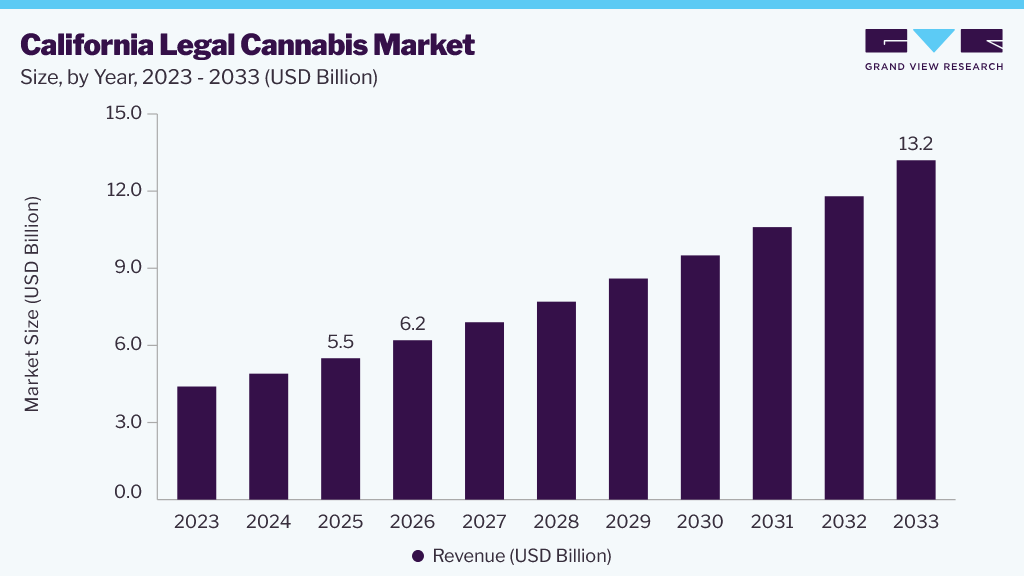 Source: Grand View Research, IR Documents, Primary Interviews, Paid DatabasesTo learn more about this report,
 Download Free Sample Report
According to a study published by NCBI in December 2025, opioid use in patients with chronic pain was reduced by 64% who were administered medical marijuana. Moreover, increasing incidences of chronic disease, coupled with the legalization of cannabis possession, are anticipated to drive the market in California over the forecast period.Market Dynamics
Awareness about Cannabis being a natural alternative pain therapy option is growing in California, in turn increasing the size of the market of legal cannabis. Consumers are trying the products of cannabis, such as flowers, edibles, oil, and tinctures, to manage various symptoms of chronic pain, arthritis, neuropathic pain, and other long-term illnesses. Traditional painkillers such as opiates are seen as a danger, having harmful side effects and addiction-related risks. Hence, cannabis products are seen as the best alternative to these groups of medicines. Furthermore, the well-established medical and recreational marijuana market of California ensures better access to a variety of cannabis products for medical and adult-use customers. Product innovation, along with continual research, has further led to the creation of specific products for pain relief, resulting in growing demand for legal marijuana products.
One of the major challenges for the market is the heavy regulation and high tax rates associated with selling cannabis legally. Licensed cannabis businesses are required to follow rules and regulations for every part of their operations, such as cultivation, manufacturing, testing, distribution, packaging, and retail. Strict rules for these operations often increase the business's costs. Adding to this, high state and local taxes on cannabis products also increase the prices paid by consumers. Strict regulations and high taxes prompt some buyers to instead utilize the illegal market, creating a price difference. This price disparity makes it difficult for legal retailers to compete.
Analyst Perspective
The market is increasingly focused on profitability and market positioning rather than expansion alone. As competition increases, companies are looking to strengthen their brands, improve operational efficiency, and build loyal customer bases. Businesses with strong retail presence, consistent product quality, and effective distribution networks are likely to have an advantage in the coming years. The market is expected to favor operators that can manage regulatory requirements efficiently while maintaining competitive pricing and a differentiated product offering.
Legalization Timelines
1996: The Compassionate Use Act was passed after receiving 55.6% votes, which allowed the medical use of cannabis in California. This drug reform, also known as Proposition 215, provides legal protection to caregivers, physicians, and patients. Moreover, the new series of laws known as the Medical Cannabis Regulation and Safety Act (MCRSA) came into effect, which created a new regulatory and licensing framework for the medical cannabis industry in California. In November 2016, Proposition 64 was passed, allowing MCRSA to govern transportation, cultivation, testing, resale, and distribution.
2003: California Senate Bill 420, also known as the Medical Marijuana Program Act, was passed to establish an identification card system for patients of medical cannabis.
2009: The Marijuana Control, Regulation, and Education Act was passed, which removed penalties for the use, possession, and cultivation of marijuana for persons of age 21 or older.
2010: The voters in California rejected Proposition 19 by 53.5% votes, hence prohibiting legalized possession, cultivation, and possession of cannabis for adults aged 21 or older
2011: California decriminalized marijuana possession by reducing the charge from a misdemeanor to an infraction for possession of 28.5 grams of cannabis or less. The bill states that if a person is found guilty of such an infraction, they are punishable by a fine of not more than USD 100 and no mandatory court appearance.
2014: Proposition 47 was passed by California voters, which reduced certain crimes, such as possession of concentrated cannabis, from felonies to misdemeanors. Under this new law, people charged with such crimes will face misdemeanor penalties.
2016: Proposition 64 was passed by voters in California, which legalized the recreational use of cannabis. The bill allows the possession of 8 grams of concentrated cannabis by adults aged 21 years and older. Moreover, under the bill, an adult can cultivate six plants per residence and can purchase cannabis from licensed retailers.
2021: The California Cannabis Appellations Project (CAP) was implemented in California for the development of appellations of origin for marijuana products. The goal of CAP is to prevent misinterpretation about the origin of cannabis products and promote the regional cannabis business
Following the passage of Prop 64 and the enactment of the MAUCRSA, three state programs handled the licensing and regulation of cannabis: The Bureau of Cannabis Control in the Department of Consumer Affairs, CalCannabis Cultivation Licensing in the Department of Food and Agriculture, and the Manufactured Cannabis Safety Branch in the Department of Health. Ongoing: The regulatory authority continues to oversee the cannabis industry by setting standards for labeling, testing, and advertising.
2024: Cannabis cafes legalized - The AB-1775 is signed. Retail stores - in local jurisdictions where such provision is not prohibited - may sell non-cannabis infused foods, nonalcoholic drinks, and live performance tickets in their stores. As of July 2025, the City of Los Angeles does not allow a cannabis cafe.
2025: A DCR licensing milestone - DCR has issued over 1,075 commercial cannabis licenses since it started in 2018.
Regulations and Norms
Medical marijuana has been legal in California since 2016 after the approval of the Compassionate Use Act. The law intended to allow the use of medical cannabis to seriously ill persons under specified and limited circumstances. Some of the qualifying conditions include Alzheimer’s, chronic pain, HIV/AIDS, Glaucoma, Amyotrophic lateral sclerosis, post-traumatic stress disorder (PTSD), and obsessive-compulsive disorder, among others. Patients are required to obtain a medical marijuana card from the California Department of Public Health to grow, transport, use, and possess medical marijuana.
In California, both recreational and medical cannabis are regulated by the Department of Cannabis Control (DCC). The department is responsible for regulations governing the cultivation, manufacturing, transportation, labeling, and sale of cannabis.
-
Recent regulations and compliance developments
-
In July 2025, the cannabis excise tax rates were revised. The rate of the cannabis excise tax was increased from 15% to 19% of the gross receipts of retail sales of cannabis or cannabis products.
-
In May 2025, the Department of Cannabis Control (DCC) continues to increase enforcement of packaging and labeling regulations. Current rules require cannabis products to be sold in child-resistant, tamper-evident with an accurate amount of cannabinoids, warnings, batch number, licensing information, etc.
-
Recreational Use
-
The legal age for possession of cannabis is 21 and above
-
Adults 21 years or older have the right to possess 28.5 grams of marijuana and grow as many as six plants in their homes
-
Public use or consumption of cannabis in public places is prohibited in California
-
Licensed retailers can operate between 6 a.m. and 10 p.m. Similarly, delivery drivers are expected to return to the retail premises before 10 p.m.
-
According to the California Department of Tax and Fee Administration, customers should pay a 15% excise tax based on the gross receipts of cannabis products.
Medical Use
-
To purchase medicinal marijuana, the patient should have a medical marijuana ID card
-
The legal age for the possession of medical marijuana is 18 years or older, with a licensed physician’s recommendation.
-
The retailer must verify the patient’s age by checking acceptable forms of ID, such as a passport, driver’s license, and military photo ID card.
-
The retailers are required to obtain a license from the California Bureau of Cannabis Control. Customers can only purchase recreational marijuana at these licensed retail dispensaries. Cannabis products must meet safety and quality standards.
-
Medical cannabis products should meet safety and quality standards and must be labeled accordingly
California Legal Cannabis Market Report Scope
Report Attribute
Details
Market size in 2025
USD 5.5 billion
Estimated market size in 2026
USD 6.2 billion
Projected market size by 2033
USD 13.2 billion
Growth rate
CAGR of 12.1% from 2026 to 2033
Historical data
2021 - 2025
Forecast period
2026 - 2033
Quantitative units
Revenue in USD billion, and CAGR from 2026 to 2033
Report coverage
Revenue forecast, company ranking, competitive landscape, growth factors, and trends
Segments covered
Source, derivatives, end use, cultivation
Key companies profiled
NORTHWEST CANNABIS SOLUTIONS, The Hollingsworth Cannabis Company, LLC, Alkaloid Cannabis Company, Herbs House, Nirvana Cannabis, Edgemont Group, OLYMPIA WEED COMPANY, Canna West Seattle, Grow Op Farms (Phat Panda), Forbidden Farms, LLC.
Customization scope
Free report customization (equivalent up to 8 analysts working days) with purchase. Addition or alteration to country, regional & segment scope.
Pricing and purchase options
Avail of customized purchase options to meet your exact research needs. Explore purchase options
Global California Legal Cannabis Market Report Segmentation
This report forecasts revenue growth at the regional and country levels and provides an analysis on the latest industry trends and opportunities in each of the sub-segments from 2021 to 2033. For this study, Grand View Research has segmented the global California legal cannabis market report based on source, product, and end use, cultivation:
-
Source Outlook (Revenue, USD Billion, 2021 - 2033)
-
Hemp
-
Hemp CBD
-
Industrial Hemp
-
-
Marijuana
-
Flower
-
Oil and Tinctures
-
-
-
Derivatives Outlook (Revenue, USD Billion, 2021 - 2033)
-
Indoor Cultivation
-
Greenhouse Cultivation
-
Outdoor Cultivation
-
-
Cultivation Outlook (Revenue, USD Billion, 2021 - 2033)
-
Indoor Cultivation
-
Greenhouse Cultivation
-
Outdoor Cultivation
-
-
End Use Outlook (Revenue, USD Billion, 2021 - 2033)
-
Industrial Use
-
Medical Use
-
Chronic Pain
-
Depression and Anxiety
-
Arthritis
-
Post-traumatic Stress Disorder (PTSD)
-
Cancer
-
Migraines
-
Epilepsy
-
Alzheimer’s
-
Multiple Sclerosis
-
AIDS
-
Amyotrophic Lateral Sclerosis
-
Tourette’s
-
Diabetes
-
Parkinson's
-
Glaucoma
-
Others
-
-
Recreational Use
-
Frequently Asked Questions About This Report
The California legal cannabis market size was valued at USD 5.5 billion in 2025 and is estimated at USD 6.2 billion for 2026.
The California legal cannabis market growth is attributed to the rising awareness regarding the use of cannabis products for pain management therapies.
The California legal cannabis market is expected to grow at a CAGR of 12.1% from 2026 to 2033, reaching USD 13.2 billion.
Medical use dominated the market in 2025.
Key players include NORTHWEST CANNABIS SOLUTIONS, The Hollingsworth Cannabis Company, LLC, Alkaloid Cannabis Company, Herbs House, Nirvana Cannabis, Edgemont Group, OLYMPIA WEED COMPANY, Canna West Seattle, Grow Op Farms (Phat Panda), Forbidden Farms, LLC.
About the Author(s)
Pharmaceuticals Research Team
Healthcare · PharmaceuticalsThis report was authored by the pharmaceuticals research team at Grand View Research - comprising two research analysts, one senior research analyst, and one industry expert - with specialized expertise in the pharmaceuticals segment of the healthcare industry. All findings are based on proprietary healthcare databases, executive interviews, and regulatory analysis, subject to internal peer review prior to publication.
Last Updated:
Speak to Analyst

Customize this report to your needs - add regions, segments, or data points, with 20% free customization.
Or view our licence options:


ISO 9001:2015 & 27001:2022 Certified
We are GDPR and CCPA compliant! Your transaction & personal information is safe and secure. For more details, please read our privacy policy.


