
- Home
- »
- Alcohol & Tobacco
- »
-
Canned Wines Market Size, Share & Growth Report, 2033GVR Report cover

Canned Wines Market (2026 - 2033)
Size, Share & Trends Analysis Report By Product (Sparkling, Fortified), By Distribution Channel (Hypermarket & Supermarket, Online Retail), By Region, And Segment Forecasts
Market Size, 2025
$125.2MMarket Estimate, 2026
$139.2MMarket Forecast, 2033
$285.3MCAGR, 2026–2033
10.8%Canned Wines Market Summary
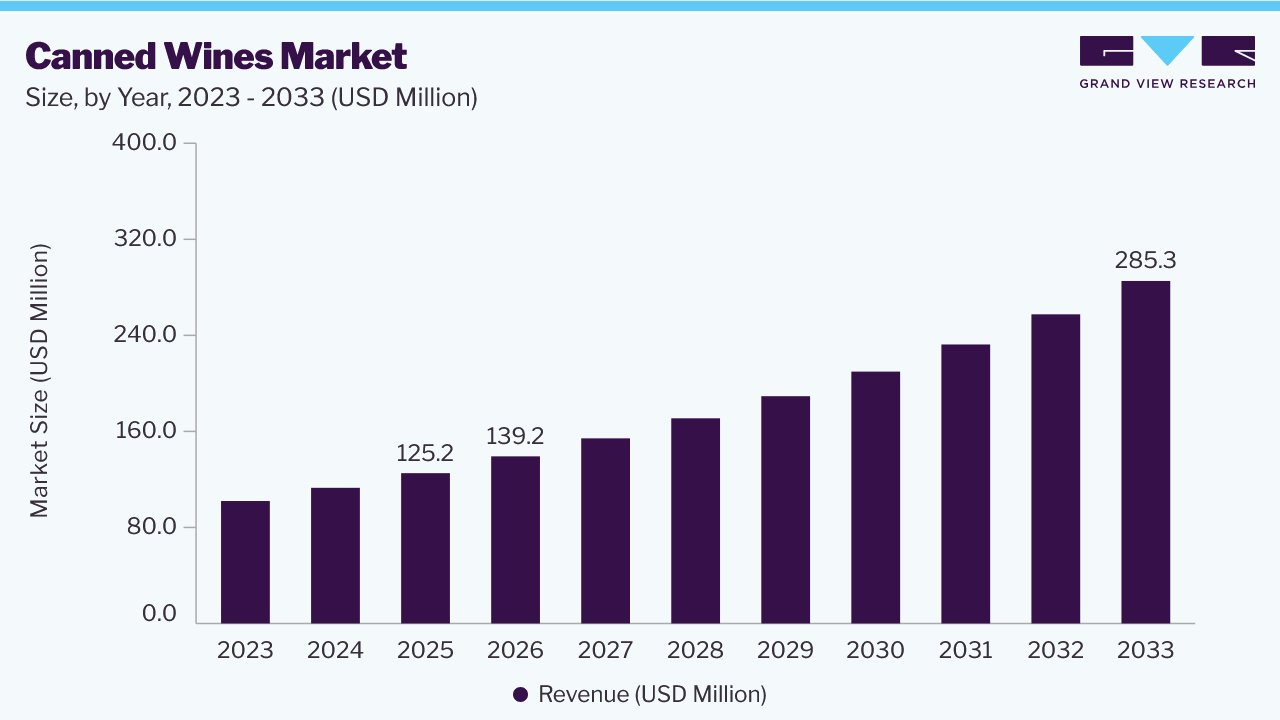
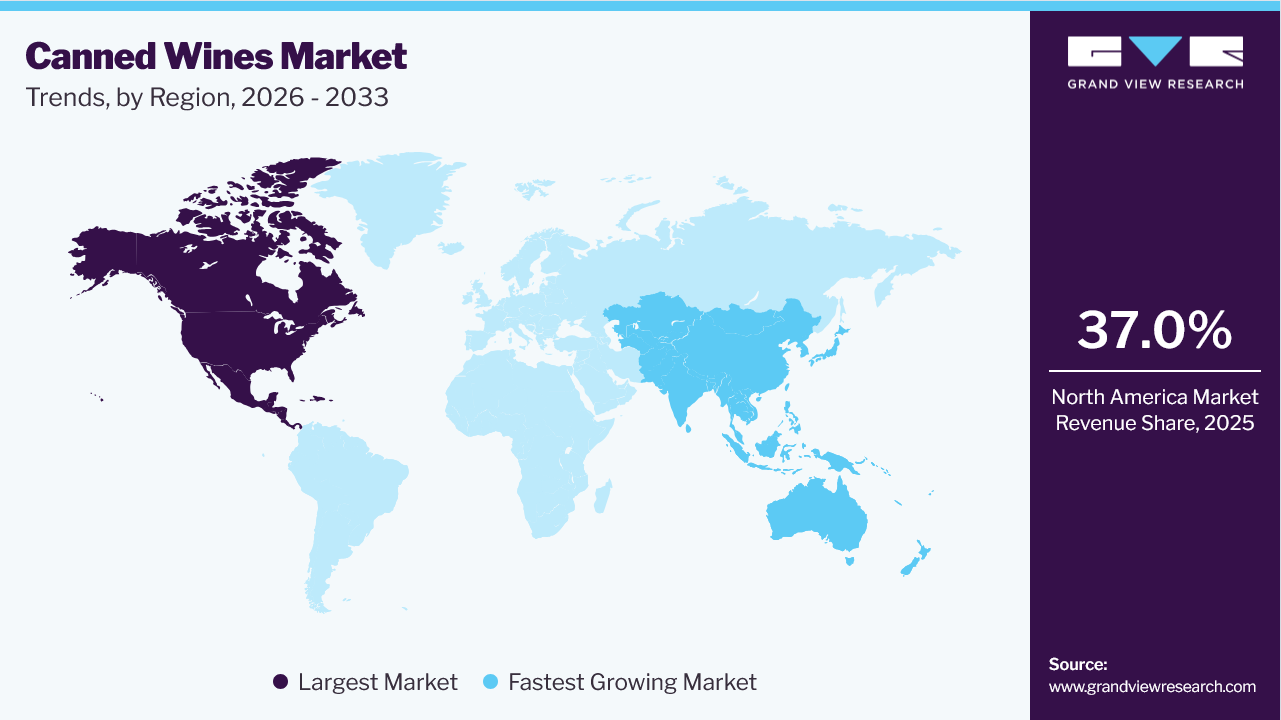
The global canned wines market size was valued at USD 125.2 million in 2025 and is projected to grow from USD 139.2 million in 2026 to USD 285.3 million in 2033, at a CAGR of 10.8% from 2026 to 2033. North America dominated the market, accounting for a largest revenue share of 37.0% in 2025. The steadily increasing demand for portable, convenient, and single-serve beverages, particularly among younger consumers, is a major driver of market growth worldwide.
 Source: Grand View Research, IR Documents, Primary Interviews, Paid DatabasesTo learn more about this report,
 Download Free Sample Report
Key Market Trends & Insights
- By product: The sparkling wine segment held the largest market share of around 60.0% in 2025.
- By distribution channel: The supermarket & hypermarket segment held a significant market share of around 45.0% in 2025.
Regional Highlights
- Largest regional market: North America (37.0% revenue share, 2025)
- Fastest-growing regional market: Asia Pacific (highest CAGR, 2026-2033)
Market Size & Forecast
- Market size in 2025: USD 125.2 Million
- Estimated market size in 2026: USD 139.2 Million
- Projected market size by 2033: USD 285.3 Million
- CAGR (2026-2033): 10.8%
Three ways to get this report
Buy it, customize it, or ask a question.Ask an Analyst
Analyst response in 1 business day
- AccessReport author, directly
- Reply timeWithin 1 working day
- No sales callDirect answer only
- FormatEmail reply
- CostFree, no cost
Get the Full Report
What the study covers
- FormatsPDF · Excel · Dashboard
- Timeline2026–2033 annual, 2025 base
- Coverage20+ countries, 5 regions
- Companies10+ key players profiled
Customize the Report
20% free customization
- IncludeCountries, segments, points
- TailorTo your product definition
- ExtendDeeper competitor detail
- OrA fully bespoke study
- Turnaround5–10 working days
In addition, consumer inclination toward ready-to-drink (RTD) products, driven by busy lifestyles and hectic work schedules, has boosted demand, especially in developed and emerging markets. With weekend getaways, camping, and hiking becoming increasingly popular, sales of products such as canned beverages have risen sharply, as they allow consumers to enjoy beverages without the issues associated with conventional bottles, such as spillage or breakage.
The rapidly expanding health- and wellness-focused population, especially in developed economies such as the U.S. and Western European countries, has created notable growth opportunities for companies in the canned wine industry. Canned wines often come in lighter, lower-alcohol varieties, which align with the growing wellness movement. Many consumers are looking for beverages that fit their healthier lifestyles, with a focus on moderation, lower calorie content, and fewer additives, and these products often cater to these preferences. The single-serving nature of canned wine helps control alcohol intake, a growing trend in many economies where consumers aim to avoid overconsumption. Canned wines are also more affordable than bottled wines, making them an attractive option for budget-conscious consumers. The lower cost of production and packaging for these cans generally results in a lower retail price, which is particularly appealing for casual or everyday drinking.
A continued focus on the environment and sustainability concerns has emerged as another promising driver for market growth. Canned wine is often seen as a more environmentally friendly option than bottled wine, especially because aluminum cans are recyclable. With growing concerns about plastic and glass waste associated with conventional bottled wine, many consumers prefer the lower environmental impact of cans. Canned wines address the global demand for sustainable products and eco-conscious consumer choices. Aluminum cans are lighter and more compact than glass bottles, reducing transportation costs and the product's overall carbon footprint.
The canned wine category has seen significant innovation in flavor and product offerings. This includes sparkling wines, flavored wine spritzers, and wine blends, which appeal to a broader range of consumer tastes. The ability to experiment with different flavor profiles and wine-based cocktails in a convenient format has helped expand the appeal of canned wines. These beverages are also available in trending options such as sangria, wine spritzers, and flavored wines, attracting a wider consumer base, including those new to wine or looking for a casual alternative.
Analyst Perspective
The canned wines market is supported by growing demand for portable, single-serve alcoholic beverages suited to outdoor events, social occasions, and casual consumption. Cans provide convenient storage, portion control, and easier transportation compared with traditional glass packaging, expanding consumption opportunities across festivals, travel, hospitality, and retail channels. Product innovation is also broadening the category through sparkling wines, rosé, flavored wine beverages, and wine-based spritzers. Improvements in can-lining technologies, filling processes, and packaging design are helping producers maintain product quality while extending the commercial viability of canned formats. Expansion of supermarkets, specialty beverage retailers, and regulated online alcohol channels is further improving product accessibility across major markets.
Product Insights
The sparkling wine segment held the largest market share, at around 60.0%, in 2025. Sparkling canned wines, such as sparkling rosé, Prosecco, and wine spritzers, cater to a broad demographic and offer a portable alternative to conventional bottled sparkling wines. Canned sparkling wines come in smaller, single-serve portions, which reduces waste and appeals to individuals who prefer not to open a full bottle. This is particularly important in markets where sparkling wine is not consumed frequently, as consumers are less likely to finish it. The widespread popularity of this type of wine has compelled major brands and startups alike to launch innovative offerings. For instance, in February 2024, Mercian Corporation launched “Frontera Sparkling Can,” a 280ml canned sparkling wine under Viña Concha y Toro’s Frontera brand in Japan. The 12.5% ABV sparkling wine is made from Chardonnay grapes and is packaged in a resealable aluminum bottle-can, offering consumers a convenient single-serve format.
The fortified wine segment is expected to advance at the fastest CAGR over the forecast period. The fortified wine segment is expected to register strong growth during the forecast period, supported by increasing experimentation with premium, cocktail-oriented, and single-serve wine formats. Vermouth and other fortified wine styles are increasingly being incorporated into ready-to-drink and aperitif-oriented products, creating opportunities for alternative packaging formats, including cans.
Distribution Channel Insights
The supermarket & hypermarket segment accounted for around 45.0% of the market in 2025. The growing presence of physical shopping outlets and the opportunity to boost product visibility have created significant demand for these distribution channels among canned wine companies. Supermarkets and hypermarkets, on their part, have expanded their canned wine selections in response to rising demand. These retail channels are capitalizing on the popularity of canned beverages by offering a variety of brands and price points, making them accessible to a wide audience. Retailers often use promotions, discounts, and in-store displays to increase the chances of impulse purchases. Tasting events or featured product spots can also drive awareness and interest among prospective buyers.
The online retail segment is expected to advance at the fastest CAGR during the forecast period. Improving internet connectivity worldwide and increasing use of social media platforms by wine brands have resulted in substantial product sales through online channels. Online retail platforms often provide a wider selection of products than conventional brick-and-mortar stores. In addition, online retailers generally offer a range of options, including different wine types (rosé, red, white, and sparkling), brands, and price points, catering to a broad spectrum of consumer tastes and preferences. Moreover, with sustainability a key factor for consumers making conscious purchasing decisions, extensive online research and brand comparisons make it easy for them to find wines that align with their environmental values.
Regional Insights
The canned wines industry in North America accounted for the largest revenue share of 37.0% globally in 2025. Increasing wine consumption among regional consumers and the availability of several wine brands in the canned format have aided regional growth. Canned wines are often perceived as a more affordable alternative to bottled wines, especially among younger consumers and the middle-class demographic in the U.S. and Canada. This has made them an attractive option for budget-conscious consumers, particularly in casual and social settings. Moreover, the Millennial and Generation Z demographics are drawn to the novelty, affordability, and sustainability aspects of cans. Canned wine thus appeals to younger consumers who seek convenience and a modern image that aligns with their lifestyles.
 To learn more about this report, Download Free Sample Report
U.S. Canned Wines Market Trends
The canned wines industry in the U.S. accounted for a dominant share of regional market revenue in 2025, aided by strong wine sales and growing competition among brands, spurring innovation. According to the Wine Institute, U.S. wine consumption totaled approximately 870 million gallons in 2024, equivalent to 2.54 gallons per resident. The established wine consumption base, combined with growing interest in portable and alternative packaging formats, supports opportunities for canned wine products in the U.S. Manufacturers are also increasingly introducing RTD options with lower alcohol content that incorporate natural ingredients to cater to the health-conscious customer base. This has helped create more avenues for product sales, aiding industry advancement.
Europe Canned Wines Market Trends
The canned wine industry in Europe accounted for a notable revenue share globally in 2025. The increasing consumption of alcoholic beverages by regional consumers at outdoor events such as picnics, music festivals, sporting events, and hikes has helped sustain strong sales of RTD products. Sustainability is a major driver in Europe, where consumers are highly attuned to environmental issues. Canned wines are often marketed as more eco-friendly than bottled wine due to the recyclability of aluminum and the lower carbon footprint associated with their production and transport. Many established wine-producing countries, such as France, Italy, and Spain, are seeing local producers embrace canned wines and RTD options to reach new audiences, particularly younger or urban consumers who may not prefer traditional wine consumption.
Asia Pacific Canned Wines Market Trends
The canned wine industry in the Asia-Pacific is expected to grow at the fastest CAGR during the forecast period. The region's steadily increasing population of beverage consumers and a substantial younger demographic have created opportunities for market players to launch novel products targeting different customer segments. A report published in 2024 stated that while the overall wine market in Japan has declined, canned wines have seen a noticeable surge in popularity, with companies such as Suntory Holdings and Mercian benefiting from this trend. The outlook for RTD beverages in India has similarly been positive in recent years. In June 2025, Suntory Holdings announced the nationwide relaunch of its “Anti-Oxidant-Free Delicious Wine. Sparkling” red and white canned sparkling wines, citing strong demand for the convenient format. The company reported that sales volume for its canned sparkling wine series increased by 26% year over year during January–May 2025, highlighting growing consumer acceptance of canned wine in Japan.
China’s canned wines industry accounted for the largest revenue share in the Asia-Pacific market in 2025. The country holds significant promise for alternative wine products due to the growing urbanization and increasing preference for alcoholic beverages among Chinese consumers. As a result, there has been a proliferation of emerging brands offering innovative products. For instance, in June 2025, COFCO's Great Wall Wine launched the Great Wall Yuexuan sparkling wine series in China, comprising three fruit-forward flavors with more than 50% fruit juice and an alcohol content of 3.5% ABV. The products target younger consumers and were introduced across the brand's official stores on Tmall, JD.com, Douyin, Kuaishou, and Xiaohongshu, reflecting the growing development of low-alcohol and innovative wine formats in China.
Key Canned Wines Company Insights
Some major companies involved in the global canned wines industry include E. & J. Gallo Winery, Canned Wine Co., and Union Wine Company, among others.
- E. & J. Gallo Winery is a family-owned winery headquartered in Modesto, California, which is involved in developing premium and innovative wines. The company has a broad portfolio of wine offerings, including Alamos, Apothic, Ballatore, Bella Sera, Dolcea, Estancia, Hahn, Liberty Creek, and Madria Sangria. In June 2023, Gallo announced the acquisition of the female-led beverage brand Bev and its premium canned wines and spritzers portfolio. The company's Bev product range includes Bev Rosé, Bev Noir, Bev PRIDE, Bev Gris, Bev Blanc, Bev Glitz, Bev Glow, Bev Glam, and Bev Brite.
- Canned Wine Co., a winery based in Bath, England, produces and sells high-quality wines in environmentally friendly packaging. The company has an extensive product range, including Verdejo 2022 - Rueda, Gamay 2021 - Loire Valley, Sparkling Chardonnay 2022, Viognier 2022, St Laurent 2020, and Old Vine Garnacha 2020, among others. It further offers a 'Build A Box' feature that allows buyers to select 3, 6, or 12 cans from the brand's portfolio that are then delivered to their homes.
Key Canned Wines Companies
The following key companies have been profiled for this study on the canned wines market.
-
E. & J. Gallo Winery
-
Union Wine Company
-
Sans Wine Co.
-
Sula Vineyards Limited
-
SUNTORY HOLDINGS LIMITED
-
Canned Wine Co.
-
Maker Wine Company
-
Archer Roose Wines
Recent Developments
- In August 2024, Archer Roose expanded distribution of its Sauvignon Blanc cans to more than 150 Dave & Buster’s locations across the U.S. The expansion increased the brand’s presence in entertainment venues and strengthened consumer access to single-serve canned wine formats outside traditional retail channels.
Canned Wines Market Report Scope
Report Attribute
Details
Market size in 2025
USD 125.2 million
Estimated market size in 2026
USD 139.2 million
Projected market size by 2033
USD 285.3 million
Growth rate
CAGR of 10.8% from 2026 to 2033
Base year for estimation
2025
Historical data
2021 – 2025
Forecast period
2026 – 2033
Quantitative units
Revenue in USD million and CAGR from 2026 to 2033
Report coverage
Revenue forecast, company ranking, competitive landscape, growth factors, and trends
Segments covered
Product, distribution channel, region
Regional Scope
North America; Europe; Asia Pacific; Latin America; MEA
Country Scope
U.S.; Canada; Mexico; Germany; UK; France; Italy; Spain; China; Japan; India; Australia; South Korea; Argentina; South Africa
Key companies profiled
E. & J. Gallo Winery; Union Wine Company; Sans Wine Co.; Sula Vineyards Limited; SUNTORY HOLDINGS LIMITED; Canned Wine Co.; Maker Wine Company; Archer Roose Wines
Customization scope
Free report customization (equivalent to 8 analyst working days) with purchase. Addition or alteration to country, regional & segment scope.
Pricing and purchase options
Avail of customized purchase options to meet your exact research needs. Explore purchase options
Global Canned Wines Market Report Segmentation
This report forecasts revenue growth at the global, regional, and country levels and provides an analysis of the latest industry trends and opportunities across each sub-segment from 2021 to 2033. For this study, Grand View Research has segmented the global canned wines market report based on product, distribution channel, and region:
-
Product Outlook (Revenue, USD Million, 2021 - 2033)
-
Sparkling Wine
-
Fortified Wine
-
Others
-
-
Distribution Channel Outlook (Revenue, USD Million, 2021 - 2033)
-
Hypermarket & Supermarket
-
Online Retail
-
On-trade
-
-
Regional Outlook (Revenue, USD Million, 2021 - 2033)
-
North America
-
U.S.
-
Canada
-
Mexico
-
- Europe
-
-
Germany
-
UK
-
Italy
-
France
-
Spain
-
-
Asia Pacific
-
China
-
Japan
-
India
-
Australia
-
South Korea
-
- Latin America
-
-
Argentina
-
MEA
-
South Africa
-
Frequently Asked Questions About This Report
North America dominated with an approximately 37.0% revenue share in 2025.
The global canned wines market was valued at USD 125.2 million in 2025 and is estimated at USD 139.2 million in 2026.
The global canned wines market is expected to grow at a CAGR of 10.8% from 2026 to 2033, reaching USD 285.3 million.
Key players in the market include E. & J. Gallo Winery; Union Wine Company; Sans Wine Co.; Sula Vineyards Limited; SUNTORY HOLDINGS LIMITED; Canned Wine Co.; Maker Wine Company; Archer Roose Wines and others.
The sparkling wine segment accounted for the largest revenue share of around 60.0% in 2025.
About the Author(s)
Alcohol & Tobacco Research Team
Consumer Goods · Alcohol & TobaccoThis report was authored by the alcohol & tobacco research team at Grand View Research - comprising two research analysts, one senior research analyst, and one industry expert - with specialized expertise in the alcohol & tobacco segment of the consumer goods industry. All findings are based on proprietary consumer goods databases, executive interviews, and regulatory analysis, subject to internal peer review prior to publication.
Last Updated:
Speak to Analyst

Customize this report to your needs - add regions, segments, or data points, with 20% free customization.
Or view our licence options:


ISO 9001:2015 & 27001:2022 Certified
We are GDPR and CCPA compliant! Your transaction & personal information is safe and secure. For more details, please read our privacy policy.


