
- Home
- »
- Advanced Interior Materials
- »
-
Cartoning Machinery Market Size And Share Report, 2033GVR Report cover

Cartoning Machinery Market (2026 - 2033)
Size, Share & Trends Analysis Report By Machine Type (Horizontal, Vertical), By Automation (Automatic, Semi-automatic), By End Use (Food & Beverage, Pharmaceuticals), By Region, And Segment Forecasts
Market Size, 2025
$5.1BMarket Estimate, 2026
$5.3BMarket Forecast, 2033
$7.5BCAGR, 2026–2033
5.0%Cartoning Machinery Market Summary
The global cartoning machinery market size was valued at USD 5.1 billion in 2025 and is projected to grow from USD 5.3 billion in 2026 to USD 7.5 billion by 2033, at a CAGR of 5.0% from 2026 to 2033. Asia Pacific dominated the global market, accounting for a revenue share of 36.0% in 2025. The industry is driven by the increasing automation of secondary packaging across the pharmaceutical, food & beverage, personal care, and consumer goods sectors.
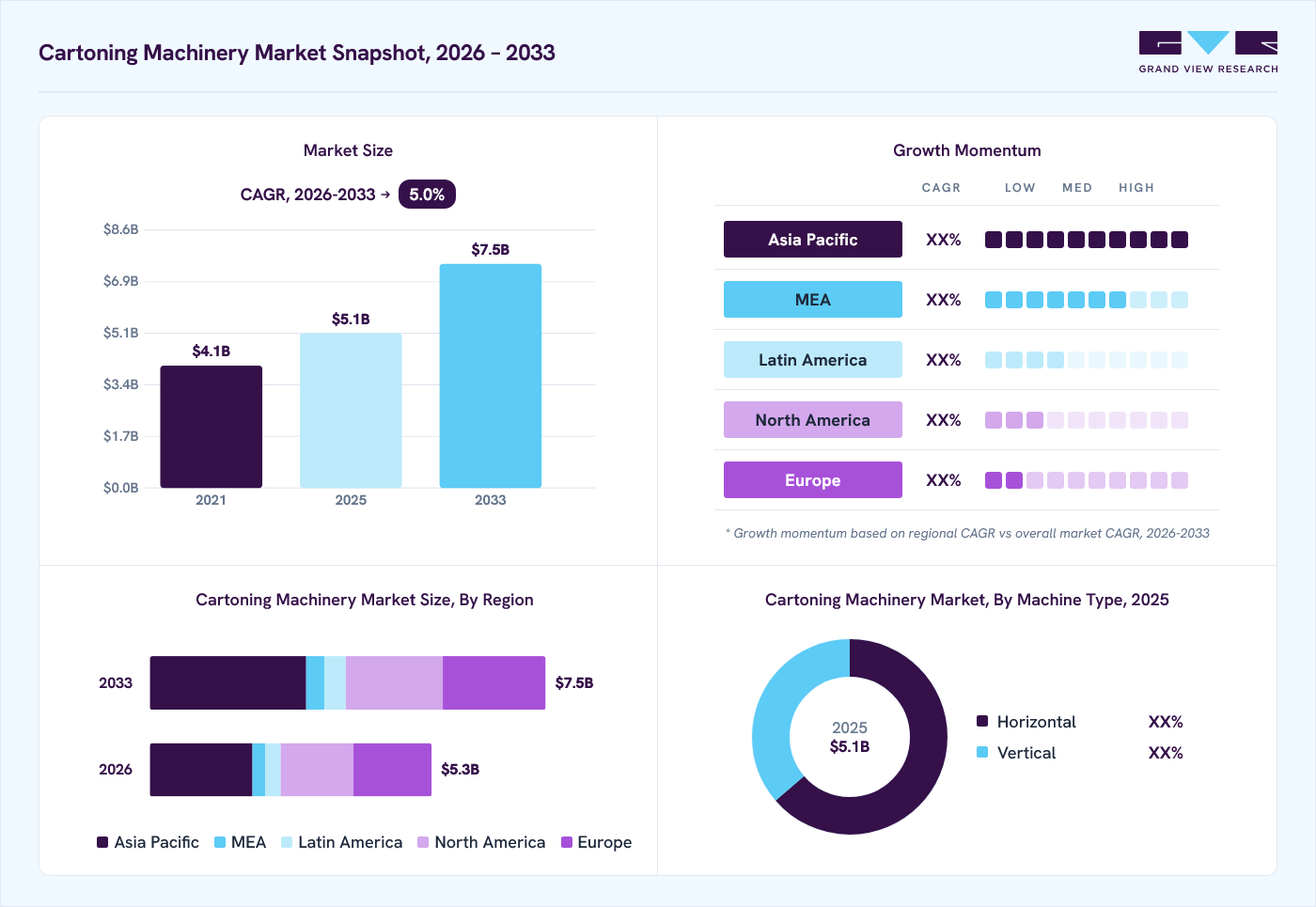 Source: Grand View Research, IR Documents, Primary Interviews, Paid DatabasesTo learn more about this report,
 Download Free Sample Report
 Key Market Trends & Insights
- By machine type: Vertical segment is projected to grow at 4.6% CAGR during the forecast period.
- By automation: Semi-automatic segment is expected to grow at a CAGR of 4.1% from 2026 to 2033.
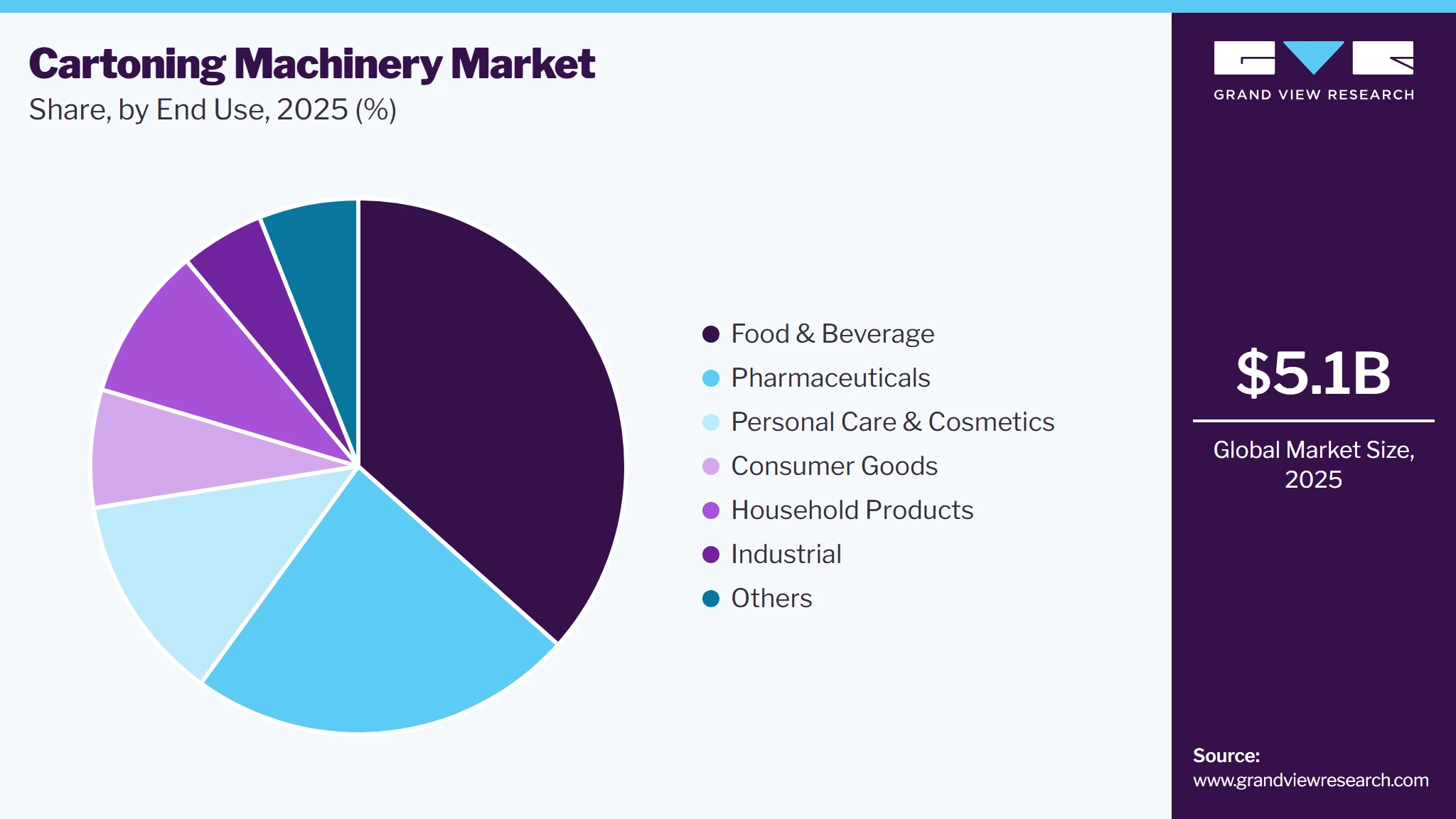
- By end use: Food & beverage segment dominated the market in 2025, accounting for 36.6% market share.
Regional Highlights
- Largest regional market: Asia Pacific (36.0% revenue share, 2025)
- By country: China held the largest market share in 2025
Market Size & Forecast
- Market Size in 2025: USD 5.1 Billion
- Estimated Market Size in 2026: USD 5.3 Billion
- Projected Market Size by 2033: USD 7.5 Billion
- CAGR (2026-2033): 5.0%
Three ways to get this report
Buy it, customize it, or ask a question.Ask an Analyst
A direct answer, usually in 1 working day
- AccessReport author, directly
- Reply timeWithin 1 working day
- No sales callDirect answer only
- FormatEmail reply
- CostFree, no cost
Get the Full Report
What the study covers
- FormatsPDF · Excel · Dashboard
- Timeline2026–2033 annual, 2025 base
- Coverage20+ countries, 5 regions
- Companies10+ key players profiled
Customize the Report
20% free customization
- IncludeCountries, segments, points
- TailorTo your product definition
- ExtendDeeper competitor detail
- OrA fully bespoke study
- Turnaround5–10 working days
Manufacturers are adopting automated cartoners to accommodate higher production volumes, improve packaging consistency, and reduce manual intervention. Demand for equipment that supports multiple carton formats, product configurations, and rapid changeovers is further expanding the application of cartoning machinery across diverse production environments.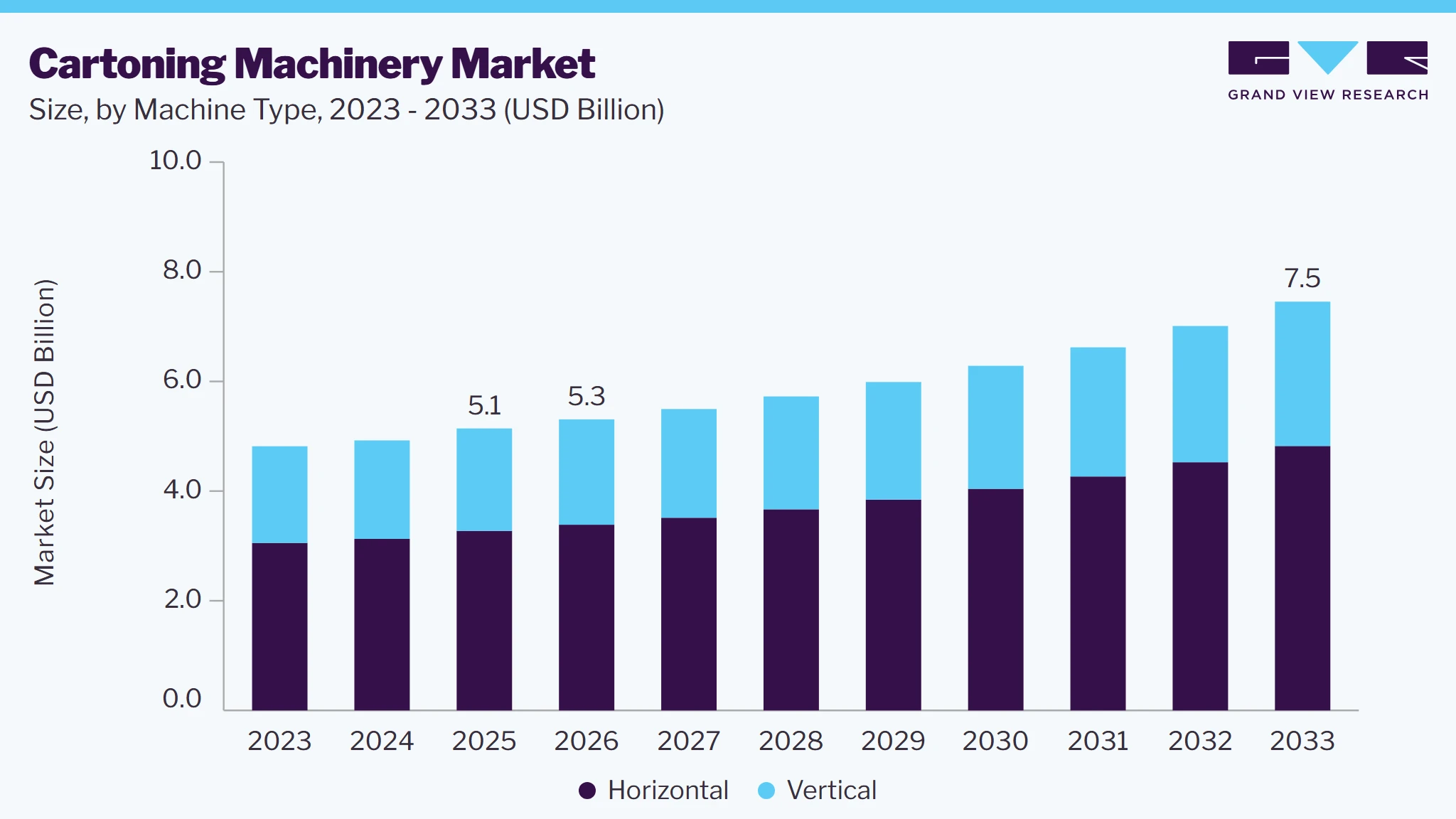 To learn more about this report, Download Free Sample Report
 Additionally, the integration of cartoning machinery with feeding, coding, inspection, serialization, and case-packing systems is strengthening demand for automated packaging lines. Advancements in servo-driven motion control, robotic product loading, and digital machine monitoring are enabling greater flexibility for multi-SKU production and shorter production runs. The shift toward lightweight and recyclable carton materials is also spurring machinery upgrades capable of reliably forming and closing cartons across varied board specifications.
Market Dynamics
The global cartoning machinery market is influenced by demand for automated carton forming, product loading, and carton closing across the pharmaceutical, food & beverage, personal care, and consumer goods manufacturing sectors. Market development is shaped by required machine speed, carton dimensions, product characteristics, changeover frequency, and compatibility with upstream feeding systems. Equipment selection is also affected by production capacity, machine configuration, footprint, maintenance requirements, and integration with existing packaging lines.
Manufacturers are replacing manual and semi-automatic carton packing processes with automated cartoning machinery to achieve consistent carton erection, product insertion, and closure at higher production speeds. Demand is particularly relevant for operations handling standardized products in continuous production environments, where manual handling can constrain throughput and packaging consistency. This is increasing the adoption of horizontal, vertical, end-load, and top-load cartoners across major end-use industries.
Automated cartoning machinery requires considerable investment in equipment, installation, commissioning, and operator training. Integration with product feeders, conveyors, coding units, inspection systems, and downstream case-packing equipment can further increase system complexity and project costs. These requirements may extend procurement and installation timelines, particularly when cartoners are retrofitted into existing production lines.
The transition toward recyclable, lightweight, and material-efficient carton structures is creating opportunities for cartoning machinery manufacturers. Changes in board thickness, stiffness, coatings, and carton geometry can affect feeding, opening, forming, and closing performance, requiring equipment adjustments or new machine configurations. Suppliers that develop cartoners capable of reliably processing evolving carton materials and designs can address emerging packaging requirements without changing the core packaging format.
Market Concentration & Characteristics
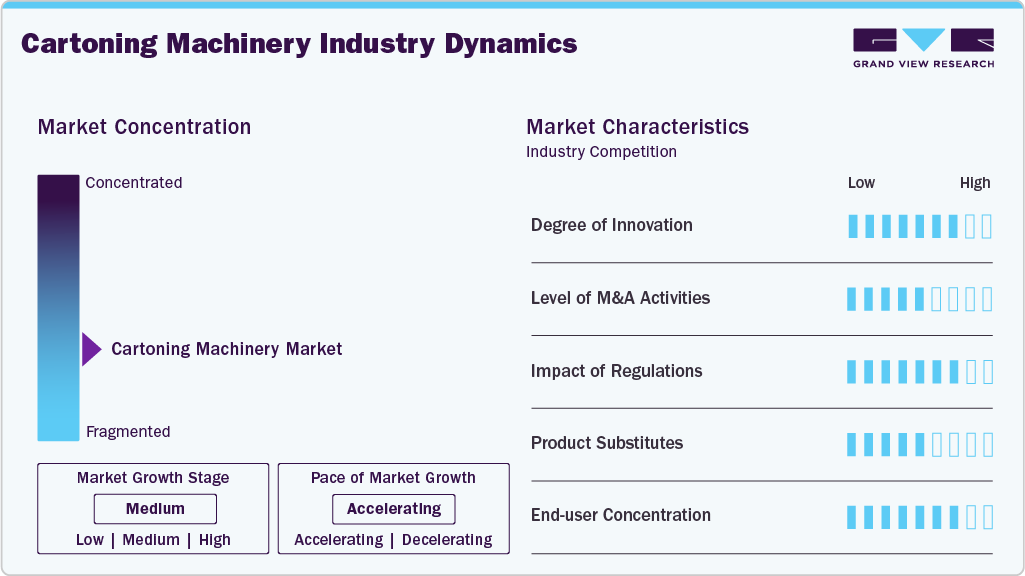
The cartoning machinery market has a fragmented-to-moderately concentrated structure, comprising global packaging machinery manufacturers, specialized cartoner suppliers, and regional equipment providers. Competition varies across machine configurations, production capacities, and application requirements, with suppliers offering horizontal, vertical, end-load, top-load, and wraparound systems. Product differentiation is primarily based on machine architecture, operating speed, carton-handling capability, footprint, and the degree of customization available for specific production environments.
Engineering requirements represent an important characteristic of the market, as cartoning machinery is typically configured around product dimensions, carton specifications, line layout, and required production capacity. Equipment selection can also vary depending on whether manufacturers require standalone machines or systems designed for integration into existing packaging lines. This application-specific nature creates demand for customized machine designs, format tooling, and engineering support rather than standardized equipment alone.
 To learn more about this report, Download Free Sample Report
 Supplier competition extends beyond machine sales to commissioning, technical support, spare parts, upgrades, and lifecycle service. Established manufacturers benefit from installed equipment bases and broader service capabilities, while specialized and regional suppliers compete through customization, shorter response times, and application-focused solutions. Market demand, therefore, includes new line installations, replacement of aging equipment, capacity expansion, and modernization of existing cartoning operations.
Analyst Perspective
The cartoning machinery market is expected to maintain steady growth as semiconductor manufacturers expand wafer fabrication capacity and adopt increasingly complex process technologies. The transition toward smaller technology nodes is intensifying requirements for wafer cleanliness, contamination control, and process precision, creating demand for advanced cleaning systems with higher automation and processing efficiency. New fab construction, capacity expansions, technology upgrades, and replacement of aging equipment will remain important contributors to equipment purchases across foundries, memory manufacturers, logic producers, and IDMs. Asia Pacific is expected to remain the largest regional market, supported by its established semiconductor manufacturing ecosystem and continued investments in wafer fabrication, while North America and Europe present additional opportunities through ongoing efforts to strengthen domestic semiconductor production.
Machine Type Insights
The horizontal segment accounted for 63.7% of the market revenue in 2025. Their adoption is associated with established use in automated secondary packaging operations requiring consistent product feeding, carton loading, and closure at commercial production volumes. The configuration accommodates a broad range of product dimensions and carton formats, and its compatibility with automated feeding and downstream packaging equipment enables its use across varied production lines.
Horizontal cartoning machines are also projected to register the fastest CAGR during the forecast period. Expansion is linked to manufacturers’ requirements for higher throughput, controlled product handling, and equipment capable of accommodating multiple carton formats and production specifications. The increasing replacement of manual cartoning processes and the modernization of existing packaging lines are expected to create further demand for horizontal systems.
Automation Insights
The automatic segment accounted for 67.2% of market revenue in 2025. The segment benefits from its use in production lines where carton erection, product insertion, leaflet placement, and carton closing are coordinated within a single automated sequence. Higher machine configurations, greater throughput capabilities, and the integration of automatic cartoners into broader packaging lines contribute to their higher revenue contribution. Demand is particularly relevant for facilities that operate standardized production schedules and require consistent machine performance over extended production cycles.
Semi-automatic cartoning machines are projected to register the fastest CAGR during the forecast period. Their adoption is linked to manufacturing environments where production requirements vary by product batch, carton specification, or order volume, making full-line automation less practical. These systems provide a mechanized approach to selected cartoning stages while retaining manual involvement for activities that require greater handling flexibility. Demand is therefore expected to increase among smaller and mid-scale production facilities, contract packagers, and manufacturers undertaking gradual modernization of existing packaging operations.
End Use Insights
The food & beverage segment accounted for the largest revenue share of the cartoning machinery market in 2025. The segment’s position reflects the extensive use of carton-based secondary packaging across packaged food and beverage categories, where product variety and packaging specifications require machines that can accommodate varying carton dimensions and loading patterns. Continuous demand for packaged products, along with the need to maintain consistent carton presentation and output across large production runs, sustains investment in cartoning equipment.
 To learn more about this report, Download Free Sample Report
 The Pharmaceuticals segment is projected to register the fastest CAGR of 5.8% during the forecast period. Demand is closely associated with the increasing sophistication of pharmaceutical secondary packaging, including requirements for accurate product insertion, leaflet handling, serialization compatibility, and controlled carton closure. Expansion of pharmaceutical production capacity and upgrades to packaging infrastructure are expected to accelerate the adoption of cartoning machinery designed for stringent handling and traceability requirements.
Regional Insights
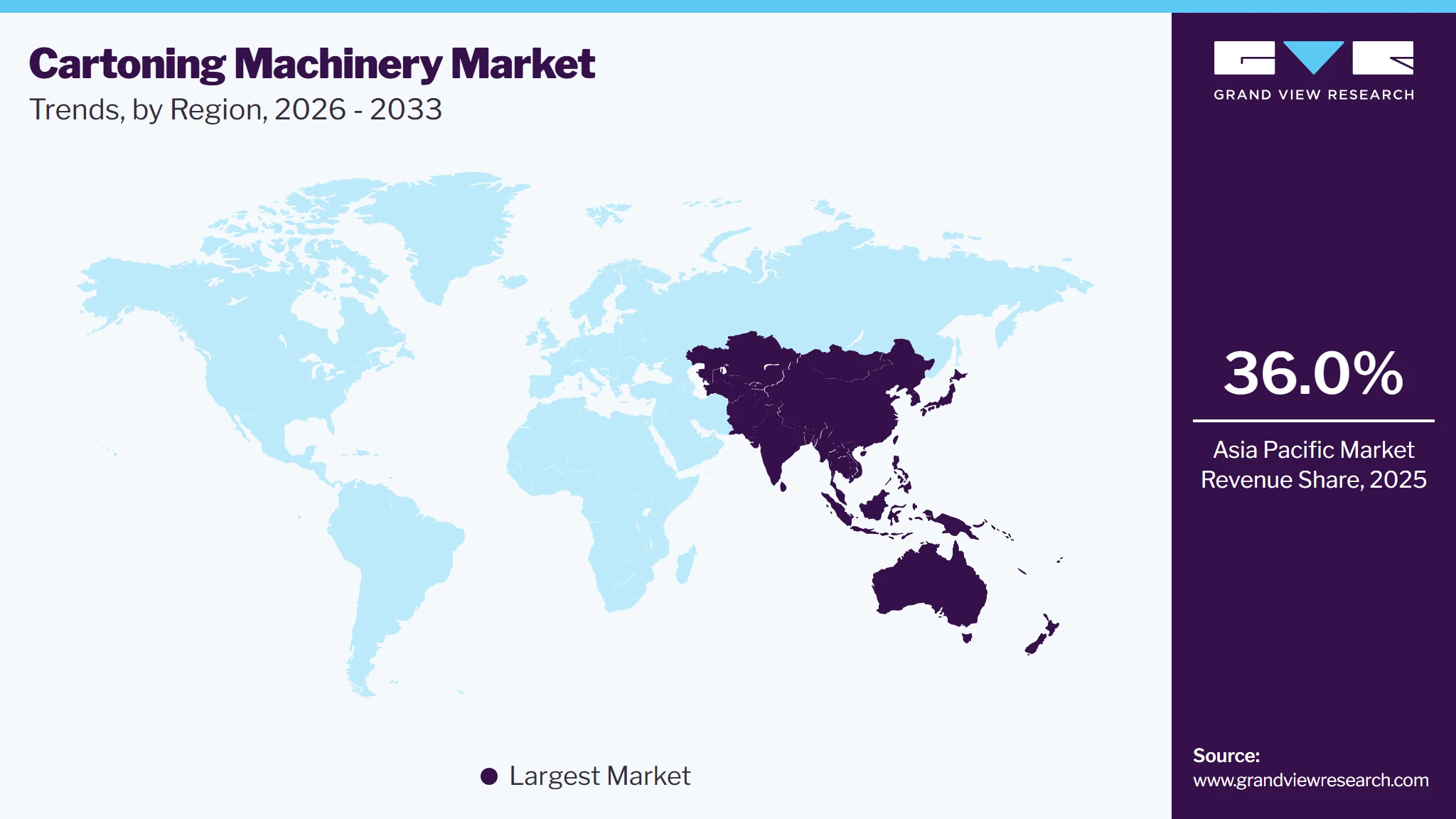
Asia Pacific dominated the global cartoning machinery market with the largest revenue share of 36.0% in 2025. Asia Pacific represents a broad and diverse sector, combining large-scale automated manufacturing with rapidly developing packaging infrastructure. Rising packaged-product consumption and expansion of manufacturing capacity are increasing the use of automated secondary packaging. The region has demand across high-speed industrial cartoners as well as modular systems suited to manufacturers transitioning from manual packaging. Differences in labor costs, production scale, and capital availability result in varied adoption patterns across countries.
 To learn more about this report, Download Free Sample Report
 The China cartoning machinery market is supported by extensive manufacturing activity and a substantial local packaging equipment industry. Demand spans standard and high-speed cartoners, with larger producers increasingly adopting servo-driven systems, robotic loading, and integrated inspection. Domestic equipment manufacturers also contribute to a competitive supply environment across different machine configurations and price ranges.
The cartoning machinery market in India is seeing greater adoption of cartoning machinery as pharmaceutical, food, personal care, and consumer product manufacturers increase packaging automation. The market has considerable scope for machines replacing manual carton packing and for equipment installed in newly expanded production facilities. Demand is particularly influenced by machine affordability, format flexibility, local service availability, and compatibility with existing packaging lines.
North America Cartoning Machinery Market Trends
The cartoning machinery market in North America is characterized by a mature secondary packaging infrastructure and widespread use of automated cartoning systems. The region has a high installed base of horizontal, vertical, end-load, and top-load cartoners across established production facilities. Demand is increasingly linked to high-speed packaging, contract manufacturing, private-label production, and frequent SKU changes, which require machines with rapid changeover and precise product handling. Equipment replacement and line upgrades remain relevant as manufacturers modernize established packaging operations.
U.S. Cartoning Machinery Market Trends
The cartoning machinery market in the U.S. has gained ground from the extensive pharmaceutical production, packaged food manufacturing, and consumer product packaging. Cartoning machinery demand is particularly associated with automated high-throughput lines and applications requiring integration with feeding, coding, inspection, and case-packing equipment. The presence of major international and domestic cartoning machinery suppliers also supports technology adoption and application-specific equipment development.
The Canada cartoning machinery market is witnessing the demand concentrated around automated packaging operations serving food, pharmaceutical, and consumer product manufacturing. Manufacturers generally require compact and adaptable cartoners suited to medium- and high-volume production. Equipment replacement and packaging-line upgrades provide a continuing source of demand as producers improve throughput and reduce manual handling.
Europe Cartoning Machinery Market Trends
The cartoning machinery market in Europe has received impetus from both sophisticated end-user manufacturing and a large base of packaging equipment manufacturers. The region has extensive use of horizontal, vertical, wraparound, and end-load cartoners, with equipment selection closely linked to carton architecture and product characteristics. Demand is increasingly influenced by recyclable carton materials, lightweight board, shorter production runs, and the need for flexible format handling. Europe also has a substantial installed base that generates recurring replacement and modernization requirements.
The Germany cartoning machinery market is gaining momentum due to advanced machinery manufacturing capabilities and highly automated production environment. Demand favors technically sophisticated cartoners with precise motion control, high operating reliability, and compatibility with integrated packaging lines. Engineering expertise and the presence of established machinery suppliers also support development of customized cartoning solutions.
The cartoning machinery market in France is strong, with demand driven by premium consumer packaging, cosmetics, food products, and pharmaceutical applications. Cartoners are required to handle presentation-oriented carton designs while maintaining accurate product positioning and consistent closure. Demand extends beyond basic high-speed equipment to machines capable of managing specialized carton formats and product configurations.
Middle East & Africa Cartoning Machinery Market Trends
The cartoning machinery market in the Middle East & Africa remains at an earlier stage of automation compared with North America, Europe, and developed Asia Pacific markets. Demand is concentrated in larger manufacturing facilities and industrial clusters where packaged-product production is being scaled up. Market development is closely associated with investment in local manufacturing infrastructure, packaging-line mechanization, and the establishment of modern production facilities. Suppliers offering scalable equipment and regional technical support are positioned to address differences in production capacity and automation requirements.
The cartoning machinery market in Saudi Arabia is well-positioned as investments in domestic manufacturing and industrial capacity have increased the requirement for modern packaging infrastructure. New and expanded production facilities are creating demand for automated cartoning systems rather than standalone manual packaging processes. Equipment procurement is influenced by scalability, integration with broader production lines, local service capabilities, and the ability to accommodate future capacity expansion.
Latin America Cartoning Machinery Market Trends
The cartoning machinery market in Latin America is witnessing the adoption varying according to manufacturing scale, investment capacity, and the degree of packaging automation. Larger production facilities increasingly use automated cartoners for consistent high-volume operations, while smaller manufacturers may favor semi-automatic or modular equipment. Imported machinery remains important in the region, making equipment cost, availability of spare parts, technical support, and machine reliability relevant purchasing considerations.
The Brazil cartoning machinery market is experiencing demand for cartoning equipment across high-volume packaged-product production and specialized applications. Large manufacturers are increasingly using automated cartoners to standardize secondary packaging and manage multiple carton configurations. The country's established industrial base also supports demand for replacement equipment, production-line upgrades, and machinery capable of integrating with existing automated packaging systems.
Key Cartoning Machinery Company Insights
Some of the key players operating in the market include Syntegon, IMA Group, and Marchesini Group.
-
Syntegon is a packaging technology company headquartered in Waiblingen, Germany, specializing in processing and packaging solutions for the food, pharmaceutical, and consumer goods industries. The company develops equipment and integrated systems covering processing, primary packaging, and secondary packaging applications. Within its packaging machinery portfolio, Syntegon manufactures cartoning systems designed for different product formats and production requirements, including horizontal, vertical, top-load, end-load, and wraparound configurations.
-
IMA Group is an Italian industrial group headquartered in Bologna, Italy, specializing in the design and manufacture of processing and packaging machinery. The company serves several industries, including pharmaceuticals, cosmetics, food, and other consumer-oriented sectors, through a broad portfolio of specialized equipment and integrated solutions. Cartoning machinery represents an important part of its packaging portfolio, covering horizontal and vertical cartoners as well as intermittent- and continuous-motion configurations.
Key Cartoning Machinery Companies
The following key companies have been profiled for this study on the cartoning machinery market:
-
Syntegon
-
IMA Group
-
Marchesini Group
-
Mpac Group
-
Cama Group
-
Jacob White Packaging
-
ADCO Manufacturing
-
Douglas Machine Inc.
-
Omori Machinery
-
ACG
-
R.A. Jones
-
Bradman Lake
-
Tishma Technologies
-
EndFlex
-
Pakona Engineers
Competitive Benchmarking
Category
Operating Strategies
Competitive Edge
Weakness
Established Players (e.g., Syntegon, IMA Group, Marchesini Group, Mpac Group, Cama Group, Omori Machinery, Douglas Machine Inc., R.A. Jones)
- Expand horizontal, vertical, top-load, end-load, and wraparound cartoning portfolios to accommodate different carton styles, product geometries, line speeds, and loading configurations.
- Develop servo-controlled motion, automatic format changeover, robotic loading, and integrated feeding and inspection capabilities to improve throughput and flexibility across multi-format cartoning operations.
- Extensive engineering capabilities and established cartoning platforms enable these companies to address high-speed and technically complex packaging requirements.
- Large installed bases and established technical service networks strengthen their ability to provide commissioning, format support, upgrades, and lifecycle service for cartoning equipment.
- Advanced cartoners with extensive automation and customized configurations require higher capital expenditure and engineering resources.
- Complex equipment integration, particularly with upstream feeding and downstream packaging systems, can increase installation, validation, and commissioning requirements.
Emerging & Regional Players (e.g., Jacob White Packaging, ADCO Manufacturing, ACG, Bradman Lake, Tishma Technologies, EndFlex, Pakona Engineers.)
- Concentrate on application-specific cartoning configurations and adaptable equipment capable of handling different carton dimensions, product arrangements, and production requirements.
- Emphasize machine customization, modular configurations, format flexibility, and regional technical support to address installations where standardized cartoning platforms may require modification.
- Greater specialization in particular cartoning configurations enables these companies to develop equipment around specific product-loading and carton-handling requirements.
- Flexible engineering and closer customer engagement can support customized machine layouts, format adjustments, and integration with existing production equipment.
- Comparatively narrower cartoning portfolios can limit coverage across highly specialized configurations and very high-speed applications.
- Smaller service and engineering networks may restrict their ability to support geographically dispersed installations and large multi-site cartoning programs.
Recent Developments
-
In March 2025, Jinlu Packing conducted product training for its RD-ZH-320W horizontal high-speed automatic cartoning machine. The machine is designed for automated cartoning of blister packs, pouches, tubes, bottles, and other products, with a reported capacity of up to 320 cartons per minute. It features servo-controlled product feeding, automatic carton forming, product and leaflet detection, carton closing, rejection, and coding. The development highlights ongoing advances in high-speed cartoning equipment, particularly in automated product handling, process monitoring, and integration with upstream and downstream packaging systems.
-
In August 2026, KEDE Machinery Technology introduced a new high-speed fully automatic cartoning machine designed for secondary packaging applications. The system automates carton erection, product insertion, and carton flap sealing, while incorporating servo-driven feeding and an HMI for production-parameter management. The machine can operate as a standalone unit or integrate with upstream blister packaging equipment to form an automated packaging line. The launch highlights continued development of cartoning machinery toward higher process automation, precise product handling, and integrated secondary packaging operations.
Cartoning Machinery Market Report Scope
Report Attribute
Details
Market size in 2025
USD 5.1 billion
Estimated market size in 2026
USD 5.3 billion
Projected market size by 2033
USD 7.5 billion
Growth rate
CAGR of 5.0% from 2026 to 2033
Historical data
2021 - 2024
Forecast period
2026 - 2033
Quantitative units
Revenue in USD billion and CAGR from 2026 to 2033
Report coverage
Revenue forecast, company ranking, competitive landscape, growth factors, and trends
Segments covered
Machine type, automation, end use, region
Regional scope
North America; Europe; Asia Pacific; Latin America; Middle East & Africa
Country scope
U.S.; Canada; Mexico; UK; Germany; France; Spain; Italy; China; Japan; India; Australia; South Korea; Brazil; Argentina; Saudi Arabia; South Africa; UAE
Key companies profiled
Syntegon.; IMA Group; Marchesini Group; Mpac Group; Cama Group; Jacob White Packaging; ADCO Manufacturing; Douglas Machine Inc.; Omori Machinery; ACG; R.A. Jones; Bradman Lake; Tishma Technologies; EndFlex; Pakona Engineers
Customization scope
Free report customization (equivalent up to 8 analysts working days) with purchase. Addition or alteration to country, regional & segment scope.
Pricing and purchase options
Avail customized purchase options to meet your exact research needs. Explore purchase options
Global Cartoning Machinery Market Report Segmentation
This report forecasts revenue growth at global, regional, and country levels and provides an analysis of the latest industry trends in each of the sub-segments from 2021 to 2033. For this study, Grand View Research has segmented the global cartoning machinery market report based on machine type, automation, end use, and region.
-
Machine Type Outlook (Revenue, USD Billion, 2021 - 2033)
-
Horizontal
-
Vertical
-
-
Automation Outlook (Revenue, USD Billion, 2021 - 2033)
-
Automatic
-
Semi-automatic
-
-
End Use Outlook (Revenue, USD Billion, 2021 - 2033)
-
Food & Beverage
-
Pharmaceuticals
-
Personal Care & Cosmetics
-
Consumer Goods
-
Household Products
-
Industrial
-
Others
-
-
Regional Outlook (Revenue, USD Billion, 2021 - 2033)
-
North America
-
U.S.
-
Canada
-
Mexico
-
-
Europe
-
Germany
-
France
-
Italy
-
Spain
-
UK
-
-
Asia Pacific
-
China
-
India
-
Japan
-
South Korea
-
Australia
-
-
Latin America
-
Brazil
-
Argentina
-
-
Middle East and Africa
-
Saudi Arabia
-
UAE
-
South Africa
-
-
Research Methodology
The cartoning machinery marketfigures in this report are based on a proven research process that combines executive interviews with secondary research from proprietary databases, company filings, and recognized regulatory and institutional sources. Market size is built through value-chain sizing-reconciling supply-side and demand-side estimates-and triangulated with bottom-up and top-down approaches. Every estimate passes multiple levels of expert validation before publication, with eachcartoning machinery segment quantified using the revenue-capture definitions in the table below.
Segment Definition
Machine Type
Revenue Capture Definition
Horizontal
Revenue generated from the sale of horizontal cartoning machines that load products into cartons through a horizontal product-feeding and carton-loading process.
Vertical
Revenue generated from the sale of vertical cartoning machines that load products into cartons through vertically oriented product insertion and carton-handling operations.
Automation
Revenue Capture Definition
Automatic
Revenue generated from fully automatic cartoning machines that perform carton erection, product loading, and carton closing with limited operator intervention.
Semi-automatic
Revenue generated from semi-automatic cartoning machines that combine mechanized carton handling or closing with operator-assisted product loading or other packaging steps
End Use
Revenue Capture Definition
Food & Beverage
Revenue from cartoning machines sold for secondary packaging operations involving food and beverage products, including equipment configured for applicable product and carton formats.
Pharmaceuticals
Revenue from cartoning machines sold for pharmaceutical secondary packaging, including systems configured for products such as blister packs, bottles, tubes, and related packaged formats.
Personal Care & Cosmetics
Revenue from cartoning machines sold for secondary packaging of personal care and cosmetic products, including equipment configured for bottles, tubes, containers, and other applicable formats.
Consumer Goods
Revenue from cartoning machines sold for secondary packaging of consumer goods requiring carton forming, product insertion, and carton closing.
Household Products
Revenue from cartoning machines sold for secondary packaging of household products, including systems configured for different product sizes, carton formats, and loading requirements.
Industrial
Revenue from cartoning machines sold for secondary packaging of industrial products requiring carton-based protection, handling, and distribution.
Others
Revenue from cartoning machines sold for secondary packaging applications outside the specified food & beverage, pharmaceutical, personal care & cosmetics, consumer goods, household products, and industrial segments.
Estimation Model
Layer Name
Key Question
Description
Cartoning Demand Generation Layer
What determines the underlying demand for cartoning machinery?
Assess packaged-product production volumes, cartonized product output, production throughput, SKU diversity, carton dimensions, and secondary packaging requirements across the defined end-use industries. Evaluate the extent to which manufacturers require automated or semi-automatic carton erection, product insertion, and carton closing to establish the underlying equipment demand.
Production Capacity & Equipment Investment Layer
Where is demand for new and replacement cartoning machinery being generated?
Evaluate new manufacturing facilities, production-capacity additions, packaging-line installations, capacity upgrades, equipment replacement cycles, and modernization of existing cartoning operations. Analyze investment by end-use manufacturers and contract packaging facilities to identify requirements for additional, replacement, or higher-capacity cartoning machines.
Cartoner Configuration & Automation Adoption Layer
Which cartoning machinery configurations and automation levels are being adopted?
Assess the adoption of horizontal and vertical cartoners across automatic and semi-automatic configurations. Incorporate machine speed, carton size and style, product-loading configuration, format flexibility, changeover requirements, operator involvement, and compatibility with feeding, coding, inspection, and downstream packaging equipment when estimating configuration and automation demand.
Revenue Conversion Layer
How is cartoning machinery demand translated into market revenue?
Estimate annual demand for cartoning machines by machine type, automation level, end use, and region. Convert machine demand into revenue using equipment-specific pricing benchmarks that reflect machine configuration, operating capacity, automation, and customization. Capture revenue generated from the sale of new, replacement, and capacity-expansion cartoning machinery while excluding carton materials, packaged products, and unrelated packaging equipment.
Customization Table
Client Request
Customization Delivered
Value Adds
Competitive Benchmarking
Evaluated cartoning machinery manufacturers based on machine configuration, operating speed, carton-format compatibility, product-loading mechanism, changeover capability, automation level, integration with adjacent packaging equipment, and technical service capabilities.
Enabled comparison of supplier portfolios, machine capabilities, application coverage, customization strengths, and competitive positioning to support equipment sourcing and strategic planning.
Regional Segmentation
Assessed regional cartoning machinery demand based on packaged-product manufacturing volumes, installed cartoning equipment, adoption of automated cartoners, production capacity, and investment in manufacturing facilities. Country-level analysis captured differences in machine configurations, production requirements, and equipment adoption.
Identified regional demand patterns and market opportunities, enabling stakeholders to prioritize geographic markets, strengthen distribution strategies, and target applications with greater equipment demand.
Opportunity Assessment
Examined opportunities arising from higher production volumes, increasing SKU diversity, demand for rapid-changeover cartoners, adoption of recyclable carton formats, replacement of aging machines, and integration of cartoners with upstream and downstream packaging equipment.
Highlighted commercial opportunities across cartoner configurations, automation levels, carton formats, applications, and geographic markets, helping stakeholders align product development and sales strategies with evolving equipment requirements.
About the Author(s)
Advanced Interior Materials Research Team
Advanced Materials · Advanced Interior MaterialsThis report was authored by the advanced interior materials research team at Grand View Research - comprising two research analysts, one senior research analyst, and one industry expert - with specialized expertise in the advanced interior materials segment of the advanced materials industry. All findings are based on proprietary advanced materials databases, executive interviews, and regulatory analysis, subject to internal peer review prior to publication.
Last Updated:
Speak to Analyst

Customize this report to your needs - add regions, segments, or data points, with 20% free customization.
Or view our licence options:


ISO 9001:2015 & 27001:2022 Certified
We are GDPR and CCPA compliant! Your transaction & personal information is safe and secure. For more details, please read our privacy policy.


