
- Home
- »
- Advanced Interior Materials
- »
-
Cellular Foam Concrete Market Size Report, 2026-2033GVR Report cover
![Cellular Foam Concrete Market (2026 - 2033)Report]()
Cellular Foam Concrete Market (2026 - 2033)
Size, Share & Trends Analysis Report By Foaming Agent (Synthetic, Natural), By End-use, By Region (North America, Asia Pacific, Europe, Central & South America, MEA), And Segment Forecasts
Market Size, 2025
$787.4MMarket Estimate, 2026
$838.6MMarket Forecast, 2033
$1,276.4MCAGR, 2026–2033
6.2%Cellular Foam Concrete Market Summary
The global cellular foam concrete market size was valued at USD 787.4 million in 2025 and is projected to grow from USD 838.6 million in 2026 to USD 1,276.4 million by 2033, at a CAGR of 6.2% from 2026 to 2033. Asia Pacific dominated the market with the largest revenue share of 43.5% in 2025, due to its sustainable and lightweight properties, which align with the construction industry's shift toward eco-friendly and energy-efficient materials.

Key Market Trends & Insights
- By foaming agent: Synthetic segment led the market with the largest revenue share of 77.0% in 2025
- By end use: Residential segment led the market with the largest revenue share of 43.4% in 2025
Regional Highlights
- Largest regional market: Asia Pacific (43.5% revenue share, 2025)
- By country: China held the largest share in the Asia Pacific region in 2025.
Market Size & Forecast
- Market Size in 2025: USD 787.4 Million
- Estimated Market Size in 2026: USD 838.6 Million
- Projected Market Size in 2033: USD 1,276.4 Million
- CAGR (2026-2033): 6.2%
As urbanization accelerates globally, particularly in developing regions, there is a pressing need for cost-effective, versatile building materials. Cellular foam concrete meets this demand by offering excellent thermal insulation, fire resistance, and acoustic performance, making it an ideal solution for both residential and infrastructure projects. Its ease of use and reduced construction time also make it attractive for builders looking to improve efficiency and reduce labor costs. Several factors are driving the growing interest in cellular foam concrete. The construction sector is under pressure to lower its environmental impact, and cellular concrete's ability to incorporate recycled materials and reduce cement usage makes it a popular choice. Governments and organizations are also encouraging the use of sustainable building materials through regulations and incentives, further accelerating its adoption. In addition, the material’s natural resistance to fire, pests, and moisture positions it as a durable option in areas prone to climate-related risks and natural disasters.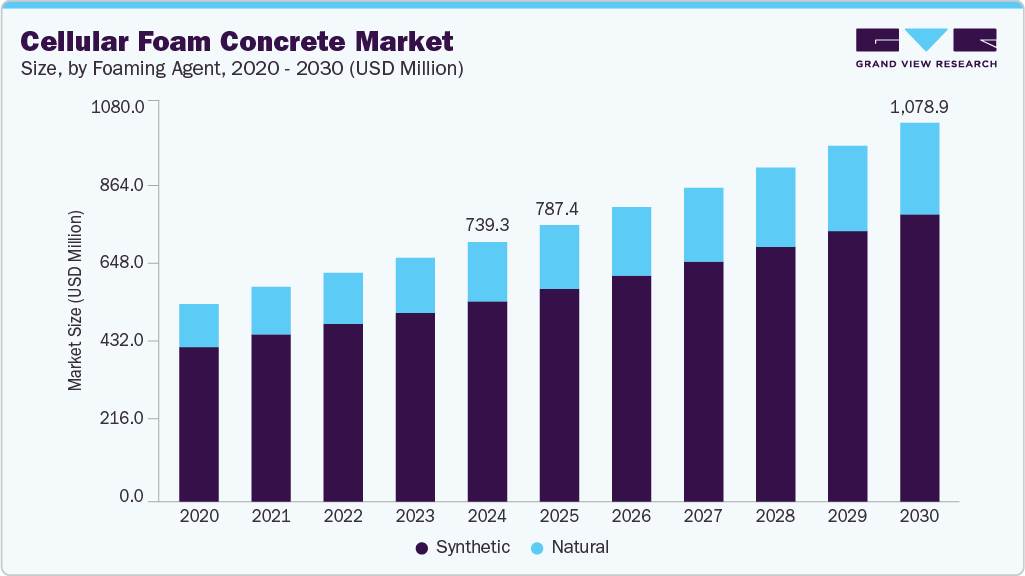
Innovations in cellular foam concrete are further enhancing its appeal and broadening its applications. Advances in foam generation technology and mixing processes have improved consistency, strength, and workability. Researchers and manufacturers are also experimenting with new additives, such as fibers and eco-friendly binders, to increase structural performance and sustainability. Automation and digitalization in production methods are helping to streamline manufacturing and reduce waste. These continuous innovations are making cellular foam concrete a modern, adaptable solution for future-ready construction projects.
Market DynamicsThe cellular foam concrete market is witnessing steady growth due to increasing demand for lightweight, energy-efficient, and sustainable construction materials across residential, commercial, industrial, and infrastructure projects. Cellular foam concrete offers several advantages, including low density, excellent thermal and acoustic insulation, reduced structural load, and ease of placement, making it suitable for applications such as roof insulation, void filling, road sub-bases, geotechnical works, and prefabricated construction. Growing investments in infrastructure development, rapid urbanization, and increasing emphasis on green building practices are further supporting market expansion.
The increasing adoption of lightweight and energy-efficient construction materials is a key factor driving the cellular foam concrete market. As the construction industry focuses on improving building performance while reducing material consumption and structural loads, cellular foam concrete has emerged as an attractive alternative to conventional concrete. Its low density, superior thermal insulation, and self-leveling properties enable faster construction, lower transportation costs, and improved energy efficiency in buildings. Additionally, the material is widely used for roof insulation, trench reinstatement, void filling, and foundation stabilization, where reduced weight and high flowability provide significant engineering advantages. Growing investments in residential and infrastructure development, coupled with stricter energy-efficiency regulations and green building initiatives, are expected to further drive the demand for cellular foam concrete.
The cellular foam concrete market faces challenges due to the requirement for specialized foaming equipment, precise mix design, and skilled workmanship to achieve consistent density and performance. Variations in foam quality, water-cement ratio, and production techniques can significantly impact the strength, durability, and overall quality of the final product. In addition, limited awareness among contractors and developers, along with the relatively low availability of specialized production facilities in certain regions, can restrict market adoption. These factors may increase project costs and limit the widespread use of cellular foam concrete, particularly in price-sensitive markets.
The growing focus on sustainable construction and low-carbon infrastructure presents significant growth opportunities for the cellular foam concrete market. Its ability to reduce raw material consumption, minimize dead loads, improve thermal performance, and incorporate supplementary cementitious materials and recycled materials aligns well with global sustainability objectives. Increasing investments in smart cities, transportation infrastructure, affordable housing, and green building projects are creating new opportunities for the adoption of cellular foam concrete in applications such as lightweight backfill, bridge abutments, road embankments, tunnel construction, and building insulation. Furthermore, advancements in foaming technologies and increasing awareness of sustainable construction materials are expected to support broader market penetration and long-term industry growth.
Market Concentration & Characteristics
The cellular foam concrete market is moderately concentrated, with a mix of established global players and regional manufacturers competing on innovation, pricing, and customization. Key players often hold significant market share due to their technological capabilities, large-scale production facilities, and strong distribution networks. However, the presence of smaller companies catering to niche applications and local markets adds to the competitive dynamics. Strategic partnerships, mergers, and investments in R&D are common as firms aim to strengthen their market position and meet evolving construction standards and sustainability goals.
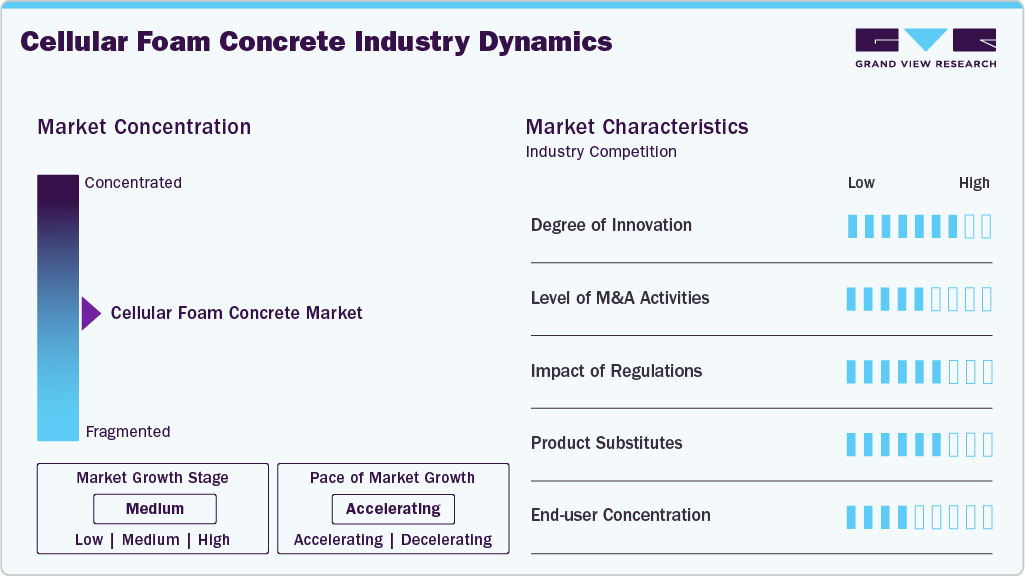
In terms of product substitutes, cellular foam concrete faces competition from traditional concrete, aerated autoclaved concrete (AAC), and lightweight aggregates. Each alternative offers unique properties, for instance, AAC provides comparable thermal insulation and is widely used in precast blocks, while lightweight concrete mixes are favored in some structural applications. However, cellular foam concrete often stands out for its superior ease of handling, cost-effectiveness in non-load-bearing uses, and lower environmental footprint. The availability and cost of raw materials, regional building codes, and end-use requirements typically influence the choice between cellular foam concrete and its substitutes.
Analyst Perspective
The cellular foam concrete market is evolving beyond its traditional role as a lightweight fill material toward becoming an integral component of sustainable and high-performance construction practices. Future market leadership will depend less on the ability to supply foamed concrete and more on the capability to deliver application-specific solutions with consistent density, compressive strength, flowability, and long-term durability. With infrastructure projects become more complex and sustainability targets become increasingly stringent, contractors and project owners are prioritizing engineered materials that reduce structural loads, improve construction efficiency, and lower lifecycle costs. Manufacturers that invest in advanced foaming technologies, stringent quality control systems, technical engineering support, and project-specific mix designs will be better positioned to secure large-scale infrastructure and commercial projects. In contrast, suppliers competing primarily on price without robust technical capabilities, standardized production processes, and reliable on-site execution are likely to face increasing pressure as performance specifications and regulatory expectations continue to rise across global construction markets.
Foaming Agent Insights
Based on foaming agent, the synthetic segment led the market with the largest revenue share of 77.0% in 2025 and is expected to grow at a CAGR 5.9% over the forecast period, due to their consistency, availability, and proven performance in large-scale construction applications. Synthetic agents offer better control over foam density and stability, which is essential for producing uniform and reliable concrete mixes. Their compatibility with automated mixing systems and industrial-scale production also makes them a preferred choice among large manufacturers. Furthermore, synthetic foaming agents typically have a longer shelf life and are easier to store and transport, which enhances their practicality in commercial use.
The natural segment is emerging as the fastest-growing segment, driven by increasing environmental awareness and the push for sustainable construction materials. Derived from plant-based or biodegradable sources, natural foaming agents reduce the environmental footprint of concrete production and align well with green building certifications and eco-friendly regulations. Technological advancements are improving their performance, narrowing the gap with synthetic alternatives. As builders and developers seek more sustainable solutions, the demand for natural foaming agents is expected to rise rapidly, especially in regions prioritizing low-carbon construction practices.
End Use Insights
Based on end use, the residential segment led the market with the largest revenue share of 43.4% in 2025 and is expected to grow at a CAGR 6.6% over the forecast period, driven by its suitability for non-load-bearing walls, insulation layers, and infill applications in housing projects. Its lightweight nature, ease of application, and cost-effectiveness make it ideal for low- to mid-rise buildings, particularly in regions with rapid urbanization and affordable housing initiatives. In addition, its thermal and sound insulation properties align well with the increasing demand for energy-efficient and comfortable residential spaces.
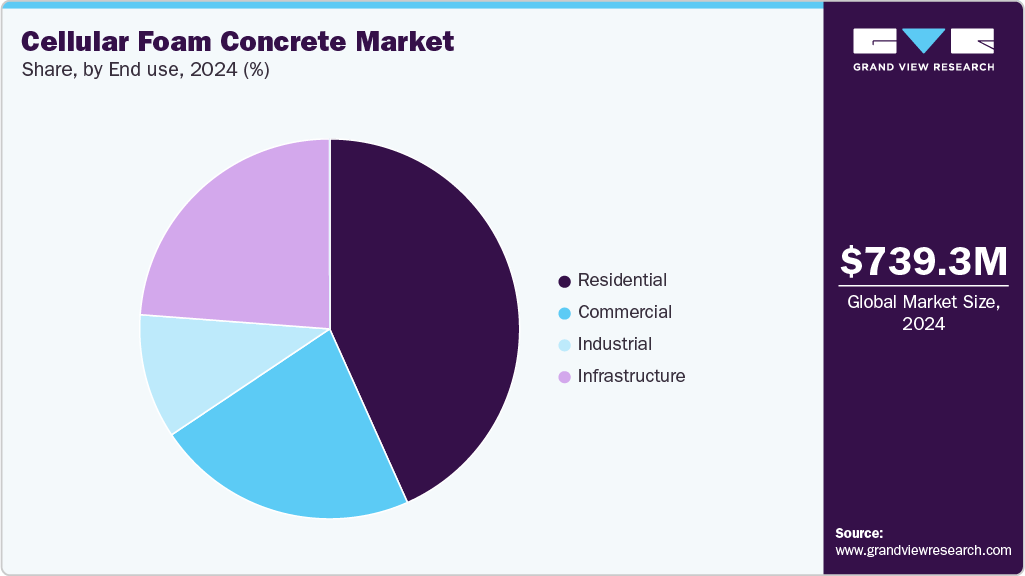
The commercial segment is emerging as the fastest-growing application area for cellular foam concrete. With a surge in commercial infrastructure projects such as offices, malls, educational institutions, and hospitals, the demand for innovative, quick-to-install, and sustainable materials is accelerating. Cellular concrete’s fire resistance, design flexibility, and compatibility with modular construction methods make it attractive for large-scale commercial developments. As green building certifications and performance standards become more critical in the commercial sector, the adoption of cellular foam concrete is expected to rise rapidly.
Regional Insights
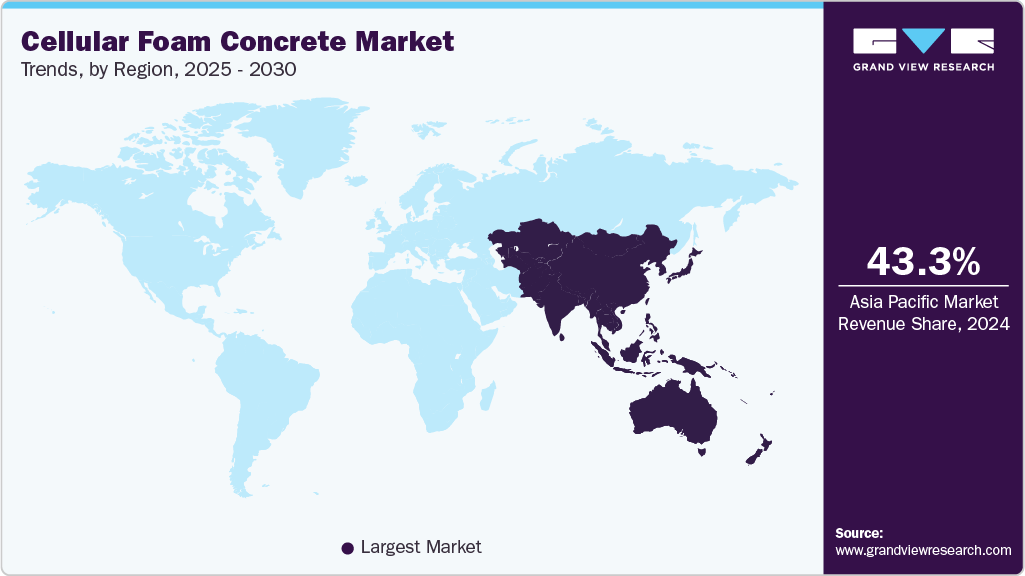
Asia Pacific dominated the cellular foam concrete market with the largest revenue share of 43.5% in 2025, due to rapid urbanization, extensive infrastructure development, and strong government support for sustainable construction. Countries such as China and India are heavily investing in residential and public infrastructure, which boosts demand for lightweight and cost-effective materials such as cellular foam concrete. The growing emphasis on green building practices and the presence of both global and regional manufacturers supports innovation and accessibility. The region's favorable construction policies and large-scale housing programs continue to drive market growth.
China Cellular Foam Concrete Market Trends
The cellular foam concrete market in the China held the largest share in the Asia Pacific region in 2025. China cellular foam concrete market holds the largest national market within Asia Pacific, driven by high-volume residential construction and massive infrastructure projects. The government's initiatives around affordable housing and eco-friendly urban planning have increased the adoption of cellular foam concrete, particularly in megacities facing population pressure. China's focus on reducing carbon emissions and adopting energy-efficient building materials also favors the use of cellular foam concrete. Domestic manufacturers benefit from high demand and economies of scale, contributing to market expansion.
North America Cellular Foam Concrete Market Trends
North America is a mature yet steadily growing market for cellular foam concrete, supported by increasing awareness of sustainable building materials and the need for energy-efficient retrofits in aging infrastructure. Demand is particularly strong in sectors such as commercial construction, roadways, and renovation projects. Technological advancements and a strong focus on building performance standards drive the adoption of innovative foaming solutions. The region's stringent building codes and emphasis on environmental compliance also support market growth.
The U.S. cellular foam concrete industry leads the North American market, with rising use of cellular foam concrete in both new construction and rehabilitation projects. Its suitability for lightweight fill, insulation, and soundproofing has made it popular in infrastructure upgrades, including highways and utility corridors. The push for sustainable practices in urban planning and commercial buildings is accelerating demand. In addition, federal and state-level incentives for green construction contribute to its increased usage across different construction segments.
Europe Cellular Foam Concrete Market Trends
Europe is a significant market for cellular foam concrete, driven by strict environmental regulations and a strong focus on sustainable development. Countries across the region are increasingly adopting low-carbon materials for residential and commercial projects. Government-backed energy efficiency mandates and widespread green certification programs encourage the use of advanced, eco-friendly materials such as cellular foam concrete. Market growth is further supported by ongoing renovation needs in older urban infrastructure and historical buildings.
Germany cellular foam concrete European market, known for its leadership in energy-efficient building practices and innovative construction technologies. The country’s strict sustainability standards and widespread use of certified green building materials have made cellular foam concrete an attractive option for developers. Germany’s industrial base and research-oriented construction sector also encourage continued innovation and application of cellular concrete in both structural and non-structural areas.
Central & South America Cellular Foam Concrete Market Trends
The cellular foam concrete market in Central & South America is in the developing stage but showing promising growth due to increasing urbanization and affordable housing needs. Countries such as Brazil and Mexico are seeing rising demand for lightweight and low-cost construction materials to support expanding urban populations. While infrastructure development is slower compared to other regions, growing awareness of sustainability and the cost benefits of cellular foam concrete are driving gradual adoption.
Middle East & Africa Cellular Foam Concrete Market Trends
The Middle East & Africa region is witnessing growing interest in cellular foam concrete, particularly in countries focused on large-scale infrastructure and real estate development. High temperatures and challenging soil conditions make the material suitable due to its insulation and load-distribution properties. While adoption is still limited by economic and logistical factors in some areas, ongoing mega-projects in the Gulf region and a shift toward sustainable construction are likely to boost future demand.
Key Cellular Foam Concrete Company Insights
Some of the key players operating in the market include Saint-Gobain and Xella Group
-
Saint-Gobain is a global leader in sustainable construction solutions, offering advanced building materials, including cellular foam concrete. Its strong R&D capabilities and focus on energy-efficient, lightweight construction products position it as a key innovator in the market. The company leverages its global network to supply eco-friendly concrete solutions for both infrastructure and residential applications.
-
Xella Group, known for its Ytong and Hebel brands, is a major European player specializing in autoclaved aerated concrete (AAC) and other cellular concrete products. With a focus on sustainable and thermally efficient building materials, Xella plays a critical role in shaping low-energy construction across Europe and expanding its footprint globally in the foam concrete segment.
CEMEX S.A.B. de C.V., and Holcim Group, are some of the emerging market participants in the cellular foam concrete market.
-
CEMEX is a multinational construction materials company that integrates cellular concrete into its product portfolio to meet the growing demand for lightweight, cost-effective, and energy-efficient solutions. The company capitalizes on its broad geographic reach and infrastructure expertise to deliver foam concrete products for urban development and infrastructure projects.
-
Holcim, a global leader in cement and aggregates, offers cellular concrete solutions as part of its commitment to green and circular construction. Holcim addresses modern construction challenges through innovation and sustainability-focused initiatives with lightweight concrete products that reduce emissions and support energy-efficient building practices.
Key Cellular Foam Concrete Companies
The following key companies have been profiled for this study on the cellular foam concrete market.
-
Saint-Gobain
-
Xella Group
-
CEMEX S.A.B. de C.V.
-
Holcim Group
-
Cematrix Corporation
-
Aerix Industries.
-
Cellucrete Corp.
-
Laston Italiana S.p.A.
-
Litebuilt
Competitive Benchmarking
Category
Operating Strategies
Competitive Edge
Weakness
Established Players (Saint-Gobain, Holcim Group, CEMEX S.A.B. de C.V., Xella Group)
- Focus on expanding sustainable and lightweight construction material portfolios through continuous product innovation, strategic acquisitions, and integration with large-scale residential, commercial, and infrastructure projects.
- Emphasis on strengthening global distribution networks and developing low-carbon construction solutions.
- Strong global brand recognition and extensive distribution channels.
- Diversified construction material portfolios, advanced R&D capabilities, large-scale manufacturing capacity, and well-established relationships with contractors, developers, and infrastructure companies.
Higher operational costs and comparatively lower flexibility in addressing niche or project-specific requirements.
Emerging Players (Cematrix Corporation, Aerix Industries, Cellucrete Corp., Laston Italiana S.p.A., Litebuilt)
- Focus on specialized cellular foam concrete solutions for geotechnical, infrastructure, mining, and lightweight fill applications.
- Emphasis on regional expansion, project-based services, customized formulations, and technical support to address specific customer requirements.
Strong technical expertise in cellular foam concrete, application-specific product offerings, operational flexibility, faster project execution.
Limited geographic presence, smaller production capacity, lower brand recognition, and greater dependence on regional infrastructure and construction projects compared to established multinational manufacturers.
Recent Developments
-
In February 2024, Saint-Gobain acquired International Cellulose Corporation, a manufacturer of sustainable spray insulation products, to enhance its portfolio in light and sustainable construction.
-
In April 2023, Holcim launched ECOCycle, its proprietary circular technology platform for recycling construction demolition materials into new building solutions. With ECOCycle, Holcim can recycle 100% of construction demolition materials across a broad range of applications, from decarbonized raw materials in low-carbon cement formulation to aggregates in concrete and fillers in road construction.
Cellular Foam Concrete Market Report Scope
Report Attribute
Details
Market size value in 2025
USD 787.4 million
Market size value in 2026
USD 838.6 million
Revenue forecast in 2033
USD 1,276.4 million
Growth rate
CAGR of 6.2% from 2026 to 2033
Base year for estimation
2025
Historical data
2021 - 2024
Forecast period
2026 - 2033
Quantitative units
Revenue in USD million/billion and CAGR from 2026 to 2033
Report coverage
Revenue forecast, company ranking, competitive landscape, growth factors, and trends
Segments covered
Foaming agent, end use, region
Regional scope
North America; Europe; Asia Pacific; Central & South America; MEA
Country scope
U.S.; Canada; Mexico; UK; Germany; France; Italy, Spain; China; India; Japan; Australia
Key companies profiled
Saint-Gobain; Xella Group; Mycoworks; Holcim Group; Cematrix Corporation; Aerix Industries.; ACICO Group; CEMEX S.A.B. de C.V.; Litebuilt; Laston Italiana S.p.A.
Customization scope
Free report customization (equivalent up to 8 analysts' working days) with purchase. Addition or alteration to country, regional & segment scope.
Pricing and purchase options
Avail customized purchase options to meet your exact research needs. Explore purchase options
Global Cellular Foam Concrete Market Report Segmentation
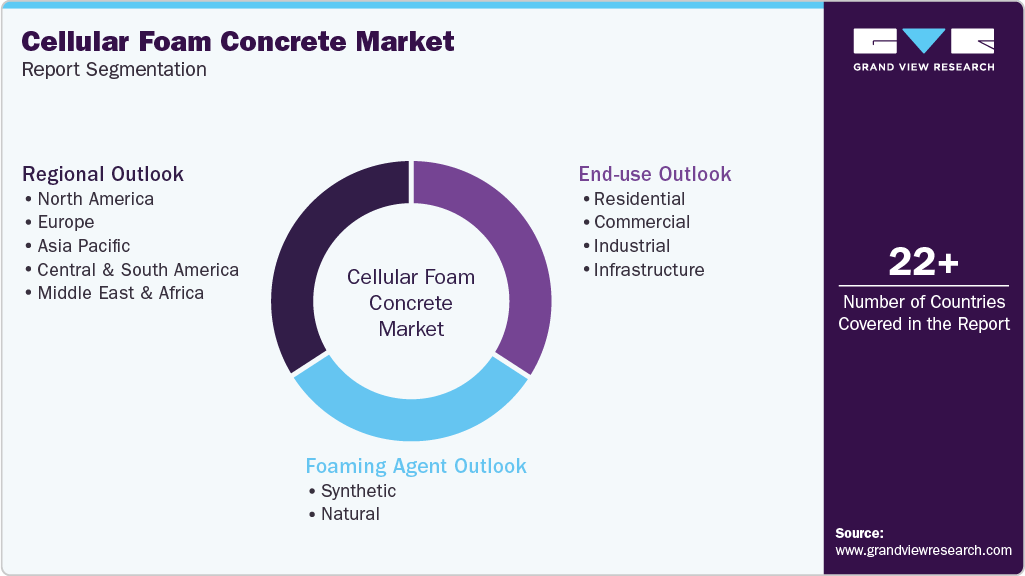
This report forecasts revenue growth at the global, regional, and country levels and provides an analysis of the latest industry trends in each of the sub-segments from 2021 to 2033. For this study, Grand View Research has segmented the global cellular foam concrete market report based on foaming agent, end use, and region:
-
Foaming Agent Outlook (Revenue, USD Million, 2021 - 2033)
-
Synthetic
-
Natural
-
-
End Use Outlook (Revenue, USD Million, 2021 - 2033)
-
Residential
-
Commercial
-
Industrial
-
Infrastructure
-
-
Regional Outlook (Revenue, USD Million, 2021 - 2033)
-
North America
-
U.S.
-
Canada
-
Mexico
-
-
Europe
-
Germany
-
UK
-
France
-
Italy
-
Spain
-
-
Asia Pacific
-
China
-
Japan
-
India
-
Australia
-
-
Central & South America
-
Middle East & Africa
-
Research Methodology
The cellular foam concrete market figures in this report are based on a proven research process that combines executive interviews with secondary research from proprietary databases, company filings, and recognized regulatory and institutional sources. Market size is built through value-chain sizing-reconciling supply-side and demand-side estimates-and triangulated with bottom-up and top-down approaches. Every estimate passes multiple levels of expert validation before publication, with each cellular foam concrete segment quantified using the revenue-capture definitions in the table below.
Segment Definition
Foaming Agent Segment
Revenue Capture Definition
Synthetic
Revenue generated from the production and sale of cellular foam concrete formulated using synthetic foaming agents. This segment includes revenues from lightweight concrete utilized in residential, commercial, industrial, and infrastructure applications where synthetic foaming agents are employed to achieve controlled density, improved workability, and consistent air-void distribution.
Natural
Revenue generated from the production and sale of cellular foam concrete formulated using natural or protein-based foaming agents. This segment includes revenues from lightweight concrete manufactured for applications requiring enhanced environmental sustainability, stable foam characteristics, and improved compatibility with green building practices across various construction sectors.
End Use Segment
Revenue Capture Definition
Residential
Revenue generated from the use of cellular foam concrete in residential construction, including single-family homes, multi-family residential buildings, apartments, villas, and affordable housing projects. This segment includes revenues from applications such as roof insulation, floor screeds, void filling, foundation works, and lightweight structural and non-structural elements.
Commercial
Revenue generated from the use of cellular foam concrete in commercial buildings, including offices, retail complexes, shopping malls, hotels, healthcare facilities, educational institutions, and mixed-use developments. This segment includes revenues from roof insulation, floor leveling, thermal insulation, void filling, and lightweight construction applications.
Industrial
Revenue generated from the use of cellular foam concrete in industrial facilities, including manufacturing plants, warehouses, logistics centers, processing facilities, and utility buildings. This segment includes revenues from equipment foundations, trench backfilling, floor sub-bases, thermal insulation, void filling, and other industrial construction applications requiring lightweight and durable concrete solutions.
Infrastructure
Revenue generated from the use of cellular foam concrete in infrastructure and civil engineering projects, including roads, highways, bridges, railways, airports, ports, tunnels, embankments, pipelines, and utility networks. This segment includes revenues from applications such as lightweight embankment fill, bridge approach stabilization, geotechnical fill, trench reinstatement, void filling, and ground stabilization projects.
Estimation Model
Layer No.
Layer Name
Key Question
Description
01
Global Concrete Market
What is the total market size for concrete used across construction applications globally?
This layer represents the broader concrete market used across residential, commercial, industrial, and infrastructure projects. It includes ready-mix concrete, precast concrete, site-mixed concrete, high-performance concrete, self-compacting concrete, lightweight concrete, and other concrete products used for structural and non-structural construction applications.
02
Lightweight Concrete Market
What portion of the global concrete market consists of lightweight concrete products?
This layer narrows the focus to lightweight concrete materials designed to reduce structural loads while providing improved thermal insulation and construction efficiency. It includes cellular foam concrete, aerated concrete, lightweight aggregate concrete, and other lightweight concrete solutions used in residential, commercial, industrial, and infrastructure applications.
03
Foamed Concrete Market
What share of the lightweight concrete market is represented by foamed concrete products?
This layer focuses specifically on foamed concrete manufactured by introducing stable foam into cementitious mixtures to produce lightweight, highly flowable, and insulating concrete. It includes foamed concrete used for void filling, trench reinstatement, roof insulation, geotechnical fill, embankments, floor screeds, and other construction applications requiring low-density concrete.
04
Cellular Foam Concrete Market
What is the market value of cellular foam concrete used across construction applications?
This final layer represents revenues generated from the production and sale of cellular foam concrete for residential, commercial, industrial, and infrastructure projects. The market includes applications such as roof insulation, floor leveling, lightweight fill, void filling, foundation stabilization, trench backfilling, bridge approaches, embankments, and other structural and non-structural construction applications where lightweight, flowable, and thermally efficient concrete solutions are required.
Delivered Customizations
This report has been delivered with the following In-depth customizations
Client Request
Customization Delivered
Value Adds
Application Opportunity Assessment
Detailed analysis of cellular foam concrete applications across residential, commercial, industrial, and infrastructure sectors, including roof insulation, floor screeds, void filling, trench reinstatement, bridge approaches, embankments, geotechnical fill, and foundation stabilization.
Identified the highest-growth application areas, enabling clients to prioritize investment, optimize product portfolios, and target end-use sectors with the strongest commercial potential.
Competitive Landscape & Market Position Analysis
Comprehensive benchmarking of leading global manufacturers and specialized cellular foam concrete providers based on product portfolio, technological capabilities, geographic presence, strategic developments, manufacturing footprint, and market positioning.
Delivered actionable competitive intelligence to support strategic planning, partnership evaluation, market entry decisions, product differentiation, and competitive benchmarking.
Regulatory & Sustainable Construction Assessment
In-depth analysis of green building regulations, energy-efficiency standards, low-carbon construction initiatives, embodied carbon reduction targets, infrastructure specifications, and sustainability certification frameworks influencing the adoption of cellular foam concrete across major markets.
Enabled clients to align product development and commercialization strategies with evolving sustainability requirements, identify compliance-driven growth opportunities, strengthen positioning in green building projects, and enhance competitiveness in infrastructure and sustainable construction markets.
Frequently Asked Questions About This Report
The global cellular foam concrete market size was estimated at USD 739.3 million in 2024 and is expected to reach USD 787.4 million in 2025.
The global cellular foam concrete market is expected to grow at a compound annual growth rate of 6.5% from 2025 to 2030 to reach USD 1078.9 million by 2030.
The synthetic cellular foam concrete segment led the market and accounted for the largest revenue share, 77.2%, in 2024, due to their consistency, availability, and proven performance in large-scale construction applications.
Saint-Gobain, Xella Group, CEMEX S.A.B. de C.V., Holcim Group, Cematrix Corporation, Aerix Industries, ACICO Group, Cellucrete Corp., Litebuilt, and Laston Italiana S.p.A. are prominent companies in the cellular foam concrete market.
Rising environmental awareness, government regulations, circular economy initiatives, and growing consumer demand for sustainable products are key factors driving the cellular foam concrete market.
About the Author(s)
Advanced Interior Materials Research Team
Advanced Materials · Advanced Interior MaterialsThis report was authored by the advanced interior materials research team at Grand View Research - comprising two research analysts, one senior research analyst, and one industry expert - with specialized expertise in the advanced interior materials segment of the advanced materials industry. All findings are based on proprietary advanced materials databases, executive interviews, and regulatory analysis, subject to internal peer review prior to publication.
Last Updated:
Speak to Analyst


Customize this report to your needs — add regions, segments, or data points, with 20% free customization.
Or view our licence options:


ISO 9001:2015 & 27001:2022 Certified
We are GDPR and CCPA compliant! Your transaction & personal information is safe and secure. For more details, please read our privacy policy.


