
- Home
- »
- Communication Services
- »
-
Cloud Kitchen Market Size And Share Report, 2026-2033GVR Report cover

Cloud Kitchen Market (2026 - 2033)
Size, Share & Trends Analysis By Type (Independent Cloud Kitchen, Commissary/Shared, Kitchen Pods), By Nature (Franchised, Standalone), By Region (North America, Europe, Asia Pacific, Latin America, MEA), And Segment Forecasts
Market Size, 2025
$80.3BMarket Estimate, 2026
$88.7BMarket Forecast, 2033
$203.7BCAGR, 2026–2033
12.6%Cloud Kitchen Market Summary
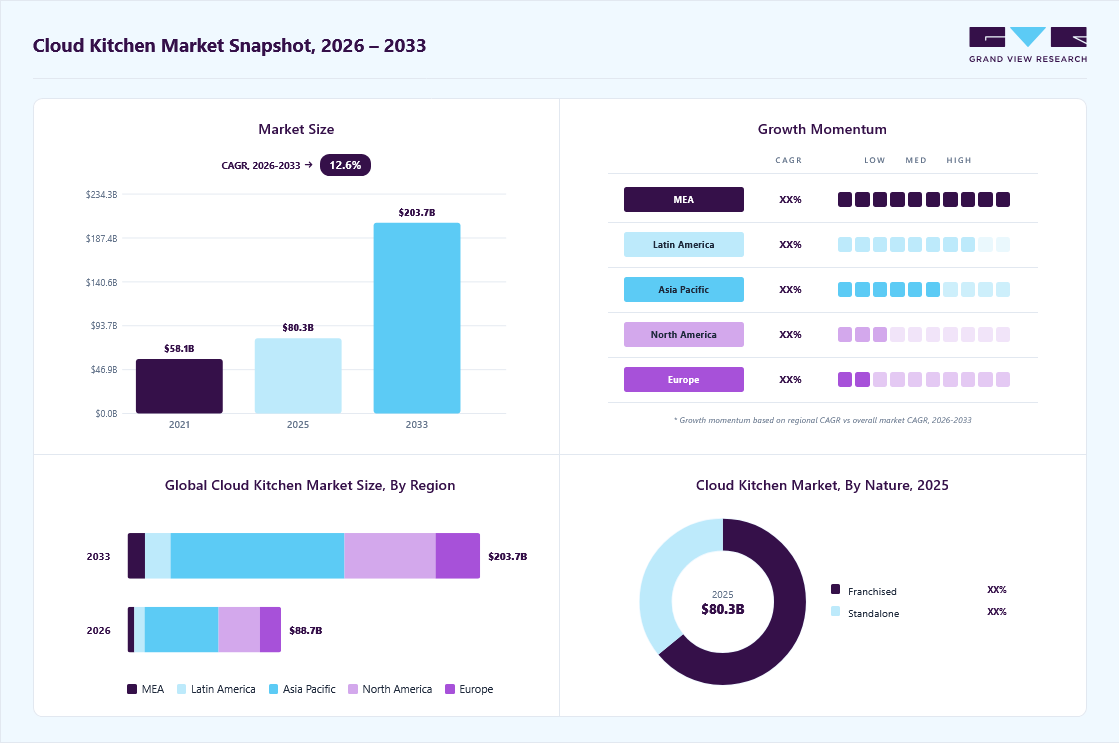
The global cloud kitchen market size was valued at USD 80.3 billion in 2025 and is projected to grow from USD 88.7 billion in 2026 to USD 203.7 billion by 2033, at a CAGR of 12.6% from 2026 to 2033. The market in Asia Pacific dominated with a revenue share of 48.0% in 2025, reflecting a significant shift in consumer behavior and food service delivery systems. A key factor contributing to this market state is the rise of food delivery apps, which have made it easier for consumers to order meals from various restaurants without the need to step out of their homes.
 Source: Grand View Research, IR Documents, Primary Interviews, Paid DatabasesTo learn more about this report,
 Download Free Sample Report
 Key Market Trends & Insights
- By type: Independent segment held the largest market share of 61.7% in 2025.
- By nature: Franchised segment held the largest market share in 2025.
Regional Highlights
- Largest regional market: Asia Pacific (48.0% revenue share, 2025)
- By country: U.S. held the largest market share in 2025
Market Size & Forecast
- Market size in 2025: USD 80.3 Billion
- Estimated market size in 2026: USD 88.7 Billion
- Projected market size by 2033: USD 203.7 Billion
- CAGR (2026-2033): 12.6%
Three ways to get this report
Buy it, customize it, or ask a question.Ask an Analyst
Analyst response in 1 business day
- AccessReport author, directly
- Reply timeWithin 1 working day
- No sales callDirect answer only
- FormatEmail reply
- CostFree, no cost
Get the Full Report
What the study covers
- FormatsPDF · Excel · Dashboard
- Timeline2026–2033 annual, 2025 base
- Coverage20+ countries, 5 regions
- Companies10+ key players profiled
Customize the Report
20% free customization
- IncludeCountries, segments, points
- TailorTo your product definition
- ExtendDeeper competitor detail
- OrA fully bespoke study
- Turnaround5–10 working days
In addition, the increasing urbanization and busy lifestyles of consumers have led to a growing preference for convenient dining options, which cloud kitchens provide by eliminating the need for physical dining spaces. The ongoing advancements in technology, particularly in logistics and food preparation processes, enhance operational efficiency for cloud kitchens. Furthermore, the growing global penetration of the internet and smartphones facilitates greater access to food delivery services, enabling more consumers to engage with cloud kitchens. The popularity of ghost kitchens is increasing as they facilitate the preparation of food exclusively for delivery, and they enable lower overhead costs and flexible menu offerings.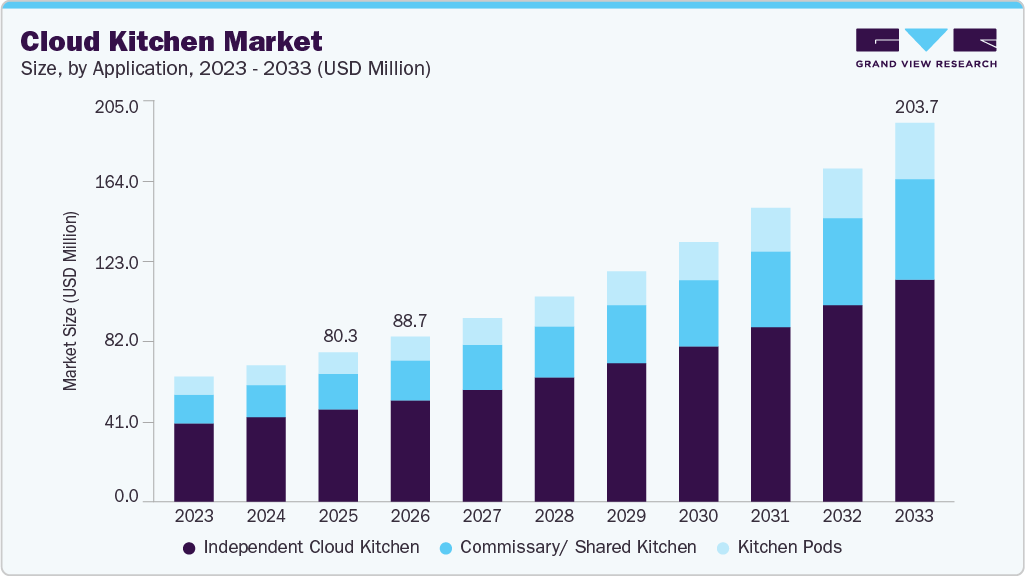 To learn more about this report, Download Free Sample Report
 Moreover, the evolving consumer preference for healthier and diverse food options is driving the cloud kitchen industry. As consumers become more health-conscious, cloud kitchens that offer nutritious meal choices are likely to attract a larger customer base. For instance, ZOIL was launched in India with the mission of providing heart-healthy food options. The company focuses on zero-oil meals, offering a menu designed for individuals seeking nutritious alternatives to their favorite Indian recipes without compromising on taste.
Furthermore, investment in the cloud kitchen sector is anticipated to surge as entrepreneurs and established restaurant brands recognize the profitability potential of this model. The growing interest of venture capitalists in innovative food service solutions is expected to drive the funding for developing advanced cloud kitchen technologies and expanding their reach.
For instance, in February 2026, UAE-based cloud kitchen network Kitopi secured USD 50 million in growth funding in a round led by EvolutionX, with participation from investors including Temasek and DBS Bank. The capital injection aims to support Kitopi’s expansion across the Middle East, underscoring strong investor confidence in the scalability of cloud kitchen platforms beyond their home markets, particularly in the GCC.
Type Insights
The independent segment led the market with the largest revenue share of 61.7% in 2025. This growth can be attributed to the flexibility and independence that these operators possess, allowing them to innovate and adapt their menus quickly to meet changing consumer preferences. In addition, because they avoid the overhead costs of traditional restaurants, independent cloud kitchens can offer more competitive pricing, attracting a wider customer base. Their ability to leverage technology for efficient order processing and delivery further enhances their appeal in a rapidly evolving food service landscape.
The commissary/shared kitchen segment is anticipated to grow at the fastest CAGR during the forecast period. This trend is driven by the increasing number of startups and small food businesses that rely on shared facilities to minimize initial investment costs. By using commissary kitchens, these businesses can access professional-grade equipment and resources while benefiting from a collaborative environment that fosters innovation and networking. As more entrepreneurs enter the cloud kitchen industry, the demand for these shared spaces is expected to rise significantly.
Nature Insights
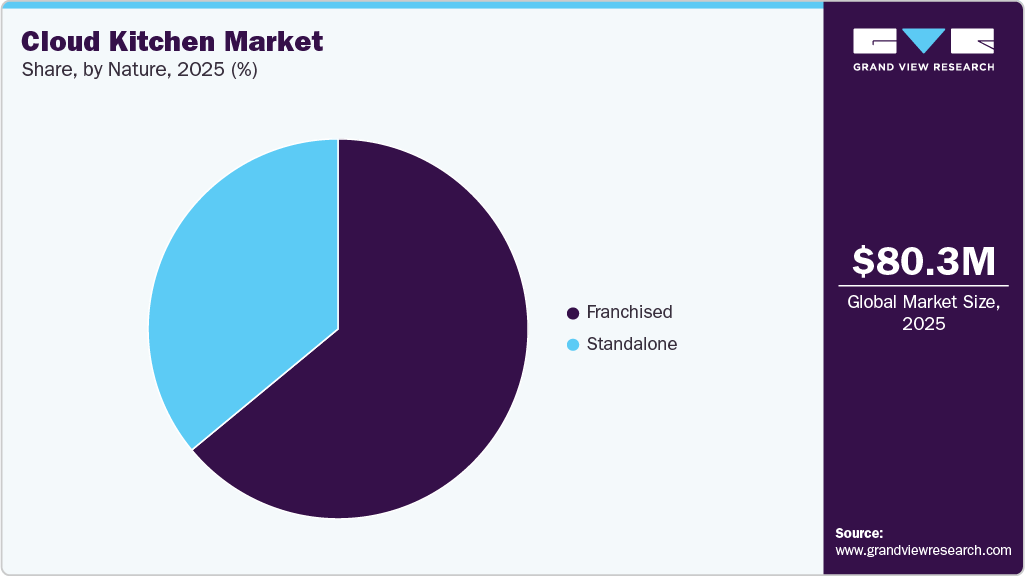
The franchised segment accounted for the largest market revenue share in 2025. Franchised cloud kitchens benefit from proven business models that reduce risks for new operators entering the cloud kitchen industry. The backing of a recognized brand attracts customers and provides franchisees with marketing support and operational guidelines that streamline their processes. For instance, Rebel Foods, which operates a network of cloud kitchens, is making a notable shift toward the offline market. The company is expanding its Oven Story Pizza brand through a franchise model. This approach is designed to enhance its market share within the rapidly growing pizza segment and to better compete with international pizza chains in the country.
 To learn more about this report, Download Free Sample Report
 The standalone segment is expected to grow at the fastest CAGR during the forecast period. Standalone cloud kitchens offer unique advantages by focusing solely on delivery, free from the distractions of dine-in services. This model allows specialization in specific cuisines or menu items, catering directly to consumer tastes. Moreover, as urbanization continues and consumers seek convenient dining options, standalone cloud kitchens are well-positioned to meet this demand by providing quick, efficient food delivery services tailored to local preferences.
Regional Insights
The cloud kitchen market in North America held a significant share in the global market in 2025, driven by changing consumer preferences and the increasing demand for food delivery services. The rise of technology and mobile applications has made it easier for consumers to access a variety of cuisines from the comfort of their homes. This trend is further supported by the growing number of startups and established restaurants adopting the cloud kitchen model, which enables them to operate without the overhead costs of traditional dining establishments.
U.S. Cloud Kitchen Market Trends
The cloud kitchen market in the U.S. accounted for the largest market revenue share in North America in 2025. The U.S. market is particularly thriving, and major cities such as New York and Los Angeles are at the forefront, where the demand for convenient food options is high. Many entrepreneurs are capitalizing on this trend by launching ghost kitchens that cater to specific dietary preferences, such as vegan or gluten-free options. In addition, partnerships with delivery platforms such as Uber Eats and DoorDash have enabled these kitchens to reach a broader audience quickly.
Europe Cloud Kitchen Market Trends
The cloud kitchen market in Europe is anticipated to register at a considerable CAGR from 2026 to 2033, driven by the structural shift toward digital food consumption, supported by high penetration of online food delivery platforms such as Deliveroo, Uber Eats, and Just Eat Takeaway. Urban density and rising real estate costs are incentivizing restaurant operators to adopt asset-light, delivery-only models that minimize capital expenditure while maximizing geographic reach.
The UK cloud kitchen market is expected to grow rapidly in the coming years, owing to the maturity of the online food delivery ecosystem and the high frequency of app-based ordering among urban consumers. Major cities exhibit strong demand for quick-service delivery, encouraging both startups and established restaurant chains to deploy dark kitchens to reduce overheads linked to prime retail locations.
The cloud kitchen market in Germany held a substantial market share in Europe in 2025, due to the steady expansion of digital ordering culture in a traditionally dine-in-oriented market, combined with increasing urbanization in cities like Berlin, Munich, and Hamburg. Consumers are gradually shifting toward convenience-driven consumption, supported by improved delivery logistics and broader platform availability.
Asia Pacific Cloud Kitchen Market Trends
Asia Pacific dominated the global cloud kitchen market with the largest revenue share of 48.0% in 2025, owing to its large population and rapidly evolving food industry. Countries such as China and India are experiencing a surge in demand for food delivery services, driven by urbanization and busy lifestyles. The region's diverse culinary landscape allows cloud kitchens to offer a wide variety of cuisines, appealing to different consumer tastes.
The cloud kitchen market in Japan is expected to grow rapidly in the coming years, driven by a combination of high urban density, advanced digital infrastructure, and strong demand for convenience-oriented food services, particularly in metropolitan areas such as Tokyo and Osaka. The widespread adoption of mobile ordering and efficient last-mile delivery networks, supported by platforms such as Uber Eats and Demae-can, is accelerating the shift toward delivery-first models.
The China cloud kitchen market held a substantial market share in Asia Pacific in 2025, as consumer preferences shifted toward online food delivery. Major cities such as Beijing and Shanghai are seeing a surge in cloud kitchens catering to local tastes while offering international cuisines. The popularity of food delivery apps has made it easier for consumers to access meals from their favorite restaurants without leaving home.
Key Cloud Kitchen Company Insights
Key players operating in the cloud kitchen industry are DoorDash and Kitopi. Rebel Foods, Swiggy Limited, and Zomato Ltd. The companies are focusing on various strategic initiatives, including new product development, partnerships & collaborations, and agreements to gain a competitive advantage over their rivals.
Key Cloud Kitchen Companies:
The following key companies have been profiled for this study on the cloud kitchen market.
- DoorDash
- Farm To Fork Sdn Bhd (Pop Meals)
- Kitopi
- Rebel Foods
- Zuul Kitchens, Inc (Kitchen United)
- Starbucks Coffee Company
- Ghost Kitchen Orlando
- City Storage Systems LLC.
- Swiggy Limited
- Zomato Ltd.
Recent Development
-
In March 2026, Zomato Ltd. expanded with the introduction of a new cloud kitchen protein-centric brand, Ritual, developed in collaboration with Massive Restaurants. While the brand is owned and operated by Massive Restaurants, Zomato is enabling its market entry through its platform, providing distribution reach and strategic support. The launch reflects a growing focus on health-oriented delivery concepts and highlights the role of food delivery platforms in incubating and scaling specialized cloud kitchen brands.
-
In April 2025, CloudKitchens has expanded its partnership-led growth strategy with the launch of a new cloud kitchen facility in Denver, U.S>, where Marco's Pizza has opened its sixth delivery-only outlet. Through Vallejo Food Pickup, the collaboration enables Marco’s Pizza to expand its market reach and serve a broader customer base without incurring the high capital costs of traditional dine-in restaurants.
Cloud Kitchen Market Report Scope
Report Attribute
Details
Market size in 2025
USD 80.3 billion
Estimated market size in 2026
USD 88.7 billion
Projected market size by 2033
USD 203.7 billion
Growth rate
CAGR of 12.6% from 2026 to 2033
Base year for estimation
2025
Historical data
2021 - 2024
Forecast period
2026 - 2033
Quantitative units
Revenue in USD million/billion, and CAGR from 2026 to 2033
Report enterprise size
Revenue forecast, company share, competitive landscape, growth factors, and trends
Segments covered
Type, nature, region
Regional scope
North America; Europe; Asia Pacific; Latin America; MEA
Country scope
U.S.; Canada; Mexico; UK; Germany; France; China; India; Japan; Australia; South Korea; Brazil; UAE; Saudi Arabia; South Africa
Key companies profiled
DoorDash; Farm To Fork Sdn Bhd (Pop Meals); Kitopi; Rebel Foods; Zuul Kitchens, Inc. (Kitchen United); Starbucks Coffee Company; Ghost Kitchen Orlando; City Storage Systems LLC.; Swiggy Limited; Zomato Ltd.
Customization scope
Free report customization (equivalent to 8 analysts working days) with purchase. Addition or alteration to country, regional & segment scope.
Pricing and purchase options
Avail customized purchase options to meet your exact research needs. Explore purchase options
Global Cloud Kitchen Market Report Segmentation
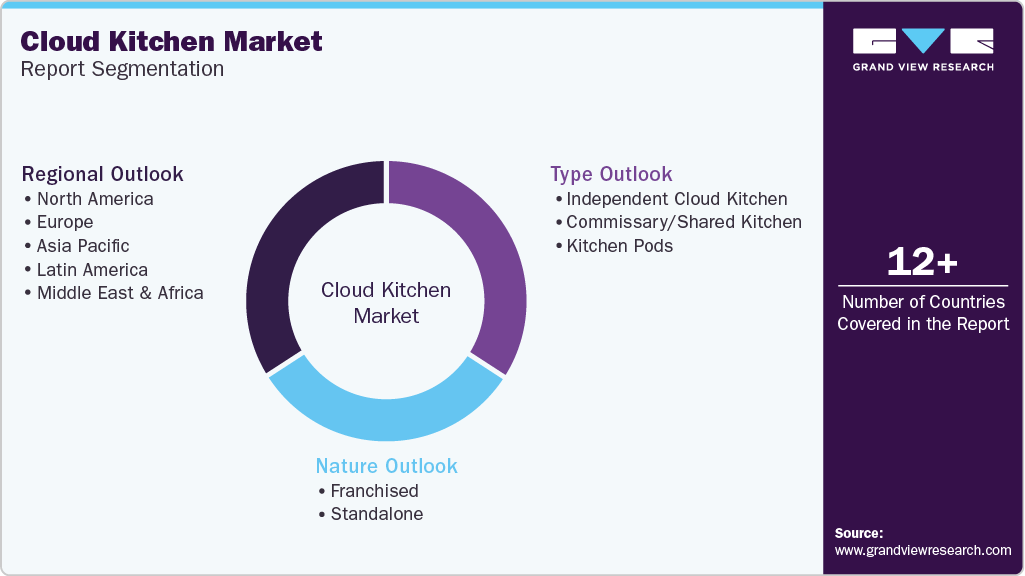
This report forecasts revenue growth at the global, regional, and country levels and provides an analysis of the latest industry trends in each of the sub-segments from 2021 to 2033. For this study, Grand View Research has segmented the global cloud kitchen market report based on type, nature, and region:
 To learn more about this report, Download Free Sample Report
 -
Type Outlook (Revenue, USD Billion, 2021 - 2033)
-
Independent Cloud Kitchen
-
Commissary/Shared Kitchen
-
Kitchen Pods
-
-
Nature Outlook (Revenue, USD Billion, 2021 - 2033)
-
Franchised
-
Standalone
-
-
Regional Outlook (Revenue, USD Billion, 2021 - 2033)
-
North America
-
U.S.
-
Canada
-
Mexico
-
-
Europe
-
UK
-
Germany
-
France
-
-
Asia Pacific
-
China
-
India
-
Japan
-
South Korea
-
Australia
-
-
Latin America
-
Brazil
-
-
Middle East & Africa
-
UAE
-
Saudi Arabia
-
South Africa
-
-
Frequently Asked Questions About This Report
Key factors that are driving the cloud kitchen market growth include increasing consumer preference for online food services over dining experiences and the increased profit margin of the virtual kitchen business in comparison to dining restaurants.
The franchised segment held the largest revenue share in 2025, while the standalone segment is the fastest-growing.
The global cloud kitchen market size was valued at USD 80.3 billion in 2025 and is estimated at USD 88.7 billion for 2026.
The global cloud kitchen market is expected to grow at a CAGR of 12.6% from 2026 to 2033, reaching USD 203.7 billion by 2033.
Asia Pacific dominated with a 48.0% revenue share in 2025.
The independent segment led with a 61.7% revenue share in 2025, while the commissary/shared kitchen segment is the fastest-growing.
Key players include DoorDash; Farm To Fork Sdn Bhd (Pop Meals); Kitopi; Rebel Foods; Zuul Kitchens, Inc. (Kitchen United); Starbucks Coffee Company; Ghost Kitchen Orlando; City Storage Systems LLC.; Swiggy Limited; Zomato Ltd.
About the Author(s)
Communication Services Research Team
Technology · Communication ServicesThis report was authored by the communication services research team at Grand View Research - comprising two research analysts, one senior research analyst, and one industry expert - with specialized expertise in the communication services segment of the technology industry. All findings are based on proprietary technology databases, executive interviews, and regulatory analysis, subject to internal peer review prior to publication.
Last Updated:
Speak to Analyst

Customize this report to your needs - add regions, segments, or data points, with 20% free customization.
Or view our licence options:


ISO 9001:2015 & 27001:2022 Certified
We are GDPR and CCPA compliant! Your transaction & personal information is safe and secure. For more details, please read our privacy policy.


