
- Home
- »
- Advanced Interior Materials
- »
-
CNC Tool & Cutter Grinding Machine Market Report, 2033GVR Report cover

CNC Tool & Cutter Grinding Machine Market (2026 - 2033)
Size, Share & Trends Analysis Report By Number Of Axis (3-4, 5), By End Use (Automotive & Transportation, Industrial Machinery & General Manufacturing), By Region, And Segment Forecasts
Market Size, 2025
$2.7BMarket Estimate, 2026
$2.8BMarket Forecast, 2033
$4.3BCAGR, 2026–2033
6.0%CNC Tool & Cutter Grinding Machine Market Summary
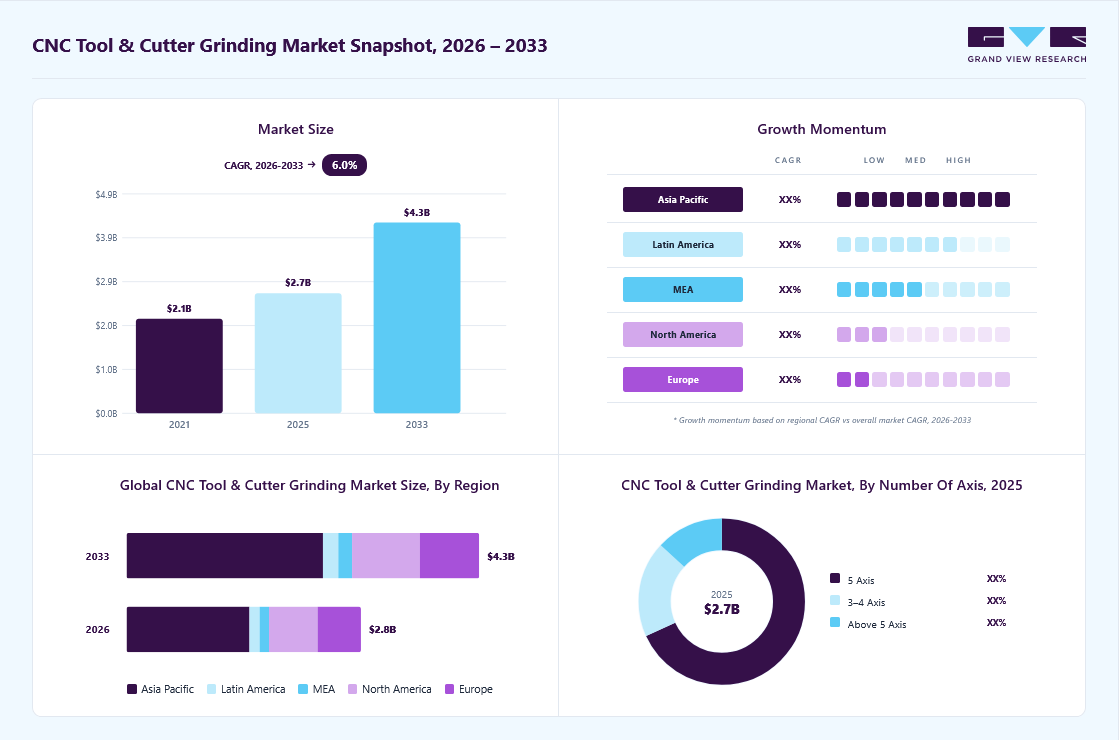
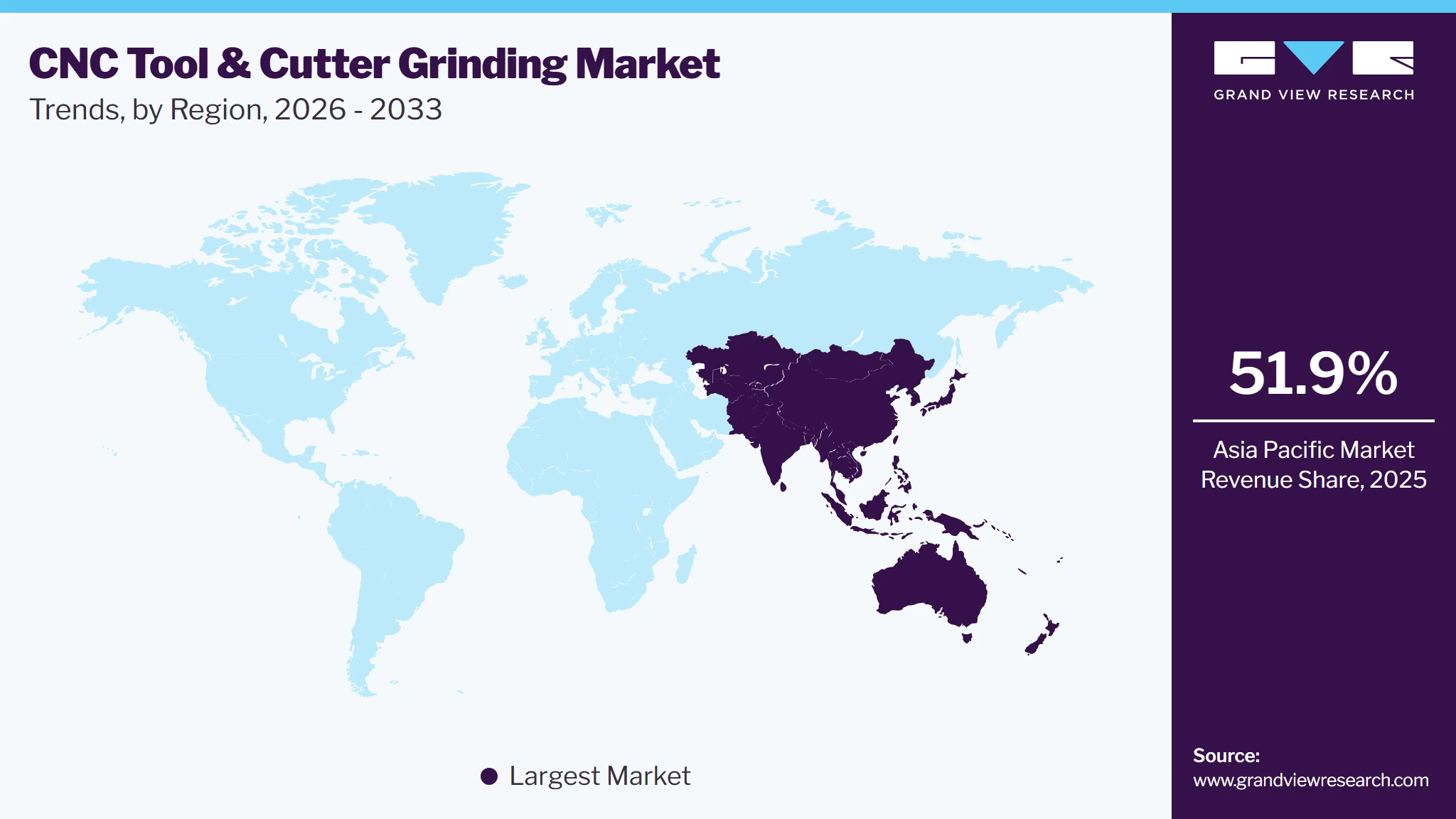
The global CNC tool & cutter grinding machine market size was valued at USD 2.7 billion in 2025 and is projected to grow from USD 2.8 billion in 2026 to USD 4.3 billion by 2033, at a CAGR of 6.0% from 2026 to 2033. Asia Pacific dominated the global market with the largest revenue share of 51.9% in 2025. The market is driven by the increasing complexity of precision machining and the corresponding requirement for tightly controlled cutting-tool geometries across automotive, aerospace, and medical manufacturing.
 Source: Grand View Research, IR Documents, Primary Interviews, Paid DatabasesTo learn more about this report,
 Download Free Sample Report
 Key Market Trends & Insights
- By number of axis: The 3-4 axis is the fastest-growing segment, projected to register a 6.7% CAGR during the forecast period.
- By end use: The automotive & transportation segment dominated the market in 2025, holding 29.9% market share.
Regional Highlights
- Largest regional market: Asia Pacific (51.9% revenue share, 2025)
- By country: China held the largest market share in 2025
Market Size & Forecast
- Market Size in 2025: USD 2.7 Billion
- Estimated market size in 2026: USD 2.8 Billion
- Projected market size by 2033: USD 4.3 Billion
- CAGR (2026-2033): 6.0%
Three ways to get this report
Buy it, customize it, or ask a question.Ask an Analyst
Analyst response in 1 business day
- AccessReport author, directly
- Reply timeWithin 1 working day
- No sales callDirect answer only
- FormatEmail reply
- CostFree, no cost
Get the Full Report
What the study covers
- FormatsPDF · Excel · Dashboard
- Timeline2026–2033 annual, 2025 base
- Coverage20+ countries, 5 regions
- Companies10+ key players profiled
Customize the Report
20% free customization
- IncludeCountries, segments, points
- TailorTo your product definition
- ExtendDeeper competitor detail
- OrA fully bespoke study
- Turnaround5–10 working days
The proliferation of high-performance carbide, high-speed steel, and other engineered cutting tools has increased the importance of controlled grinding parameters, dimensional repeatability, edge preparation, and profile accuracy throughout tool production and reconditioning. In addition, the restructuring of tool-production environments toward automated and digitally controlled manufacturing is accelerating investment in multi-axis grinding systems. Integration of CNC programming, automated tool handling, in-process measurement, grinding-wheel management, and application-specific software enables manufacturers to accommodate diverse tool geometries while reducing manual intervention and setup variability.
 To learn more about this report, Download Free Sample Report
 Market Dynamics
The market is undergoing a structural transition from conventional tool-processing equipment toward highly programmable and digitally integrated grinding systems. This transition reflects the increasing sophistication of cutting-tool designs, tighter dimensional specifications, greater product variety, and the need to accommodate shorter production cycles. Equipment suppliers are consequently incorporating advanced CNC architectures, sophisticated tool-design software, automated inspection, thermal compensation, and closed-loop process controls into grinding platforms.
The proliferation of high-performance cutting tools for demanding machining applications is strengthening capital expenditure on CNC grinding equipment. Cutting tools used for aerospace alloys, hardened steels, carbide-intensive applications, miniaturized components, and intricate component geometries require tightly controlled flute dimensions, helix profiles, clearance surfaces, cutting-edge preparation, and concentricity. The growing penetration of micro-tools and application-specific tooling further raises the technical threshold for grinding accuracy and process stability.
The capital and engineering intensity associated with sophisticated CNC tool & cutter grinding systems can restrict adoption among smaller tool manufacturers and lower-volume machining establishments. Investment requirements extend beyond the machine platform to include specialized grinding wheels, work holding arrangements, software, measurement equipment, installation, programming, and operator training. The economic justification is particularly difficult where tool volumes are limited, product geometries remain relatively standardized, or existing grinding assets retain adequate functional capability.
The increasing digitization of cutting-tool manufacturing presents a substantial opportunity for CNC grinding equipment suppliers to move beyond standalone machine sales toward integrated production solutions. CAD/CAM-based tool design, automated workpiece handling, in-process measurement, robotic loading, tool identification, grinding-wheel management, and production-data monitoring can be combined within interconnected grinding cells. Such configurations are particularly relevant to manufacturers seeking unattended or semi-unattended production and standardized processing across diverse tool portfolios.
Market Concentration & Characteristics
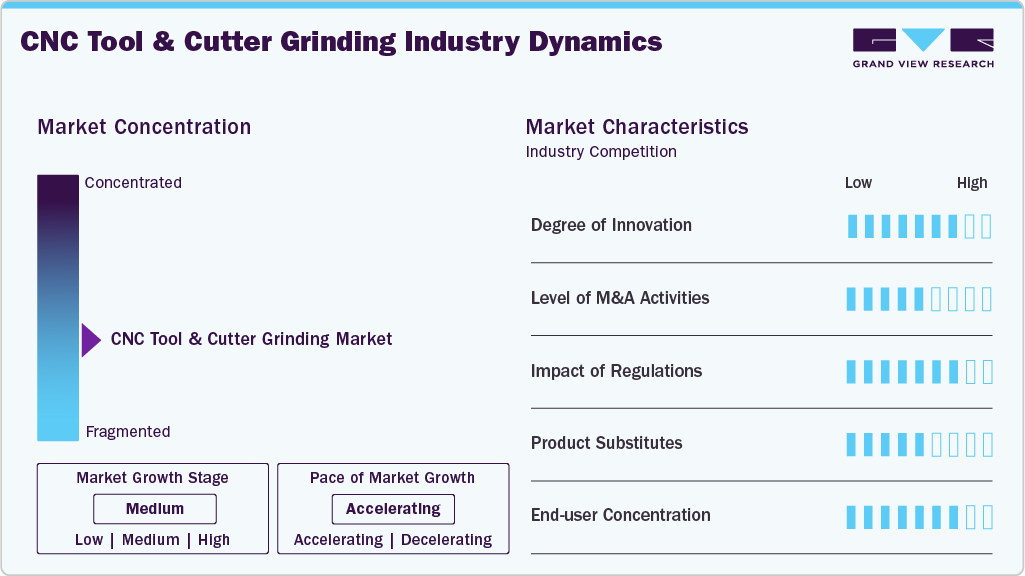
The market has a specialized supplier structure, with competition concentrated among manufacturers possessing established capabilities in precision grinding, machine-tool engineering, CNC control, and cutting-tool processing. The industry includes dedicated tool and cutter grinding machine producers alongside diversified machine-tool manufacturers with specialized grinding portfolios. High technical entry barriers arise from the need to develop machine kinematics, spindle systems, axis interpolation, grinding-process expertise, and application-specific software.
Product characteristics vary according to machine architecture, axis configuration, grinding capability, and the complexity of cutting tools being processed. Three- and four-axis platforms primarily address conventional tool manufacturing, sharpening, and reconditioning, while 5-axis and above 5-axis systems provide greater kinematic flexibility for intricate profiles and multi-surface grinding operations. Competition also extends to automated loading, in-process measurement, wheel dressing, tool-management systems, simulation software, and digital process control.
 To learn more about this report, Download Free Sample Report
 The market exhibits distinct demand characteristics across cutting-tool manufacturers, tool rooms, precision machining facilities, and industrial production environments. Automotive and transportation, aerospace and defense, industrial machinery, electronics and semiconductor, and medical manufacturing contribute to equipment requirements through their dependence on specialized cutting tools with application-specific geometries and performance specifications. Demand encompasses new machine installations for capacity expansion as well as replacement and modernization of existing grinding equipment.
Analyst Perspective
The market is characterized by demand from precision-oriented manufacturing environments requiring controlled tool geometry, dimensional consistency, repeatable grinding quality, and higher process automation. Market development is closely linked to cutting-tool production and reconditioning requirements across automotive and transportation, industrial machinery and general manufacturing, aerospace and defense, electronics and semiconductor, and medical equipment manufacturing. The adoption of higher-axis configurations is particularly relevant for complex tool profiles, multi-surface grinding, tighter tolerances, and applications requiring reduced setup intervention, while conventional configurations continue to serve standard tool-production and sharpening requirements.
Number of Axis Insights
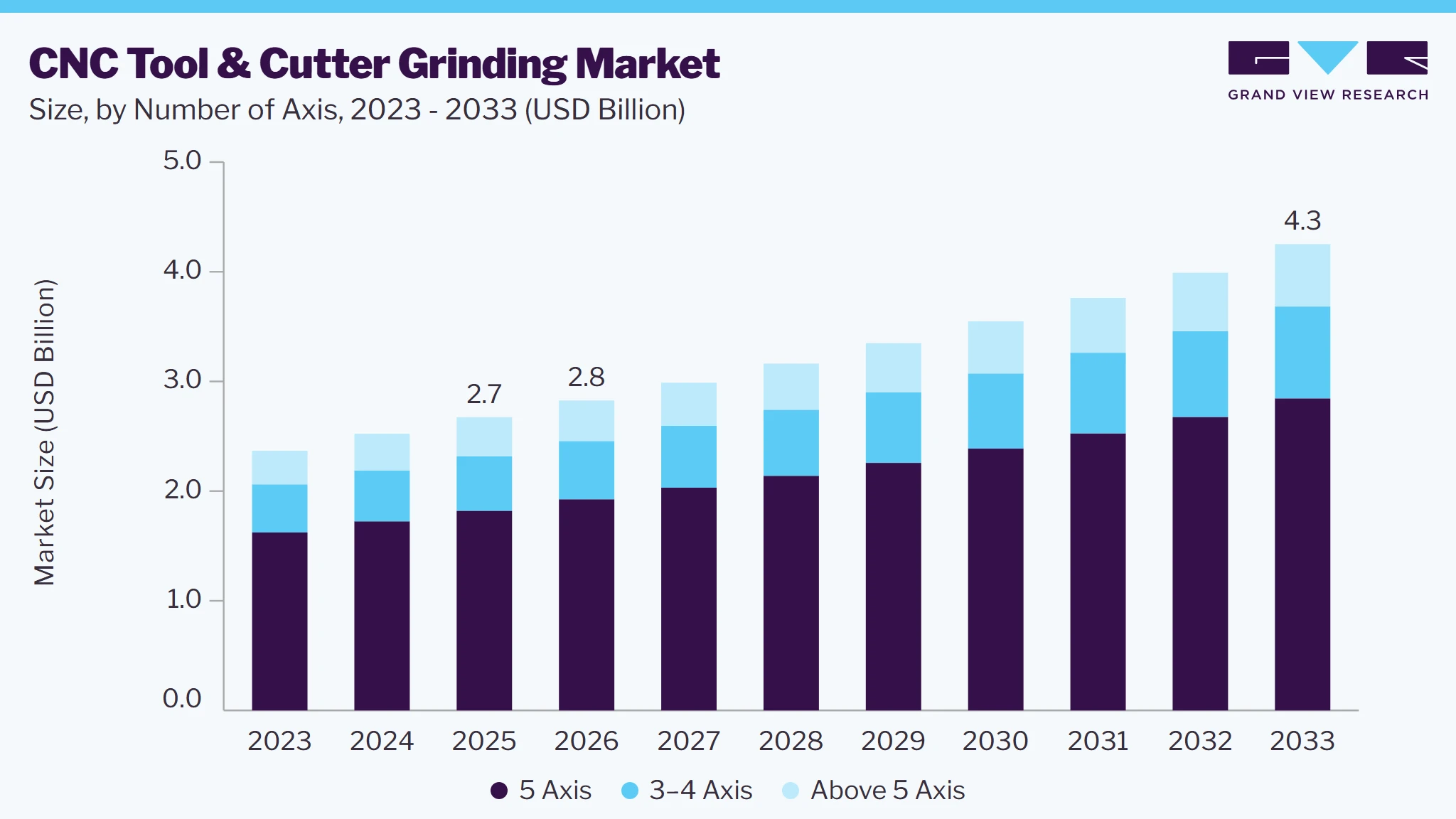
The 5-axis segment held the largest market share of 68.1% in 2025. Its leading position reflects the suitability of five-axis configurations for coordinated grinding of intricate cutting-tool geometries, including complex flutes, relief surfaces, variable profiles, and multi-faceted cutting edges. These systems provide greater freedom of movement between the grinding wheel and workpiece, enabling manufacturers to process sophisticated tooling with fewer repositioning requirements. Their relevance is particularly high in precision-oriented tool manufacturing, where dimensional consistency and geometric conformity are critical to the finished tool.
The 3-4 axis segment is projected to be the fastest-growing segment during the forecast period. These configurations remain commercially relevant for standard drills, cutters, reamers, and other tools requiring comparatively straightforward grinding movements. Their broader applicability across sharpening, reconditioning, and conventional tool-production operations provides an economically viable configuration for manufacturers that do not require the kinematic capabilities of higher-axis platforms.
End Use Insights
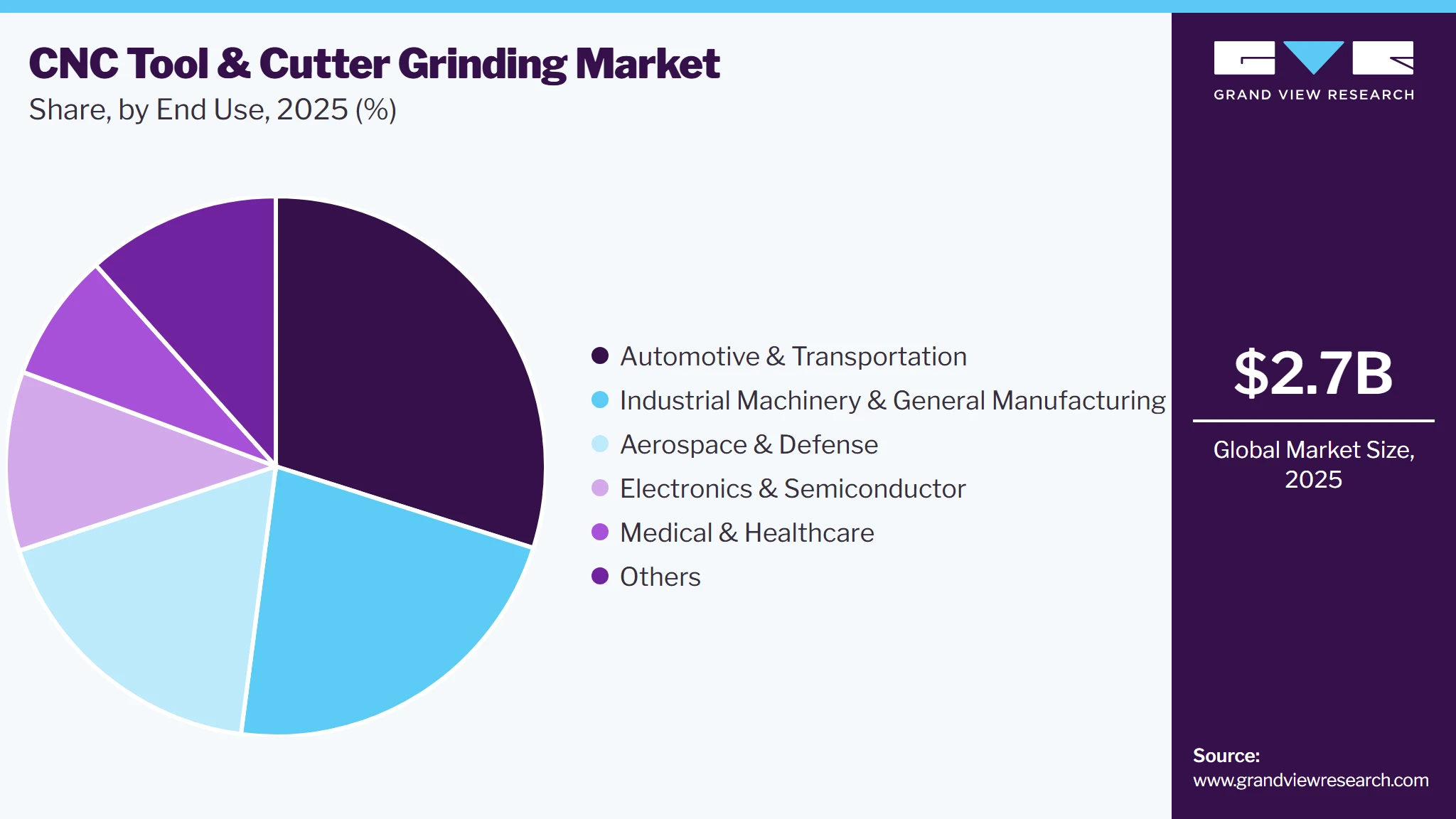
The automotive & transportation segment dominated the market in 2025. Extensive machining requirements across vehicle bodies, powertrain components, transmissions, braking systems, and other precision-engineered parts generate recurring consumption of cutting tools. High-volume production environments require consistent tool geometry and controlled reconditioning cycles to maintain machining specifications, creating demand for CNC tool & cutter grinding equipment among tool manufacturers and associated machining facilities. The increasing use of specialized tooling for lightweight materials, hardened components, and complex automotive parts further broadens the application base.
 To learn more about this report, Download Free Sample Report
 Industrial machinery & general manufacturing is projected to be the fastest-growing end-use segment, registering a CAGR of 6.5% during the forecast period. The segment encompasses machinery producers, engineering companies, tool rooms, fabrication operations, and precision machining facilities with diverse tooling requirements. Increasing production of specialized machinery and engineered components is generating demand for cutting tools across different diameters, profiles, materials, and cutting geometries.
Regional Insights
The CNC tool & cutter grinding machine market in the Asia Pacific represents the largest market, owing to its extensive manufacturing infrastructure and concentration of automotive, electronics, machinery, semiconductor, aerospace, and general engineering production. The regional market encompasses both highly developed machine-tool economies and rapidly expanding manufacturing bases, resulting in varied equipment requirements. China, Japan, South Korea, Taiwan, and India contribute substantially to regional demand through machinery investment, industrial expansion, and increasing localization of manufacturing processes.
 To learn more about this report, Download Free Sample Report
 China CNC Tool & Cutter Grinding Machine Market Trends
The CNC tool & cutter grinding machine market in China maintains a strong market position, supported by the scale of domestic manufacturing and extensive production of automobiles, machinery, electronics, new-energy vehicles, and aerospace equipment. Continued modernization of China's machine-tool industry is encouraging the adoption of higher-performance CNC systems, while manufacturers are increasing their use of advanced grinding equipment for sophisticated cutting-tool requirements. The growing emphasis on domestic production capabilities and higher-value manufacturing is also creating demand for technologically advanced tool-grinding systems.
India CNC tool & cutter grinding machine market is projected to be the fastest-growing country in the regional market, registering a CAGR of 7.8% during the forecast period. Demand is associated with expanding automotive manufacturing, engineering goods, aerospace and defense production, electronics, and industrial machinery. Increasing localization of component production is widening requirements for domestic cutting-tool manufacturing and reconditioning, while investments in organized machining facilities are encouraging the replacement of conventional equipment with CNC-based systems. Growing manufacturing capacity and the adoption of modern production technologies are creating additional opportunities for tool and cutter grinding machine suppliers.
North America CNC Tool & Cutter Grinding Machine Market Trends
The CNC tool & cutter grinding machine market in North America represents a mature demand, supported by established aerospace, automotive, industrial machinery, medical-device, and precision-engineering industries. The regional market is characterized by the replacement of aging grinding assets, the modernization of tool rooms, and investment in digitally controlled production equipment. Demand is also associated with the region's extensive base of cutting-tool manufacturers and contract machining companies, which require dedicated equipment for tool production, sharpening, and reconditioning.
The U.S. CNC tool & cutter grinding machine market is supported by a broad manufacturing base spanning aerospace and defense, automotive, medical technology, semiconductor equipment, and industrial machinery. The concentration of high-value machining activities creates demand for CNC grinding systems capable of handling specialized cutting tools and demanding production specifications. Continued investment in domestic manufacturing capacity and advanced production equipment provides a steady replacement and expansion market for CNC tool & cutter grinding machines.
Mexico CNC tool & cutter grinding machine market is developing as an important manufacturing location within North America, particularly through automotive, aerospace, electrical equipment, and industrial-component production. Expansion of manufacturing facilities and the increasing localization of component production are strengthening requirements for cutting-tool supply and associated reconditioning capabilities. CNC grinding equipment, therefore, benefits from the development of machining clusters and the establishment of production facilities requiring locally available tool-processing capacity.
Europe CNC Tool & Cutter Grinding Machine Market Trends
The CNC tool & cutter grinding machine market in Europe remains a technologically advanced market, underpinned by a dense concentration of machine-tool producers, precision-tool manufacturers, automotive suppliers, aerospace companies, and industrial engineering firms. Germany, Italy, Switzerland, and other manufacturing centers provide an established customer base for specialized grinding equipment. The region's mature industrial structure generates demand through equipment replacement, factory modernization, and continued development of high-value manufacturing processes.
Germany CNC tool & cutter grinding machine market maintains a strong position within Europe through its extensive machine-tool and precision-engineering base. The country's manufacturing structure includes established automotive suppliers, machinery producers, aerospace companies, and specialized tooling manufacturers, creating varied requirements for CNC grinding equipment. Although investment conditions have remained uneven across the machine-tool industry, aerospace and defense, electronics, medical technology, and machinery applications are providing areas of demand diversification.
The CNC tool & cutter grinding machine market in the UK is supported by aerospace, automotive, defense, medical technology, and advanced engineering activities that require specialized cutting tools for precision component production. Demand is concentrated around manufacturers and machining suppliers seeking to maintain tool-processing capabilities close to production operations. The development of advanced manufacturing facilities and continued emphasis on domestic engineering capacity provide opportunities for replacement and capacity-enhancement purchases of CNC tool & cutter grinding equipment.
Middle East & Africa CNC Tool & Cutter Grinding Machine Market Trends
The CNC tool & cutter grinding machine market in MEA represents a comparatively developing market for CNC tool & cutter grinding machines, with demand concentrated in countries undertaking industrial diversification and manufacturing-capacity development. Oil and gas equipment manufacturing, metalworking, automotive assembly, aerospace, defense, and industrial fabrication contribute to the regional requirement for precision machining equipment. Market development is closely associated with the establishment of local manufacturing capabilities, modernization of industrial workshops, and increasing reliance on sophisticated machining for engineered components.
Saudi Arabia CNC tool & cutter grinding machine market is emerging as an important market within the region through industrial diversification programs and investments in manufacturing, defense, machinery, automotive, and energy-related production. Development of local component manufacturing and industrial clusters is increasing the requirement for modern machining infrastructure, including equipment used for cutting-tool production and maintenance. The gradual expansion of precision manufacturing capabilities provides a foundation for CNC tool & cutter grinding machine demand as manufacturers seek to reduce dependence on externally sourced tool-processing services.
Latin America CNC Tool & Cutter Grinding Machine Market Trends
The CNC tool & cutter grinding machine market in Latin America presents an emerging demand base for CNC tool & cutter grinding machines, with market activity concentrated around automotive manufacturing, industrial machinery, metalworking, aerospace, and general engineering. Brazil and Mexico serve as important production centers, while other countries contribute through mining equipment, energy infrastructure, agricultural machinery, and industrial fabrication. Demand is influenced primarily by the expansion of machining capacity, the replacement of conventional equipment, and the increasing availability of sophisticated manufacturing technologies.
Brazil CNC tool & cutter grinding machine market represents the principal market in Latin America, supported by its sizeable automotive, machinery, aerospace, energy, and industrial-equipment manufacturing base. The country's diversified engineering sector generates requirements for cutting tools across high-volume and specialized machining operations. Growth in domestic manufacturing capacity and modernization of industrial production facilities provide opportunities for CNC tool & cutter grinding machine suppliers, particularly where manufacturers seek to establish or upgrade internal tool-production and reconditioning capabilities.
Key CNC Tool & Cutter Grinding Machine Company Insights
Some of the key players operating in the market include ANCA Pty Ltd., UNITED GRINDING Group, Rollomatic SA, VOLLMER WERKE Maschinenfabrik GmbH, and ISOG Technology GmbH.
-
ANCA Pty Ltd. is a specialized manufacturer of CNC tool and cutter grinding machines, headquartered in Australia, with a core focus on cutting-tool production and reconditioning. The company provides grinding systems for drills, end mills, milling cutters, medical instruments, and other precision rotary tools, serving cutting-tool manufacturers and specialized machining operations. Its portfolio combines multi-axis grinding equipment with CNC control, tool-design software, simulation, in-machine measurement, and production-management capabilities.
-
UNITED GRINDING Group is a precision machine-tool manufacturer with CNC tool and cutter grinding capabilities offered primarily through its WALTER and EWAG brands. The company provides grinding and tool-machining systems for the production, sharpening, and reconditioning of cutting tools, including complex and specialized tooling used in precision manufacturing. Its portfolio combines CNC grinding equipment with tool measurement, eroding, automation, and process-control technologies for different tool-processing requirements.
Key CNC Tool & Cutter Grinding Machine Companies
The following key companies have been profiled for this study on the CNC tool & cutter grinding machine market.
-
ANCA Pty Ltd.
-
UNITED GRINDING Group
-
Rollomatic SA
-
Schneeberger Maschinen AG
-
VOLLMER Werke Maschinenfabrik GmbH
-
Agathon AG
-
Star Cutter Company
-
Makino Seiki Co., Ltd.
-
TOP-WORK Industry Co., Ltd.
-
Coborn Engineering Ltd.
-
Schütte Schleiftechnik GmbH
-
ISOG Technology GmbH
-
Friedrich Deckel GmbH / DECKEL
-
Fives Group
-
Gebr. SAACKE GmbH & Co. KG
Competitive Benchmarking
Category
Operating Strategies
Competitive Edge
Weakness
Established Players (e.g., ANCA Pty Ltd.; UNITED GRINDING Group; Rollomatic SA; VOLLMER Werke Maschinenfabrik GmbH; Agathon AG; SCHÜTTE Schleiftechnik GmbH; ISOG Technology GmbH)
- Develop multi-axis CNC grinding platforms with integrated tool-design software, automated loading, measurement, and process-control functions.
- Strengthen customer relationships through application engineering, machine customization, commissioning, and technical service.
- Strong expertise in tool-grinding kinematics, CNC systems, complex-tool processing, and automated production.
- Established installed bases and application knowledge support customer retention and replacement or capacity-expansion purchases.
- High machine and implementation costs can restrict adoption among smaller tool manufacturers.
- Advanced systems require specialized programming, process engineering, calibration, and operator expertise.
Emerging & Regional Players (e.g., TOP-WORK Industry Co., Ltd.; Star Cutter Company; Micromatic Grinding Technologies Ltd.; Chevalier Machinery Inc.; Makino Seiki Co., Ltd.)
- Target selected tool-grinding applications through cost-competitive equipment, regional distribution, machine customization, and localized technical support.
- Focus on standard and mid-complexity tool manufacturing and reconditioning requirements in targeted markets.
- Competitive pricing, flexible configurations, regional market knowledge, and responsiveness to customer-specific requirements.
- Established expertise in selected tool types and regional applications can strengthen penetration within focused market segments.
- Narrower product portfolios and international service networks can limit participation in complex tool-grinding projects.
- More constrained resources for advanced multi-axis systems, proprietary software, automation, and integrated measurement technologies.
Recent Developments
-
In May 2025, VOLLMER introduced the VGrind infinity linear CNC tool grinding machine for rotary cutting-tool manufacturing. The machine accommodates tool diameters from 0.2 mm to 200 mm and processes carbide, HSS, PcBN, and ceramic materials. It features vertically arranged grinding spindles, linear drives across the X, Y, and Z axis, and temperature-controlled cooling designed to stabilize grinding conditions during tool production.
-
In July 2025, UNITED GRINDING Group acquired GF Machining Solutions from Georg Fischer AG, resulting in the formation of UNITED MACHINING SOLUTIONS. The combined organization includes 15 brands, around 5,000 employees, and more than 50 locations worldwide, with sales exceeding USD 1.5 billion. UNITED GRINDING continues to operate its grinding business within the new organization, with WALTER and EWAG retaining their positions in CNC tool grinding and precision tool machining.
CNC Tool & Cutter Grinding Machine Market Report Scope
Report Attribute
Details
Market size in 2025
USD 2.7 billion
Estimated market size in 2026
USD 2.8 billion
Projected market size by 2033
USD 4.3 billion
Growth rate
CAGR of 6.0% from 2026 to 2033
Historical data
2021 - 2025
Forecast period
2026 - 2033
Quantitative units
Revenue in USD billion and CAGR from 2026 to 2033
Report coverage
Revenue forecast, company ranking, competitive landscape, growth factors, and trends
Segments covered
Number of axis, end use, region
Regional scope
North America; Europe; Asia Pacific; Latin America; MEA
Country scope
U.S.; Canada; Mexico; UK; Germany; France; Italy; Spain; China; Japan; India; Australia; South Korea; Brazil; Argentina; UAE; Saudi Arabia; South Africa
Key companies profiled
ANCA Pty Ltd.; UNITED GRINDING Group; Rollomatic SA; Schneeberger Maschinen AG; VOLLMER Werke Maschinenfabrik GmbH; Agathon AG; Star Cutter Company; Makino Seiki Co., Ltd.; TOP-WORK Industry Co., Ltd.; Coborn Engineering Ltd.; Schütte Schleiftechnik GmbH; ISOG Technology GmbH; Friedrich Deckel GmbH / DECKEL; Fives Group; Gebr. SAACKE GmbH & Co. KG
Customization scope
Free report customization (equivalent up to 8 analysts working days) with purchase. Addition or alteration to country, regional & segment scope.
Pricing and purchase options
Avail customized purchase options to meet your exact research needs. Explore purchase options
Global CNC Tool & Cutter Grinding Machine Market Report Segmentation
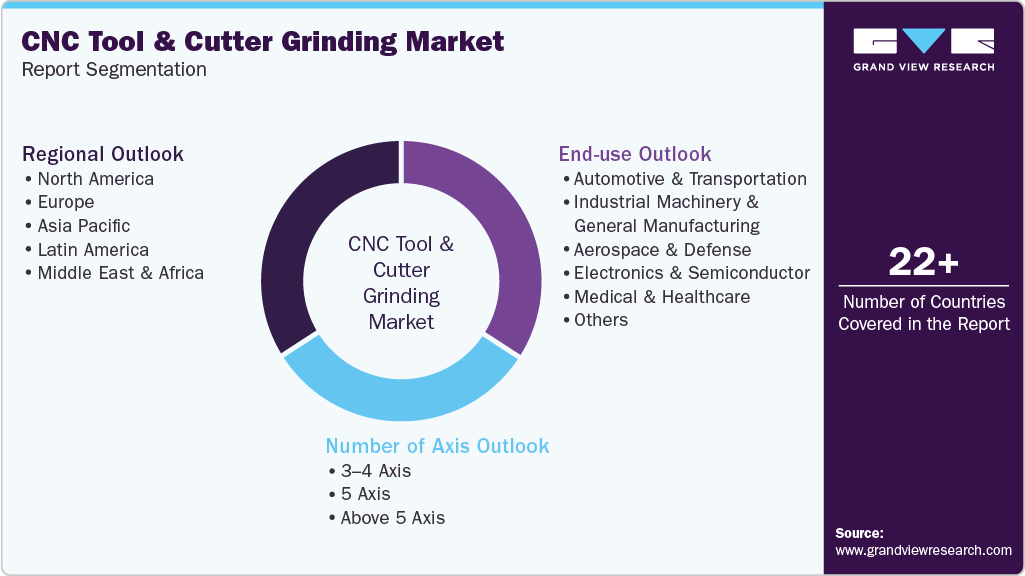
This report forecasts revenue growth at global, regional, and country levels and provides an analysis of the latest industry trends in each of the sub-segments from 2021 to 2033. For this study, Grand View Research has segmented the global CNC tool & cutter grinding machine market report based on the number of axis, end use, and region:
 To learn more about this report, Download Free Sample Report
 -
Number of Axis Outlook (Revenue, USD Billion, 2021 - 2033)
-
3-4 Axis
-
5 Axis
-
Above 5 Axis
-
-
End Use Outlook (Revenue, USD Billion, 2021 - 2033)
-
Automotive & Transportation
-
Industrial Machinery & General Manufacturing
-
Aerospace & Defense
-
Electronics & Semiconductor
-
Medical & Healthcare
-
Other
-
-
Regional Outlook (Revenue, USD Billion, 2021 - 2033)
-
North America
-
U.S.
-
Canada
-
Mexico
-
-
Europe
-
Germany
-
Spain
-
France
-
Italy
-
UK
-
-
Asia Pacific
-
China
-
India
-
Japan
-
Australia
-
South Korea
-
-
Latin America
-
Brazil
-
Argentina
-
-
Middle East and Africa
-
Saudi Arabia
-
UAE
-
South Africa
-
-
Research Methodology
The CNC tool & cutter grinding machine market figures in this report are based on a proven research process that combines executive interviews with secondary research from proprietary databases, company filings, and recognized regulatory and institutional sources. Market size is built through value-chain sizing - reconciling supply-side and demand-side estimates - and triangulated with bottom-up and top-down approaches. Every estimate passes multiple levels of expert validation before publication, with each CNC tool & cutter grinding machine segment quantified using the revenue-capture definitions in the table below.
Segment Definition
Segment - Number of Axis
Revenue Capture Definition
3-4 Axis
Revenue from the sale of CNC tool & cutter grinding machines equipped with three to four controlled axis for cutting-tool manufacturing, sharpening, and reconditioning.
5 Axis
Revenue from the sale of 5-axis CNC tool & cutter grinding machines for precision manufacturing, sharpening, and reconditioning of cutting tools with complex geometries.
Above 5 Axis
Revenue from the sale of CNC tool & cutter grinding machines incorporating more than five controlled axis for complex cutting-tool manufacturing and specialized grinding applications.
Segment - End Use
Revenue Capture Definition
Automotive & Transportation
Revenue from the sale of CNC tool & cutter grinding machines to automotive and transportation manufacturers, component producers, and related machining facilities.
Industrial Machinery & General Manufacturing
Revenue from the sale of CNC tool & cutter grinding machines to industrial machinery manufacturers, machine shops, tool rooms, and general manufacturing facilities.
Aerospace & Defense
Revenue from the sale of CNC tool & cutter grinding machines to aerospace and defense manufacturers and precision machining suppliers.
Electronics & Semiconductor
Revenue from the sale of CNC tool & cutter grinding machines to electronics and semiconductor manufacturers and associated precision machining operations.
Medical & Healthcare
Revenue from the sale of CNC tool & cutter grinding machines to medical device manufacturers and precision machining facilities producing surgical, orthopedic, dental, and other medical components.
Other
Revenue from the sale of CNC tool & cutter grinding machines to end-use industries outside the defined segments, including energy, marine, railways, and construction equipment manufacturing.
Estimation Model
Layer No.
Layer Name
Key Question
Description
01
Precision Cutting Tool Demand Layer
Where are CNC tool & cutter grinding machines required?
Assess the requirement for CNC tool & cutter grinding machines across cutting-tool manufacturers, machine shops, and industries with intensive precision machining operations. Evaluate demand associated with the production, sharpening, and reconditioning of drills, milling cutters, end mills, reamers, inserts, and other cutting tools, considering machining intensity, tool consumption, production volumes, and precision requirements to determine the addressable market.
02
Manufacturing Capacity & Capital Investment Layer
Where is additional machine demand being created?
Examine manufacturing capacity additions, plant expansions, equipment modernization, and replacement cycles across automotive and transportation, industrial machinery, aerospace and defense, electronics and semiconductor, medical devices, and other precision manufacturing sectors. Assess capital expenditure on machining and tooling operations, movement toward automated production, and replacement of conventional grinding equipment to identify potential installations of CNC tool & cutter grinding machines.
03
Number of Axis Adoption Layer
Which CNC tool & cutter grinding machine configurations are being adopted?
Evaluate adoption across 3-4 axis, 5-axis, and above 5-axis configurations based on tool complexity, grinding requirements, dimensional tolerances, production volumes, automation levels, and required flexibility. Assess the suitability of each configuration for standard and complex tool geometries, multi-surface grinding, tool reconditioning, and high-precision manufacturing requirements to determine the technology mix within the market.
04
Revenue Generation Layer
How much revenue is generated from machine sales?
Calculate annual market revenue from the sale of CNC tool & cutter grinding machines across the defined number-of-axis categories, end-use industries, and geographic markets. Incorporate revenues associated with new installations, replacement of existing equipment, capacity expansion, and production modernization, while accounting for differences in machine configurations and application requirements across end-use sectors.
Delivered Customizations
This report has been delivered with the following In-depth customizations
Client Request
Customization Delivered
Value Adds
Competitive Benchmarking
Conducted a structured competitive assessment of leading CNC tool & cutter grinding machine manufacturers, covering machine portfolio breadth, number-of-axis configurations, grinding capabilities, automation architecture, CNC and software systems, tool-processing capabilities, application coverage, machine customization, manufacturing footprint, geographic presence, and product development activity.
Enables systematic comparison of technological capabilities, product positioning, portfolio depth, and geographic reach. The assessment identifies competitive differentiation, capability gaps, technology positioning, and potential areas for portfolio enhancement.
Regional Segmentation
Evaluated market conditions across North America, Europe, Asia Pacific, Latin America, and the Middle East & Africa, with country-level analysis based on precision manufacturing activity, cutting-tool production, automotive and aerospace output, industrial machinery investment, semiconductor and electronics manufacturing, capital expenditure, equipment replacement patterns, and CNC technology adoption.
Provides a granular assessment of regional market attractiveness and demand conditions. The analysis supports geographic prioritization, market-entry planning, resource allocation, and identification of regions with favorable conditions for CNC tool & cutter grinding machine deployment.
Opportunity Assessment
Assessed commercial opportunities across 3-4 axis, 5-axis, and above 5-axis configurations and major end-use industries, including automotive & transportation, industrial machinery & general manufacturing, aerospace & defense, electronics & semiconductor, medical & healthcare, and other precision manufacturing applications. The assessment incorporated new equipment installations, replacement requirements, manufacturing capacity expansion, production modernization, tool manufacturing, and tool reconditioning demand.
Quantifies and compares addressable revenue opportunities across machine configurations and end-use industries. The assessment helps identify high-value application areas, technology gaps, replacement-driven demand, and market whitespace, supporting portfolio strategy, investment prioritization, and targeted commercial expansion.
About the Author(s)
Advanced Interior Materials Research Team
Advanced Materials · Advanced Interior MaterialsThis report was authored by the advanced interior materials research team at Grand View Research - comprising two research analysts, one senior research analyst, and one industry expert - with specialized expertise in the advanced interior materials segment of the advanced materials industry. All findings are based on proprietary advanced materials databases, executive interviews, and regulatory analysis, subject to internal peer review prior to publication.
Last Updated:
Speak to Analyst

Customize this report to your needs - add regions, segments, or data points, with 20% free customization.
Or view our licence options:


ISO 9001:2015 & 27001:2022 Certified
We are GDPR and CCPA compliant! Your transaction & personal information is safe and secure. For more details, please read our privacy policy.


