
- Home
- »
- Consumer F&B
- »
-
Cocoa Butter Alternatives Market Size, Share Report, 2033GVR Report cover
![Cocoa Butter Alternatives Market (2026 - 2033)Report]()
Cocoa Butter Alternatives Market (2026 - 2033)
Size, Share & Trends Analysis Report By Source (Palm Oil & Palm Kernel Oil, Shea Butter), By Application (Bakery & Confectionery, Cosmetics & Personal Care), By Region, And Segment Forecasts
Market Size, 2025
$2.8BMarket Estimate, 2026
$3.0BMarket Forecast, 2033
$4.2BCAGR, 2026–2033
4.7%Cocoa Butter Alternatives Market Summary
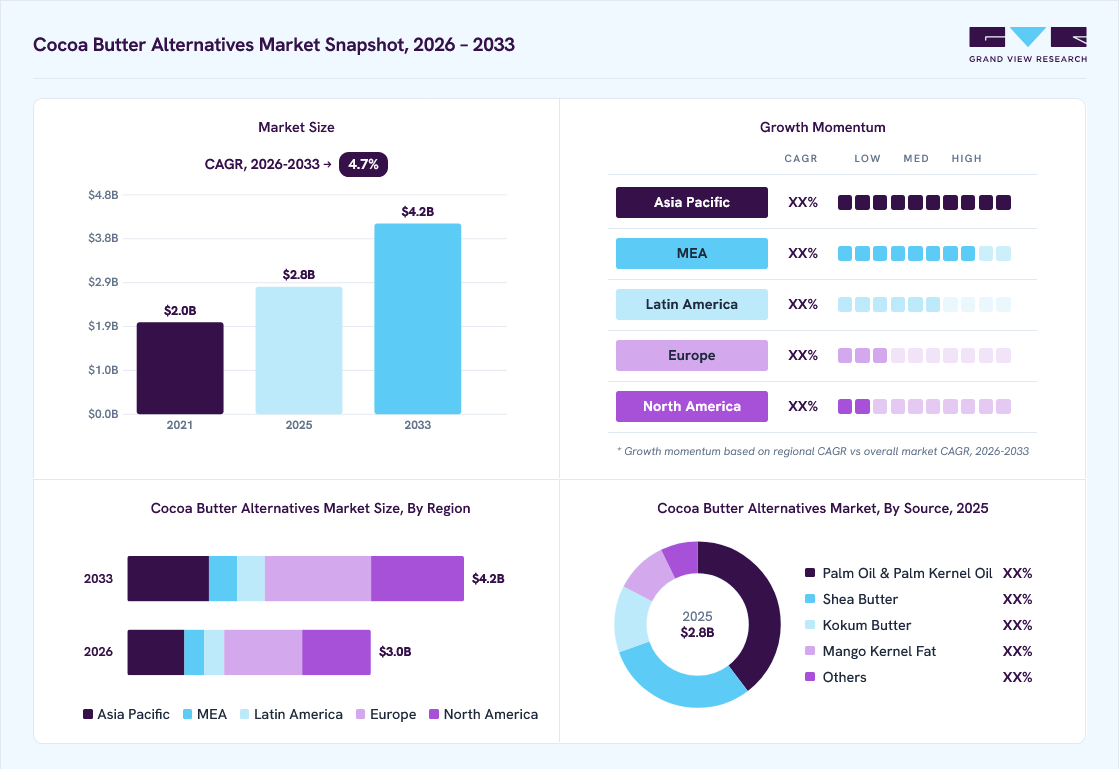
The global cocoa butter alternatives market size was valued at USD 2.8 billion in 2025 and is projected to grow from USD 3.0 billion in 2026 to USD 4.2 billion by 2033, at a CAGR of 4.7% from 2026 to 2033. Europe dominated the market, accounting for a revenue share of 32.1% in 2025. The global market is primarily driven by rising cocoa butter prices and supply volatility, which are encouraging manufacturers to adopt cost-effective substitutes. The growing demand for plant-based, vegan, and sustainably sourced ingredients across confectionery, bakery, cosmetics, and personal care is further supporting market expansion.
Key Market Trends & Insights
- By source: Palm oil & palm kernel oil led the market and accounted for a share of 39.6% in 2025.
- By application: The cosmetics & personal care is expected to experience the fastest growth at a CAGR of 5.0% over the forecast period.
Regional Highlights
- Largest regional market: Europe (32.1% revenue share, 2025)
- Fastest-growing regional market: Asia Pacific (highest CAGR, 2026-2033)
Market Size & Forecast
- Market size in 2025: USD 2.8 Billion
- Estimated market size in 2026: USD 3.0 Billion
- Projected market size by 2033: USD 4.2 Billion
- CAGR (2026-2033): 4.7%
Three ways to get this report
Buy it, customize it, or ask a question.Get the Full Report
What the study covers
- FormatsPDF · Excel · Dashboard
- Timeline2026–2033 annual, 2025 base
- Coverage20+ countries, 5 regions
- Companies10+ key players profiled
Customize the Report
20% free customization
- IncludeCountries, segments, points
- TailorTo your product definition
- ExtendDeeper competitor detail
- OrA fully bespoke study
- Turnaround5–10 working days
Ask Prism AI
A cited answer in seconds
- Corpus30K studies, 1.2M points
- ScopeAll markets, not just this
- CitationTraced to report & table
- HonestySays "not covered" if so
- SpeedSeconds, not days
In addition, technological advancements in fat fractionation and crystallization are enabling alternatives to closely replicate cocoa butter’s texture, melting properties, and stability. In May 2026, AAK debuted Illexao EN 10, a cocoa butter equivalent designed to closely replicate cocoa butter’s smooth melt, texture, snap, gloss, and crystallization properties. The innovation highlights how advances in fat composition and crystallization can enable cocoa butter alternatives with comparable functionality and processing stability.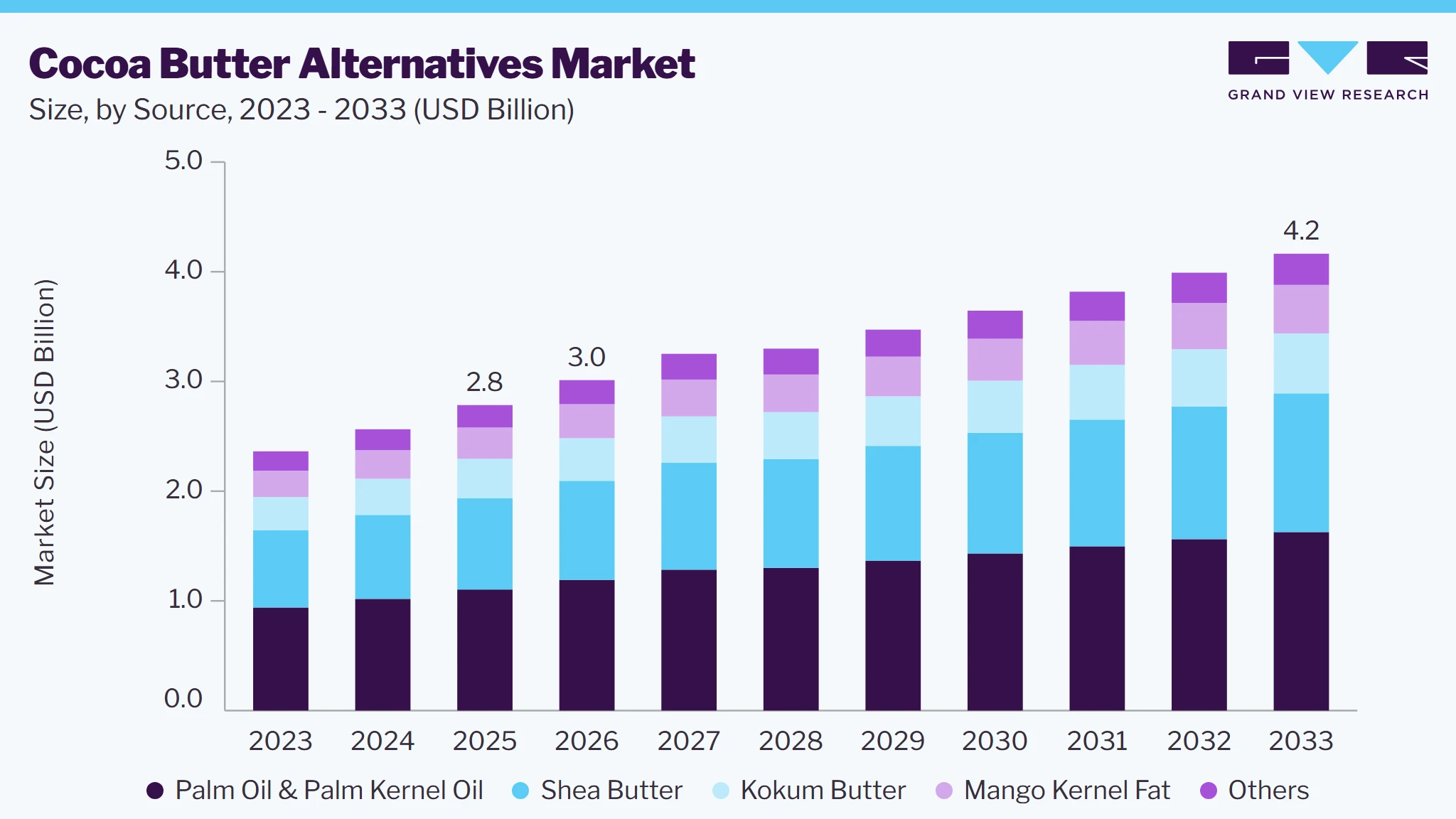
Increasing use of cocoa butter alternatives in coatings, fillings, compound chocolates, bakery products, dairy desserts, and personal-care formulations is creating additional demand. For instance, Cargill’s Olinera cocoa butter replacer is used across confectionery applications, including chocolate fillings, filled bars, compound chocolate, and bakery, wafer, and biscuit coatings. Moreover, their ability to provide consistent product quality, improved heat stability, and longer shelf life is encouraging manufacturers to incorporate them into a wider range of formulations.
Market Dynamics
Volatility in cocoa butter prices is encouraging manufacturers to evaluate alternative fat ingredients for their formulations. Unpredictable cocoa availability can make procurement and production-cost planning more difficult for confectionery producers. This creates a stronger need for ingredients that can provide greater flexibility in formulation and sourcing. Cocoa butter alternatives can help manufacturers reduce their exposure to fluctuations in cocoa-derived ingredient costs. According to the data published in August 2026, cocoa prices rose 1.85% to an 11-month high as concerns over West African crop quality and supply intensified. Ghana’s 2026/27 cocoa crop was estimated at 650,000 MT, down 13%, while the Ivory Coast’s was projected at 1.8 MMT, down 18%, highlighting supply uncertainty and increasing cost pressures for cocoa-dependent manufacturers.
Regulatory requirements across markets can restrict the quantities and types of cocoa butter alternatives that may be incorporated into chocolate. Manufacturers must comply with specific compositional and labeling standards before marketing products containing these ingredients. Such requirements can limit formulation choices and increase the complexity of developing products for multiple geographic markets. Compliance procedures may also require additional testing, documentation, and adjustments to manufacturing processes. In August 2025, cocoa shortages and rising prices pushed brands such as Nestlé and Pladis to reformulate products, with cocoa butter levels falling below the UK’s 20% legal minimum for chocolate. These regulatory differences can therefore slow the introduction and commercialization of alternative-fat formulations.
The cosmetics and personal care sector provides an opportunity for cocoa butter alternatives to reach applications beyond traditional food products. These specialty fats can be incorporated into formulations such as skincare creams, lotions, lip-care products, and other emollient-based products. Their functional characteristics allow formulators to develop products with desirable consistency and skin-conditioning properties. Demand for naturally derived ingredients is also encouraging cosmetic manufacturers to explore alternatives such as shea, mango, and kokum-based fats.
Analyst Perspective
The global market for cocoa butter alternatives is experiencing steady growth, driven by rising cocoa prices, supply constraints, and manufacturers’ focus on cost-effective fat solutions. Growing demand for compound chocolate, confectionery, bakery, and coating applications is encouraging wider adoption of CBE, CBS, and CBR products. Increasing emphasis on product consistency, shelf stability, and sustainable sourcing is further supporting market development. Expansion in emerging markets and advances in specialty fat formulations are improving application opportunities.
Source Insights
The palm oil & palm kernel oil segment accounted for the largest share of 39.6% of the market revenue in 2025. Palm oil and palm kernel oil are widely studied sources for producing cocoa butter alternatives because their fractions can be tailored for confectionery applications. Through processes such as fractionation, blending, and enzymatic modification, their functional characteristics can be adjusted to achieve desirable melting and crystallization behavior. Palm oil fractions can contribute triglycerides that support the formation of stable fat structures in chocolate and compound coatings.
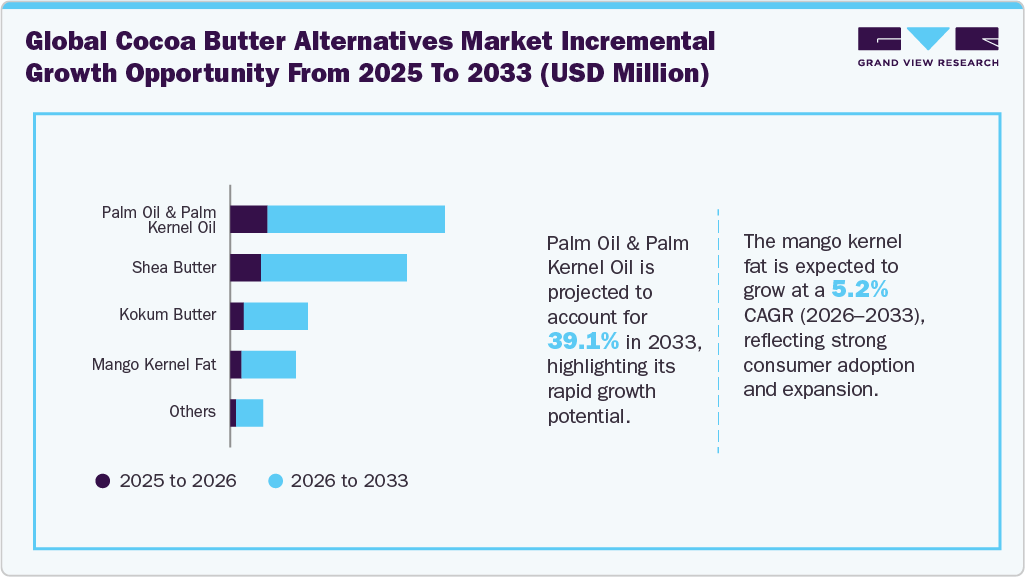
The mango kernel fat segment is projected to grow at the fastest CAGR of 5.2% from 2026 to 2033. Mango kernel fat is obtained from mango seeds and represents a promising source of cocoa butter alternatives for confectionery applications. Its fatty-acid and triglyceride composition contains characteristics that can provide properties comparable to cocoa butter when appropriately processed or blended. Research has demonstrated that mango kernel fat can be incorporated into chocolate formulations while maintaining acceptable texture and stability.
Application Insights
The bakery & confectionery segment accounted for the largest share of 52.8% of the revenue in 2025. The bakery and confectionery segment represents a major application area for cocoa butter alternatives, particularly in chocolate coatings, fillings, biscuits, cakes, and compound products. These fats can provide desirable hardness, gloss, snap, and melting characteristics required for finished products. Their functionality also supports applications in which chocolate coatings must remain stable during processing and storage. In bakery products, they can improve the consistency and handling properties of fat-based coatings and fillings.
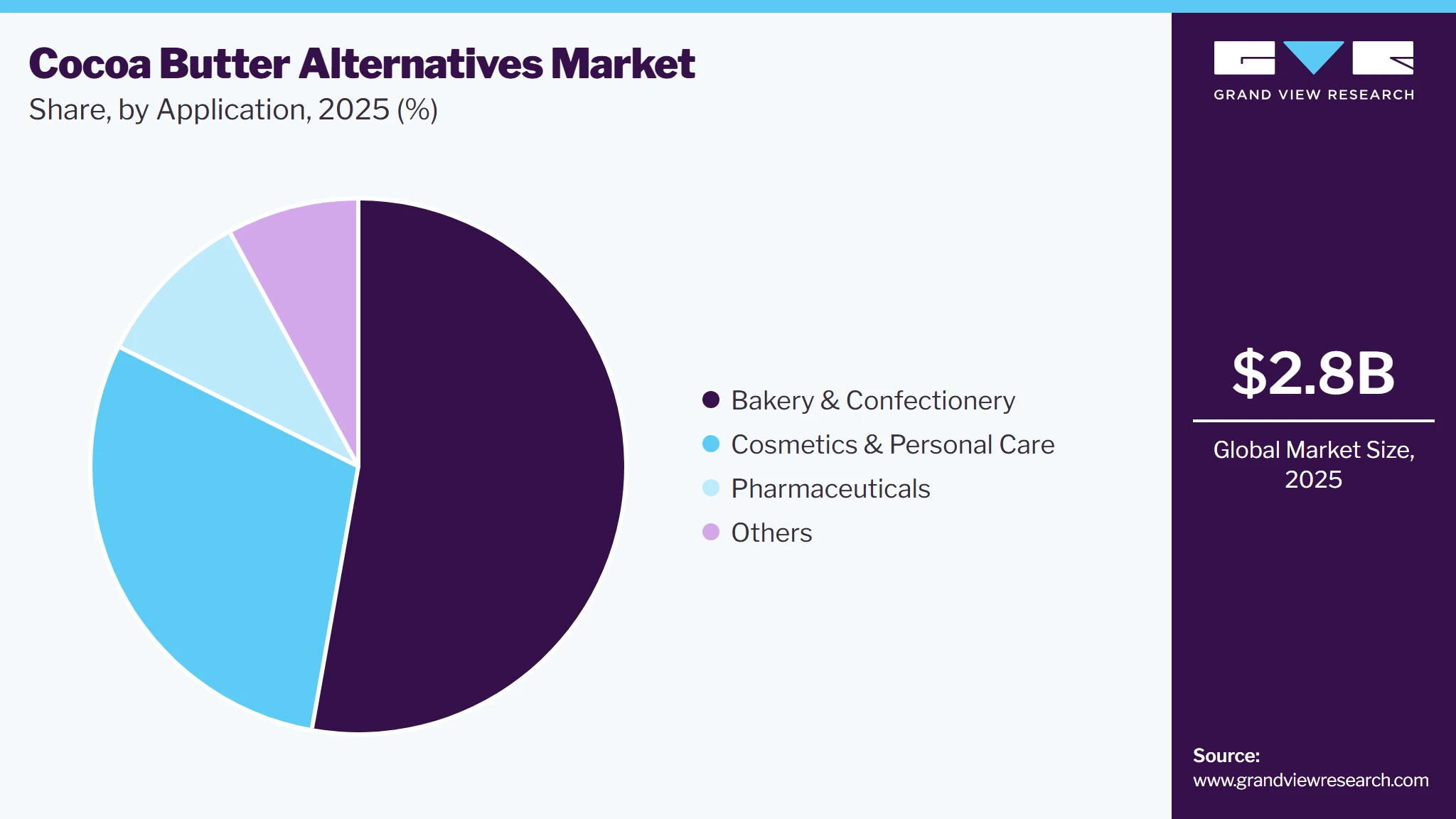
The use of cocoa butter alternatives for cosmetics & personal care is projected to grow at a CAGR of 5.0% from 2026 to 2033. Cosmetics and personal care represent an expanding non-food application area for cocoa butter alternatives, particularly in skin and lip-care formulations. These specialty fats can serve as emollient ingredients, contributing to smooth application and a pleasant sensory experience. They can be incorporated into products such as creams, lotions, lip balms, and other topical formulations.
Regional Insights
Europe Cocoa Butter Alternatives Market Trends
The cocoa butter alternatives industry in Europe led the global market in 2025 with a revenue share of 32.1%. The Europe market is driven by its extensive chocolate, bakery, and confectionery manufacturing base, which creates sustained demand for specialty fats. Consumer interest in plant-based and sustainably sourced ingredients is influencing manufacturers to reconsider their choice of fat ingredients. The region’s focus on responsible sourcing is also encouraging the development and adoption of alternatives with stronger sustainability credentials. In addition, established ingredient supply networks make it easier for manufacturers to access specialized fat formulations.
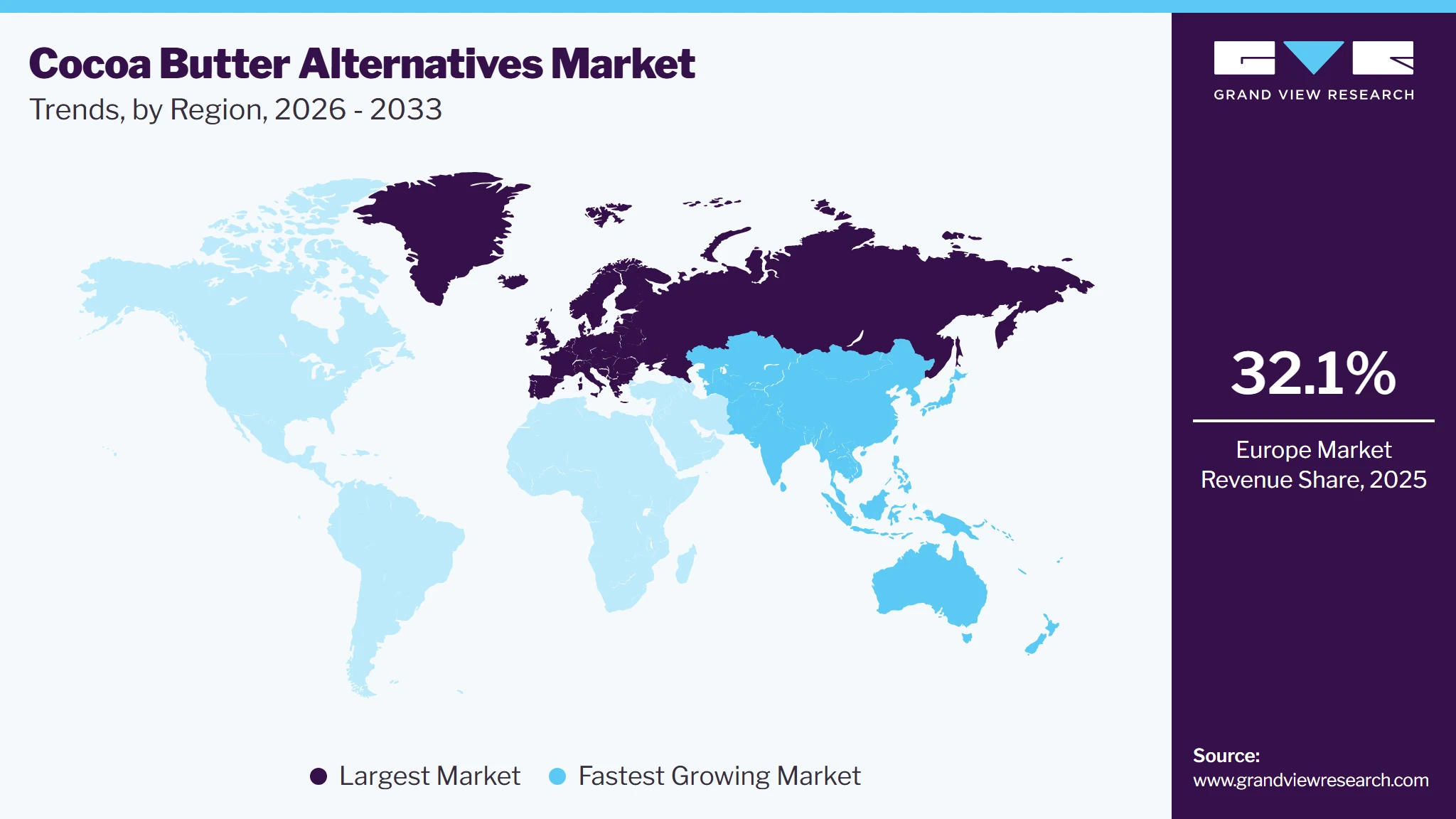
The cocoa butter alternatives industry in Germany led the European region in 2025, with the largest market share of 23.3% of the region’s total revenue. Germany is a major European market because of its strong chocolate and confectionery manufacturing ecosystem and highly developed food-processing industry. Manufacturers are increasingly interested in specialty fats that can support product consistency while meeting evolving formulation requirements. Consumer expectations around sustainability and ingredient quality are also influencing the development of alternative-fat products.
North America Cocoa Butter Alternatives Market Trends
The cocoa butter alternatives industry in North America held a market share of 28.3% of the total revenue in 2025. The market in North America is driven by the region’s well-developed confectionery, bakery, dessert, and processed-food industries. Manufacturers are increasingly focusing on formulations that deliver consistent performance across mass-market and premium products. Demand for non-hydrogenated and plant-derived fats is also encouraging product reformulation across food categories. Strong investment in ingredient research and formulation technology is helping suppliers develop alternatives with improved functionality.
U.S. Cocoa Butter Alternatives Market Trends
The cocoa butter alternatives industry in the U.S. led the North American market in 2025, holding the largest market share with 83.2% of the region’s total revenue. The U.S. market is supported by high consumption of chocolate, bakery products, cookies, ice cream, and other fat-based foods that utilize specialty ingredients. The country’s large food-processing sector provides manufacturers with substantial opportunities to incorporate cocoa butter alternatives into new and reformulated products. Growing interest in vegan, non-GMO, and clean-label formulations is further influencing ingredient selection. Continuous product development and technical research are improving the suitability of alternatives for different applications.
Asia Pacific Cocoa Butter Alternatives Market Trends
The Asia Pacific cocoa butter alternatives industry is projected to grow at the fastest CAGR of 5.2% from 2026 to 2033. The market in Asia Pacific is being propelled by rapid urbanization, rising disposable incomes, and the expansion of modern food-processing industries. Growing consumer exposure to Western-style chocolates, bakery products, and packaged desserts is expanding the regional customer base for cocoa butter alternatives. The region’s warm climatic conditions also create a need for fats that can provide suitable handling and stability during manufacturing and distribution.
The cocoa butter alternatives industry in China led the Asia Pacific market in 2025, holding the largest market share with 30.6% of the region’s total revenue share. The market in China is supported by a growing middle-class consumer base and increasing interest in premium chocolates and confectionery products. Expansion of domestic food manufacturing is creating greater demand for functional specialty fats that can be incorporated into locally produced products. The growth of e-commerce is also improving access to a wider range of chocolate and confectionery products, supporting market penetration. Domestic manufacturers are increasingly collaborating with international companies to enhance product quality and expand their formulations.
Central & South America Cocoa Butter Alternatives Market Trends
The cocoa butter alternatives industry in the Central & South America market is projected to grow at a CAGR of 4.8% from 2026 to 2033. The Central and South American market is supported by the expansion of food and cosmetic industries and the region’s significant role in agricultural commodity production. Climate-related challenges affecting cocoa cultivation can encourage manufacturers to explore alternative fat ingredients for selected applications. Growing urban populations and changing consumer preferences are expanding demand for processed foods, confectionery, and bakery products.
Middle East & Africa Cocoa Butter Alternatives Market Trends
The cocoa butter alternatives industry in the Middle East & Africa region is expected to grow at a CAGR of 5.1% from 2026 to 2033. The Middle East and Africa market is driven by the gradual development of food-processing and confectionery manufacturing capabilities. Increasing consumer awareness of sustainable and cost-conscious ingredients is encouraging manufacturers to evaluate alternative specialty fats. Urbanization and changing consumption patterns are also expanding demand for packaged foods, chocolates, bakery products, and desserts.
Key Cocoa Butter Alternatives Company Insights
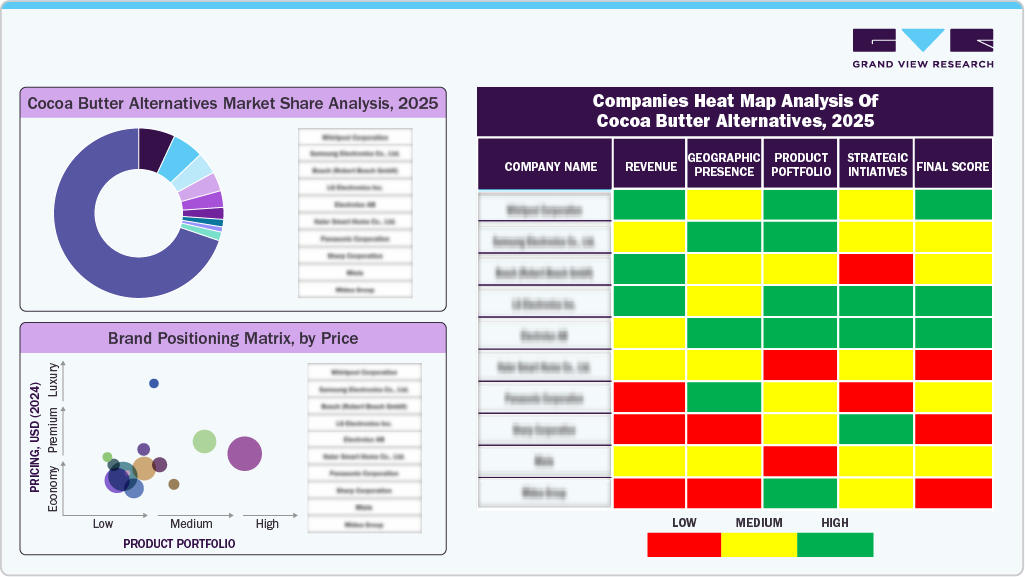
The cocoa butter alternatives industry is moderately fragmented, with competition spread across major multinational specialty-fat producers and regional manufacturers. Key companies include Fuji Oil Holdings, Cargill, AAK, Barry Callebaut, Bunge, Wilmar International, Olam, and Musim Mas Group.
Leading players are strengthening their positions through product innovation, expanded production capabilities, application-specific formulations, and broader geographic reach. Fuji Oil Holdings and Cargill are identified among the prominent market participants, while several regional suppliers compete by offering specialized fat solutions. Market share remains distributed across these established companies and smaller regional producers, creating a competitive environment where technological capabilities, product performance, supply networks, and customer support are key differentiating factors.
Key Cocoa Butter Alternatives Companies:
The following key companies have been profiled for this study on the cocoa butter alternatives market.
-
Fuji Oil Holdings
-
Cargill, Incorporated
-
AAK.
-
Wilmar International Ltd
-
Olam International Limited.
-
Musim Mas Group Ingredients
-
Manorama Industries Limited
-
INTERCONTINENTAL SPECIALTY FATS SDN. BHD
-
Mewah Group
-
The Nisshin OilliO Group, Ltd.
Competitive Benchmarking
Category
Operating Strategies
Competitive Edge
Weakness
Established Players (Olam International Limited, Fuji Oil Holdings, Cargill, Incorporated)
Scale production, broaden applications, secure long-term supply contracts, and optimize formulations.
Strong customer relationships, technical expertise, established supply chains, and global reach.
High production costs, commodity price exposure, and reliance on major buyers.
Emerging Players (Mewah Group, Manorama Industries Limited)
Develop specialty fats, focus on sustainable sourcing, target niche applications, and expand regionally.
Faster innovation, customized solutions, sustainability positioning, and market agility.
Limited scale, lower brand recognition, and weaker distribution networks.
Recent Developments:
-
In September 2026, C16 Biosciences launched Palmless, a cocoa butter equivalent produced through aerobic precision fermentation using a naturally oil-producing microorganism. The ingredient offers a more predictable fat profile than conventional cocoa butter, whose composition can vary with cocoa-growing region, season, and harvest conditions.
-
In June 2026, Sun Bear Biofuture completed its first production run of a yeast-derived cocoa butter alternative, with tests showing no performance difference versus conventional cocoa butter. The company plans to launch the ingredient through a cosmetics partnership in 2027, supporting growing use of cocoa butter alternatives in personal-care formulations.
Cocoa Butter Alternatives Market Report Scope
Report Attribute
Details
Market size in 2025
USD 2.8 billion
Estimated market size in 2026
USD 3.0 billion
Revenue Forecast in 2033
USD 4.2 billion
Growth rate (Revenue)
CAGR of 4.7% from 2026 to 2033
Actuals
2021 - 2025
Forecast period
2026 - 2033
Quantitative (Revenue) units
Revenue in USD Billion and CAGR from 2026 to 2033
Report coverage
Revenue forecast, company ranking, competitive landscape, growth factors, and trends
Segments covered
Source, application, region
Regional Scope
North America; Europe; Asia-Pacific; Central & South America; Middle East & Africa
Country scope
U.S.; Canada; Mexico; UK; Germany; France; Italy; Spain; China; Japan; India; Australia & New Zealand; South Korea; Brazil; South Africa
Key companies profiled
Fuji Oil Holdings; Cargill, Incorporated; AAK; Wilmar International Ltd; Olam International Limited; Musim Mas Group; Manorama Industries Limited; INTERCONTINENTAL SPECIALTY FATS SDN. BHD; Mewah Group; The Nisshin OilliO Group, Ltd.
Customization scope
Free report customization (equivalent up to 8 analysts’ working days) with purchase. Addition or alteration to country, regional & segment scope.
Pricing and purchase options
Avail customized purchase options to meet your exact research needs. Explore purchase options
Global Cocoa Butter Alternatives Market Report Segmentation
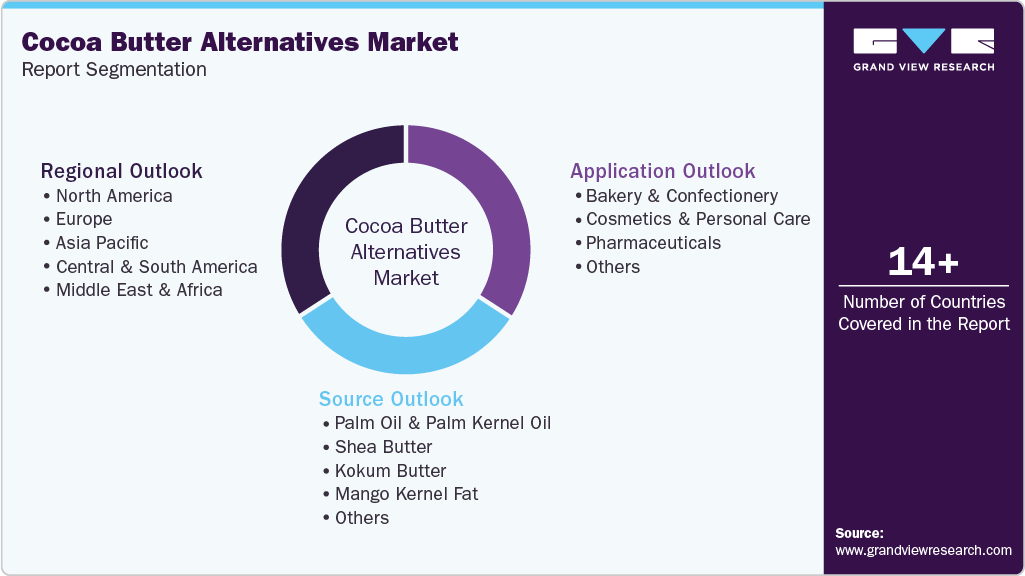
This report forecasts revenue growth at the regional and country levels and provides an analysis of the latest industry trends and opportunities in each of the sub-segments from 2021 to 2033. For this study, Grand View Research has segmented the global cocoa butter alternatives market report based on source, application, and region.
-
Source Outlook (Revenue, USD Billion, 2021 - 2033)
-
Palm Oil & Palm Kernel Oil
-
Shea Butter
-
Kokum Butter
-
Mango Kernel Fat
-
Others
-
-
Application Outlook (Revenue, USD Billion, 2021 - 2033)
-
Bakery & Confectionery
-
Cosmetics & Personal Care
-
Pharmaceuticals
-
Others
-
-
Regional Outlook (Revenue, USD Billion, 2021 - 2033)
-
North America
-
U.S.
-
Canada
-
Mexico
-
-
Europe
-
UK
-
Germany
-
France
-
Italy
-
Spain
-
-
Asia Pacific
-
China
-
Japan
-
India
-
Australia & New Zealand
-
South Korea
-
-
Central & South America
-
Brazil
-
-
Middle East & Africa
-
South Africa
-
-
Research Methodology
The cocoa butter alternatives market figures in this report are based on a proven research process that combines executive interviews with secondary research from proprietary databases, company filings, and recognized regulatory and institutional sources. Market size is built through value-chain sizing—reconciling supply-side and demand-side estimates—and triangulated with bottom-up and top-down approaches. Every estimate passes multiple levels of expert validation before publication, with each cocoa butter alternatives segment quantified using the revenue-capture definitions in the table below.
Segment Definition
Segment - Source
Revenue capture definition
Palm Oil & Palm Kernel Oil
Revenue is captured through the supply and sale of refined, fractionated, and specialty palm-derived fats used as cocoa butter replacers, equivalents, or other functional fat systems. Suppliers generate revenue through bulk ingredient contracts, customized fat blends, and recurring sales to chocolate, confectionery, bakery, and other food manufacturers.
Shea Butter
Revenue is generated through the sale of shea-derived specialty fats processed and formulated to deliver cocoa-butter-like functionality. Suppliers capture value through industrial ingredient sales, customized grades and blends, and long-term supply agreements with manufacturers using shea-based fats in confectionery and related applications.
Kokum Butter
Revenue is captured through the commercialization of kokum-derived specialty fats and butter fractions used to provide specific melting, firmness, and textural characteristics. Sales are primarily generated through ingredient supply contracts, formulation-specific grades, and premium specialty-fat products supplied to food and personal-care manufacturers.
Mango Kernel Fat
Revenue is generated through the processing and sale of mango-kernel-derived fats as functional specialty ingredients. Suppliers capture revenue from bulk and customized formulations designed to deliver targeted melting, crystallization, texture, and stability characteristics across confectionery, bakery, and personal-care applications.
Others
Revenue is captured through the commercialization of alternative fat sources and specialty lipid systems that can provide selected cocoa-butter functionalities. This includes sales of emerging plant-derived fats, tailored blends, and technologically modified fat systems through direct manufacturer contracts, ingredient distributors, and specialty formulation partnerships.
Estimation Model
Each layer progressively narrows the population pool and applies a conversion rate to arrive at addressable revenue.
Step Number
Layer
Guiding Question
Description
01
Consumption Universe Layer
Who uses cocoa butter alternatives globally?
Food manufacturers using alternatives in chocolate, confectionery, bakery, and coatings.
02
Access & Availability Layer
Who can source cocoa butter alternatives?
Manufacturers with access to CBE, CBS, CBR, and alternative‑fat suppliers.
03
Purchase & Usage Layer
Who regularly purchases these alternatives?
Producers using alternatives for cost optimization, formulation flexibility, or cocoa‑fat replacement.
04
Revenue Conversion Layer
How is revenue generated?
Revenue from ingredient sales across confectionery, bakery, coatings, and industrial food applications.
Customization Table
This report has been delivered with the following In-depth customizations
CLIENT REQUEST
CUSTOMIZATION DELIVERED
VALUE ADDS
Global Cocoa Butter Alternatives Market Assessment
Mapped the competitive landscape across cocoa butter equivalents, replacers, and substitutes, including key fat sources such as shea, palm derivatives, kokum, mango kernel, sal, and illipe.
Enables identification of attractive ingredient segments, competitive positioning opportunities, and areas for product innovation.
Cocoa Butter Alternative Application Analysis
Assessed adoption across chocolate and confectionery, bakery, dairy and frozen desserts, cosmetics, pharmaceuticals, and other end-use categories, with emphasis on formulation requirements and functionality.
Helps prioritize high-potential applications, tailor product portfolios, and identify opportunities beyond traditional confectionery.
Cocoa Butter Alternative Sourcing & Formulation Assessment
Evaluated alternative fat sources and processing approaches, including fractionation, blending, and interesterification, while considering melting behavior, compatibility, stability, cost, and sustainability considerations.
Supports raw-material strategy, formulation optimization, cost management, and development of differentiated alternatives aligned with customer requirements.
Frequently Asked Questions About This Report
The cocoa butter alternatives market size was valued at USD 2.8 billion in 2025 and is estimated at USD 3.0 billion for 2026
Key factors driving the market include rising demand for cost-effective and stable alternatives to cocoa butter, increasing chocolate and confectionery production, and growing demand for specialty fats with improved functionality.
The palm oil & palm kernel oil segment led with a 39.6% revenue share in 2025.
The cocoa butter alternatives market is expected to grow at a CAGR of 4.7% from 2026 to 2033, reaching USD 4.2 billion by 2033
Key players include Fuji Oil Holdings, Cargill, Incorporated, AAK, Wilmar International Ltd, Olam International Limited, Musim Mas Group, Manorama Industries Limited, INTERCONTINENTAL SPECIALTY FATS SDN. BHD, Mewah Group, and The Nisshin OilliO Group, Ltd.
The Asia Pacific cocoa butter alternatives are projected to grow at a CAGR from 2026 to 2033.
The use of cocoa butter alternatives in cosmetics & personal care is projected to grow at a CAGR of 5.0% from 2026 to 2033.
Europe dominated with a 32.1% revenue share in 2025.
About the Author(s)
Consumer F&B Research Team
Consumer Goods · Consumer F&BThis report was authored by the consumer f&b research team at Grand View Research - comprising two research analysts, one senior research analyst, and one industry expert - with specialized expertise in the consumer f&b segment of the consumer goods industry. All findings are based on proprietary consumer goods databases, executive interviews, and regulatory analysis, subject to internal peer review prior to publication.
Last Updated:
Speak to Analyst


Customize this report to your needs - add regions, segments, or data points, with 20% free customization.
Or view our licence options:


ISO 9001:2015 & 27001:2022 Certified
We are GDPR and CCPA compliant! Your transaction & personal information is safe and secure. For more details, please read our privacy policy.


