
- Home
- »
- Consumer F&B
- »
-
Cod Liver Oil Market Size, Share & Growth Report, 2033GVR Report cover
![Cod Liver Oil Market (2026 - 2033)Report]()
Cod Liver Oil Market (2026 - 2033)
Size, Share & Trends Analysis Report By Source (Atlantic Cod, Arctic Cod), By Application (Dietary Supplements, Pharmaceuticals), By Form (Liquid, Softgels), By Region (North America, Asia Pacific), And Segment Forecasts
Market Size, 2025
$142.3MMarket Estimate, 2026
$150.5MMarket Forecast, 2033
$245.5MCAGR, 2026–2033
7.2%Cod Liver Oil Market Summary
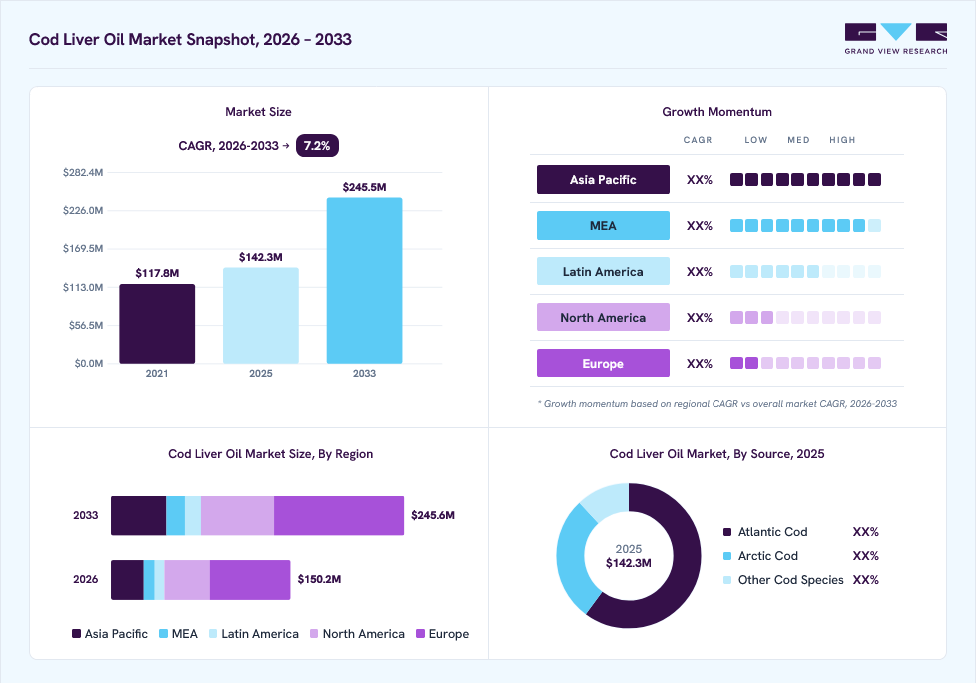
The global cod liver oil market size was valued at USD 142.3 million in 2025 and is projected to grow from USD 150.5 million in 2026 to reach USD 245.5 million by 2033, at a CAGR of 7.2% from 2026 to 2033. Europe dominated the global market, accounting for the largest revenue share of 45.1% in 2025. The market is primarily driven by growing awareness of its nutritional benefits, particularly its omega-3 fatty acids and vitamins A and D. Increasing consumer interest in preventive nutrition and overall wellness is encouraging the use of cod liver oil as a dietary supplement. Its perceived benefits for heart, bone, immune, and cognitive health further support consumer demand.
Key Market Trends & Insights
- By source: The atlantic cod oil segment led the market and accounted for the largest share of 60.1% in 2025.
- By application: The dietary supplements segment led the market and accounted for a share of 64.4% in 2025.
- By form: The softgels segment held the largest share in 2025.
Regional Highlights
- Largest regional market: Europe (45.1% revenue share, 2025)
- Fastest-growing regional market: Asia Pacific (highest CAGR, 2026-2033)
- By country: The Germany held the largest market share in 2025
Market Size & Forecast
- Market size in 2025: USD 142.3 Million
- Estimated market size in 2026: USD 150.5 Million
- Projected market size by 2033: USD 245.5 Million
- CAGR (2026-2033): 7.2%
In addition, product innovation and the availability of cod liver oil in diverse forms, such as capsules, soft gels, and liquid formulations, are supporting wider consumer adoption. The growing preference for convenient and easy-to-use supplements is encouraging manufacturers to introduce user-friendly product formats. Expansion of distribution through pharmacies, health stores, and online retail channels is also improving product accessibility.
The market is also supported by rising demand for naturally sourced nutritional products and clean-label supplements. Consumers are increasingly seeking products with recognizable ingredients and minimal artificial additives. Growing product availability across specialized nutrition outlets and direct-to-consumer platforms is further contributing to market expansion. In January 2024, Wiley’s Finest launched Cod Liver Oil+, featuring 765mg of omega-3s (EPA/DHA), plus vitamins D3 and E. The Orange Bliss-flavoured formula is designed to support cognitive function, stress, immunity, and eye health.
Furthermore, increasing interest in marine-derived ingredients is encouraging the incorporation of cod liver oil into functional foods and nutritional formulations. Manufacturers are also focusing on improving taste, purity, stability, and formulation quality to enhance product appeal. Greater emphasis on traceability and responsible sourcing is further influencing product development across the industry.
Market Dynamics
The growing demand for omega-3-rich dietary products is supporting the use of cod liver oil as a nutritional supplement. Consumers are increasingly interested in incorporating essential fatty acids into their daily diets through convenient supplement formats. Cod liver oil is a source of omega-3 fatty acids, making it attractive to consumers seeking nutrient-rich dietary options. This trend is encouraging wider consideration of cod liver oil products across different consumer groups. As interest in omega-3 supplementation continues, it can support demand for cod liver oil.
The strong taste and odor of cod liver oil can limit consumer acceptance and regular usage. Some consumers may find its distinctive flavor and aftertaste unpleasant, particularly when using liquid formulations. This sensory issue can discourage first-time users and may affect continued consumption. According to the Nutriterra survey, in collaboration with Qualtrics, among 1,200 consumers, with a younger demographic emphasis, about 64% reported preferring plant-based omega-3 as an alternative to cod liver oil. Compared with more neutral-tasting supplement alternatives, cod liver oil can therefore face a disadvantage. Manufacturers need to address these characteristics to improve the overall consumer experience.
The development of flavored and easy-to-consume formulations presents an opportunity to make cod liver oil more appealing to consumers. Manufacturers can introduce improved-tasting liquids, flavored options, soft gels, and other convenient formats. Such products can minimize the unpleasant taste and odor associated with traditional formulations. Easier consumption may also encourage regular use among consumers who are sensitive to taste. Product innovation focused on convenience and palatability can therefore support broader adoption. Key players such as J.R. Carlson Laboratories.INC offers cod liver oil in various flavors such as Green Apple, Lemon, Fruit, and Splash flavor, and offering health benefits such as cardiovascular function, cognitive health and joint support.
Analyst Perspective
The global cod liver oil market is experiencing steady growth, driven by rising consumer awareness of omega-3 fatty acids and essential vitamins, alongside increasing interest in preventive health and nutritional supplementation. Demand is expanding across both developed and emerging markets, with liquid oils, softgels, and premium formulations gaining traction among consumers seeking convenient supplementation options. E-commerce and specialty health retailers are also improving product accessibility and expanding consumer reach.
Source Insights
The Atlantic cod liver oil market accounted for the largest share, accounting for around 60.1% in 2025. Atlantic cod is a preferred source for cod liver oil due to the nutritional value of its liver and its suitability for oil extraction. Its established use in traditional food and supplement applications supports continued consumer familiarity. The oil obtained from Atlantic cod can be incorporated into various supplement formulations. Interest in naturally derived marine ingredients also supports their use as a source material. Product quality, processing methods, and sourcing practices further influence its suitability for cod liver oil production.

The arctic cod liver oil market is projected to grow at the fastest CAGR of 7.5% from 2026 to 2033. Arctic cod is gaining attention as a source of cod liver oil owing to its association with cold-water marine environments and naturally derived nutritional ingredients. The liver provides oil that can be processed for use in dietary supplement formulations. Its origin can appeal to consumers interested in marine-sourced and naturally positioned products. Advances in processing can maintain the quality and stability of oil derived from this source. Increasing product differentiation based on fish origin also creates scope for Arctic cod-based formulations.
Application Insights
The dietary supplements segment held the largest share of the cod liver oil market of 64.4% of the revenue in 2025. Cod liver oil is widely suited to dietary supplement formulations as it can be offered in convenient forms such as capsules, soft gels, and liquids. Its nutrient profile makes it relevant for consumers looking to complement their regular diets with additional nutritional ingredients. Flexible dosage formats allow manufacturers to design products for different consumer preferences. Improved encapsulation and formulation techniques can also address taste and odor concerns. These characteristics support the integration of cod liver oil into everyday supplement routines.
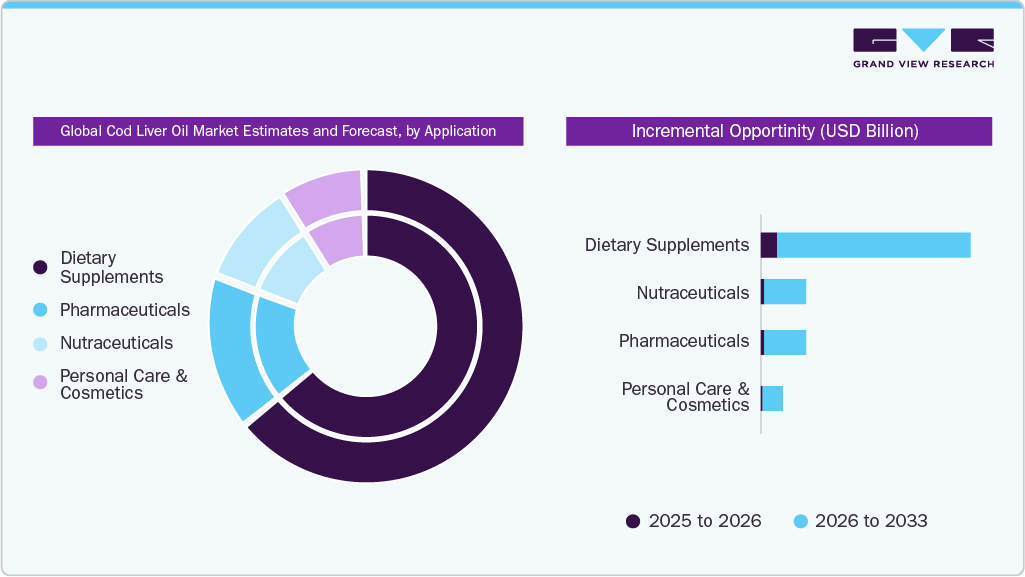
The nutraceuticals segment is projected to grow at a CAGR of 7.8% from 2026 to 2033. The use of cod liver oil in nutraceuticals is supported by its suitability as an ingredient in products positioned around targeted nutritional benefits. Its marine-derived composition allows manufacturers to incorporate it into specialized wellness formulations. Cod liver oil can be combined with other nutritional ingredients to create differentiated product concepts. Advances in formulation can improve stability, absorption, and consumer convenience. This versatility provides manufacturers with opportunities to develop innovative nutraceutical products for specific dietary needs.
Form Insights
The softgels form accounted for the largest share of 45.4% of the revenue in 2025. Softgels are favored for cod liver oil due to their sealed format can protect the oil from exposure to air and light. Their smooth outer shell also makes them easier to swallow compared with liquid formulations. Softgels can minimize direct exposure to the oil’s strong taste and odor during consumption. Consistent dosing makes them convenient for users following regular supplementation routines. These practical characteristics make softgels a suitable format for cod liver oil products.
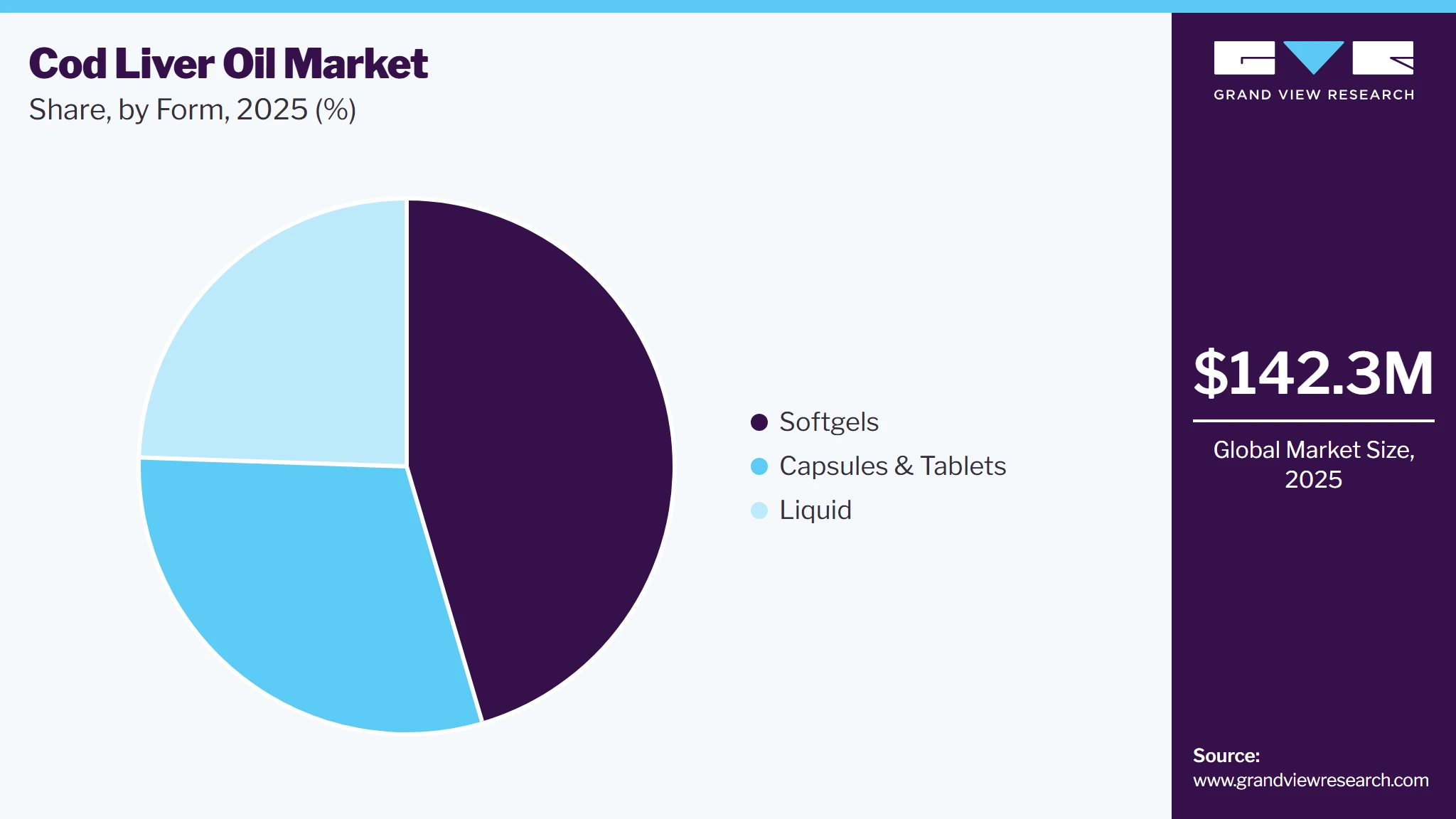
The capsules & tablets form is projected to grow at a CAGR of 7.7% from 2026 to 2033. Capsules and tablets offer a convenient and portable format for consumers who prefer straightforward supplement administration. They can provide controlled serving sizes, making them easy to incorporate into daily routines. Encapsulated formats can also reduce direct contact with the distinctive flavor and smell of cod liver oil. Manufacturers can combine cod liver oil with other nutritional ingredients in certain formulations. Their compact design also supports convenient storage and transportation.
Regional Insights
The cod liver oil market in Europe holding the largest market share of 45.1% in global revenue. Europe is supported by a strong tradition of using nutritional supplements as part of everyday wellness routines. Consumer interest in naturally sourced ingredients and responsible product composition creates a favorable environment for cod liver oil products. The region’s emphasis on product quality and transparency also encourages manufacturers to focus on sourcing and formulation standards. Cod liver oil can be positioned across dietary supplement and specialized nutrition applications. Growing attention to preventive nutrition further contributes to its relevance within the European market.

Cod liver oil market in Germany led the European market in 2025, holding the largest market share with 23.2% of the region’s total revenue. Germany’s cod liver oil market is supported by consumer interest in nutritional products with clearly defined ingredients and established quality standards. The country has a well-developed supplement sector serving consumers seeking convenient additions to their diets. Demand is also influenced by interest in naturally derived ingredients and products associated with balanced nutrition. Manufacturers can appeal to German consumers through transparent sourcing and carefully formulated products. Convenient dosage formats further support regular use and product accessibility.
North America Cod Liver Oil Market Trends
The cod liver oil market in North America led the global cod liver oil market in 2025, holding the market share with 25.3% of the total revenue. The market is driven by strong consumer interest in nutritional products and dietary supplementation. The region’s established health and wellness culture supports the incorporation of marine-based ingredients into daily nutrition routines. Well-developed retail and e-commerce channels also make different cod liver oil formats readily accessible. Product innovation focused on convenience and improved sensory characteristics further supports consumer acceptance. Increasing preference for nutrient-focused products provides an additional foundation for regional demand.
U.S. Cod Liver Oil Market Trends
The U.S. led the North American cod liver oil market in 2025, holding the largest market share with 82.6% of the region’s total revenue. In the U.S., demand for cod liver oil is supported by the broad availability of dietary supplements through pharmacies, health stores, supermarkets, and online platforms. Consumers increasingly seek convenient nutritional products that can complement their everyday diets. The presence of established supplement manufacturers also encourages product diversification across capsules, softgels, and liquid formats. In addition to human nutrition, cod liver oil is also finding application in pet food formulations as a natural source of omega-3 fatty acids and vitamins, supporting its use as a functional nutritional ingredient for pets. For instance, in April 2024, Bering Select introduced a cod liver oil ingredient for pet food, offering a natural source of omega-3 fatty acids, vitamins A and D, and other nutrients. The ingredient is designed to support pet health while providing manufacturers with a palatable, functional addition to pet food formulations.
Asia Pacific Cod Liver Oil Market Trends
The cod liver oil market in APAC is projected to grow at the fastest CAGR of 7.8% from 2026 to 2033, driven by increasing interest in dietary supplementation alongside changing consumer lifestyles and nutritional preferences. Growing awareness of marine-derived ingredients is creating opportunities for cod liver oil products across different supplement categories. Urban consumers are increasingly looking for convenient products that can fit into busy daily routines. Expansion of modern retail and online purchasing channels is improving access to nutritional supplements. Product localization and consumer-friendly formulations can further strengthen the regional appeal of cod liver oil.
Cod liver oil market in China led the Asia Pacific market in 2025, holding the largest market share with 35.5% of the region’s total revenue. China’s cod liver oil market is supported by increasing attention to nutritional supplementation and convenient health-oriented products. Consumers are showing greater interest in products containing recognizable nutritional ingredients and marine-derived components. E-commerce platforms provide manufacturers with opportunities to reach consumers beyond traditional retail channels. Product formats that are simple to use and suitable for different age groups can enhance consumer acceptance. Greater emphasis on product quality and authenticity also influences purchasing preferences.
Central & South America Cod Liver Oil Market Trends
The Central & South America cod liver oil market is projected to grow at a CAGR of 7.4% over the forecast period, supported by increasing consumer interest in dietary supplementation and nutritional products. Growing availability through pharmacies, specialty stores, and online channels is improving consumer access to cod liver oil products. Marine-derived nutritional ingredients can appeal to consumers seeking naturally sourced supplement options. Manufacturers can benefit from offering affordable and convenient formats suited to local purchasing preferences. Expansion of modern retail infrastructure also creates opportunities for broader product distribution.
Middle East & Africa Cod Liver Oil Market Trends
The Middle East & Africa cod liver oil market is expected to grow at a CAGR of 7.7% from 2026 to 2033, driven by growing awareness of nutritional supplementation and increasing availability of wellness-oriented products. Consumers are showing greater interest in convenient supplements that can complement their regular dietary habits. Expansion of pharmacies, specialized health retailers, and digital commerce is improving access to imported and locally distributed products. Product quality, trusted sourcing, and clear nutritional positioning are important factors influencing consumer confidence. Manufacturers offering convenient and culturally appropriate formulations can further support adoption across the region.
Key Cod Liver Oil Company Insights
The cod liver oil industry is characterized by the presence of manufacturers offering products across multiple formulations and end-use categories. Companies compete through product quality, sourcing practices, formulation improvements, and portfolio diversification. Differentiation in taste, purity, packaging, and ease of consumption is increasingly important for attracting consumers.
Manufacturers are also exploring applications beyond traditional dietary supplements, including functional nutrition and pet food. These strategies allow companies to strengthen their product positioning and build a distinct presence within the industry.

Key Cod Liver Oil Companies
The following key companies have been profiled for this study on the cod liver oil market.
-
Nordic Naturals
-
NOW Foods
-
J.R. Carlson Laboratories.INC.
-
Garden of Life
-
Seven Seas.
-
Lýsi hf Ingredients
-
Nature Made
-
Olvea Fish Oils
-
Nature’s Bounty
-
WN Pharmaceuticals Ltd.
Competitive Benchmarking
Category
Operating Strategies
Competitive Edge
Weakness
Established Players (Seven Seas; Carlson; Nordic Naturals)
Expand product portfolios, offer liquid and softgel formats, emphasize omega-3 and vitamin content, strengthen retail and e-commerce distribution, and build brand trust.
Strong brand recognition, established distribution networks, product quality credentials, and broad consumer reach.
Higher operating and marketing costs, intense competition, dependence on raw-material sourcing, and pressure from private-label products.
Emerging Players (Wiley’s Finest; specialty & clean-label brands)
Focus on sustainably sourced ingredients, premium formulations, differentiated flavors and formats, clean-label positioning, and targeted digital/e-commerce expansion.
Product differentiation, sustainability positioning, faster innovation, premium branding, and targeted consumer segments.
Lower brand awareness, smaller distribution networks, limited economies of scale, and higher per-unit production costs.
Recent Developments
-
In May 2026, Kaneka Ubiquinol was recognized with the 2026 Vitafoods Europe Innovation Award. The formulation brings together sustainably sourced Arctic cod liver oil from CodMarine, organic cold-pressed extra virgin olive oil, vitamin D3, and Kaneka Ubiquinol.
-
In April 2024, Bering Select introduced a cod liver oil ingredient for pet food, offering a natural source of omega-3 fatty acids, vitamins A and D, and other nutrients. The ingredient is designed to support pet health while providing manufacturers with a palatable, functional addition to pet food formulations.
Cod Liver Oil Market Report Scope
Report Attribute
Details
Market size in 2025
USD 142.3 million
Estimated market size in 2026
USD 150.5 million
Projected market size by 2033
USD 245.5 million
Growth rate (Revenue)
CAGR of 7.2% from 2026 to 2033
Actual data
2021 - 2025
Forecast period
2026 - 2033
Quantitative (Revenue) units
Revenue in USD Million, and CAGR from 2026 to 2033
Report coverage
Revenue forecast, company ranking, competitive landscape, growth factors, and trends
Segments covered
Source, application, form, region
Regional Scope
North America; Europe; Asia-Pacific; Central & South America; Middle East & Africa
Country scope
U.S.; Canada; Mexico; UK; Germany; France; Italy; Spain; China; Japan; India; Australia & New Zealand; South Korea; Brazil; South Africa
Key companies profiled
Nordic Naturals; NOW Foods; J.R. Carlson Laboratories.INC; Garden of Life; Seven Seas; Lýsi hf; Nature Made; Olvea Fish Oils; Nature’s Bounty; WN Pharmaceuticals Ltd.
Customization scope
Free report customization (equivalent up to 8 analysts’ working days) with purchase. Addition or alteration to country, regional & segment scope.
Pricing and purchase options
Avail customized purchase options to meet your exact research needs. Explore purchase options
Global Cod Liver Oil Market Report Segmentation
This report forecasts revenue growth at the global, regional, and country levels and provides an analysis of the latest industry trends and opportunities in each of the sub-segments from 2021 to 2033. For this study, Grand View Research has segmented the global cod liver oil market report based on source, application, form, and region:

-
Source Outlook (Revenue, USD Million, 2021 - 2033)
-
Atlantic Cod
-
Arctic Cod
-
Other Cod Species
-
-
Application Outlook (Revenue, USD Million, 2021 - 2033)
-
Dietary Supplements
-
Pharmaceuticals
-
Nutraceuticals
-
Personal Care & Cosmetics
-
-
Form Outlook (Revenue, USD Million, 2021 - 2033)
-
Liquid
-
Softgels
-
Capsules & Tablets
-
-
Regional Outlook (Revenue, USD Million, 2021 - 2033)
-
North America
-
U.S.
-
Canada
-
Mexico
-
-
Europe
-
UK
-
Germany
-
France
-
Italy
-
Spain
-
-
Asia Pacific
-
China
-
Japan
-
India
-
Australia & New Zealand
-
South Korea
-
-
Central & South America
-
Brazil
-
-
Middle East & Africa
-
South Africa
-
-
Research Methodology
The cod liver oil market figures in this report are based on a proven research process that combines executive interviews with secondary research from proprietary databases, company filings, and recognized regulatory and institutional sources. Market size is built through value-chain sizing-reconciling supply-side and demand-side estimates-and triangulated with bottom-up and top-down approaches. Every estimate passes multiple levels of expert validation before publication, with each cod liver oil segment quantified using the revenue-capture definitions in the table below.
Segment Definition
Segment - Source
Revenue capture definition
Atlantic Cod
Atlantic cod captures revenue through the processing and sale of cod liver oil derived from Atlantic cod livers. Manufacturers generate value by converting the raw liver into refined oil for use in dietary supplements, nutraceuticals, and other nutritional formulations. Revenue is captured through bulk ingredient sales to manufacturers as well as finished cod liver oil products sold through retail and online channels.
Arctic Cod
Arctic cod generates revenue through the extraction and processing of liver oil for use in nutritional and wellness-oriented products. Its value can be enhanced through quality-focused processing, purification, and formulation into consumer-ready supplements. Revenue is captured through sales of processed oil to supplement manufacturers and through branded finished products distributed across retail and digital channels.
Other Cod Species
Other cod species contribute to revenue through the utilization of suitable liver sources for cod liver oil extraction and processing. Manufacturers can create value by refining the oil and incorporating it into supplements, nutraceutical formulations, and specialized nutritional products. Revenue is generated through bulk ingredient supply, private-label manufacturing, and finished-product sales across various distribution channels.
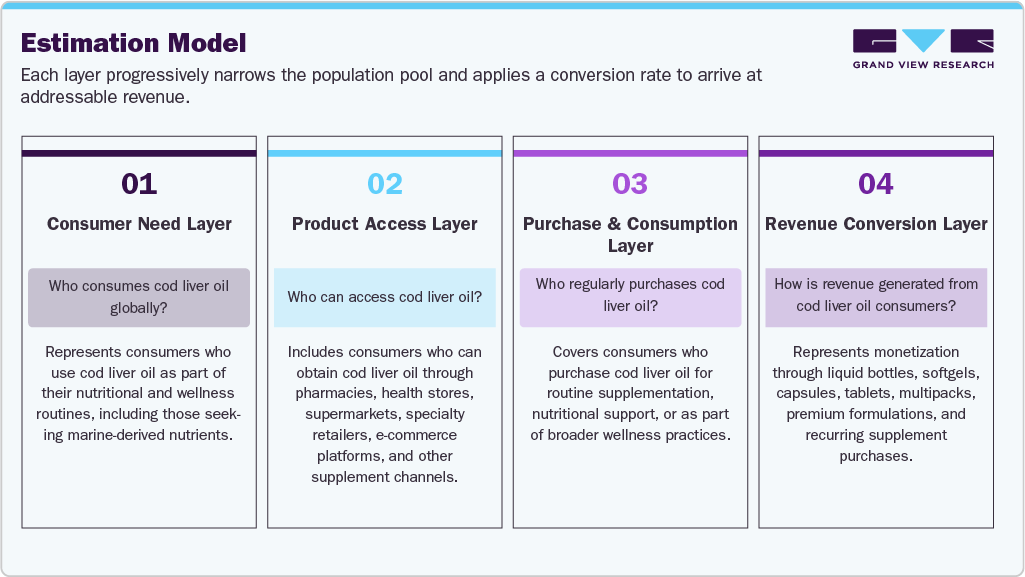
Estimation Model
Customization Table
Client Request
Customization Delivered
Value Adds
Global cod liver oil Product & Flavor Landscape
Assessed key product formats, flavor profiles, topping combinations, portion sizes, and formulation trends across major markets.
Supports product differentiation, flavor innovation, and portfolio expansion.
Global cod liver oil Distribution & Channel Landscape
Evaluated the role of supermarkets, convenience stores, specialty outlets, foodservice establishments, and digital ordering channels in market reach.
Helps optimize channel strategies, identify high-potential routes to market, and improve consumer accessibility.
Global cod liver oil Regional Demand Assessment
Analyzed consumption patterns, market maturity, climate influence, local preferences, and category development across key geographic regions.
Supports regional prioritization, market-entry planning, and targeted expansion strategies.
Frequently Asked Questions About This Report
The global cod liver oil market size was valued at USD 142.3 million in 2025 and is estimated at USD 150.5 million for 2026.
The global cod liver oil market is expected to grow at a CAGR of 7.2% from 2026 to 2033, reaching USD 245.5 million by 2033
Key factors include rising health consciousness, growing demand for omega-3 supplements, and increasing awareness of the benefits of vitamins A and D for overall wellness.
The Atlantic cod liver oil market led with a 60.1% revenue share in 2025.
The arctic cod liver oil market is projected to grow at the fastest CAGR of 7.5% from 2026 to 2033.
The use of cod liver oil in dietary supplements led with a 64.4% revenue share in 2025.
The softgels form segment accounted for the largest share of 45.4% of the revenue in 2025.
The capsules & tablets form segment is projected to grow at a CAGR of 5.3% from 2026 to 2033.
Key players include Nordic Naturals, NOW Foods, J.R. Carlson Laboratories.INC, Garden of Life, Seven Seas, Lýsi hf, Nature Made, Olvea Fish Oils, Nature’s Bounty, and WN Pharmaceuticals Ltd.
About the Author(s)
Consumer F&B Research Team
Consumer Goods · Consumer F&BThis report was authored by the consumer f&b research team at Grand View Research - comprising two research analysts, one senior research analyst, and one industry expert - with specialized expertise in the consumer f&b segment of the consumer goods industry. All findings are based on proprietary consumer goods databases, executive interviews, and regulatory analysis, subject to internal peer review prior to publication.
Last Updated:
Speak to Analyst


Customize this report to your needs — add regions, segments, or data points, with 20% free customization.
Or view our licence options:


ISO 9001:2015 & 27001:2022 Certified
We are GDPR and CCPA compliant! Your transaction & personal information is safe and secure. For more details, please read our privacy policy.


