
- Home
- »
- Advanced Interior Materials
- »
-
Cold Weather Construction Materials Market Report, 2033GVR Report cover

Cold Weather Construction Materials Market (2026 - 2033)
Size, Share & Trends Analysis Report By Material Type (Cold-Weather Concrete Admixtures, Concrete Curing And Protection Materials, Thermal Insulation Materials), By Application, By End Use, By Region, And Segment Forecasts
Market Size, 2025
$18.6BMarket Estimate, 2026
$19.7BMarket Forecast, 2033
$29.7BCAGR, 2026–2033
6.1%Cold Weather Construction Materials Market Summary
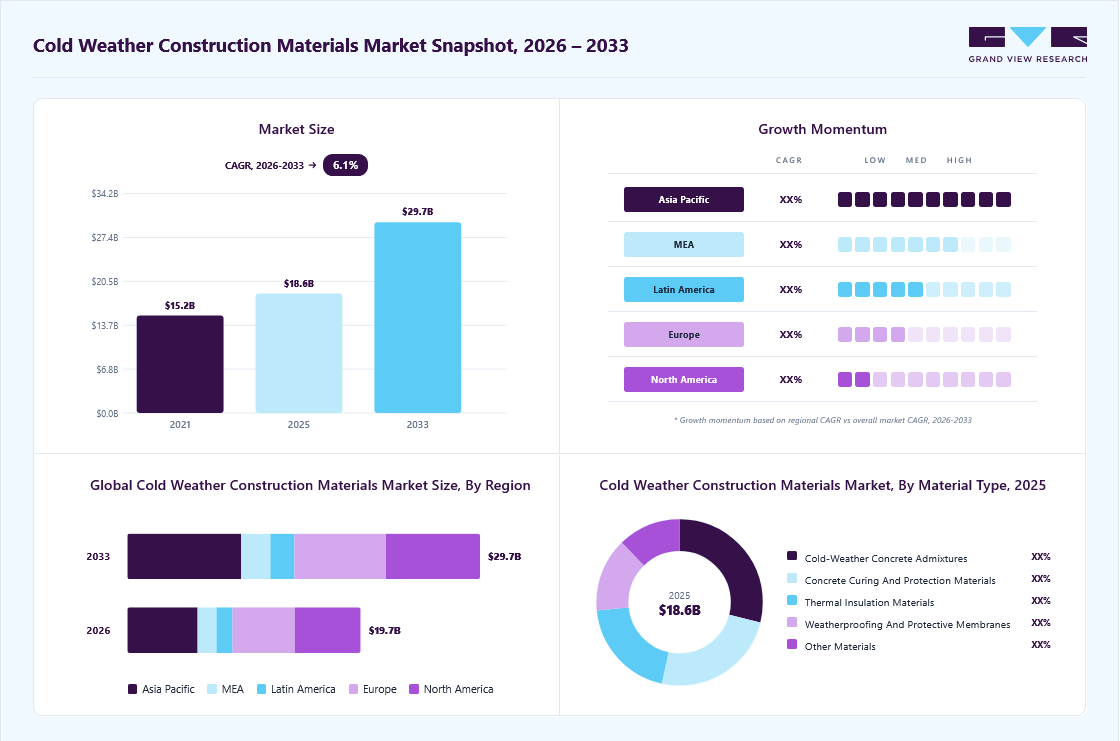
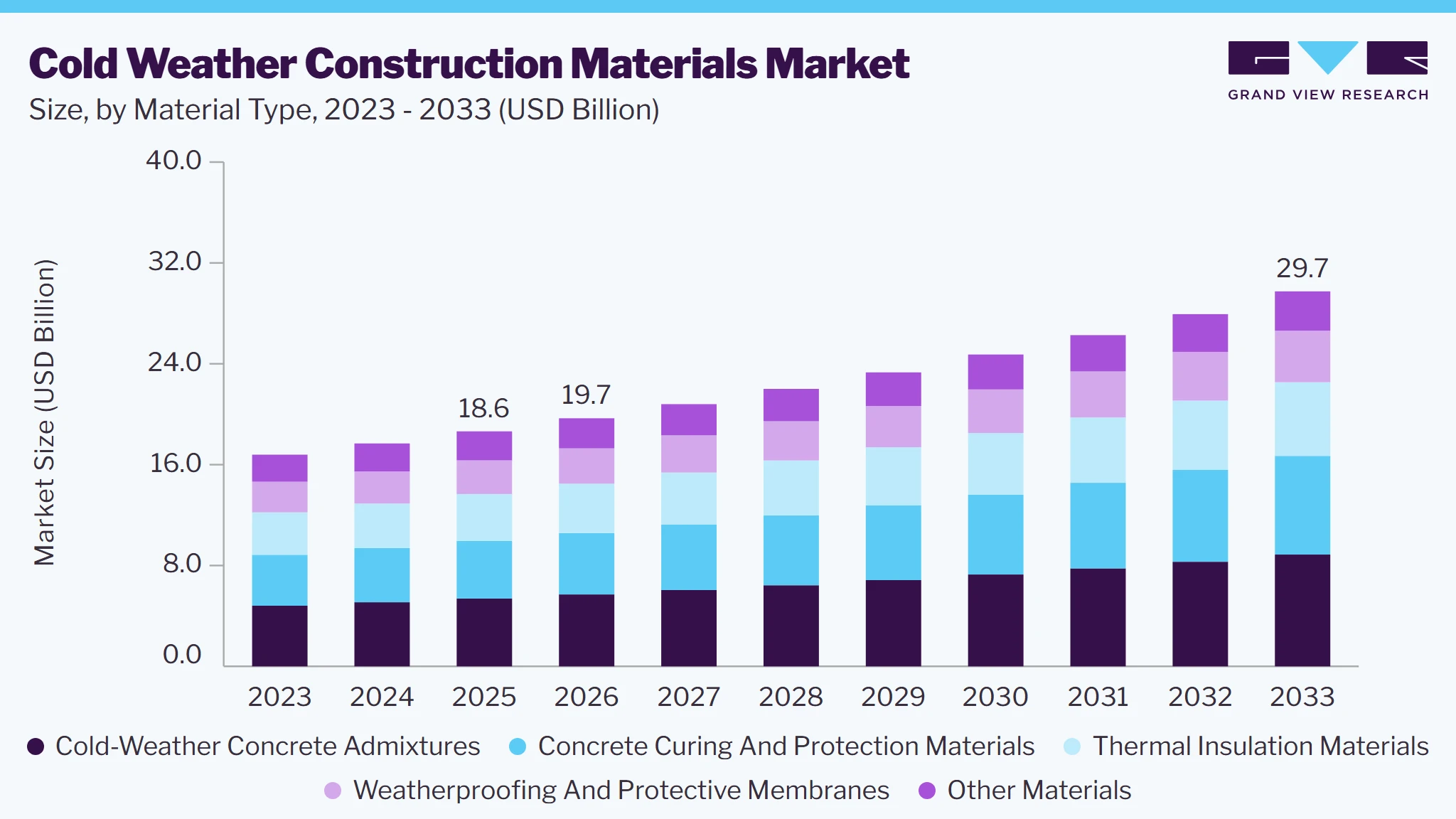
The cold weather construction materials market size was estimated at USD 18.6 billion in 2025 and is projected to grow from USD 19.7 billion in 2026 to USD 29.7 billion by 2033, growing at a CAGR of 6.1% from 2026 to 2033. Asia pacific dominated the market, accounting for a revenue share of 29.8% in 2025. The cold weather construction materials market comprises specialized construction materials, additives, insulation systems, curing solutions, and protective products designed to support building activities in low-temperature environments.
 Source: Grand View Research, IR Documents, Primary Interviews, Paid DatabasesTo learn more about this report,
 Download Free Sample Report
Key Market Trends & Insights
- The infrastructure construction segment is expected to grow at a CAGR of 7.1% over the forecast period.
- By application, the concrete placement and curing segment dominated the market with a revenue share of 39.9% in 2025.
- The concrete curing and protection materials segment is projected to register a CAGR of 7.0% during the forecast period from 2026 to 2033.
Regional Highlights
- Largest regional market: Asia Pacific (29.8% revenue share, 2025)
- By country: China held the largest market share in 2025.
Market Size & Forecast
- Market size in 2025: USD 18.6 Billion
- Estimated market size in 2026: USD 19.7 Billion
- Projected market size by 2033: USD 29.7 Billion
- CAGR (2026-2033): 6.1%
GVR research-powered AIAsk Prism AI about the cold weather construction materials marketGet cited answers from GVR research on market growth, segments, regulations and forecasts.Start with✓ Source-linked answers ✓ Market-specific context ✓ Traceable figuresExplore Prism AI ↗These materials help maintain concrete strength development, reduce the risk of freezing-related damage, improve thermal performance, and protect construction components during winter conditions. Demand is associated with residential, commercial, industrial, and infrastructure projects undertaken in regions that experience prolonged winters, seasonal freezing, and frequent temperature fluctuations. Market growth is supported by construction activity in cold-climate regions, infrastructure modernization, urban development, and the need to extend construction schedules beyond traditional warm-weather periods. Concrete accelerators, non-chloride admixtures, cold-weather curing compounds, thermal insulation materials, protective coverings, and temporary heating systems help contractors manage low-temperature conditions. The use of these products can reduce weather-related delays, minimize rework, and support consistent construction quality.
 To learn more about this report, Download Free Sample Report
Technological development is focused on improving the performance, reliability, and ease of application of construction materials under low-temperature conditions. Advances in concrete admixtures, rapid-strength development, non-chloride accelerators, thermal curing blankets, insulated formwork, and moisture-resistant insulation systems help address common winter construction challenges. Manufacturers are also developing lower-emission formulations, recycled-content insulation products, and energy-efficient building envelope solutions that align with broader sustainability objectives.
Market Dynamics
The cold weather construction materials market is influenced by climatic conditions, construction expenditure, project scheduling requirements, material performance, and regional building regulations. Demand varies according to the severity and duration of winter conditions, the types of construction projects undertaken, and the availability of materials suitable for low-temperature applications. Contractors evaluate products based on their ability to maintain workability, support curing, resist freeze-thaw damage, and preserve building envelope performance. Material costs, installation requirements, transportation conditions, and the availability of skilled labor also affect purchasing decisions.
Construction companies operating in cold-climate regions increasingly seek materials that allow projects to continue during winter rather than relying exclusively on favorable weather conditions. Low temperatures can slow concrete strength development, increase the risk of early-age freezing, and affect the installation of certain building products. Cold-weather admixtures, insulated curing systems, temporary enclosures, and protective coverings help contractors manage these challenges and maintain project schedules. Demand is particularly relevant to infrastructure projects, commercial developments, industrial facilities, and residential construction where delays can increase labor costs, equipment expenses, and contractual risks. The ability to maintain construction quality under adverse weather conditions makes specialized materials an important part of project planning.
Infrastructure renewal and investment in energy-efficient buildings provide an additional source of demand. Roads, bridges, parking structures, utility facilities, and other exposed structures require materials that can withstand repeated freeze-thaw cycles and temperature variations. In residential and commercial buildings, high-performance insulation, air-sealing products, weather barriers, and moisture-control systems help reduce heat loss and improve indoor comfort during winter. As developers place greater emphasis on building durability, operating efficiency, and predictable project completion, demand is expected to benefit from the combined need for low-temperature construction performance and long-term protection against cold-weather damage.
Demand for several cold-weather construction products is seasonal and depends on prevailing temperatures, regional construction schedules, and the timing of infrastructure projects. Contractors in areas with mild winters may have limited requirements for specialized admixtures, heated enclosures, or intensive curing protection. This variability can affect production planning, inventory management, and capacity utilization for suppliers serving geographically concentrated markets. Construction companies may also adjust project schedules to avoid extreme weather instead of investing in additional materials and equipment, limiting adoption where winter construction is not economically necessary.
The growing emphasis on energy-efficient buildings and resilient infrastructure creates opportunities for integrated cold-weather construction materials that combine thermal protection, moisture control, durability, and ease of installation. High-performance insulation, advanced air barriers, insulated formwork, freeze-thaw-resistant concrete systems, and low-emission construction chemicals can address multiple project requirements within a coordinated material solution. Suppliers can also develop products tailored to renovation projects, prefabricated construction, remote infrastructure sites, and buildings exposed to repeated temperature fluctuations. Solutions that simplify installation and reduce dependence on extensive temporary heating may provide additional value to contractors.
Market Concentration & Characteristics
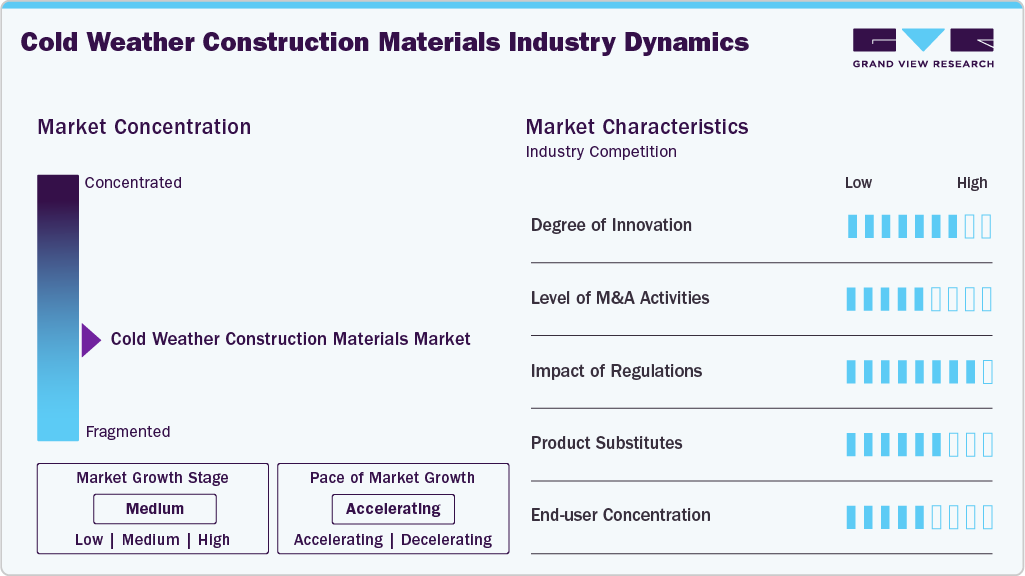
The cold weather construction materials market is characterized by a mix of large construction chemical manufacturers, insulation producers, building envelope specialists, and regional suppliers serving specific climatic and application requirements. Competition varies across product categories, as concrete admixtures, thermal insulation, curing systems, weather barriers, and protective construction products have different manufacturing processes, distribution channels, and technical requirements. Established manufacturers benefit from broad product portfolios, established contractor relationships, technical service capabilities, and compliance with regional construction standards. Regional suppliers remain relevant because material availability, transportation costs, climate conditions, and local building practices influence purchasing decisions.
 To learn more about this report, Download Free Sample Report
The threat of substitutes in the cold weather construction materials market is moderate because certain specialized products can be replaced by alternative construction methods, conventional materials used with additional protection, or changes to project scheduling. For example, contractors may use temporary heating, insulated enclosures, thermal blankets, or modified curing procedures instead of relying exclusively on chemical admixtures. In building envelopes, different insulation materials and weatherproofing systems can provide comparable thermal protection, depending on installation conditions and performance requirements. However, substitutes are not always interchangeable because concrete curing, freeze-thaw resistance, moisture management, and structural performance depend on application-specific technical requirements.
Analyst Perspective
The cold weather construction materials market is driven by the need to maintain construction quality, minimize weather-related delays, and improve building durability in low-temperature environments. Demand is supported by infrastructure development, winter construction activity, and growing requirements for energy-efficient building envelopes. Cold-weather concrete admixtures and curing materials address immediate construction challenges, while thermal insulation and protective membranes support long-term building performance. Market opportunities depend on regional climatic conditions, construction expenditure, regulatory requirements, and contractor adoption of specialized materials. Manufacturers offering reliable low-temperature performance, cost-effective solutions, and technical support are well positioned to strengthen their market presence.
Material Type Insights
The cold-weather concrete admixtures segment held the highest revenue share of 28.9% in 2025, due to its essential role in maintaining concrete performance under low-temperature conditions. Accelerating admixtures and antifreeze additives help support setting, early strength development, and protection against freezing during concrete placement. Their application across residential buildings, commercial developments, and infrastructure projects supports widespread demand. The need to minimize weather-related delays and maintain construction schedules further strengthens the segment's market position.
The concrete curing and protection materials segment is expected to grow at a CAGR of 7.0% over the forecast period, as contractors increasingly focus on maintaining concrete temperature and preventing early-age freezing during winter construction. Insulated curing blankets, protective covers, curing compounds, and insulated formwork help maintain suitable curing conditions and support concrete strength development. Rising infrastructure investment, the need to reduce weather-related rework, and increased adoption of planned winter construction practices are expected to support demand for these materials.
Application Insights
The concrete placement and curing segment held the highest revenue share of 39.9% in 2025, because concrete work requires careful temperature management, setting control, and protection during cold weather. Low temperatures can delay hydration and strength development, increasing the need for specialized admixtures, curing compounds, thermal blankets, and protective enclosures. Their use across foundations, structural components, roads, bridges, and commercial buildings supports demand. The importance of maintaining concrete quality and meeting project schedules further contributes to the segment's leading position.
The building envelope insulation and weatherproofing segment is expected to grow at a CAGR of 6.2% over the forecast period, due to increasing demand for energy-efficient buildings, improved thermal comfort, and protection against moisture infiltration in cold climates. High-performance insulation, air barriers, weatherproofing membranes, and sealants help reduce heat loss and protect exterior building components from freezing conditions and moisture-related deterioration. Building renovation initiatives, stricter energy-efficiency requirements, and growing emphasis on long-term building performance are expected to create additional demand across residential and commercial construction.
End Use Insights
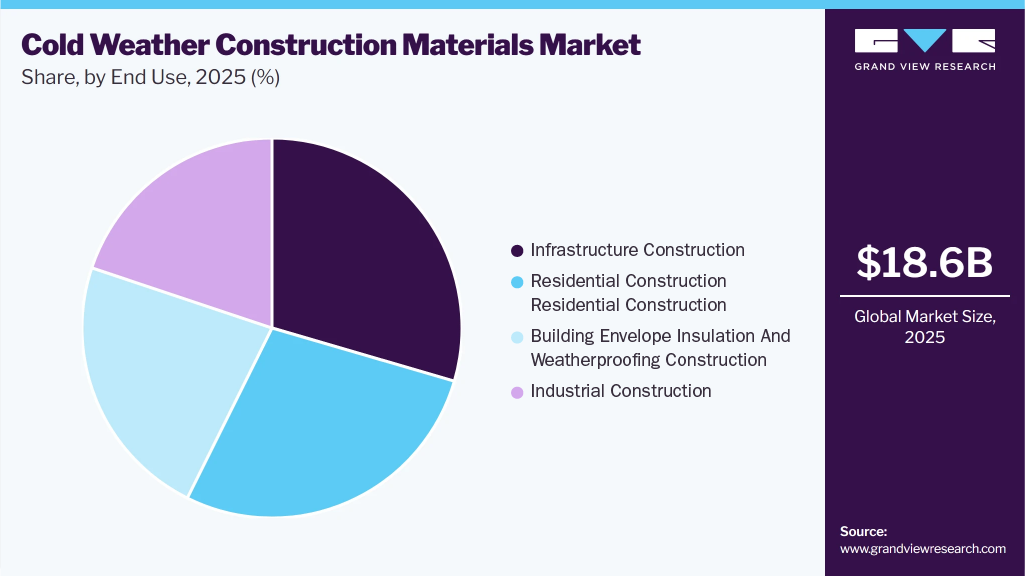
The infrastructure construction segment held the highest revenue market share of 29.5% in 2025, supported by the need for durable materials in roads, bridges, tunnels, railways, and other public infrastructure exposed to freezing temperatures and repeated freeze-thaw cycles. These projects require concrete admixtures, curing and protection materials, and weather-resistant solutions to maintain structural performance and reduce weather-related construction delays. Infrastructure development, rehabilitation of aging assets, and the need to improve long-term durability support demand for cold-weather construction materials across major cold-climate regions.
 To learn more about this report, Download Free Sample Report
The industrial construction segment is expected to grow at a CAGR of 6.1% over the forecast period, as investments in manufacturing facilities, warehouses, processing plants, and logistics infrastructure increase across regions experiencing cold weather. These projects require reliable concrete performance, structural durability, thermal insulation, and weatherproofing to support construction under challenging climatic conditions. The expansion of industrial facilities in colder regions and the need to maintain project schedules throughout winter are expected to encourage the use of specialized admixtures, curing systems, and protective construction materials.
Regional Insights
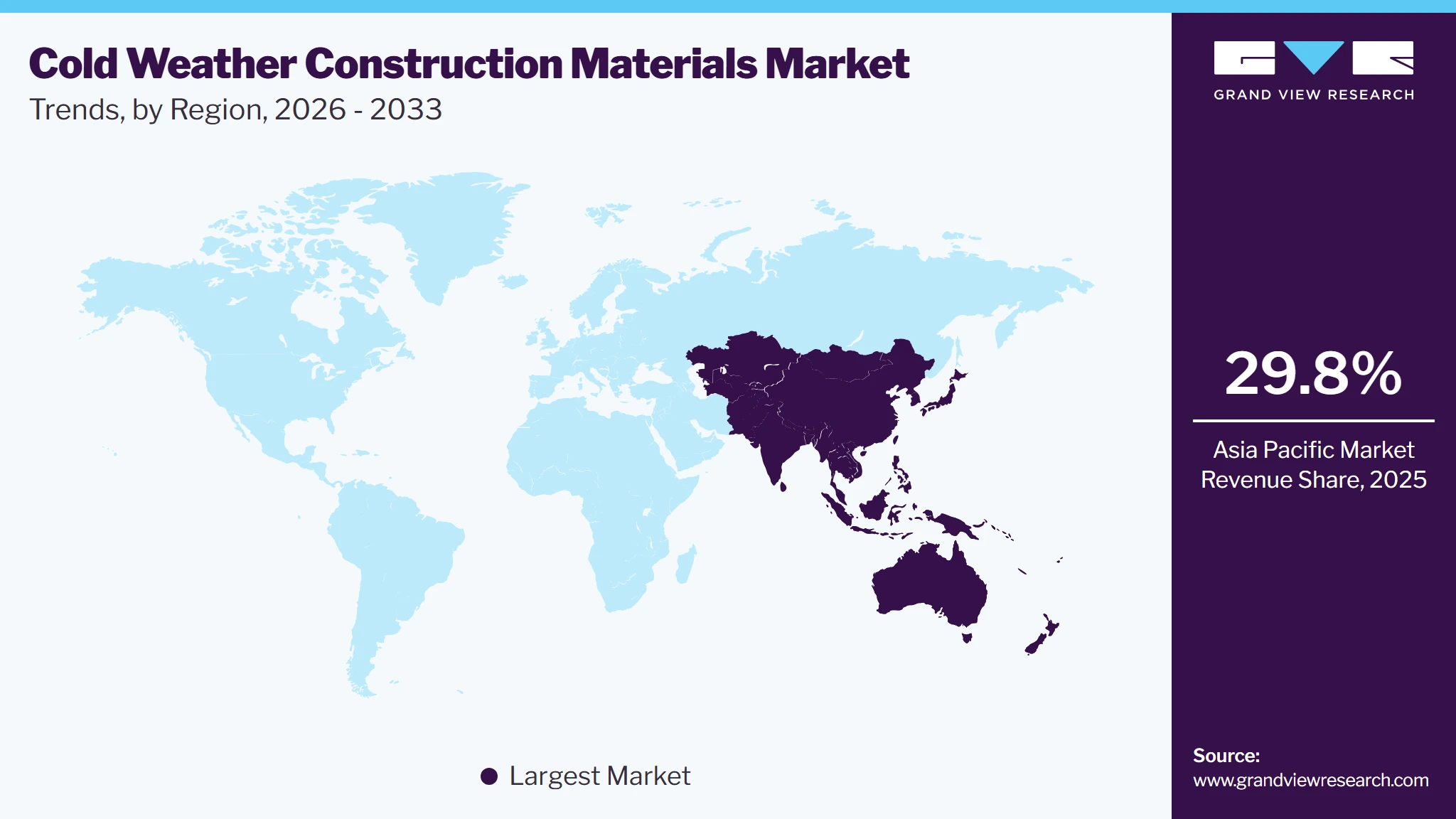
Asia Pacific dominated the global cold weather construction materials market and accounted for the largest revenue share of 29.8% in 2025, as it presents a diverse market because cold-weather construction requirements vary substantially between temperate, tropical, and high-altitude regions. China, Japan, South Korea, and colder parts of the Himalayan region experience conditions that can increase demand for winter construction materials. Residential development, commercial construction, industrial facilities, and infrastructure projects support the use of insulation, concrete admixtures, protective coverings, and weather-resistant building products in relevant locations. Energy-efficient building requirements and modernization of existing structures provide additional demand opportunities.
 To learn more about this report, Download Free Sample Report
China Cold Weather Construction Materials Market Trends
China’s cold weather construction materials market is shaped by demand for energy-efficient buildings, winter construction solutions, and improvements to existing building stock, particularly across northern and northeastern provinces that experience prolonged freezing conditions. Demand for high-performance thermal insulation, cold-weather concrete admixtures, curing compounds, insulated formwork, and freeze-thaw-resistant materials is supported by building energy-efficiency standards and investments in energy-saving renovations. The market is also moving toward low-carbon construction materials, improved insulation systems, and technologies that help maintain concrete quality during winter construction.
North America Cold Weather Construction Materials Market Trends
North America represents an important market for cold weather construction materials because several parts of the United States and Canada experience prolonged winters, freezing temperatures, and repeated freeze-thaw cycles. Demand is supported by residential and commercial construction, infrastructure rehabilitation, industrial development, and maintenance of roads and bridges exposed to severe weather. Concrete admixtures, curing blankets, insulated enclosures, thermal insulation, and moisture-resistant building envelope products support construction activities during colder months.
U.S. Cold Weather Construction Materials Market Trends
The U.S. market is influenced by winter construction requirements across the Northeast, Midwest, northern mountain states, and other regions experiencing seasonal freezing. Commercial buildings, residential developments, transportation infrastructure, and industrial facilities create demand for low-temperature concrete solutions, protective curing systems, and high-performance insulation. Contractors assess materials based on installation temperature limits, concrete strength development, durability, and compatibility with project specifications. Building energy codes and requirements for weather-resistant construction further support the use of thermal insulation, air barriers, and moisture-control products.
Europe Cold Weather Construction Materials Market Trends
Europe offers demand across northern, central, and eastern countries where winter temperatures affect construction schedules and building performance. Residential construction, commercial development, infrastructure rehabilitation, and energy-efficiency upgrades support the use of thermal insulation, weather barriers, cold-weather concrete admixtures, and protective curing solutions. Building renovation programs and energy-performance requirements encourage improvements to insulation, airtightness, and moisture management. Contractors must also account for country-specific building regulations, material standards, and climatic conditions.
Germany Cold Weather Construction Materials Market Trends
Germany's market is supported by residential and commercial construction, industrial facilities, infrastructure maintenance, and building renovation. Winter temperatures and seasonal freezing create requirements for appropriate concrete placement, curing protection, and durable exterior building materials. Thermal insulation, airtight construction systems, weather barriers, and moisture-control solutions also support building energy performance. Energy-efficiency regulations and renovation requirements encourage investment in building envelope improvements, while construction chemical suppliers provide products designed for specific installation conditions.
Central and South America Cold Weather Construction Materials Market Trends
Central and South America represent a varied market in which cold-weather construction demand is concentrated in higher-altitude areas, southern regions, and locations experiencing seasonal temperature declines. Construction activity in the Andes, southern Chile, Argentina, and other colder areas can require thermal insulation, weatherproofing, and appropriate concrete protection. Infrastructure development, housing construction, and renovation projects support the adoption of materials suited to local climatic conditions. In warmer markets, demand for specialized winter construction products is more limited and may be confined to specific elevations or project requirements.
Middle East & Africa Cold Weather Construction Materials Market Trends
The Middle East and Africa market is primarily influenced by construction activity, infrastructure investment, and localized climatic requirements rather than widespread severe winter conditions. Demand for cold-weather construction materials is concentrated in high-altitude locations, mountainous areas, and projects exposed to seasonal freezing. Insulation, moisture protection, concrete admixtures, and weather-resistant building systems may be required where temperature fluctuations affect construction quality or building performance.
Key Companies & Market Share Insights
Some of the key players operating in the market include Sika and Fosroc
-
Sika is a global specialty chemicals manufacturer providing construction solutions across concrete admixtures, curing, waterproofing, insulation, sealing, and structural protection. Its product portfolio includes solutions that support concrete performance and durability under challenging climatic conditions, making the company relevant to the cold weather construction materials market.
-
Fosroc is an international manufacturer of high-performance construction chemicals, with a strong focus on concrete and cement applications. Its portfolio includes concrete admixtures, accelerators, curing compounds, waterproofing systems, and protective coatings. Its Conplast NC accelerator is identified for use in low-temperature regions, supporting its relevance to cold-weather construction.
Yara International and Quikrete are some of the emerging market participants in the cold weather construction materials market.
-
Yara International is a Norwegian company primarily focused on crop nutrition, ammonia, and industrial nitrogen-based solutions. Its chemical expertise may be relevant to certain industrial material applications; however, its direct participation in cold-weather construction materials should be verified against specific construction-grade products before including it as a core market competitor.
-
QUIKRETE is a major manufacturer of packaged concrete, mortar, grout, repair products, stucco, and other cement-based construction materials. Its portfolio serves residential, commercial, and infrastructure-related construction and repair activities. The company is relevant to the broader cold-weather construction materials market through its concrete and masonry product offerings, although individual products should be checked for suitability at low temperatures.
Key Cold Weather Construction Materials Companies
The following key companies have been profiled for this study on the cold weather construction materials market.
-
Sika
-
Fosroc
-
MAPEI
-
The Euclid Chemical Company
-
Master Builders Solutions
-
GCP Applied Technologies Inc.
-
Quikrete
-
Yara International
-
WOTAIchem
-
Henry Company
Competitive Benchmarking
Category
Operating Strategies
Competitive Edge
Weakness
Established Players (Sika, Fosroc, MAPEI, The Euclid Chemical Company, Master Builders Solutions, GCP Applied Technologies Inc.)
Expand cold-weather concrete admixture, curing, waterproofing, and insulation product portfolios to address diverse construction requirements.
Invest in product development to improve low-temperature performance, concrete strength development, and freeze-thaw resistance.
Strengthen distribution networks and technical support for infrastructure, commercial, and residential construction projects across cold-climate regions.
Established market presence and extensive construction chemical portfolios across multiple applications.
Strong technical expertise in concrete admixtures, curing systems, waterproofing, and building protection.
Established distribution channels, product testing capabilities, and contractor relationships support adoption across large construction projects.
Exposure to fluctuations in chemical raw material costs and construction demand.
Product performance requirements and regional regulations increase testing and compliance costs.
Competition from alternative materials and specialized regional suppliers can create pricing pressure in individual product categories.
Emerging Players (Quikrete, Yara International, WOTAIchem, Henry Company)
Expand specialized construction material offerings for low-temperature applications, concrete protection, and building envelope performance.
Develop application-specific formulations and weatherproofing solutions to address regional construction requirements.
Strengthen partnerships with distributors, contractors, and construction companies to increase product availability and adoption across relevant markets.
Specialized capabilities in concrete products, chemical formulations, waterproofing, and building envelope protection.
Opportunities to address niche applications through targeted product portfolios and regional distribution.
Flexibility in serving specific construction requirements can support differentiation in selected product categories.
Comparatively limited presence in some specialized cold-weather material categories or geographic markets.
Dependence on construction activity, raw material availability, and distribution reach can affect growth.
Establishing product credibility, demonstrating low-temperature performance, and meeting regional standards may require additional investment.
Recent Developments
-
In March 2026, Sika announced five new manufacturing sites across the United States, Argentina, Colombia, Bangladesh, and Tanzania. The new Florida facility produces concrete admixtures, strengthening production capacity for materials that improve concrete performance, durability, and sustainability.
- In February 2026, MAPEI introduced Mapeair N, a natural air-entraining admixture designed to improve concrete durability under freeze-thaw conditions.
Cold Weather Construction Materials Market Report Scope
Report Attribute
Details
Market size in 2025
USD 18.6 billion
Estimated market size in 2026
USD 19.7 billion
Projected market size by 2033
USD 29.7 billion
Growth rate
CAGR of 6.1% from 2026 to 2033
Actual estimates/Historical data
2021 - 2024
Forecast period
2026 - 2033
Quantitative units
Revenue in USD billion and CAGR from 2026 to 2033
Report coverage
Revenue forecast, company ranking, competitive landscape, growth factors, and trends
Segments covered
Material type, application, end use, and region.
Regional scope
Global
Country scope
U.S., Canada, Mexico, Germany, UK, France, Italy, Spain, China, Japan, India, South Korea, Brazil, Saudi Arabia
Key companies profiled
Sika, Fosroc, MAPEI, The Euclid Chemical Company, Master Builders Solutions, GCP Applied Technologies Inc., Quikrete, Yara International, WOTAIchem, Henry Company
Customization scope
Free report customization (equivalent up to 8 analysts working days) with purchase. Addition or alteration to country, regional & segment scope.
Pricing and purchase options
Avail customized purchase options to meet your exact research needs. Explore purchase options
Global Cold Weather Construction Materials Market Report Segmentation
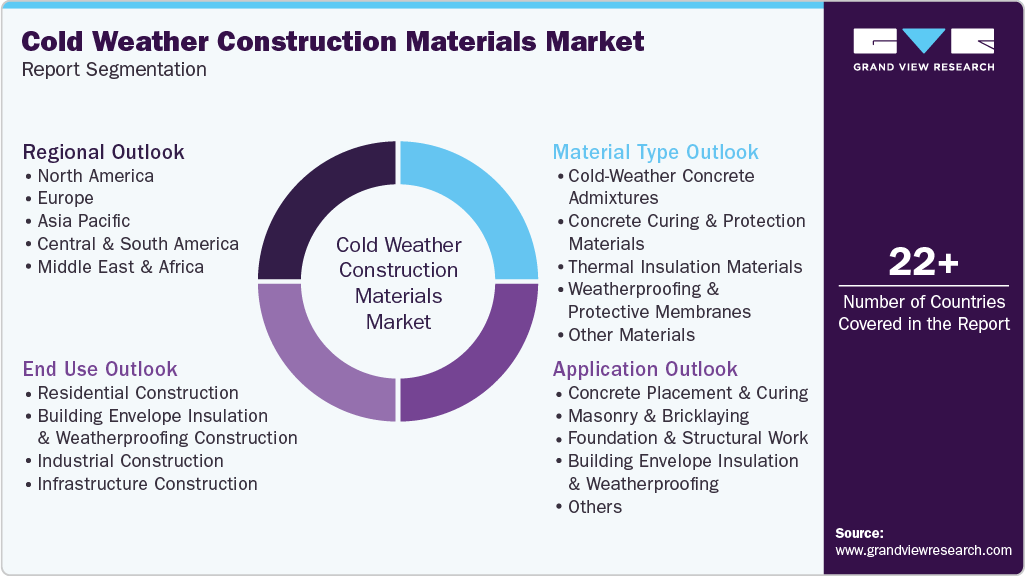
This report forecasts revenue growth at regional & country levels and provides an analysis on the industry trends in each of the sub-segments from 2021 to 2033. For the purpose of this study, Grand View Research has segmented the cold weather construction materials market on the basis of material type, application, end use, and region:
 To learn more about this report, Download Free Sample Report
-
Material Type Outlook (Revenue, USD Million; 2021 - 2033)
-
Cold-Weather Concrete Admixtures
-
Concrete Curing and Protection Materials
-
Thermal Insulation Materials
-
Weatherproofing and Protective Membranes
-
Other Materials
-
-
Application Outlook (Revenue, USD Million; 2021 - 2033)
-
Concrete Placement and Curing
-
Masonry and Bricklaying
-
Foundation and Structural Work
-
Building Envelope Insulation and Weatherproofing
-
Others
-
-
End Use Outlook (Revenue, USD Million; 2021 - 2033)
-
Residential Construction
-
Building Envelope Insulation and Weatherproofing Construction
-
Industrial Construction
-
Infrastructure Construction
-
-
Regional Outlook (Revenue, USD Million; 2021 - 2033)
-
North America
-
U.S.
-
Canada
-
Mexico
-
-
Europe
-
UK
-
Germany
-
France
-
Italy
-
Spain
-
-
Asia Pacific
-
China
-
Japan
-
India
-
South Korea
-
-
Central and South America
-
Brazil
-
-
Middle East and Africa
-
Saudi Arabia
-
-
Research Methodology
The cold weather construction materials market figures in this report are based on a proven research process that combines executive interviews with secondary research from proprietary databases, company filings, and recognized regulatory and institutional sources. Market size is built through value-chain sizing-reconciling supply-side and demand-side estimates-and triangulated with bottom-up and top-down approaches. Every estimate passes multiple levels of expert validation before publication, with each cold weather construction materials segment quantified using the revenue-capture definitions in the table below.
Segment Definition
Material Type
Revenue Capture Definition
Cold-Weather Concrete Admixtures
Revenue generated from cold-weather concrete admixtures, including accelerating admixtures, non-chloride accelerators, and other chemical additives used to support concrete setting, strength development, and performance under low-temperature conditions.
Concrete Curing and Protection Materials
Revenue generated from concrete curing and protection materials, including curing blankets, insulated formwork, protective covers, and curing compounds used to maintain concrete temperatures and protect freshly placed concrete during cold weather.
Thermal Insulation Materials
Revenue generated from thermal insulation materials used in cold-climate construction to reduce heat loss, improve building energy efficiency, and maintain indoor thermal comfort across walls, roofs, floors, foundations, and other building components.
Weatherproofing and Protective Membranes
Revenue generated from weatherproofing and protective membranes used to protect buildings and structures against moisture penetration, wind exposure, freezing conditions, and weather-related deterioration during construction and throughout their service life.
Other Materials
Revenue generated from other cold-weather construction materials, including specialized sealants, frost-protection products, temporary protective coverings, and related materials used to support construction quality and structural durability in low-temperature environments.
Application
Revenue Capture Definition
Concrete Placement and Curing
Revenue generated from cold-weather construction materials used during concrete mixing, placement, setting, and curing, including concrete admixtures, insulated curing systems, and protective materials that support strength development and prevent early-age freezing.
Masonry and Bricklaying
Revenue generated from cold-weather construction materials used in masonry and bricklaying, including cold-weather mortar additives, protective coverings, and related products that support mortar setting, bonding, and durability under low-temperature conditions.
Foundation and Structural Work
Revenue generated from cold-weather construction materials used in foundations and structural components, including specialized concrete admixtures, curing and protection systems, and frost-resistant materials used in footings, slabs, columns, beams, and other load-bearing structures.
Building Envelope Insulation and Weatherproofing
Revenue generated from insulation materials, weatherproofing membranes, sealants, and protective systems used in building envelopes to minimize heat loss, control moisture infiltration, and protect walls, roofs, and other exterior components against cold-weather exposure.
Others
Revenue generated from cold-weather construction materials used in other applications, including site preparation, repair and maintenance, temporary construction enclosures, and ancillary construction activities requiring protection against low temperatures and winter weather.
End Use
Revenue Capture Definition
Building Envelope Insulation and Weatherproofing Construction
Revenue generated from cold-weather construction materials used in building envelope insulation and weatherproofing projects, including thermal insulation, protective membranes, air barriers, sealants, and related products designed to improve thermal performance and protect buildings against moisture and freezing conditions.
Residential Construction
Revenue generated from cold-weather construction materials used in residential buildings, including houses, apartments, and multifamily developments, to support winter construction, concrete curing, thermal insulation, weatherproofing, and long-term energy efficiency.
Industrial Construction
Revenue generated from cold-weather construction materials used in factories, manufacturing facilities, warehouses, processing plants, and other industrial structures requiring low-temperature construction solutions, structural protection, insulation, and weather-resistant building systems.
Infrastructure Construction
Revenue generated from cold-weather construction materials used in roads, bridges, tunnels, railways, utility facilities, and other infrastructure projects requiring concrete protection, freeze-thaw resistance, structural durability, and reliable construction performance in cold climates.
Estimation Model
Layer Name
Key Question
Description
Parent Market Analysis
What is the overall size and growth outlook of the broader construction materials market?
The estimation begins by assessing construction activity, residential and commercial development, infrastructure investment, climatic conditions, and winter construction requirements to establish the total addressable market for cold weather construction materials.
Cold Weather Construction Materials Penetration Analysis
What is the market contribution of different cold weather construction material types?
This layer evaluates Cold-Weather Concrete Admixtures, Concrete Curing and Protection Materials, Thermal Insulation Materials, Weatherproofing and Protective Membranes, and Other Materials based on product adoption, low-temperature performance, manufacturing capabilities, and construction requirements.
Regional, Application & End-use Demand Assessment
Which regions, applications, and end uses contribute the highest demand?
Demand is assessed across North America, Europe, Asia Pacific, Central & South America, and the Middle East & Africa based on climatic conditions, construction activity, and building regulations. Applications and end uses are evaluated to determine revenue contributions across concrete placement and curing, masonry, structural work, residential construction, industrial construction, infrastructure, and building envelope insulation and weatherproofing.
Company Revenue Validation & Market Forecasting
How is the final market size validated and forecast?
Market estimates are validated using company revenues, product portfolios, manufacturing capacities, product launches, project pipelines, and expansion initiatives. Bottom-up and top-down approaches are triangulated with industry statistics and secondary research to develop market estimates and long-term forecasts for the Cold Weather Construction Materials Market.
Delivered Customizations
We have successfully delivered the following deep-dive customizations
Client Request
Customization Delivered
Value Adds
Material & Performance Benchmarking
Comparative assessment of cold-weather concrete admixtures, curing and protection materials, thermal insulation, and weatherproofing membranes based on low-temperature performance, freeze-thaw resistance, application requirements, durability, and installation conditions.
Helps stakeholders identify suitable materials, compare product performance, optimize material selection, and identify opportunities for product development.
Regional Regulatory & Construction Standards Assessment
Evaluation of regional building codes, concrete placement and curing requirements, energy-efficiency standards, insulation regulations, and material performance specifications across key cold-climate markets.
Supports regulatory compliance, identifies region-specific product requirements, and helps prioritize markets based on construction practices and regulatory conditions.
Cold-Climate Demand & Application Assessment
Analysis of winter construction activity, climatic exposure, infrastructure investment, and material demand across concrete placement, masonry, structural work, building envelopes, and major end-use sectors.
Helps businesses identify high-potential applications, align product portfolios with regional requirements, and prioritize commercial opportunities in cold-climate construction markets.
About the Author(s)
Advanced Interior Materials Research Team
Advanced Materials · Advanced Interior MaterialsThis report was authored by the advanced interior materials research team at Grand View Research - comprising two research analysts, one senior research analyst, and one industry expert - with specialized expertise in the advanced interior materials segment of the advanced materials industry. All findings are based on proprietary advanced materials databases, executive interviews, and regulatory analysis, subject to internal peer review prior to publication.
Last Updated:
Speak to Analyst

Customize this report to your needs - add regions, segments, or data points, with 20% free customization.
Or view our licence options:


ISO 9001:2015 & 27001:2022 Certified
We are GDPR and CCPA compliant! Your transaction & personal information is safe and secure. For more details, please read our privacy policy.


