
- Home
- »
- Advanced Interior Materials
- »
-
Composite Concrete Deck Market Size Report, 2026-2033GVR Report cover
![Composite Concrete Deck Market (2026 - 2033)Report]()
Composite Concrete Deck Market (2026 - 2033)
Size, Share & Trends Analysis Report By Thickness (1.5”,2”,3”), By Deck Type (Proprietary System, Precast, Site-Built), By Application (Residential, Commercial), By Region, And Segment Forecasts
Market Size, 2025
$3.8BMarket Estimate, 2026
$4.0BMarket Forecast, 2033
$6.5BCAGR, 2026–2033
7.1%Composite Concrete Deck Market Summary
The global composite concrete deck market was valued at USD 3.8 billion in 2025 and is projected to grow from USD 4.0 billion in 2026 to USD 6.5 billion in 2033, at a CAGR of 7.1% from 2026 to 2033. North America dominated the global composite concrete deck market with the largest revenue share of approximately 33.9% in 2025. This growth of the market is attributed to the surging demand for sustainable building materials in residential and commercial construction activities.
Key Market Trends & Insights
- By thickness type: The 3.0” thickness type segment led the market, holding the largest revenue share around 44.1% in 2025.
- By deck type: The site-built deck type segment is expected to hold a share of over 49.0% in 2025.
Regional Highlights
- Largest regional market: North America (approximately 33.9% revenue share, 2025)
Market Size & Forecast
- Market size in 2025: USD 3.8 Billion
- Estimated market size in 2026: USD 4.0 Billion
- Projected market size by 2033: USD 6.5 Billion
- CAGR (2026-2033): 7.1%
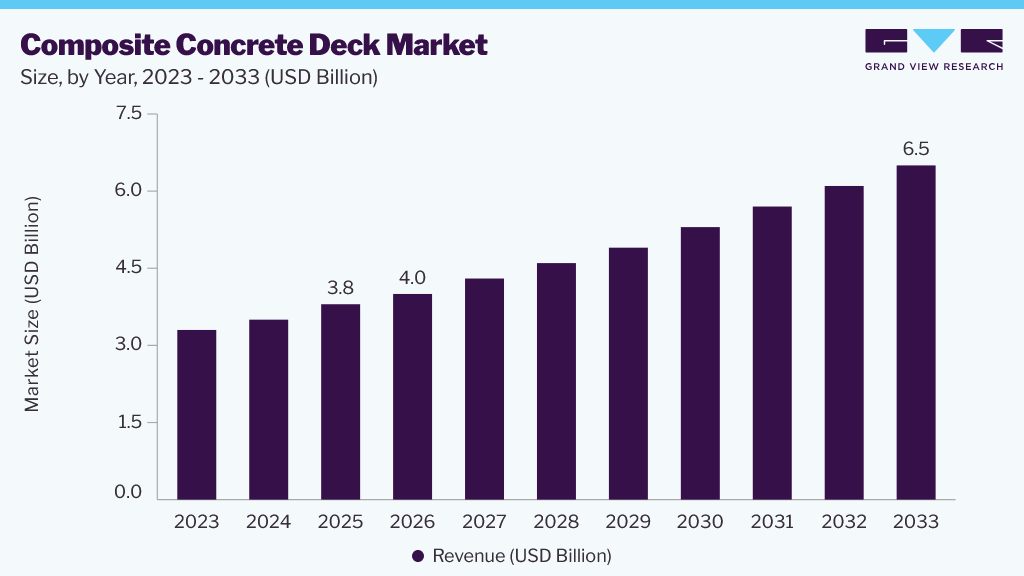
Environmental concerns and stringent regulations have encouraged the use of sustainable building materials such as composite decking. The composite concrete deck industry in the U.S. is expected to grow in the coming years as more consumers become aware of the benefits of composite decking and seek to upgrade their outdoor living spaces. Furthermore, a composite concrete deck requires little maintenance, which is another advantage in the U.S., where the cost of labor and materials can be high. The reduced need for maintenance also means less disruption to traffic and reduced costs during the life of the structure. Thus, these factors are expected to positively impact the market demand in the U.S. during the forecast period.
Thickness Type Insights
The 3.0” thickness type segment led the market and accounted for the largest revenue share of 42.35% in 2022. It is the most common and profound variety of composite floor deck. It is a decent flooring choice because it can support concrete slabs thicker than the 1.5" or 2.0" composite concrete deck. The majority of its applications in outdoor flooring are for larger spans. The market demand is expected to increase during the forecast period due to the expanding trends in the industrial and commercial construction industries.
2.0" thickness composite concrete decking is primarily used in various private and public sector projects, including offices, factories, hospitals, sports arenas, parking lots, etc. As a result, demand for the market is anticipated to increase during the forecast period due to the growth of commercial and industrial buildings worldwide owing to increased commercialization.
The market for a 1.5” thickness composite concrete deck is growing at the fastest CAGR of 7.3% during the forecast year 2023-2030. A 1.5" composite deck is majorly used for outdoor flooring applications. Short spans are best suited for this composite concrete deck type because of its low profile. Furthermore, the widespread use of 1.5" composite concrete deck in non-residential applications for low-rise, high-rise, and manufacturing sectors is one of the factors in the market's expansion.
Market Dynamics
The demand for composite concrete decking is largely driven by a broad industry shift toward quick-track construction programs for multi-rise/mixed-use projects. The lengthy curing and large amount of false work necessary for the construction of traditional in-place poured concrete frames hinder workflow at concentrated inner-city sites. With the addition of thin-concrete topping over corrugated steel profile sheets, the design engineer can avoid false work and create structurally safe access ways at several levels of a building simultaneously. The ability to save time drives commercial builders to select composite concrete decking for rapid project completion and reduced labor on site costs.
Commercial widespread use of composite floor decking is severely hampered by the large variations in price in the international market for sheet steel, and lack of certified field labor. Steel, (thin gauge structural steel) is the key support for these composite decks; any shocks to the supply chain of steel will immediately affect the material purchasing costs for contractors. In addition, full composite action between the concrete and the steel deck depends upon adequate field welding of heavy duty shear connector studs to the support beams via the metal deck, which requires high voltage, and certified trades people for welding-delay at the field when skilled people are not readily available.
The construction industry’s increasing focus on decarbonization is creating new opportunities for composite deck manufacturers to adopt lower-emission production processes. The use of structural steel sourced from Electric Arc Furnace (EAF) facilities powered by renewable energy enables reduced embodied carbon in decking systems, supporting compliance with corporate sustainability targets and green building certification requirements. The shift toward recyclable, circular steel profiles is also encouraging closer collaboration among steel producers, roll-forming companies, and construction design firms focused on sustainable infrastructure.
In 2024, Tata Steel UK advanced its decarbonization strategy through a government-supported transformation plan to transition its Port Talbot operations from blast furnace-based steelmaking to lower-emission EAF technology. The initiative aims to reduce carbon emissions and modernize steel production, supporting the broader supply of low-carbon steel for industrial and construction applications.
Analyst Perspective
The composite concrete deck market is projected to grow efficient structures over the coming years, driven by significant investments in commercial construction projects, infrastructure improvements, and the need for cost-effective structures. The market expansion can be attributed to the rapid rate of urbanization, industrial growth, and the increasing prevalence of sustainable construction practices. The key factors that continue to sustain steady demand are strong structural performance, increased load-carrying capacity, and shorter construction periods offered by composite concrete decks. The ability to integrate steel and concrete benefits into a single system, improving structural performance and durability, will act as a key differentiator. The market is positioned for sustained growth as construction stakeholders prioritize efficiency, safety, and long-term asset performance.
Thickness Type Insights
The 3.0" thickness type segment led the market and accounted for the largest revenue share of around 44.1% in 2025. It is the most common and profound variety of composite floor deck. It is a decent flooring choice because it can support concrete slabs thicker than the 1.5 inch or 2.0 inch composite concrete decks. It is mainly used in outdoor flooring for covering larger spaces. The demand for this category of decks is expected to increase during the forecast period due to changing trends in the construction sector and the growth of commercial and industrial buildings with rising commercialization.
The 1.5" thickness composite concrete deck segment is expected to record a notable CAGR over the forecast period. Composite decks having a thickness of 1.5" are mainly used for outdoor flooring applications. Short spans are best suited to this composite concrete deck type due to its low profile. Furthermore, the widespread use of 1.5" composite concrete decks in non-residential applications for low-rise, high-rise, and manufacturing sectors is one of the key factors driving their demand.
Deck Type Insights
Site-built deck type led the market, accounting for the largest revenue share of over 49.0% in 2025. Site-built concrete is preferable in composite concrete decks because it can provide additional structural integrity, making the deck more stable and resistant to movement or shifting. The additional benefit of site-built concrete over other segments is that it can be customized to fit the exact specifications of the deck. This ensures a perfect fit and a more cohesive overall design, which is expected to drive demand during the forecast period.
The proprietary system composite concrete deck type segment is projected to record a significant CAGR over the forecast period, from 2026 to 2033. Proprietary systems are manufactured to strict standards, ensuring consistency in the materials and dimensions. This can help ensure a consistent quality of the finished product. This consistency and quality control are critical in large or complex projects where a small error can cause significant problems. Rising use of proprietary systems in developed countries is likely to favor the growth of this segment.
Precast deck type accounted for a notable revenue share in 2025. There has been a growing use of precast concrete owing to its several benefits, such as offsite manufacturing, quick installation, high strength, and durability. Moreover, the major factors driving the demand for this material during the forecast period include its ability to withstand harsh weather conditions, heavy loads, and exposure to chemicals or other corrosive materials, which can prolong the structure's lifespan.
Application Insights
The residential application segment accounted for the largest market share in 2025. Composite concrete decks are known for their high durability and resistant to damage from weather, pests, and other environmental factors. In addition, they can last many years without requiring significant maintenance or repairs, making them a cost-effective choice for residential buildings. Composite concrete decking is used on a large scale in residential spaces as homeowners seek low-maintenance and eco-friendly alternatives over traditional wood decking. It is highly durable and requires less maintenance than wood, making it an attractive option for residential buildings for outdoor spaces without spending much time and money on upkeep.
In the commercial market, composite concrete decking is often used in public spaces, such as boardwalks, parks, and outdoor dining areas. Commercial applications often require high-performance materials that can withstand heavy foot traffic and exposure to the elements, and composite decking offers excellent durability and resistance to wear and tear. In addition, composite decking is often chosen for its low maintenance requirements, which can reduce maintenance costs for businesses and municipalities. These factors are anticipated to increase the demand for composite concrete decks in commercial construction over the coming years.
Regional Insights
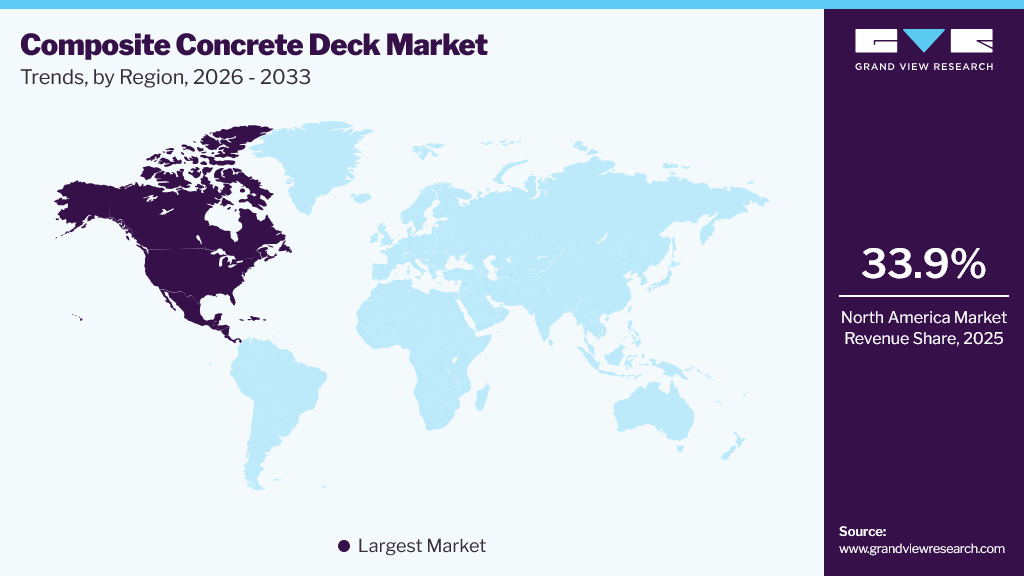
North America dominated the market and accounted for a revenue share of approximately 33.9% in the global composite concrete deck demand in 2025. This growth is attributed to rising concerns about sustainability and the environmental impact of building materials. Furthermore, composite deck is often made from recycled materials and is designed to last longer than a traditional wood deck, which reduces waste and helps protect the environment. There have been various regulations and initiatives introduced within the region to address these issues. These factors are likely to contribute to the growth of the market.
Asia Pacific Composite Concrete Deck Market Trends
In Asia Pacific, demand for the composite concrete deck is primarily driven by the increasing construction activity in the region. Furthermore, governments in the Asia Pacific region are investing heavily in infrastructure development, including roads, bridges, and buildings, owing to urbanization and population growth. Composite concrete deck is an attractive option for infrastructure projects because they are lightweight, durable, and easy to install. The abovementioned factors are anticipated to boost demand for the composite concrete deck in the region.
Europe Composite Concrete Deck Market Trends
Europe accounted for a notable share in 2025 and is expected to grow at a significant pace over the forecast period. The market is driven by the increasing demand for sustainable construction materials, the growing construction industry, technological advancements, favorable government policies, and increasing infrastructure investments.
Middle East & Africa Composite Concrete Deck Market Trends
The demand for composite concrete decks in the Middle East & Africa is anticipated to be driven by the growing residential sector during the forecast period because the construction industry has a multiplier effect on the economy, creating jobs and generating demand for goods and services. Growing investments in this industry in the region are anticipated to enhance market growth in the Middle East & Africa region.
Key Composite Concrete Deck Company Insights
The global composite concrete deck market is dominated by global and domestic established players. These companies focus on forward integration by providing products directly to end-users. Some of these companies also use an established distribution and sales network to connect with their customers across regions easily.
Key Composite Concrete Deck Companies:
The following key companies have been profiled for this study on the composite concrete deck market
-
ASC Steel Deck
-
Raised Floor Solutions Limited
-
Tata Steel
-
Prodeck-Fixing Ltd.
-
Structural Metal Decks
-
O’Donnell Metal Deck, LLC
-
Construction Metal Forming
-
Cordeck
-
A.C.T. Metal Deck Supply
-
TRUEDEK Steel Decking solutions
Recent Developments
-
In December 2025, Tata Steel, in collaboration with Constructsteel, inaugurated a steel-based Zero Energy Building (ZEB) in Bhubaneswar, Odisha. The pilot facility, built using Light-Gauge Steel Frame (LGSF) technology, demonstrates advanced low-carbon construction practices and energy-efficient design, aiming for net-zero operational performance. The project highlights faster construction methods, improved structural efficiency, and sustainable building practices, serving as a scalable model for climate-resilient infrastructure development.
-
In August 2025, Steel Dynamics, Inc. announced a definitive agreement to acquire the remaining 55% equity interest in New Process Steel, a U.S.-based flat-rolled steel processor and distributor. The transaction strengthens Steel Dynamics’ downstream steel processing capabilities and expands its value-added manufacturing footprint.
Composite Concrete Deck Market Report Scope
Report Attribute
Details
Market size in 2025
USD 3.8 Billion
Estimated market size in 2026
USD 4.0 Billion
Projected market size by 2033
USD 6.5 Billion
Growth rate
CAGR of 7.1% from 2026 to 2033
Base year for estimation
2025
Historical data
2021 - 2024
Forecast period
2026 - 2033
Quantitative units
Revenue in USD million, and CAGR from 2026 to 2033
Report coverage
Revenue forecast, company ranking, competitive landscape, growth factors, and trends
Segments covered
Thickness type, deck type, application, region
Regional scope
North America; Europe; Asia Pacific; Central & South America; Middle East & Africa
Key companies profiled
ASC Steel Deck; Raised Floor Solutions Limited; Tata Steel; Prodeck-Fixing Ltd.; Structural Metal Decks; O’Donnell Metal Deck, LLC; Construction Metal Forming; Cordeck; A.C.T. Metal Deck Supply; TRUEDEK Steel Decking solutions.
Customization scope
Free report customization (equivalent up to 8 analysts working days) with purchase. Addition or alteration to country, regional & segment scope.
Pricing and purchase options
Avail of customized purchase options to meet your exact research needs. Explore purchase options
Global Composite Concrete Deck Market Report Segmentation
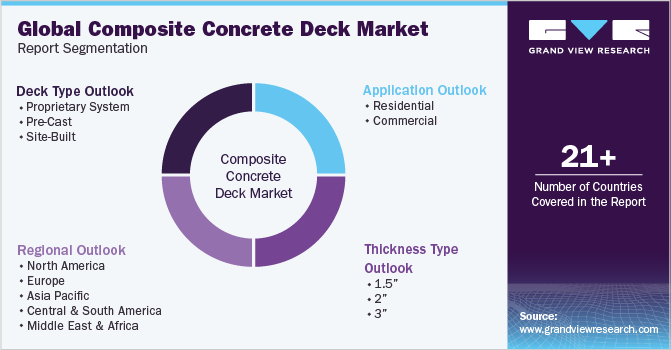
This report forecasts revenue growth at the regional, and country levels and provides an analysis on the latest industry trends and opportunities in each of the sub-segments from 2021 to 2033. For the purpose of this study, Grand View Research has segmented the global composite concrete deck market report on the basis of thickness type, deck type, application, and region:
-
Thickness Type Outlook (Volume, Million Square Feet; Revenue, USD Million, 2021 - 2033)
-
1.5”
-
2”
-
3”
-
-
Deck Type Outlook (Volume, Million Square Feet; Revenue, USD Million, 2021 - 2033)
-
Proprietary System
-
Pre-Cast
-
Site-Built
-
-
Application Outlook (Volume, Million Square Feet; Revenue, USD Million, 2021 - 2033)
-
Residential
-
Commercial
-
-
Regional Outlook (Volume, Million Square Feet; Revenue, USD Million; 2021 - 2033)
-
North America
-
U.S.
-
Canada
-
-
Europe
-
Germany
-
France
-
Italy
-
U.K.
-
Spain
-
-
Asia Pacific
-
Japan
-
South Korea
-
Australia
-
-
Central & South America
-
Brazil
-
-
Middle East & Africa
-
Frequently Asked Questions About This Report
The global composite concrete deck market size was valued at USD 3.8 billion in 2025 and is estimated at USD 4.0 billion for 2026.
The global composite concrete deck market is expected to grow at a CAGR of 7.1% from 2026 to 2033, reaching USD 6.5 billion.
North America dominated with a 33.9% revenue share in 2025.
Key players include ASC Steel Deck; Raised Floor Solutions Limited; Tata Steel; Prodeck-Fixing Ltd.; Structural Metal Decks; O’Donnell Metal Deck, LLC; Construction Metal Forming; Cordeck; A.C.T. Metal Deck Supply; TRUEDEK Steel Decking solutions.
Key factors that are driving the market growth include the increasing utilization of sustainable building materials in residential and commercial construction.
Site-built deck type segment dominated the composite concrete deck market with a share of 49.0% in 2025, while 3.0” thickness type is the fastest-growing segment.
About the Author(s)
Advanced Interior Materials Research Team
Advanced Materials · Advanced Interior MaterialsThis report was authored by the advanced interior materials research team at Grand View Research - comprising two research analysts, one senior research analyst, and one industry expert - with specialized expertise in the advanced interior materials segment of the advanced materials industry. All findings are based on proprietary advanced materials databases, executive interviews, and regulatory analysis, subject to internal peer review prior to publication.
Last Updated:
Speak to Analyst


Customize this report to your needs — add regions, segments, or data points, with 20% free customization.
Or view our licence options:


ISO 9001:2015 & 27001:2022 Certified
We are GDPR and CCPA compliant! Your transaction & personal information is safe and secure. For more details, please read our privacy policy.


