
- Home
- »
- Renewable Energy
- »
-
Concentrated Solar Power Market Size report, 2026-2033GVR Report cover

Concentrated Solar Power Market (2026 - 2033)
Size, Share & Trends Analysis Report By Technology (Parabolic Trough, Linear Fresnel, Dish, Power Tower), By Application (Utilities, EOR, Desalination), By Region (North America, Europe, Asia Pacific, MEA), And Segment Forecasts
Market Size, 2025
$8.9BMarket Estimate, 2026
$9.8BMarket Forecast, 2033
$12.5BCAGR, 2026–2033
3.6%Concentrated Solar Power Market Summary
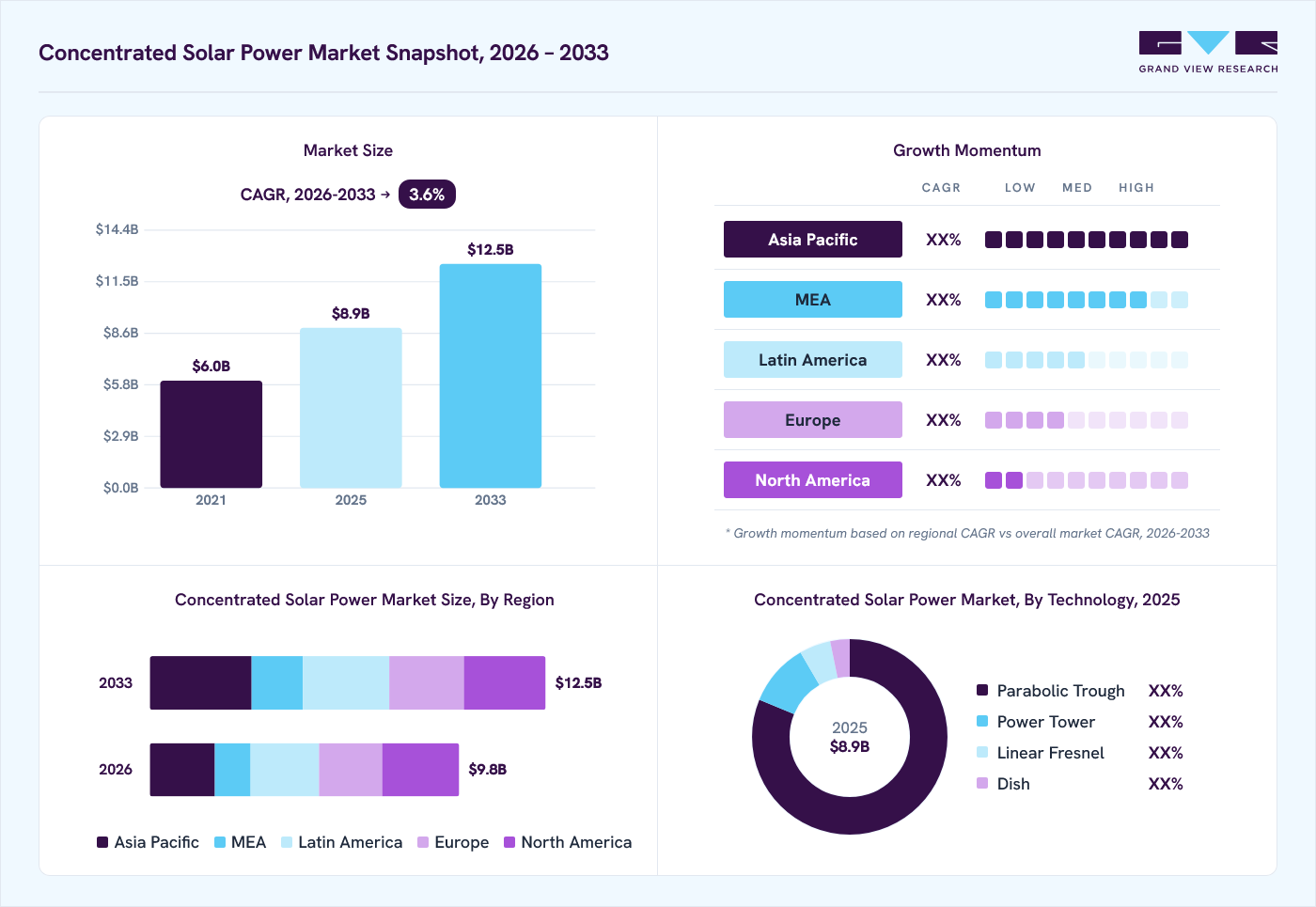
The global concentrated solar power market size was valued at USD 8.9 billion in 2025 and is projected to grow from USD 9.8 billion in 2026 to USD 12.5 billion by 2033, at a CAGR of 3.6% from 2026 to 2033. North America dominated the market, accounting for the largest revenue share of 27.2% in 2025. This growth is driven by increasing environmental concerns and the global push to reduce carbon emissions, as CSP technology offers a clean and sustainable energy solution.
 Source: Grand View Research, IR Documents, Primary Interviews, Paid DatabasesTo learn more about this report,
 Download Free Sample Report
Key Market Trends & Insights
- By application: The utilities segment dominated the global market with share of 61.8% in 2025.
- By technology: The parabolic trough segment accounted for the largest share of 81.1% in 2025.
Regional Highlights
- Largest regional market: North America (27.2% revenue share, 2025)
- By country: The U.S. held the largest share of North America in 2025.
Market Size & Forecast
- Market size in 2025: USD 8.9 Billion
- Estimated market size in 2026: USD 9.8 Billion
- Projected market size by 2033: USD 12.5 Billion
- CAGR (2026-2033): 3.6%
Prism AI by Grand View Research Free to tryAsk a question about the concentrated solar power marketTry asking✓Every figure cited from GVR research Prefer the report? Download free sample →
Government incentives and policies promoting renewable energy, such as feed-in tariffs, tax credits, and subsidies, encourage investments in concentrated solar power (CSP) projects. Technological advancements and declining costs of CSP components, including mirrors, receivers, and thermal energy storage systems, make CSP more competitive with other energy sources.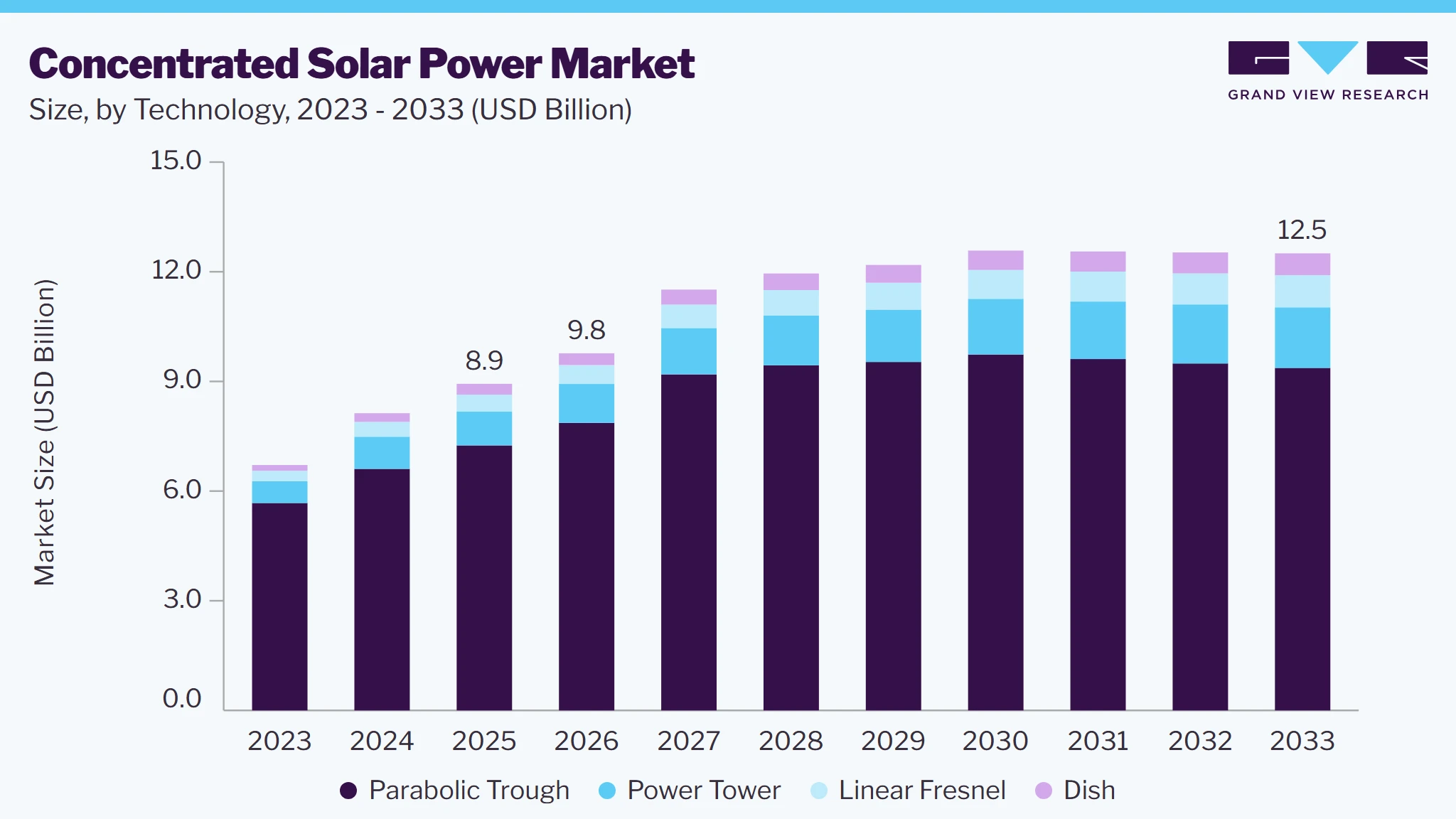 To learn more about this report, Download Free Sample Report
Government policies and regulations play a crucial role in shaping the CSP market. In the U.S., the Investment Tax Credit (ITC) has been a significant driver, providing a 30% tax credit for solar energy systems, including CSP, which has been extended through 2023. The Clean Development Mechanism (CDM) under the Kyoto Protocol also supports CSP projects by allowing developed countries to invest in renewable energy projects in developing countries to earn carbon credits. In India, the National Action Plan on Climate Change (NAPCC) and the Jawaharlal Nehru National Solar Mission (JNNSM) are key initiatives promoting the deployment of CSP technologies.
Market Dynamics
The concentrated solar power (CSP) market is driven by the increasing need for renewable electricity that can provide a stable power supply even after sunset. Growing investments in utility-scale clean energy projects, thermal energy storage, and grid modernization are supporting the adoption of CSP in regions with high solar resources. Governments are also promoting the technology through decarbonization policies and renewable energy targets to improve energy security and reduce emissions. However, high initial investment requirements and increasing competition from lower-cost solar PV and battery storage systems remain key challenges for broader deployment.
As electricity grids incorporate higher shares of solar and wind power, there is a growing need for renewable energy technologies that can deliver power even when sunlight or wind is unavailable. CSP addresses this challenge by storing thermal energy, which can be used to generate electricity for several hours after sunset. This ability to provide dispatchable, long-duration renewable power reduces dependence on chemical batteries while improving grid reliability. Utilities and governments are increasingly considering CSP for large-scale renewable energy projects that require a stable and flexible electricity supply.
In January 2026, the Blue Book of China’s Concentrating Solar Power Industry (2025) reported that China connected 9 new CSP plants with 900 MW of installed capacity in 2025, most of which were equipped with 6-16 hours of thermal energy storage. The report also highlighted a national policy promoting CSP as a reliable source of green baseload power and supporting CSP plants with electric heating systems to function as long-duration energy storage stations, reinforcing the role of thermal storage in future renewable power systems.
CSP projects require significant upfront investment due to the need for large mirror fields, thermal energy storage systems, heat transfer equipment, and steam turbine infrastructure. These higher capital requirements make project financing more challenging compared to conventional solar PV installations, particularly in cost-sensitive markets. Longer construction timelines and extended payback periods can further delay investment decisions and commercial deployment. In March 2025, the World Bank highlighted that Morocco's Noor CSP project continued to face significant financing challenges, with its high capital requirements requiring extensive support from multiple international financial institutions to achieve financial closure.
Beyond electricity generation, CSP is creating new opportunities by supplying high-temperature heat directly to energy-intensive industries such as mining, chemicals, cement, and manufacturing. Many industrial processes require continuous heat at temperatures that conventional solar PV cannot provide, making CSP an attractive low-carbon alternative to fossil fuels. Its ability to deliver stable thermal energy also helps industries reduce fuel consumption and meet increasingly stringent decarbonization targets. As industrial sectors pursue cleaner production methods, the demand for CSP-based process heat solutions is expected to increase. In May 2025, South Africa commissioned the 100 MW Redstone Solar Thermal Power Project with 12 hours of molten salt storage, demonstrating CSP's growing role in delivering reliable renewable energy for large-scale industrial and utility applications.
Analyst Perspective
The concentrated solar power (CSP) market is gradually regaining attention as energy systems increasingly require renewable sources that can supply electricity beyond daylight hours. Unlike conventional solar PV, CSP's ability to integrate thermal energy storage makes it well-suited for providing reliable, dispatchable power. The market is also expanding beyond electricity generation into applications such as industrial heat, desalination, and green hydrogen production. A key trend is the increasing adoption of power tower technology with molten salt storage, as developers prioritize higher efficiency and longer-duration energy storage to support grid stability.
Technology Insights
Based on technology, the parabolic trough segment led the market with the largest revenue share of 81.1% in 2025 due to the maturity and proven reliability of parabolic trough technology, which uses long, curved mirrors to focus sunlight onto a receiver tube containing a heat transfer fluid. The heated fluid is then used to generate steam, driving a turbine to produce electricity. Parabolic trough systems are well-established, with several large-scale commercial plants operating worldwide. Their ability to integrate thermal energy storage systems, providing consistent power even during non-sunny periods, makes them a preferred choice for utility-scale CSP projects.
The dish segment is expected to grow at a CAGR of 9.2% from 2026 to 2033. Dish Stirling systems, a type of CSP technology, use a parabolic dish to concentrate sunlight onto a receiver mounted on a central tower. The concentrated sunlight heats a gas in the receiver, which drives a Stirling engine connected to a generator. Dish Stirling systems offer high efficiency and the potential for modular, scalable installations. Their ability to provide high-temperature heat and suitability for remote and off-grid applications drive their growth.
Application Insights
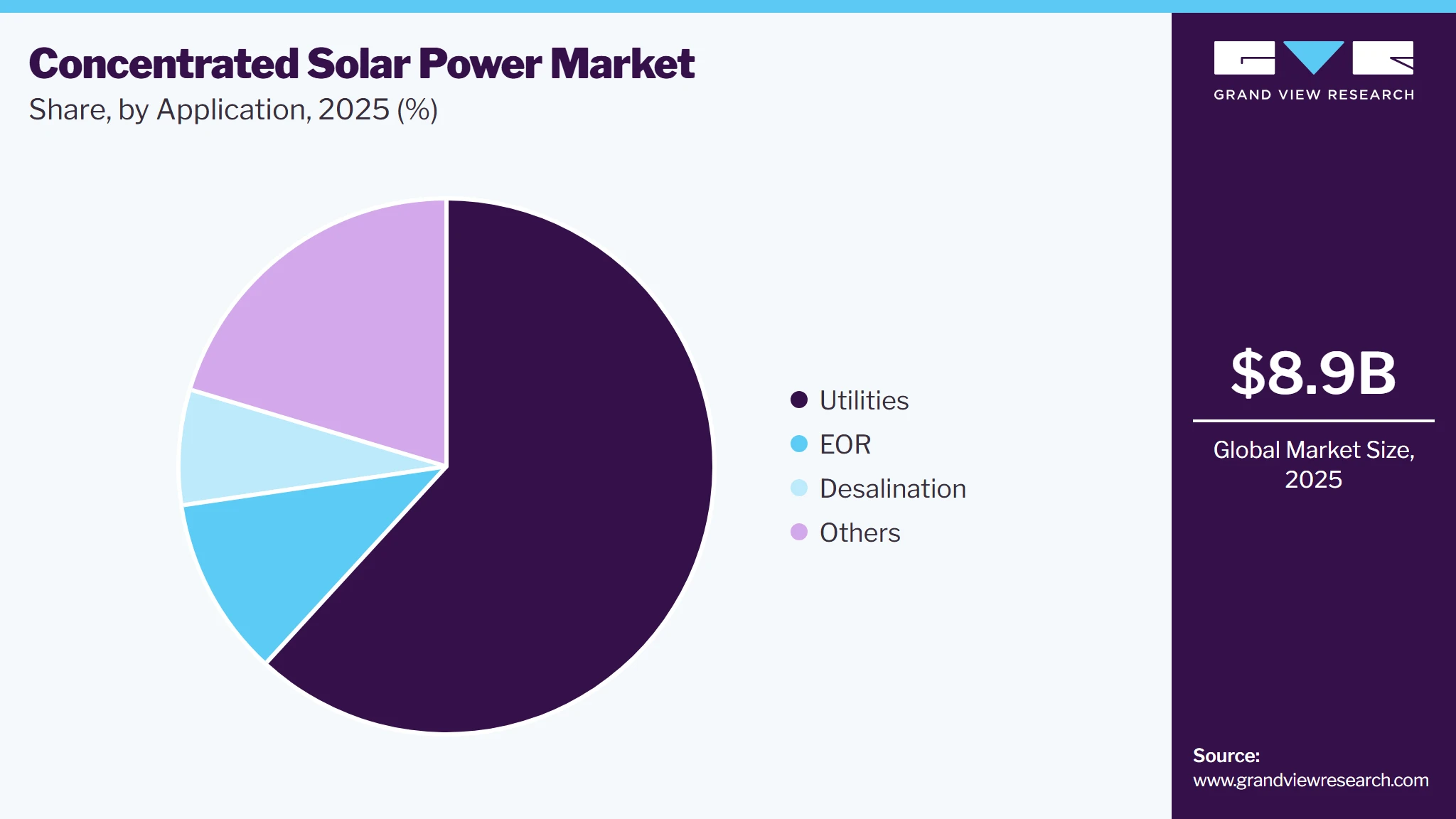
Based on application, the utilities segment led the market with the largest revenue share of 61.8% in 2025, primarily due to the increasing demand for large-scale renewable energy projects. Utilities are leveraging CSP technology to generate electricity on a commercial scale, benefiting from its ability to provide stable and dispatchable power. CSP plants can integrate thermal energy storage systems, allowing them to supply electricity even during non-sunny periods, which enhances grid stability and reliability. This capability makes CSP an attractive option for utilities aiming to meet renewable energy targets and reduce their carbon footprint.
 To learn more about this report, Download Free Sample Report
The desalination segment is projected to grow at the fastest CAGR of 5.1% over the forecast period. The increasing global water scarcity and the need for sustainable freshwater solutions drive this rapid growth. CSP technology is used to power desalination plants, which convert seawater into potable water. Integrating CSP with desalination offers a dual benefit: it provides a renewable energy source and addresses the critical issue of water shortage. As more regions face water stress, the demand for CSP-powered desalination plants is expected to rise significantly, making it the fastest-growing application segment in the CSP market.
Regional Insights
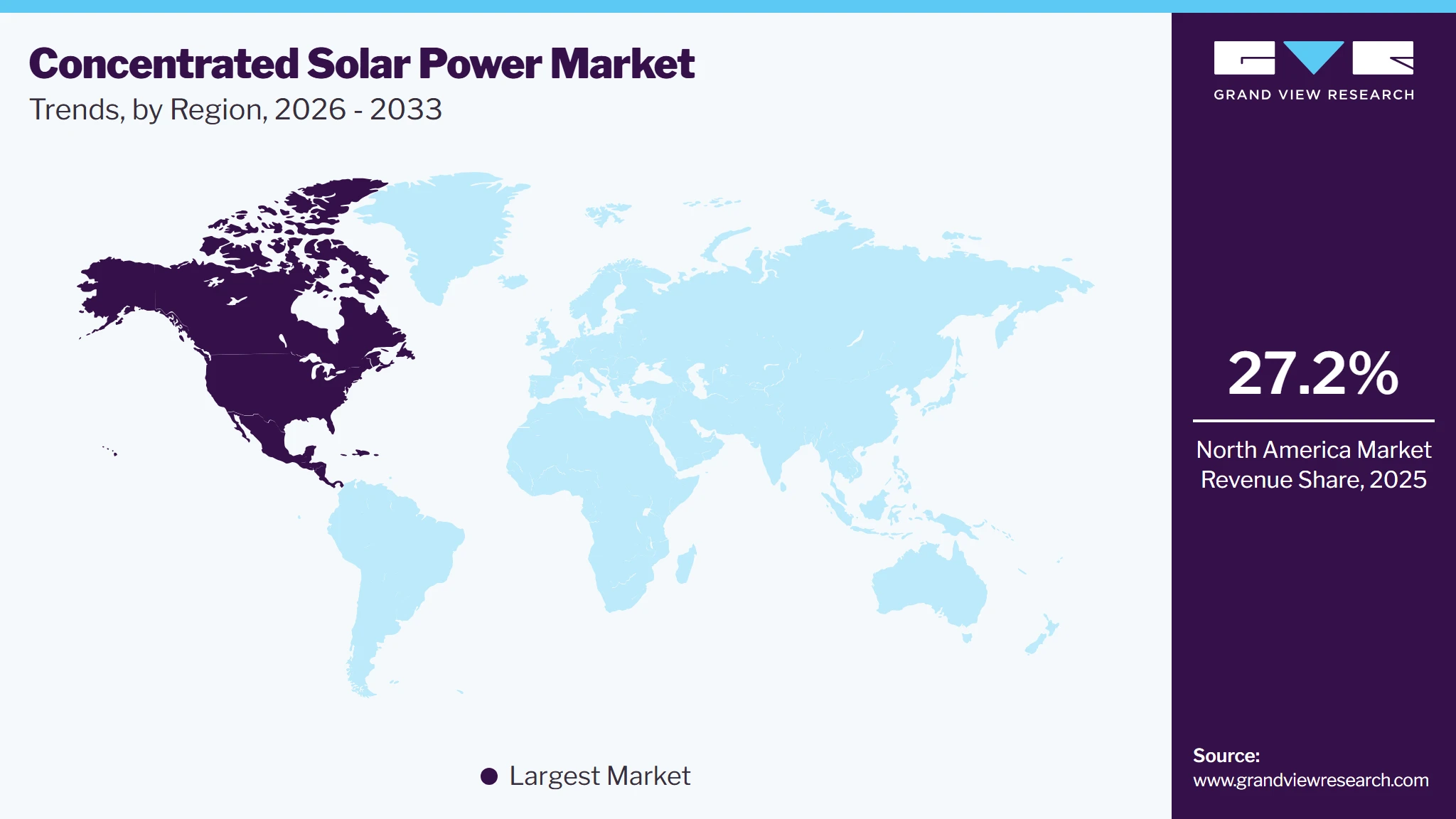
North America dominated the concentrated solar power market with the largest revenue share of 27.2% in 2025, driven by significant investments in renewable energy infrastructure and supportive government policies. The region's emphasis on reducing greenhouse gas emissions and transitioning to sustainable energy sources has facilitated the expansion of CSP projects. Technological advancements and the presence of major industry players further strengthen North America's competitive edge, enabling it to capture a substantial share of the global market.
 To learn more about this report, Download Free Sample Report
U.S. Concentrated Solar Power Market Trends
The concentrated solar power market in U.S. held the largest share in the North America region in 2025, fueled by federal and state-level incentives to promote renewable energy. Key initiatives, such as tax credits and grants, have encouraged investment in CSP technologies, leading to the development of large-scale solar plants. The growing demand for clean energy solutions and a maturing technological landscape have positioned the U.S. as a frontrunner in CSP deployment, setting a benchmark for other regions.
Europe Concentrated Solar Power Market Trends
Europe held a significant revenue share of the global concentrated solar power market in 2025. Countries including Spain and Italy have been pivotal in advancing CSP technology, supported by robust policy frameworks and funding mechanisms. However, the market faces challenges, including competition from other renewable sources and regulatory hurdles. Nevertheless, Europe’s focus on innovation and its integration of CSP with other renewable technologies indicate a resilient market poised for future growth.
Asia Pacific Concentrated Solar Power Market Trends
The Asia Pacific concentrated solar power market is anticipated to grow fastest during the forecast period. This growth can be attributed to increasing energy demands, rapid industrialization, and a growing recognition of the need for sustainable energy solutions. Countries such as China and India are leading the charge, implementing ambitious solar energy targets and investing heavily in CSP projects. The region's unique geographical advantages, such as high solar insolation, further enhance its potential, positioning Asia Pacific as a key player in the global CSP landscape.
Key Concentrated Solar Power Company Insights
Some of the key companies in the Concentrated solar power market include Abengoa, BrightSource Energy, Inc., Siemens Energy, Acciona, and Aalborg CSP.
-
Abengoa is a key player in the concentrated solar power market, known for its innovative solar thermal technologies and large-scale projects. The company has developed several notable CSP plants globally, focusing on integrating energy storage solutions to enhance efficiency and reliability.
-
Aalborg CSP specializes in delivering tailored solutions for the concentrated solar power market. The company focuses on enhancing the performance of CSP systems through advanced thermal storage and integration with other renewable technologies.
Key Concentrated Solar Power Companies
The following key companies have been profiled for this study on the concentrated solar power market.
-
Abengoa
-
BrightSource Energy, Inc.
-
Siemens Energy
-
Acciona
-
Aalborg CSP
-
TSK Fl
-
ACWA POWER
-
INITEC Energía
-
Torresol Energy
-
Enel Spa
-
Trivelli Energia srl
-
Grün leben GmbH
Competitive Benchmarking
Category
Operating Strategies
Competitive Edge
Weakness
Established Players (ACWA Power, Siemens Energy, ACCIONA, SENER Group, TSK, Aalborg CSP)
- Develop and execute large-scale utility CSP projects with integrated thermal energy storage.
- Offer end-to-end capabilities including technology, EPC, equipment supply, and plant operation.
- Expand through strategic partnerships, government-backed renewable projects, and international market presence.
- Proven track record with multiple commercial CSP installations worldwide.
- Strong engineering expertise, financial resources, and established customer relationships.
- Broad technology portfolios and extensive experience in complex infrastructure projects.
- High dependence on large capital-intensive projects and government policy support.
- Longer project execution cycles and slower adoption of disruptive technologies.
- Higher operating and organizational costs compared to smaller competitors.
Emerging Players (Heliogen, Inc., Frenell GmbH, GlassPoint, Cosin Solar)
- Focus on next-generation CSP technologies, industrial process heat, and high-temperature solar applications.
- Develop innovative receiver systems, heliostat designs, and thermal storage solutions to improve efficiency.
- Target niche markets through technology innovation and strategic demonstration projects.
- Greater flexibility and faster commercialization of advanced CSP solutions.
- Strong focus on innovation, digital optimization, and industrial decarbonization applications.
- Ability to address emerging opportunities such as green hydrogen, solar fuels, and industrial heat.
- Limited commercial deployment and smaller installed project base.
- Greater reliance on external funding, pilot projects, and strategic partnerships.
- Lower global brand recognition and fewer large-scale reference projects than established competitors.
Recent Developments
-
In September 2024, Masdar announced a plan to acquire Saeta Yield, a prominent independent developer, owner, and operator of renewable energy assets. Saeta Yield possesses expertise across the entire value chain of renewable energy projects. However, the acquisition does not encompass a regulated portfolio of 350 MW of concentrated solar power assets, which will remain under the ownership of Brookfield.
-
In October 2023, Australian researchers achieved a significant breakthrough in concentrated solar power storage by heating ceramic particles to a record-breaking temperature using concentrated sunlight. This advancement could pave the way for more efficient and reliable solar energy storage solutions. The innovative approach involves dropping ceramic particles through a beam of concentrated sunlight, allowing them to absorb and store thermal energy for extended periods. This technology offers a promising alternative to traditional energy storage methods such as lithium-ion batteries, which face challenges such as cost, self-discharge, and safety concerns.
Concentrated Solar Power Market Report Scope
Report Attribute
Details
Market Definition
The global Concentrated Solar Power (CSP) market represents the revenue generated from the sale and deployment of solar thermal systems that use mirrors or lenses to concentrate sunlight for electricity generation and thermal energy production across utility-scale and industrial applications.
Market size in 2025
USD 8.9 billion
Estimated Market size in 2026
USD 9.8 billion
Projected Market size by 2033
USD 12.5 billion
Growth rate
CAGR of 3.6% from 2026 to 2033
Base year for estimation
2025
Historical data
2021 - 2024
Forecast period
2026 - 2033
Quantitative units
Revenue in USD Million, Volume in MW, and CAGR from 2026 to 2033
Report coverage
Revenue forecast, volume forecast, company ranking, competitive landscape, growth factors, and trends
Segments covered
Technology, Application, Region
Regional scope
North America; Europe; Asia Pacific; Latin America; Middle East & Africa
Country scope
U.S., Spain, Italy, China, India, Brazil, Argentina, Morocco, Algeria
Key companies profiled
Aalborg CSP, ACCIONA, Acwa, Cosin Solar, Frenell GmbH, Glasspoint, Heliogen, Inc., Sener Group, Siemens Energy, TSK
Customization scope
Free report customization (equivalent up to 8 analysts' working days) with purchase. Addition or alteration to country, regional & segment scope.
Pricing and purchase options
Avail customized purchase options to meet your exact research needs. Explore purchase options
Global Concentrated Solar Power Market Report Segmentation
This report forecasts revenue growth at global, regional, and country levels and provides an analysis of the latest industry trends in each of the sub-segments from 2021 to 2033. For this study, Grand View Research has segmented the global concentrated solar power market report based on technology, application, and region:
 To learn more about this report, Download Free Sample Report
-
Technology Outlook (Volume, MW; Revenue, USD Billion, 2021 - 2033)
-
Parabolic Trough
-
Linear Fresnel
-
Dish
-
Power Tower
-
-
Application Outlook (Volume, MW; Revenue, USD Billion, 2021 - 2033)
-
Utilities
-
EOR
-
Desalination
-
Others
-
-
Regional Outlook (Volume, MW; Revenue, USD Billion, 2021 - 2033)
-
North America
-
U.S.
-
-
Europe
-
Spain
-
Italy
-
-
Asia Pacific
-
China
-
Japan
-
-
Latin America
-
Brazil
-
Argentina
-
-
Middle East and Africa (MEA)
-
Morocco
-
Algeria
-
-
Research Methodology
The concentrated solar power market figures in this report are based on a proven research process that combines executive interviews with secondary research from proprietary databases, company filings, and recognized regulatory and institutional sources. Market size is built through value-chain sizing - reconciling supply-side and demand-side estimates - and triangulated with bottom-up and top-down approaches. Every estimate passes multiple levels of expert validation before publication, with each concentrated solar power segment quantified using the revenue-capture definitions in the table below.
Segment Definition
Segment - Technology
Revenue capture definition
Parabolic Trough
Parabolic trough systems use curved mirrors to concentrate sunlight onto a receiver tube, generating high-temperature heat for electricity production. Revenue is generated through the sale and deployment of parabolic trough CSP systems for utility-scale power generation and industrial heat applications.
Linear Fresnel
Linear Fresnel systems use multiple flat or slightly curved mirrors to focus sunlight onto a fixed elevated receiver for thermal energy generation. Revenue is generated through the sale and installation of Linear Fresnel CSP systems across power generation and industrial process heat projects.
Dish
Dish systems use parabolic dish-shaped mirrors to concentrate solar radiation onto a receiver, typically coupled with a Stirling engine or other power conversion system. Revenue is generated through the sale of dish-based CSP systems for distributed power generation and specialized off-grid applications.
Power Tower
Power tower systems use a field of heliostats to reflect sunlight onto a central receiver, producing high-temperature heat for electricity generation and thermal storage. Revenue is generated through the deployment and sale of power tower CSP systems for large-scale utility and industrial energy projects.
Segment - Application
Revenue capture definition
Utilities
This segment includes CSP systems deployed by electric utilities for grid-connected electricity generation and renewable energy supply. Revenue is generated through the installation and operation of CSP plants developed to deliver utility-scale power.
EOR
This segment includes CSP systems used to generate thermal energy for enhanced oil recovery operations, reducing the reliance on conventional fuel sources. Revenue is generated through the deployment of CSP technologies that supply solar-generated steam or heat for oil extraction processes.
Desalination
This segment includes CSP systems integrated with desalination facilities to provide thermal energy or electricity for freshwater production. Revenue is generated through the deployment of CSP solutions supporting large-scale and industrial desalination operations.
Others
This segment includes CSP applications in industrial process heat, mining, district heating, research facilities, and other specialized thermal energy uses. Revenue is generated through the sale and deployment of CSP systems designed for these niche and application-specific requirements.
Estimation Model
Layer Name
Key Question
Description
CSP Project Development Layer
What forms the demand base for CSP systems?
Assess global and regional CSP installations across utility, EOR, desalination, and industrial applications. Evaluate annual capacity additions, upcoming project pipeline, renewable energy targets, solar resource availability, and investments in dispatchable renewable power infrastructure to determine the underlying demand for CSP technologies.
Technology Adoption Layer
Which CSP technologies are being deployed?
Analyze the adoption of parabolic trough, linear Fresnel, dish, and power tower technologies across different project types. Assess operating temperature, thermal efficiency, storage compatibility, land requirements, project scale, and technology maturity to determine segment-wise demand.
Application Deployment Layer
Where are CSP systems being used?
Evaluate CSP deployment across utilities, enhanced oil recovery, desalination, and other industrial heat applications. Analyze project size, energy output requirements, thermal storage integration, and end-use demand to determine the contribution of each application segment to overall market consumption.
Revenue Layer
How is market revenue generated?
Market revenue is quantified through the deployment and sale of CSP technologies used for solar thermal power generation and heat supply. The overall market value is determined by installed capacity, technology type, project development cost, thermal storage integration, and application-level deployment across utilities, EOR, desalination, and other end-use sectors.
Delivered Customizations
This report has been delivered with the following In-depth customizations
Client Request
Customization Delivered
Value Adds
Technology Benchmarking Assessment
Compared parabolic trough, power tower, linear Fresnel, and dish technologies based on thermal efficiency, operating temperature, storage compatibility, capital cost, technology maturity, and commercial deployment. Assessed their suitability for utility-scale power generation and industrial heat applications.
Helped identify the most suitable CSP technologies based on performance, cost, and long-term commercial potential.
Competitive Landscape
Assessment
Benchmarked major CSP companies based on technology portfolio, installed capacity, project pipeline, EPC capabilities, geographic presence, and strategic partnerships. Assessed their competitive positioning and expansion strategies.
Enabled competitor benchmarking, identified market leaders, and supported partnership and investment decisions.
Regional Deployment & Policy Assessment
Assessed regional CSP deployment trends, project pipeline, direct normal irradiation (DNI) potential, renewable energy targets, government incentives, and financing mechanisms. Evaluated how policy support and resource availability influence market growth.
Helped identify high-growth investment regions and understand policy-driven market opportunities.
Frequently Asked Questions About This Report
Based on technology, the parabolic trough segment accounted for the largest revenue share of 81.1% in 2025.
The North America region dominated the concentrated solar power market with a revenue share of 27.2% in 2025.
Asia Pacific is anticipated to register the fastest CAGR of 6.6% over the forecast period.
Based on application, the utilities segment accounted for largest revenue share of 61.8% in 2025.
The concentrated solar power market is primarily driven by the growing demand for dispatchable renewable energy, increasing integration of thermal energy storage, and supportive government policies promoting low-carbon power generation.
Some of the key players operating in the concentrated solar power market are Aalborg CSP, ACCIONA, Acwa, Cosin Solar, Frenell GmbH, Glasspoint, Heliogen, Inc., Sener Group, Siemens Energy, TSK, and others.
The U.S. dominated the North America region in 2025 and is anticipated to continue this over the forecast period.
The global concentrated solar power market size was estimated at USD 8.9 billion in 2025 and is expected to reach USD 9.8 billion in 2026.
The global concentrated solar power market is expected to grow at a CAGR of 7.1% from 2026 to 2033 to reach USD 12.5 billion by 2033.
About the Author(s)
Renewable Energy Research Team
Energy & Power · Renewable EnergyThis report was authored by the renewable energy research team at Grand View Research - comprising two research analysts, one senior research analyst, and one industry expert - with specialized expertise in the renewable energy segment of the energy & power industry. All findings are based on proprietary energy & power databases, executive interviews, and regulatory analysis, subject to internal peer review prior to publication.
Last Updated:
Speak to Analyst

Customize this report to your needs - add regions, segments, or data points, with 20% free customization.
Or view our licence options:


ISO 9001:2015 & 27001:2022 Certified
We are GDPR and CCPA compliant! Your transaction & personal information is safe and secure. For more details, please read our privacy policy.


