
- Home
- »
- Advanced Interior Materials
- »
-
Concrete Admixtures Market Size & Size Report, 2026-2033GVR Report cover

Concrete Admixtures Market (2026 - 2033) Size, Share & Trends Analysis Report By Type (Water Reducing Admixtures, Air-entraining Admixtures, Waterproofing Agents, Accelerating Agents), By Region, And Segment Forecasts
Market Size, 2025
$20.1BMarket Estimate, 2026
$21.4BMarket Forecast, 2033
$38.3BCAGR, 2026–2033
8.6%Concrete Admixtures Market Summary
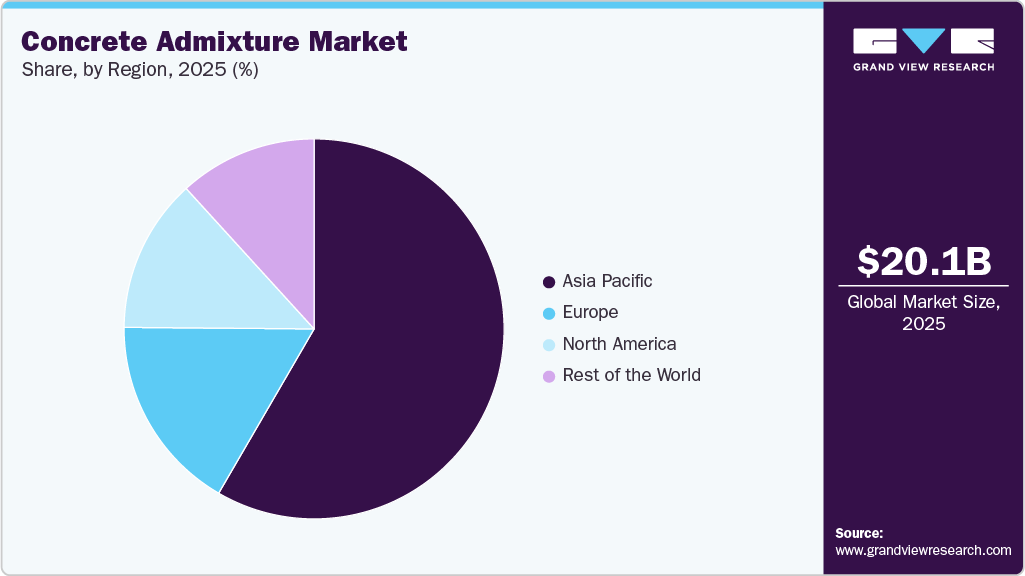
The global concrete admixtures market size was valued at USD 20.1 billion in 2025 and is projected to grow from USD 21.4 billion in 2026 to USD 38.3 billion by 2033, at a CAGR of 8.6% from 2026 to 2033. The market in asia pacific dominated with a revenue share of 56.1% in 2025. The demand for concrete admixtures is increasing steadily due to rapid urbanization, large-scale infrastructure development, and rising construction activities across both emerging and developed economies.
 Source: Grand View Research, IR Documents, Primary Interviews, Paid DatabasesTo learn more about this report,
 Download Free Sample Report
 Key Market Trends & Insights
- By type: Water-reducing segment led the market with the largest share of 47.8% in 2025.
Regional Highlights
- Largest regional market: Asia Pacific (56.1% revenue share, 2025)
- By country: The china held the largest market share in 2025.
Market Size & Forecast
- Market size in 2025: USD 20.1 billion
- Estimated market size in 2026: USD 21.4 billion
- Projected market size by 2033: USD 38.3 billion
- CAGR (2026-2033): 8.6%
Three ways to get this report
Buy it, customize it, or ask a question.Ask an Analyst
Analyst response in 1 business day
- AccessReport author, directly
- Reply timeWithin 1 working day
- No sales callDirect answer only
- FormatEmail reply
- CostFree, no cost
Get the Full Report
What the study covers
- FormatsPDF · Excel · Dashboard
- Timeline2026–2033 annual, 2025 base
- Coverage20+ countries, 5 regions
- Companies10+ key players profiled
Customize the Report
20% free customization
- IncludeCountries, segments, points
- TailorTo your product definition
- ExtendDeeper competitor detail
- OrA fully bespoke study
- Turnaround5–10 working days
The growing need for high-performance and durable concrete in residential, commercial, and industrial projects has significantly boosted admixture consumption. Increasing investments in transportation infrastructure, such as roads, bridges, metros, and airports, further support market growth. Admixtures help improve workability, strength, setting time, and durability, making them essential for modern construction. The rise of high-rise buildings and complex architectural structures is also driving demand. In addition, the adoption of ready-mix concrete is expanding admixture usage. Climate variability and challenging construction conditions are pushing contractors to rely more on specialized admixtures.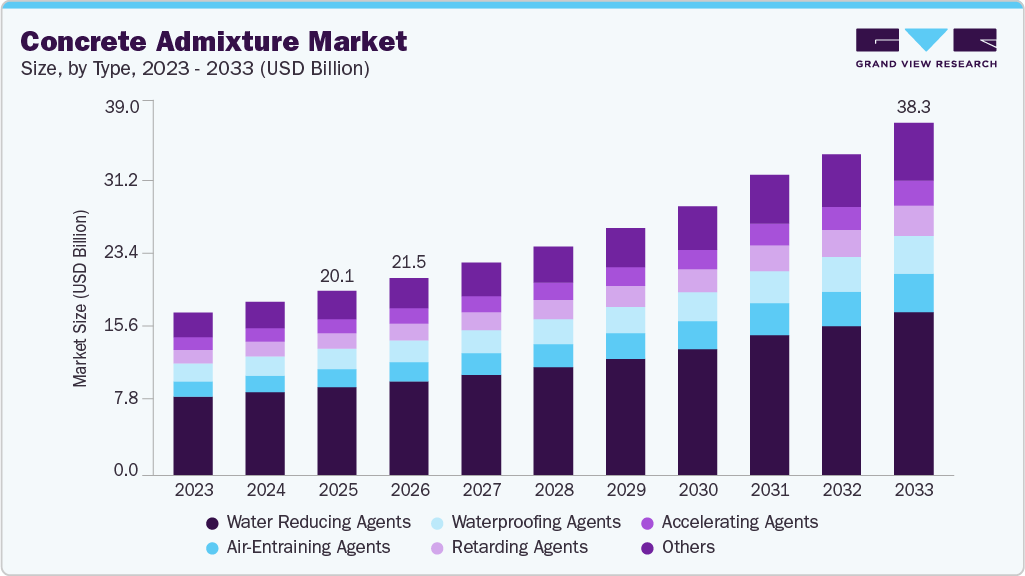 To learn more about this report, Download Free Sample Report
 Key drivers of the concrete admixtures industry include the need for enhanced construction efficiency, reduced project timelines, and improved concrete performance. Water-reducing and superplasticizer admixtures are widely used to achieve high strength with lower cement content. Rising awareness of lifecycle cost reduction and structural longevity is encouraging the adoption of chemical admixtures. Sustainability goals are driving builders toward admixtures that reduce carbon emissions by lowering cement usage. Growth in mega infrastructure projects and smart city developments is another major driver. Labor shortages in the construction industry are also accelerating the use of admixtures to enhance workability and improve placement. Technological advancements in admixture formulations continue to support demand.
Government initiatives focused on infrastructure modernization and urban development are strongly supporting the concrete admixtures industry. Large public investments in transportation, housing, water management, and energy projects are increasing concrete consumption. Green building codes and sustainability regulations are encouraging the use of admixtures that enhance durability and reduce environmental impact. Many governments are promoting affordable housing schemes, which rely heavily on cost-effective and high-performance concrete solutions. Infrastructure stimulus packages in emerging economies are accelerating project execution timelines, boosting admixture usage. Regulations on construction quality and safety standards further encourage the use of performance-enhancing admixtures. Public-private partnerships in infrastructure projects are also contributing to market expansion.
Innovation in the concrete admixtures industry is centered around high-performance, sustainable, and customized solutions. Manufacturers are developing advanced superplasticizers, shrinkage-reducing admixtures, and corrosion inhibitors. Bio-based and low-VOC admixtures are gaining traction due to environmental concerns. The integration of digital construction technologies is enabling precise admixture dosing and performance optimization. Admixtures designed for extreme weather conditions, such as hot and cold climates, are becoming increasingly important. The trend toward self-compacting and ultra-high-performance concrete is driving innovation. In addition, admixtures compatible with recycled aggregates are emerging as a key trend.
Market Dynamics
The increasing investments in residential, commercial, and infrastructure construction projects across emerging and developed economies are significantly driving demand for concrete admixtures. Rapid urbanization, industrialization, and government spending on transportation infrastructure, smart cities, bridges, tunnels, and energy projects are supporting the adoption of high-performance concrete solutions. Concrete admixtures are widely used to improve workability, durability, strength, and setting time of concrete, making them essential in modern construction practices.
In addition, growing demand for sustainable and energy-efficient construction materials is accelerating the use of advanced admixtures in the construction industry. The increasing adoption of ready-mix concrete and precast concrete components, along with the need for reduced water consumption and improved construction efficiency, is further supporting market growth. Technological advancements in admixture formulations designed for high-strength and low-carbon concrete applications are also contributing to rising product demand globally.
The concrete admixture market faces challenges due to fluctuations in the prices of chemical raw materials used in admixture production, which directly impact manufacturing costs and profit margins. In addition, lack of standardization in construction practices and limited awareness regarding the proper selection and usage of admixtures in developing regions may hinder market growth. Compatibility issues between certain admixtures and cement compositions can also affect concrete performance, creating operational and quality-related concerns for manufacturers and end users.
Market Concentration & Characteristics
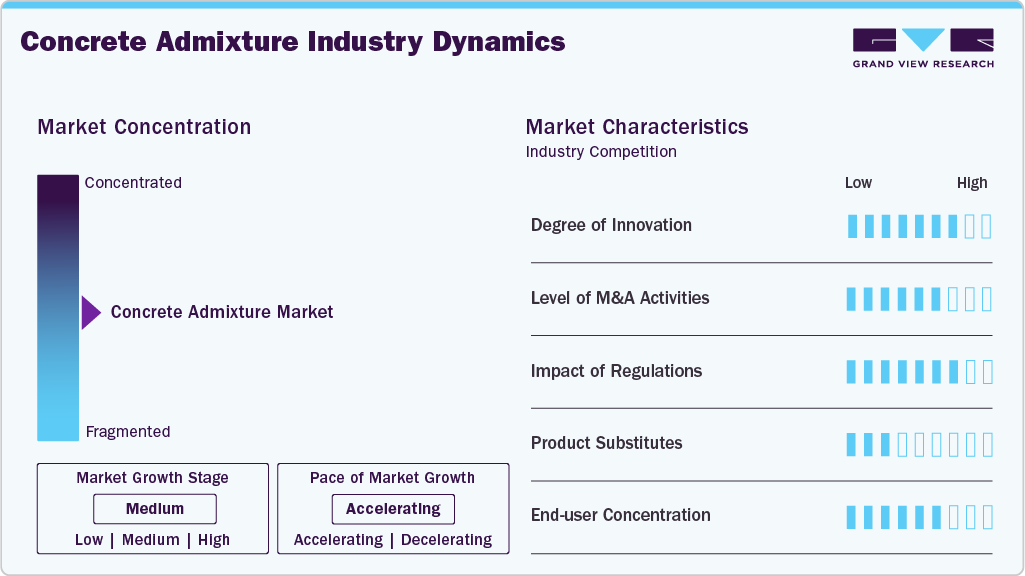
The concrete admixtures industry is moderately consolidated, with several multinational players holding significant market share alongside strong regional manufacturers. Large companies benefit from extensive product portfolios, global distribution networks, and strong R&D capabilities. Strategic partnerships with construction companies and ready-mix concrete producers enhance market positioning. However, regional players remain competitive due to localized expertise and cost advantages. The presence of both global and local suppliers creates a balanced competitive landscape. Continuous innovation and branding play a critical role in market differentiation.
 To learn more about this report, Download Free Sample Report
 The threat of substitutes in the concrete admixtures industry is relatively low, as admixtures provide performance benefits that cannot be easily replicated by traditional construction methods. Alternatives such as higher cement usage increase costs and environmental impact, making them less attractive. Mechanical methods to improve concrete performance are limited and often inefficient. While alternative binders and construction techniques exist, they do not fully replace the functional advantages of chemical admixtures. The growing complexity of construction projects further limits the risk of substitution. Sustainability regulations also favor admixture usage over substitutes.
Type Insights
The water-reducing agents segment led the market with the largest revenue share of 47.8% in 2025. This growth is attributed to their ability to decrease water content in concrete mixes without compromising workability or strength. This enhances durability and performance, making them essential for sustainable construction practices. In addition, the increasing demand for eco-friendly building materials and rising construction activities in emerging markets further fuel their adoption. Furthermore, technological advancements also contribute to developing more effective water-reducing agents, solidifying their position in the market.
The air-entraining agents segment is expected to grow at the fastest CAGR of 10.1% over the forecast period, primarily driven by their role in improving concrete's workability and resistance to freeze-thaw cycles. By introducing tiny air bubbles into the mix, these agents enhance the durability and longevity of concrete structures. In addition, the growing focus on infrastructure development and the need for high-performance concrete solutions are key factors driving their demand. Furthermore, as environmental concerns rise, the use of air-entraining agents aligns with sustainable construction practices by reducing the overall carbon footprint of concrete production.
Regional Insights
The concrete admixtures market in North America is expected to grow at a significant CAGR of 8.0% over the forecast period, owing to a robust housing sector and increased construction activities. Rising household formations and a strong demand for residential properties are key factors contributing to this growth. Furthermore, government initiatives aimed at supporting infrastructure improvement projects are enhancing the need for advanced concrete solutions. The trend toward sustainable construction practices also drives the adoption of innovative concrete admixtures that enhance performance while reducing their environmental footprint.
U.S. Concrete Admixtures Market Trends
The concrete admixtures market in the U.S. held a significant share in North America in 2025, driven by rising construction costs and an emphasis on high-quality building materials. The demand for durable and efficient concrete solutions is growing as infrastructure projects expand nationwide. Furthermore, consumer preferences for larger homes and sustainable building practices are prompting builders to utilize advanced concrete admixtures, which improve strength and longevity while minimizing environmental impacts.
Asia Pacific Concrete Admixtures Market Trends
Asia Pacific dominated the global concrete admixtures market with the largest revenue share of 56.1% in 2025, driven by massive infrastructure development and rapid urban growth. Countries such as China, India, and Southeast Asian nations are witnessing strong demand from residential and public infrastructure projects. Increasing investments in transportation networks and smart cities support market expansion. The region benefits from large-scale concrete consumption and cost-sensitive construction practices. The rising adoption of ready-mix concrete further drives demand for admixtures. A local manufacturing presence reduces costs and improves supply chain efficiency. Favorable government policies continue to strengthen regional dominance.
 To learn more about this report, Download Free Sample Report
 The concrete admixtures market in China accounted for the largest market revenue share in Asia Pacific in 2025, primarily driven by extensive infrastructure development initiatives and urbanization. In addition, the government’s focus on sustainable construction practices and green building technologies is driving the demand for high-performance concrete solutions. Furthermore, significant investments in housing projects and public infrastructure are boosting the consumption of concrete admixtures, as they improve workability and reduce environmental impact, aligning with national goals for eco-friendly construction.
Europe Concrete Admixtures Market Trends
The concrete admixtures market in Europeis expected to witness a significant growth over the forecast period, owing to stringent construction quality and sustainability regulations. Countries within Europe are increasingly focusing on eco-friendly building practices, which promote the use of high-performance concrete with reduced carbon footprints. In addition, the presence of established manufacturers and a strong emphasis on infrastructure development further support market expansion. Furthermore, rising urbanization rates necessitate innovative solutions to meet construction demands efficiently.
The Germany concrete admixtures market is expected to be driven by a strong construction sector characterized by high standards for quality and sustainability. The country's commitment to green building practices encourages the use of advanced concrete admixtures that enhance durability and reduce environmental impact. Moreover, ongoing investments in infrastructure projects, including transportation and residential developments, create a favorable environment for adopting innovative concrete solutions that meet evolving engineering specifications.
Key Concrete Admixtures Company Insights
Key companies in the global concrete admixtures industry include GCP Applied Technologies, Inc., RPM International, Inc., Fosroc, Inc., and others. These companies adopt various strategies to enhance their competitive edge. These include investing in research and development to innovate and improve product offerings, expanding their geographic presence through strategic partnerships and acquisitions, and focusing on sustainable practices to meet environmental regulations.
Furthermore, companies emphasize customer engagement and tailored solutions to address specific market needs, while also enhancing their distribution networks to ensure efficient product availability and support for construction projects worldwide.
-
RPM International, Inc. manufactures concrete admixtures that enhance concrete mixes' durability, workability, and strength. The company's product portfolio includes various construction materials such as grouts, mortars, and protective coatings, catering to industrial and commercial applications.
-
Fosroc, Inc. specializes in manufacturing concrete admixtures designed to improve the performance and durability of concrete in various applications. The company’s product offerings include water-reducing agents, superplasticizers, and air-entraining agents. Operating primarily in the construction segment, Fosroc serves diverse markets including infrastructure, commercial, and residential projects to meet evolving industry demands.
Key Concrete Admixtures Companies:
The following are the leading companies in the concrete admixtures market. These companies collectively hold the largest market share and dictate industry trends.
- Sika AG
- BASF SE
- GCP Applied Technologies, Inc.
- RPM International, Inc.
- Fosroc, Inc.
- Mapei SpA
- CHYRSO SAS
- Rhein-Chemotechnik GmbH
Competitive Benchmarking
Operating Strategies
Competitive Edge
Weaknesses
Mature Players: Sika AG; BASF SE; RPM International, Inc.; Mapei SpA
- Investments in advanced admixture technologies and high-performance concrete solutions.
- Expansion of manufacturing facilities and distribution networks across infrastructure growth regions.
- Focus on sustainable, low-carbon, and water-reducing admixture formulations.
- Strong brand recognition and established relationships with construction contractors and infrastructure developers.
- Broad portfolio of concrete admixtures and specialty construction chemicals.
- Advanced R&D capabilities and strong technical support expertise.
- High dependence on construction and infrastructure spending cycles.
- Exposure to raw material price volatility and energy cost fluctuations.
Emerging Players: GCP Applied Technologies; Rhein-Chemotechnik
- Focus on niche and specialized admixture solutions for targeted construction applications.
- Expansion through regional distributor partnerships and localized technical support.
- Development of customized admixture formulations for high-performance and durable concrete applications.
- Greater flexibility in addressing evolving customer and regional construction requirements.
- Strong focus on specialty and application-specific concrete admixture products.
- Limited global manufacturing and distribution presence compared to established market leaders
Recent Developments
-
In May 2024, Fosroc India inaugurated a state-of-the-art construction chemicals plant in Hyderabad, enhancing its capacity to produce concrete admixtures and other products. This facility, covering over 260,000 square feet, aims to improve service levels and expand geographical reach across South and Central India. The inauguration featured notable dignitaries and reflects Fosroc's commitment to sustainability and innovation in the construction sector.
-
In November 2023, Sika expanded its production capacity for concrete admixtures at its Sealy, Texas facility. This investment, the second in five years, aimed to meet the growing demand for Sika ViscoCrete, a high-performance concrete admixture. The expansion is driven by U.S. government initiatives that promote infrastructure development and sustainability.
Concrete Admixtures Market Report Scope
Report Attribute
Details
Market size in 2025
USD 20.1 billion
Estimated market size in 2026
USD 21.4 billion
Projected market size by 2033
USD 38.3 billion
Growth rate
CAGR of 8.6% from 2026 to 2033
Base year for estimation
2025
Historical data
2021 - 2023
Forecast period
2026 - 2033
Quantitative units
Volume in kilotons, revenue in USD million/billion, and CAGR from 2026 to 2033
Report coverage
Revenue forecast, company ranking, competitive landscape, growth factors, and trends
Segments covered
Type, region
Regional scope
North America; Asia Pacific; Europe; Rest of the World
Country scope
U.S.; Canada; Mexico; China; India; Japan; Germany; UK; France; Brazil
Key companies profiled
Sika AG; BASF SE; GCP Applied Technologies, Inc.; RPM International, Inc.; Fosroc, Inc.; Mapei SpA; CHYRSO SAS; Rhein-Chemotechnik GmbH.
Customization scope
Free report customization (equivalent to 8 analyst working days) with purchase. Addition or alteration to country, regional & segment scope.
Pricing and purchase options
Avail customized purchase options to meet your exact research needs. Explore purchase options
Global Concrete Admixtures Market Report Segmentation
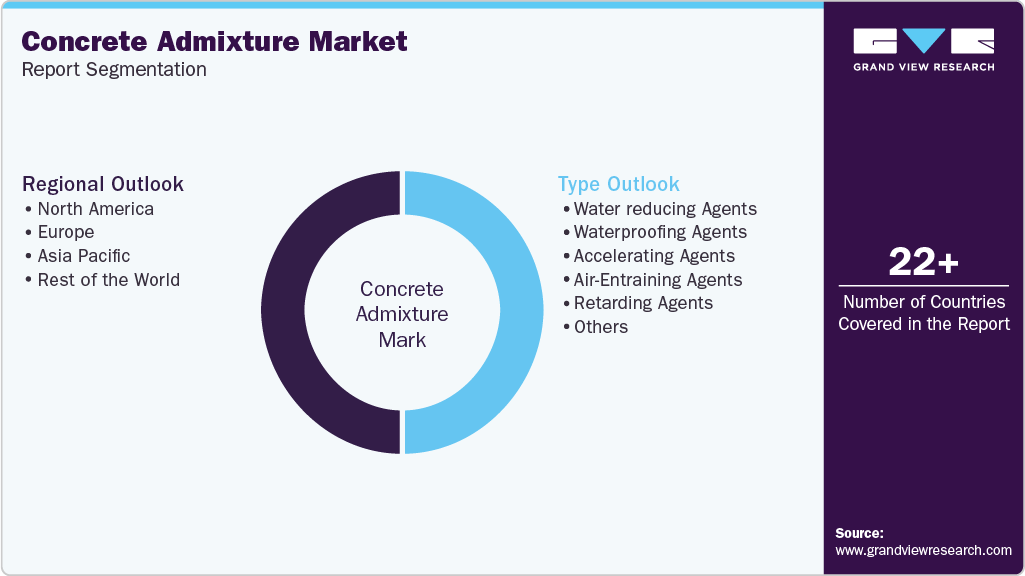
This report forecasts revenue growth at global, regional, and country levels and analyzes the latest industry trends in each sub-segment from 2021 to 2033. For this study, Grand View Research has segmented the global concrete admixtures market report based on type, and region.
 To learn more about this report, Download Free Sample Report
 -
Type Outlook (Volume, Kilotons; Revenue, USD Million, 2021 - 2033)
-
Water reducing agents
-
Waterproofing Agents
-
Accelerating Agents
-
Air-Entraining Agents
-
Retarding Agents
-
Others
-
-
Regional Outlook (Volume, Kilotons; Revenue, USD Million, 2021 - 2033)
-
North America
-
U.S.
-
Canada
-
Mexico
-
-
Europe
-
Germany
-
France
-
UK
-
-
Asia Pacific
-
China
-
India
-
Japan
-
-
Rest of the World
-
Delivered Customizations
This report has been delivered with the following In-depth customizations
Client Request
Customization Delivered
Value Adds
Pricing Analysis
Analysis of pricing dynamics in the concrete admixtures market covering raw material costs, chemical formulation expenses, manufacturing and processing costs, regional price variations, historical pricing trends, and pricing comparison across admixture types and applications.
Enable understanding of cost structures and pricing trends across concrete admixture products. Support procurement planning, pricing strategy development, and cost optimization initiatives.
Opportunity Assessment
Evaluation of growth opportunities across admixture types, construction applications, and end-use sectors including residential, commercial, industrial, and infrastructure construction, along with assessment of sustainable construction trends, ready-mix concrete adoption, and demand for high-performance concrete solutions.
Identify high-growth construction segments and emerging demand areas. Support product development, market expansion, and strategic planning driven by increasing infrastructure investments and sustainable construction practices.
Regional Extension
Expanded regional analysis of the concrete admixtures market, including country-level construction activities, infrastructure investments, urbanization trends, regulatory landscape, and adoption patterns of advanced concrete technologies.
Enable identification of high-growth regional markets and construction demand hotspots. Support regional expansion strategies and understanding of region-specific construction trends, regulatory frameworks, and competitive dynamics.
Frequently Asked Questions About This Report
Asia Pacific dominated with a 56.1% revenue share in 2025.
Some of the key players operating in the concrete admixtures market include Sika AG, BASF SE, GCP Applied Technologies Inc., RPM International, Inc., Fosroc Inc., Mapei SpA, CHYRSO SAS, and Rhein-Chemotechnik GmbH.
The concrete admixtures market is expected to grow at a significant rate over the estimated time frame owing to their properties such as high strength, water reduction, retardation, durability, and others to concrete, thereby making it ideal for use in infrastructure components.
The global concrete admixtures market size was estimated at USD 20.1 billion in 2025 and is expected to reach USD 21.4 billion in 2026.
The global concrete admixtures market is projected to grow at a compound annual growth rate (CAGR) of 8.6% from 2026 to 2033, reaching a value of USD 38.3 billion by 2033.
Water-reducing agents dominated the market and accounted for the largest revenue share of 47.8% in 2025.
About the Author(s)
Advanced Interior Materials Research Team
Advanced Materials · Advanced Interior MaterialsThis report was authored by the advanced interior materials research team at Grand View Research - comprising two research analysts, one senior research analyst, and one industry expert - with specialized expertise in the advanced interior materials segment of the advanced materials industry. All findings are based on proprietary advanced materials databases, executive interviews, and regulatory analysis, subject to internal peer review prior to publication.
Last Updated:
Speak to Analyst

Customize this report to your needs - add regions, segments, or data points, with 20% free customization.
Or view our licence options:


ISO 9001:2015 & 27001:2022 Certified
We are GDPR and CCPA compliant! Your transaction & personal information is safe and secure. For more details, please read our privacy policy.


