
- Home
- »
- Plastics, Polymers & Resins
- »
-
Concrete Bonding Agents Market Size, Growth Report, 2026-2033GVR Report cover

Concrete Bonding Agents Market (2026 - 2033)
Size, Share & Trends Analysis Report By Product (Cementitious Latex-based, Epoxy-based), By Application (Repairing, Decorative), By End-use, By Region, And Segment Forecasts
Market Size, 2025
$5.6BMarket Estimate, 2026
$6.1BMarket Forecast, 2033
$10.7BCAGR, 2026–2033
8.4%Concrete Bonding Agents Market Summary
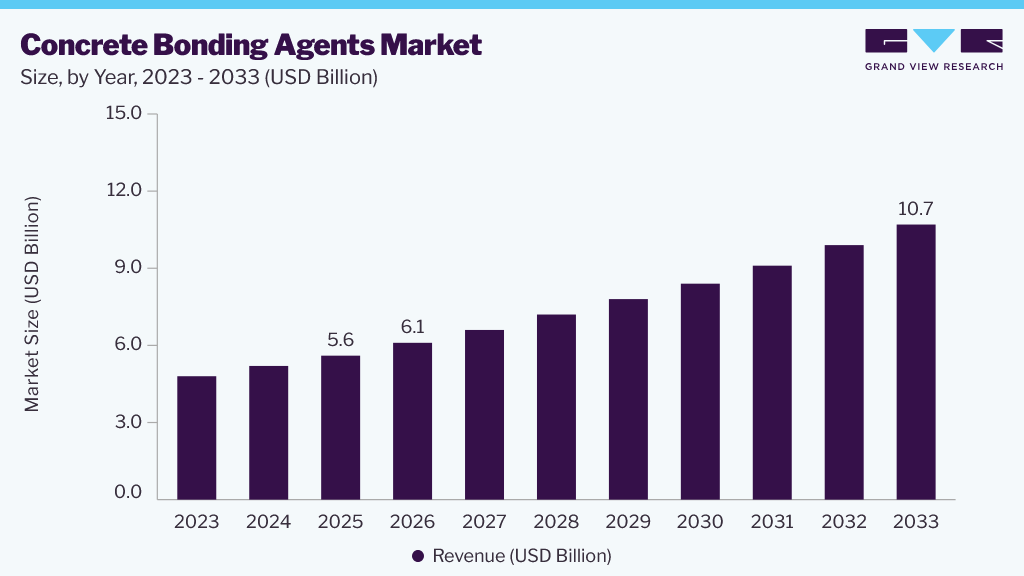
The global concrete bonding agents market size was valued at USD 5.6 billion in 2025 and is projected to grow from USD 6.1 billion in 2026 to USD 10.7 billion by 2033, growing at a CAGR of 8.4% from 2026 to 2033. The Asia Pacific dominated the market, accounting for a revenue share of 45.0% in 2025. Market growth is driven by increasing construction, repair, renovation, and infrastructure redevelopment activities, which are generating higher demand for concrete bonding agents across residential, commercial, and infrastructure projects.
 Source: Grand View Research, IR Documents, Primary Interviews, Paid DatabasesTo learn more about this report,
 Download Free Sample Report
Key Market Trends & Insights
- By product: The cementitious latex-based segment held the largest revenue share of around 67.5% in 2025.
- By application: The repairing segment held the largest market share of over 64.0% in 2025.
- By end use: The non-residential segment held the largest revenue share of more than 57.0% in 2025.
Regional Highlights
- Largest regional market: Asia Pacific (45.0% revenue share, 2025)
- Fastest-growing regional market: North America (highest CAGR, 2026-2033)
Market Size & Forecast
- Market size in 2025: USD 5.6 Billion
- Estimated market size in 2026: USD 6.1 Billion
- Projected market size by 2033: USD 10.7 Billion
- CAGR (2026-2033): 8.4%
Prism AI by Grand View Research Free to tryAsk a question about the concrete bonding agents marketTry asking✓Every figure cited from GVR research Prefer the report? Download free sample →Concrete bonding agents are used to improve adhesion between newly placed concrete or plaster and existing hardened concrete surfaces. They help develop a strong bond between old and new concrete, reducing the risk of delamination and improving the durability and structural performance of repaired or renovated structures. These products are widely used in flooring, repair and rehabilitation, decorative concrete, overlays, and other construction applications.
Analyst Perspective
The market is evolving alongside the global shift toward infrastructure preservation and sustainable construction practices. While new construction continues to generate demand, long-term market expansion will increasingly be supported by repair, rehabilitation, and structural strengthening of aging assets. Product innovation is moving beyond basic adhesion performance toward multifunctional formulations that enhance durability, moisture resistance, and compatibility with modern cementitious materials. In addition, stricter construction quality standards and the growing adoption of performance-based building practices are encouraging the use of advanced bonding solutions across residential, commercial, and infrastructure projects. Emerging economies are expected to remain key growth centers due to rapid urban development, while mature markets will continue to generate demand through renovation and maintenance activities, supporting sustained market growth over the forecast period.
Product Insights
By product, cementitious latex-based held the largest revenue share of around 67.5% in 2025. The segment's dominance is attributed to its extensive use in concrete repair, resurfacing, flooring, waterproofing, and structural rehabilitation applications. Cementitious latex-based bonding agents provide excellent adhesion between existing and newly applied concrete while improving workability, crack resistance, and durability. Their compatibility with a wide range of cement-based materials and ease of application make them a preferred choice across residential, commercial, and infrastructure projects. For instance, in June 2024, Euclid Chemical launched VERSASPEED RMC, a rapid-setting cementitious concrete repair mortar developed for structural repairs, parking decks, pavements, balconies, and other concrete restoration applications. The product supports faster repair schedules while delivering durable concrete restoration performance.
The epoxy-based segment is expected to grow at a significant CAGR during the forecast period. Growth is driven by increasing demand for high-performance bonding solutions in applications requiring superior mechanical strength, chemical resistance, and long-term durability. Epoxy-based bonding agents are widely used in bridge rehabilitation, industrial flooring, heavy-duty infrastructure, and structural concrete repairs where strong adhesion under harsh operating conditions is essential. Their ability to withstand moisture, chemicals, heavy loads, and temperature fluctuations makes them suitable for demanding environments. Rising investments in industrial facilities, transportation infrastructure, and commercial construction, coupled with the growing focus on extending the service life of concrete structures, are expected to support continued adoption of epoxy-based concrete bonding agents during the forecast period.
Application Insights
By application, repairing dominated the market with the largest revenue share of over 64.0% in 2025, driven by the increasing need to repair, rehabilitate, and strengthen aging buildings, bridges, roads, tunnels, and other infrastructure assets. Concrete bonding agents play a critical role in ensuring strong adhesion between existing and newly applied concrete, improving structural integrity and extending the service life of repaired structures. Growing investments in infrastructure maintenance and renovation across both developed and emerging economies continue to support segment growth. For instance, in December 2025, Simpson Strong-Tie launched Strong-Bond, a fast-curing anchoring and bonding adhesive designed for concrete, masonry, and stone repair applications. The product enables rapid repairs while delivering durable bond performance across structural restoration projects.
The flooring segment is expected to register the fastest CAGR during the forecast period. Rising demand for durable, high-performance flooring systems across residential, commercial, industrial, and institutional buildings is driving the adoption of concrete bonding agents. These products improve adhesion between existing and newly placed concrete layers, making them suitable for floor resurfacing, overlays, screeds, and renovation projects. They also enhance crack resistance, load-bearing capacity, and long-term durability under heavy foot traffic and mechanical loads. Increasing construction of commercial complexes, warehouses, manufacturing facilities, healthcare institutions, and retail spaces, along with growing renovation activities, is expected to accelerate demand for concrete bonding agents in flooring applications over the forecast period.
End Use Insights
By end use, non-residential accounted for the largest share, at more than 57.0% in 2025. The segment's dominance is attributed to the extensive use of concrete bonding agents across commercial buildings, industrial facilities, transportation infrastructure, airports, bridges, tunnels, and public utilities. These projects require durable repair and rehabilitation solutions to maintain structural performance under heavy loads and continuous use. Concrete bonding agents improve adhesion between existing and newly placed concrete, enhancing structural integrity, load-bearing capacity, and long-term durability. Increasing investments in infrastructure modernization, commercial redevelopment, and industrial construction, along with the growing need to extend the service life of aging structures, continue to support demand for concrete bonding agents across non-residential applications.
The residential segment is expected to register a significant CAGR during the forecast period. Rising residential construction, home renovation, and housing redevelopment projects are increasing the use of concrete bonding agents in foundations, driveways, flooring, walls, patios, and repair applications. These products provide strong adhesion between old and new concrete, helping improve crack resistance, durability, and the overall service life of residential structures. Growing consumer preference for long-lasting and low-maintenance construction materials, coupled with increasing investments in affordable housing and residential renovation, is expected to drive demand for concrete bonding agents across the residential sector throughout the forecast period.
Regional Insights
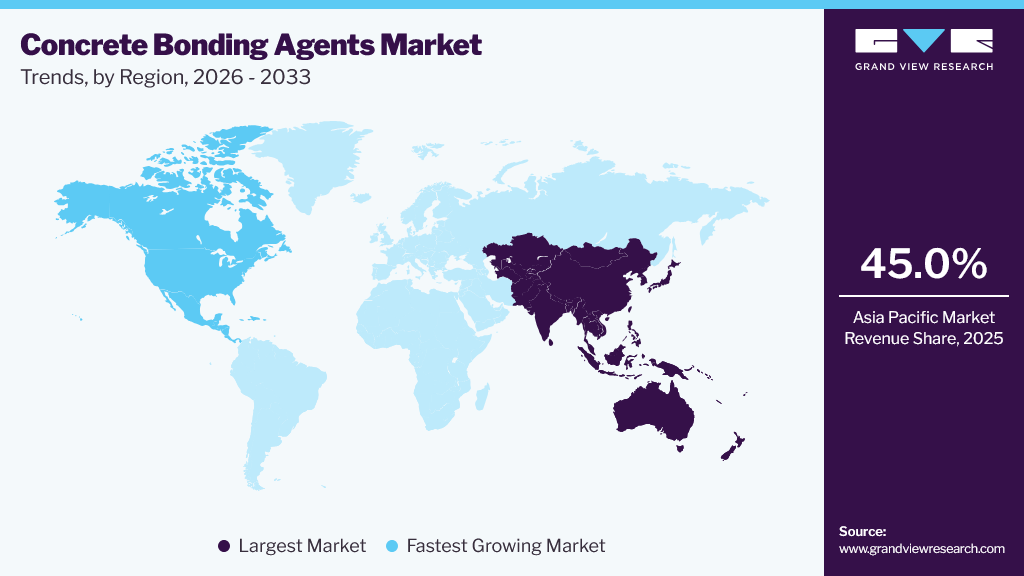
Asia Pacific concrete bonding agents dominated the market, accounting for a revenue share of 45.0% of the market share in 2025. Rapid urbanization, expanding infrastructure development, and increasing renovation and rehabilitation of existing buildings are driving demand for concrete bonding agents across the region. Growing investments in residential, commercial, and transportation infrastructure in countries such as China, India, Japan, South Korea, and Australia continue to drive the adoption of products for concrete repair, restoration, and structural strengthening.
 To learn more about this report, Download Free Sample Report
China Concrete Bonding Agents Market Trends
The concrete bonding agents market in China dominated the global market. Rising infrastructure investment, urban redevelopment, and expansion of residential and commercial construction are increasing demand for concrete repair and bonding solutions. For instance, in January 2025, Sika AG opened new manufacturing facilities in Singapore and Xi'an, China, expanding its regional production capacity. The Xi'an facility manufactures tile adhesives, cementitious waterproofing products, flooring systems, and related construction materials, strengthening the company's supply network across Asia.
North America Concrete Bonding Agents Market Trends
The concrete bonding agents market in North America is expected to grow at the fastest CAGR during the forecast period. Growth is driven by increasing investments in infrastructure rehabilitation, commercial construction, and residential renovation projects across the U.S. and Canada. The growing need to repair aging bridges, highways, parking structures, and public infrastructure is increasing demand for concrete repair materials, including concrete bonding agents, to improve structural integrity and extend service life. For instance, in June 2025, the U.S. Department of Transportation announced USD 5.4 billion in federal bridge funding, including nearly USD 4.9 billion through the Bridge Investment Program, to support the rehabilitation and replacement of aging bridges, with approximately 42,000 bridges in poor condition. Such investments are expected to support demand for concrete bonding agents used in repair and restoration applications.
Key Concrete Bonding Agents Company Insights
Organizations are focusing on increasing their customer base to gain a competitive edge in the industry. Therefore, key players are taking several strategic initiatives, such as mergers and acquisitions, and partnerships with other major companies.
Key Concrete Bonding Agents Companies
The following key companies have been profiled for this study on the concrete bonding agents market:
-
BASF SE
-
Saint-Gobain Weber S.A.
-
The Dow Chemical Company
-
ChemCo Systems, Inc.
-
Flowcrete Group Ltd.
-
Fosroc, Inc.
-
GCP Applied Technologies Inc.
-
Mapei S.p.A.
-
Sika AG
-
The Euclid Chemical Company
-
Adhesives Technology Corporation
Recent Developments
-
In January 2025, Saint-Gobain completed the acquisition of OVNIVER Group, a Mexico-based construction chemicals manufacturer. The acquisition expands Saint-Gobain's portfolio of concrete repair, bonding, waterproofing, and surface treatment solutions while strengthening its presence in the Latin American market.
-
In February 2025, Saint-Gobain completed its acquisition of FOSROC, a construction chemicals manufacturer with a strong presence in India, Asia-Pacific, and the Middle East. Its portfolio includes concrete and cement admixtures, adhesives and sealants, waterproofing solutions, concrete repair products, and flooring systems.
Concrete Bonding Agents Market Report Scope
Report Attribute
Details
Market size in 2025
USD 5.6 billion
Estimated market size in 2026
USD 6.1 billion
Projected market size by 2033
USD 10.7 billion
Growth rate
CAGR of 8.4% from 2026 to 2033
Base year for estimation
2025
Historical data
2021 – 2024
Forecast period
2026 – 2033
Quantitative units
Revenue in USD billion, and CAGR from 2026 to 2033
Report coverage
Revenue forecast, company ranking, competitive landscape, growth factors, and trends
Segments covered
Product, application, end use, region
Regional scope
North America; Europe; Asia Pacific; Latin America; MEA
Country scope
U.S.; Canada; Mexico; Germany; UK; France; Italy; Spain; China; Japan; India; South Korea; Brazil; Argentina; Saudi Arabia; South Africa
Key companies profiled
BASF SE; Saint-Gobain Weber S.A.; The Dow Chemical Company; ChemCo Systems, Inc.; Flowcrete Group Ltd.; Fosroc, Inc.; GCP Applied Technologies Inc.; Mapei S.p.A.; Sika AG; The Euclid Chemical Company; Adhesives Technology Corporation
Customization scope
Free report customization (equivalent up to 8 analysts working days) with purchase. Addition or alteration to country, regional & segment scope.
Pricing and purchase options
Avail of customized purchase options to meet your exact research needs. Explore purchase options
Global Concrete Bonding Agents Market Report Segmentation
This report forecasts revenue growth at the global, regional, and country levels and provides an analysis of the latest industry trends and opportunities in each sub-segment from 2021 to 2033. For this study, Grand View Research has segmented the global concrete bonding agents market report based on product, application, end use, and region.
-
Product Outlook (Volume, Kilotons, Revenue, USD Billion, 2021 - 2033)
-
Cementitious Latex-based
-
Epoxy-based
-
-
Application Outlook (Volume, Kilotons, Revenue, USD Billion, 2021 - 2033)
-
Repairing
-
Flooring
-
Decorative
-
Others
-
-
End-use Outlook (Volume, Kilotons, Revenue, USD Billion, 2021 - 2033)
-
Residential
-
Non-Residential
-
-
Regional Outlook (Volume, Kilotons, Revenue, USD Billion, 2021 - 2033)
-
North America
-
U.S.
-
Canada
-
Mexico
-
-
Europe
-
Germany
-
UK
-
France
-
Italy
-
Spain
-
-
Asia Pacific
-
China
-
Japan
-
India
-
South Korea
-
-
Central & South America
-
Brazil
-
Argentina
-
-
Middle East and Africa
-
Saudi Arabia
-
South Africa
-
-
Frequently Asked Questions About This Report
The global concrete bonding agents market size was valued at USD 5.6 billion in 2025 and is estimated at USD 6.1 billion in 2026.
The global concrete bonding agents market is expected to grow at a CAGR of 8.4% from 2026 to 2033, reaching USD 10.7 billion.
Key players in the market include BASF SE, Saint-Gobain Weber S.A., The Dow Chemical Company, ChemCo Systems, Inc., Flowcrete Group Ltd., Fosroc, Inc., GCP Applied Technologies Inc., Mapei S.p.A., Sika AG, The Euclid Chemical Company, Adhesives Technology Corporation, and others.
The cementitious latex-based segment accounted for the largest revenue share of around 67.5% in 2025
Asia Pacific dominated with an approximately 45.0% revenue share in 2025.
About the Author(s)
Plastics, Polymers & Resins Research Team
Bulk Chemicals · Plastics, Polymers & ResinsThis report was authored by the plastics, polymers & resins research team at Grand View Research - comprising two research analysts, one senior research analyst, and one industry expert - with specialized expertise in the plastics, polymers & resins segment of the bulk chemicals industry. All findings are based on proprietary bulk chemicals databases, executive interviews, and regulatory analysis, subject to internal peer review prior to publication.
Last Updated:
Speak to Analyst

Customize this report to your needs - add regions, segments, or data points, with 20% free customization.
Or view our licence options:


ISO 9001:2015 & 27001:2022 Certified
We are GDPR and CCPA compliant! Your transaction & personal information is safe and secure. For more details, please read our privacy policy.


