
- Home
- »
- Automotive & Transportation
- »
-
Container Depot Services Market Report, 2025-2033GVR Report cover
![Container Depot Services Market (2025 - 2033)Report]()
Container Depot Services Market (2025 - 2033)
Size, Share & Trends Analysis Report By Service Type (Storage, Handling/Movement, Maintenance & Repair, Transportation), By Container Type (Dry/Standard, Reefer, Tank), By End-use, By Region, And Segment Forecasts
Market Size, 2024
$9.1BMarket Estimate, 2026
$10.0BMarket Forecast, 2033
$14.8BCAGR, 2025–2033
5.7%Container Depot Services Market Summary
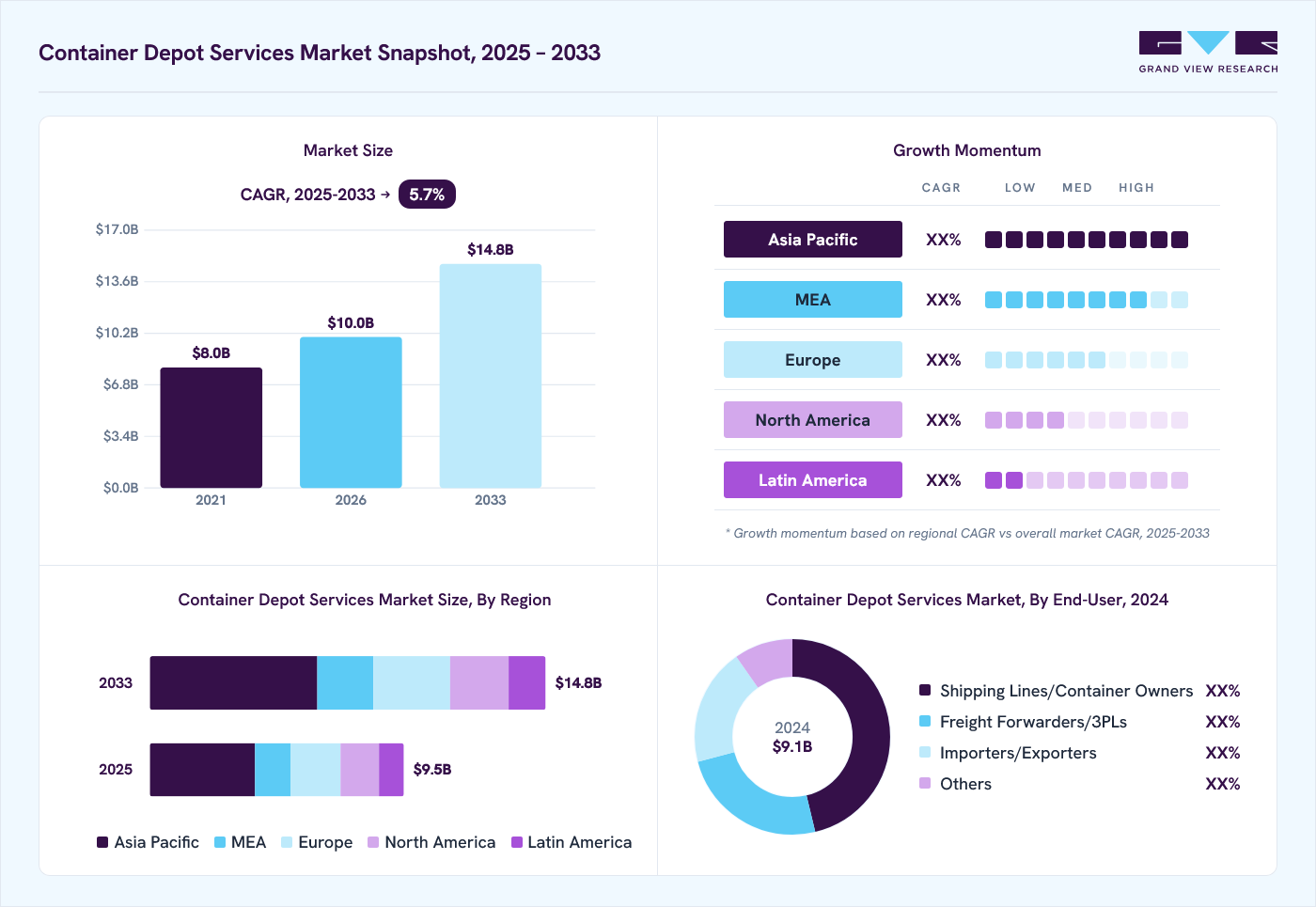
The global container depot services market size was valued at USD 9.1 billion in 2024 and is projected to grow from USD 10.0 billion in 2026 to USD 14.8 billion by 2033, at a CAGR of 5.7% from 2025 to 2033. Asia Pacific dominated the market, accounting for a revenue share of 41.3% in 2024. The rising port congestion and container throughput pressures across major global trade hubs are propelling market growth, as shippers and carriers increasingly rely on depot services for storage, repositioning, and maintenance of containers.
Key Market Trends & Insights
- The container depot services industry in China held a dominant position in 2024.
- By service type, the storage segment accounted for the largest share of 29.7% in 2024.
- By container type, the dry/standard segment held the largest market share in 2024.
- By end use, the shipping lines/container owners segment dominated the market in 2024.
Market Size & Forecast
- 2024 Market Size: USD 9.1 Billion
- 2033 Projected Market Size: USD 14.8 Billion
- CAGR (2025-2033): 5.7%
- Asia Pacific: Largest market in 2024
Furthermore, expansion of cold chain logistics, digitalization of yard operations, stricter decarbonization policies, and regional port infrastructure investments are boosting demand for depot networks, strengthening their role as a critical link in the global supply chain. Global seaport networks continue to experience high container throughput, vessel bunching, and congestion at key gateways, creating persistent demand for off-port storage and depot services. The U.S. Department of Transportation highlights that elevated port activity has required shippers to rely on inland depots to maintain fluid cargo flows, while the U.S. Federal Maritime Commission notes that additional container storage and repositioning facilities are critical to maintaining supply chain resilience. These conditions are propelling market growth for container depots, as operators provide essential buffer capacity to manage surges in container volumes and avoid terminal gridlock.
The Food and Agriculture Organization (FAO) reports that demand for refrigerated transport continues to climb as global food trade expands and consumers expect year-round access to perishable goods. This trend is boosting the market for reefer container handling, storage, and maintenance at depots, as specialized services such as temperature monitoring, plug-in points, and inspection reduce product losses and improve supply reliability. As governments emphasize stronger cold chain systems to mitigate food waste, depot operators investing in reefer capabilities are capturing a growing share of this market.
The World Bank emphasizes that digital yard management, electronic manifests, and automated slot booking are central to improving maritime logistics efficiency. These initiatives are supporting market growth by enabling depots to integrate seamlessly with ports and carriers, reducing container dwell times, and enhancing real-time visibility of assets. Adoption of digital solutions allows depot operators to manage higher container volumes with fewer delays, directly boosting operational efficiency and market competitiveness in the depot services sector.
The International Maritime Organization’s 2023 GHG strategy introduced mandatory measures such as the Energy Efficiency Existing Ship Index (EEXI) and Carbon Intensity Indicator (CII), reshaping container flows and logistics planning. These regulatory shifts are propelling depot operators to adopt low-emission handling equipment, electrified yard vehicles, and energy-efficient infrastructure. By aligning with stricter environmental standards, depots are not only reducing carbon footprints but also boosting their attractiveness to shipping lines seeking compliant logistics partners, thereby fueling long-term market growth.
According to UNCTAD, Asia-Pacific remains the dominant hub of maritime trade, while governments in the Middle East, Africa, and Latin America are expanding port infrastructure to capture a larger share of container traffic. These regional investments are boosting demand for depot services near new and upgraded terminals, as operators seek to manage increased container flows and diversify away from congested chokepoints. The combination of strong APAC volumes and emerging markets’ infrastructure expansion is propelling steady global growth in the container depot services industry.
Service Type Insights
The storage segment accounted for the largest share of 29.7% in 2024. Rising port congestion and fluctuating container imbalances are propelling the demand for storage services within depot facilities. According to port utilization data from the U.S. Department of Transportation’s Bureau of Transportation Statistics, containerized trade volumes have reached record highs across both Atlantic and Pacific gateways, creating a shortage of available yard space at ports. As a result, depot operators are seeing accelerated demand for longer dwell-time storage, with some facilities incorporating digital yard management systems to optimize container stacking and retrieval. This storage-led expansion is boosting market revenues, especially in Asia-Pacific and North America, where container flows remain heavily imbalanced.
The maintenance & repair segment is projected to grow at the fastest CAGR over the forecast period. Increasing regulatory standards for container safety and international compliance are boosting the maintenance and repair segment. The International Maritime Organization enforces the Convention for Safe Containers (CSC) standards, making regular inspection and repair mandatory before containers are deemed seaworthy. Depot operators offering certified repair and refurbishment services are witnessing strong growth, particularly for reefer and tank containers that require periodic structural checks and refrigeration system servicing. This trend is further supported by a rising global emphasis on container reuse and refurbishment to reduce steel consumption and carbon emissions in the logistics industry.
Container Type Insights
The dry/standard segment held the largest market share in 2024. Dry containers continue to dominate depot service demand as they account for the majority of international container traffic. Government trade statistics highlight that manufactured goods, raw materials, and bulk commodities, largely moved in dry containers, still represent the highest share of global shipping flows. This reliance is propelling consistent demand for depot services, particularly in storage, inspection, and handling. Growth is further boosted by e-commerce supply chains, where retailers increasingly require flexible depot solutions for repositioning empty dry boxes across multiple regions.
The reefer (temperature-sensitive) segment is projected to grow at the fastest CAGR over the forecast period. The surge in cross-border trade of perishable goods, such as pharmaceuticals, fresh produce, and frozen food, is boosting reefer container demand. Reports from the U.S. Department of Agriculture confirm that agricultural exports have risen sharply, creating higher throughput for temperature-controlled logistics. Depot operators specializing in reefer storage, plug-in facilities, and repair of refrigeration units are experiencing rapid adoption. Additionally, the COVID-19 pandemic’s impact on vaccine distribution demonstrated the critical role of reefer infrastructure, further propelling depot investment into cold chain readiness across Europe, Asia, and North America.
End-use Insights
The shipping lines/container owners segment dominated the market in 2024 and is projected to grow at a significant CAGR over the forecast period. Shipping lines remain the largest end use group for depot services, driven by the need for repositioning, inspection, and fleet optimization. As highlighted by the Federal Maritime Commission, container imbalances during global trade disruptions created unprecedented surges in demand for depots, especially near secondary ports and inland hubs. Lines are increasingly contracting with depot operators for guaranteed capacity and value-added repair services, boosting this segment’s growth.
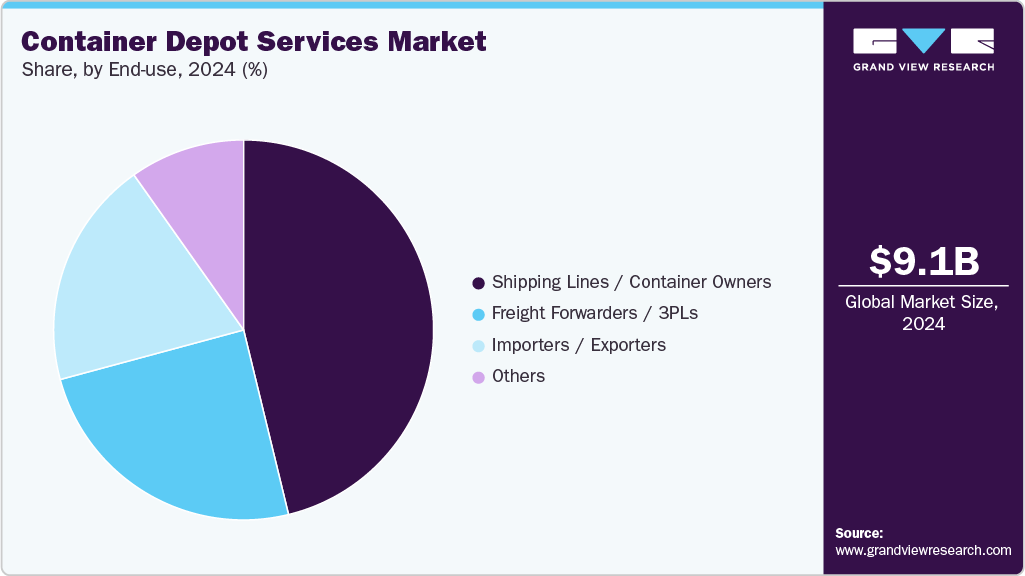
The importers/exporters segment is projected to grow at the fastest CAGR over the forecast period. Importers and exporters are also driving demand as they increasingly require just-in-time storage and pre-shipment inspection services at depots. U.S. International Trade Commission data shows sustained growth in bilateral trade flows, creating greater reliance on depots to manage short-term storage, container release, and customs inspection readiness. This segment is particularly strong in developing economies where exporters depend on third-party depots for efficient turnaround before dispatch to ports, thereby boosting demand for scalable depot networks.
Regional Insights
North America container depot services market accounted for a 15.2% share of the overall market in 2024. The container depot services market in North America is being boosted by rising intermodal traffic and the growing need for inland storage solutions. According to the U.S. Department of Transportation’s Bureau of Transportation Statistics, containerized imports into North American ports surpassed 30 million TEUs annually, straining port yard capacity and pushing demand for depots in inland logistics hubs such as Chicago, Dallas, and Toronto. Investments in rail-connected depots are propelling growth, ensuring smoother container repositioning and faster supply chain turnaround across the region.
U.S. Container Depot Services Market Trends
The container depot services industry in the U.S. held a dominant position in 2024. In the U.S., depot services are witnessing strong momentum due to supply chain disruptions and elevated port congestion. The Federal Maritime Commission reports that ocean carriers faced unprecedented delays at West Coast gateways, which intensified demand for off-dock storage and repair services. Cold chain expansion is also boosting reefer depot activity, as the U.S. Department of Agriculture highlights rising exports of meat, dairy, and fresh produce that rely heavily on temperature-controlled containers. This dual demand for dry and reefer depots is fueling significant investments in digital yard management and automation within U.S. depots.
Europe Container Depot Services Market Trends
The container depot services industry in Europe holds a substantial share, propelled by the continent’s strong focus on sustainability and regulatory compliance. The European Commission has rolled out stricter emission reduction targets under its Fit for 55 package, requiring greener logistics solutions. This has led depot operators to invest in low-emission equipment, digital monitoring systems, and more efficient storage models. Rising trade within the EU single market, combined with container traffic through major hubs like Rotterdam and Antwerp, is boosting demand for scalable depot capacity across Europe.
Germany stands out in Europe as a depot service hotspot due to its role as a central logistics hub. According to Germany Trade & Invest, the country handled over 15 million TEUs annually through its ports, including Hamburg and Bremerhaven, making it a critical node for container storage and maintenance services. Additionally, Germany’s strong automotive and chemical export industries rely heavily on tank and reefer containers, boosting depot repair and inspection demand. Investments in digital twin technology for depots are emerging as a trend, enabling predictive maintenance and better asset utilization.
In the U.K., Brexit-related trade realignments are driving fresh demand for depot services. HM Revenue & Customs highlights increased customs checks and port delays since Brexit, which have boosted off-dock container storage requirements near London Gateway and Felixstowe. The rise of e-commerce and associated import flows is also fueling depot activity, particularly for dry containers. Furthermore, depot operators are diversifying into value-added services such as pre-shipment inspections and customs compliance to support U.K. exporters and importers navigating post-Brexit trade complexities.
Asia Pacific Container Depot Services Market Trends
The container depot services industry in Asia Pacific held the largest share of 41.3% in 2024 and is expected to grow at the fastest CAGR, propelled by its position as the world’s manufacturing hub. According to the United Nations Economic and Social Commission for Asia and the Pacific, the region accounts for over 60% of global container throughput, creating a strong foundation for depot service demand. Inland depot facilities are expanding rapidly in countries like India, Vietnam, and Indonesia, where ports face congestion and exporters rely on inland container depots (ICDs) for smoother operations. The rapid integration of IoT and automation across depots in APAC is boosting efficiency, enabling predictive container tracking and faster turnaround times.

China’s container depot services market is propelled by its dominant role in global trade and manufacturing. Data from China’s Ministry of Transport shows that container throughput in Chinese ports exceeded 300 million TEUs, the highest worldwide. To manage such volumes, depots near Shanghai, Ningbo, and Shenzhen have become critical for storage, repair, and repositioning. Additionally, China’s push toward digital logistics, supported by government-backed initiatives in smart ports and AI-driven container tracking, is accelerating depot modernization, boosting the country’s leadership in this market.
The container depot services industry in Japan is growing due to rising reefer container demand from the country’s seafood and electronics exports. The Ministry of Land, Infrastructure, Transport and Tourism has reported increasing reliance on cold chain infrastructure, with depots offering plug-in facilities for reefer storage near major ports such as Yokohama and Kobe. Furthermore, Japan’s logistics sector is advancing toward automation and robotics in container handling, aligning with the government’s Society 5.0 vision. These initiatives are boosting the efficiency and sustainability of depot services in Japan.
India container depot services industry is witnessing rapid growth, propelled by strong government investment in port-led logistics. Under the Sagarmala Programme, over 570 port modernization and connectivity projects are underway, significantly expanding the need for inland container depots (ICDs) and container freight stations (CFS). Rising exports of textiles, pharmaceuticals, and agricultural produce are boosting demand for both dry and reefer depots. With customs clearance delays still common at ports, ICDs and depots are playing a critical role in reducing congestion and supporting exporters, making India one of the fastest-growing depot service markets globally.
Key Container Depot Services Companies Insights
Key players operating in the container depot services market are undertaking various initiatives to strengthen their presence and increase the reach of their products and services. Strategies such as expansion activities and partnerships are key in propelling the market growth. Some of the major players in the container depot services market include DP World, A.P. Moller - Maersk, COSCO Shipping Corporation, PSA International, Hutchison Port Holdings Trust, and ICTSI, among others, due to their expansive depot networks, consistent investments in digital yard automation, and strong partnerships with shipping lines and logistics companies. These firms have demonstrated excellence in managing high-volume container flows, offering critical services such as storage, repair, maintenance, and repositioning. Their ability to support technologies like IoT-enabled yard management, automated handling systems, cold chain integration, and sustainable energy-powered depots makes them critical to the value chain. Additionally, their strategic global footprint, integration of eco-friendly practices, and focus on value-added service innovation continue to boost their relevance and competitiveness in this rapidly evolving market.
-
DP World is one of the world’s prominent providers of terminal and logistics solutions. The company plays a leading role in the container depot services market through its vast global network of depots and container yards. DP World offers a comprehensive portfolio of services, including empty container storage, inspection, repair, and repositioning. Its deep investments in automation and digital yard management systems position it as a key enabler of efficient container flow management, supporting shipping lines, freight forwarders, and exporters across more than 50 countries.
-
PSA International is a globally recognized terminal operator with extensive depot facilities. The company specializes in managing high-volume container depots linked to major global ports like Singapore and Antwerp. With a strong focus on digital transformation, PSA has become a preferred partner for shipping lines and logistics providers, offering depot solutions that support faster container turnaround, predictive maintenance, and enhanced cold chain integration. Its investments in smart logistics ecosystems, automation, and data-driven operations serve demanding markets such as e-commerce, food supply chains, and pharmaceuticals.
Key Container Depot Services Companies:
The following are the leading companies in the container depot services market. These companies collectively hold the largest market share and dictate industry trends.
- DP World
- A.P. Moller - Maersk
- COSCO Shipping Corporation
- PSA International
- Hutchison Port Holdings Trust
- ICTSI
- Gateway Distriparks Limited
- Adani Group
- DCI
- CONCOR
Recent Developments
-
In May 2025, DP World announced a USD 2.5 billion logistics infrastructure investment programme that will fund major projects across India, Africa, and Europe, a move expected to expand depot, yard, and rail-linked container handling capacity in several markets.
-
In June 2025, A.P. Moller - Maersk issued a formal change to empty-container release procedures at selected depots (requiring a transit order/updated documentation and clarifying drop-off rules), a procedural change that directly affects depot collection flows and empty-box turnaround.
-
In November 2023, Depot Connect International (DCI) announced acquisitions that expanded its tank-container depot and maintenance footprint in the U.S. Pacific Northwest, strengthening specialized depot services for ISO tanks and repair/maintenance.
Container Depot Services Market Report Scope
Report Attribute
Details
Market size in 2024
USD 9.1 billion
Estimated market size in 2026
USD 10.0 billion
Projected market size by 2033
USD 14.8 billion
Growth rate
CAGR of 5.7% from 2025 to 2033
Base year for estimation
2024
Historical data
2021 - 2023
Forecast period
2025 - 2033
Quantitative units
Revenue in USD million/billion, and CAGR from 2025 to 2033
Report coverage
Revenue forecast, company ranking, competitive landscape, growth factors, and trends
Segments covered
Service type, container type, end-use, region
Regional scope
North America; Europe; Asia Pacific; Latin America; Middle East & Africa
Country scope
U.S.; Canada; Mexico; Germany; UK; France; China; Japan; India; South Korea; Australia; Brazil; KSA; UAE; South Africa
Key companies profiled
DP World; A.P. Moller - Maersk; COSCO Shipping Corporation; PSA International; Hutchison Port Holdings Trust; ICTSI; Gateway Distriparks Limited; Adani Group; DCI; CONCOR
Customization scope
Free report customization (equivalent up to 8 analysts working days) with purchase. Addition or alteration to country, regional & segment scope.
Pricing and purchase options
Avail customized purchase options to meet your exact research needs. Explore purchase options
Global Container Depot Services Market Report Segmentation
This report forecasts revenue growth at the global, regional, and country levels and provides an analysis of the latest industry trends in each of the sub-segments from 2021 to 2033. For this study, Grand View Research has segmented the global container depot services market report based on service type, container type, end-use, and region:

-
Service Type Outlook (Revenue, USD Million, 2021 - 2033)
-
Storage
-
Handling/Movement
-
Maintenance & Repair
-
Transportation
-
Others
-
-
Container Type Outlook (Revenue, USD Million, 2021 - 2033)
-
Dry/Standard
-
Reefer (Temperature-Sensitive)
-
Tank (Liquid/Chemical)
-
Others
-
-
End-use Outlook (Revenue, USD Million, 2021 - 2033)
-
Shipping Lines/Container Owners
-
Freight Forwarders/3PLs
-
Importers/Exporters
-
Others
-
-
Regional Outlook (Revenue, USD Million, 2021 - 2033)
-
North America
-
U.S.
-
Canada
-
Mexico
-
-
Europe
-
Germany
-
UK
-
France
-
-
Asia Pacific
-
China
-
Japan
-
India
-
South Korea
-
Australia
-
-
Latin America
-
Brazil
-
-
Middle East and Africa (MEA)
-
KSA
-
UAE
-
South Africa
-
-
Frequently Asked Questions About This Report
The global container depot services market is expected to grow at a CAGR of 5.7% from 2025 to 2033, reaching USD 14.8 billion by 2033.
Asia Pacific held the largest market share of 41.3% in 2024. Asia-Pacific remains the largest regional market, propelled by its position as the world’s manufacturing hub.
Some of the players in the market are DP World, A.P. Moller – Maersk, COSCO Shipping Corporation, PSA International, Hutchison Port Holdings Trust, ICTSI, Gateway Distriparks Limited, Adani Group, DCI, and CONCOR.
The key driving trend in the Container Depot Services market is the rapid growth of global trade and containerization, which, along with rising e-commerce demand, is increasing the need for efficient container storage, maintenance, and repair. This trend is further supported by the adoption of digitalization and automation technologies, such as IoT and RFID tracking, and a growing reliance on third-party logistics providers to optimize operations and reduce costs.
The global container depot services market size was valued at USD 9.1 billion in 2024 and is estimated at USD 10.0 billion for 2026.
About the Author(s)
Automotive & Transportation Research Team
Technology · Automotive & TransportationThis report was authored by the automotive & transportation research team at Grand View Research - comprising two research analysts, one senior research analyst, and one industry expert - with specialized expertise in the automotive & transportation segment of the technology industry. All findings are based on proprietary technology databases, executive interviews, and regulatory analysis, subject to internal peer review prior to publication.
Last Updated:
Speak to Analyst

Need a Tailored Report?
Customize this report to your needs — add regions, segments, or data points, with 20% free customization.
Or view our licence options:


ISO 9001:2015 & 27001:2022 Certified
We are GDPR and CCPA compliant! Your transaction & personal information is safe and secure. For more details, please read our privacy policy.












