
- Home
- »
- IT Services & Applications
- »
-
Cross-Border Workforce & Migration Solutions Market Report 2033GVR Report cover

Cross-border Workforce & Migration Solutions Market (2026 - 2033)
Size, Share, & Trends Analysis Report By Solution (Workforce Centralized Management Systems, Immigration Tech Platforms, Mobility Management), By Application, By End Use, By Region, And Segment Forecasts
Market Size, 2025
$4.7BMarket Estimate, 2026
$5.1BMarket Forecast, 2033
$11.4BCAGR, 2026–2033
12.1%Cross-Border Workforce & Migration Solutions Market Summary
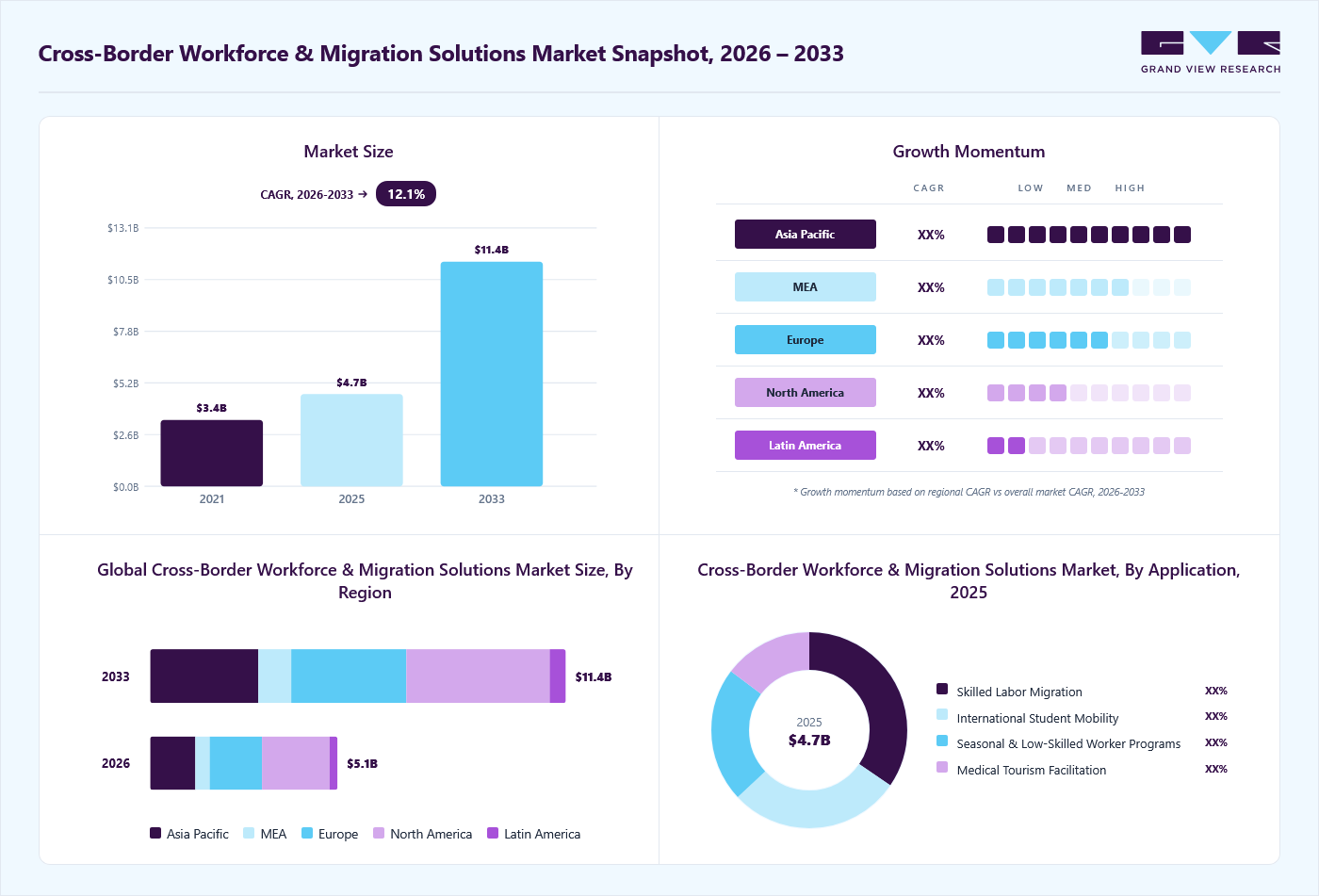
The global cross-border workforce & migration solutions market size was valued at USD 4.7 billion in 2025 and is projected to grow from USD 5.1 billion in 2026 to USD 11.4 billion in 2033, growing at a CAGR of 12.1% from 2026 to 2033. North America dominated the market with the largest revenue share of 36.3% in 2025. Globalization of workforce and rising remote work models is driving cross-border workforce & migration solutions market.
 Source: Grand View Research, IR Documents, Primary Interviews, Paid DatabasesTo learn more about this report,
 Download Free Sample Report
 Key Market Trends & Insights
- By solution: Workforce centralized management systems segment led the market with the largest revenue share of 26.7% in 2025.
- By application: Skilled labor migration segment led the market with the largest revenue share of 34.5% in 2025.
- By end use: Government agencies segment led the market with the largest revenue share of 32.2% in 2025.
Regional Highlights
- Largest regional market: North America (36.3% revenue share, 2025)
- Fastest-growing regional market: Asia Pacific (highest CAGR, 2026-2033)
- By country: The U.S. held the largest market share in 2025
Market Size & Forecast
- Market size in 2025: USD 4.7 Billion
- Estimated market size in 2026: 5.1 Billion
- Projected market size by 2033: USD 11.4 Billion
- CAGR (2026-2033): 12.1%
Three ways to get this report
Buy it, customize it, or ask a question.Ask an Analyst
Analyst response in 1 business day
- AccessReport author, directly
- Reply timeWithin 1 working day
- No sales callDirect answer only
- FormatEmail reply
- CostFree, no cost
Get the Full Report
What the study covers
- FormatsPDF · Excel · Dashboard
- Timeline2026–2033 annual, 2025 base
- Coverage20+ countries, 5 regions
- Companies10+ key players profiled
Customize the Report
20% free customization
- IncludeCountries, segments, points
- TailorTo your product definition
- ExtendDeeper competitor detail
- OrA fully bespoke study
- Turnaround5–10 working days
The globalization of the workforce has transformed enterprises’ approach towards talent acquisition, with companies no longer constrained by geographical boundaries when sourcing critical skills. Organizations are increasingly tapping into international talent pools to overcome skill shortages in their domestic markets, fueling demand for cross-border workforce and migration solutions. Employers require platforms and services that facilitate compliant hiring, payroll, and immigration support for globally distributed teams. For instance, in the World Bank’s Flexibility at Work dataset, only 32% of economies had established legal frameworks for remote work. Only 12% covered both remote work and flexible time, underlining the growing recognition of flexible employment structures. As governments create legal infrastructure for flexible work, companies are compelled to adopt solutions that ensure compliance while expanding global workforce strategies.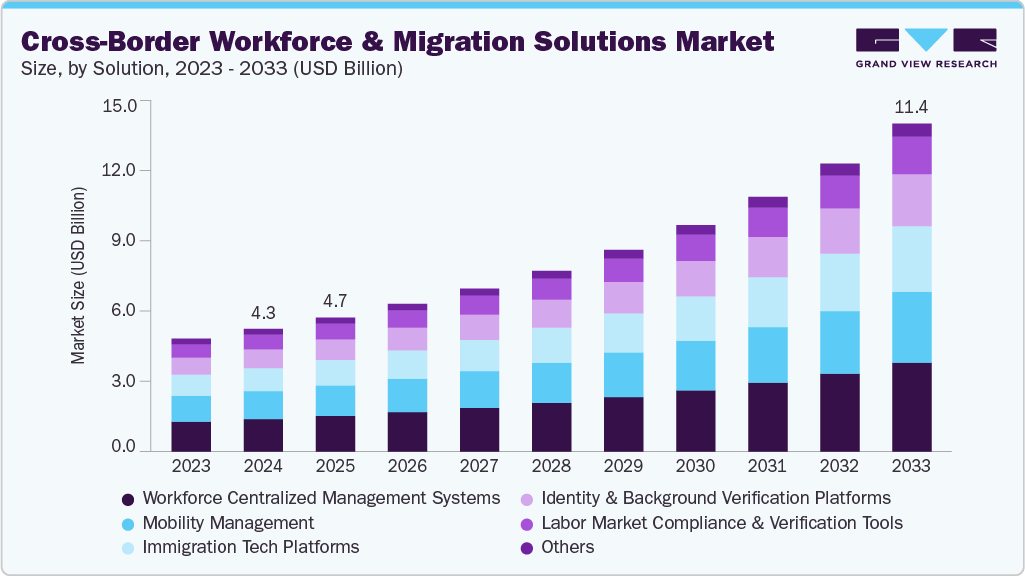 To learn more about this report, Download Free Sample Report
 In addition, the shift to remote and hybrid work has further accelerated the globalization trend by reducing the need for physical relocation while simultaneously increasing the complexity of cross-border employment. Businesses employing remote workers across jurisdictions face challenges in tax residency, payroll compliance, and labor law adherence, all of which require specialized solutions to navigate. For instance, in the U.S. federal workforce, 43% of employees engaged in telework during FY2023, while in the private sector, over 50% of telework-capable employees continued to work remotely, according to the Partnership for Public Service. These sustained patterns illustrate that remote work is not a temporary phenomenon but an enduring feature of labor markets, creating recurring demand for technology-driven compliance, payroll, and migration services.
Moreover, the telecom sector in India is another example of a demand-supply imbalance that is driving market growth for cross-border workforce solutions. With the rollout of 5G technology, the country requires approximately 22 million skilled professionals by 2025, yet there is a current shortage of 2.41 million workers, which is projected to grow 3.8 times by 2030. This shortage is restricting the pace of network application and the adoption of next-generation technologies, compelling companies to seek skilled labor internationally.
Similarly, in European municipalities, a lack of skilled professionals in environmental, engineering, and climate-related fields is delaying critical investments in the green transition. Governments and organizations are increasingly depending on cross-border talent to propel sustainable infrastructure projects, speed up energy transition initiatives, and meet policy-driven environmental goals. For instance, in Europe, municipalities have reported that skill shortages in technical and climate-focused roles are slowing project timelines and impeding progress toward sustainability targets.
Furthermore, the electronics manufacturing sector in India further underscores the global nature of the skills gap. While the industry is projected to create 12 million new jobs by 2028, it faces a shortage of 8 million skilled professionals due to a mismatch between academic outputs and industry requirements. This gap threatens production targets and innovation capacity, prompting companies to leverage international talent to meet workforce demands increasingly. For instance, in India’s electronics manufacturing industry, companies are struggling to fill critical technical positions, driving the adoption of cross-border recruitment strategies.
Market Dynamics
The cross-border workforce & migration solutions market is being driven by increasing global talent shortages, rising international workforce mobility, and the expansion of remote and hybrid work models. Organizations are increasingly hiring talent across borders, creating demand for immigration management, global payroll, compliance monitoring, and Employer of Record (EOR) services. Growing digitalization of visa processing and workforce management is further accelerating adoption. However, complex immigration regulations, varying labor laws, data privacy requirements, and geopolitical uncertainties present challenges. Despite these barriers, continued globalization and demand for skilled international talent are expected to sustain long-term market growth.
The growing shortage of skilled professionals across industries is a major driver of the cross-border workforce & migration solutions market, as organizations increasingly seek talent beyond domestic labor pools. Sectors such as technology, healthcare, engineering, financial services, and manufacturing face persistent workforce gaps that cannot be filled locally. According to the World Economic Forum, over 75% of employers globally report difficulties finding skilled talent, prompting companies to expand international recruitment efforts. As businesses adopt borderless hiring strategies and remote work models, demand for immigration management, global payroll, compliance, and Employer of Record (EOR) solutions continues to rise, accelerating market growth.
Complex immigration policies and varying labor regulations across countries remain a significant restraint on the cross-border workforce & migration solutions market. Employers hiring international workers must navigate multiple visa categories, work permit requirements, tax obligations, employment laws, and data privacy regulations. According to global mobility industry estimates, multinational companies often manage employees across 20-50 different regulatory jurisdictions, increasing administrative complexity and compliance risks. Frequent policy changes, geopolitical developments, and country-specific labor requirements can delay workforce deployment and increase operational costs. These challenges discourage some organizations from pursuing international hiring initiatives and limit broader market adoption.
The rapid growth of Employer of Record (EOR) and global employment platforms presents a significant opportunity for the cross-border workforce & migration solutions market. EOR providers enable companies to hire employees in foreign markets without establishing local legal entities, reducing expansion costs and accelerating market entry. Industry estimates indicate that setting up a legal entity in a new country can require USD 20,000-100,000+ and several months of administrative effort, whereas EOR solutions can onboard employees within weeks. As organizations increasingly pursue international expansion and remote talent acquisition, demand for scalable EOR, payroll, and workforce compliance platforms is expected to grow substantially.
Analyst Perspective
The cross-border workforce & migration solutions market sits at a powerful intersection of long-term structural trends that few HR and workforce technology segments can match, including persistent global talent shortages, increasing workforce globalization, the expansion of remote and distributed work models, and growing regulatory complexity surrounding international employment. Organizations are increasingly seeking talent beyond domestic borders, creating sustained demand for solutions that simplify hiring, mobility, payroll, and compliance across multiple jurisdictions. The central competitive moat, however, will belong to providers that seamlessly integrate Employer of Record (EOR) services, immigration management, global payroll, compliance monitoring, workforce mobility, and identity verification into a unified platform. By transforming fragmented international workforce processes into a streamlined digital ecosystem, these providers can deliver faster talent acquisition, reduced compliance risk, improved employee experiences, and scalable global expansion capabilities for organizations operating in an increasingly borderless labor market.
Solution Insights
Based on solution, the workforce centralized management systems segment led the market with the largest revenue share of 26.7% in 2025 and is expected to grow at the significant CAGR over the forecast period. Global Talent Mobility and Employer of Record (EOR) solutions are pivotal in an interconnected economy, where businesses increasingly hire skilled professionals across international borders. As organizations expand globally, they face complex challenges related to local labor laws, payroll processing, tax regulations, and employee benefits administration. Managing these tasks manually or through fragmented systems leads to inefficiencies, increased risk of non-compliance, and higher costs. An Employer of Record (EOR) simplifies this by acting as the legal employer of the workforce in a foreign country. This allows companies to hire employees without the need to establish a local legal entity.
The immigration tech platforms segment is projected to be the fastest-growing segment from 2025 to 2033. Global mobility is rapidly expanding due to economic globalization, the search for better employment opportunities, access to quality education, and geopolitical events such as conflicts or regional instability. Skilled professionals, seasonal workers, and international students are moving across borders more than ever before. This increased movement of people brings complexity in managing visa applications, work permits, residence authorizations, and compliance with local labor laws. Manual processes and disjointed systems are insufficient to handle the scale and speed of these activities. Immigration Tech Platforms provide a digital framework that automates document processing, tracks applications in real-time, and ensures adherence to evolving regulations. These solutions help businesses and individuals efficiently navigate the intricate cross-border workforce landscape, enabling seamless talent mobility while minimizing compliance risks.
Application Insights
Based on application, the skilled labor migration segment led the market with the largest revenue share of 34.5% in 2025. The shortage of global talent is a growth factor for skilled labor migration, helping market growth in the coming years. Many developed economies, particularly in sectors such as IT, healthcare, engineering, and advanced manufacturing, are experiencing significant skill gaps. As technological advancements accelerate and industries evolve, local talent pools are often insufficient to meet the growing demand for specialized expertise. Therefore, Companies are increasingly turning to skilled workers from abroad to fill these critical roles. This drives the need for comprehensive solutions that facilitate the entire migration process, including visa application management, compliance monitoring, credential verification, and relocation support, ensuring a smooth and legal transition of talent.
The international student mobility segment is projected to grow significantly from 2025 to 2033. The rising demand for global education is a major growth driver in the international student mobility segment of the cross-border workforce and migration solutions market. Increasing numbers of students are seeking higher education abroad to access world-class academic programs, broaden cultural perspectives, and enhance career prospects. Popular destinations such as the U.S., UK, Canada, Australia, and Germany attract students due to their high-quality education systems, advanced research opportunities, and strong job markets. This growing trend fuels the need for efficient solutions that support the entire study abroad journey, including student visa processing, compliance with local immigration regulations, document verification, and tailored support services.
End Use Insights
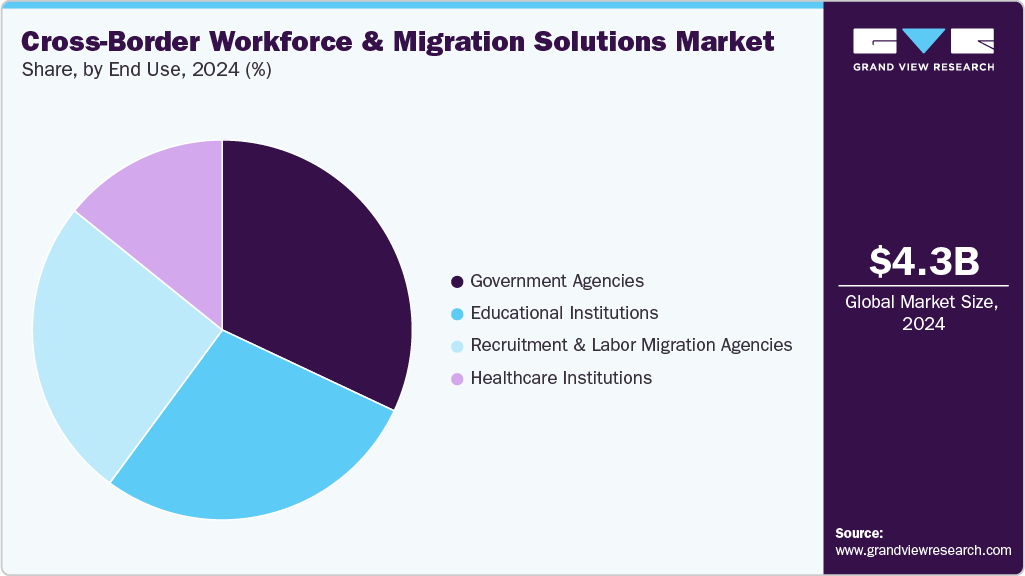
Based on end use, the government agencies segment led the market with the largest revenue share of 32.2% in 2025. Governments worldwide are implementing immigration policy reforms to attract and retain skilled workers, aiming to fill labor shortages in critical sectors such as healthcare, IT, engineering, and education. Initiatives such as the EU Blue Card, the UK Skilled Worker visa, and Australia’s Temporary Skill Shortage visa are designed to streamline the entry of qualified professionals while ensuring compliance with national labor regulations. These programs require extensive administrative support, including application processing, credential verification, and monitoring of visa conditions. Consequently, government agencies and specialized service providers are increasingly engaged in managing these processes, facilitating workforce integration, and ensuring that skilled migrants can contribute effectively to the domestic economy.
 To learn more about this report, Download Free Sample Report
 The educational institutions segment is projected to grow significantly from 2025 to 2033. Educational institutions are experiencing significant growth in the cross-border workforce & migration solutions market due to the rising mobility of international students. Students from Asia, Africa, and Latin America increasingly seek high-quality education in countries such as the U.S., UK, Australia, and Canada. The pursuit of advanced degrees, access to research opportunities, and better career prospects drive this global trend. The continuous influx of international students creates sustained demand for specialized services, including student visa advisory, pre-departure orientation, and immigration compliance support. These services help students navigate complex visa requirements, prepare for cultural integration, and meet legal obligations throughout their academics.
Regional Insights
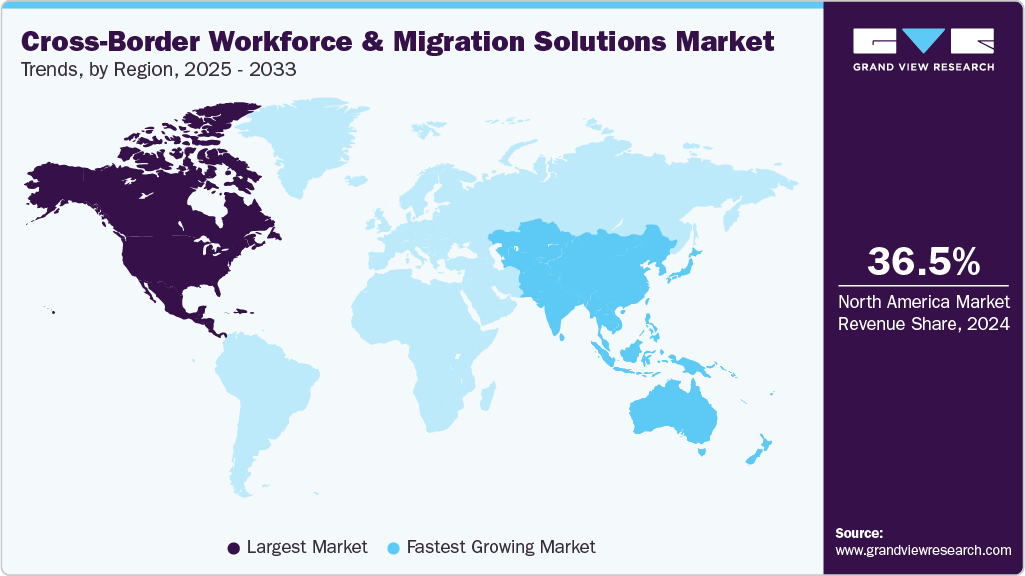
North America dominated the cross-border workforce & migration solutions market with the largest revenue share of 36.3% in 2025. The U.S. and Canada are experiencing significant skill shortages across key sectors such as technology, healthcare, engineering, and advanced manufacturing. As industries rapidly evolve and digital transformation accelerates, the local talent pool often falls short of meeting demand for specialized skills. This shortage has led businesses to increasingly look abroad to recruit highly skilled professionals, especially in areas where domestic candidates are unavailable or insufficient. According to data released by the Global Migration Data Portal, by mid-year 2024, Northern America was home to 61.2 million international migrants, up from 58.8 million in mid-year 2020, reflecting a 4% increase. Nearly half (45%) of these migrants came from Latin America and the Caribbean, followed by Asia (32%), Europe (11%), Africa (4%), Northern America (2%), and Oceania (less than 1%).
 To learn more about this report, Download Free Sample Report
 U.S. Cross-Border Workforce & Migration Solutions Market Trends
The cross-border workforce & migration solutions market in the U.S. held the largest share in the North America region in 2025. The rise of remote and hybrid work models drives market growth. Many U.S. companies are broadening their recruitment beyond borders to tap into global talent pools without necessarily requiring immediate relocation. This shift has created demand for workforce solutions that can handle international payroll, tax compliance, and benefits administration, while also enabling smoother transitions for employees who may later migrate physically. Providers offering flexible solutions for both virtual and physical cross-border employment are witnessing heightened adoption.
Asia Pacific Cross-Border Workforce & Migration Solutions Market Trends
The Asia Pacific cross-border workforce & migration solutions industry is expected to be the fastest growing segment, with a CAGR of 13.3% over the forecast period. The movement of skilled workers to the EU and North America, coupled with the influx of students from Asia pursuing higher education, plays a significant role in driving the growth of the cross-border workforce & migration solutions market. Skilled workers relocating for job opportunities help address labor shortages in high-demand sectors such as healthcare, IT, engineering, and finance. Their migration necessitates services such as visa processing, credential recognition, compliance support, relocation assistance, and integration programs, creating demand for specialized migration solutions. Countries in the EU and North America increasingly rely on these solutions to efficiently attract onboard, and retain international talent, enhancing workforce productivity and competitiveness.
The cross-border workforce & migration solutions industry in China is projected to grow during the forecast period. Outbound talent from China remains a key driver of the Cross-Border Workforce & Migration Solutions Market. Education-driven migration is particularly significant, as Chinese students constitute the largest cohort of international students worldwide. Large numbers of students move to the US, UK, Australia, Canada, and EU countries, creating strong demand for comprehensive services such as student visa advisory, pre-departure orientation, settlement support, and post-graduation planning for work visas or permanent residency. These high-value services help students and their families maximize returns on educational investments while navigating complex immigration processes.
Europe Cross-Border Workforce & Migration Solutions Market Trends
The cross-border workforce & migration solutions industry in Europe is expected to grow during the forecast period. Europe is undergoing significant shifts in immigration policy as governments seek to address growing labor shortages and demographic challenges. Aging populations, declining birth rates, and a shrinking workforce have created gaps in key sectors such as healthcare, agriculture, and construction. This demographic trend has placed pressure on countries to secure a steady supply of skilled and semi-skilled labor to sustain economic growth and social welfare systems.
The cross-border workforce & migration solutions industry in Germany is grow during the forecast period. Germany has implemented a series of strategic reforms to strengthen its position in the global labor market and address domestic skill shortages. The government has implemented the Skilled Immigration Act (Fachkräfteeinwanderungsgesetz), which simplifies the immigration process for skilled workers, including those with vocational training. The Act reduces bureaucratic barriers by streamlining visa applications, accelerating the recognition of foreign qualifications, and providing clearer pathways for employment.
Key Cross-Border Workforce & Migration Solutions Companies & Market Share Insights
Some of the key companies operating in the market, include Papaya Global, and Sirva Worldwide, Inc., among others are some of the leading participants in the cross-border workforce & migration solutions market.
-
Papaya Global is a global workforce management platform. The company provides a cloud-based, end-to-end solution for managing payroll, payments, HR, compliance, and Employer of Record (EOR) services in over 160 countries, enabling organizations to hire, onboard, pay, and support employees and contractors worldwide without needing to establish local entities.
-
Sirva Worldwide, Inc. is a global company in employee relocation and moving services. The company delivers comprehensive mobility solutions for corporate clients, including household goods, home sale, destination services, temporary living, mortgage lending, and commercial moving, combining a vast network of partners, in-house expertise, and robust digital tools to support relocations of any size, frequency, or complexity.
VFS Global Group, and Equus Software, LLC are some of the emerging market participants in the cross-border workforce & migration solutions market.
-
VFS Global is the world’s largest outsourcing and technology services provider for governments and diplomatic missions, specializing in front-end administrative processing for visa, passport, consular, identity management, and biometrics. The group serves 60+ client governments through 3,500+ application centers across 140+ countries, having processed hundreds of millions of applications, and delivers solutions spanning application intake, document verification, enrollment, appointment management, eVisa enablement, customer support, and secure data handling.
-
Equus Software, LLC is a global provider of cloud-based workforce mobility and relocation software trusted by over 2,000 organizations worldwide, including a significant share of Fortune 100 and FTSE 100 companies. Its flagship Equus Platform is widely recognized for automating and managing the full spectrum of global workforce moves such as international assignments, business travel, remote work, immigration, tax compliance, and relocation, helping HR, finance, and mobility teams streamline operations, maintain compliance, and improve visibility for all solutions of mobile employees within a unified digital ecosystem.
Key Cross-Border Workforce & Migration Solutions Companies:
The following key companies have been profiled for this study on the cross-border workforce migration & solutions market.
-
VFS Global Group
-
Equus Software, LLC
-
Topia
-
Sirva Worldwide, Inc.
-
Envoy Global, Inc.
-
Deel, Inc.
-
Papaya Global
-
Employment Conditions Abroad Limited
-
Weichert Workforce Mobility
Competitive Benchmarking
Category
Operating Strategies
Competitive Edge
Weakness
Established Players (Deel; Papaya Global; VFS Global; Workday; Velocity Global)
- Mature players focus on comprehensive global workforce ecosystems that combine Employer of Record (EOR), global payroll, immigration management, compliance monitoring, and workforce analytics.
- They expand through international partnerships, country-specific compliance expertise, and integrated HR technology platforms that support multinational hiring and employee mobility.
- These companies benefit from extensive global coverage, established compliance frameworks, strong brand recognition, and large customer bases.
- Their platforms offer end-to-end workforce management across multiple jurisdictions, reducing complexity for multinational employers.
- Significant investments in automation, AI, and regulatory expertise further strengthen their market position.
- Established providers face high compliance and operational costs due to constantly evolving labor and immigration regulations.
- Maintaining legal entities and service networks across numerous countries requires substantial investment.
- Larger platforms may also face challenges in providing customized solutions for niche industries or smaller businesses.
Emerging Players Remote; Oyster; Rippling; Borderless AI; Multiplier)
- Emerging players focus on AI-driven workforce mobility, automated compliance management, digital onboarding, and remote-first employment solutions.
- Many leverage SaaS-based subscription models and emphasize rapid employee onboarding, localized payroll services, and streamlined international hiring processes.
- Emerging players offer flexible and highly scalable solutions with faster deployment and lower implementation complexity. Their platforms are often designed specifically for remote workforces and digital-first organizations.
- Strong innovation in AI, automation, and user experience enables them to respond quickly to changing customer needs.
- Emerging companies often have limited geographic coverage compared with established providers. Dependence on external legal partners and local service providers can affect service consistency.
- Smaller customer bases, lower brand awareness, and funding constraints may limit expansion into highly regulated or complex international markets.
Recent Developments
-
In September 2025, Deel, Inc. acquired Legalpad, a U.S.-based immigration tech company, to further streamline and accelerate work visa processing initially for the U.S. and later expanding to Europe and Asia. This deepens Deel’s capabilities in end-to-end global mobility, offering integrated onboarding, compliance, payroll, and visa support for both employers and employees.
-
In July 2024, Papaya Global partnered with Worksome to provide enterprise clients a unified, end-to-end solution to manage & pay the contingent/freelancer workforce globally (onboarding, classification, payments, compliance) in 160+ countries.
-
In June 2025, VFS Global launched advisory services under its Education, Travel & Migration (ETM) division in Bangladesh, in partnership with Riyada International. Using generative AI tools, this service offers guidance for visas and immigration to ~45 countries (UK, UAE, Canada, etc.).
Cross-Border Workforce & Migration Solutions Market Report Scope
Report Attribute
Details
Market size in 2025
USD 4.7 billion
Estimated market size in 2026
USD 5.1 billion
Projected market size by 2033
USD 11.4 billion
Growth rate
CAGR of 12.1% from 2026 to 2033
Base year for estimation
2025
Historical data
2021 - 2024
Forecast period
2026 - 2033
Quantitative units
Revenue in USD billion and CAGR from 2026 to 2033
Report coverage
Revenue forecast, company ranking, competitive landscape, growth factors, and trends
Segments covered
Solution, application, end use, region
Regional scope
North America; Europe; Asia Pacific; Latin America; MEA
Country scope
U.S.; Canada; Mexico; Germany; UK; France; China; Japan; India; South Korea; Australia; Brazil; Saudi Arabia; South Africa; UAE
Key companies profiled
VFS Global Group; Equus Software, LLC; Topia; Sirva Worldwide, Inc.; Envoy Global, Inc.; Deel, Inc.; Papaya Global; Employment Conditions Abroad Limited; Weichert Workforce Mobility
Customization scope
Free report customization (equivalent up to 8 analysts' working days) with purchase. Addition or alteration to country, regional & segment scope.
Pricing and purchase options
Avail customized purchase options to meet your exact research needs. Explore purchase options
Global Cross-Border Workforce & Migration Solutions Market Report Segmentation
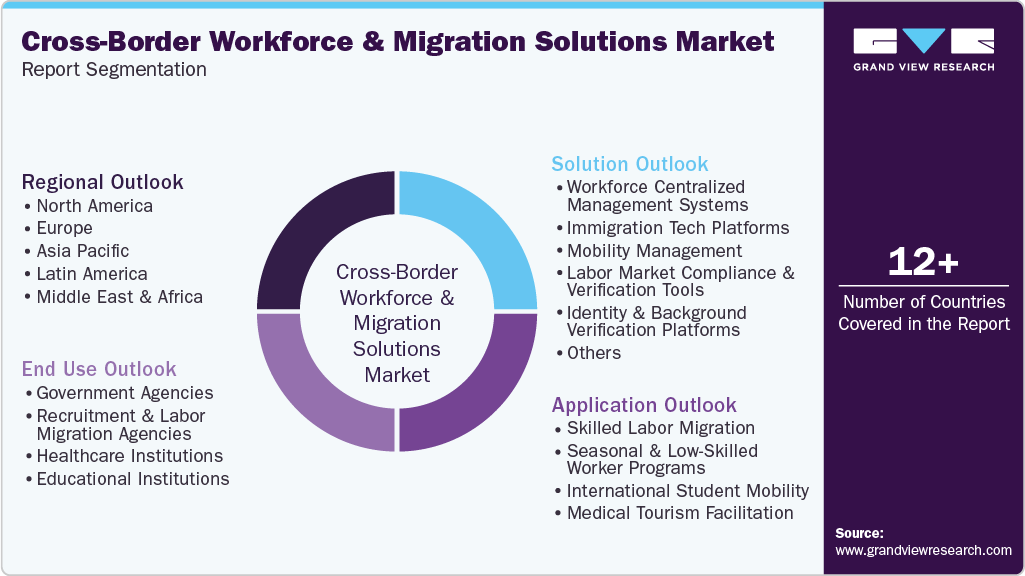
This report forecasts revenue growth at global, regional, and country levels and provides an analysis of the latest industry trends in each of the sub-segments from 2021 to 2033. For this study, Grand View Research has segmented the cross-border workforce & migration solutions market report based on solution, application, end use, and region:
 To learn more about this report, Download Free Sample Report
 -
Solution Outlook (Revenue, USD Billion, 2021 - 2033)
-
Workforce Centralized Management Systems
-
Immigration Tech Platforms
-
Mobility Management
-
Labor Market Compliance & Verification Tools
-
Identity & Background Verification Platforms
-
Others
-
-
Application Outlook (Revenue, USD Billion, 2021 - 2033)
-
Skilled Labor Migration
-
Seasonal & Low-Skilled Worker Programs
-
International Student Mobility
-
Medical Tourism Facilitation
-
-
End Use Outlook (Revenue, USD Billion, 2021 - 2033)
-
Government Agencies
-
Recruitment & Labor Migration Agencies
-
Healthcare Institutions
-
Educational Institutions
-
-
Regional Outlook (Revenue, USD Billion, 2021 - 2033)
-
North America
-
U.S.
-
Canada
-
Mexico
-
-
Europe
-
Germany
-
UK
-
France
-
-
Asia Pacific
-
China
-
India
-
Japan
-
South Korea
-
Australia
-
-
Latin America
-
Brazil
-
-
Middle East & Africa
-
UAE
-
Saudi Arabia
-
South Africa
-
-
Research Methodology
Segment Definition
Segment - Solution
Revenue capture definition
Workforce Centralized Management Systems
Platforms that provide a unified environment for managing international employees, contractors, payroll, workforce records, onboarding, compliance, and HR operations across multiple countries. These systems help organizations streamline global workforce administration through a single interface.
Immigration Tech Platforms
Digital solutions that automate and manage visa applications, work permits, immigration documentation, case tracking, regulatory compliance, and communication between employers, employees, and immigration authorities.
Mobility Management
Solutions and services designed to support employee relocation and international assignments, including travel coordination, housing assistance, relocation benefits, tax support, destination services, and assignment management.
Labor Market Compliance & Verification Tools
Platforms that help organizations comply with country-specific labor laws, employment regulations, wage requirements, tax obligations, and worker eligibility standards while reducing legal and compliance risks.
Identity & Background Verification Platforms
Solutions that verify the identity, educational qualifications, employment history, criminal records, certifications, and work eligibility of international candidates before hiring or relocation.
Others
Includes translation services, document authentication, workforce analytics, international payroll processing, cultural integration tools, expatriate support services, and workforce advisory solutions that facilitate cross-border employment and migration.
Segment - Application
Revenue capture definition
Skilled Labor Migration
The movement of highly qualified professionals such as engineers, healthcare workers, IT specialists, researchers, and executives across international borders to address talent shortages and support economic growth.
Seasonal & Low-Skilled Worker Programs
Programs that facilitate temporary or recurring cross-border employment for workers in industries such as agriculture, construction, hospitality, manufacturing, and logistics, where labor demand fluctuates seasonally.
International Student Mobility
The movement of students across countries for educational purposes, including university admissions, visa processing, compliance management, accommodation support, and post-study work transitions.
Medical Tourism Facilitation
Services that assist individuals traveling internationally to receive medical treatment, including visa support, travel coordination, patient documentation management, healthcare provider matching, and regulatory compliance assistance
Segment – End Use
Revenue capture definition
Government Agencies
National, regional, and local government bodies responsible for immigration management, labor market regulation, border control, workforce planning, visa administration, and migrant worker oversight..
Recruitment & Labor Migration Agencies
Organizations that connect employers with international talent, manage candidate sourcing, facilitate migration processes, and ensure compliance with labor and immigration regulations.
Healthcare Institutions
Hospitals, clinics, healthcare networks, and medical staffing organizations that recruit, onboard, and manage international healthcare professionals to address workforce shortages and specialized skill requirements.
Educational Institutions
Universities, colleges, vocational training centers, and academic organizations that support international student admissions, enrollment, visa compliance, mobility programs, and student services.
Estimation Model
Addressable Workforce Mobility Layer
Regulatory & Infrastructure Access Layer
Adoption & Utilization Layer
Monetization Layer
Who can benefit from cross-border workforce & migration solutions?
Who can deploy cross-border workforce & migration solutions?
Who actively uses cross-border workforce & migration solutions?
How much revenue is generated?
Identify multinational corporations, SMBs, staffing firms, educational institutions, healthcare providers, government agencies, and global employers that recruit, relocate, manage, or support international workers, students, and expatriates. This layer defines the total addressable market by assessing the global population of organizations engaged in international hiring, talent mobility, immigration management, and workforce deployment activities.
Apply factors such as immigration policy openness, labor mobility frameworks, digital government services, visa processing infrastructure, payroll and tax compliance requirements, workforce globalization trends, and availability of migration technology platforms. This layer determines the technologically and operationally reachable market where organizations can effectively implement workforce mobility, immigration, and compliance solutions.
Apply international hiring rates, global workforce mobility trends, Employer of Record (EOR) adoption, expatriate assignment volumes, international student mobility, and immigration technology utilization benchmarks. This layer converts reachable organizations into active users by assessing the extent to which employers, agencies, and institutions utilize digital platforms for global hiring, workforce management, compliance, and mobility operations.
Assess revenue generation potential by analyzing spending on immigration management software, Employer of Record services, global payroll platforms, workforce mobility solutions, compliance verification tools, relocation services, identity verification systems, and managed migration services. Revenue is further driven by subscription-based SaaS platforms, transaction fees, professional consulting services, and recurring workforce management contracts across the active customer base.
Delivered Customizations
This report has been delivered with the following In-depth customizations
Client Request
Customization Delivered
Value Adds
Global Talent Mobility & Cross-Border Hiring Trends
Conducted a focused analysis of international talent mobility covering skilled labor migration, remote cross-border employment, Employer of Record (EOR) adoption, global payroll requirements, immigration technology platforms, and workforce relocation trends across key economic regions.
Helps stakeholders identify high-growth workforce corridors, evaluate international hiring opportunities, and assess revenue potential in global employment, payroll, and mobility management solutions.
Cross-Border Workforce Ecosystem & Market Opportunity Assessment
Assessed demand for Employer of Record (EOR) services, global employment platforms, workforce mobility solutions, relocation services, international student mobility programs, and integrated migration technology ecosystems. Evaluated regulatory, operational, and technology adoption barriers alongside emerging market opportunities.
Supports investment and expansion strategies by identifying underserved markets, evaluating workforce globalization readiness, and strengthening long-term growth opportunities in international talent acquisition, workforce mobility, and cross-border employment solutions.
International Student Mobility Market Assessment
Examined student migration flows, visa processing trends, education destination attractiveness, post-study work programs, and enrollment support technologies across major education markets.
Assists institutions and service providers in identifying growth opportunities, optimizing international recruitment strategies, and enhancing student mobility programs.
Frequently Asked Questions About This Report
The global cross border workforce & migration solutions market size was estimated at USD 4.7 billion in 2025 and is expected to reach USD 5.1 billion in 2026.
The global cross border workforce & migration solutions market is expected to grow at a compound annual growth rate of 12.1% from 2026 to 2033 to reach USD 11.4 billion by 2033.
Factors such as the globalization of workforce and rising remote work models are the key factors driving the market growth.
North America dominated with 36.3% revenue share in 2025.
Asia Pacific is the fastest-growing region over the forecast period.
The workforce centralized management systems segment led with a 26.7% revenue share in 2025, while immigration tech platforms segment is the fastest-growing segment.
The skilled labor migration segment led with a 34.5% revenue share in 2025 and is the fastest growing segment over the forecast period.
The government agencies segment led with a 34.5% revenue share in 2025 and is the fastest growing segment over the forecast period.
Some key players operating in the market include VFS Global Group, Equus Software, LLC, Topia, Sirva Worldwide, Inc., Envoy Global, Inc., Deel, Inc., Papaya Global, Employment Conditions Abroad Limited, Weichert Workforce Mobility.
About the Author(s)
IT Services & Applications Research Team
Technology · IT Services & ApplicationsThis report was authored by the it services & applications research team at Grand View Research - comprising two research analysts, one senior research analyst, and one industry expert - with specialized expertise in the it services & applications segment of the technology industry. All findings are based on proprietary technology databases, executive interviews, and regulatory analysis, subject to internal peer review prior to publication.
Last Updated:
Speak to Analyst

Customize this report to your needs - add regions, segments, or data points, with 20% free customization.
Or view our licence options:


ISO 9001:2015 & 27001:2022 Certified
We are GDPR and CCPA compliant! Your transaction & personal information is safe and secure. For more details, please read our privacy policy.


