
- Home
- »
- Advanced Interior Materials
- »
-
Cullet Market Size, Share & Analysis Report, 2026-2033GVR Report cover

Cullet Market (2026 - 2033)
Size, Share & Trends Analysis Report By Product (Furnace Ready Cullet, Crushed Cullet, Mixed Cullet, Glass Powder), By Application (Container Glass, Flat Glass, Fiberglass, Construction Aggregates, Abrasives & Fillers), By Region, And Segment Forecasts
Market Size, 2025
$3.3BMarket Estimate, 2026
$3.5BMarket Forecast, 2033
$5.1BCAGR, 2026–2033
5.7%Cullet Market Summary
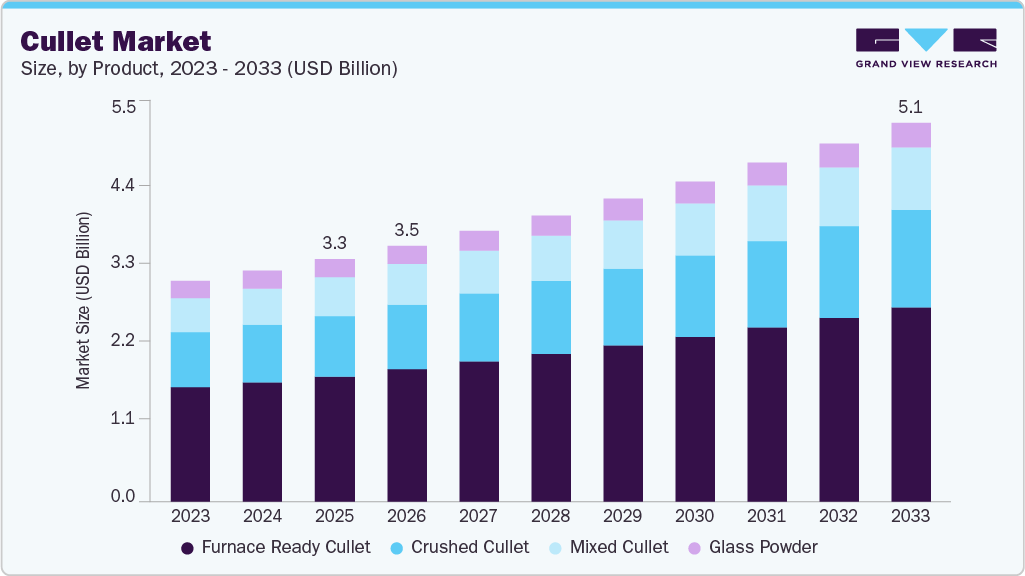
The global cullet market size was valued at USD 3.3 billion in 2025 and is projected to grow from USD 3.5 billion in 2026 to USD 5.1 billion by 2033, at a CAGR of 5.7% from 2026 to 2033. The market in Europe dominated with a revenue share of 32.0% in 2025. Cullet refers to crushed or broken recycled glass that is processed and reused as a raw material in glass manufacturing and other industrial applications.
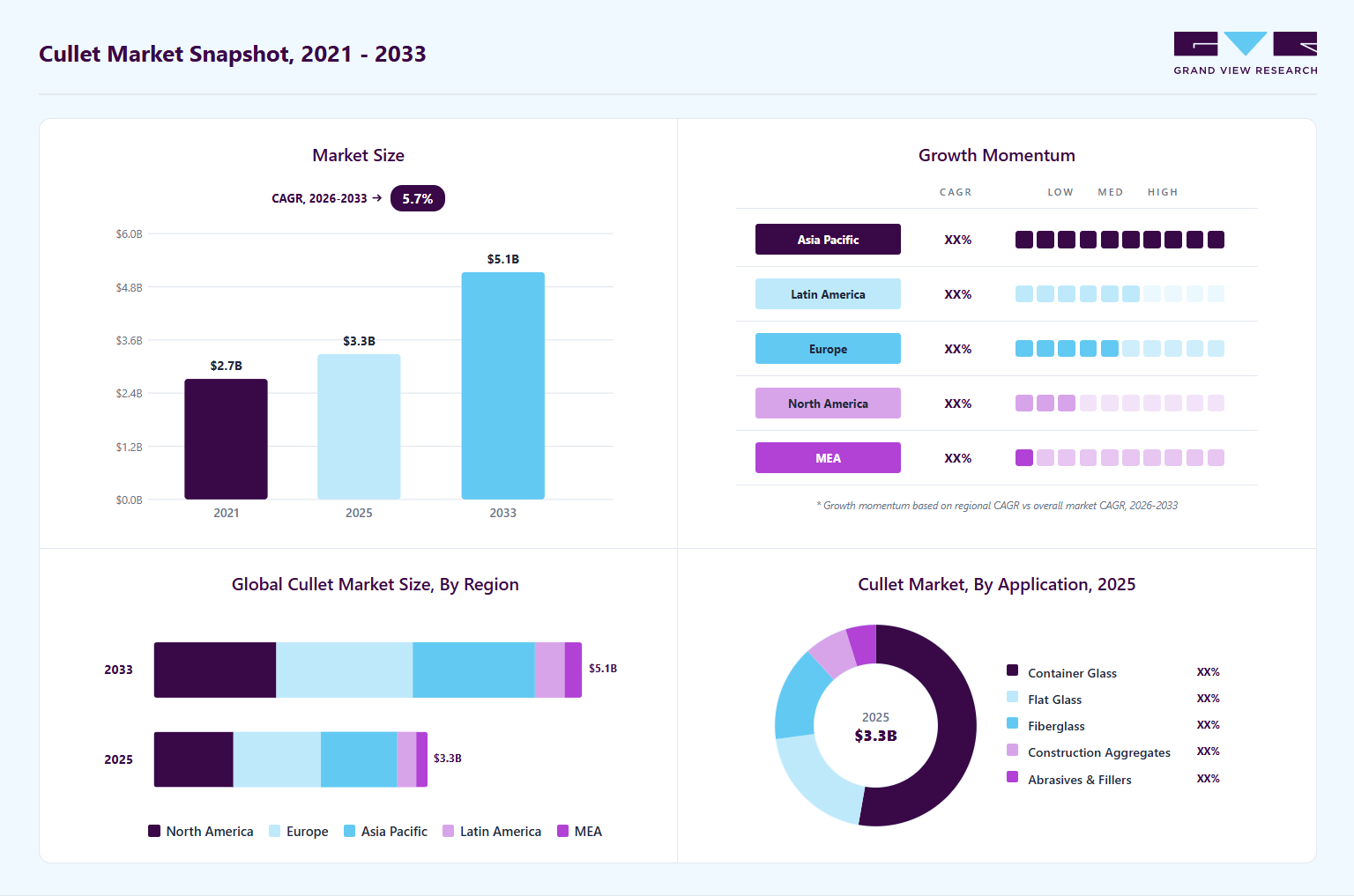 Source: Grand View Research, IR Documents, Primary Interviews, Paid DatabasesTo learn more about this report,
 Download Free Sample Report
 Key Market Trends & Insights
- By product: Furnace ready cullet segment held the largest market share in 2025.
- By application: Container glass segment held the largest market share in 2025.
Regional Highlights
- Largest regional market: Europe (32.0% revenue share, 2025)
- Fastest-growing regional market: Asia Pacific (highest CAGR, 2026-2033)
Market Size & Forecast
- Market size in 2025: USD 3.3 Billion
- Estimated market size in 2026: USD 3.5 Billion
- Projected market size by 2033: USD 5.1 Billion
- CAGR (2026-2033): 5.7%
GVR research-powered AIAsk Prism AI about the cullet marketGet cited answers from GVR research on market growth, segments, regulations and forecasts.Start with✓ Source-linked answers ✓ Market-specific context ✓ Traceable figuresExplore Prism AI ↗The growth of the global cullet market is primarily driven by the rising demand for sustainable and energy-efficient glass manufacturing processes. Cullet, which consists of recycled glass fragments, significantly reduces the energy required for glass melting compared to virgin raw materials such as silica sand, soda ash, and limestone. Glass manufacturers are increasingly incorporating higher percentages of cullet into furnace operations to lower fuel consumption, reduce carbon emissions, and improve operational efficiency. Growing environmental regulations on industrial emissions and circular-economy practices are further encouraging the use of recycled glass across the packaging, construction, and automotive industries.
 To learn more about this report, Download Free Sample Report
 The expanding glass packaging industry is another major factor supporting the growth of the cullet market. Increasing consumption of beverages, pharmaceuticals, cosmetics, and food products packaged in glass containers is generating strong demand for recycled glass feedstock. According to the Glass Packaging Institute (GPI), every 10% increase in cullet usage can reduce manufacturing energy consumption by nearly 2% to 3%, making recycled glass economically attractive for manufacturers facing high-energy costs. Beverage manufacturers and consumer goods companies are actively promoting recyclable packaging solutions to meet sustainability targets and reduce plastic waste. This has led to greater investments in glass recycling infrastructure and collection systems, particularly in Europe and North America, where bottle-to-bottle recycling initiatives are gaining momentum.
Market Dynamics
The growing demand for recyclable packaging is significantly driving the expansion of the cullet market, particularly in the food and beverage industry, where glass containers are widely used for sustainability and product safety. Consumers increasingly prefer environmentally friendly packaging solutions to plastic alternatives, encouraging manufacturers to adopt glass packaging with higher recycled content. Cullet plays a crucial role in this transition by enabling glass producers to reduce the use of virgin raw materials while supporting closed-loop recycling systems.
Government regulations and sustainability initiatives aimed at reducing packaging waste are further accelerating cullet consumption globally. Several countries across Europe and North America have implemented strict recycling mandates, deposit return schemes, and circular economy policies that promote glass collection and reuse. These measures have improved glass recycling rates and strengthened the supply chain for cullet processing.
Contaminated cullet requires additional sorting, cleaning, and processing steps, increasing operational costs for recyclers and manufacturers. Excess contamination can also affect furnace performance and lead to defects in finished glass products, limiting the proportion of cullet that can be used in production. In regions with inefficient waste segregation and recycling systems, maintaining a consistent supply of high-purity cullet remains a significant challenge for market participants.
Product Insights
Furnace ready cullet registered the largest market revenue share due to its direct usability in glass manufacturing furnaces without requiring extensive additional processing. This type of cullet is cleaned, sorted, and processed to meet strict quality specifications, enabling glass manufacturers to improve furnace efficiency, reduce melting temperatures, and lower energy consumption. The growing focus on sustainable glass production and circular economy practices has increased the adoption of furnace ready cullet across container glass, flat glass, and fiberglass manufacturing industries.
Mixed cullet is anticipated to register the fastest CAGR over the forecast period due to its wide availability from municipal solid waste streams and post-consumer glass collection systems. This segment consists of mixed color and mixed composition glass fragments collected before undergoing advanced sorting and refining processes. Increasing urbanization, rising glass consumption, and expanding recycling initiatives across residential and commercial sectors are driving the generation of mixed cullet globally.
Application Insights
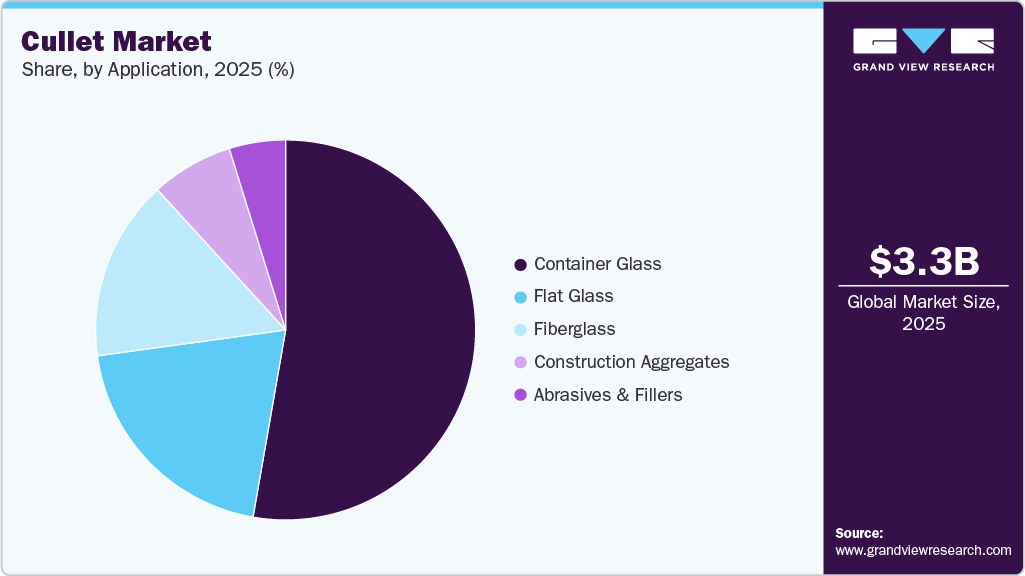
The container glass segment accounted for the largest share in 2025, and it is expected to dominate the application segment, in terms of revenue share, over the forecast period. Glass manufacturers increasingly use cullet in container glass production because it lowers furnace operating temperatures, reduces energy consumption, and decreases carbon dioxide emissions during manufacturing. Growing consumer preference for sustainable, recyclable packaging materials is further driving demand for recycled glass in container manufacturing. Regulatory policies promoting circular economy practices and packaging waste reduction across Europe and North America are also accelerating the adoption of cullet in this segment.
 To learn more about this report, Download Free Sample Report
 The fiberglass segment is witnessing substantial growth in the market due to the increasing use of recycled glass in insulation materials, automotive components, wind turbine blades, and construction composites. Manufacturers are increasingly incorporating cullet into fiberglass production to reduce energy consumption and improve sustainability in manufacturing operations. The rising demand for lightweight and durable materials across transportation and infrastructure sectors is supporting fiberglass consumption globally.
Regional Insights
The cullet industry in Europe led the global market in 2025, largely due to stringent European Union recycling regulations and circular economy initiatives. Policies under the EU Packaging and Packaging Waste Directive are encouraging higher recovery and recycling rates for glass packaging, leading to stronger demand for recycled glass cullet across container glass and fiberglass manufacturing industries. European countries are increasingly investing in advanced collection, sorting, and recycling infrastructure to improve the availability and quality of cullet.
 To learn more about this report, Download Free Sample Report
 Asia Pacific Cullet Market Trends
The cullet industry in the Asia Pacific has gained traction from rapid urbanization and increasing consumption of packaged food, beverages, and pharmaceuticals across the region. Countries such as China, India, Japan, and South Korea are witnessing strong demand for glass containers and bottles, thereby increasing the need for recycled glass cullet in manufacturing operations. The expansion of the food and beverage industry, along with rising preference for sustainable packaging solutions, has encouraged glass manufacturers to increase cullet utilization to reduce production costs and energy consumption.
North America Cullet Market Trends
The cullet industry in North America is expected to experience growing demand for sustainable glass packaging across the food, beverage, and pharmaceutical industries. Beverage manufacturers and food packaging companies are increasingly using recycled glass cullet to reduce carbon emissions and meet corporate sustainability targets. The rising preference for eco-friendly packaging as an alternative to plastic is encouraging higher recycled glass utilization in container glass manufacturing across the U.S. and Canada.
U.S. Cullet Market Trends
The U.S. cullet industry is expected to witness strong demand from the U.S. food, beverage, and pharmaceutical packaging industries. Glass manufacturers are increasingly using recycled cullet to reduce production costs, improve furnace efficiency, and meet corporate sustainability commitments. The growing shift toward recyclable and environmentally friendly packaging has encouraged higher adoption of cullet in container glass manufacturing. In addition, increasing consumer awareness regarding waste reduction and circular economy practices is supporting higher glass collection and recycling rates across the U.S.
Latin America Cullet Market Trends
The cullet industry in Latin America has received impetus from growing urbanization and rising consumption of packaged food and beverages. For instance, countries such as Brazil, Argentina, and Chile are witnessing increasing demand for glass packaging from the beverage, pharmaceutical, and cosmetics industries, which is supporting higher utilization of recycled glass cullet in manufacturing processes.
Key Cullet Company Insights
Some of the key players operating in the market include AGC Inc., Corning Incorporated, and others.
-
AGC Inc. is a global manufacturer of glass, chemicals, electronics materials, and advanced industrial solutions with a strong presence in architectural and automotive glass markets. The company's offerings in the cullet market include recycled flat glass cullet, furnace ready cullet solutions, low-carbon glass products produced using recycled cullet, and closed-loop recycling services for architectural and construction glass.
-
Corning Incorporated is a global technology company specializing in specialty glass, ceramics, optical communications, and advanced materials. The company operates extensive glass recycling and cullet reuse programs across its manufacturing facilities to support sustainability and waste reduction initiatives. The company's offerings in the cullet market include internal process cullet recycling solutions, recycled glass feedstock for specialty glass and tubing production, glass scrap recovery systems, and recycled glass reuse programs for industrial applications.
Key Cullet Companies:
The following key companies have been profiled for this study on the cullet market.
- AGC Inc.
- Ardagh Group S.A.
- Corning Incorporated
- Guardian Industries
- Nippon Electric Glass Co., Ltd.
- O-I Glass, Inc.
- Owens Corning
- Saint-Gobain S.A.
- Sisecam Group
- Vetropack Holding Ltd.
Recent Development
-
In March 2026, Cullet LLC formed a new subsidiary, Cullet Ohio, and acquired the assets of Cleveland-based Repeat Glass LLC to establish a Midwest glass reuse and recycling platform that will prioritize source-separated collection, local processing, and curbside and commercial pickup in Northeast Ohio.
Competitive Benchmarking
Operating Strategies
Competitive Edge
Weaknesses
Mature Players: AGC Inc; Ardagh Group S; Saint-Gobain S.A; Sisecam Group; Corning Incorporated; Guardian Industries
Mature participants in the cullet market primarily focus on establishing integrated glass recycling ecosystems that connect collection, sorting, processing, and glass manufacturing operations.
Established participants possess strong competitive advantages due to their extensive recycling infrastructure, large processing capacities, and long-standing relationships with glass manufacturers and municipal authorities.
Despite their strong market position, mature participants face operational challenges, including contamination management, fluctuating glass waste collection rates, and high transportation costs.
Emerging Players: Nippon Electric Glass Co. Ltd.; O-I Glass, Inc.; Owens Corning; Vetropack Holding Ltd.
Emerging participants in the cullet market are focusing on localized recycling models, innovative sorting technologies, and specialized recycled glass applications.
Emerging companies benefit from operational flexibility, faster innovation cycles, and stronger alignment with evolving sustainability trends.
Emerging participants face significant limitations related to scale, funding, and access to stable glass waste streams.
Cullet Market Report Scope
Report Attribute
Details
Market Definition
The cullet market size represents the revenue generated from the sale of processed recycled glass cullet used across container glass, flat glass, fiberglass insulation, abrasives, fillers, and construction applications globally.
Market size in 2025
USD 3.3 billion
Estimated market size in 2026
USD 3.5 billion
Projected market size by 2033
USD 5.1 billion
Growth rate
CAGR of 5.7% from 2026 to 2033
Base year for estimation
2025
Historical data
2021 - 2024
Forecast period
2026 - 2033
Quantitative Units
Revenue in USD million/billion, volume in kilotons, and CAGR from 2026 to 2033
Report coverage
Revenue & volume forecast, competitive landscape, growth factors, and trends
Segments covered
Product, application, region
Regional scope
North America; Europe; Asia Pacific; Latin America; Middle East & Africa
Country scope
U.S.; Canada; Mexico; Germany; Italy; France; Russia; China; India; Japan; Brazil; Saudi Arabia, UAE
Key companies profiled
O-I Glass, Inc.; Ardagh Group S.A.; Vetropack Holding Ltd.; Nippon Electric Glass Co., Ltd.; Owens Corning; Saint-Gobain S.A.; AGC Inc.; Corning Incorporated; Sisecam Group; Guardian Industries
Customization scope
Free report customization (equivalent up to 8 analysts working days) with purchase. Addition or alteration to country, regional & segment scope.
Pricing and purchase options
Avail customized purchase options to meet your exact research needs. Explore purchase options
Global Cullet Market Report Segmentation
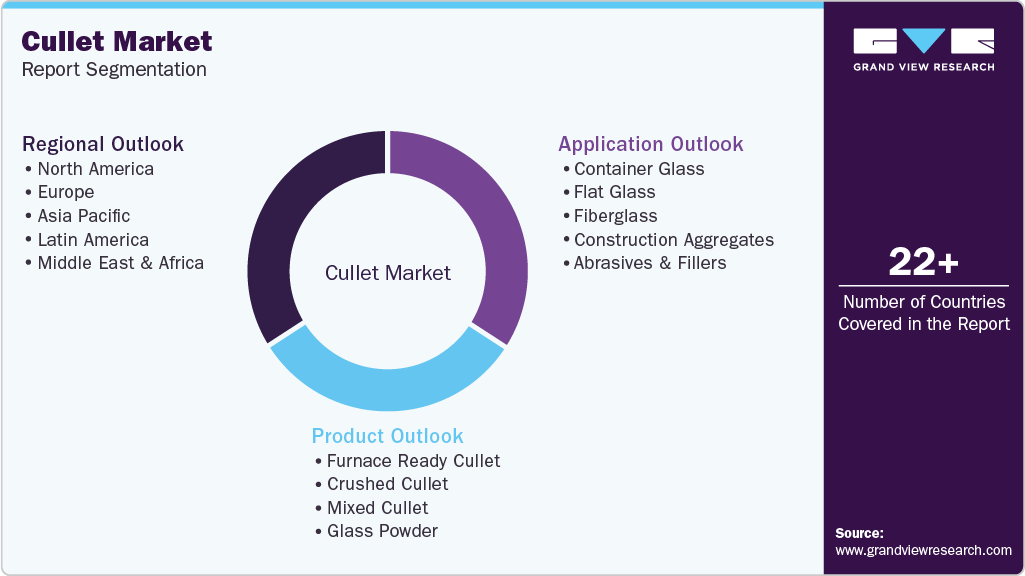
This report forecasts revenue and volume growth at global, regional, and country levels and provides an analysis of the latest industry trends in each of the sub-segments from 2021 to 2033. For this study, Grand View Research has segmented the global cullet market report on the basis of product, application, and region.
 To learn more about this report, Download Free Sample Report
 -
Product Outlook (Volume, Kilotons; Revenue, USD Million, 2021 - 2033)
-
Furnace Ready Cullet
-
Crushed Cullet
-
Mixed Cullet
-
Glass Powder
-
-
Application Outlook (Volume, Kilotons; Revenue, USD Million, 2021 - 2033)
-
Container Glass
-
Flat Glass
-
Fiberglass
-
Construction Aggregates
-
Abrasives & Fillers
-
-
Regional Outlook (Volume, Kilotons; Revenue, USD Million, 2021 - 2033)
-
North America
-
U.S.
-
Canada
-
Mexico
-
-
Europe
-
Germany
-
Italy
-
France
-
Russia
-
-
Asia Pacific
-
China
-
India
-
Japan
-
-
Latin America
-
Brazil
-
-
Middle East & Africa
-
Saudi Arabia
-
UAE
-
-
Delivered Customizations
This report has been delivered with the following In-depth customizations
Client Request
Customization Delivered
Value Adds
Regional Segmentation
Detailed regional analysis of the cullet market across North America, Europe, Asia Pacific, Latin America, and Middle East & Africa, including country level assessment. Included analysis of glass recycling infrastructure, cullet collection rates, container glass manufacturing capacities, recycled glass utilization mandates, import dependency, sustainability regulations, and regional consumption trends across key end use industries.
Identified high growth recycling hubs and emerging demand centers for recycled glass materials. Enabled region specific expansion planning based on glass manufacturing capacity additions, recycling targets, and circular economy initiatives. Supported supply chain optimization and regional sourcing strategies.
Opportunity Assessment
Identification of high growth opportunities across container glass manufacturing, fiberglass insulation, sustainable construction materials, and recycled content packaging applications. Assessed untapped demand driven by rising beverage packaging recycling rates, green building initiatives, landfill reduction policies, and increasing adoption of recycled glass in industrial fillers and abrasives.
Enabled prioritization of high growth applications and emerging regional markets. Supported long term investment planning, recycling infrastructure expansion, and strategic business development aligned with sustainability and circular economy goals.
Trade Assessment
Assessment of global and regional cullet trade flows, export import trends, trade balance, logistics routes, and country wise dependence on recycled glass imports. Included analysis of cross border movement of processed cullet, recycled glass feedstock, and secondary raw materials utilized in container glass, fiberglass, and construction applications.
Highlighted export opportunities, supply shortage regions, and import dependency risks across major glass manufacturing markets. Supported sourcing diversification, logistics planning, and international expansion strategies.
Frequently Asked Questions About This Report
The global cullet market size was estimated at USD 3.3 billion in 2025 and is expected to reach USD 3.5 billion in 2026.
The global cullet market is expected to grow at a compound annual growth rate of 5.7% from 2026 to 2033 to reach USD 5.1 billion by 2033.
Europe dominated with a 32.0% revenue share in 2025.
Asia Pacific is the fastest-growing region over the forecast period.
The furnace ready cullet segment dominated the market with a revenue share of over 51% in 2025.
Some of the key players of the global cullet market are O-I Glass, Inc., Ardagh Group S.A., Vetropack Holding Ltd., Nippon Electric Glass Co., Ltd., Owens Corning, Saint-Gobain S.A., AGC Inc., Corning Incorporated, Sisecam Group, Guardian Industries, and others.
The key factor driving the growth of the global cullet market is the rising demand for recycled glass in container manufacturing, construction materials, and fiberglass production due to increasing sustainability initiatives and energy efficient manufacturing practices.
The furnace ready cullet segment held the largest revenue share in 2025, while the mixed cullet segment is the fastest-growing.
The container glass segment held the largest revenue share in 2025, while the fiberglass segment is the fastest-growing.
About the Author(s)
Advanced Interior Materials Research Team
Advanced Materials · Advanced Interior MaterialsThis report was authored by the advanced interior materials research team at Grand View Research - comprising two research analysts, one senior research analyst, and one industry expert - with specialized expertise in the advanced interior materials segment of the advanced materials industry. All findings are based on proprietary advanced materials databases, executive interviews, and regulatory analysis, subject to internal peer review prior to publication.
Last Updated:
Speak to Analyst

Customize this report to your needs - add regions, segments, or data points, with 20% free customization.
Or view our licence options:


ISO 9001:2015 & 27001:2022 Certified
We are GDPR and CCPA compliant! Your transaction & personal information is safe and secure. For more details, please read our privacy policy.


