
- Home
- »
- IT Services & Applications
- »
-
Customer Communication Management Software Market Report, 2030GVR Report cover
![Customer Communication Management Software Market (2026 - 2033)Report]()
Customer Communication Management Software Market (2026 - 2033)
Size, Share & Trends Analysis Report By Component (Solution, Services), By Deployment (On-premise, Cloud), By Enterprise Size (SMEs, Large Enterprises), By End-use, By Region, And Segment Forecasts
Market Size, 2025
$1.9BMarket Estimate, 2026
$2.1BMarket Forecast, 2033
$5.0BCAGR, 2026–2033
13.3%Customer Communication Management Software Market Summary
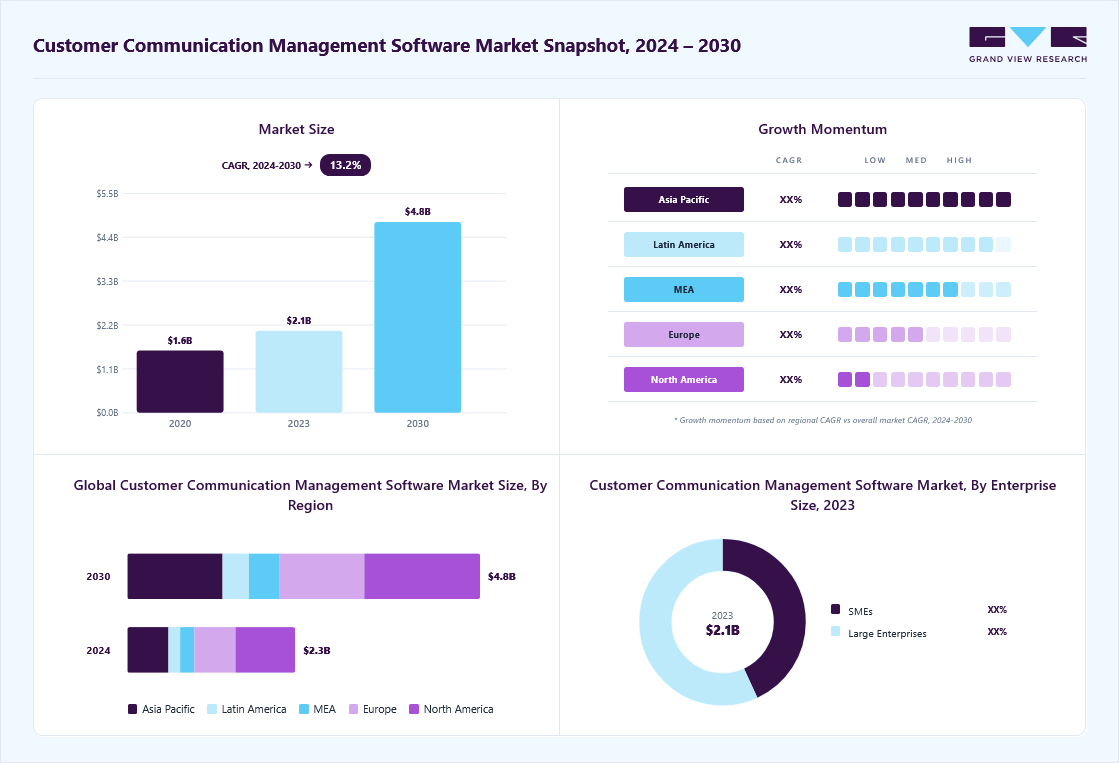
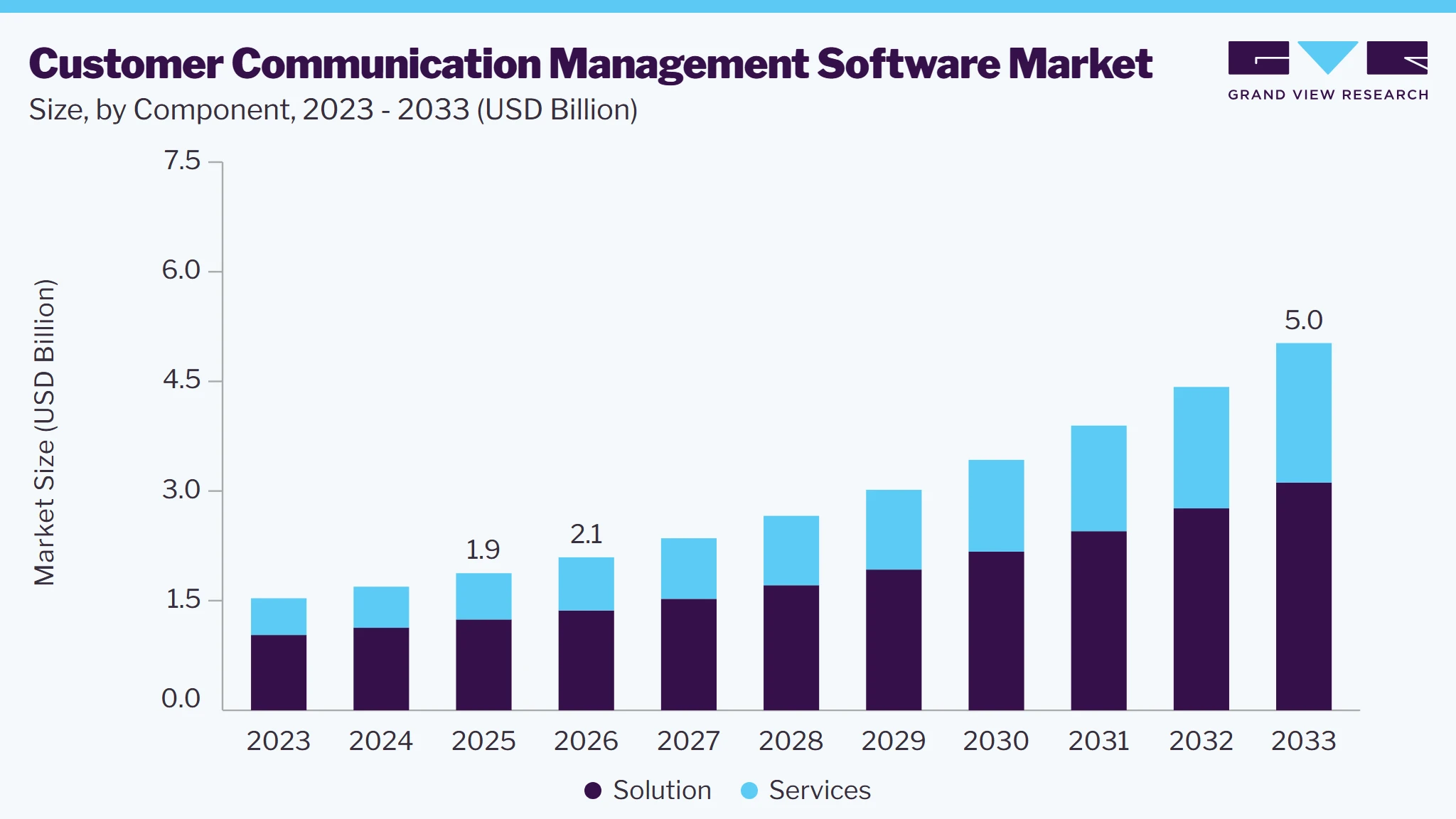
The global customer communication management software market size was valued at USD 1.9 billion in 2025 and is projected to grow from USD 2.1 billion in 2026 to USD 5.0 billion by 2033, at a CAGR of 13.3% from 2026 to 2033. North America dominated the market, accounting for a revenue share of 41.3% in 2025. This growth is driven by growing demand for AI-powered omnichannel customer engagement and cloud-based communication solutions.
Key Market Trends & Insights
- By component: Solution led the market and accounted for a share of 66.2% in 2025.
- By deployment: Cloud segment dominated the market, with a revenue share of 54.7% in 2025.
- By enterprise size: Large enterprises segment dominated the market, with a revenue share of 58.2% in 2025.
- By end use: BFSI segment held the largest revenue share in 2025.
Regional Highlights
- Largest regional market: North America (41.3% revenue share, 2025)
- Fastest-growing regional market: Asia Pacific (highest CAGR, 2026-2033)
- By country: The U.S. held the largest market share in 2025.
Market Size & Forecast
- Market size in 2025: USD 1.9 Billion
- Estimated market size in 2026: USD 2.1 Billion
- Projected market size by 2033: USD 5.0 Billion
- CAGR (2026-2033): 13.3%
Three ways to get this report
Buy it, customize it, or ask a question.Ask an Analyst
A direct answer, usually in 1 working day
- AccessReport author, directly
- Reply timeWithin 1 working day
- No sales callDirect answer only
- FormatEmail reply
- CostFree, no cost
Get the Full Report
What the study covers
- FormatsPDF · Excel · Dashboard
- Timeline2026–2033 annual, 2025 base
- Coverage20+ countries, 5 regions
- Companies10+ key players profiled
Customize the Report
20% free customization
- IncludeCountries, segments, points
- TailorTo your product definition
- ExtendDeeper competitor detail
- OrA fully bespoke study
- Turnaround5–10 working days
The growing adoption of digital transformation initiatives and the rise of omnichannel communication strategies propel demand for advanced CCM solutions. In addition, rapid digital transformation occurring in many organizations is a significant factor contributing to the growth of the CCM software market. As businesses increasingly move towards digital channels for customer engagement, the need for efficient and effective communication management solutions has become more pronounced. CCM software provides the tools to streamline and automate communication processes, ensuring consistency and accuracy across digital and traditional channels. This enhances operational efficiency and helps maintain regulatory compliance, which is particularly crucial in sectors such as banking, insurance, and healthcare.
The rise in demand for omnichannel communication solutions is an important growth driver of the market. As customers increasingly expect seamless and consistent interactions across various communication channels, businesses recognize the need to adopt omnichannel communication strategies. Omnichannel communication solutions enable companies to engage with their customers through multiple touchpoints- email, SMS, social media, and web portals while maintaining a unified and coherent message. This capability is essential for enhancing customer experience, as it ensures that interactions are smooth and continuous regardless of the channel used.
Therefore, the growing emphasis on omnichannel communication is boosting the adoption of CCM software designed to support and streamline these multifaceted interactions. For instance, in November 2022, Nordis Technologies, a U.S.-based customer communications management and payment solutions provider collaborated with Solutions by Text (SBT), a U.S.-based company specializing in text messaging solutions for businesses for augmenting its text messaging services. This partnership enables the clients of Nordis Technologies to create and disseminate both one-off and repetitive, rule-abiding text messages via the company’s proprietary Expresso CCM platform, which is powered by SBT. This advancement by Nordis Technologies facilitates businesses in implementing and tailoring text message schemes to boost customer engagement, cut down on postage and printing expenditures, and improve payment processes.
The integration of Artificial Intelligence (AI) and Machine Learning (ML) technologies into CCM software impacts the market due to its transformative effect on document generation, personalization, and communication workflows. AI and ML enable the automation of document creation, allowing businesses to generate large volumes of personalized documents quickly and accurately. These technologies analyze vast amounts of data to identify patterns and preferences, enabling the automated creation of customized communications tailored to individual customer needs.
This automation reduces the time and effort required for document generation and ensures a higher level of accuracy and consistency, which is crucial for maintaining customer trust and satisfaction. For instance, in March 2025, LeapXpert, a U.S.-based communication platform, unveiled Maxen, a GenAI application. This application is designed to enhance the efficiency of relationship managers and boost the quality of their interactions with clients. By integrating information from various external communication channels such as WhatsApp, iMessage, SMS, and voice calls with internal collaboration tools, including Slack and Microsoft Teams, along with client information and corporate knowledge, Maxen delivers advanced Communication Intelligence. Maxen modernizes client communications by giving live insights and message recommendations.
The shift towards cloud-based CCM solutions due to their scalability, flexibility, and cost-effectiveness leads to the growing adoption of CCM software. Cloud-based CCM solutions allow businesses to scale their operations seamlessly as their communication needs grow. Cloud solutions eliminate the need for large upfront investments in hardware or infrastructure, offering a pay-as-you-go model where companies only pay for the resources they use. This reduces capital expenditure and makes it easier for businesses of all sizes to access and implement advanced CCM capabilities. The ability to quickly scale up or down based on demand ensures that businesses can effectively manage large volumes of communications without incurring unnecessary costs.
Data privacy and security concerns pose a restraint on the growth of the market. Handling sensitive customer information necessitates strict adherence to regulations such as the General Data Protection Regulation (GDPR) and the California Consumer Privacy Act (CCPA). These regulations impose rigorous requirements on how customer data is collected, stored, and processed, placing a substantial burden on companies to ensure compliance. The complexity and cost associated with implementing and maintaining these compliance measures can deter businesses from adopting or expanding their use of CCM software. Moreover, the potential for severe financial penalties and reputational damage in the event of a data breach or non-compliance incident can make organizations cautious of fully embracing CCM solutions, thereby restraining market growth.
Market Dynamics
The global customer communication management software Market is experiencing strong growth as enterprises across banking, financial services, insurance (BFSI), healthcare, telecommunications, retail, utilities, government, and manufacturing increasingly invest in personalized, omnichannel customer engagement solutions to enhance customer experience and regulatory compliance. Customer communication management software enables organizations to create, manage, deliver, and track personalized communications across multiple digital and print channels, including email, SMS, mobile applications, web portals, social media, and printed documents, from a centralized platform. Modern CCM solutions integrate artificial intelligence (AI), cloud computing, workflow automation, analytics, document generation, customer journey orchestration, and CRM integration to improve communication efficiency, customer satisfaction, and operational agility.
The increasing focus on delivering personalized, omnichannel customer experiences is a major driver of the global Customer Communication Management Software Market. Enterprises across BFSI, healthcare, telecommunications, retail, utilities, and government are adopting CCM platforms to automate customer communications while delivering consistent, personalized interactions across digital and physical channels. CCM software enables centralized content management, automated document generation, real-time communication, customer journey orchestration, regulatory compliance, and seamless integration with CRM, ERP, and marketing automation platforms. AI-powered personalization, intelligent document processing, analytics, and workflow automation further help organizations improve customer engagement, enhance operational efficiency, and strengthen customer loyalty. For instance, in March 2026, OpenText showcased secure agentic AI capabilities that enhance intelligent content management, workflow automation, and enterprise information management, strengthening AI-driven customer communication and document management capabilities.
Implementation complexity and integration with legacy enterprise applications remain significant restraints for the global customer communication management software market. Deploying CCM platforms often requires integration with CRM, ERP, billing systems, document repositories, customer databases, and multiple communication channels, increasing implementation time and deployment costs. Organizations must also ensure data consistency, regulatory compliance, cybersecurity, and seamless migration of existing communication templates and customer records. In addition, extensive customization requirements, employee training, and ongoing system maintenance may delay adoption, particularly among small and medium-sized enterprises with limited IT resources and budgets.
The rapid expansion of AI-powered customer engagement, cloud-native communication platforms, and intelligent automation presents a significant growth opportunity for the global Customer communication management software market. Organizations are increasingly investing in CCM solutions equipped with generative AI, predictive analytics, conversational AI, intelligent document generation, multilingual communication, and automated workflow capabilities to deliver highly personalized customer experiences at scale. The continued growth of digital banking, e-commerce, telehealth, customer self-service portals, and mobile-first engagement strategies is creating demand for scalable, cloud-based CCM platforms capable of managing high-volume, real-time communications across multiple channels. Furthermore, advancements in AI-driven content personalization, low-code workflow automation, API-based integrations, and customer journey analytics are enabling vendors to deliver intelligent, secure, and future-ready CCM solutions that support evolving customer engagement, compliance, and digital transformation requirements.
Component Insights
Based on component, the solution segment led the market with the largest revenue share of 66.2% in 2025. Businesses are looking for all-encompassing solutions that can handle various aspects of customer communication, from creation and management to delivery and analysis. These solutions offer a seamless experience by integrating multiple functionalities into a single platform, reducing the complexity and inefficiency of using other tools. As organizations aim to improve customer engagement and streamline their communication processes, the demand for strong, integrated CCM solutions continues to rise, driving growth in this segment.
The services segment is projected to witness significant growth from 2025 to 2033 due to the shift towards cloud-based CCM solutions also boosts the services segment. Cloud adoption often requires specialized migration services to transition from on-premises systems to cloud platforms. Cloud-based solutions offer subscription-based services, including SaaS (Software as a Service) and PaaS (Platform as a Service), which provide businesses with continuous access to the latest features and enhancements without significant in-house IT resources.
Deployment Insights
Based on deployment, the cloud segment led the market with the largest revenue share of 54.7% in 2025, share of the global revenue owing to the integration capabilities offered by cloud-based CCM solutions. These platforms can integrate with other business systems, such as CRM (Customer Relationship Management) and ERP (Enterprise Resource Planning) systems, allowing for the consolidation of customer data and personalized communication across multiple channels. This integration enhances operational efficiency and enables organizations to deliver consistent and targeted communications to their customers.
The on-premise segment is projected to witness significant growth from 2025 to 2033 due to growing preference for predictable costs and long-term investments. While cloud solutions often offer lower upfront costs, some organizations prefer the predictability of on-premise solutions, which involve a one-time licensing fee and ongoing maintenance costs. It is more attractive for businesses that have the resources to manage their own IT infrastructure and prefer to amortize their software investments over a longer period
Enterprise Size Insights
Based on enterprise size, the Large enterprises segment led the market with the largest revenue share of 58.2% in 2025. The need for enhanced data security and compliance is driving large enterprises to adopt robust CCM solutions. With stringent regulations such as GDPR and increasing concerns about data privacy, large enterprises require CCM platforms that can ensure secure handling of sensitive customer information and maintain compliance with industry-specific regulations. This is particularly crucial for sectors such as banking, financial services, and insurance (BFSI), which handle highly sensitive customer data and are subject to strict regulatory requirements.
The SMEs segment is projected to witness significant growth from 2025 to 2033 due to CCM's integration capability with existing systems. This allows SMEs to leverage their existing IT investments while modernizing their customer communication strategies. Many SMEs operate with diverse IT environments, including legacy systems and third-party applications. CCM solutions that offer seamless integration with these systems streamline operations, reduce manual processes, and improve overall efficiency.
End-use Insights
Based on end use, BFSI segment led the market with the largest revenue share of 17.8% in 2025. Risk management and security considerations play a crucial role in the BFSI segment's adoption of CCM software. Data security is paramount in financial services, given the sensitivity of customer information and regulatory requirements. CCM solutions offer robust security features, including encryption, access controls, and audit trails, ensuring that sensitive financial communications are protected from unauthorized access and breaches. For instance, in May 2025, Newgen Software, India based digital transformation platform provider unveil LumYn, artificial intelligence (AI)-powered platform aimed at personalization of experience within the banking industry. Its features include conversational AI capability, which allows business professionals to engage with customer data covering transactions, behaviors, and interactions in a natural, intuitive manner. In addition, LumYn delivers a reliable and secure AI experience, maintaining full data transparency and employing a visibly transparent modelling process.
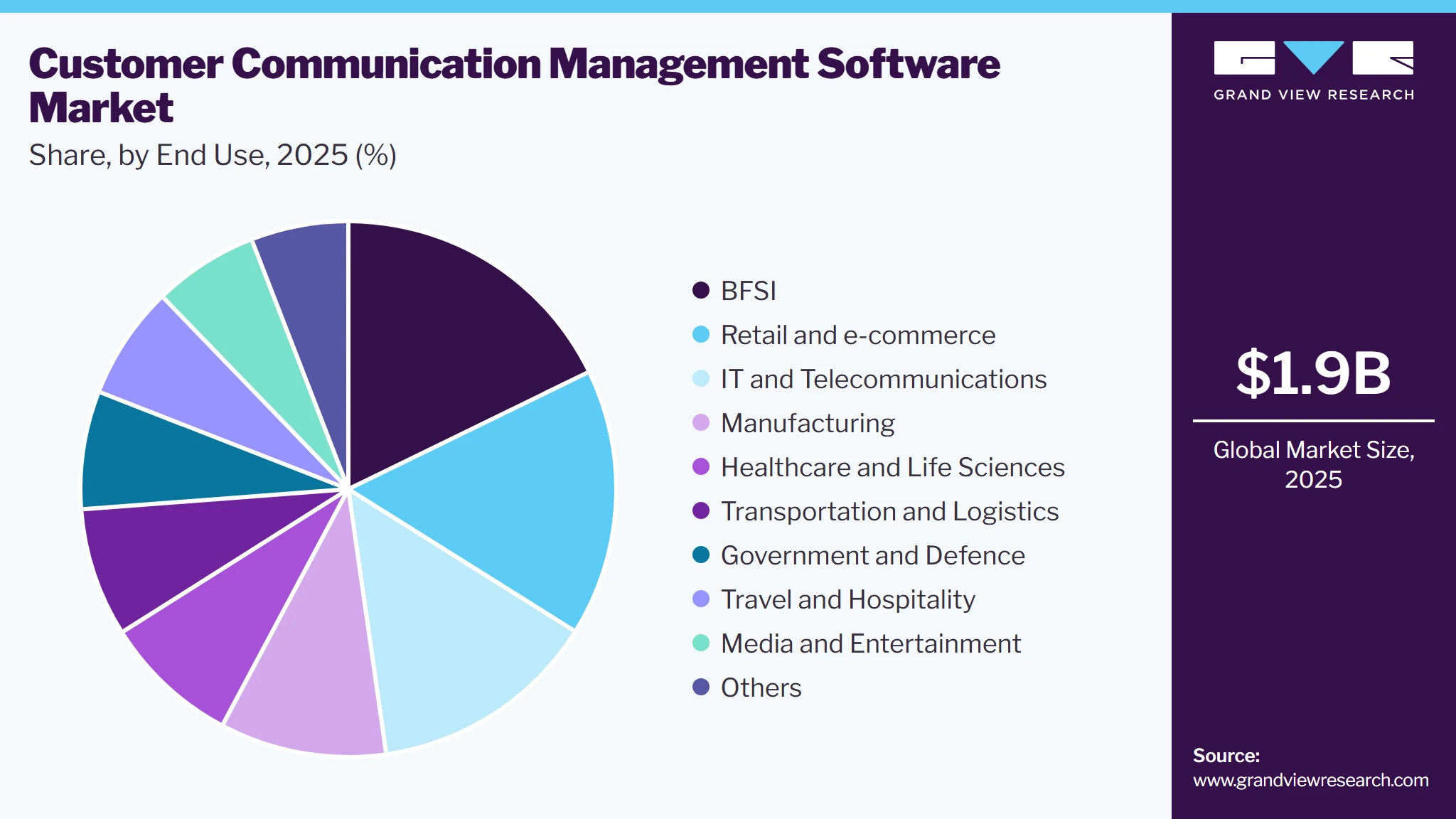
The media and entertainment segment is projected to witness significant growth from 2025 to 2033 due to analytics and insights capabilities provided by CCM software for strategic decisions and optimizing audience engagement strategies. Media companies leverage data analytics to gain actionable insights into audience preferences, behavior patterns, and content consumption trends. These insights enable targeted marketing campaigns, content recommendations, and personalized communications, ultimately driving revenue growth and customer retention.
Regional Insights
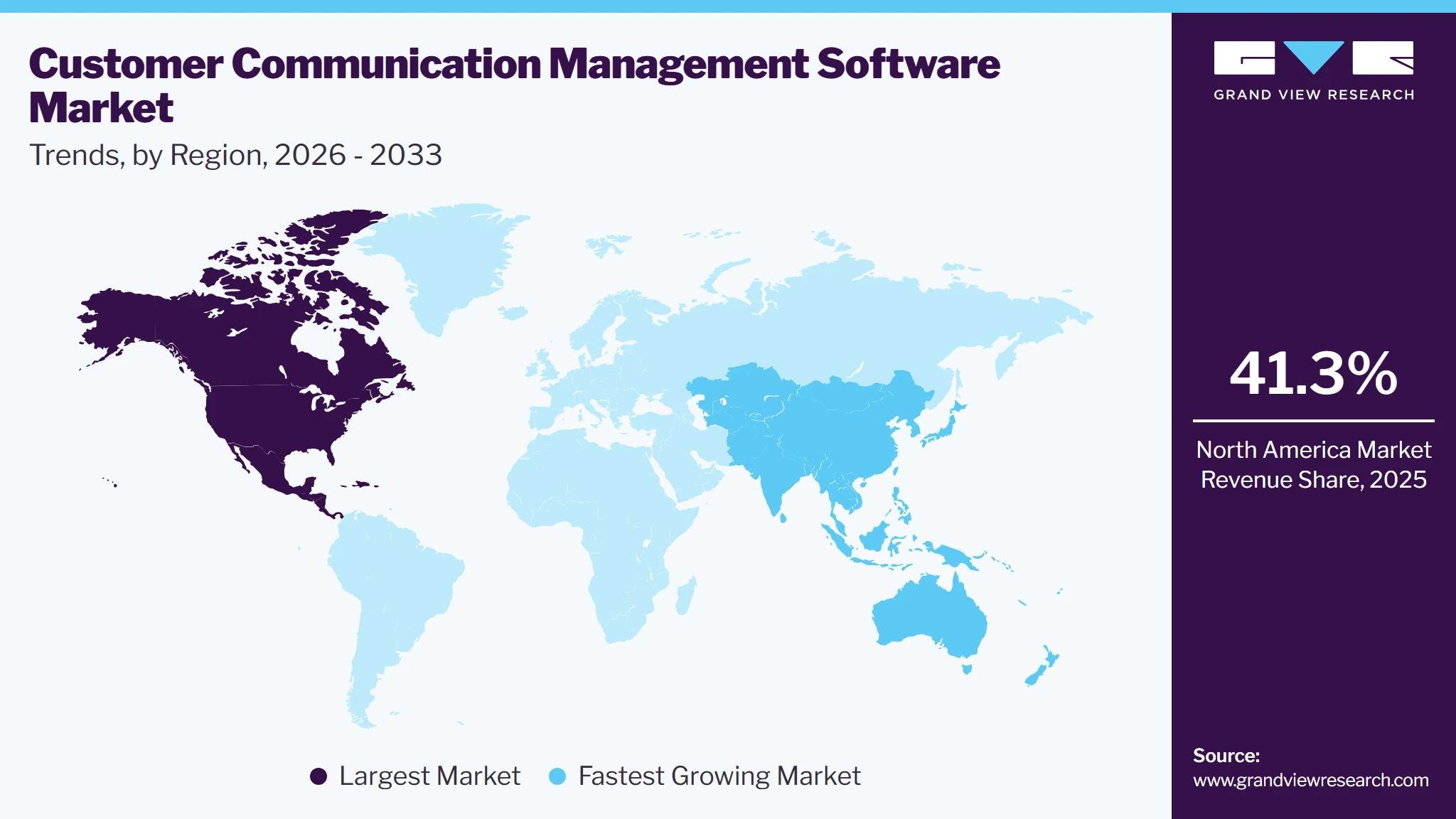
North America dominated the global customer communication management software market with the largest revenue share of 41.3% in 2025, share of the global revenue due to the integration of artificial intelligence (AI) and machine learning (ML) capabilities in CCM software. These technologies enable automated content creation, predictive analytics for personalized messaging, and sentiment analysis to improve customer engagement and retention. Businesses in the region are increasingly leveraging AI-powered CCM solutions to gain actionable insights from customer data and enhance communication strategies.
U.S. Customer Communication Management Software Market Trends
The customer communication management software market in the U.S. held the largest share in the North America region in 2025, digital transformation initiatives across industries are compelling organizations to adopt advanced CCM solutions. Companies recognize the need to enhance customer experience through personalized and interactive communications delivered via multiple channels such as email, SMS, social media, and mobile apps. CCM software facilitates seamless integration of these channels, enabling businesses to engage customers effectively across their preferred platforms while maintaining consistency and relevance in messaging.
Asia Pacific Customer Communication Management Software Market Trends
The Asia Pacific region is expected to grow at the highest CAGR from 2026 to 2033, driven by several key factors due to the rapid growth of e-commerce and digital banking in the region. As online transactions and digital interactions surge, businesses are looking for efficient ways to manage customer communications throughout the customer journey from acquisition and onboarding to support and retention. CCM software plays a crucial role in automating these communications, enabling companies to scale their operations and deliver personalized services effectively.
Europe Customer Communication Management Software Market Trends
The customer communication management software market in Europe is expected to witness notable growth from 2025 to 2033 owing to the regulatory compliance requirements in Europe, such as GDPR (General Data Protection Regulation) that ensures data privacy and security. Companies operating within the EU or handling EU citizen data must adhere to strict regulations concerning the handling and processing of personal information. CCM solutions that offer strong data protection measures and compliance capabilities are therefore in high demand, especially among industries such as finance, healthcare, and telecommunications.
Key Customer Communication Management Software Company Insights
Key players operating in the customer communication management software market include Adobe, Oracle, Open Text Corporation, Zendesk, Newgen Software Technologies Limited, Capgemini, Quadient, Smart Communications, Precisely, and Sefas Innovation, Inc. The companies are focusing on various strategic initiatives, including new product development, partnerships & collaborations, and agreements to gain a competitive advantage over their rivals. The following are some instances of such initiatives.
-
In July 2025, Quadient, French automation platform provider launched Secure Barcode. This cloud-based application aims to boost the security of physical customer communications by effortlessly generating and embedding barcodes into documents. Specifically conceived for small enterprises looking to step into digital mailing solutions, this tool promises immediate improvements in managing documents and enhancing operational processes. It also features a user-friendly drag-and-drop interface, simplifying the process of uploading files and embedding barcodes, thus eliminating the need for advanced technical knowledge.
-
In February 2025, Oracle unveiled its Enterprise Communications Platform (ECP), a solution designed to bridge Oracle industry applications with networks and Internet of Things (IoT) devices, enhancing their utility and transforming business operations. Leveraging the robust performance and security features of Oracle Cloud Infrastructure (OCI), the ECP provides a strong communication framework and edge computing architecture that can be directly incorporated into the Oracle applications ecosystem. This platform includes functionalities for IoT device management, allowing organizations to bypass the complexities of managing intricate integrations and network agreements, thereby facilitating the seamless delivery of connectivity and data analysis required for launching essential new services.
Key Customer Communication Management Software Companies:
The following key companies have been profiled for this study on the customer communication management software market.
-
Adobe
-
Capgemini
-
Newgen Software Technologies Limited
-
Open Text Corporation
-
Oracle
-
Precisely
-
Quadient
-
Sefas Innovation, Inc.
-
Smart Communications
-
Zendesk
Competitive Benchmarking
Category
Operating Strategies
Competitive Edge
Weakness
Established Players (Adobe, Oracle, OpenText, Zendesk, Capgemini, Quadient)
Deliver integrated cloud-based CCM platforms with AI, omnichannel communication, document automation, and CRM/ERP integration.
Focus on continuous AI innovation, strategic partnerships, regulatory compliance, and global expansion.
Strong global customer base, extensive partner ecosystem, and broad enterprise portfolio.
Advanced AI capabilities, scalable cloud platforms, and comprehensive implementation services.
High implementation costs and complex product portfolios.
Long sales cycles and growing competition from cloud-native CCM vendors.
Emerging Players (Smart Communications, Precisely, Newgen Software Technologies)
Offer cloud-native CCM solutions with AI-driven personalization and workflow automation.
Focus on rapid innovation, SaaS delivery, competitive pricing, and industry-specific solutions.
Agile product development, faster deployment, and flexible customization.
Strong expertise in document automation and personalized customer communications.
Limited global presence and smaller customer base.
Fewer partner ecosystems and lower R&D resources than established vendors.
Customer Communication Management Software Market Report Scope
Report Attribute
Details
Market size in 2025
USD 1.9 billion
Estimated market size in 2026
USD 2.1 billion
Projected market size by 2033
USD 5.0 billion
Growth rate
CAGR of 13.3% from 2026 to 2033
Base year for estimation
2025
Historical data
2021 - 2025
Forecast period
2026 - 2033
Quantitative units
Revenue in USD million/billion and CAGR from 2026 to 2033
Report coverage
Revenue forecast, company market share analysis, competitive landscape, growth factors, and trends
Segments covered
Component, deployment, enterprise size, end use, region
Regional scope
North America; Europe; Asia Pacific; Latin America; MEA
Country scope
U.S.; Canada; Mexico; Germany; UK; France; China; Japan; India; South Korea; Australia; Brazil; Saudi Arabia; South Africa; UAE
Key companies profiled
Adobe; Oracle; Open Text Corporation; Zendesk; Newgen Software Technologies Limited; Capgemini; Quadient; Smart Communications; Precisely; Sefas Innovation, Inc.
Customization scope
Free report customization (equivalent up to 8 analysts' working days) with purchase. Addition or alteration to country, regional & segment scope.
Pricing and purchase options
Avail customized purchase options to meet your exact research needs. Explore purchase options
Global Customer Communication Management Software Market Report Segmentation
This report forecasts revenue growth at global, regional, and country levels and provides an analysis of the latest industry trends in each of the sub-segments from 2021 to 2033. For this study, Grand View Research has segmented the customer communication management software market report based on component, deployment, enterprise size, end-use, and region.
-
Component Outlook (Revenue, USD Billion, 2021 - 2033)
-
Solution
-
Services
-
-
Deployment Outlook (Revenue, USD Billion, 2021 - 2033)
-
On-premise
-
Cloud
-
-
Enterprise Size Outlook (Revenue, USD Billion, 2021 - 2033)
-
SMEs
-
Large Enterprises
-
-
End-use Outlook (Revenue, USD Billion, 2021 - 2033)
-
Banking, Financial Services, and Insurance (BFSI)
-
Retail and e-commerce
-
Telecommunications and IT
-
Manufacturing
-
Transportation and Logistics
-
Government and Defense
-
Healthcare and Life Sciences
-
Media and Entertainment
-
Travel and Hospitality
-
Others
-
-
Regional Outlook (Revenue, USD Billion, 2021 - 2033)
-
North America
-
U.S.
-
Canada
-
Mexico
-
-
Europe
-
Germany
-
UK
-
France
-
-
Asia Pacific
-
China
-
India
-
Japan
-
South Korea
-
Australia
-
-
Latin America
-
Brazil
-
-
Middle East & Africa
-
U.A.E
-
Saudi Arabia
-
South Africa
-
-
Research Methodology
The customer communication management software market figures in this report are based on a proven research process that combines executive interviews with secondary research from proprietary databases, company filings, and recognized regulatory and institutional sources. Market size is built through value-chain sizing - reconciling supply-side and demand-side estimates - and triangulated with bottom-up and top-down approaches. Every estimate passes multiple levels of expert validation before publication, with each customer communication management software segment quantified using the revenue-capture definitions in the table below.
Segment Definition
Segment - Component
Revenue capture definition
Solution
Revenue is generated from the licensing or subscription of CCM software platforms that enable organizations to create, manage, personalize, deliver, and track customer communications across digital and print channels. Revenue includes document generation, omnichannel communication, customer journey management, template management, workflow automation, analytics, content management, AI-powered communication capabilities, and software updates delivered through perpetual licenses or SaaS subscriptions.
Services
Revenue is generated from professional and managed services supporting CCM software deployments, including consulting, implementation, customization, system integration, cloud migration, data migration, training, maintenance, technical support, managed services, and ongoing software optimization.
Segment - Deployment
Revenue capture definition
On-premise
Revenue is generated from Customer Communication Management software deployed within an organization's own IT infrastructure or private data centers. Revenue includes software licensing, implementation, maintenance, upgrades, and associated support services for self-managed deployments.
Cloud
Revenue is generated from cloud-based (SaaS, public cloud, private cloud, or hybrid cloud) Customer Communication Management solutions delivered through subscription models. Revenue includes recurring software subscriptions, cloud hosting, platform management, software maintenance, security updates, and cloud support services.
Segment - Enterprise Size
Revenue capture definition
Small & Medium Enterprises
The SMEs segment, with respect to the number of employees, generally includes organizations employing between 10 and 999 employees.
Large Enterprises
The large enterprises segment, with respect to the number of employees, typically comprises organizations employing more than 1,000 employees for multinational corporations.
Segment - End Use
Revenue capture definition
BFSI
Revenue is generated from CCM solutions used by banks, financial institutions, and insurance companies to manage customer statements, policy documents, regulatory communications, billing, notifications, marketing communications, and personalized customer engagement.
Retail and e-commerce
Revenue is generated from CCM platforms supporting order confirmations, invoices, promotional campaigns, loyalty communications, customer support, shipping notifications, and personalized marketing across online and offline retail channels.
IT and Telecommunications
Revenue is generated from CCM software used by IT service providers and telecommunications companies for billing, service notifications, customer onboarding, contract management, marketing campaigns, and customer support communications.
Manufacturing
Revenue is generated from CCM solutions supporting customer documentation, warranty communications, invoices, product notifications, service updates, distributor communications, and after-sales engagement.
Transportation and Logistics
Revenue is generated from CCM platforms used for shipment notifications, delivery updates, invoices, customer support, transportation documents, and supply chain communications.
Government and Defense
Revenue is generated from CCM software supporting citizen communications, tax notices, permits, licenses, benefits administration, public service notifications, regulatory correspondence, and secure document delivery.
Healthcare and Life Sciences
Revenue is generated from CCM solutions managing patient communications, appointment reminders, medical billing, insurance correspondence, laboratory reports, regulatory documents, and personalized healthcare engagement.
Media and Entertainment
Revenue is generated from CCM platforms supporting subscriber communications, billing, promotional campaigns, personalized content recommendations, event notifications, and customer engagement initiatives.
Travel and Hospitality
Revenue is generated from CCM software used for booking confirmations, travel itineraries, loyalty program communications, invoices, promotional offers, customer service notifications, and personalized guest experiences.
Others
Revenue is generated from CCM deployments across education, utilities, energy, real estate, professional services, non-profit organizations, and other industries utilizing omnichannel customer communication, document management, and personalized engagement solutions.
Estimation Model
Layer
Question
Analysis
Enterprise Customer Engagement Demand Layer
Who can benefit from CCM software?
Identify organizations that require personalized, secure, and omnichannel customer communication to improve customer engagement, operational efficiency, and regulatory compliance. These include banks, insurance companies, healthcare providers, retailers, e-commerce companies, telecommunications operators, government agencies, utilities, manufacturing enterprises, travel companies, and other customer-centric organizations. Businesses seeking to automate document generation, streamline communication workflows, enhance customer experiences, and strengthen customer retention represent the core demand base for CCM software.
Digital Transformation & IT Readiness Layer
Who can deploy CCM software?
Evaluate organizations based on their digital transformation maturity, cloud adoption, CRM and ERP implementation, customer engagement strategies, omnichannel communication capabilities, API integration readiness, cybersecurity infrastructure, and regulatory compliance requirements. Enterprises with modern IT environments, cloud infrastructure, customer data platforms, and digital communication channels possess the operational readiness to deploy CCM solutions effectively.
Adoption & Utilization Layer
Who actively uses CCM software?
Analyze CCM software adoption across BFSI, healthcare, retail and e-commerce, telecommunications, government, manufacturing, transportation and logistics, media and entertainment, travel and hospitality, utilities, and other industries. Active users leverage CCM platforms for personalized customer communications, billing and invoicing, policy documents, customer onboarding, notifications, marketing campaigns, regulatory correspondence, customer support, digital document delivery, and omnichannel engagement across email, SMS, mobile applications, web portals, and print channels.
Monetization Layer
How much revenue is generated?
Assess revenue generated through software licensing, SaaS subscriptions, cloud-based CCM platforms, document generation solutions, omnichannel communication software, workflow automation, AI-powered personalization, customer journey orchestration, and analytics. Additional revenue streams include consulting, implementation, customization, system integration, cloud migration, data migration, managed services, maintenance, technical support, software upgrades, cybersecurity services, compliance management, and long-term subscription and enterprise support contracts associated with CCM software deployments.
Delivered Customizations
This report has been delivered with the following In-depth customizations
Client Request
Customization Delivered
Value Adds
AI-Powered Customer Engagement & Personalization Trends
Conducted a structured analysis of AI-enabled CCM capabilities, including generative AI, intelligent document generation, predictive analytics, conversational AI, workflow automation, and personalized omnichannel customer communications.
Helps stakeholders understand emerging AI technologies, identify high-growth innovation areas, and evaluate investments that enhance customer engagement and operational efficiency.
Cloud CCM & Omnichannel Communication Trends
Conducted a comprehensive analysis of cloud-based CCM adoption across SaaS, hybrid cloud, omnichannel communication, CRM/ERP integration, API connectivity, and enterprise digital transformation initiatives.
Helps stakeholders identify cloud modernization opportunities, assess omnichannel communication strategies, and evaluate scalable CCM solutions that improve customer experience and business agility.
Regulatory Compliance & Customer Experience Trends
Conducted a comprehensive analysis of CCM solutions focused on regulatory compliance, secure document delivery, digital customer journeys, customer analytics, workflow automation, and personalized communication management.
Helps stakeholders strengthen compliance, optimize customer communication processes, improve customer satisfaction, and maximize returns from CCM software investments.
Frequently Asked Questions About This Report
The global customer communication management software market size was estimated at USD 1.9 billion in 2025 and is estimated at USD 2.1 billion in 2026.
The global customer communication management software market is expected to grow at a compound annual growth rate of 13.3% from 2026 to 2033, reaching USD 5.0 billion by 2033.
North America dominated with 41.3% revenue share in 2025.
Asia Pacific is the fastest-growing region over the forecast period.
The solution segment led with a 66.2% revenue share in 2025, while services segment is the fastest-growing segment.
Key players operating in the customer communication management software market include Adobe; Oracle; Open Text Corporation; Zendesk; Newgen Software Technologies Limited; Capgemini; Quadient; Smart Communications; Precisely; Sefas Innovation, Inc.
Key factors include growing demand for AI-powered omnichannel customer engagement and cloud-based communication solutions, growing demand for AI-powered omnichannel customer engagement and cloud-based communication solutions, and expansion of AI-powered customer engagement, cloud-based CCM, and intelligent automation.
The cloud segment led with an 54.7% revenue share in 2025, share of the global revenue owing to the integration capabilities offered by cloud-based CCM solutions.
Large enterprises segment led the market with the largest revenue share of 58.2% in 2025., while small & medium enterprises segment is the fastest-growing segment.
About the Author(s)
IT Services & Applications Research Team
Technology · IT Services & ApplicationsThis report was authored by the it services & applications research team at Grand View Research - comprising two research analysts, one senior research analyst, and one industry expert - with specialized expertise in the it services & applications segment of the technology industry. All findings are based on proprietary technology databases, executive interviews, and regulatory analysis, subject to internal peer review prior to publication.
Last Updated:
Speak to Analyst


Customize this report to your needs - add regions, segments, or data points, with 20% free customization.
Or view our licence options:


ISO 9001:2015 & 27001:2022 Certified
We are GDPR and CCPA compliant! Your transaction & personal information is safe and secure. For more details, please read our privacy policy.


