
- Home
- »
- Next Generation Technologies
- »
-
Data Center Virtualization Market Size & Share Report, 2033GVR Report cover

Data Center Virtualization Market (2026 - 2033)
Size, Share & Trends Analysis By Type (Server, Storage), By Component (Software, Services), By Service, By Enterprise Size, By End Use, By Region, And Segment Forecasts
Market Size, 2025
$10.5BMarket Estimate, 2026
$12.2BMarket Forecast, 2033
$47.9BCAGR, 2026–2033
21.6%Data Center Virtualization Market Summary
The global data center virtualization market size was estimated at USD 10.5 billion in 2025 and is projected to grow from USD 12.2 billion in 2026 to USD 47.9 billion in 2033, at a CAGR of 21.6% from 2026 to 2033. North America dominated the market, accounting for a revenue share of 45.1% in 2025. North America hosts a large concentration of hyperscale data centers operated by major cloud providers, driving significant adoption of virtualization technologies.
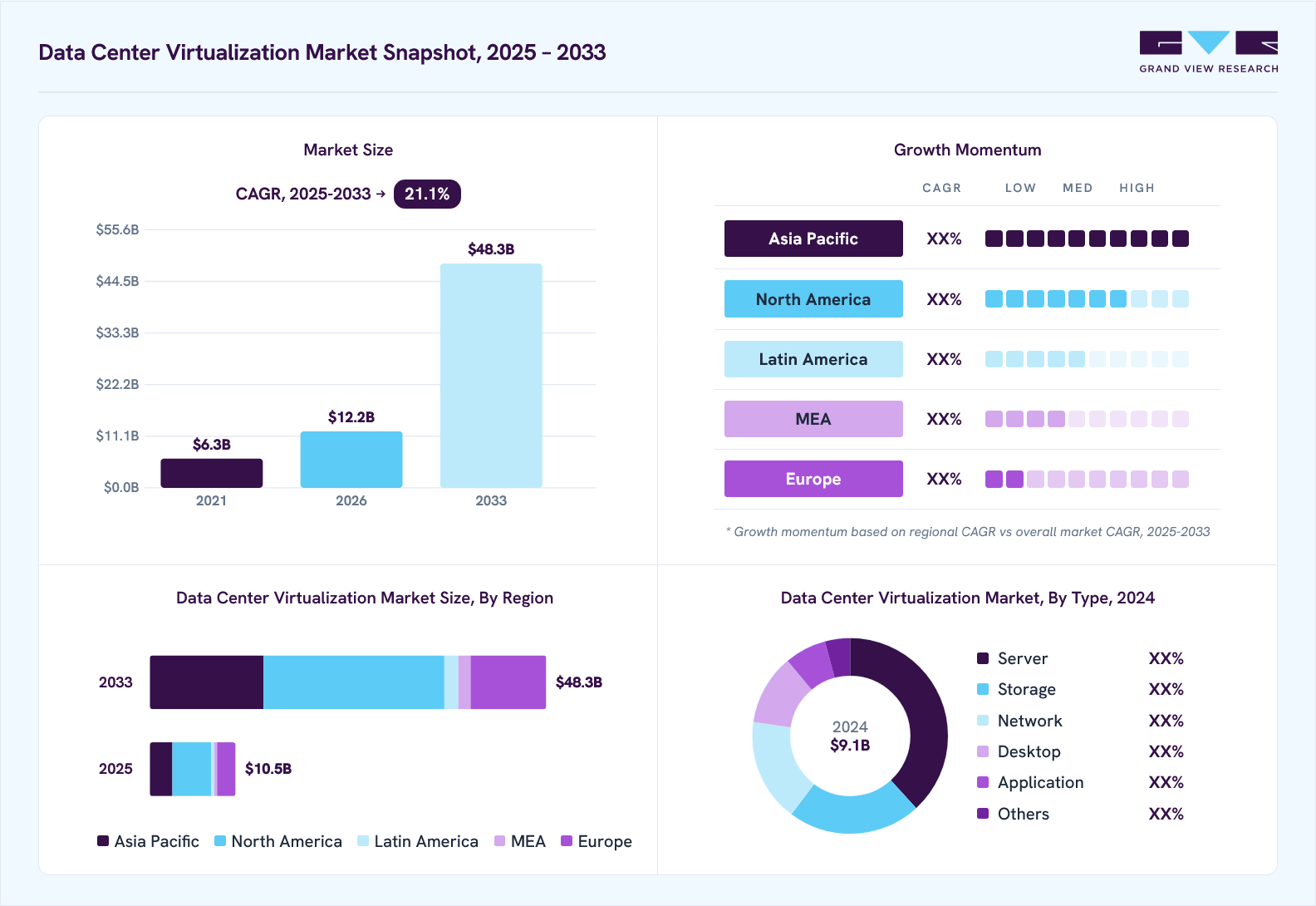 Source: Grand View Research, IR Documents, Primary Interviews, Paid DatabasesTo learn more about this report,
 Download Free Sample Report
 Key Market Trends & Insights
- By type: Servers segment dominated the market, with a revenue share of 38.1% in 2025
- By component: Software segment held the largest market share of 78.6% in 2025.
- By service: Advisory & implementation services segment held the largest market share of 33.3%
- By organization size: Large enterprises segment held the largest market share
- By end use: IT & telecommunication segment held the largest revenue share in 2025
Regional Highlights
- Largest regional market: North America (45.1% revenue share, 2025)
- Fastest-growing regional market: Asia Pacific (highest CAGR, 2026-2033)
- By country: The U.S. held the largest market share in 2025.
Market Size & Forecast
- Market size in 2025: USD 10.5 Billion
- Estimated market size in 2026: USD 12.2 Billion
- Projected market size by 2033: USD 47.9 Billion
- CAGR (2026-2033): 21.6%
Three ways to get this report
Buy it, customize it, or ask a question.Ask an Analyst
Analyst response in 1 business day
- AccessReport author, directly
- Reply timeWithin 1 working day
- No sales callDirect answer only
- FormatEmail reply
- CostFree, no cost
Get the Full Report
What the study covers
- FormatsPDF · Excel · Dashboard
- Timeline2026–2033 annual, 2025 base
- Coverage20+ countries, 5 regions
- Companies10+ key players profiled
Customize the Report
20% free customization
- IncludeCountries, segments, points
- TailorTo your product definition
- ExtendDeeper competitor detail
- OrA fully bespoke study
- Turnaround5–10 working days
Organizations increasingly rely on virtualized infrastructure to maximize server utilization, improve workload flexibility, and efficiently manage growing computing demands across large-scale cloud environments. The increasing demand for cost-effective and scalable IT infrastructure drives the growth. Data center virtualization allows organizations to reduce hardware dependencies, improve server utilization rates, and cut down operational costs. By consolidating workloads on fewer physical machines, companies can significantly reduce capital and energy expenditures, making virtualization an attractive solution for businesses of all sizes, especially small and medium enterprises (SMEs). To learn more about this report, Download Free Sample Report
 The rising adoption of cloud computing and hybrid cloud environments also contributes to the growth of the data center virtualization industry. As enterprises migrate their workloads to cloud platforms, virtualization plays a crucial role in enabling seamless integration, scalability, and agility across on-premise and cloud environments. Virtualization technologies, such as hypervisors and virtual machine managers, help organizations build flexible IT environments that support dynamic workload distribution and disaster recovery solutions. According to studies conducted by Amazon Web Services (AWS) in collaboration with Telecom Advisory Services, cloud computing had a significant economic impact in 2023, contributing over USD 1 trillion to the global gross domestic product (GDP). The reports also highlight the growing role of cloud-enabled artificial intelligence (AI), which accounted for more than USD 98 billion of that contribution.
Enhanced security and data protection features also contribute to the market's expansion. Virtualized environments support rapid patch management, isolated virtual machines, and centralized control, improving security posture while minimizing the risk of breaches or downtime. With growing concerns around data privacy and regulatory compliance, especially in highly regulated sectors like finance and healthcare, virtualization offers a more secure framework for managing sensitive information.
The increasing need for digital transformation across industries is accelerating the demand for modern, agile data center solutions. Virtualization supports automation, orchestration, and remote management capabilities, which are vital for businesses embracing DevOps practices, edge computing, and AI-driven analytics. This trend is further supported by the proliferation of Internet of Things (IoT) devices, which require efficient backend infrastructure to process vast volumes of data in real time.
Market Dynamics
The data center virtualization market is experiencing robust growth as organizations increasingly seek to optimize IT infrastructure, improve resource utilization, and enhance operational agility in response to evolving digital business requirements. Data center virtualization enables enterprises to abstract physical computing, storage, and networking resources into virtual environments, allowing multiple workloads to run efficiently on shared infrastructure while reducing hardware dependency and operational costs. The growing adoption of cloud computing, artificial intelligence (AI), machine learning, big data analytics, and enterprise applications is driving demand for scalable and flexible virtualized environments capable of supporting dynamic workloads. Additionally, the increasing implementation of hybrid and multi-cloud strategies is encouraging organizations to deploy virtualization technologies that facilitate seamless workload mobility, centralized management, and interoperability across diverse IT environments. Rising focus on business continuity, disaster recovery, cybersecurity, and infrastructure resilience is further supporting market expansion, as virtualization enhances backup, replication, and failover capabilities. The rapid growth of software-defined data centers (SDDCs), hyperconverged infrastructure (HCI), edge computing deployments, and automated IT operations is also accelerating adoption of advanced virtualization solutions. As enterprises continue their digital transformation journeys and seek greater efficiency, scalability, and flexibility in infrastructure management, demand for data center virtualization technologies is expected to grow steadily across industries worldwide.
The increasing need to optimize IT infrastructure utilization, reduce operational costs, and support hybrid cloud environments is a major driver for the data center virtualization market. Organizations are adopting virtualization technologies to consolidate physical servers, improve resource allocation, and enhance infrastructure scalability without significant hardware investments. As enterprises deploy cloud-native applications, AI workloads, big data analytics, and digital services, virtualization provides the flexibility needed to manage dynamic computing demands efficiently. Additionally, the growing adoption of hybrid and multi-cloud strategies is accelerating demand for virtualization platforms that enable seamless workload mobility, centralized management, and interoperability across diverse IT environments.
Performance overhead, deployment complexity, and security concerns remain significant restraints for the data center virtualization market. Virtualized environments can introduce latency and resource contention issues for high-performance applications, particularly those requiring intensive computing resources. Organizations also face challenges related to managing complex virtual infrastructures, ensuring compatibility across heterogeneous environments, and maintaining visibility into virtualized workloads. Furthermore, vulnerabilities at the hypervisor or virtual machine level can create additional security risks, making effective monitoring, access control, and compliance management critical for enterprise adoption.
The rapid adoption of software-defined data centers (SDDCs), edge computing, and automated infrastructure management presents a significant opportunity for the data center virtualization market. Enterprises increasingly require agile, software-driven environments that can dynamically allocate compute, storage, and networking resources to support distributed applications and real-time data processing. Virtualization technologies serve as the foundation of SDDCs by enabling infrastructure abstraction, automation, and centralized orchestration. Additionally, the expansion of edge computing, AI-driven applications, 5G networks, and hyperconverged infrastructure is creating substantial opportunities for virtualization vendors to deliver scalable, intelligent, and highly efficient data center solutions across industries.
Analyst Perspective
The data center virtualization market sits at the center of several transformative technology trends, including the rapid adoption of hybrid and multi-cloud architectures, accelerating deployment of artificial intelligence (AI) and machine learning workloads, growing investment in software-defined data centers (SDDCs), expansion of edge computing infrastructure, and increasing enterprise focus on IT modernization and automation. The central competitive moat, however, will belong to vendors that successfully integrate intelligent workload orchestration, AI-driven infrastructure management, advanced security controls, automation capabilities, container and Kubernetes support, and seamless hybrid cloud interoperability into a unified virtualization platform. Furthermore, increasing adoption across BFSI, healthcare, manufacturing, retail, government, education, and telecommunications sectors will continue to create opportunities for innovation and differentiation within the global virtualization ecosystem.
Type Insights
Based on type, the servers segment led the market with the largest revenue share of 38.1% in 2026 and is expected to grow at the significant CAGR over the forecast period. Virtualization enables multiple virtual machines to run on a single physical server, reducing hardware costs and improving server efficiency. The rise in cloud computing, edge deployments, and AI workloads is pushing enterprises to adopt high-performance, virtualized servers to support dynamic and scalable operations.
The network segment is anticipated to grow at the fastest CAGR during the forecast period due to the rising adoption of software-defined networking (SDN) and network function virtualization (NFV), which allow more agile, programmable, and efficient network management within virtualized data centers. These technologies decouple network control from hardware, enabling centralized management, automation, and rapid provisioning of network resources, which is crucial for supporting dynamic workloads and multi-tenant environments.
Component Insights
Based on component, software segment led the market with the largest revenue share of 78.6% in 2025. This can be attributed to the growing need for centralized management, orchestration tools, and automation platforms that streamline virtual infrastructure operations. As virtual environments become more complex, enterprises are increasingly adopting virtualization software for tasks such as workload balancing, real-time monitoring, and automated provisioning to enhance operational efficiency. The rise of containerization and microservices architecture is also fueling demand for software solutions such as Kubernetes and OpenShift that manage containerized applications within virtualized environments.
The service segment is expected to grow at a significant CAGR during the forecast period due to the increasing demand for consulting, integration, migration, and managed services as organizations navigate complex virtualization deployments. Many enterprises, especially those with legacy infrastructure, rely on third-party expertise to design and implement tailored virtualization strategies that align with their business goals. The rapid pace of technological change and the shortage of in-house IT skills further drive the need for professional services to ensure smooth transitions and minimal disruption.
Service Insights
Based on service, advisory & implementation services segment led the market with the largest revenue share of 33.3% in 2025, driven by the increasing complexity of IT environments and the strategic need for customized virtualization roadmaps that align with digital transformation goals. Organizations are seeking expert guidance to assess virtualization readiness, plan phased implementations, and ensure alignment with compliance, governance, and business continuity frameworks.
The optimization services segment is expected to grow at a significant CAGR during the forecast period, as businesses focus on maximizing the ROI of their virtualized infrastructure through performance tuning, workload redistribution, and capacity planning. These services help identify underutilized resources, eliminate performance bottlenecks, and ensure that virtual environments operate at peak efficiency. With growing requirements to meet SLAs, improve application responsiveness, and reduce downtime, optimization services are becoming essential for sustaining long-term operational excellence in increasingly dynamic and resource-intensive data center environments.
Organization Size Insights
Based on organization size, large enterprises segment led the market with the largest revenue share of 70.6% in 2025, fueled by digital resilience, global scalability, and seamless integration across diverse IT environments. With operations spanning multiple geographies and complex application ecosystems, these organizations are adopting virtualization to support unified infrastructure management, enable faster deployment of enterprise applications, and enhance business agility during periods of expansion or restructuring.
The SMEs segment is expected to grow at a significant CAGR during the forecast period as SMEs increasingly turn to virtualization to overcome limited IT budgets and physical infrastructure constraints. For SMEs, virtualization offers a cost-efficient pathway to access enterprise-grade computing capabilities, reduce hardware dependency, and support business continuity planning without the need for large-scale data center investments.
End Use Insights
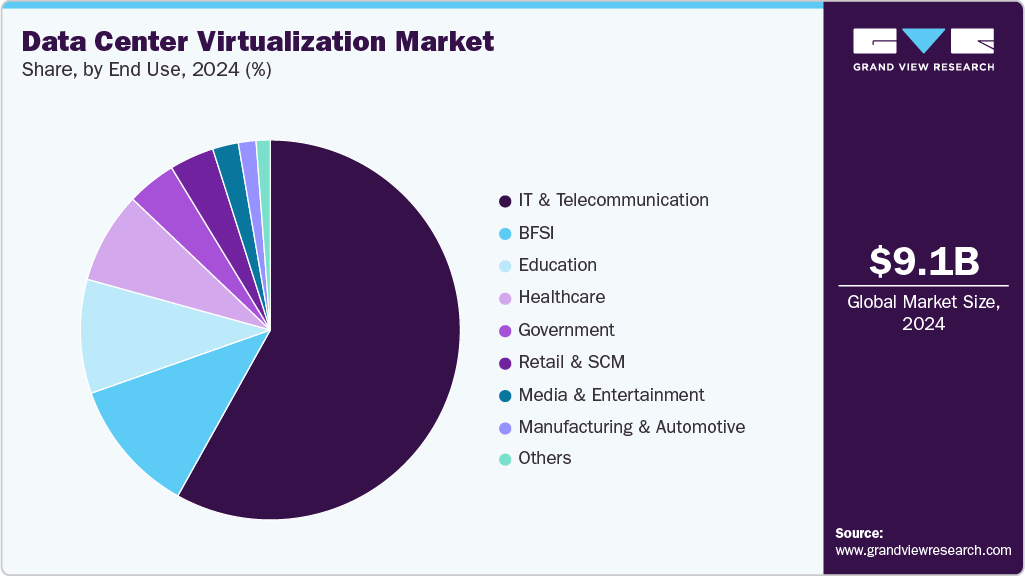
Based on vertical, IT & telecommunication segment led the market with the largest revenue share of 57.4% in 2025, driven by the need for high availability, rapid service delivery, and dynamic network management. Virtualization enables telcos and IT service providers to efficiently manage large volumes of data, deploy new services quickly, and reduce time-to-market for applications and platforms. As telecom operators transition to 5G and edge computing, virtualization plays a critical role in supporting virtual network functions (VNFs) and enabling flexible, software-driven infrastructure.
 To learn more about this report, Download Free Sample Report
 The healthcare segment is expected to grow at a significant CAGR over the forecast period owing to the rising demand for secure, scalable, and interoperable systems that can handle electronic health records (EHRs), telemedicine, and AI-powered diagnostics. Virtualization helps healthcare providers improve data accessibility, ensure disaster recovery, and meet regulatory compliance (such as HIPAA), all while supporting seamless integration across various medical applications and systems in a cost-effective and secure environment.
Regional Insights
North America dominated the data center virtualization market with the largest revenue share of 45.1% in 2025, driven by the increasing penetration of advanced technologies such as AI, IoT, and big data analytics, which demand scalable and flexible computing environments. The region's mature IT infrastructure, strong presence of cloud service providers, and early adoption of virtualization across sectors such as BFSI, retail, and government further drive market growth.
 To learn more about this report, Download Free Sample Report
 U.S. Data Center Virtualization Market Trends
The data center virtualization market in the U.S. held the largest share in the North America region in 2025, due to the accelerated pace of digital transformation among companies and federal agencies. A strong emphasis on modernizing legacy systems within defense, education, and public sector organizations has led to increased demand for virtual infrastructure. Furthermore, robust investments in hyperscale data centers and federal initiatives like the Cloud Smart strategy are fueling adoption of virtualization platforms nationwide.
Europe Data Center Virtualization Market Trends
The data center virtualization industry in Europe is anticipated to register considerable growth from 2025 to 2033, due to sustainability mandates and green data center initiatives. Virtualization plays a central role in reducing the carbon footprint of data centers by enabling workload consolidation and improving energy efficiency. Moreover, the push for digital sovereignty and local data processing in line with GDPR compliance is encouraging European businesses to invest in secure, virtualized data center environments.
The UK data center virtualization market is expected to grow rapidly in the coming years, owing to organizations revamping digital operations to remain competitive in global markets. The fintech and legal tech sectors, coupled with rising cybersecurity concerns, are prompting increased adoption of virtualization for secure, agile, and compliant data management and service delivery frameworks.
The data center virtualization market in Germany held a substantial revenue share in 2024 due to its industrial digitalization (Industrie 4.0) push, especially among automotive and manufacturing firms. These sectors are leveraging virtualization to support smart factory operations, real-time data analytics, and remote equipment management. In addition, Germany’s strong regulatory focus on data localization and resilience is leading to more virtualized private data centers.
Asia Pacific Data Center Virtualization Market Trends
Asia Pacific data center virtualization industry is expected to witness the fastest growth from 2025 to 2033, due to digitally driven economic development and large-scale cloud adoption by government and enterprises alike. Regional initiatives such as Digital India, China’s New Infrastructure Plan, and Southeast Asia’s e-governance projects are contributing to widespread virtualization. The need for agile, scalable infrastructure across fast-growing economies is making virtualization essential for both public and private sector modernization.
The Japan data center virtualization market is expected to grow rapidly in the coming years, driven by the aging workforce and labor shortages, prompting businesses to automate and virtualize IT operations for higher efficiency. The country’s aggressive move toward digital government (Digital Agency reforms) and the digital twin infrastructure development for manufacturing and urban planning are pushing demand for high-performance, virtualized environments.
The data center virtualization market in China held a substantial market share in 2024, due to the government’s New Infrastructure strategy, which promotes 5G, AI, and data center development. Rapid expansion of internet services, smart city projects, and cloud-native platforms among local tech giants is accelerating virtualization. Additionally, strong demand for sovereign cloud solutions and domestic virtualization software vendors is shaping a robust, localized virtualization ecosystem.
Key Data Center Virtualization Company Insights
Key players operating in the data center virtualization industry are VMware, Inc.; Microsoft; IBM Corporation; Cisco Systems, Inc.; Hewlett-Packard Enterprise Development LP; and Dell Inc. The companies are focusing on various strategic initiatives, including new product development, partnerships & collaborations, and agreements to gain a competitive advantage over their rivals. The following are some instances of such initiatives.
-
In May 2025, Hewlett Packard Enterprise Development LP expanded its HPE Aruba Networking portfolio with new wired and wireless solutions, including the HPE Aruba Networking CX 10K distributed services switches. In collaboration with AMD, HPE aims to deliver secure, scalable, and cost-effective data center and colocation networking solutions designed to meet the demands of large-scale enterprise deployments.
-
In February 2025, Cisco Systems, Inc. expanded its partnership with NVIDIA Corporation to offer AI solutions that support high-performance, low-latency, and energy-efficient connectivity across data centers and cloud platforms, helping enterprises build scalable AI-ready infrastructure.
-
In July 2024, Digital Realty Trust introduced a new Microsoft Azure ExpressRoute peering point at its Dallas data center campus in the U.S., enabling customers to access Azure services through a single cross-connect. The company also joined as a launch partner for Microsoft’s Azure ExpressRoute Metro service in Zurich and Amsterdam, offering secure, low-latency, and private connectivity to Azure from its facilities. This enhances support for hybrid IT and cloud-adjacent architectures.
Key Data Center Virtualization Companies:
The following key companies have been profiled for this study on the data center virtualization market.
-
ATTO Technology
-
AT&T
-
Cisco Systems, Inc.
-
Dell Inc.
-
Fujitsu
-
HCL Technologies Limited
-
Hewlett Packard Enterprise Development LP
-
Huawei Technologies Co., Ltd.
-
IBM Corporation
-
Konverge
-
Microsoft
-
Oracle
-
Rahi
-
Veritis Group Inc.
-
VMware, Inc.
Competitive Benchmarking
Category
Operating Strategies
Competitive Edge
Weakness
Established Players (VMware by Broadcom, Microsoft, Red Hat, Nutanix, Cisco Systems, IBM, Oracle, Hewlett Packard Enterprise)
- Established players focus on delivering comprehensive virtualization platforms encompassing server, storage, network, desktop, and application virtualization. Their strategies emphasize integration with hybrid and multi-cloud environments, software-defined data centers (SDDCs), hyperconverged infrastructure (HCI), automation, AI-driven infrastructure management, and cybersecurity capabilities.
- These companies benefit from extensive enterprise customer bases, mature virtualization ecosystems, strong partner networks, broad product portfolios, and deep expertise in infrastructure management. Their ability to provide integrated solutions spanning virtualization, cloud management, networking, security, storage, and automation enables organizations to modernize IT operations while ensuring scalability, reliability, and compliance.
- High product and licensing costs, complex deployment requirements, and dependence on legacy infrastructure can hinder adoption among cost-sensitive organizations. Additionally, increasing competition from containerization technologies, open-source platforms, and cloud-native architectures may impact long-term growth. Customers may also face concerns regarding vendor lock-in, migration complexity, and ongoing subscription expenses.
Emerging Players (Scale Computing, VergeIO, Sangfor Technologies, Proxmox, OpenNebula, Virtuozzo)
- Emerging players focus on delivering cost-effective, simplified, and highly scalable virtualization solutions targeting SMEs, distributed enterprises, edge computing deployments, and cloud service providers. Their strategies emphasize open-source technologies, hyperconverged infrastructure, lightweight virtualization, edge virtualization, simplified management, and flexible subscription models.
- These companies offer greater flexibility, lower total cost of ownership (TCO), simplified deployment, and faster innovation cycles. Their solutions often provide attractive alternatives to traditional virtualization platforms, particularly for organizations seeking cost optimization, reduced complexity, and cloud-native infrastructure capabilities.
- Limited brand recognition, smaller partner ecosystems, and lower R&D budgets may restrict their ability to compete with established vendors in large enterprise environments. They may also face challenges in scaling global operations, providing extensive support services, achieving regulatory certifications, and building customer confidence for mission-critical workloads.
Data Center Virtualization Market Report Scope
Report Attribute
Details
Market size in 2025
USD 10.5 billion
Estimated market size in 2026
USD 12.2 billion
Projected market size by 2033
USD 47.9 billion
Growth rate
CAGR of 21.6% from 2026 to 2033
Base year for estimation
2025
Historical data
2021 - 2024
Forecast period
2026 - 2033
Quantitative units
Revenue in USD billion and CAGR from 2026 to 2033
Report coverage
Revenue forecast, company ranking, competitive landscape, growth factors, and trends
Segments covered
Type; component; service; enterprise size; end use; region
Regional scope
North America; Europe; Asia Pacific; Latin America; MEA
Country scope
U.S.; Canada; Mexico; Germany; UK; France; China; Japan; India; South Korea; Australia; Brazil; Saudi Arabia; South Africa; UAE
Key companies profiled
ATTO Technology; AT&T; Cisco Systems, Inc.; Dell Inc.; Fujitsu; HCL Technologies Limited; Hewlett Packard Enterprise Development LP; Huawei Technologies Co., Ltd.; IBM Corporation; Konverge; Microsoft; Oracle; Veritis Group Inc.; VMware, Inc.
Customization scope
Free report customization (equivalent up to 8 analysts' working days) with purchase. Addition or alteration to country, regional & segment scope.
Pricing and purchase options
Avail customized purchase options to meet your exact research needs. Explore purchase options
Global Data Center Virtualization Market Report Segmentation
This report forecasts revenue growth at the global, regional, and country levels and provides an analysis of the latest industry trends in each of the sub-segments from 2021 to 2033. For this study, Grand View Research has segmented the data center virtualization market report based on type, component, service, enterprise size, end use, and region:
-
Type Outlook (Revenue, USD Billion, 2021 - 2033)
-
Server
-
Storage
-
Network
-
Desktop
-
Application
-
Others
-
-
Component Outlook (Revenue, USD Billion, 2021 - 2033)
-
Services
-
Software
-
-
Service Outlook (Revenue, USD Billion, 2021 - 2033)
-
Advisory & Implementation Services
-
Optimization Services
-
Managed Services
-
Technical Support Services
-
-
Enterprise Size Outlook (Revenue, USD Billion, 2021 - 2033)
-
SMEs
-
Large Enterprises
-
-
End Use Outlook (Revenue, USD Billion, 2021 - 2033)
-
BFSI
-
IT & Telecommunication
-
Manufacturing & Automotive
-
Government
-
Healthcare
-
Education
-
Retail & SCM
-
Media & Entertainment
-
Others
-
-
Regional Outlook (Revenue, USD Billion, 2021 - 2033)
-
North America
-
U.S.
-
Canada
-
Mexico
-
-
Europe
-
UK
-
Germany
-
France
-
-
Asia Pacific
-
China
-
India
-
Japan
-
South Korea
-
Australia
-
-
Latin America
-
Brazil
-
-
Middle East & Africa
-
UAE
-
Saudi Arabia
-
South Africa
-
-
Research Methodology
The data center virtualization market figures in this report are based on a proven research process that combines executive interviews with secondary research from proprietary databases, company filings, and recognized regulatory and institutional sources. Market size is built through value-chain sizing - reconciling supply-side and demand-side estimates - and triangulated with bottom-up and top-down approaches. Every estimate passes multiple levels of expert validation before publication, with each data center virtualization segment quantified using the revenue-capture definitions in the table below.
Segment Definition
Segment - Type
Revenue capture definition
Server
Server virtualization involves partitioning a physical server into multiple virtual machines (VMs), each operating independently with its own operating system and applications. It improves server utilization, reduces hardware requirements, and enhances workload flexibility.
Storage
Storage virtualization abstracts physical storage resources from multiple devices into a centralized virtual storage pool. It simplifies storage management, improves resource allocation, and enhances data availability and disaster recovery capabilities.
Network
Network virtualization combines hardware and software network resources into logical, software-defined networks. It enables centralized network management, improves scalability, enhances security, and supports dynamic workload movement across data centers.
Desktop
Desktop virtualization separates desktop environments from physical devices, allowing users to access virtual desktops remotely through centralized servers. It improves security, simplifies IT administration, and supports remote and hybrid work environments.
Application
Application virtualization enables applications to run in isolated virtual environments without being directly installed on the underlying operating system. This improves application compatibility, deployment flexibility, and management efficiency.
Others
This category includes emerging virtualization technologies such as data virtualization, operating system virtualization, container-based virtualization, and specialized virtualization solutions designed for specific enterprise workloads.
Segment - Component
Revenue capture definition
Services
Services include consulting, deployment, integration, optimization, maintenance, and support activities that help organizations implement and manage virtualization environments effectively.
Software
Software comprises hypervisors, virtualization platforms, management tools, orchestration software, monitoring solutions, and automation technologies used to create, manage, and optimize virtualized infrastructure.
Segment - Service
Revenue capture definition
Advisory & Implementation Services
These services assist organizations in assessing virtualization requirements, designing architectures, planning migrations, and deploying virtualization solutions aligned with business objectives.
Optimization Services
Optimization services focus on improving the performance, efficiency, scalability, and resource utilization of existing virtualized environments through monitoring, tuning, and infrastructure enhancements.
Managed Services
Managed services involve ongoing administration, monitoring, maintenance, and operation of virtualized infrastructure by third-party service providers, enabling organizations to focus on core business activities.
Technical Support Services
Technical support services provide troubleshooting, system updates, issue resolution, maintenance assistance, and vendor support to ensure uninterrupted operation of virtualization environments.
Segment - Enterprise Size
Revenue capture definition
Large Enterprises
The Large enterprises segment, with respect to the number of employees, typically comprises organizations employing more than 1,000 employees for multinational corporations.
SMEs
The SMEs segment, with respect to the number of employees, generally includes organizations employing between 10 and 999 employees.
Segment - End Use
Revenue capture definition
BFSI
The Banking, Financial Services, and Insurance sector utilizes virtualization to improve data center efficiency, support digital banking services, enhance disaster recovery capabilities, and meet regulatory compliance requirements.
IT & Telecommunication
IT and telecommunications organizations leverage virtualization to support cloud services, network functions virtualization (NFV), large-scale data processing, and efficient management of distributed infrastructure.
Manufacturing & Automotive
Manufacturing and automotive companies use virtualization to support industrial automation, smart manufacturing initiatives, product development environments, and operational technology infrastructure.
Government
Government agencies adopt virtualization to modernize IT infrastructure, improve cybersecurity, enhance service delivery, optimize resource utilization, and support digital governance initiatives.
Healthcare
Healthcare organizations utilize virtualization to manage electronic health records, medical imaging systems, telehealth applications, and secure patient data while ensuring regulatory compliance.
Education
Educational institutions implement virtualization to provide virtual learning environments, centralized IT management, remote access to educational resources, and cost-effective infrastructure utilization.
Retail & SCM
Retail and supply chain management organizations use virtualization to support e-commerce platforms, inventory management systems, customer analytics, logistics operations, and omnichannel retail experiences.
Media & Entertainment
Media and entertainment companies leverage virtualization to support content creation, digital asset management, video processing, broadcasting operations, and scalable media distribution infrastructure.
Others
This segment includes industries such as energy, utilities, transportation that utilize virtualization technologies to improve operational efficiency and infrastructure flexibility.
Estimation Model
Layer
Question
Analysis
Enterprise Infrastructure Demand Layer
Who requires Data Center Virtualization solutions?
Identify end-user organizations requiring virtualized IT infrastructure, including BFSI, IT & telecommunications, healthcare, retail, manufacturing, government, education, media & entertainment, and cloud-native enterprises. Assess the number of organizations pursuing digital transformation, hybrid cloud adoption, workload consolidation, and IT modernization initiatives to estimate the total addressable market for data center virtualization solutions.
Virtualization Adoption & IT Modernization Layer
Which organizations deploy Data Center Virtualization solutions?
Evaluate enterprise adoption of server, storage, network, desktop, and application virtualization technologies. Analyze cloud readiness, hybrid and multi-cloud strategies, software-defined data center (SDDC) initiatives, disaster recovery requirements, workload mobility needs, and IT automation maturity to determine potential deployment opportunities across industries.
Infrastructure Investment & Digital Transformation Layer
Who actively invests in Data Center Virtualization solutions?
Analyze investments by enterprises, hyperscale cloud providers, colocation operators, managed service providers, government agencies, educational institutions, and healthcare organizations. Assess spending on data center modernization, virtualization software licenses, hyperconverged infrastructure (HCI), software-defined networking (SDN), automation platforms, and cloud integration projects to identify key adopters of virtualization technologies.
Monetization Layer
How much revenue is generated?
Quantify revenue generated from virtualization software, hypervisors, management platforms, orchestration tools, virtualization security solutions, consulting services, implementation services, managed services, optimization services, and technical support services. Evaluate recurring revenue streams from software subscriptions, SaaS-based virtualization platforms, maintenance contracts, and managed virtualization services across enterprise segments and industry verticals.
Delivered Customizations
This report has been delivered with the following In-depth customizations
CLIENT REQUEST
CUSTOMIZATION DELIVERED
VALUE ADDS
Regional Virtualization Adoption & Data Center Modernization Assessment
Analyzed regional adoption of server, storage, network, desktop, and application virtualization technologies, including enterprise digital transformation initiatives, hybrid cloud adoption, software-defined data center (SDDC) deployments, hyperconverged infrastructure investments, edge computing expansion, and IT modernization trends Latin America, and the Middle East & Africa.
Helps technology vendors, investors, cloud providers, and enterprises identify high-growth markets, prioritize regional expansion strategies, optimize resource allocation, and capitalize on emerging virtualization opportunities.
Competitive Benchmarking & Virtualization Platform Innovation Assessment
Assessed virtualization platforms, hypervisor technologies, cloud integration capabilities, container and Kubernetes support, automation features, AI-driven infrastructure management tools, security frameworks, pricing strategies, ecosystem partnerships, and go-to-market approaches of leading and emerging virtualization vendors globally.
Helps stakeholders benchmark competitors, identify technology gaps, evaluate partnership and acquisition opportunities, strengthen product differentiation, and develop effective competitive positioning strategies.
Edge Virtualization & Distributed Infrastructure Assessment
Evaluated virtualization adoption across edge computing environments, including remote sites, branch offices, industrial facilities, telecommunications networks, and IoT ecosystems. Assessed workload distribution strategies, low-latency computing requirements, and edge infrastructure management frameworks.
Helps stakeholders identify emerging growth opportunities, support real-time application requirements, optimize distributed infrastructure operations, and capitalize on edge computing expansion trends.
Frequently Asked Questions About This Report
North America dominated with 45.1% revenue share in 2025.
Asia Pacific is the fastest-growing region over the forecast period.
The server segment led with a 38.1% revenue share in 2025, while network segment is the fastest-growing segment.
The software segment led with a 78.6% revenue share in 2025, while services segment is the fastest-growing segment.
Some key players operating in the data center virtualization market include ATTO Technology, AT&T, Cisco Systems, Inc., Dell Inc., Fujitsu, HCL Technologies Limited, Hewlett Packard Enterprise Development LP, Huawei Technologies Co., Ltd., IBM Corporation, Konverge, Microsoft, Oracle, Veritis Group Inc., VMware, Inc.
The global data center virtualization market size was estimated at USD 10.5 billion in 2025 and is expected to reach USD 12.2 billion in 2026.
Key factors driving the data center virtualization market growth include increasing demand for cost-effective and scalable IT infrastructure. Data center virtualization allows organizations to reduce hardware dependencies, improve server utilization rates, and cut down operational costs.
The advisory & implementation services held the largest share of 33.3% in 2025, while optimization services segment is the fastest-growing segment.
The global data center virtualization market is expected to grow at a compound annual growth rate of 21.6% from 2026 to 2033 to reach USD 47.9 billion by 2033.
About the Author(s)
Next Generation Technologies Research Team
Technology · Next Generation TechnologiesThis report was authored by the next generation technologies research team at Grand View Research - comprising two research analysts, one senior research analyst, and one industry expert - with specialized expertise in the next generation technologies segment of the technology industry. All findings are based on proprietary technology databases, executive interviews, and regulatory analysis, subject to internal peer review prior to publication.
Last Updated:
Speak to Analyst

Customize this report to your needs - add regions, segments, or data points, with 20% free customization.
Or view our licence options:


ISO 9001:2015 & 27001:2022 Certified
We are GDPR and CCPA compliant! Your transaction & personal information is safe and secure. For more details, please read our privacy policy.


