
- Home
- »
- Network Security
- »
-
Data Lineage Security Market Size And Share Report, 2033GVR Report cover

Data Lineage Security Market (2026 - 2033)
Size, Share & Trends Analysis Report By Component (Software, Services), By Deployment (Cloud-based, On-premises, Hybrid), By Organization Size, By Application, By End Use, By Region, And Segment Forecasts
Market Size, 2025
$889.6MMarket Estimate, 2026
$1,034.6MMarket Forecast, 2033
$3,314.9MCAGR, 2026–2033
18.1%Data Lineage Security Market Summary
The global data lineage security market size was valued at USD 889.6 million in 2025 and is projected to grow from USD 1,034.6 million in 2026 to USD 3,314.9 million by 2033, at a CAGR of 18.1% from 2026 to 2033. The market in North America dominated with a revenue share of 40.5% in 2025. The global market is gaining importance as organizations seek stronger protection for lineage metadata, metadata repositories, lineage-generation pipelines, and associated APIs.
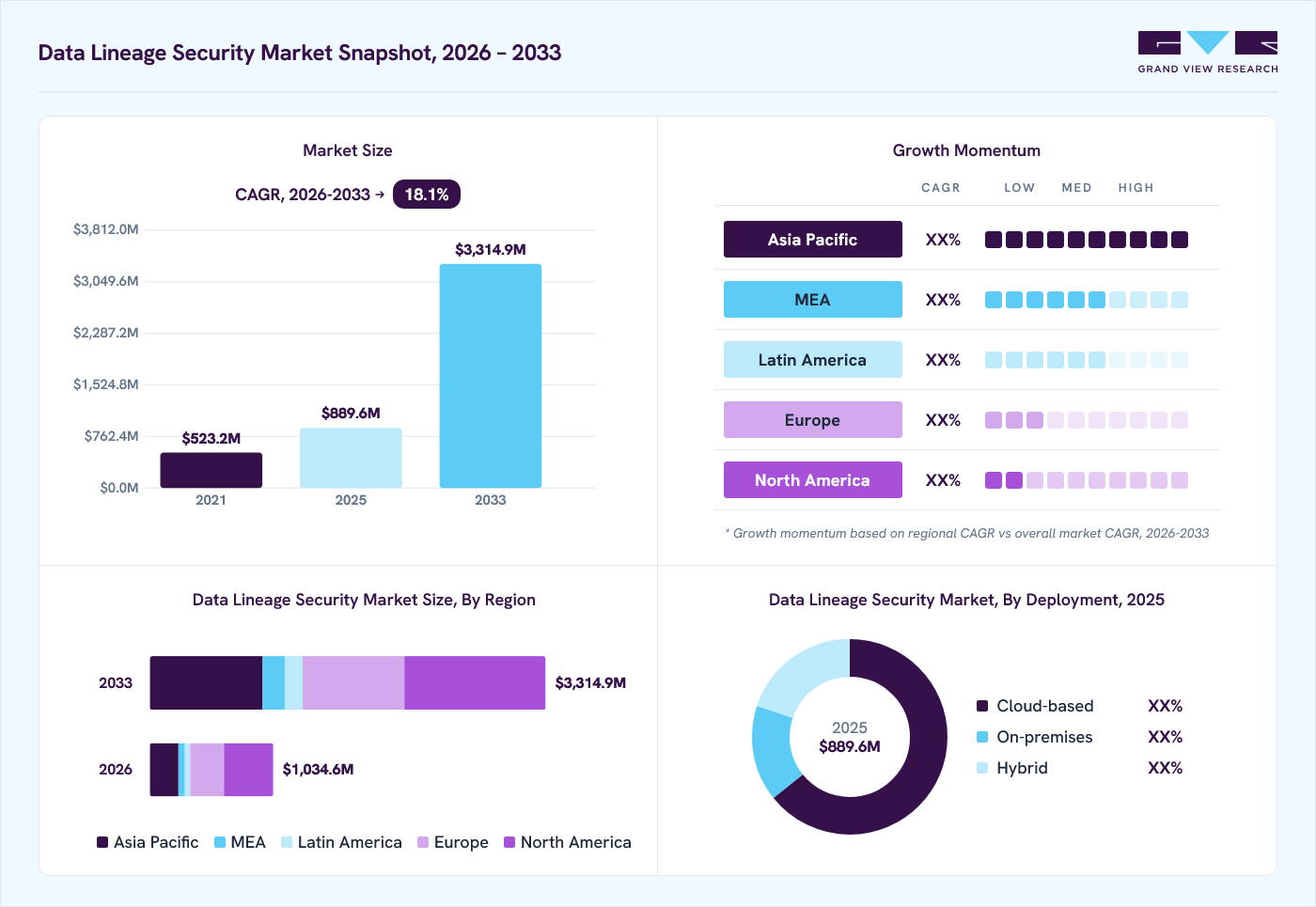 Source: Grand View Research, IR Documents, Primary Interviews, Paid DatabasesTo learn more about this report,
 Download Free Sample Report
Key Market Trends & Insights
- By component: Software segment held the largest market share of 71.3% in 2025.
- By deployment: Cloud-based segment held the largest market share of 64.2% in 2025.
- By organization size: Large enterprises segment held the largest market share of 74.1% in 2025.
- By application: Lineage-aware discovery and classification segment held the largest market share of 44.4% in 2025.
- By end use: BFSI segment held the largest market share of 27.4% in 2025.
Regional Highlights
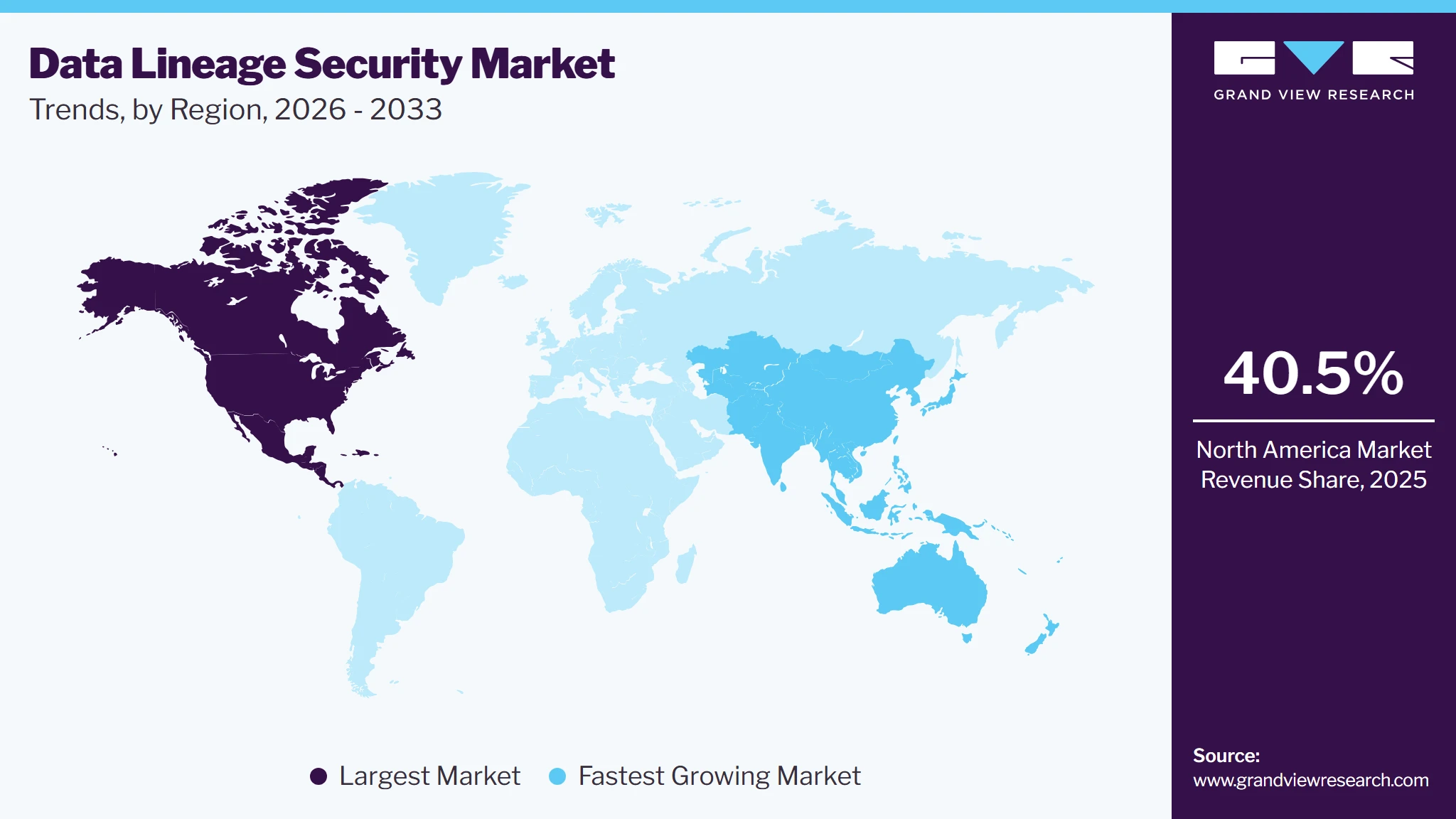
- Largest regional market: North America (40.5% revenue share, 2025)
- Fastest-growing regional market: Asia Pacific (highest CAGR, 2026-2033)
- By country: The U.S. held the largest market share in 2025
Market Size & Forecast
- Market size in 2025: USD 889.6 Million
- Estimated market size in 2026: USD 1,034.6 Million
- Projected market size by 2033: USD 3,314.9 Million
- CAGR (2026-2033): 18.1%
Prism AI by Grand View Research Free to tryAsk a question about the data lineage security marketTry asking✓Every figure cited from GVR research Prefer the report? Download free sample →The growing complexity of enterprise data architectures, including hybrid-cloud and multicloud environments, is increasing the need to safeguard records that document data origins, transformations, and movement. Organizations are integrating lineage capabilities with data governance, identity and access management, and audit logging to improve metadata integrity, traceability, and accountability.
 To learn more about this report, Download Free Sample Report
Market Dynamics
Growing regulatory scrutiny surrounding data governance, privacy, and auditability is driving demand for stronger security controls over lineage metadata and lineage systems. Organizations across BFSI, healthcare, government, and other regulated industries need reliable records of data origins, transformations, access, and movement to support compliance assessments and internal audits. Protecting these records against unauthorized modification or disclosure is becoming increasingly important as enterprises adopt cloud-based data platforms, AI systems, and complex data pipelines. Consequently, organizations are likely to invest in access controls, integrity monitoring, and audit logging for lineage repositories and related services.
The limited availability of standalone solutions specifically designed to secure lineage metadata and lineage systems may constrain market growth. Many vendors incorporate relevant capabilities, such as role-based access controls, audit logs, and metadata permissions, into broader data governance, cataloging, and data management platforms. This bundling makes it difficult for buyers to identify dedicated solutions, compare offerings, and allocate budgets specifically to lineage security. Furthermore, organizations may consider existing platform-level security controls sufficient, reducing the incentive to purchase specialized products. These factors can limit the visibility and independent commercialization of the market.
The growing use of AI, machine learning, and automated data pipelines presents an opportunity for specialized lineage security solutions. AI applications depend on data collected and transformed across multiple systems, increasing the importance of protecting lineage metadata that documents data provenance and transformations. Unauthorized changes to lineage records can undermine auditability, data governance, and confidence in the traceability of datasets used to develop or operate AI models. Vendors can capitalize on this need by developing solutions that combine tamper-evident lineage records, fine-grained access management, continuous monitoring, and integration with existing data engineering and AI governance platforms. Such capabilities could support adoption among enterprises seeking stronger oversight of complex data ecosystems.
Market Concentration & Characteristics
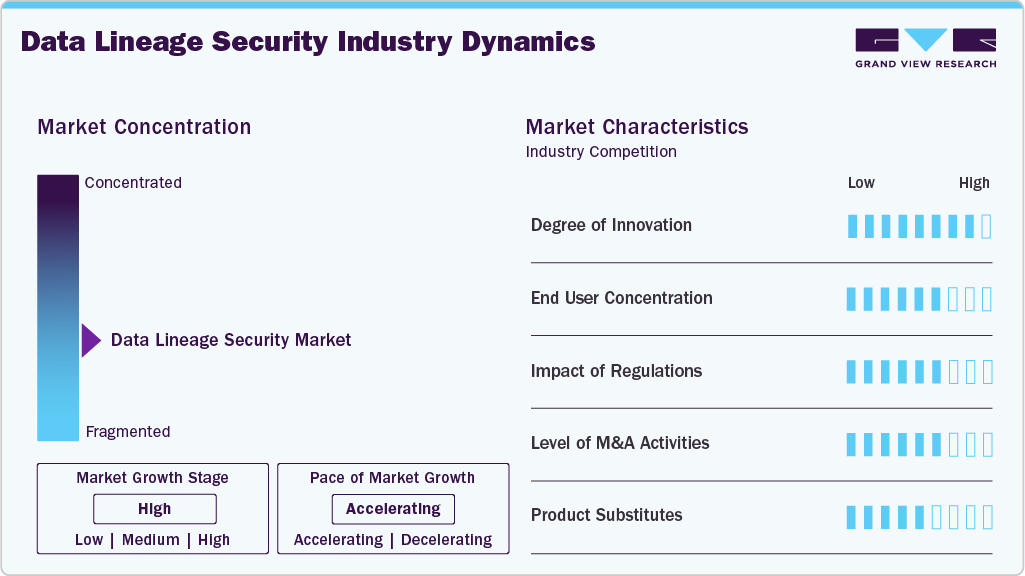
The data lineage security industry is an emerging, specialized segment within the broader data security, governance, and metadata management landscape. The market comprises large technology and cloud providers, data governance and lineage platform vendors, and metadata management solution providers that offer security-related capabilities for lineage repositories, metadata access, and lineage processing systems. Competition is primarily driven by the ability to enforce access controls, preserve the integrity of lineage metadata, secure APIs and metadata repositories, and provide auditability across data environments. Many relevant capabilities are embedded within broader data governance and lineage platforms rather than offered as standalone solutions.
 To learn more about this report, Download Free Sample Report
The market is characterized by increasing emphasis on metadata access governance, lineage record integrity, identity and access management, audit logging, and protection of metadata pipelines and repositories. As organizations expand their use of cloud data platforms, distributed data architectures, and AI-driven data workflows, securing lineage information is becoming increasingly relevant for data governance, regulatory compliance, and operational accountability. However, the market remains difficult to define and quantify independently because lineage-security features are frequently bundled with broader governance and security offerings. Integration with existing data catalogs, heterogeneous data environments, legacy systems, and enterprise security frameworks remains a key consideration for solution providers and adopters.
Analyst Perspective
The data lineage security industry is an emerging niche driven by the growing need to protect lineage metadata and maintain the integrity and traceability of data flows across complex data environments. Increasing adoption of cloud-based data platforms, AI-driven workflows, and distributed architectures is expected to strengthen demand for secure lineage management. Vendors are likely to enhance access controls, metadata integrity monitoring, and audit capabilities within existing data governance and lineage solutions. However, limited standalone product offerings and the bundling of security features within broader platforms may challenge independent market measurement and commercialization.
Component Insights
The software segment led the market with the largest revenue share of 71.3% in 2025, driven by increasing demand for software-based solutions that protect lineage metadata, secure metadata repositories, and monitor lineage information across enterprise data environments. The growing integration of lineage tracking with data security platforms is further supporting software adoption; for instance, in April 2025, Proofpoint launched a unified data security solution featuring Nexus Data Lineage, which tracks data flows from origin through transformations to egress channels and enables context-based security controls. The integration of lineage visibility, metadata monitoring, and security enforcement within software platforms is expected to sustain the segment’s dominance over the forecast period.
The services segment is projected to grow at the fastest CAGR during the forecast period, as enterprises increasingly rely on implementation, integration, managed monitoring, and advisory support to deploy lineage-aware controls across fragmented, multi-cloud, and AI data environments. Growth is driven by vendors and service providers packaging lineage-based security into repeatable managed and advisory offerings, which reduces the in-house skills burden for buyers. For instance, in February 2026, Netskope announced Netskope One Data Lineage, which provides visibility and analytics to track the provenance of data wherever it rests, moves, and is used, and the company positioned it to help MSPs and MSSPs scale data security services by replacing manual log analysis with automated chains of custody across their customer base. As a result, rising demand for continuous monitoring, audit-ready evidence, and expert-led deployment is expected to keep services growing faster than software through 2033.
Deployment Insights
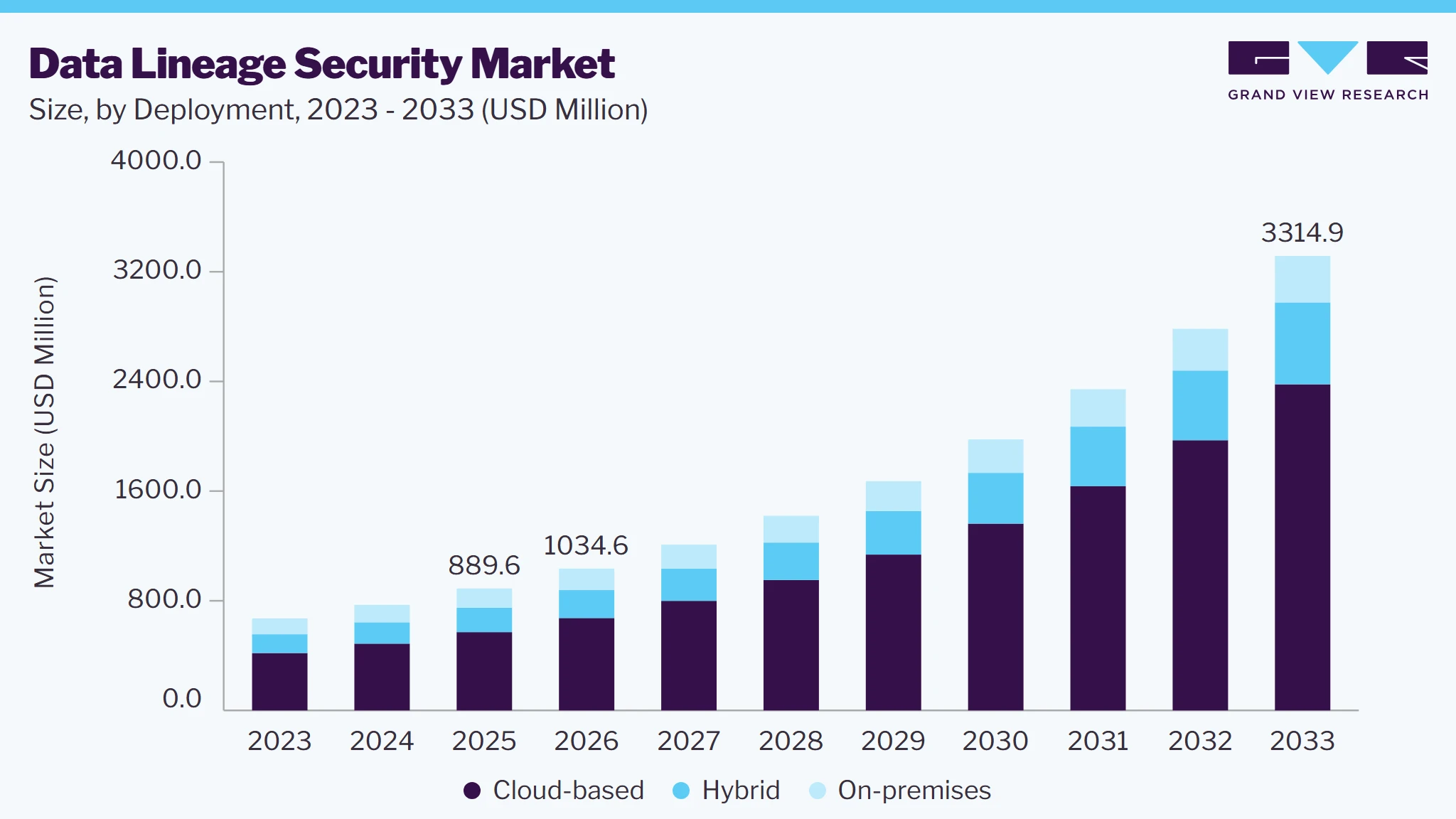
The cloud-based segment accounted for the largest market revenue share of 64.2% in 2025, as organizations moving data pipelines, lakehouses, and AI workloads to the cloud increasingly adopt cloud-native lineage platforms with built-in access controls, audit logging, and API-based metadata ingestion that scale without on-premises infrastructure. Adoption is supported by vendors that deliver lineage-aware security through cloud marketplaces and integrated consoles, thereby shortening procurement and deployment cycles. For instance, in May 2026, Microsoft announced that its Security Store is now embedded directly inside Microsoft Entra and Microsoft Purview, turning those admin consoles into a discovery channel for partner security solutions. Consequently, the scalability, faster deployment, and native integration of cloud-based offerings are expected to sustain the segment’s leadership over the forecast period.
The hybrid segment is anticipated to grow at a significant CAGR during the forecast period, as regulated enterprises keep sensitive systems on-premises or in private clouds for residency and sovereignty reasons while moving analytics and AI workloads to the public cloud. This creates a need for consistent lineage protection, access control, and audit logging across both environments. Growth is supported by vendors extending lineage and governance visibility across distributed data estates, helping security teams maintain a single trusted record of data movement. For instance, in March 2026, Cloudera Octopai Data Lineage added support for the Trino federated query engine, letting users query data in place across hybrid and multi-cloud environments while preserving governance and lineage. Consequently, the need to secure and audit lineage across mixed on-premises and cloud environments is expected to drive strong adoption of hybrid deployments.
Organization Size Insights
The large enterprises segment dominated the market with the largest revenue share of 74.1% in 2025, as large organizations run complex, multi-system data estates under strict regulatory oversight such as BCBS 239, DORA, SOX, and HIPAA, and need strong protection and auditability for their lineage metadata, repositories, and APIs. They also have the budgets and dedicated security teams to adopt lineage-security capabilities earlier than smaller firms. Demand is reinforced by vendors building enterprise-grade lineage with audit-ready evidence and tighter control over metadata exposure. For instance, in March 2026, Solidatus launched an agentic AI lineage assistant that builds and maintains lineage across complex enterprise data estates and produces audit-ready evidence. It can run on customers’ own large language models, so that metadata stays within the customer’s governance boundary. Consequently, the regulatory pressure, scale, and security maturity of large enterprises are expected to sustain the segment’s leadership over the forecast period.
The SMEs segment is projected to grow at the fastest CAGR during the forecast period, as small and mid-sized organizations adopt cloud data platforms and AI tools and face growing compliance obligations such as GDPR, HIPAA, and PCI DSS. They are looking for lightweight, subscription-based lineage security that protects lineage metadata and access without needing a dedicated governance team. Growth is supported by vendors offering simpler, modular, and lower-cost lineage and governance tools suited to lean teams. For instance, in February 2026, Acceldata published guidance that described affordable lineage tools as a practical option for mid-market teams, providing essential visibility into data flows without heavy infrastructure or lengthy implementation cycles. Subsequently, the increasing availability of cost-effective, easy-to-deploy offerings is expected to accelerate the adoption of lineage security among SMEs.
Application Insights
The lineage-aware discovery and classification segment accounted for the largest market share of 44.4% in 2025, as discovery and classification are the foundational step of data protection. Organizations must first locate and label sensitive data, then carry those labels and policies along the lineage as data is copied, transformed, and fed into analytics and AI systems. Adoption is reinforced when DSPM and data security vendors combine AI-driven classification with lineage, so that sensitivity context follows the data as it moves. For instance, in January 2026, Cyberhaven detailed its DSPM offering, which continuously discovers data across connected data stores, applies AI-driven classification and correlates events into a lineage view of the data’s journey. Consequently, the growing need to keep sensitivity labels accurate across data movement and AI use is expected to sustain the segment’s leadership over the forecast period.
The lineage integrity and tamper protection segment is expected to grow at the fastest CAGR during the forecast period, driven by rising concerns about unauthorized modifications, deletions, and falsification of lineage metadata, which can compromise data traceability and audit reliability. Organizations are prioritizing controls that preserve lineage records and identify unauthorized changes across metadata repositories and data processing pipelines. For instance, in May 2025, IBM expanded its Guardium Data Security Center capabilities to strengthen data security posture management and monitoring across enterprise data environments, supporting broader efforts to improve data visibility and control. These developments are expected to increase demand for integrity monitoring, change detection, and tamper-resistant audit mechanisms to maintain the reliability of lineage information.
End Use Insights
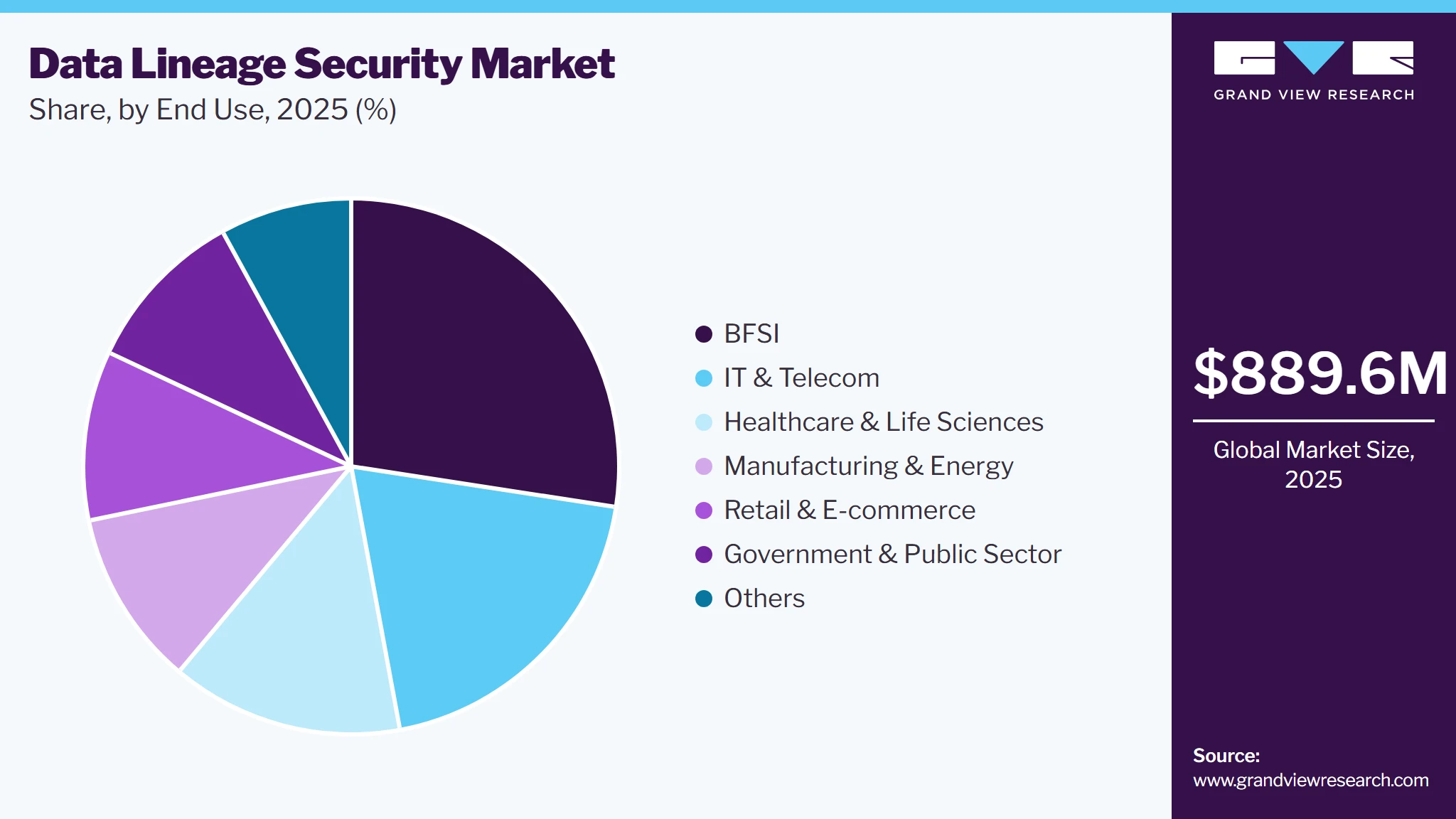
The BFSI segment led the market with the largest revenue share of 27.4% in 2025, driven by stringent regulatory reporting requirements and the need to maintain accurate, traceable, and auditable data records across banking systems. Financial institutions are increasingly adopting lineage-related controls to strengthen data governance, improve reporting accuracy, and support regulatory compliance. For instance, in April 2026, Ahana announced a data management solution for cooperative banks in India designed to streamline Reserve Bank of India (RBI) reporting through standardized data pipelines, traceable data lineage, and historical records for audit reviews. The growing importance of data traceability, reporting integrity, and audit readiness is expected to sustain demand for lineage security capabilities across the BFSI sector.
 To learn more about this report, Download Free Sample Report
The healthcare and life sciences segment is anticipated to grow at the fastest CAGR during the forecast period, driven by the increasing need to protect lineage metadata associated with electronic health records, clinical trial datasets, medical research, and AI-driven healthcare applications. Healthcare organizations are prioritizing traceability and integrity controls to support data privacy, research reproducibility, and regulatory compliance across interconnected systems. For instance, in February 2025, the U.S. Department of Health and Human Services proposed updates to the HIPAA Security Rule to strengthen cybersecurity requirements for electronic protected health information, reinforcing the need for stronger safeguards across healthcare data environments. The growing emphasis on data integrity, controlled access, and auditability is expected to support adoption of lineage security capabilities across healthcare and life sciences organizations.
Regional Insights
The North America data lineage security market held the largest revenue share of 40.5% in 2025. North America is witnessing increased emphasis on role-based access controls and audit logging for lineage metadata, with cloud platforms offering granular permissions for lineage records and APIs. Enterprises are strengthening governance over metadata repositories by applying least-privilege access policies and restricting lineage modification rights. Another specific trend is the adoption of regional lineage storage and controlled cross-region lineage searches to manage metadata across distributed cloud environments. Integration of lineage collection with existing data pipelines and governance catalogs is also shaping deployment, as organizations seek to secure lineage generation and ingestion without replacing their established data platforms.
 To learn more about this report, Download Free Sample Report
U.S. Data Lineage Security Market Trends
The data lineage security market in the U.S. accounted for the largest market revenue share in North America in 2025, due to increasing requirements to protect lineage metadata against unauthorized access, tampering, and disclosure across cloud-based data platforms. Growing adoption of enterprise data governance frameworks is encouraging organizations to implement granular permissions, audit trails, and integrity controls for lineage repositories and metadata APIs. In addition, the integration of data lineage tools with existing identity and access management systems is strengthening the protection of lineage collection and processing workflows.
Asia Pacific Data Lineage Security Market Trends
The data lineage security market in the Asia Pacific is anticipated to grow at the fastest CAGR during the forecast period. Asia Pacific is witnessing a growing focus on role-based access controls and audit trails for lineage metadata as enterprises expand cloud data warehouses and distributed data environments. Adoption of federated data governance and cross-domain lineage tracking is increasing the need to secure metadata exchanged across business units, projects, and cloud platforms. Vendors are also integrating lineage permissions with centralized identity management and catalog governance to restrict unauthorized access to metadata and lineage APIs. In addition, the use of lineage metadata to support data provenance and compliance reporting is encouraging organizations to strengthen controls over lineage records and changes to metadata repositories.
TheChina data lineage security marketis witnessing steady growth due to increasing emphasis on data security governance, classified data protection, and traceability of data processing activities under the country’s data protection framework. Enterprises are strengthening access controls and audit mechanisms for lineage metadata to improve oversight of data collection, processing, and transfers across enterprise systems. The adoption of domestic cloud platforms and integrated data governance solutions is also encouraging the development of localized metadata management and security capabilities, particularly among financial institutions, telecommunications providers, and large enterprises managing sensitive datasets.
The data lineage security marketin Indiais at an emerging stage due to the limited availability of standalone solutions specifically designed to secure lineage metadata and lineage management systems. Increasing adoption of cloud data platforms, enterprise data governance tools, and centralized metadata repositories is creating demand for stronger access controls, audit trails, and protection against unauthorized modifications to lineage records. The implementation of India’s Digital Personal Data Protection framework is also increasing organizational attention to data processing accountability, although its impact on lineage-specific security adoption will depend on implementation requirements and enterprise priorities.
Europe Data Lineage Security Trends
The data lineage security market in Europe is increasingly focused on strengthening access controls, auditability, and integrity protection for lineage metadata under stringent data protection and governance requirements. Organizations are integrating lineage-aware auditing with data governance platforms to trace access to sensitive data and maintain records of data processing activities. The EU Data Act’s emphasis on data access, interoperability, and safeguards for stored data is also reinforcing attention to secure metadata exchange across cloud environments and data-sharing systems. In addition, organizations participating in cross-border data-sharing initiatives are prioritizing controlled metadata access and standardized governance mechanisms to protect lineage information exchanged across platforms.
Key Data Lineage Security Company Insights
Key players operating in the data lineage security industry include Alation; Amazon Web Services; Atlan; BigID; Collibra; Databricks; Google Cloud; IBM; Immuta; Informatica; Microsoft; OneTrust; Securiti; Snowflake; Varonis, and others.
-
Alation offers data lineage capabilities within its broader data intelligence and governance platform. Its solution maps data flows, transformations, and dependencies, while governance features support policy management, sensitive-data protection, and controlled access. These capabilities are relevant to securing lineage metadata and improving its auditability, although the company primarily positions its offerings within data lineage and data governance rather than a standalone data lineage security category.
-
AWS supports lineage metadata management through AWS Glue Data Catalog, which records data transformations and operations to provide lineage information for auditing and provenance. Integration with AWS Lake Formation enables fine-grained access controls for catalog resources, while AWS Key Management Service supports encryption of stored catalog metadata.
-
Atlan provides metadata management, data lineage, and governance capabilities through its unified data platform. Its architecture stores lineage metadata within its metadata infrastructure and supports identity and access management, encrypted communications, and controlled access to metadata. Its AI capabilities also enforce permission-scoped metadata retrieval and tenant isolation. These features are relevant to protecting lineage metadata and associated systems, although Atlan primarily positions its offering as a metadata and governance platform rather than a standalone data lineage security solution.
Key Data Lineage Security Companies
The following key companies have been profiled for this study on the global data lineage security market.
-
Alation
-
Amazon Web Services
-
Atlan
-
BigID
-
Collibra
-
Databricks
-
Google Cloud
-
IBM
-
Immuta
-
Informatica
-
Microsoft
-
OneTrust
-
Securiti
-
Snowflake
-
Varonis
Competitive Benchmarking
Operating Strategies
Competitive Edge
Weaknesses
Mature Players: Amazon Web Services; Collibra; Google Cloud; IBM; Informatica; Microsoft; Snowflake
- Integrating lineage metadata management with broader data governance, cataloging, cloud data platform, and security offerings, while strengthening access controls, audit logging, and metadata protection capabilities.
- Expanding cloud-native and enterprise-wide integrations to secure lineage metadata across distributed data environments, with emphasis on identity-based permissions, metadata integrity, and governance automation.
- Established enterprise relationships, extensive cloud and data infrastructure, and broad governance and security portfolios support the integration of lineage protection into existing technology environments.
- Extensive platform ecosystems and integrations with enterprise data pipelines, catalogs, and identity management systems enable vendors to embed relevant security controls into existing workflows.
- Lineage security capabilities are generally embedded within broader platforms, making standalone product differentiation and independent revenue attribution difficult.
- Complex integration requirements across heterogeneous data environments, legacy systems, and third-party platforms can increase deployment complexity and limit consistent lineage protection.
Emerging Players: Alation; Atlan; BigID; Databricks; Immuta; OneTrust; Securiti; Varonis
- Strengthening specialized capabilities across data lineage, active metadata management, sensitive-data discovery, privacy governance, and data access controls to address security requirements surrounding lineage systems and metadata repositories.
- Expanding integrations with cloud data warehouses, data catalogs, and enterprise security tools to improve metadata visibility, access governance, and auditability across connected data environments.
- Focused expertise in metadata management, data discovery, privacy, and access governance enables targeted solutions for protecting lineage records and associated metadata infrastructure.
- Flexible platform architectures and integrations with established data ecosystems support the adoption of specialized capabilities without requiring organizations to replace their existing data infrastructure.
- Most providers do not offer a dedicated, independently marketed data lineage security product, limiting direct positioning within this narrowly defined market.
- Dependence on underlying data platforms, third-party integrations, and broader governance frameworks can constrain control over end-to-end lineage security and make differentiation difficult.
Recent Developments
-
In May 2026, Alation launched its AI Governance offering to manage AI models, agents, and tools, with lineage linking AI assets to upstream data dependencies. The solution includes logged governance workflows and audit trails, thereby strengthening visibility into the metadata and dependencies that support AI systems.
-
In May 2026, Informatica announced four new capabilities for its Databricks integration, including Unity Catalog tag extraction, Lakebase connectivity, and enhanced data management. The developments support more consistent governance context across connected data platforms, helping organizations manage metadata and data dependencies.
-
In September 2025, BigID joined the launch partner ecosystem for the Databricks Data Intelligence Platform for Cybersecurity. Its sensitive-data discovery, classification, and remediation capabilities extend data visibility and control across cloud and AI environments, complementing metadata governance and lineage-related security workflows.
-
In August 2025, Atlan made its App Framework publicly available, enabling developers and partners to build applications, integrations, and workflows using APIs for metadata, lineage, governance, and collaboration. Its secure runtime and extensibility support the development of additional controls and governance functions around lineage metadata.
-
In June 2025, Databricks introduced a public-preview capability to bring external assets and workflows into Unity Catalog lineage, extending lineage visibility beyond workloads running natively on its platform. It also introduced attribute-based access control in beta, enabling tag-driven access policies. These developments are relevant to lineage coverage and metadata governance across distributed data environments.
Data Lineage Security Market Report Scope
Report Attribute
Details
Market size in 2025
USD 889.6 million
Estimated market size in 2026
USD 1,034.6 million
Projected market size by 2033
USD 3,314.9 million
Growth rate
CAGR of 18.1% from 2026 to 2033
Base year for estimation
2025
Historical data
2021 - 2024
Forecast period
2026 - 2033
Quantitative units
Revenue in USD million and CAGR from 2026 to 2033
Report coverage
Revenue forecast, company share, competitive landscape, growth factors, and trends
Segments covered
Component, deployment, organization size, application, end use, region
Regional scope
North America; Europe; Asia Pacific; Latin America; Middle East and Africa
Country scope
U.S.; Canada; Mexico; UK; Germany; France; China; Japan; India; South Korea; Australia; Brazil; UAE; KSA; South Africa
Key companies profiled
Alation; Amazon Web Services; Atlan; BigID; Collibra; Databricks; Google Cloud; IBM; Immuta; Informatica; Microsoft; OneTrust; Securiti; Snowflake; Varonis
Customization scope
Free report customization (equivalent to up to 8 analyst working days) with purchase. Addition or alteration to country, regional & segment scope.
Pricing and purchase options
Avail customized purchase options to meet your exact research needs. Explore purchase options
Global Data Lineage Security Market Report Segmentation
This report forecasts revenue growth at global, regional, and country levels and provides an analysis of the latest industry trends in each of the sub-segments from 2021 to 2033. For this study, Grand View Research has segmented the global data lineage security market report based on component, deployment, organization size, application, end use, and region.
-
Component Outlook (Revenue, USD Million, 2021 - 2033)
-
Software
-
Services
-
-
Deployment Outlook (Revenue, USD Million, 2021 - 2033)
-
Cloud-based
-
On-premises
-
Hybrid
-
-
Organization Size Outlook (Revenue, USD Million, 2021 - 2033)
-
Large Enterprises
-
SMEs
-
-
Application Outlook (Revenue, USD Million, 2021 - 2033)
-
Lineage-aware Discovery and Classification
-
Lineage-based Access Control
-
Data Flow Monitoring and Audit Logging
-
Lineage Integrity and Tamper Protection
-
-
End Use Outlook (Revenue, USD Million, 2021 - 2033)
-
BFSI
-
IT and Telecom
-
Healthcare and Life Sciences
-
Government and Public Sector
-
Manufacturing and Energy
-
Retail and E-commerce
-
Others
-
-
Regional Outlook (Revenue, USD Million, 2021 - 2033)
-
North America
-
U.S.
-
Canada
-
Mexico
-
-
Europe
-
UK
-
Germany
-
France
-
-
Asia Pacific
-
China
-
Japan
-
India
-
South Korea
-
Australia
-
-
Latin America
-
Brazil
-
-
Middle East and Africa
-
UAE
-
KSA
-
South Africa
-
-
Research Methodology
The data lineage security marketfigures in this report are based on a proven research process that combines executive interviews with secondary research from proprietary databases, company filings, and recognized regulatory and institutional sources. Market size is built through value-chain sizing-reconciling supply-side and demand-side estimates-and triangulated with bottom-up and top-down approaches. Every estimate passes multiple levels of expert validation before publication, with each data lineage security segment quantified using the revenue-capture definitions in the table below.
Segment Definition
Component
Revenue Capture Definition
Software
Revenue generated from licenses, subscriptions, and software-as-a-service (SaaS) offerings for securing lineage metadata and lineage systems, including access controls, lineage-aware monitoring, audit logging, integrity verification, and tamper protection.
Services
Revenue generated from consulting, implementation, integration, configuration, customization, managed services, training, and technical support specifically attributable to deploying and maintaining data lineage security capabilities.
Deployment
Revenue Capture Definition
Cloud-based
Revenue from cloud-hosted or SaaS-based data lineage security solutions, including subscription fees for securing lineage metadata, managing permissions, monitoring metadata activities, and protecting cloud-based lineage repositories and APIs.
On-premises
Revenue from software licenses, maintenance, and related offerings deployed within customer-controlled infrastructure to secure locally hosted lineage metadata repositories, lineage processing systems, and associated interfaces.
Hybrid
Revenue from solutions that secure lineage metadata and associated systems across a combination of on-premises infrastructure and cloud environments, including hybrid deployment licenses, subscriptions, and attributable integration capabilities.
Organization Size
Revenue Capture Definition
Large Enterprises
Revenue attributable to data lineage security solutions purchased by large organizations to protect complex, high-volume, and distributed lineage environments across multiple business units, data platforms, geographies, and regulatory jurisdictions.
SMEs
Revenue attributable to solutions purchased by small and medium-sized enterprises to secure lineage metadata and related systems, including affordable SaaS subscriptions, packaged security features, and outsourced implementation or management services.
Application
Revenue Capture Definition
Lineage-aware Discovery and Classification
Revenue from software capabilities that use lineage context to identify, classify, and track sensitive or business-critical lineage metadata and associated assets, including security-related discovery and classification functions.
Lineage-based Access Control
Revenue from capabilities that enforce authentication, authorization, role-based access control, and permission policies governing access to lineage metadata, repositories, APIs, and lineage management interfaces.
Data Flow Monitoring and Audit Logging
Revenue from solutions that monitor access to lineage systems, record metadata creation and modification activities, track lineage-related events, and maintain audit logs to identify suspicious activity and support compliance requirements.
Lineage Integrity and Tamper Protection
Revenue from capabilities designed to detect, prevent, or document unauthorized alteration, deletion, falsification, or corruption of lineage metadata, including integrity validation, change detection, and tamper-resistant audit mechanisms.
End Use
Revenue Capture Definition
BFSI
Revenue from data lineage security solutions purchased by banks, financial institutions, insurance providers, and other financial services organizations to protect lineage metadata supporting financial reporting, risk management, transaction processing, auditability, and regulatory compliance.
IT and Telecom
Revenue from solutions purchased by IT service providers, software companies, cloud service providers, and telecommunications operators to secure lineage metadata across enterprise data platforms, distributed systems, cloud environments, and telecommunications data infrastructure.
Healthcare and Life Sciences
Revenue from solutions purchased by hospitals, healthcare providers, pharmaceutical companies, biotechnology firms, and research organizations to protect lineage metadata associated with electronic health records, clinical trials, research datasets, and regulated data processing workflows.
Government and Public Sector
Revenue from solutions purchased by government agencies, public institutions, and public-sector organizations to secure lineage metadata associated with citizen records, administrative databases, public data platforms, and sensitive government information systems.
Manufacturing and Energy
Revenue from solutions purchased by manufacturers, energy companies, and industrial operators to protect lineage metadata associated with operational data, industrial analytics, supply chain information, asset management systems, and connected operational technology environments.
Retail and E-commerce
Revenue from solutions purchased by retailers, e-commerce platforms, and consumer-facing businesses to secure lineage metadata associated with customer records, transaction data, inventory systems, sales analytics, and marketing data pipelines.
Others
Revenue from data lineage security solutions purchased by organizations in other industries, including education, transportation, logistics, media, hospitality, and professional services, where the relevant capabilities are not captured in the specified end-use segments.
Estimation Model
Layer Name
Key Questions
Description
Data Lineage Security Infrastructure Layer (TAM)
Who might require Data Lineage Security solutions?
Organizations, enterprises, cloud service providers, and data platform operators that generate, store, process, or manage lineage metadata and require protection for lineage repositories, metadata pipelines, APIs, and associated systems.
Data Lineage Security Requirement Layer (SAM)
Who can technically and commercially adopt Data Lineage Security solutions?
Organizations with established data lineage, metadata management, or data governance infrastructure that require dedicated or attributable security controls, including access management, integrity protection, audit logging, and monitoring of lineage metadata.
Active Data Lineage Security Adoption Layer (SOM)
Who actively uses or purchases relevant solutions today?
Organizations deploying lineage-related security capabilities through data governance platforms, cloud data services, metadata management solutions, and enterprise security tools to restrict unauthorized access, detect metadata changes, and secure lineage systems.
Revenue Realization Layer
How is revenue generated?
Revenue attributable to dedicated lineage-security software, security modules, incremental platform subscriptions, and related implementation, integration, customization, and support services specifically associated with protecting lineage metadata and lineage systems.
Delivered Customizations
This report has been delivered with the following in-depth customizations
Client Request
Customization Delivered
Value Adds
Data lineage security market strategy and enterprise security assessment
- Assessment of demand for securing lineage metadata, metadata repositories, lineage-generation pipelines, APIs, and associated systems against unauthorized access, tampering, deletion, and disclosure.
- Evaluation of adoption across enterprises using data lineage, metadata management, data governance, cloud data platforms, and distributed data architectures.
- Developed a market assessment framework focused on the security of lineage metadata and lineage systems, aligned with enterprise data governance, metadata integrity, access control, and auditability requirements.
- Identified potential growth opportunities across lineage metadata protection, access governance, integrity monitoring, and security controls for metadata infrastructure.
Data lineage security technology and vendor benchmarking
- Comparative assessment of relevant providers, including Alation, Amazon Web Services, Atlan, BigID, Collibra, Databricks, Google Cloud, IBM, Immuta, Informatica, Microsoft, OneTrust, Securiti, Snowflake, and Varonis, based on relevant security capabilities, metadata protection, access controls, audit logging, and platform integrations.
- Evaluation of dedicated versus embedded lineage-security capabilities across data governance, metadata management, cloud infrastructure, and data security platforms.
- Delivered a structured vendor benchmarking framework to evaluate the availability, maturity, and differentiation of lineage-security capabilities across established and emerging providers.
- Identified relevant vendors based on lineage infrastructure, metadata security controls, integration capabilities, enterprise adoption, and the extent to which security functionality is independently available or bundled within broader platforms.
Data lineage security use-case, technology, and adoption assessment
- Assessment of security use cases covering lineage metadata access control, lineage record integrity, API authentication and authorization, metadata change monitoring, repository protection, and audit trails.
- Evaluation of technology requirements, including identity and access management, encryption, tamper detection, logging, metadata interoperability, and integration with existing enterprise security frameworks.
- Provided recommendations for prioritizing lineage-security opportunities based on enterprise data complexity, cloud adoption, metadata infrastructure maturity, governance requirements, and security risks.
- Identified potential adoption opportunities across regulated industries, cloud-based data environments, enterprise data platforms, and organizations managing sensitive or business-critical lineage metadata.
Frequently Asked Questions About This Report
The global data lineage security market is expected to grow at a CAGR of 18.1% from 2026 to 2033, reaching USD 3,314.9 million by 2033.
The global data lineage security market size was valued at USD 889.6 million in 2025 and is estimated at USD 1,034.6 million for 2026.
Asia Pacific is the fastest-growing region over the forecast period.
North America dominated with 40.5% revenue share in 2025.
Key factors include gaining importance as organizations seek stronger protection for lineage metadata, metadata repositories, lineage-generation pipelines, and associated APIs. The growing complexity of enterprise data architectures, including hybrid-cloud and multicloud environments, is increasing the need to safeguard records that document data origins, transformations, and movement.
Key players operating in the data lineage security market include Alation; Amazon Web Services; Atlan; BigID; Collibra; Databricks; Google Cloud; IBM; Immuta; Informatica; Microsoft; OneTrust; Securiti; Snowflake; Varonis, and others.
The software segment held the largest share (over 71.0%) in 2025, while the services is the fastest-growing segment.
The cloud-based segment held the largest share (over 64.0%) in 2025 and is also the fastest-growing segment.
The BFSI segment held the largest share (over 27.0%) in 2025, while healthcare and life sciences segment is the fastest-growing segment.
About the Author(s)
Network Security Research Team
Technology · Network SecurityThis report was authored by the network security research team at Grand View Research - comprising two research analysts, one senior research analyst, and one industry expert - with specialized expertise in the network security segment of the technology industry. All findings are based on proprietary technology databases, executive interviews, and regulatory analysis, subject to internal peer review prior to publication.
Last Updated:
Speak to Analyst

Customize this report to your needs - add regions, segments, or data points, with 20% free customization.
Or view our licence options:


ISO 9001:2015 & 27001:2022 Certified
We are GDPR and CCPA compliant! Your transaction & personal information is safe and secure. For more details, please read our privacy policy.


