
- Home
- »
- Next Generation Technologies
- »
-
Data Protection As A Service Market Share Report 2026-2033GVR Report cover

Data Protection As A Service Market (2026 - 2033) Size, Share & Trends Analysis By Service (DRaaS, BaaS, STaaS), By Deployment (Public Cloud, Private Cloud), By Enterprise Size, By End Use (Healthcare, Retail), By Region, And Segment Forecasts
Market Size, 2025
$28.1BMarket Estimate, 2026
$33.9BMarket Forecast, 2033
$179.1BCAGR, 2026–2033
26.8%Data Protection As A Service Market Summary
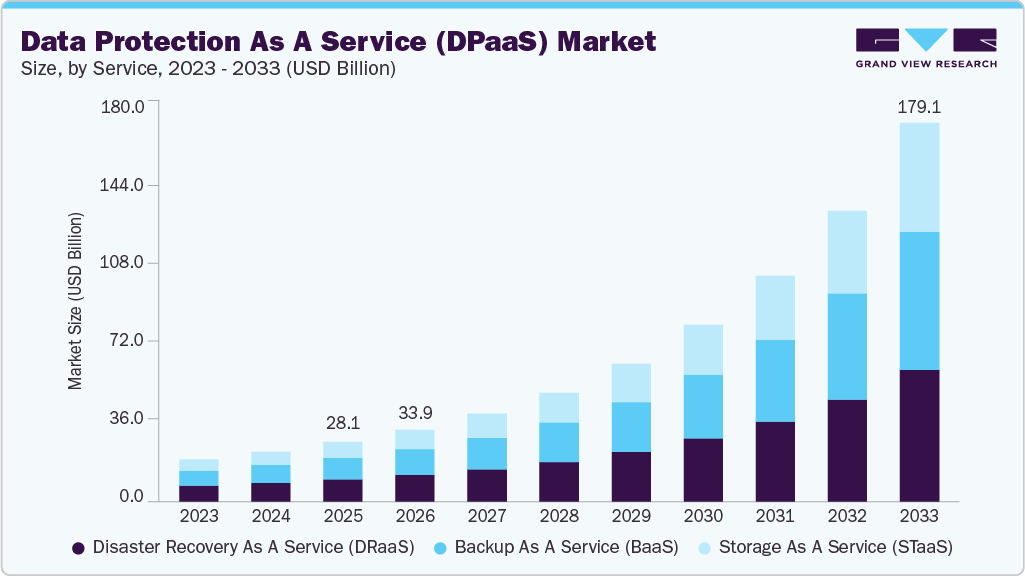
The global data protection as a service market size was valued at USD 28.1 billion in 2025 and is projected to grow from USD 33.9 billion in 2026 to USD 179.1 billion by 2033, at a CAGR of 26.8% from 2026 to 2033. North America held the largest revenue share of 38.4% of the global market in 2025. due to the increasing volume of data generated across enterprises and the rising incidence of cyber threats such as ransomware, phishing, and data breaches. As organizations transition to hybrid and multi-cloud environments, the need for scalable, cloud-based backup, recovery, and storage solutions has become critical to ensure business continuity and compliance with evolving data privacy regulations like GDPR and CCPA.
 Source: Grand View Research, IR Documents, Primary Interviews, Paid DatabasesTo learn more about this report,
 Download Free Sample Report
 Key Market Trends & Insights
- By service: Disaster recovery as a service (DRaaS) segment held the largest market share of 37.6% in 2025.
- By deployment: Private cloud segment held the largest market share in 2025.
- By end use: The BFSI segment held the largest market share in 2025.
Regional Highlights
- Largest regional market: North America (38.4% market share, 2025)
- By country: The U.S. data protection as a service industry held the largest market share in 2025.
Market Size & Forecast
- Market size in 2025: USD 28.1 Billion
- Estimated market size in 2026: USD 33.9 Billion
- Projected market size by 2033: USD 179.1 Billion
- CAGR (2026-2033): 26.8%
Three ways to get this report
Buy it, customize it, or ask a question.Ask an Analyst
Analyst response in 1 business day
- AccessReport author, directly
- Reply timeWithin 1 working day
- No sales callDirect answer only
- FormatEmail reply
- CostFree, no cost
Get the Full Report
What the study covers
- FormatsPDF · Excel · Dashboard
- Timeline2026–2033 annual, 2025 base
- Coverage20+ countries, 5 regions
- Companies10+ key players profiled
Customize the Report
20% free customization
- IncludeCountries, segments, points
- TailorTo your product definition
- ExtendDeeper competitor detail
- OrA fully bespoke study
- Turnaround5–10 working days
Modern cyberattacks have shifted from merely stealing data to holding it hostage through encryption. This malicious evolution has rendered traditional, infrequent backup methods obsolete. Organizations now recognize that data is a critical asset whose integrity and availability are paramount to business continuity. DPaaS solutions directly address this by offering robust, automated, and immutable backups that cannot be altered or deleted by attackers. Moreover, leading DPaaS providers integrate advanced security features like AI-driven anomaly detection to identify suspicious activity before a full-scale attack occurs, and streamlined disaster recovery orchestration that allows businesses to restore operations from a clean copy of their data in minutes or hours, rather than days. This transition from a reactive to a proactive and resilient data protection posture is a powerful driver compelling enterprises to adopt cloud-based data protection services.
 To learn more about this report, Download Free Sample Report
 The increasingly stringent global regulatory landscape for data privacy and compliance is a significant compliance-driven growth factor. Regulations such as the General Data Protection Regulation (GDPR) in Europe, the California Consumer Privacy Act (CCPA), and various industry-specific mandates such as HIPAA for healthcare and PCI-DSS for payment data, impose strict requirements on how data is stored, processed, and protected. Non-compliance can result in devastating financial penalties and reputational damage.
In the second quarter of 2025, global regulators significantly intensified privacy and data protection enforcement, collectively issuing fines exceeding €800 million. Authorities across various regions introduced landmark rulings and enforcement actions that are set to redefine corporate compliance practices. The Q2 2025 Privacy & Data Protection Regulatory Enforcement Report provides an in-depth analysis of these key developments, highlighting major penalties, evolving regulatory trends, and the strategic impacts organizations must consider to strengthen their data protection frameworks moving forward.
Market Dynamics
Organizations are adopting data protection as a service solution as cyberattacks, ransomware incidents, and data loss risks continue to grow across industries. Businesses now require secure backup systems that not only store data safely but also provide faster recovery, continuous monitoring, and protection against unauthorized changes. Features such as immutable backup storage, threat detection, and simplified recovery management are becoming essential for companies looking to reduce downtime and maintain business continuity. In addition, enterprises prefer cloud-based, service-driven data protection models to improve scalability, reduce infrastructure complexity, and strengthen overall security operations.
For instance, in May 2024, Catalogic Software launched an upgraded version of Catalogic DPX with enhanced immutable backup storage, snapshot exploration, advanced threat detection, and faster file recovery capabilities for the data protection as a service market. The solution helps organizations improve ransomware resilience, simplify recovery workflows, and strengthen backup security across existing IT environments. Such developments highlight how vendors are focusing on advanced cyber resilience and recovery capabilities, which are expected to drive the growth of the Data Protection as a Service market.
One of the major restraints in the data protection as a service market is concern about data security, regulatory compliance, and reliance on third-party service providers. Many organizations, especially those operating in the banking, healthcare, and government sectors, are hesitant to store sensitive business data on external cloud platforms due to risks of data breaches, unauthorized access, and compliance violations. In addition, businesses may face operational challenges due to service outages, limited visibility into backup processes, or reliance on a single vendor for long-term data management. These concerns can slow down the adoption of DPaaS solutions, particularly among enterprises with strict data governance requirements.
To address these concerns, DPaaS providers are increasingly focusing on stronger encryption technologies, multi-factor authentication, immutable backups, and compliance-based security frameworks to improve customer trust. Vendors are also offering hybrid deployment models, transparent monitoring tools, and flexible recovery options to give organizations better control over their data protection environment. As companies continue to invest in advanced cybersecurity and compliance capabilities, the market is expected to gradually address these concerns and support wider adoption of data protection-as-a-service solutions across industries.
The increasing adoption of artificial intelligence and cloud technologies is creating significant growth opportunities for the data protection-as-a-service market. Businesses are looking for smarter data protection solutions that can automatically identify cyber threats, reduce recovery time, improve backup efficiency, and support compliance requirements. AI-powered monitoring and automated recovery capabilities help organizations minimize operational disruptions and improve business continuity during cyberattacks or system failures. In addition, the growing shift toward hybrid and multi-cloud environments is increasing demand for advanced cloud-based data resilience and recovery services across enterprises.
For instance, in February 2025, Microsoft expanded its partnership with Veeam Software to strengthen AI-powered data resilience solutions for the DPaaS market. The collaboration enhances threat detection, backup security, automated recovery, and compliance management capabilities, helping organizations protect critical business data and improve cloud recovery operations. Such strategic partnerships are expected to create new growth opportunities for the Data Protection as a Service market by encouraging the adoption of intelligent, automated, and secure data protection solutions.
Market Concentration & Characteristics
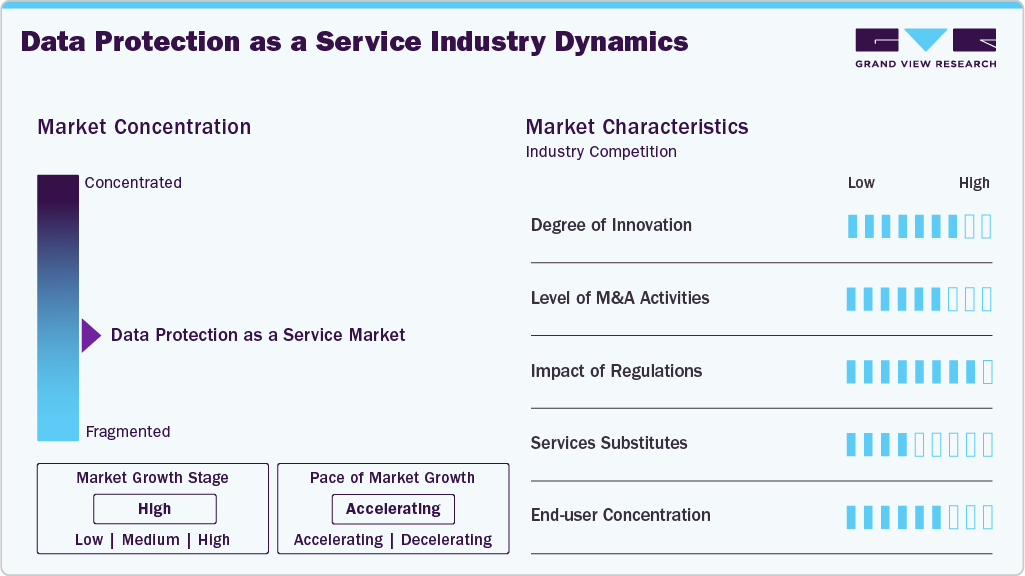
The data protection as a service market is moderately fragmented, with several global technology companies, cloud service providers, and specialized cybersecurity vendors competing across regions. The market is witnessing strong growth driven by rising demand for ransomware protection, cloud backup solutions, regulatory compliance, and disaster recovery services. Increasing digital transformation activities, hybrid cloud adoption, and growing cyber threats are accelerating market demand across industries such as BFSI, healthcare, government, retail, and IT & telecom. In addition, continuous investments in AI-powered backup management, automated recovery, and secure cloud storage solutions are accelerating global market growth.
 To learn more about this report, Download Free Sample Report
 In terms of market characteristics, the DPaaS market is highly innovative, with vendors continually introducing advanced technologies such as AI-based threat detection, immutable storage, and automated recovery solutions to strengthen cyber resilience. The number of mergers, acquisitions, and strategic partnerships is also increasing as companies aim to expand their cloud security capabilities and strengthen their market presence. Regulatory impact remains high because organizations must comply with strict data privacy and security regulations across different countries and industries. The threat from service substitutes is relatively low, as businesses are gradually shifting away from traditional backup systems toward managed cloud-based protection services. Additionally, the end-user base is well diversified across multiple industries, supporting stable, long-term market expansion.
Service Insights
The disaster recovery as a service (DRaaS) segment dominated the market and accounted for a revenue share of 37.6% in 2025, driven by the critical need for robust business continuity in an era of escalating cyber threats, particularly ransomware. Traditional disaster recovery (DR) plans, often reliant on physical hardware in a secondary data center, are notoriously complex, expensive, and slow to execute. In the face of a ransomware attack that can encrypt an entire network, the speed of recovery is paramount to survival. DRaaS directly addresses this vulnerability by offering a cloud-based recovery site that is on standby. Modern DRaaS solutions provide automated failover and failback processes, allowing businesses to redirect users to replicated workloads in the cloud within minutes or hours, rather than the days or weeks typical of traditional DR.
The storage as a service (STaaS) segment is anticipated to grow at the fastest CAGR during the forecast period due to the strategic shift from capital-intensive storage procurement to a flexible, operational expenditure model. Traditional storage infrastructure requires significant upfront capital expenditure (CapEx) for hardware, leading to challenges in capacity forecasting, frequent over-provisioning, and rigid refresh cycles. STaaS disrupts this model by offering a subscription-based, pay-as-you-go model. This provides organizations with predictable operating expenses (OpEx), direct cost alignment with actual storage consumption, and the ability to elastically scale capacity on-demand.
Deployment Insights
The private cloud segment dominated the market and accounted for the largest revenue share in 2025. The demand for predictable performance and granular control over IT resources continues to fuel private cloud deployment. Organizations with latency-sensitive applications or large, steady-state workloads often find that a private cloud offers more consistent performance without the potential variability associated with shared public cloud resources. Moreover, the private cloud model provides unparalleled administrative control, allowing IT teams to customize hardware, software, and management protocols to meet precise operational needs.
The public cloud segment is expected to grow at a significant CAGR during the forecast period. Small and medium-sized businesses (SMBs) historically lacked the capital and expertise to implement and manage sophisticated disaster recovery (DR) and data backup solutions comparable to those of large enterprises. Public Cloud DPaaS has fundamentally leveled the playing field. SMBs can now access the same underlying, globally resilient infrastructure and advanced software capabilities as large corporations, but through a simple, subscription-based portal.
Enterprise Size Insights
The large enterprises segment dominated the market and accounted for the largest revenue share in 2025. Traditional data protection infrastructure requires heavy capital expenditure and maintenance resources. DPaaS enables large enterprises to transition to an operational expenditure (OPEX) model with predictable subscription costs. This shift reduces hardware dependency, simplifies scalability, and allows IT teams to focus on strategic initiatives instead of backup administration.
The small and medium-sized enterprises (SMEs) segment is expected to grow at a significant CAGR during the forecast period. SMEs often lack redundant infrastructure for disaster recovery. DPaaS provides cloud-based replication, quick restore options, and reliable data continuity, enabling SMEs to maintain operations during disruptions without significant capital investment. SMEs in regulated sectors must comply with data protection and privacy regulations. DPaaS simplifies compliance by offering automated policy enforcement, audit trails, and secure storage that meets regulatory standards.
End Use Insights
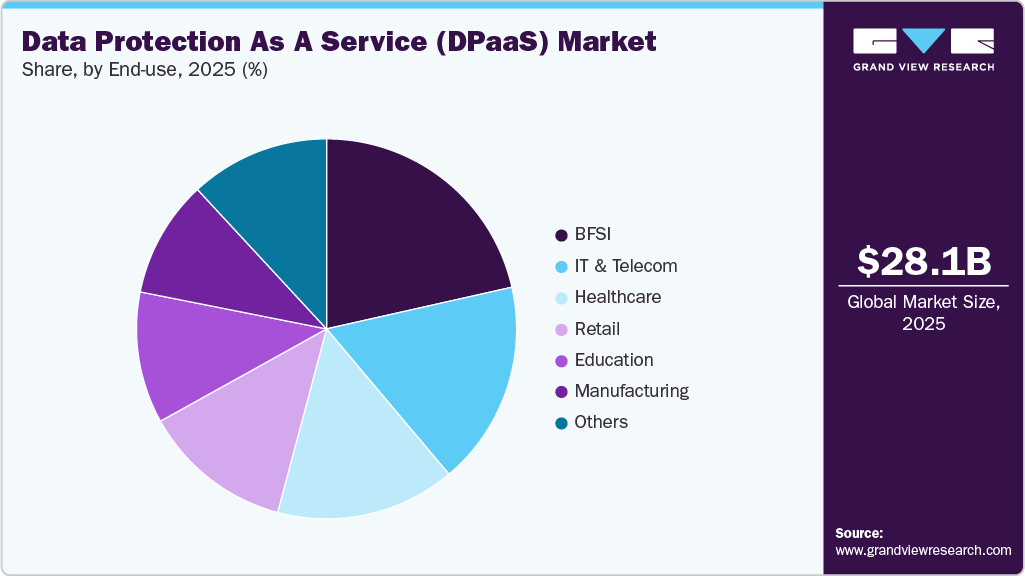
The BFSI segment dominated the market and accounted for the largest revenue share in 2025. BFSI firms generate enormous volumes of transactional, customer, and market data daily. DPaaS enables efficient backup, deduplication, and long-term retention at scale, allowing institutions to manage and protect large datasets without expanding on-premises infrastructure. Moreover, with the rise of digital banking, online insurance platforms, and fintech services, BFSI organizations are migrating workloads to cloud environments. DPaaS provides seamless protection across hybrid and multi-cloud deployments, safeguarding mission-critical applications and customer data in real time.
 To learn more about this report, Download Free Sample Report
 The manufacturing segment is expected to grow at a significant CAGR over the forecast period. Manufacturing firms rely heavily on production data, supply chain information, and industrial control systems. DPaaS ensures that this operational data is securely backed up and recoverable in case of system failures, cyberattacks, or human errors, minimizing downtime and production losses. Moreover, with the adoption of smart factories, connected machines, and IoT-enabled sensors, manufacturing data volumes are increasing exponentially. DPaaS provides scalable, automated backup and recovery for these diverse and high-volume datasets, ensuring continuous protection across the digital manufacturing ecosystem.
Regional Insights
North America Data Protection as a Service Industry Trends
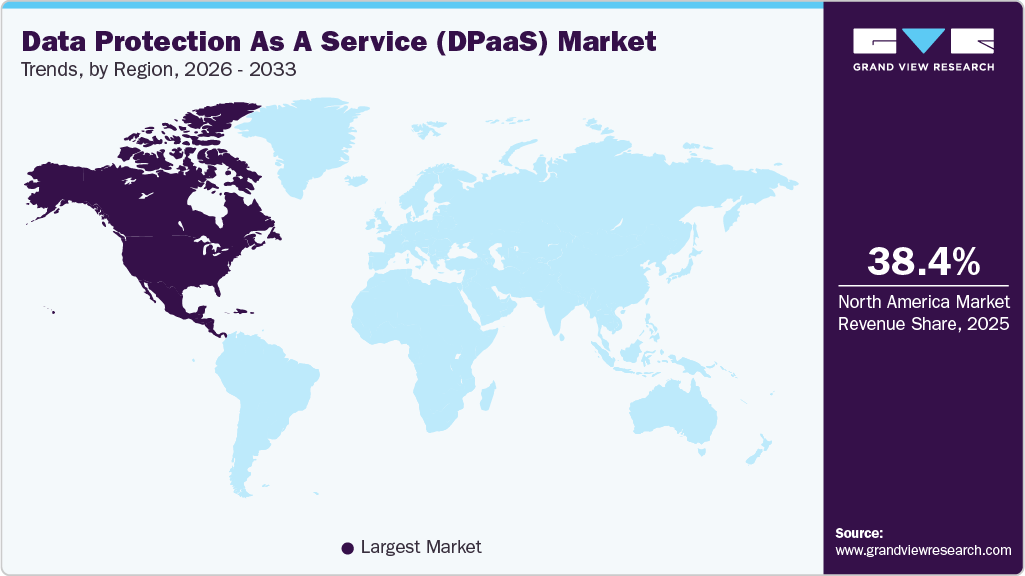
North Americadata protection as a service industry dominated the global market with the largest revenue share of 38.4% in 2025, driven by stringent cybersecurity standards across industries, with enterprises increasingly adopting cloud-native solutions to meet federal guidelines such as the Cybersecurity Maturity Model Certification (CMMC) and NIST frameworks. This regulatory pressure, combined with a high rate of digital transformation initiatives, propels demand for advanced, automated, and compliant data protection services.
 To learn more about this report, Download Free Sample Report
 U.S. Data Protection as a Service Market Trends
The data protection as a service industry in the U.S. is expected to grow significantly at a CAGR of 25.6% from 2026 to 2033, due to large-scale adoption of multi-cloud architectures and SaaS platforms across enterprises. Organizations seek centralized backup and recovery solutions to ensure seamless data protection across hybrid IT environments while maintaining compliance with sector-specific regulations such as HIPAA and GLBA.
Europe Data Protection as a Market Trends
The data protection as a service industry in Europe is anticipated to register considerable growth from 2026 to 2033 due to strong emphasis on data privacy and GDPR enforcement. Companies are investing in cloud-based backup and recovery services that offer robust data governance, cross-border compliance, and encrypted storage to adhere to strict European privacy standards.
The UK data protection as a service industry is expected to grow rapidly in the coming years, owing to financial services and insurance sectors, which require high levels of resilience and disaster recovery capabilities. DPaaS adoption is rising as banks and insurers seek to protect mission-critical data while reducing capital-intensive backup infrastructure.
The Germany data protection as a service industry held a substantial market share in 2025 due to the industrial and manufacturing sectors’ shift toward Industry 4.0. Enterprises are increasingly adopting automated backup and recovery solutions to safeguard operational technology (OT) and production data while ensuring business continuity across digitalized factories.
Asia Pacific Data Protection as a Service Market Trends
Asia Pacific data protection as a service industry held a significant share in the global market in 2025, due to rapid digital adoption among SMEs and large enterprises is a key growth driver. The region’s expanding e-commerce, fintech, and telecommunication sectors are increasingly leveraging DPaaS to secure cloud workloads and distributed data across multiple countries with varying compliance requirements.
The Japan data protection as a service industry is expected to grow rapidly in the coming years, driven by enterprises modernizing legacy IT systems and integrating hybrid cloud architectures. Businesses seek reliable, managed data protection services to reduce operational complexity while supporting advanced analytics and AI-driven workloads in mission-critical environments.
The China data protection as a service industry held a substantial market share in 2025, due to the strict local data sovereignty laws and the increasing volume of data generated by government, fintech, and technology sectors. Organizations are adopting localized, compliant cloud-based backup solutions to ensure secure storage, cross-region replication, and adherence to cybersecurity mandates.
Key Data Protection As A Service Company Insights
Key players operating in the data protection as a service industry are Amazon Web Services, Inc., Microsoft, IBM Corporation, Dell Inc., and Broadcom.The companies are focusing on various strategic initiatives, including new product development, partnerships & collaborations, and agreements to gain a competitive advantage over their rivals. The following are some instances of such initiatives.
-
In August 2025, Microsoft unveiled Windows Backup for Organizations, a new cloud-based enterprise backup solution designed to streamline device migration and safeguard system settings and user preferences. The service provides encrypted, regionally stored backups and supports Windows 10 and Windows 11 devices connected through Microsoft Entra. This launch underscores Microsoft’s commitment to enhancing data protection and business continuity across enterprise environments through secure and scalable cloud infrastructure.
-
In February 2025, IBM Corporation released updates for its Guardium Database Protection Service (DPS), introducing versions 11.x and 12.x with expanded capabilities. The new releases feature enhanced vulnerability assessments, updated security policies, and improved reporting tools designed to strengthen customers’ database protection and compliance management. These upgrades help organizations maintain a robust security posture across hybrid and cloud environments.
-
In April 2024, Dell Inc. expanded its data protection portfolio with the introduction of new PowerProtect Data Domain appliances delivering enhanced performance and security, alongside the launch of Dell APEX Backup Services AI. The AI-driven solution is designed to boost operational efficiency and productivity while providing comprehensive protection and recovery across hybrid, multi-cloud, and SaaS environments. This expansion reinforces Dell’s focus on delivering intelligent, scalable data protection for modern enterprise workloads.
Key Data Protection As A Service Companies:
The following are the leading companies in the data protection as a service (DPaaS) market. These companies collectively hold the largest market share and dictate industry trends.
- Amazon Web Services, Inc.
- Asigra Inc.
- Broadcom
- Cisco Systems, Inc.
- Commvault
- Cyfuture
- Dell Inc.
- Hewlett Packard Enterprise Development LP
- Huawei
- IBM Corporation
- Microsoft
- Oracle
- Quantum Corporation
- Quest Software Inc.
- Veritas Technologies LLC
Competitive Benchmarking
Operating Strategies
Competitive Edge
Weaknesses
Mature Players: Amazon Web Services, Inc.; Microsoft; IBM Corporation; Dell Inc.; Oracle; Cisco Systems, Inc.; Hewlett Packard Enterprise Development LP; Broadcom
- Focus on expanding cloud-native backup, disaster recovery, and multi-cloud data protection capabilities.
- Strengthen market position through partnerships, acquisitions, and AI-powered cybersecurity integration.
- Strong global infrastructure, large enterprise customer base, and high investment capability.
- Ability to provide end-to-end cloud, security, storage, and compliance solutions through integrated ecosystems.
- Complex pricing structures and higher implementation costs for small and medium enterprises.
- Slower innovation flexibility due to large-scale operations and legacy system integration challenges.
Emerging Players: Commvault; Asigra Inc.; Quest Software Inc.; Quantum Corporation; Veritas Technologies LLC; Cyfuture
- Focus on ransomware protection, immutable backup storage, and AI-driven recovery solutions.
- Expand hybrid cloud and industry-specific data protection offerings for mid-sized enterprises.
- Faster innovation cycles and specialized expertise in backup recovery and cyber resilience solutions.
- More flexible deployment models and customized services for specific industry requirements.
- Limited global infrastructure and lower brand visibility compared to large technology companies.
- Higher dependency on partnerships and channel networks for international expansion.
Data Protection as a Service (DPaaS) Market Report Scope
Report Attribute
Details
Market size value in 2025
USD 28.1 billion
Estimated Market size in 2026
USD 33.9 billion
Projected Market size by 2033
USD 179.1 billion
Growth Rate
CAGR of 26.8% from 2026 to 2033
Actual data
2021 - 2025
Forecast period
2026 - 2033
Quantitative units
Revenue in USD billion and CAGR from 2026 to 2033
Report coverage
Revenue forecast, company share, competitive landscape, growth factors, and trends
Segments covered
Service, deployment, enterprise size, end use, region
Regional scope
North America; Europe; Asia Pacific; Latin America; MEA
Country scope
U.S.; Canada; Mexico; UK; Germany; France; China; India; Japan; Australia; South Korea; Brazil; UAE; Kingdom of Saudi Arabia; South Africa
Key companies profiled
Amazon Web Services, Inc.; Asigra Inc.; Broadcom; Cisco Systems, Inc.; Commvault; Cyfuture; Dell Inc.; Hewlett Packard Enterprise Development LP; Huawei; IBM Corporation; Microsoft; Oracle; Quantum Corporation; Quest Software Inc.; Veritas Technologies LLC
Customization scope
Free report customization (equivalent to 8 analysts working days) with purchase. Addition or alteration to country, regional & segment scope.
Pricing and purchase options
Avail customized purchase options to meet your exact research needs. Explore purchase options
Global Data Protection as a Service (DPaaS) Market Report Segmentation
This report forecasts revenue growth at the global, regional, and country levels and provides an analysis of the latest industry trends in each of the sub-segments from 2021 to 2033. For this study, Grand View Research has segmented the global data protection as a service (DPaaS)market report based on service, deployment, enterprise size, end use, and region.
-
Service Outlook (Revenue, USD Billion, 2021 - 2033)
-
Disaster Recovery as a Service (DRaaS)
-
Backup as a Service (BaaS)
-
Storage as a Service (STaaS)
-
-
Deployment Outlook (Revenue, USD Billion, 2021 - 2033)
-
Public Cloud
-
Private Cloud
-
Hybrid Cloud
-
-
Enterprise Size Outlook (Revenue, USD Billion, 2021 - 2033)
-
Small and Medium-sized Enterprises (SMEs)
-
Large Enterprises
-
-
End Use Outlook (Revenue, USD Billion, 2021 - 2033)
-
BFSI
-
Healthcare
-
IT and Telecom
-
Retail
-
Education
-
Manufacturing
-
Others
-
-
Regional Outlook (Revenue, USD Billion, 2021 - 2033)
-
North America
-
U.S.
-
Canada
-
Mexico
-
-
Europe
-
UK
-
Germany
-
France
-
-
Asia Pacific
-
China
-
India
-
Japan
-
South Korea
-
Australia
-
-
Latin America
-
Brazil
-
-
Middle East & Africa
-
UAE
-
Saudi Arabia
-
South Africa
-
-
Delivered Customizations
This report has been delivered with the following In-depth customizations
Client Request
Customization Delivered
Value Adds
U.S. and Canada-specific analysis for the Data Protection as a Service market with regulatory impact assessment.
- Added detailed market sizing and forecast analysis for the U.S. and Canada.
- Included country-level evaluation of ransomware trends, cloud adoption rates, and data privacy regulations such as CCPA and PIPEDA.
- Helped the client identify high-growth industries and regional investment opportunities.
- Supported strategic expansion planning for North American cloud data protection services.
- Improved understanding of compliance-driven demand across both countries.
Inclusion of additional key players and competitive benchmarking for the Asia Pacific Data Protection as a Service market.
- Added profiling of regional and global vendors, including cloud-native backup providers and cybersecurity companies.
- Included comparative analysis based on service portfolio, strategic initiatives such as partnerships, collaboration, product launch, and others.
- Enabled the client to benchmark competitors and identify partnership opportunities.
- Helped in understanding regional competitive intensity
Europe-specific data protection as a service market analysis
- Included detailed profiles of regional players operating in Europe.
- Provided country-level insights across manufacturing, the BFSI sector, and others.
- Assisted the client in identifying local acquisition and collaboration opportunities.
- Improved visibility into the country-specific market scenario.
- Supported development of region-focused business and expansion strategies across Europe.
Frequently Asked Questions About This Report
North America dominated with a 38.4% market share in 2025.
The disaster recovery as a service (DRaaS) segment led the market with 37.6% share in 2025, while the storage as a service (STaaS) segment is expected to grow at the fastest CAGR over the forecast period.
The global DPaaS market size was estimated at USD 28.1 billion in 2025 and is expected to reach USD 33.9 billion in 2026.
The private cloud segment dominated the market and accounted for the largest revenue share of 57.5% in 2025. The demand for predictable performance and granular control over IT resources continues to fuel private cloud deployment. Organizations with latency-sensitive applications or large, steady-state workloads often find that a private cloud offers more consistent performance without the potential variability associated with shared public cloud resources. Moreover, the private cloud model provides unparalleled administrative control, allowing IT teams to customize hardware, software, and management protocols to meet precise operational needs.
Key players operating in the data protection as a service industry are Amazon Web Services, Inc., Microsoft, IBM Corporation, Dell Inc., and Broadcom.
As organizations transition to hybrid and multi-cloud environments, the need for scalable, cloud-based backup, recovery, and storage solutions has become critical to ensure business continuity and compliance with evolving data privacy regulations like GDPR and CCPA
The global DPaaS market is expected to grow at a compound annual growth rate of 26.8% from 2026 to 2033 to reach USD 179.1 billion by 2033.
About the Author(s)
Next Generation Technologies Research Team
Technology · Next Generation TechnologiesThis report was authored by the next generation technologies research team at Grand View Research - comprising two research analysts, one senior research analyst, and one industry expert - with specialized expertise in the next generation technologies segment of the technology industry. All findings are based on proprietary technology databases, executive interviews, and regulatory analysis, subject to internal peer review prior to publication.
Last Updated:
Speak to Analyst

Customize this report to your needs - add regions, segments, or data points, with 20% free customization.
Or view our licence options:


ISO 9001:2015 & 27001:2022 Certified
We are GDPR and CCPA compliant! Your transaction & personal information is safe and secure. For more details, please read our privacy policy.


