
- Home
- »
- Next Generation Technologies
- »
-
Data Visualization Tools Market Size & Share Report, 2026-2033GVR Report cover

Data Visualization Tools Market (2026 - 2033)
Size, Share & Trends Analysis Report By Component (Software, Service), By Application (Human Resources, Operations, Finance), By Organization Size, By Deployment, By End Use, By Region, And Segment Forecasts
Market Size, 2025
$11.8BMarket Estimate, 2026
$13.5BMarket Forecast, 2033
$34.8BCAGR, 2026–2033
14.5%Data Visualization Tools Market Summary
The global data visualization tools market size was valued at USD 11.8 billion in 2025 and is projected to grow from USD 13.5 billion in 2026 to USD 34.8 billion in 2033, at a CAGR of 14.5% from 2026 to 2033. North America dominated the market in 2025, accounting for over 40.0% of global revenue. Data visualization tools are essential for businesses and organizations to interpret, analyze, and communicate data insights, allowing Users to create graphs, charts, and other visual representations of data, making it easier to identify trends, patterns, and relationships.
Key Market Trends & Insights
- By component: The software segment accounted for the largest revenue share of over 60.0% in 2025.
- By organization size: The large enterprises segment held the largest market share of approximately 70.0% in 2025.
Regional Highlights
- Largest regional market: North America (40.0% revenue share, 2025)
- Fastest-growing regional market: Asia Pacific (highest CAGR, 2026-2033)
Market Size & Forecast
- Market size in 2025: USD 11.8 Billion
- Estimated market size in 2026: USD 13.5 Billion
- Projected market size by 2033: USD 34.8 Billion
- CAGR (2026-2033): 14.5%
Three ways to get this report
Buy it, customize it, or ask a question.Ask an Analyst
Analyst response in 1 business day
- AccessReport author, directly
- Reply timeWithin 1 working day
- No sales callDirect answer only
- FormatEmail reply
- CostFree, no cost
Get the Full Report
What the study covers
- FormatsPDF · Excel · Dashboard
- Timeline2026–2033 annual, 2025 base
- Coverage20+ countries, 5 regions
- Companies10+ key players profiled
Customize the Report
20% free customization
- IncludeCountries, segments, points
- TailorTo your product definition
- ExtendDeeper competitor detail
- OrA fully bespoke study
- Turnaround5–10 working days
Several key factors drive the data visualization tools market, such as the increasing volume and complexity of data being generated and collected by organizations. With vast data available, organizations can analyze and transcribe it with data visualization tools, enabling them to easily create charts, graphs, and other visual representations of their data, making it easier to identify patterns and insights.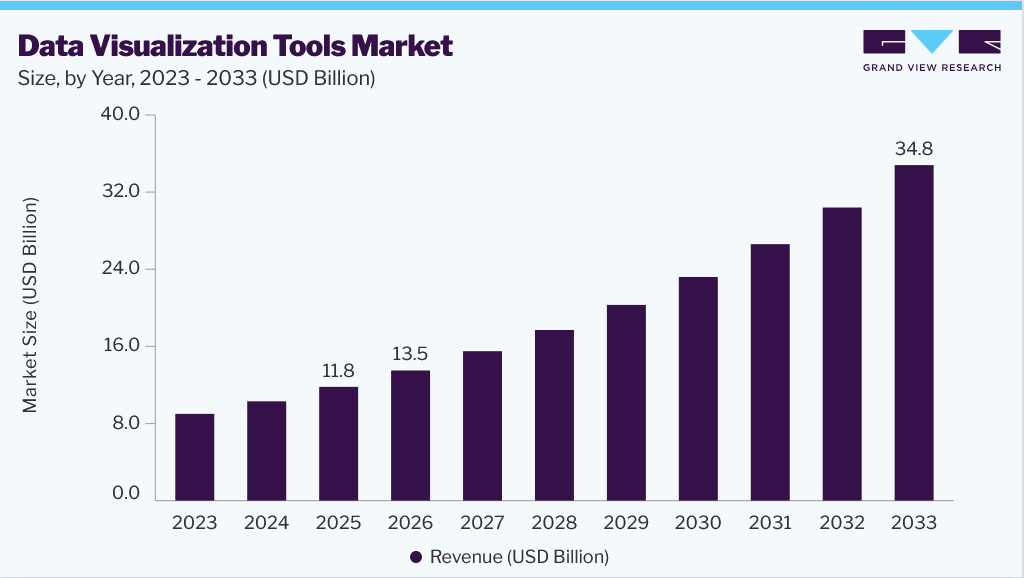 Source: Grand View Research, IR Documents, Primary Interviews, Paid DatabasesTo learn more about this report,
 Download Free Sample Report
 Another factor driving the growth of the data visualization tools market is the need for real-time data analysis. Visualization tools enable users to quickly analyze and understand data, allowing them to make informed decisions in real time. Visual Analytics tools enable users to effectively analyze and understand complex data sets, allowing them to identify patterns, trends, relationships, and opportunities within their data and explore detailed data with simple drill-down and drill-through capabilities. With visual analytics tools, users can analyze structured and unstructured data. These tools often provide users with interactive dashboards and visualizations, such as charts, graphs, and maps that help to bring the data to life and make it easier to understand.
Cloud-based solutions have been a catalyst for the growth of the data visualization tools market due to their ability to offer flexibility and scalability to organizations. With cloud-based data visualization tools, users can access and analyze data from anywhere with an internet connection. It is essential for organizations with remote or distributed workforces, as it enables users to collaborate and work together on data analysis, regardless of their location. With cloud-based data visualization tools, organizations can pay for only the resources they need rather than invest in expensive hardware and software licenses, which makes cloud-based solutions more accessible to smaller organizations or those with limited budgets.
The COVID-19 pandemic has significantly impacted many industries, including the data visualization tools market. One of the most significant impacts has been the increased demand for data visualization tools, as organizations have had to adapt to remote work and quickly change business conditions. The pandemic has also highlighted the importance of real-time data analysis, particularly in industries such as healthcare and supply chain management. With many businesses facing disruptions to their supply chains, shifts in consumer behavior, and other challenges, data visualization tools have been essential in helping organizations understand and adapt to these changes.
Market Dynamics
The growing need for real-time data analysis is a key market driver. Organizations across industries are generating large volumes of structured and unstructured data and require advanced visualization solutions to transform complex datasets into actionable insights. Data visualization tools enable users to identify patterns, trends, relationships, and business opportunities through interactive dashboards, charts, graphs, and drill-down analytics. These solutions enable faster, more informed decision-making by providing real-time visibility into business operations. For instance, in March 2025, Tableau introduced enhanced AI-powered analytics and visualization capabilities designed to help organizations accelerate data exploration, improve insight generation, and support real-time decision-making across enterprise environments. Such innovations are expected to support the continued market growth.
The increasing volume and complexity of enterprise data remain a key challenge restraining market growth. Organizations manage vast amounts of structured and unstructured data generated from multiple sources, making it difficult to ensure data consistency, quality, and usability. While visualization tools help simplify data interpretation, organizations often face challenges related to data preparation, integration, and governance before meaningful visual insights can be generated. In addition, analyzing highly complex datasets may require specialized expertise and advanced analytics capabilities. These challenges can increase implementation complexity and operational costs, limiting the adoption of data visualization tools among organizations with limited technical resources and data management capabilities.
The increasing adoption of cloud-based data visualization solutions is creating significant market opportunities. Cloud-based platforms provide organizations with greater scalability, flexibility, and accessibility, enabling users to access and analyze data from any location with an internet connection. These solutions also support collaboration among distributed teams while reducing the need for significant investments in on-premises infrastructure and software licenses. For instance, in April 2025, Microsoft continued expanding Power BI's cloud capabilities with new AI-driven analytics, enhanced visualization features, and improved collaborative reporting. Such advancements are enabling organizations to derive greater value from enterprise data and are expected to create substantial growth market opportunities.
Component Insights
The software segment accounted for the highest revenue share of over 60.0% in 2025 and is anticipated to maintain the largest share throughout the forecast period. Startup companies in the market are constantly introducing new products and innovative solutions to meet the evolving needs of organizations. These new products often leverage the latest technological advancements to give Uses more powerful and intuitive data analysis capabilities. For instance, Flourish is a data visualization tool that enables users to import and analyze data in various formats. While the tool is suitable for personal use cases, such as visualizing health data from any Android smartwatch, it also offers enterprise-level capabilities to handle larger datasets for organizations. With Flourish, Uses have the flexibility to manage and present complex data in a clear, understandable format, regardless of dataset size or intended audience.
The services segment is estimated to expand at the fastest CAGR over the forecast period. Many data visualization tool providers offer integration services to help businesses merge data from different sources into a single platform. It allows a comprehensive data view and enables better analysis. In addition, companies can build customized dashboards tailored to specific business requirements, enabling better data visualization and analysis. Market players often provide training and support services to help businesses use their software effectively and get the most out of the platform.
Organization Size Insights
The large enterprises segment led the market in 2025, accounting for approximately 70.0% of global revenue. Data visualization tools allow large enterprises to manage and analyze vast amounts of data to make better-informed decisions. In addition to helping enterprises identify insights, data visualization tools allow them to communicate findings and trends more effectively. Visual representations of data are easier to understand and interpret, enabling teams to collaborate, share information, and make informed decisions.
The SMEs segment is estimated to grow significantly over the forecast period. SMEs face unique challenges when managing and analyzing their business data. These tools can help SMEs analyze customer behavior across various touchpoints, such as social media, email campaigns, and website visits. By visualizing this data, SMEs can identify customer preferences and tailor their marketing messages, leading to more effective campaigns and increased sales. These tools can help SMEs optimize operations and drive growth by providing a clear, intuitive way to analyze and understand data.
Deployment Insights
The on-premises segment held the highest market share in 2025, accounting for around 60.0% of global revenue. One of the primary needs for on-premises data visualization tools is data security and privacy. Some organizations, particularly those in heavily regulated industries such as finance and healthcare, must keep their data on-premises due to compliance and security concerns. Preserving data on their infrastructure gives these organizations greater control over their data and better ensures its protection. In addition, the need for mobile access drives the development of on-premises solutions that support remote and mobile access.
The cloud segment is estimated to grow steadily over the forecast period. One of the biggest trends in cloud-based data visualization tools is the use of artificial intelligence (AI) and machine learning (ML) algorithms. Another trend is integrating data visualization tools with other cloud-based services, such as data warehousing and business intelligence platforms. With AI-powered analytics, seamless integrations, scalability, and robust security, cloud-based data visualization tools are becoming increasingly important for organizations seeking to gain insights and make data-driven decisions.
End Use Insights
The IT and telecommunications segment alone accounted for the largest revenue share, over 20.0%, in 2025. Data visualization tools enable IT and telecom companies to analyze and interpret vast amounts of data, including network performance, customer behavior, and financial data. Predictive analytics is a trend in the IT and telecommunications industry. Predictive analytics can help companies forecast future trends and identify potential problems before they occur. Data visualization tools that support predictive analytics can provide companies with insights that can help them stay ahead of the competition.
The healthcare and life sciences segment is anticipated to witness a notable CAGR over the forecast period. There is a need for data visualization tools in the healthcare & life sciences industry to support decision-making. Healthcare companies need to make informed decisions based on their data, and data visualization tools can help by providing a clear, easy-to-understand view. Solutions can help companies make better decisions and improve their performance and patient treatment. Further, the need for data security and privacy is becoming increasingly important in the healthcare industry. Healthcare companies handle sensitive customer data, and data visualization tools must support the highest levels of security and privacy, including features that protect billing information, patient details, and other sensitive data.
Application Insights
The marketing and sales segment led the market in 2025, accounting for around 35.0% of global revenue. Marketing departments use data visualization tools to identify patterns and trends in consumer behavior, allowing marketers to make more informed decisions about their campaigns. Marketers can create targeted campaigns that resonate with their audience and drive higher engagement and conversions by analyzing customer demographics, behavior, and preferences. Similarly, sales data visualization tools can be used to analyze customer data and identify critical trends and patterns. By visualizing sales data, teams can quickly identify opportunities and focus their efforts on the most profitable market segments.
The Human Resources (HR) segment is estimated to grow significantly over the forecast period. Data visualization tools can help HR professionals to communicate complex data in a way that is easy to understand. It can be beneficial when presenting data to executives or other stakeholders who may need a background in HR or data analysis. In addition, as companies become more data-driven, there is an increasing demand for HR professionals with strong analytical skills. Data visualization tools can bridge the gap between HR and data analytics, allowing HR professionals to analyze and interpret data without requiring specialized technical skills.
Regional Insights
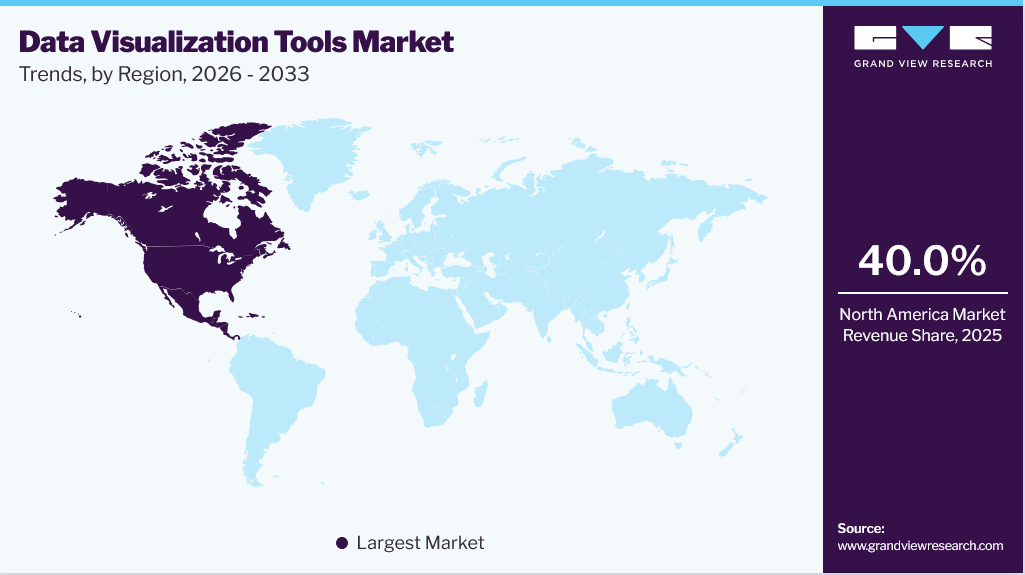
North America dominated the market in 2025, accounting for over 40.0% of global revenue. Businesses and organizations in North America rely heavily on data to make informed decisions, and data visualization tools play a critical role in this process. Some of North America's popular data visualization tools include Tableau, Power BI, D3.js, and Google Data Studio. As data security and privacy concerns continue to grow, there is also an increasing demand for data visualization tools to ensure secure data storage and transfer. Such tools are required to protect sensitive data from cyber threats and ensure compliance with data privacy regulations such as GDPR.
 To learn more about this report, Download Free Sample Report
 Asia Pacific Data Visualization Tools Market Trends
The data visualization tools market in the Asia Pacific is predicted to register the fastest CAGR from 2026 to 2033. With the rise of big data, machine learning, and other advanced technologies, organizations in the Asia Pacific need data visualization tools to help them identify patterns, trends, and anomalies in their data. This need is particularly acute in finance, healthcare, and logistics industries, where timely and accurate decision-making is critical to success. With the rise of online shopping and social media, businesses in the Asia Pacific are using data visualization to gain insights into consumer behavior and preferences and to develop targeted marketing campaigns that drive sales and engagement. This trend is particularly evident in countries such as China and India, where e-commerce is a significant driver of economic growth.
Key Data Visualization Tools Company Insights
Many prominent data visualization tools companies have adopted product launches and developments as their primary business strategy to gain a larger market share. Further strategies have been pursued, including contracts, agreements, partnerships, and collaborations, to drive innovation.
-
In April 2025, Tableau introduced Tableau Next, a new AI-powered analytics platform built on the Salesforce Platform. The launch enhanced data visualization, analytics, and decision-making capabilities through agentic analytics, semantic understanding, and AI-driven insights. The development reflects Tableau’s continued focus on expanding its cloud-based analytics and data visualization portfolio while strengthening integration with Salesforce’s ecosystem. Tableau also stated 70% of new customers choose the fully hosted Tableau Cloud over on-premises or hybrid deployments.
-
In March 2025, Databricks Company announced enhancements to its AI/BI platform, introducing advanced visualization and data exploration capabilities that enable users to analyze, search, and interact with enterprise data through intuitive dashboards and AI-powered analytics. The enhancements were designed to improve data accessibility, accelerate insight generation, and support more effective decision-making across organizations.
Key Data Visualization Tools Companies
The following key companies have been profiled for this study on the data visualization tools market.
-
Salesforce, Inc.
-
Alibaba Cloud
-
Oracle
-
Amazon Web Services, Inc.
-
SAS Institute Inc.
-
Sisense Inc.
-
Microsoft Corporation
-
TIBCO software
-
IBM
-
SAP
Data Visualization Tools Market Report Scope
Report Attribute
Details
Market size in 2025
USD 11.8 billion
Estimated market size in 2026
USD 13.5 billion
Projected market size by 2033
USD 34.8 billion
Growth rate
CAGR of 14.5% from 2026 to 2033
Historical data
2021 - 2025
Forecast period
2026 - 2033
Quantitative units
Revenue in USD billion, and CAGR from 2026 to 2033
Report coverage
Revenue forecast, company ranking, competitive landscape, growth factors, and trends
Segments covered
Component, application, organization size, deployment, end use, and region.
Regional scope
North America; Europe; Asia Pacific; Latin America; MEA
Country scope
U.S.; Canada; UK; Germany; France; China; Japan; India; South Korea; Australia; Brazil; Mexico; Saudi Arabia; UAE; South Africa
Key companies profiled
Salesforce, Inc.; Alibaba Cloud; Oracle; Amazon Web Services, Inc.; SAS Institute Inc.; Sisense Inc.; Microsoft Corporation; TIBCO software; International Business Machines Corp.; SAP
Customization scope
Free report customization (equivalent up to 8 analysts working days) with purchase. Addition or alteration to country, regional & segment scope.
Pricing and purchase options
Avail of customized purchase options to meet your exact research needs. Explore purchase options
Global Data Visualization Tools Market Report Segmentation
This report forecasts revenue growth at global, regional, and country levels and provides an analysis of the latest industry trends in each of the sub-segments from 2021 to 2033. For this study, Grand View Research has segmented the global data visualization tools market report based on component, application, organization size, deployment, end use, and region:
-
Component Outlook (Revenue, USD Billion, 2021 - 2033)
-
Software
-
Standalone
-
Integrated
-
-
Service
-
Consulting Services
-
Support Services
-
-
-
Application Outlook (Revenue, USD Billion, 2021 - 2033)
-
Human Resources
-
Operations
-
Finance
-
Marketing & Sales
-
-
Organization Size Outlook (Revenue, USD Billion, 2021 - 2033)
-
Large Enterprises
-
SMEs
-
-
Deployment Outlook (Revenue, USD Billion, 2021 - 2033)
-
Cloud
-
On-premises
-
-
End Use Outlook (Revenue, USD Billion, 2021 - 2033)
-
BFSI
-
IT and Telecommunication
-
Manufacturing
-
Healthcare & Life Sciences
-
Retail and E-commerce
-
Government
-
Transportation & logistics
-
Others
-
-
Regional Outlook (Revenue, USD Billion, 2021 - 2033)
-
North America
-
U.S.
-
Canada
-
-
Europe
-
UK
-
Germany
-
France
-
-
Asia Pacific
-
China
-
Japan
-
India
-
South Korea
-
Australia
-
-
Latin America
-
Brazil
-
Mexico
-
-
Middle East and Africa (MEA)
-
Saudi Arabia
-
UAE
-
South Africa
-
-
Frequently Asked Questions About This Report
The global data visualization tools market size was valued at USD 11.8 billion in 2025 and is estimated at USD 13.5 billion for 2026.
The global data visualization tools market is expected to grow at a CAGR of 14.5% from 2026 to 2033, reaching USD 34.8 billion by 2033.
North America dominated with a revenue share of 40.0% in 2025.
Key players include Salesforce, Inc.; Alibaba Cloud; Oracle; Amazon Web Services, Inc.; SAS Institute Inc.; Sisense Inc.; Microsoft Corporation; TIBCO software; International Business Machines Corp.; SAP .
software dominated the data visualization tools market with a share of 60.0% in 2025, while services is the fastest-growing segment.
About the Author(s)
Next Generation Technologies Research Team
Technology · Next Generation TechnologiesThis report was authored by the next generation technologies research team at Grand View Research - comprising two research analysts, one senior research analyst, and one industry expert - with specialized expertise in the next generation technologies segment of the technology industry. All findings are based on proprietary technology databases, executive interviews, and regulatory analysis, subject to internal peer review prior to publication.
Last Updated:
Speak to Analyst

Customize this report to your needs - add regions, segments, or data points, with 20% free customization.
Or view our licence options:


ISO 9001:2015 & 27001:2022 Certified
We are GDPR and CCPA compliant! Your transaction & personal information is safe and secure. For more details, please read our privacy policy.


