
- Home
- »
- Consumer F&B
- »
-
Dehydrated Potato Market Size, Share Report, 2026-2033GVR Report cover

Dehydrated Potato Market (2026 - 2033)
Size, Share & Trends Analysis Report By Product (Potato Flakes, Potato Powder, Shredded Potatoes), By Distribution Channel (B2B, B2C), By Region, And Segment Forecasts
Market Size, 2025
$5.6BMarket Estimate, 2026
$6.0BMarket Forecast, 2033
$9.0BCAGR, 2026–2033
6.1%Dehydrated Potato Market Summary
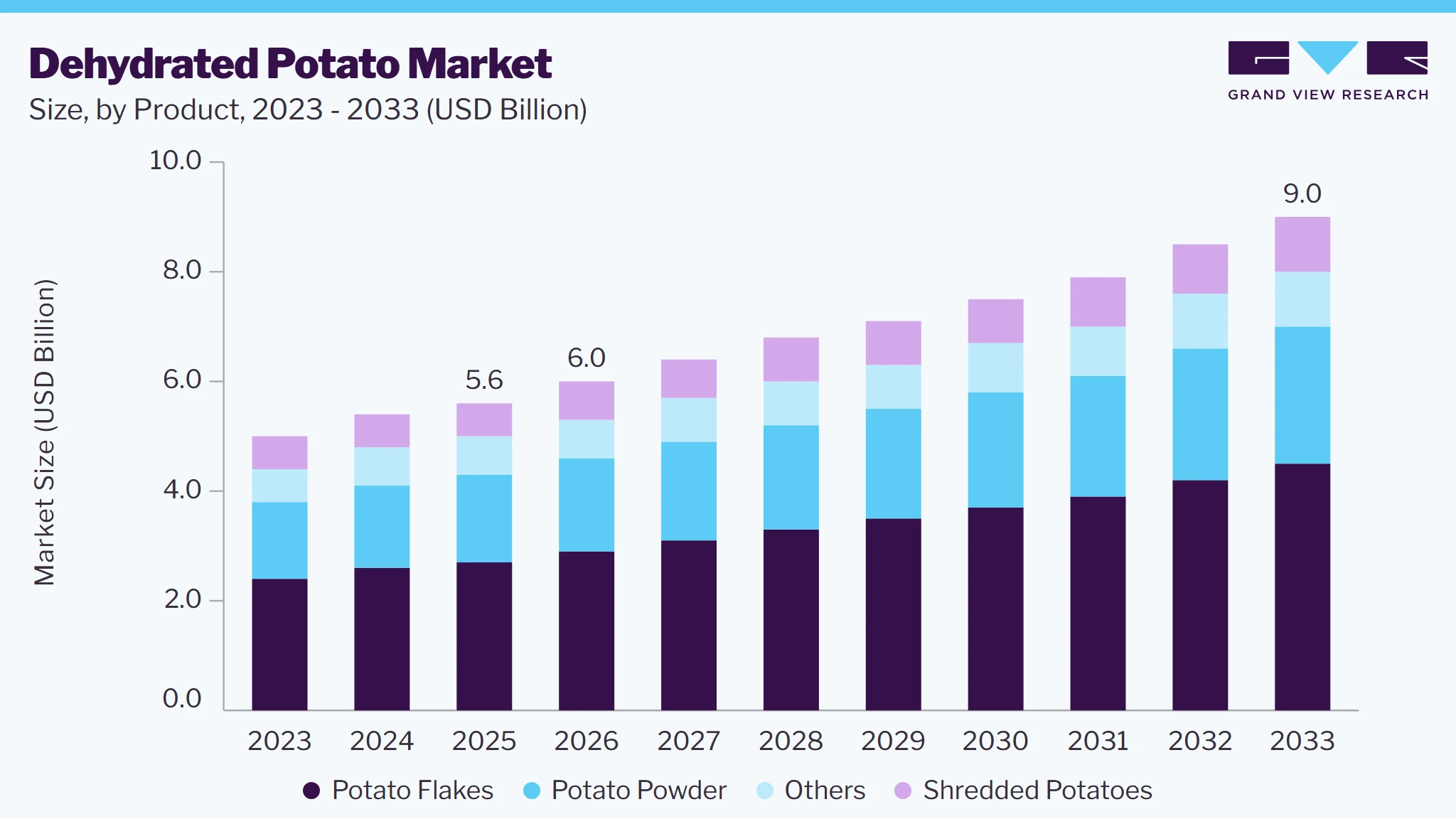
The global dehydrated potato market size was valued at USD 5.6 billion in 2025 and is projected to grow from USD 6.0 billion in 2026 to USD 9.0 billion by 2033, at a CAGR of 6.1% from 2026 to 2033. Asia Pacific dominated the market, accounting for a revenue share of 30.0% in 2025. The industry is primarily driven by growing demand for convenient and ready-to-cook foods. It is also supported by longer shelf life, easier storage, and reduced food wastage. Increasing use in snacks, soups, bakery products, and processed meals further supports demand.
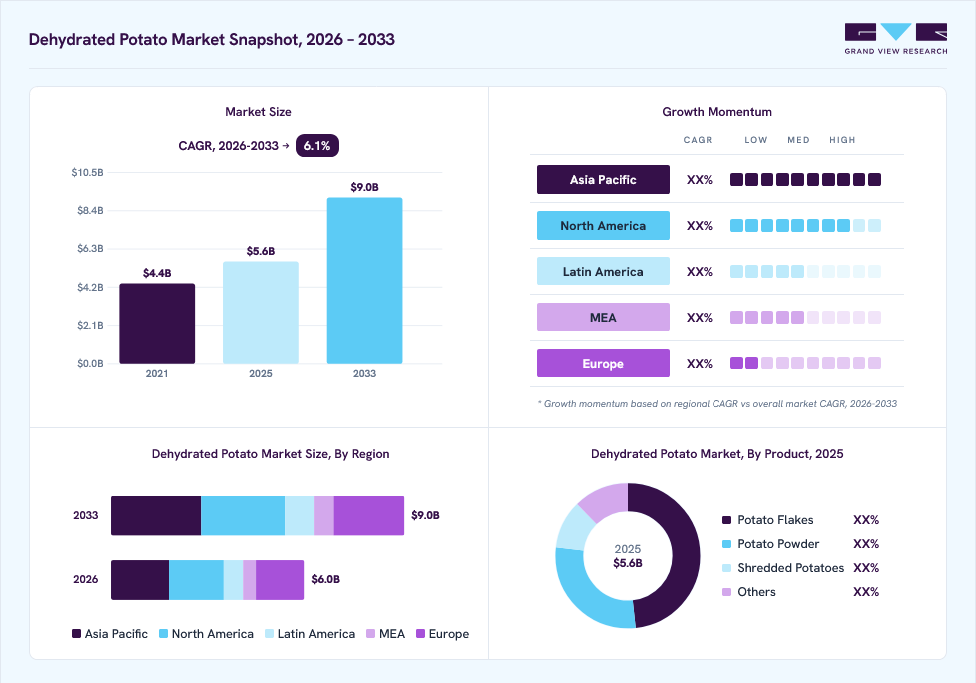 Source: Grand View Research, IR Documents, Primary Interviews, Paid DatabasesTo learn more about this report,
 Download Free Sample Report
 Key Market Trends & Insights
- By product: the potato flakes segment held the largest share of 48.6% in 2025.
- By distribution channel: the B2B segment held the largest share of 75.5% in 2025.
Regional Highlights
- Largest regional market: Asia Pacific (30.0% revenue share, 2025)
- Fastest-growing regional market: Asia Pacific (highest CAGR, 2026-2033)
- By country: China led the market in 2025, holding the largest share
Market Size & Forecast
- Market Size in 2025: USD 5.6 billion
- Estimated Market Size in 2026: USD 6.0 billion
- Projected Market Size in 2033: USD 9.0 billion
- CAGR (2026 - 2033): 6.1%
Three ways to get this report
Buy it, customize it, or ask a question.Ask an Analyst
A direct answer, usually in 1 working day
- AccessReport author, directly
- Reply timeWithin 1 working day
- No sales callDirect answer only
- FormatEmail reply
- CostFree, no cost
Get the Full Report
What the study covers
- FormatsPDF · Excel · Dashboard
- Timeline2026–2033 annual, 2025 base
- Coverage20+ countries, 5 regions
- Companies10+ key players profiled
Customize the Report
20% free customization
- IncludeCountries, segments, points
- TailorTo your product definition
- ExtendDeeper competitor detail
- OrA fully bespoke study
- Turnaround5–10 working days
The market is also influenced by the versatility of dehydrated potatoes across various food applications. Their easy transportation and handling make them suitable for food manufacturers and food-service operators. Consistent quality and year-round availability further encourage their use across different end-use industries. In January 2025, GreenFay Farm Foods launched a state-of-the-art potato flakes plant in Gujarat with a capacity of 2,200 kg/hour, positioning it among India’s largest potato-flake producers. The facility uses advanced processing, storage and ventilation systems to ensure consistent quality and supply for Indian and global markets.
 To learn more about this report, Download Free Sample Report
 Moreover, the increasing adoption of dehydrated potatoes in food processing and industrial applications. Advances in dehydration and preservation techniques help maintain desirable taste, texture, and nutritional properties. Product innovation and the development of different forms, such as flakes, granules, and powder, also broaden their potential uses. In June 2025, Aviko expanded its Gansu, China, facility to increase potato flakes and granules capacity by 70%, driven by rising demand across China and Southeast Asia. The new production line, supported by 50,000 tonnes of additional potato storage, is expected to be operational by the end of 2027 and serve both Asian and international markets.
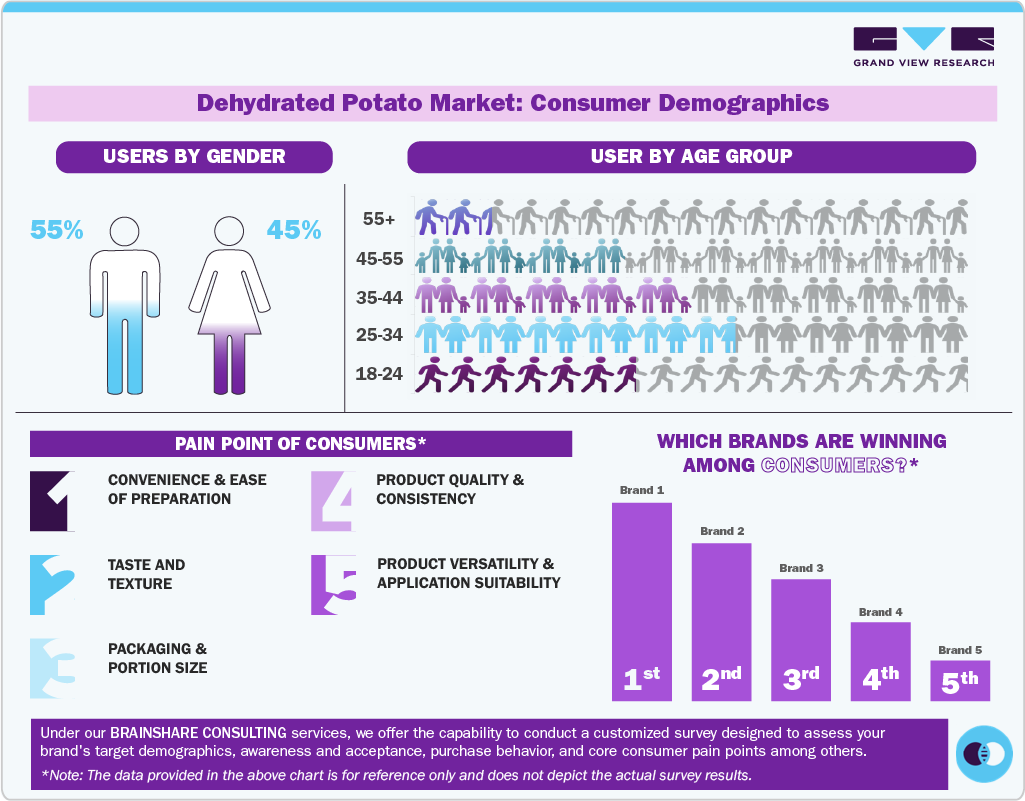
Consumer Insights for the Dehydrated Potato Market:
Consumers are increasingly interested in dehydrated potato products that offer convenience and simple preparation. Product choice is influenced by taste, texture, packaging, and ease of use. Different formats, such as flakes, powder, and shredded potatoes, appeal to varied cooking and meal-preparation needs. Consumers also value products that can be stored easily and incorporated into different recipes. Brand familiarity, perceived quality, and affordability can further influence purchasing decisions.
 To learn more about this report, Download Free Sample Report
 Market Dynamics
Dehydrated potatoes are being incorporated into a wide range of food formulations. They can be adapted to different recipes and manufacturing processes, making them suitable for diverse food products. Their functional properties support their use in both traditional and modern food applications. Food producers can incorporate them into formulations without extensive fresh-potato preparation. This broad applicability encourages greater adoption across the food industry. In June 2026, Hungritos showcased its customizable dehydrated potato flakes and potato powder at SNACKEX 2026 in Lisbon, targeting global snack manufacturers and food processors. The company highlighted tailored potato-based ingredient solutions and sought partnerships with buyers, distributors, and food manufacturers.
The dehydration process requires substantial energy to remove moisture from potatoes efficiently. Energy consumption can increase overall processing expenses for manufacturers. Changes in energy costs may place additional pressure on production margins. Processors may need to invest in energy-efficient equipment to control operational expenses. This can create challenges for producers seeking to maintain cost efficiency. According to the data published by OptiCept, dehydrating potatoes face obstacles such as non-uniform drying, high energy consumption due to long drying cycles, texture degradation, resulting in shrinkage and nutrient degradation, due to prolonged heat exposure.
Manufacturers can introduce innovative dehydrated potato formats tailored to specific applications. Product development can focus on improving convenience, functionality, and ease of incorporation. Specialized formats can address the requirements of different food-processing segments. Innovation can also help producers differentiate their offerings in competitive markets. This creates scope for expanding the range and value of dehydrated potato products. According to the data published by Goodrich Cereals, potato flakes are a cost-effective alternative to fresh potatoes, reducing preparation time, labor, waste, and storage costs. With a 12-month shelf life and versatile applications across snacks, bakery, soups, and ready-to-eat foods, they offer operational efficiency and consistent quality.
Analyst Perspective
The industry is supported by its broad applicability across food processing and commercial food preparation. Product differentiation through flakes, powders, shreds, and specialty formats provides manufacturers with multiple avenues for growth. Competitive positioning increasingly depends on processing efficiency, product consistency, and the ability to meet application-specific requirements. Cost management remains important due to energy-intensive processing and raw material variability. Overall, innovation and expansion into specialized applications are expected to shape the competitive landscape.
Product Insights
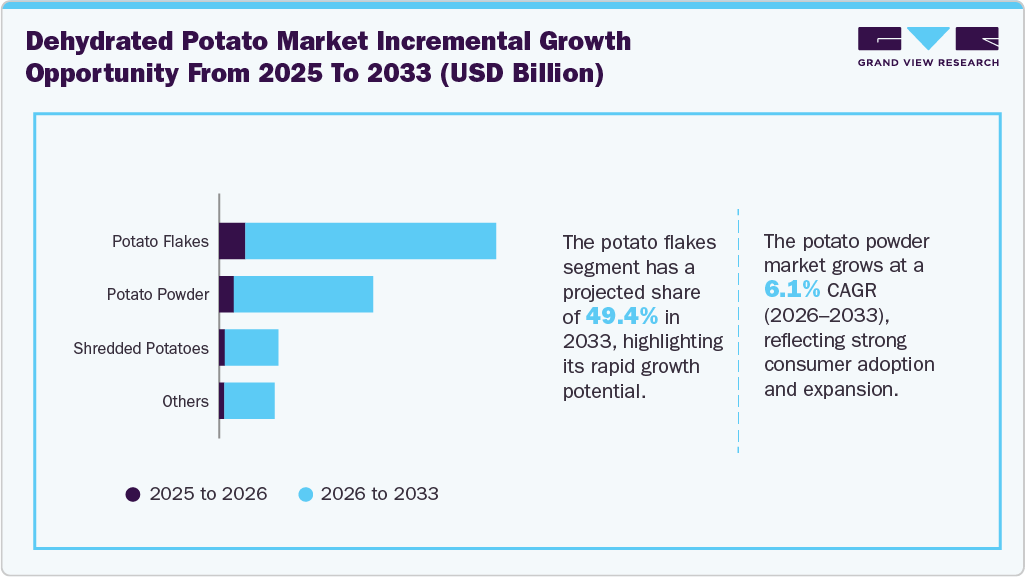
The potato flakes segment accounted for the largest share of 48.6% of the global revenue in 2025. Potato flakes are produced by cooking, mashing, and drying potatoes into thin, lightweight pieces. They are commonly used as a base ingredient in instant mashed potato preparations. Their texture allows them to absorb liquids and reconstitute relatively quickly during food preparation. Potato flakes can also be incorporated into snacks, bakery products, and prepared meals. Their convenient form makes them suitable for applications requiring a consistent potato texture.
 To learn more about this report, Download Free Sample Report
 The potato powder segment is projected to grow significantly at a CAGR of 6.1% from 2026 to 2033. Potato powder is a finely milled, dehydrated potato ingredient designed for easy incorporation into food formulations. It can be used as a thickening or binding ingredient in various processed foods. Its fine particle size enables uniform mixing with other ingredients during manufacturing. Potato powder is suitable for sauces, soups, seasonings, bakery mixes, and snack formulations. Its ability to blend easily makes it useful where a smooth and consistent ingredient is required.
Distribution Channel Insights
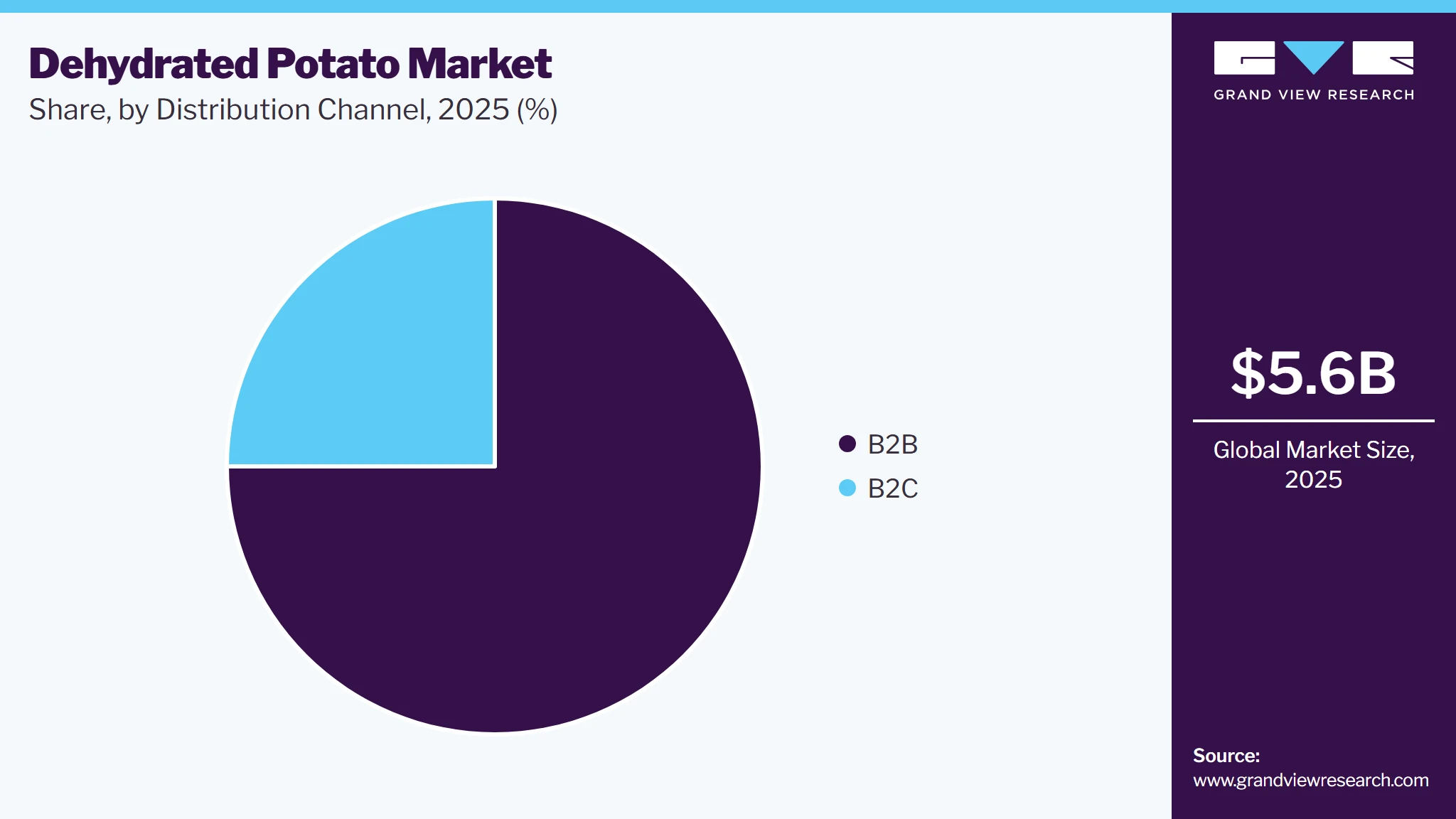
The B2B segment accounted for the largest share of 75.5% of the global revenue in 2025. The segment includes sales of dehydrated potato products to food manufacturers, processors, and commercial food-service operators. These buyers typically use potato ingredients as inputs for producing finished or semi-finished food products. Purchasing decisions are often influenced by formulation requirements, order volumes, and supply consistency. The segment covers applications across prepared foods, snacks, bakery products, and other industrial formulations. Long-term supplier relationships can play an important role in this channel.
 To learn more about this report, Download Free Sample Report
 The B2C segment is projected to grow at the fastest CAGR of 6.3% from 2026 to 2033. The segment involves dehydrated potato products being sold directly to individual consumers through retail and consumer-oriented channels. Products may be offered in convenient household formats designed for home cooking and meal preparation. Consumer preferences can vary according to taste, preparation requirements, packaging, and product familiarity. Retail availability through supermarkets, specialty stores, and online channels supports consumer access. This segment is particularly relevant to packaged products intended for personal or family use.
Regional Insights
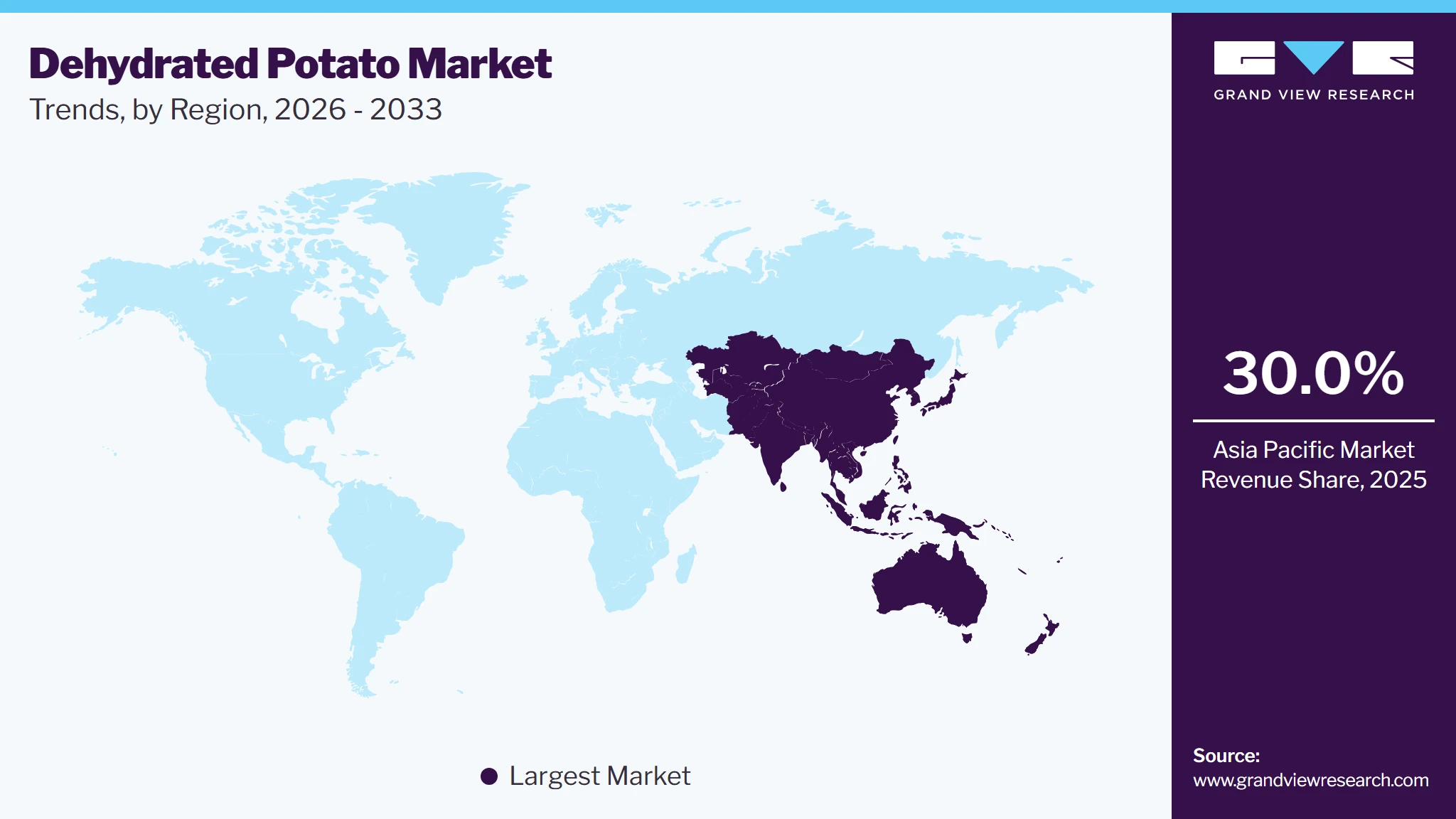
The Asia Pacific dehydrated potato market held the largest share of over 30.0% in 2025 and is projected to grow at the fastest CAGR of 6.5% from 2026 to 2033. The market is driven by the expansion of food-processing activities and changing consumption patterns across several countries. Increasing urbanization is encouraging manufacturers to develop products suited to faster and more convenient meal preparation. In January 2026, Leelaram Enterprises, led by food technologist Dinesh Garg, pioneered India’s first potato flakes processing plant and has developed 150+ applications for potato flakes. The region also has a broad base of snack, instant-food, and prepared-food producers. Growing investment in modern food-processing facilities supports the adoption of specialized ingredients. Increasing exposure to international food formats is creating additional applications for dehydrated potato products.
 To learn more about this report, Download Free Sample Report
 The dehydrated potato market in China led the Asia Pacific in 2025, holding the largest share of 46.4%. The Chinese market is supported by its large food-processing industry and expanding production of packaged and prepared foods. Potato ingredients are increasingly incorporated into snack, convenience-food, and food-service formulations. The development of modern food manufacturing facilities is improving the ability to process and utilize specialized ingredients. Changing dietary preferences are also encouraging greater product variety within processed foods. Expanding distribution networks provides manufacturers with broader access to different domestic markets.
North America Dehydrated Potato Market Trends
The dehydrated potato market in North America accounted for a share of 29.1% in 2025, supported by the region’s well-established processed food industry and extensive use of potato-based ingredients. Demand is also influenced by the presence of large-scale food manufacturers and institutional food-service operations. Manufacturers increasingly seek ingredients that simplify production and improve formulation efficiency. The region’s developed retail and distribution infrastructure facilitates wider product availability. Ongoing innovation in packaged and prepared foods further supports the use of dehydrated potato ingredients.
U.S. Dehydrated Potato Market Trends
The dehydrated potato market in the U.S. led North America in 2025, holding a share of 72.9%. The U.S. market is driven by the strong presence of convenience-oriented food products and large commercial food-processing operations. Potato ingredients are incorporated into numerous prepared foods manufactured for both retail and food-service channels. Advanced processing capabilities enable producers to develop specialized ingredient solutions for different formulations. Product development focused on taste, texture, and preparation efficiency further supports adoption. In November 2025, Idahoan Foods, one of the largest U.S. producers of dehydrated and value-added potato products, replaced frequently failing rubber belts with Intralox’s S1750 modular belt, achieving zero unplanned downtime. The belt delivers up to three years of service life and achieves full payback within one year, significantly reducing maintenance costs and stoppages.
Europe Dehydrated Potato Market Trends
The dehydrated potato market in Europe is projected to grow at a CAGR of 5.7% from 2026 to 2033. Europe benefits from a mature food-processing sector with diverse applications for potato-derived ingredients. Demand is supported by established bakery, snack, prepared-meal, and food-service industries across the region. Manufacturers place emphasis on efficient ingredient handling and standardized food production. The region’s diverse culinary preferences create opportunities for different dehydrated potato applications. Continued development of processed and packaged food offerings contributes to regional demand.
The Germany dehydrated potato market held the largest regional share of 26.0% in 2025. Germany is supported by its strong food manufacturing base and sophisticated industrial processing capabilities. Dehydrated potato ingredients can be incorporated into a variety of prepared and processed food formulations. The country’s established bakery and snack industries provide additional application areas. Manufacturers also focus on production efficiency and consistent ingredient performance. The presence of well-developed food distribution channels facilitates access to both industrial and commercial buyers.
Central & South America Dehydrated Potato Market Trends
The dehydrated potato market in Central & South America is projected to grow at a CAGR of 6.2% from 2026 to 2033. The industry is supported by the development of processed-food industries and the increasing diversification of food products. Potato-based ingredients are used by manufacturers seeking practical solutions for commercial food preparation. The region’s established potato cultivation and food-processing activities provide a foundation for ingredient utilization. Growth in packaged snacks and prepared foods creates additional application possibilities. Improvements in food distribution infrastructure can further facilitate the movement of dehydrated potato products.
Middle East & Africa Dehydrated Potato Market Trends
The dehydrated potato industry in the Middle East & Africa is expected to grow at a CAGR of 6.1% from 2026 to 2033. The region is driven by the expansion of modern food-service and food-processing operations. Dehydrated potato ingredients offer manufacturers flexibility in preparing potato-based foods where fresh-product handling may be less convenient. Growing retail modernization is supporting the availability of packaged and processed food products. The development of hospitality and institutional catering also creates additional application areas. Increasing investment in local food manufacturing is encouraging the adoption of processed food ingredients.
Key Dehydrated Potato Company Insights
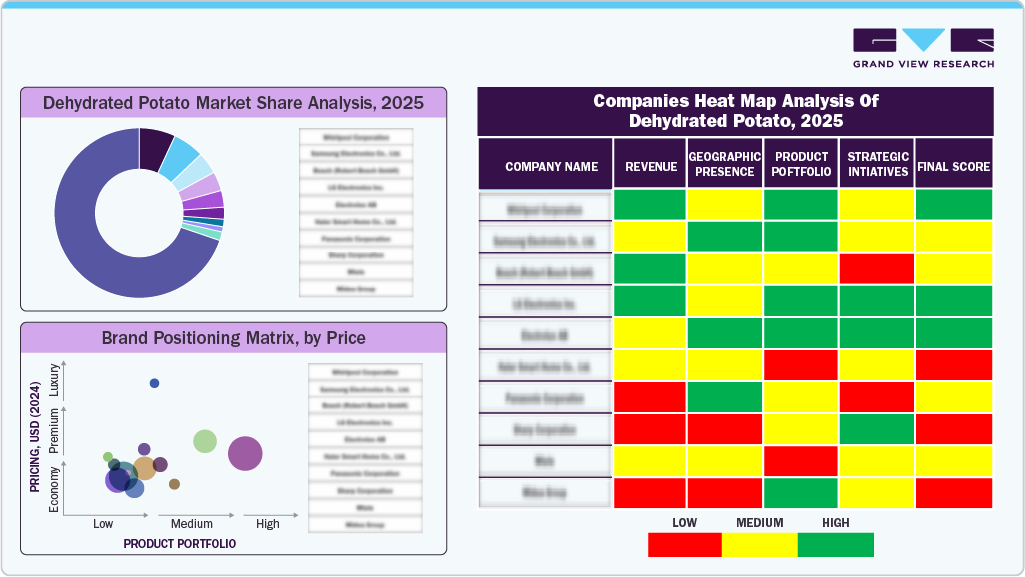
The dehydrated potato industry is characterized by the presence of established food ingredient manufacturers and specialized potato processors. Companies compete through product quality, processing capabilities, application expertise, and supply reliability. Product portfolios typically include different dehydrated formats designed for varied food-processing requirements. Regional production capabilities and access to raw potato supplies can influence competitive positioning. Innovation, customized formulations, and expansion into new applications remain important areas of competition.
 To learn more about this report, Download Free Sample Report
 Key Dehydrated Potato Companies
The following key companies have been profiled for this study on the dehydrated potato market.
-
McCain Foods Limited
-
Lamb Weston Holdings, Inc.
-
J.R. Simplot Company
-
Aviko B.V.
-
Emsland Group
-
Idahoan Foods, LLC
-
Rixona B.V.
-
Mydibel Group
-
Pacific Valley Foods, Inc.
-
AGRANA Beteiligungs-AG
Competitive Benchmarking
Category
Operating Strategies
Competitive Edge
Weakness
Established Players (McCain Foods, Lamb Weston, J.R. Simplot)
- Expand production capacity, optimize sourcing, and broaden dehydrated potato offerings.
- Strong processing capabilities, established distribution, and extensive customer networks.
- High capital intensity and sensitivity to raw potato and energy costs.
Emerging Players (Mydibel Group; Pacific Valley Foods, Inc.)
- Develop specialized products, target niche applications, and expand regional presence.
- Product specialization, customer responsiveness, and application-focused innovation.
- Smaller scale, narrower geographic reach, and lower brand visibility.
Recent Developments
-
In June 2026, Hungritos showcased its customizable dehydrated potato flakes and potato powder at SNACKEX 2026 in Lisbon, targeting global snack manufacturers and food processors. The company highlighted tailored potato-based ingredient solutions and sought partnerships with buyers, distributors, and food manufacturers.
-
In June 2025, Aviko expanded its Gansu, China, facility to increase potato flakes and granules capacity by 70%, driven by rising demand across China and Southeast Asia. The new production line, supported by 50,000 tonnes of additional potato storage, is expected to be operational by the end of 2027 and serve both Asian and international markets.
Global Dehydrated Potato Market Report Scope
Report Attribute
Details
Market size value in 2025
USD 5.6 billion
Estimated market size in 2026
USD 6.0 billion
Revenue forecast in 2033
USD 9.0 billion
Growth rate
CAGR of 6.1% from 2026 to 2033
Actuals
2021 - 2025
Forecast period
2026 - 2033
Quantitative units
Revenue in USD billion, and CAGR from 2026 to 2033
Report coverage
Revenue forecast, company ranking, competitive landscape, growth factors, and trends
Segments covered
Product, distribution channel, region
Regional scope
North America; Europe; Asia-Pacific; Central & South America; Middle East & Africa
Country scope
U.S.; Canada; Mexico; UK; Germany; France; Italy; Spain; China; Japan; India; Australia & New Zealand; South Korea; Brazil; South Africa
Key companies profiled
McCain Foods Limited; Lamb Weston Holdings, Inc.; J.R. Simplot Company; Aviko B.V.; Emsland Group; Idahoan Foods, LLC; Rixona B.V.; Mydibel Group; Pacific Valley Foods, Inc.; AGRANA Beteiligungs-AG
Customization scope
Free report customization (equivalent up to 8 analysts’ working days) with purchase. Addition or alteration to country, regional & segment scope.
Pricing and purchase options
Avail customized purchase options to meet your exact research needs. Explore purchase options
Global Dehydrated Potato Market Report Segmentation
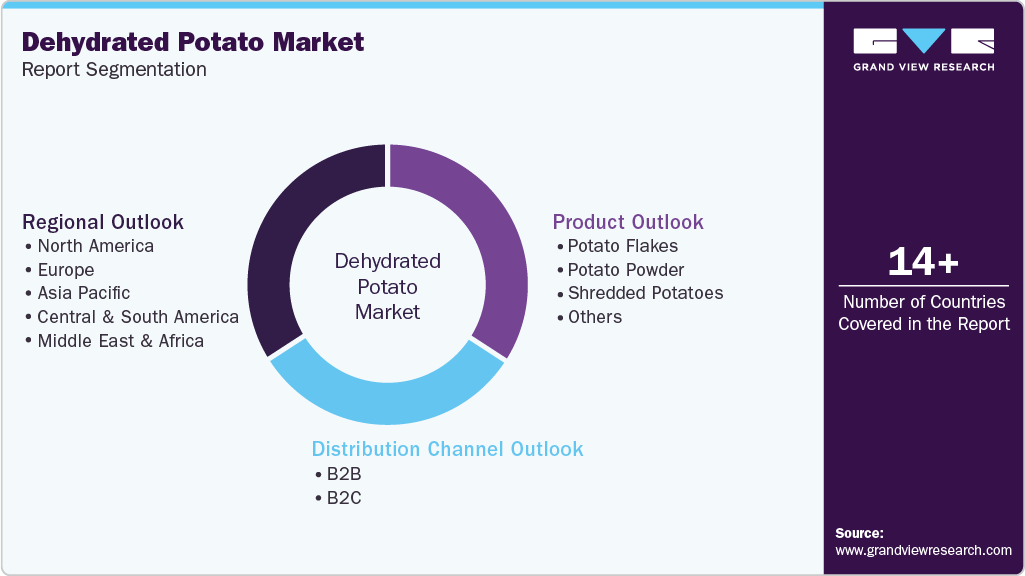
This report forecasts revenue growth at the global, regional and country levels and provides an analysis of the latest industry trends and opportunities in each of the sub-segments from 2021 to 2033. For this study, Grand View Research has segmented the global dehydrated potato market report on the basis of product, distribution channel, and region.
 To learn more about this report, Download Free Sample Report
 -
Product Outlook (Revenue, USD Billion, 2021 - 2033)
-
Potato Flakes
-
Potato Powder
-
Shredded Potatoes
-
Others
-
-
Distribution Channel Outlook (Revenue, USD Billion, 2021 - 2033)
-
B2B
-
Food Manufacturers / Food Processors
-
QSRs
-
Restaurants & Hotels
-
-
B2C
-
Supermarkets & Hypermarkets
-
Convenience Stores
-
Specialty Stores
-
Online
-
-
-
Regional Outlook (Revenue, USD Billion, 2021 - 2033)
-
North America
-
U.S.
-
Canada
-
Mexico
-
-
Europe
-
UK
-
Germany
-
France
-
Italy
-
Spain
-
-
Asia Pacific
-
China
-
Japan
-
India
-
Australia & New Zealand
-
South Korea
-
-
Central & South America
-
Brazil
-
-
Middle East & Africa
-
South Africa
-
-
Research Methodology
The dehydrated potato market figures in this report are based on a proven research process that combines executive interviews with secondary research from proprietary databases, company filings, and recognized regulatory and institutional sources. Market size is built through value-chain sizing-reconciling supply-side and demand-side estimates-and triangulated with bottom-up and top-down approaches. Every estimate passes multiple levels of expert validation before publication, with each dehydrated potato segment quantified using the revenue-capture definitions in the table below.
Segment Definition
Segment - Product
Revenue capture definition
Potato Flakes
Companies generate revenue by supplying flakes as ingredients for instant foods, prepared meals, snacks, and foodservice applications. Sales are made through industrial bulk orders as well as consumer-oriented packaged products. Flake grades can be tailored to achieve specific texture and reconstitution characteristics. Customized specifications can help suppliers secure recurring contracts with food manufacturers.
Potato Powder
Revenue is generated through the supply of finely processed potato powder for sauces, soups, bakery mixes, seasonings, and formulated foods. Manufacturers serve both industrial buyers and commercial food operators through different pack sizes. Functional characteristics such as consistency and blending performance can influence product selection. Specialized grades designed for particular formulations can provide opportunities for higher-value sales.
Shredded Potatoes
Companies earn revenue from supplying shredded dehydrated potato products for prepared foods, snack applications, and foodservice preparations. Products can be offered in varying shred dimensions and specifications to suit different processing requirements. Bulk supply agreements with manufacturers and commercial kitchens represent important sales channels. Application-specific specifications can support customer retention and repeat purchasing.
Others
Revenue is generated through specialized dehydrated formats designed for particular processing and food-preparation applications. Granules, diced potatoes, slices, and pellets can be supplied in industrial, foodservice, and retail formats. Differences in size, shape, and processing characteristics allow manufacturers to target specific formulation needs. Specialty formats and customized specifications can create additional value and revenue opportunities.
Delivered Customizations
This report has been delivered with the following In-depth customizations
Client Request
Customization Delivered
Value Adds
Dehydrated Potato End-Use & Application Analysis
Mapped applications across soups, sauces, bakery, snacks, prepared meals, and ingredient blends. Evaluated usage requirements and application-specific demand drivers.
Pinpoints high-potential applications and prioritizes attractive end-use segments for growth.
Dehydrated Potato Pricing & Cost Structure Assessment
Evaluated price drivers across raw material costs, processing, packaging, logistics, and product specifications. Benchmarked pricing differences by product type and market.
Identifies margin improvement levers, pricing opportunities, and cost-optimization areas.
Dehydrated Potato Supply Chain & Trade Analysis
Assessed production hubs, import-export flows, supply availability, logistics routes, and regional supply-demand dynamics.
Highlights supply-chain risks, sourcing opportunities, and potential regional advantages.
Frequently Asked Questions About This Report
The global dehydrated potato market size was valued at USD 5.6 billion in 2025 and is estimated at USD 6.0 billion for 2026.
The global dehydrated potato market is expected to grow at a CAGR of 6.1% from 2026 to 2033, reaching USD 9.0 billion.
Key factors driving the dehydrated potato market include rising demand for convenience and ready-to-eat foods, expansion of QSRs and foodservice, longer shelf life, and easy storage and transportation.
The potato flakes segment led with a 48.6% revenue share in 2025.
The potato powder market is projected to grow significantly at a CAGR of 4.0% from 2026 to 2033.
Asia Pacific led the global dairy dessert market with a 30.0% revenue share in 2025.
The sales of dairy desserts through the B2B channels accounted for the largest share of 75.5% of the revenue in 2025.
The sales of dairy desserts through the B2C channels are projected to grow at a CAGR of 6.3% from 2026 to 2033.
Key players include McCain Foods Limited, Lamb Weston Holdings, Inc., Aviko Rixona B.V., J.R. Simplot Company, Emsland Group, Idahoan Foods, LLC, Basic American Foods, Agrarfrost GmbH & Co. KG, Lutosa SA, and Pacific Valley Foods, Inc.
About the Author(s)
Consumer F&B Research Team
Consumer Goods · Consumer F&BThis report was authored by the consumer f&b research team at Grand View Research - comprising two research analysts, one senior research analyst, and one industry expert - with specialized expertise in the consumer f&b segment of the consumer goods industry. All findings are based on proprietary consumer goods databases, executive interviews, and regulatory analysis, subject to internal peer review prior to publication.
Last Updated:
Speak to Analyst

Customize this report to your needs - add regions, segments, or data points, with 20% free customization.
Or view our licence options:


ISO 9001:2015 & 27001:2022 Certified
We are GDPR and CCPA compliant! Your transaction & personal information is safe and secure. For more details, please read our privacy policy.


