
- Home
- »
- Medical Devices
- »
-
Dental Bracket Market Size, Growth Report, 2026-2033GVR Report cover

Dental Bracket Market (2026 - 2033)
Size, Share & Trends Analysis Report By Material Type (Metallic Brackets, Ceramic / Aesthetic, Polycarbonate), By Ligation Type, By Demographics, By Aesthetic Preference, By Region, And Segment Forecasts
Market Size, 2025
$4.1BMarket Estimate, 2026
$4.4BMarket Forecast, 2033
$6.9BCAGR, 2026–2033
6.6%Dental Bracket Market Summary
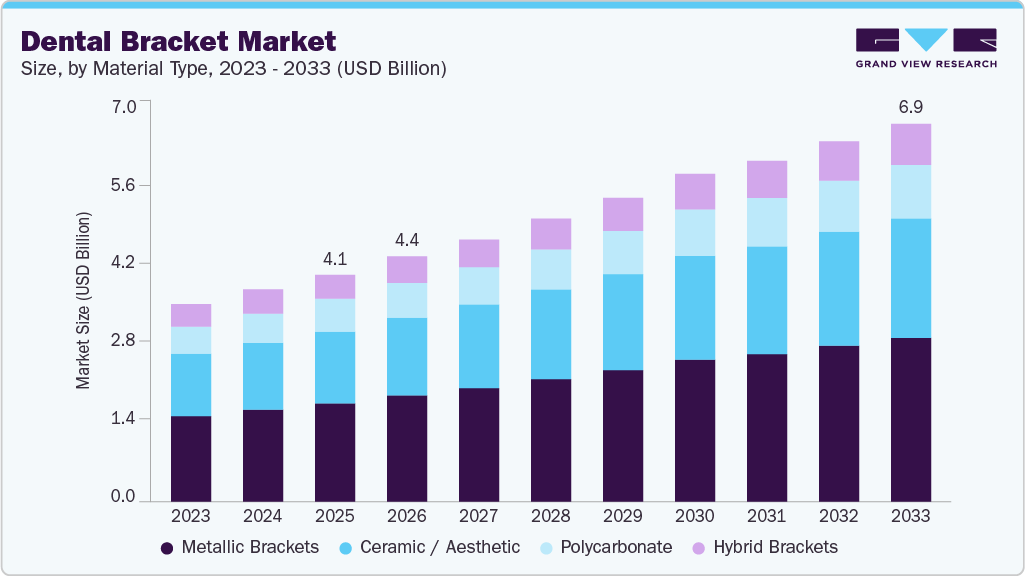
The global dental bracket market size was valued at USD 4.1 billion in 2025 and is projected to grow from USD 4.4 billion in 2026 to USD 6.9 billion by 2033, at a CAGR of 6.6% from 2026 to 2033. North America dominated the global market, accounting for the largest revenue share of 35.4% in 2025.. The market is experiencing steady growth due to a combination of rising cosmetic awareness, technological advancements in orthodontics, and increasing affordability of dental treatments.
Key Market Trends & Insights
- By Material type: Metallic brackets segment led the material type category, with the largest revenue share.
- By ligation type: Conventional ligation led the market with the largest revenue share in 2025.
- By demographics: Adolescent segment led the market in 2025, with the largest revenue share.
- By aesthetic preference: Non-aesthetic brackets segment led the market by aesthetic preference in 2025.
Regional Highlights
- Largest regional market: North America (35.4% revenue share, 2025)
- Fastest-growing regional market: Asia Pacific (highest CAGR, 2026-2033)
- By country: The U.S dental bracket industry is a major contributor to the global market.
Market Size & Forecast
- Market size in 2025: USD 4.1 Billion
- Estimated market size in 2026: USD 4.4 Billion
- Projected market size by 2033: USD 6.9 Billion
- CAGR (2026-2033): 6.6%
Three ways to get this report
Buy it, customize it, or ask a question.Ask an Analyst
Analyst response in 1 business day
- AccessReport author, directly
- Reply timeWithin 1 working day
- No sales callDirect answer only
- FormatEmail reply
- CostFree, no cost
Get the Full Report
What the study covers
- FormatsPDF · Excel · Dashboard
- Timeline2026–2033 annual, 2025 base
- Coverage20+ countries, 5 regions
- Companies10+ key players profiled
Customize the Report
20% free customization
- IncludeCountries, segments, points
- TailorTo your product definition
- ExtendDeeper competitor detail
- OrA fully bespoke study
- Turnaround5–10 working days
In addition, the increasing prevalence of dental disorders, particularly malocclusion, overcrowding, and misaligned teeth, is observed among both children and adults. Poor dietary habits, lack of early dental care, and changing lifestyles have contributed to a higher demand for orthodontic treatments worldwide.
 Source: Grand View Research, IR Documents, Primary Interviews, Paid DatabasesTo learn more about this report,
 Download Free Sample Report
 The rising demand for discreet orthodontic solutions is driven by increasing participation of adults and working professionals, who prioritize maintaining a professional and socially acceptable appearance during treatment. This has led to a strong preference for tooth-colored ceramic brackets and minimally visible systems over traditional metal options. Aesthetic considerations are now a key decision factor, with patients seeking treatments that balance effectiveness and low visibility. This shift is further supported by expanding digital exposure; for instance, global internet penetration reached 74% in 2025, according to the International Telecommunication Union, increasing awareness and influencing patient preferences toward aesthetic orthodontic solutions.
Participant Demographics and Social Media Platform Usage in Orthodontic Decision-Making Study:
Parameter
Details
Total Participants (n)
206
Gender Distribution
Women: 148 (71.8%)
Men: 58 (28.2%)
Mean Age
37.3 ± 15.0 years
Most Used Social Media Platforms
WhatsApp (95.1%)
Instagram (92.2%)
YouTube (56.8%)
Facebook (30.1%)
The rising demand for discreet orthodontic options is largely driven by increasing participation of adults and working professionals in orthodontic treatment. This group places high importance on maintaining a professional and socially acceptable appearance during treatment, leading to a preference for tooth-colored ceramic brackets and minimally visible systems over traditional metal brackets. Aesthetic considerations have become a primary factor in decision-making, with patients actively seeking solutions that combine effectiveness with low visibility.
For instance, in 2025, according to International Telecommunication Union (ITU), global internet penetration reached 74%, up from 71% in 2024, with total users increasing to 6 billion from 5.8 billion. Year-on-year growth rose slightly to 3.3%, indicating steady digital expansion.
 To learn more about this report, Download Free Sample Report
 Consumer Behaviour Analysis
Consumer behaviour in the dental brackets market is shaped by functional, psychological, and social factors. The main consumers are teenagers, young adults, and adults who seek teeth alignment for both health and appearance reasons. Increasing awareness of oral hygiene and the benefits of straight teeth has significantly boosted demand, as people associate better dental alignment with improved confidence and social acceptance.
Price is an important factor in decision-making. Cost sensitive consumers prefer traditional metal brackets, while ceramic and lingual brackets are chosen by those willing to pay more for better aesthetics. There is also growing interest in clear aligners, as consumers prefer less visible and more comfortable treatment options. Consumers consider factors such as discomfort, treatment duration, and convenience when choosing orthodontic solutions. However, many still rely on brackets for complex dental corrections based on orthodontist recommendations.
Characteristic
Teenagers
Young Adults
Adults
Target Consumers
Primary users
Group of young bracket users
Seeking orthodontic correction
Key Decision Factors
Aesthetic appearance
Doctor/orthodontist recommendation
Dental health awareness
Purchase Preferences
Cost-sensitive consumers prefer metal brackets
Aesthetic-focused consumers prefer ceramic or lingual brackets
Growing interest in clear alternatives is influencing expectations
Behavioural Concerns
Discomfort during treatment
Oral hygiene difficulties
Long treatment duration
Market Influence Drivers
Social influence and peer perception
Rising awareness of oral health
Increasing disposable income in emerging Markets
Source: Grand View Research Analysis
Market Concentration & Characteristics
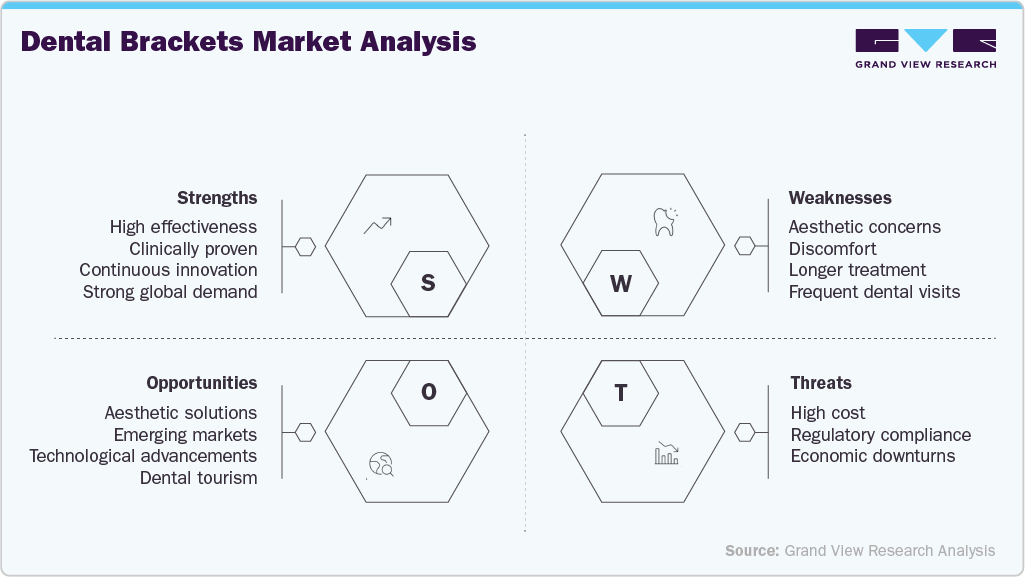
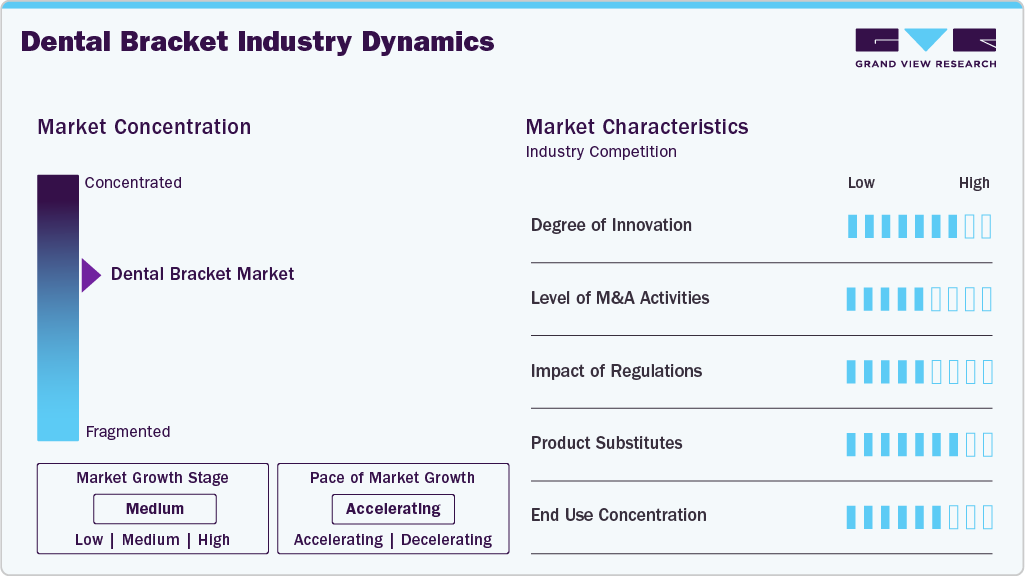
The dental bracket market shows a high degree of innovation, which influences its competitive structure. Companies invest in advanced ceramic materials, translucent brackets, self-ligating systems, and low-friction designs to improve both aesthetics and treatment efficiency. Innovation is also driven by increasing demand for less visible orthodontic solutions, especially among adults and working professionals. In addition, integration with digital orthodontics, CAD/CAM systems, and 3D customization technologies is reshaping product development. Firms that innovate successfully often gain a strong competitive advantage, allowing them to capture premium pricing and loyal orthodontist networks. However, innovation also increases entry barriers because smaller firms struggle with high R&D costs and clinical validation requirements.
The market exhibits a moderate level of merger and acquisitions (M&A) activity, which contributes to gradual consolidation. Large orthodontic and dental companies often acquire smaller manufacturers to expand product portfolios, access new technologies, or enter emerging regional markets. This strategy assist firms strengthen their position in aesthetic orthodontics, especially in ceramic and clear bracket segments. However, the market is not highly acquisition-driven compared to industries such as pharmaceuticals or medical devices on a large scale. Instead, M&A is strategic and selective, focusing on technology acquisition and distribution expansion rather than full-scale consolidation. For instance, in December 2023, Kuraray Noritake Dental Inc. (Kuraray Group) announced an expansion of its ceramic dental materials production capacity at its Miyoshi Plant in Aichi Prefecture to support business growth. The company invested approximately ¥2.2 billion (USD 13.77 million) in capacity expansion to strengthen its manufacturing capabilities. This move is aimed at accelerating the expansion of its dental materials business and meeting rising demand.
 To learn more about this report, Download Free Sample Report
 The dental bracket market is influenced by a moderate to high regulatory burden, which contributes to market consolidation. In the U.S., orthodontic brackets are classified as Class II medical devices under FDA regulations (21 CFR 872.5470) and typically require 510(k) premarket notification clearance to demonstrate substantial equivalence to existing approved devices. This regulatory pathway ensures that all products meet strict requirements for safety, biocompatibility, and clinical performance, particularly since brackets are directly bonded to teeth and remain in long-term oral contact.
The presence of substitutes such as clear aligners and lingual braces has a strong impact on the dental bracket market. Clear aligners are rapidly gaining popularity due to their invisibility, comfort, and removability, making them a major alternative to fixed aesthetic brackets. This increases competition across orthodontic solutions and limits pricing power for bracket manufacturers. However, aesthetic brackets remain important for complex dental corrections where aligners are less effective or more expensive. Therefore, while substitutes do not eliminate demand, they fragment patient preference across different orthodontic solutions. This creates competitive pressure on bracket manufacturers to innovate and improve product aesthetics and comfort.
The market shows a moderate to high concentration in Aesthetic Preferencers, driven by orthodontists, dental clinics, and specialized dental hospitals. Dental clinics account for the largest share as they are the initial point of treatment delivery for aesthetic orthodontics. A small number of large dental chains and orthodontic practices often handle a significant volume of procedures, especially in urban and developed regions. This creates a customer side concentration, where manufacturers depend heavily on professional dental networks rather than individual consumers. Such concentration strengthens the bargaining power of large clinics and procurement groups, influencing product adoption and pricing structures.
Material Type Insights
The metallic brackets segment dominated the dental bracket market in 2025, driven by their high durability, cost-effectiveness, and clinical reliability. Orthodontists prefer them for complex tooth movements due to superior strength and reduced breakage risk. Their affordability makes them accessible across price-sensitive markets, especially in developing regions. Continuous improvements in design, including smaller sizes and enhanced comfort, have also increased patient acceptance. In addition, widespread availability and familiarity among dental professionals further support their continued dominance in orthodontic treatments globally.
The ceramic / aesthetic segment in the dental bracket market is expected to grow at the fastest CAGR during the forecast period. The growth of ceramic and aesthetic brackets is driven by increasing demand for discreet orthodontic solutions, particularly among adults and working professionals. Rising awareness of dental appearance and social confidence has boosted preference for tooth-colored or transparent options. Advancements in material strength and stain resistance have improved their clinical performance. Higher disposable incomes and willingness to invest in cosmetic treatments further support adoption. Additionally, influence from social media and image-conscious lifestyles is accelerating demand for aesthetically appealing orthodontic solutions.
Ligation Type Insights
Conventional ligation segment dominated the dental bracket market in 2025. The dominance of conventional ligation brackets is driven by their proven clinical effectiveness and lower treatment cost. These systems offer precise control over tooth movement, making them suitable for a wide range of orthodontic cases. Their affordability compared to newer alternatives makes them widely accessible, especially in cost-sensitive regions. Orthodontists are highly familiar with their Demographics and outcomes, reducing the learning curve. Additionally, the availability of customizable ligatures provides flexibility in treatment planning, reinforcing their continued widespread use.
The self-ligating brackets segment in the dental bracket market is expected to grow at a significant rate during the forecast period. The growth of self-ligating brackets is driven by their ability to reduce treatment time and improve patient comfort. These systems eliminate the need for elastic ties, resulting in lower friction and fewer clinical visits. Patients increasingly prefer quicker and more convenient orthodontic solutions, especially among working adults. Technological advancements have enhanced efficiency and treatment outcomes. Moreover, growing awareness among orthodontists and patients about reduced chair time and improved hygiene benefits is accelerating the adoption of self-ligating systems.
Demographics Insights
The Adolescent segment dominated the dental bracket market in 2025, due to the high incidence of malocclusion identified during early dental development stages. Orthodontic treatment is often recommended during teenage years when jaw growth allows more effective correction. Parental awareness and willingness to invest in corrective dental care further support demand. School-based dental checkups and early diagnosis programs contribute to higher treatment rates. Additionally, social factors such as peer influence and appearance consciousness during adolescence drive increased acceptance of orthodontic treatments in this Ligation Type.
Pediatric segment in the dental bracket market is expected to grow at the significant rate during the forecast period. The pediatric segment is growing rapidly due to increasing awareness of early orthodontic intervention benefits. Rising prevalence of dental issues among children, driven by dietary habits and enamel erosion, is expanding the treatment base. Early treatment prevents severe complications, reducing long-term costs and complexity. Pediatric-focused dental services and improved access to specialized care are also contributing factors. Additionally, parental focus on preventive healthcare and regular dental checkups is accelerating the adoption of orthodontic solutions in younger children.
Aesthetic Preference Insights
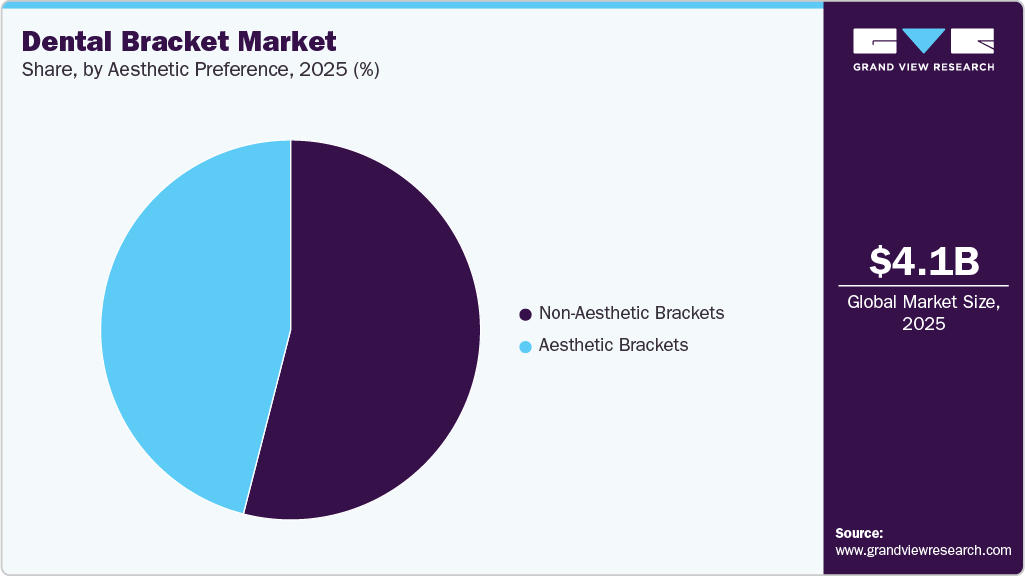
The non-aesthetic brackets dominate the market in 2025, due to their cost-effectiveness, durability, and strong clinical performance. They are widely preferred for complex orthodontic cases requiring precise tooth movement and higher mechanical strength. Their affordability makes them accessible across large patient populations, particularly in price-sensitive markets. Orthodontists’ familiarity and established treatment protocols further reinforce their usage. Additionally, continuous improvements in design, including reduced size and enhanced comfort, have sustained patient acceptance, supporting their continued dominance despite rising aesthetic alternatives.
 To learn more about this report, Download Free Sample Report
 The aesthetic brackets segment is expected to grow at the fastest rate over the forecast period, due to increasing demand for discreet orthodontic treatments. Rising awareness of dental appearance and self-image, particularly among adults and working professionals, is a key driver. Advancements in ceramic and clear materials have improved durability and stain resistance, enhancing clinical acceptance. Higher disposable incomes and willingness to invest in cosmetic dentistry further support adoption. Furthermore, social media influence and image-conscious lifestyles are accelerating preference for less visible orthodontic solutions.
Regional Insights
The North America dental bracket market is growing mainly due to rising demand for cosmetic orthodontic treatments and increasing awareness about dental aesthetics. In the U.S., Canada, and Mexico, growth is mainly driven by a shift toward visually appealing orthodontic solutions such as ceramic brackets, as patients prefer discreet alternatives to traditional metal braces.
 To learn more about this report, Download Free Sample Report
 U.S. Dental Bracket Market Trends
The U.S. dental bracket market is witnessing significant growth, driven by the increase in overall dental expenditures and improved affordability of orthodontic treatments. In recent years, consumers in the U.S. have been allocating higher spending toward dental care, supported by rising disposable incomes and greater emphasis on preventive and corrective oral health. For instance, in 2024, according to the American Dental Association, national dental expenditure in the U.S. reached USD 189 billion, accounting for 3.6% of total health expenditure. Private dental insurance spending grew by 2.3%, while out-of-pocket payments increased by 3.3%. Government spending rose by 9%, mainly driven by higher Medicare related dental expenditures. These rising dental expenditures and expanding insurance coverage are expected to further support the steady growth of the U.S. dental bracket market.
Europe Dental Bracket Market Trends
Dental bracket market in Europe is witnessing strong growth due to rising demand for cosmetic orthodontic treatments and increasing focus on dental aesthetics across countries such as the UK, Germany, France, Italy, Spain, Denmark, Sweden, and Norway. A major growth driver is the rapid advancement in orthodontic technologies, including ceramic brackets, self-ligating systems, and digitally designed customized braces, which offer better comfort, faster treatment, and improved visual appeal.
The UK dental bracket market is growing due to rising health consciousness and increasing consumer preference for natural oral care products. A growing number of consumers are becoming more aware of the potential concerns associated with synthetic ingredients and are actively seeking safer, plant-based, and chemical-free alternatives for daily use. This shift is strongly influenced by wellness trends, preventive healthcare awareness, and demand for holistic personal care solutions.
Dental bracket market in France is steadily expanding, driven by stringent medical device regulations aligned with the EU Medical Device Regulation (MDR). These regulations require strict product classification, comprehensive safety testing, and clinical validation for orthodontic devices, ensuring high standards of product quality and patient safety. While this regulatory framework increases compliance requirements for manufacturers, including higher costs and longer approval timelines, it also strengthens market credibility. As a result, greater trust is established among dental professionals and patients, which supports the sustained adoption and growth of dental bracket market.
Asia Pacific Dental Bracket Market Trends
The Asia Pacific dental bracket market is gaining momentum, driven by the rising middle-class incomes, which are increasing consumer spending on premium and specialized oral care products. For instance, according to People Research on India’s Consumer Economy (PRICE), India’s economy is set for significant transformation, shifting from an aspirer-led to a middle-class driven model. Total income is projected to grow from USD 2.2 trillion in 2021 to USD 7.1 trillion by 2031, while consumer spending is expected to rise from USD 1.9 trillion to nearly USD 5.2 trillion. This strong rise in income and consumption is expected to significantly boost demand for dental brackets, as more consumers prioritize appearance and advanced orthodontic treatments across the region.
Dental bracket market in China is growing rapidly, driven by a combination of social, economic, and healthcare developments. Increasing emphasis on facial aesthetics and social media influence is driving younger populations to seek discreet dental correction solutions such as ceramic and clear brackets. In China, appearance has become closely linked with personal confidence and social acceptance, especially among urban youth and working professionals. The widespread use of social media platforms has further amplified awareness of facial symmetry and smile aesthetics, encouraging individuals to invest in orthodontic treatments that are less visible in daily interactions and online presence.
Latin America Dental Bracket Market Trends
The Latin America dental bracket market is growing steadily due to rising demand for cosmetic dentistry and increasing awareness of dental aesthetics across countries such as Brazil and Argentina. Growth is strongly supported by the rapid expansion of dental clinics, hospitals, and specialty orthodontic centers, which are improving access to advanced orthodontic treatments.In addition, urbanization and greater exposure to social media trends are boosting demand for visually appealing dental solutions.
MEA Dental Bracket Market Trends
The MEA dental bracket market is gradually emerging, due to a combination of evolving healthcare systems and changing patient expectations across countries such as Saudi Arabia, UAE, Kuwait, and South Africa. In these markets, rising investment in modern dental clinics and expansion of private orthodontic practices are improving access to advanced treatment options including ceramic and lingual brackets. At the same time, increasing adoption of digital dentistry tools such as CAD/CAM systems and 3D scanning is enhancing treatment precision and efficiency, encouraging wider use of aesthetic brackets.
Key Dental Bracket Company Insights
Some of the key companies in the dental bracket market include 3M, Ormco Corporation, Dentsply Sirona, FORESTADENT Bernhard Förster GmbH, G&H Orthodontics, DENTAURUM GmbH & Co. KG, TP Orthodontics, Inc., and OrthoAmerica Holdings, LLC. Organizations are focusing on increasing customer base to gain a competitive edge in the industry. Therefore, key players are taking several strategic initiatives, such as product launch, and partnerships with other major companies.
Key Dental Bracket Companies:
The following key companies have been profiled for this study on the dental bracket market.
- 3M
- Ormco Corporation
- Dentsply Sirona
- FORESTADENT Bernhard Förster GmbH
- G&H Orthodontics
- DENTAURUM GmbH & Co. KG
- TP Orthodontics, Inc.
- OrthoAmerica Holdings, LLC.
- GC Orthodontics
- ADENTA GMBH
- HANGZHOU SHINYE ORTHODONTIC PRODUCTS CO., LTD.
- Zhejiang Yahong Medical Apparatus Co., Ltd.
Recent Developments
-
In April 2026, LightForce Orthodontics launched LightBracket Metal, the world’s first patient-specific 3D-printed metal bracket. This innovation expands individualized orthodontic treatment into fixed braces, creating a new category of generative braces. The development aims to improve treatment precision and broaden access to customized orthodontic care.
-
In April 2026, Ormco Corporation announced the expansion of its Digital Bonding (ODB) technology to support most of its orthodontic bracket portfolio, strengthening its digital orthodontic solutions. The company likely to showcase its enhanced EtchFree Bonding system at the AAO 2026 Annual Session in Orlando. This development highlights Ormco’s continued focus on advancing digital orthodontic treatment technologies.
-
In February 2026, Dentsply Sirona and Burkhart Dental Supply expanded their distribution partnership from April 1 to include full dental technology equipment along with preventive and restorative products. The collaboration aims to improve access to digital solutions, clinical tools, and streamlined workflows for dental professionals, strengthening adoption of advanced dental systems including bracket solutions.
-
In November 2025, Clove Dental launched its first Orthodontic Centre of Excellence in Gurugram, focusing exclusively on braces and aligner treatments. The facility provides full-time orthodontist support along with advanced digital scanning and treatment monitoring. It enhances patient care for issues related to bracket adjustments, wire problems, and other orthodontic concerns.
-
In August 2023, LightForce Orthodontics, based in Cambridge, Massachusetts, USA, raised USD 80 million in Series D funding led by Ally Bridge Group, Transformation Capital, and CareCapital. The company plans to expand its customized ceramic components, including additively manufactured dental brackets. Existing and new investors also participated in the funding round.
Dental Bracket Market Report Scope
Report Attribute
Details
Market size in 2025
USD 4.1 billion
Estimated Market size in 2026
USD 4.4 billion
Projected Market size by 2033
USD 6.9 billion
Growth rate
CAGR of 6.6% from 2026 to 2033
Base year for estimation
2025
Actual estimates/Historical data
2021 - 2024
Forecast period
2026 - 2033
Market representation
Revenue in USD Million/Billion and CAGR from 2026 to 2033
Segments covered
Material type, ligation type, demographics, aesthetic preference, region
Regional scope
North America; Europe; Asia Pacific; Latin America; Middle East & Africa
Country scope
U.S.; Canada; Mexico; UK; Germany; France; Italy; Spain; Denmark; Sweden; Norway; Japan; China; India; Thailand; Australia; South Korea; Brazil; Argentina; South Africa; Saudi Arabia; UAE; Kuwait
Key companies profiled
3M; Ormco Corporation; Dentsply Sirona; FORESTADENT Bernhard Förster GmbH; G&H Orthodontics; DENTAURUM GmbH & Co. KG; TP Orthodontics, Inc.; OrthoAmerica Holdings, LLC.; GC Orthodontics; ADENTA GMBH; HANGZHOU SHINYE ORTHODONTIC PRODUCTS CO., LTD.; Zhejiang Yahong Medical Apparatus Co., Ltd.
Customization scope
Free report customization (equivalent up to 8 analyst’s working days) with purchase. Addition or alteration to country, regional & segment scope
Pricing and purchase options
Avail customized purchase options to meet your exact research needs. Explore purchase options
Global Dental Bracket Market Report Segmentation
This report forecasts revenue growth at global, regional & country levels and provides an analysis of the latest industry trends in each of the sub-segments from 2021 to 2033. For this study, Grand View Research has segmented the global dental bracket market report based on material type, ligation type, demographics, aesthetic preference, and region:
-
Material Type Outlook (Revenue, USD Million, 2021 - 2033)
-
Metallic Brackets
-
Ceramic / Aesthetic
-
Polycarbonate
-
Hybrid Brackets
-
-
Ligation Type Outlook (Revenue, USD Million, 2021 - 2033)
-
Conventional Ligation
-
Self-Ligating Brackets
-
-
Demographics Outlook (Revenue, USD Million, 2021 - 2033)
-
Adult
-
Pediatric
-
Adolescent
-
-
Aesthetic Preference Outlook (Revenue, USD Million, 2021 - 2033)
-
Aesthetic Brackets
-
Non-Aesthetic Brackets
-
-
Regional Outlook (Revenue, USD Million, 2021 - 2033)
-
North America
-
U.S.
-
Canada
-
Mexico
-
-
Europe
-
UK
-
Germany
-
France
-
Italy
-
Spain
-
Denmark
-
Sweden
-
Norway
-
-
Asia Pacific
-
Japan
-
China
-
India
-
Thailand
-
Australia
-
South Korea
-
-
Latin America
-
Brazil
-
Argentina
-
-
Middle East & Africa
-
South Africa
-
Saudi Arabia
-
UAE
-
Kuwait
-
-
Frequently Asked Questions About This Report
North America dominated with a 35.4% revenue share in 2025.
Asia Pacific is the fastest-growing region over the forecast period.
Conventional ligation segment held the largest revenue share in 2025.
The adolescent segment led the market with the largest revenue share in 2025.
Non-aesthetic brackets segment held the largest share in 2025, while aesthetic brackets is the fastest-growing segment.
The global dental bracket market size was valued at USD 4.1 billion in 2025 and is estimated at USD 4.4 billion for 2026.
The global dental bracket market is expected to grow at a CAGR of 6.6% from 2026 to 2033, reaching USD 6.9 billion by 2033.
The metallic brackets segment dominated the dental bracket market in 2025 driven by their high durability, cost-effectiveness, and clinical reliability. Orthodontists prefer them for complex tooth movements due to superior strength and reduced breakage risk.
Key players include 3M; Ormco Corporation; Dentsply Sirona; FORESTADENT Bernhard Förster GmbH; G&H Orthodontics; DENTAURUM GmbH & Co. KG; TP Orthodontics, Inc.; OrthoAmerica Holdings, LLC.; GC Orthodontics; ADENTA GMBH; HANGZHOU SHINYE ORTHODONTIC PRODUCTS CO., LTD.; Zhejiang Yahong Medical Apparatus Co., Ltd.
The growth of dental bracket is driven by a combination of rising cosmetic awareness, technological advancements in orthodontics, and increasing affordability of dental treatments. In addition, the increasing prevalence of dental disorders, particularly malocclusion, overcrowding, and misaligned teeth, is observed among both children and adults. Poor dietary habits, lack of early dental care, and changing lifestyles have contributed to a higher demand for orthodontic treatments worldwide.
About the Author(s)
Medical Devices Research Team
Healthcare · Medical DevicesThis report was authored by the medical devices research team at Grand View Research - comprising two research analysts, one senior research analyst, and one industry expert - with specialized expertise in the medical devices segment of the healthcare industry. All findings are based on proprietary healthcare databases, executive interviews, and regulatory analysis, subject to internal peer review prior to publication.
Last Updated:
Speak to Analyst

Customize this report to your needs - add regions, segments, or data points, with 20% free customization.
Or view our licence options:


ISO 9001:2015 & 27001:2022 Certified
We are GDPR and CCPA compliant! Your transaction & personal information is safe and secure. For more details, please read our privacy policy.


