
- Home
- »
- Medical Devices
- »
-
Dental Lasers Market Size And Share Report, 2026-2033GVR Report cover

Dental Lasers Market (2026 - 2033)
Size, Share & Trends Analysis Report By Product (Dental Surgical Lasers, Dental Surgical Lasers), By Application, By End Use, By Region, And Segment Forecasts
Market Size, 2025
$375.0MMarket Estimate, 2026
$402.1MMarket Forecast, 2033
$651.2MCAGR, 2026–2033
7.2%Dental Lasers Market Summary
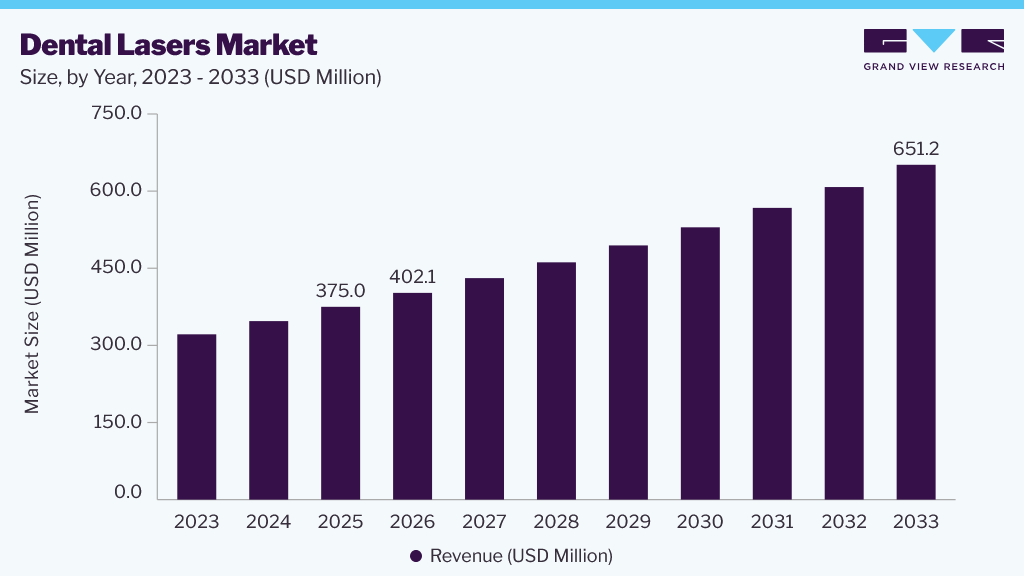
The global dental lasers market size was valued at USD 375.0 million in 2025 and is projected to grow from USD 402.1 million in 2026 to USD 651.2 million by 2033, at a CAGR of 7.2% from 2026 to 2033. North America dominated the market, accounting for a revenue share of 45.0% in 2025. The market growth can be attributed to the increasing prevalence of dental disorders, rising awareness of oral hygiene, and growing adoption of minimally invasive dental procedures.
 Source: Grand View Research, IR Documents, Primary Interviews, Paid DatabasesTo learn more about this report,
 Download Free Sample Report
Key Market Trends & Insights
- By product: The dental surgical laser segment dominated the market, with a revenue share of around 88.0% in 2025.
- By application: The periodontics segment held the largest revenue share of around 20.0% in 2025.
- By end use: The dental clinics segment held the largest market share of over 50.0% in 2025.
Regional Highlights
- Largest regional market: North America (45.0% revenue share, 2025)
- Fastest-growing regional market: Asia Pacific (highest CAGR, 2026-2033)
Market Size & Forecast
- Market size in 2025: USD 375.0 Million
- Estimated market size in 2026: USD 402.1 Million
- Projected market size by 2033: USD 651.2 Million
- CAGR (2026-2033): 7.2%
Three ways to get this report
Buy it, customize it, or ask a question.Ask an Analyst
Analyst response in 1 business day
- AccessReport author, directly
- Reply timeWithin 1 working day
- No sales callDirect answer only
- FormatEmail reply
- CostFree, no cost
Get the Full Report
What the study covers
- FormatsPDF · Excel · Dashboard
- Timeline2026–2033 annual, 2025 base
- Coverage20+ countries, 5 regions
- Companies10+ key players profiled
Customize the Report
20% free customization
- IncludeCountries, segments, points
- TailorTo your product definition
- ExtendDeeper competitor detail
- OrA fully bespoke study
- Turnaround5–10 working days
The technological advancements have improved the accuracy, safety, and adaptability of laser dentistry, making it a more appealing choice for dental practitioners. In addition, several advantages of dental lasers contribute to their growing popularity. They allow minimally invasive operations, which decrease bleeding, hasten healing, and enhance patient comfort. Dental lasers' precision targeting enables accurate and effective treatment of various dental conditions, including cavity fillings, gum surgery, and tooth whitening. These benefits have accelerated product usage in dentistry.Market Dynamics
The market is experiencing steady growth, driven by rising demand for minimally invasive, less painful dental procedures that enhance patient comfort and facilitate faster recovery. Growing awareness of oral health, the rising prevalence of dental disorders, and increasing adoption of advanced dental care technologies are encouraging dental clinics and hospitals to incorporate laser-based treatment systems. In addition, the growing popularity of cosmetic dentistry, coupled with continuous advancements in laser technology, is further supporting market expansion.
The increasing prevalence of dental disorders and complications associated with dental implants is expected to support demand for dental lasers. Conditions such as periodontal disease, dental caries, and peri-implantitis require timely and effective treatment, creating opportunities for minimally invasive technologies. In particular, the growing prevalence of peri-implantitis is increasing the need for effective treatment approaches that can manage inflammation and infection while preserving surrounding tissues. Dental lasers can provide advantages in selected periodontal and peri-implant treatments by enabling precise tissue management and reducing the need for more invasive interventions. For instance, a review published in the National Center for Biotechnology Information (NCBI) reported that solid-state lasers demonstrated positive effects in the nonsurgical treatment of peri-implantitis, including improvements in probing depth (PD), bleeding on probing (BOP), and clinical attachment level (CAL). The growing clinical applications of lasers in periodontal and peri-implant treatments are expected to support their adoption across dental practices.
High initial costs associated with dental laser systems remain a key barrier to adoption, particularly among small dental practices and facilities in price-sensitive and emerging markets. Advanced laser systems can require significant capital investment, while additional costs may arise from maintenance, accessories, and specialized delivery systems. Although technological advancements and increasing competition are gradually improving cost efficiency, the relatively high upfront investment can limit adoption among practices with constrained budgets. In addition, the effective use of dental lasers requires specialized clinical training and familiarity with different wavelengths, power settings, and treatment protocols. Improper selection of laser parameters or application techniques can result in thermal or tissue damage, increasing the importance of operator training and clinical expertise. These requirements can increase the overall cost and time required to adopt laser-based treatment systems, potentially limiting market penetration.
The growing preference for minimally invasive, precise, and patient-centric dental procedures is creating opportunities for the development of advanced dental laser systems. Increasing demand for technologies that offer greater treatment precision, improved procedural control, and enhanced patient comfort is encouraging manufacturers to develop more sophisticated systems for dental practices and specialist clinics. Technological advancements in laser systems include improved wavelength selection, adjustable pulse parameters, enhanced fiber-optic delivery systems, and ergonomically designed handpieces. These innovations are expanding the applicability of dental lasers across hard- and soft-tissue procedures, endodontics, periodontics, oral surgery, and teeth whitening. Furthermore, advances in digital control and laser technology are enabling greater treatment precision, improved usability, and enhanced procedural flexibility. The growing adoption of cosmetic dentistry and preventive oral healthcare is also encouraging the development of specialized laser applications for procedures such as gum contouring, treatment of dental sensitivity, and selected early-stage caries applications. As patients increasingly seek faster, more comfortable, and minimally invasive treatment experiences, dental practices are expected to invest in advanced laser platforms, creating additional growth opportunities during the forecast period.
Product Insights
The dental surgical laser segment accounted for the largest revenue share of around 88.0% in 2025. Dental surgical lasers offer enhanced precision and control during surgical procedures, enabling dentists to selectively target and remove diseased or damaged tissue while preserving surrounding healthy tissue. These capabilities can improve procedural efficiency, patient comfort, and recovery outcomes. For instance, the Laser-Assisted New Attachment Procedure (LANAP) is an FDA-cleared, minimally invasive laser protocol for the treatment of moderate to severe periodontal disease. The protocol has received FDA clearance for true periodontal regeneration based on human histological studies demonstrating regeneration of the attachment apparatus, including new cementum, periodontal ligament, and alveolar bone.
In addition, technological advancements, including the increasing use of diode lasers in periodontal treatments, are supporting segment growth. Laser-based periodontal procedures can help reduce bleeding, inflammation, and postoperative discomfort in selected clinical applications while improving treatment precision. The ability to perform certain procedures with reduced tissue trauma and, in some cases, lower reliance on anesthesia or conventional instruments can further improve the patient experience and encourage the adoption of laser-based surgical systems.
Application Insights
The periodontics segment accounted for the largest share of around 20.0% in 2025. This growth can be attributed to the high prevalence of periodontal diseases, including gingivitis and periodontitis, which are associated with inadequate oral hygiene, aging, and other risk factors. The substantial disease burden continues to drive demand for periodontal diagnosis and treatment, supporting the adoption of laser-based technologies for selected periodontal procedures. According to the Centers for Disease Control and Prevention (CDC), approximately 42% of U.S. adults aged 30 years and older had periodontitis, highlighting the substantial need for periodontal care.
The oral surgery segment is expected to register the fastest CAGR over the forecast period, supported by increasing demand for specialized dental surgical procedures and growing awareness of advanced oral healthcare. As patients increasingly seek timely treatment for complex dental conditions, demand for procedures such as tooth extractions, implant-related interventions, soft-tissue surgery, and other oral surgical procedures is increasing. In addition, the high volume of endodontic procedures represents a significant potential base for applications of laser-based technologies.
End Use Insights
The dental clinics segment accounted for the largest revenue share of over 50.0% in 2025 and is estimated to register the fastest CAGR over the forecast period, retaining its dominance throughout the forecast period. Dental lasers have a broad range of applications in dental clinics, including periodontal treatments, soft-tissue procedures, endodontics, teeth whitening, and selected surgical interventions.
The precise targeting capabilities of dental lasers enable dentists to selectively treat diseased or damaged tissue while minimizing trauma to surrounding healthy tissue. These advantages can contribute to improved procedural precision, patient comfort, and clinical outcomes, supporting adoption among dental practices. In addition, the increasing availability of laser-equipped dental clinics demonstrates growing end user acceptance of technology.
Regional Insights
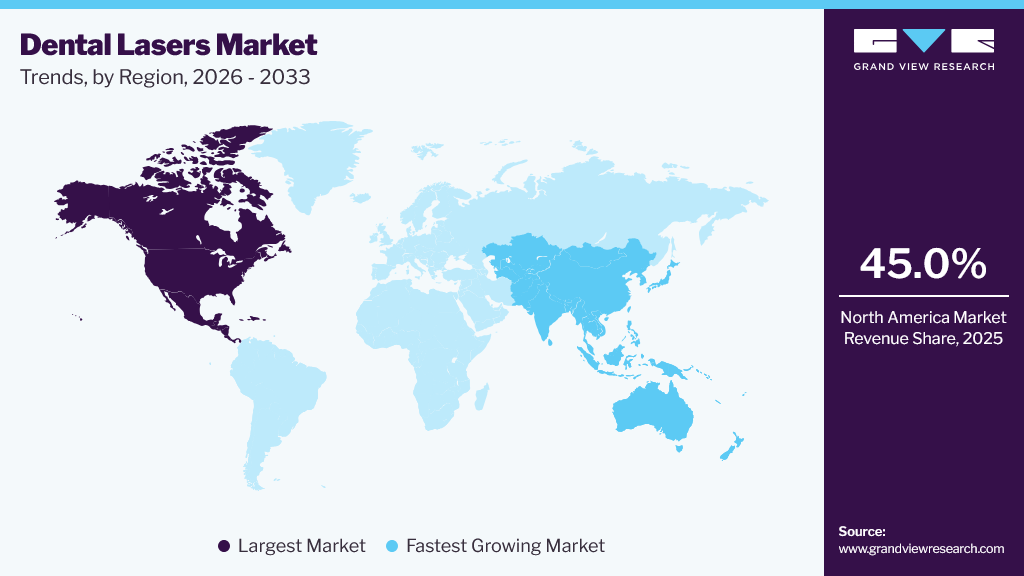
The dental lasers industry in North America accounted for the largest global revenue share of around 45.0% in 2025, supported by the region's strong adoption of advanced dental technologies and growing preference for minimally invasive treatment procedures. The presence of well-established dental care infrastructure, high healthcare expenditure, and increasing awareness of advanced oral healthcare technologies is supporting the adoption of dental lasers across dental clinics and specialist practices. Dental lasers offer advantages such as precise tissue targeting, reduced bleeding, minimized trauma to surrounding tissues, and improved patient comfort, aligning with the growing demand for efficient, less invasive dental procedures. In addition, the presence of leading dental laser manufacturers and increasing investments in product innovation and clinical applications are expected to reinforce the region's market position.
 To learn more about this report, Download Free Sample Report
Asia Pacific Dental Lasers Market Trends
The dental lasers industry in Asia Pacific is estimated to register the fastest CAGR over the forecast period. The growth is supported by rising dental care expenditure, improving healthcare infrastructure, increasing disposable incomes, and growing awareness of advanced oral healthcare technologies across emerging economies. The expansion of private dental clinics and specialist practices is further broadening the customer base for dental laser systems. In addition, the increasing prevalence of dental disorders and growing demand for cosmetic and minimally invasive dental procedures are encouraging dentists to adopt advanced treatment technologies. Improvements in digital dentistry and the gradual adoption of technology-enabled dental care are also expected to support the integration of laser systems into modern dental practices. As manufacturers expand their presence across high-growth Asian markets and introduce more versatile and user-friendly laser platforms, the region is expected to offer significant growth opportunities during the forecast period.
Key Dental Lasers Company Insights
The dental lasers market is competitive, with established manufacturers focusing on product innovation, application expansion, strategic partnerships, and geographic expansion to strengthen their market positions. Companies are increasingly developing versatile laser platforms with improved precision, multiple wavelength options, enhanced digital controls, and ergonomic designs to address a wider range of dental procedures. In addition, manufacturers are focusing on expanding distribution networks, strengthening relationships with dental professionals, and providing training and education programs to accelerate technology adoption.
Key Dental Lasers Companies:
The following key companies have been profiled for this study on the dental lasers market:
-
BIOLASE, Inc.
-
Fotona
-
GIGAALASER Group
-
AMD Lasers, Inc. (formerly CAO Group)
-
Dentsply Sirona Inc.
-
Convergent Dental, Inc.
-
LightScalpel, Inc.
-
Zolar Technology & Manufacturing, Inc.
Recent Developments
-
In September 2025, BIOLASE was acquired by MegaGen Implant, marking a strategic transition aimed at strengthening the company's innovation, customer support, training, and clinical capabilities in dental laser technology. Following the acquisition, BIOLASE expanded its focus on periodontal and implant applications. The developments are expected to broaden the clinical applications of dental lasers and strengthen BIOLASE's competitive position in the market
-
In January 2025, Convergent Dental reached a milestone of 2,000 installed Solea all-tissue lasers across North America, highlighting the growing adoption of laser-based dentistry among dental professionals. The company subsequently expanded the clinical reach of Solea through a June 2025 collaboration with The Ohio State University College of Dentistry
Dental Lasers Market Report Scope
Report Attribute
Details
Market size value in 2025
USD 375.0 million
Market size value in 2026
USD 402.1 million
Revenue forecast in 2033
USD 651.2 million
Growth rate
CAGR of 7.2% from 2026 to 2033
Base year for estimation
2025
Historical data
2021 - 2024
Forecast period
2026 - 2033
Quantitative units
Revenue in USD million and CAGR from 2026 to 2033
Report coverage
Revenue forecast, company ranking, competitive landscape, growth factors, and trends
Segments covered
Product, application, end use, region
Regional Scope
North America; Europe; Asia Pacific; Latin America; Middle East & Africa
Country Scope
U.S.; Canada; Germany; UK; France; Italy; Spain; Norway; Denmark; Sweden; China; Japan; India; Australia; Thailand; South Korea; Brazil; Mexico; Argentina; South Africa; Saudi Arabia; UAE; Kuwait
Key companies profiled
BIOLASE, Inc.; Fotona; Gigaalaser; LightScalpel, Inc.; AMD Lasers, Inc.; Zolar Technology & Manufacturing, Inc.; Dentsply Sirona; Convergent Dental, Inc.
Customization scope
Free report customization (equivalent to 8 analyst working days) with purchase. Addition or alteration to country, regional & segment scope.
Pricing and purchase options
Avail of customized purchase options to meet your exact research needs. Explore purchase options
Global Dental Lasers Market Report Segmentation
This report forecasts revenue growth and provides an analysis of the latest trends in each of the sub-segments from 2021 to 2033. For this report, Grand View Research has segmented the global dental lasers market based on product, application, end use, and region:
- Product Outlook (Revenue, USD Million, 2021 - 2033)
- Dental Surgical Lasers
- Dental Welding Lasers
- Application Outlook (Revenue, USD Million, 2021 - 2033)
- Conservative Dentistry
- Endodontic Treatment
- Oral Surgery
- Implantology
- Peri-implantitis
- Periodontics
- Tooth Whitening
- End Use Outlook (Revenue, USD Million, 2021 - 2033)
- Hospitals
- Dental Clinics
- Others
- Regional Outlook (Revenue, USD Million, 2021 - 2033)
- North America
- U.S.
- Canada
- Europe
- UK
- Germany
- France
- Italy
- Spain
- Sweden
- Norway
- Denmark
- Asia Pacific
- China
- Japan
- India
- Australia
- Thailand
- South Korea
- Latin America
- Brazil
- Mexico
- Argentina
- Middle East and Africa
- Saudi Arabia
- South Africa
- UAE
- Kuwait
- North America
Frequently Asked Questions About This Report
The global dental lasers market is expected to grow at a CAGR of 7.2% from 2026 to 2033, reaching USD 651.2 million.
The global dental lasers market size was valued at USD 375.0 million in 2025 and is estimated at USD 402.1 million for 2026.
North America dominated with approximately 45.0% revenue share in 2025.
Key players in the market include BIOLASE, Inc., Fotona, Gigaalaser, LightScalpel, Inc., AMD Lasers, Inc., Zolar Technology & Manufacturing, Inc., Dentsply Sirona, Convergent Dental, Inc., and others.
Key players in the market include BIOLASE, Inc., Fotona, Gigaalaser, LightScalpel, Inc., AMD Lasers, Inc., Zolar Technology & Manufacturing, Inc., Dentsply Sirona, Convergent Dental, Inc., and others.
About the Author(s)
Medical Devices Research Team
Healthcare · Medical DevicesThis report was authored by the medical devices research team at Grand View Research - comprising two research analysts, one senior research analyst, and one industry expert - with specialized expertise in the medical devices segment of the healthcare industry. All findings are based on proprietary healthcare databases, executive interviews, and regulatory analysis, subject to internal peer review prior to publication.
Last Updated:
Speak to Analyst

Customize this report to your needs - add regions, segments, or data points, with 20% free customization.
Or view our licence options:


ISO 9001:2015 & 27001:2022 Certified
We are GDPR and CCPA compliant! Your transaction & personal information is safe and secure. For more details, please read our privacy policy.


