
- Home
- »
- Display Technologies
- »
-
Digital Signage Market Size And Share Report, 2026-2033GVR Report cover

Digital Signage Market (2026 - 2033)
Size, Share & Trends Analysis Report By Type (Video Walls, Transparent LED Screens), By Component (Hardware, Software), By Technology, By Screen Size, By Resolution, By Content Category, By Location, By Application, By Region, And Segment Forecasts
Market Size, 2025
$31.1BMarket Estimate, 2026
$33.6BMarket Forecast, 2033
$58.4BCAGR, 2026–2033
8.2%Digital Signage Market Summary
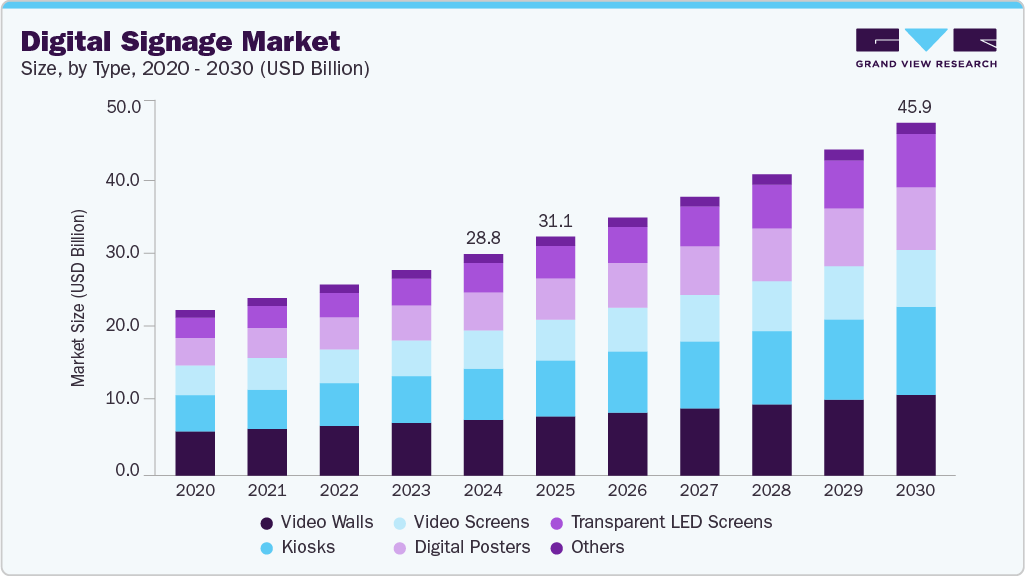
The global digital signage market was valued at USD 31.1 billion in 2025 and is projected to grow from USD 33.6 billion in 2026 to USD 58.4 billion by 2033, at a CAGR of 8.2% from 2026 to 2033. North America dominated the market, with a revenue share of 35.6% in 2025. Growing demand for digital promotion, the use of digital signage for highway and menu displays, and its ability to grab attention are the key drivers of market growth.
 Source: Grand View Research, IR Documents, Primary Interviews, Paid DatabasesTo learn more about this report,
 Download Free Sample Report
Key Market Trends & Insights
- By type: Video walls segment held the largest market share of 25.5% in 2025.
- By component: Hardware segment held the largest market share of 59.1% in 2025.
- By technology: LCD segment held the largest market share of 40.4% in 2025.
- By screen size: 32 to 52 inches segment held the largest market share of 47.3% in 2025.
- By resolution: 4K segment held the largest market share of 40.7% in 2025.
- By content category: Non-broadcast segment held the largest market share of 55.9% in 2025.
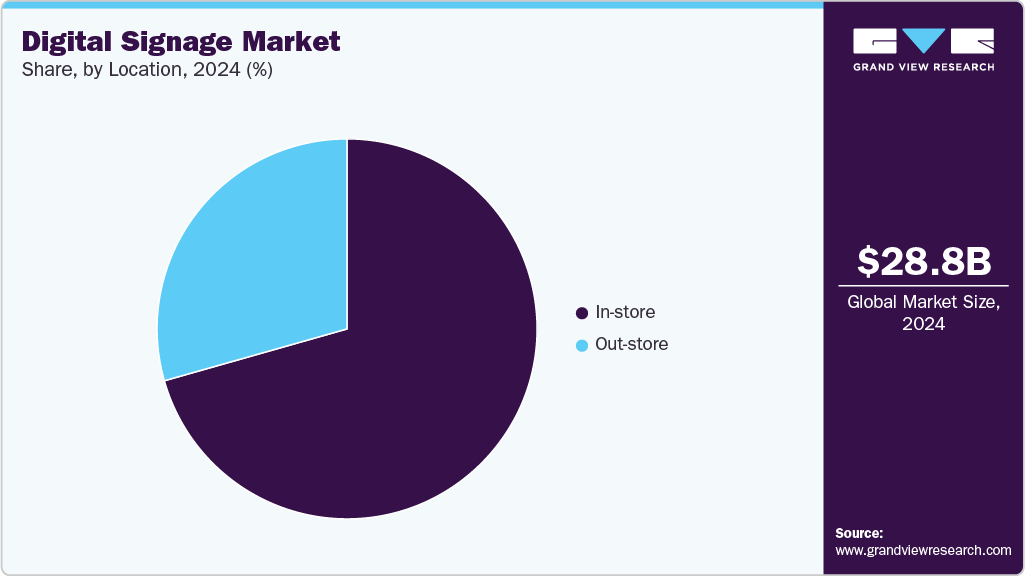
- By location: In-store segment held the largest market share of 70.2% in 2025.
- By application: Retail segment held the largest market share of 18.6% in 2025.
Regional Highlights
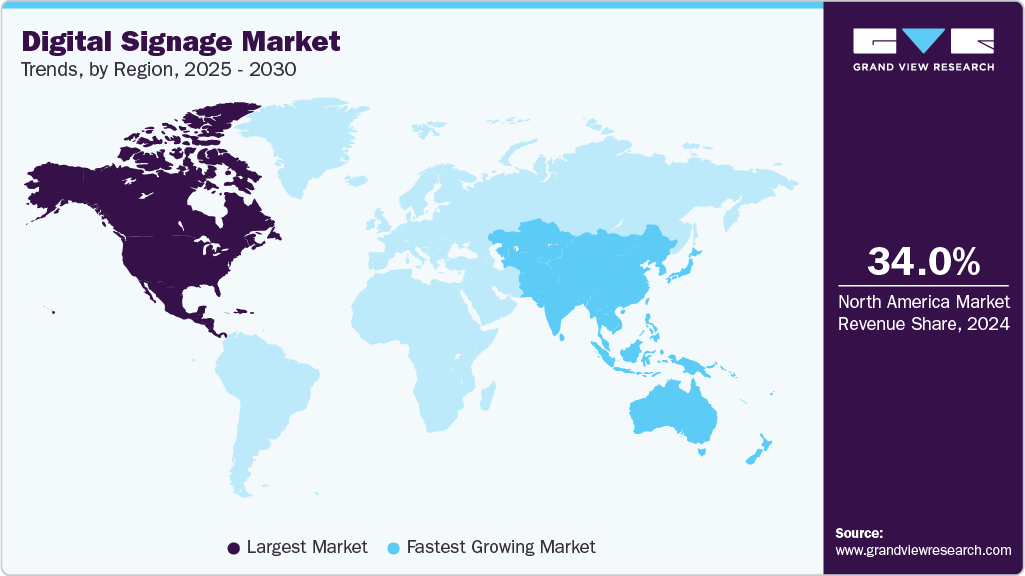
- Largest regional market: North America (35.6% revenue share, 2025)
- Fastest-growing regional market: Asia Pacific (highest CAGR, 2026-2033)
Market Size & Forecast
- Market size in 2025: USD 31.1 Billion
- Estimated market size in 2026: USD 33.6 Billion
- Projected market size by 2033: USD 58.4 Billion
- CAGR (2026-2033): 8.2%
Three ways to get this report
Buy it, customize it, or ask a question.Ask an Analyst
Analyst response in 1 business day
- AccessReport author, directly
- Reply timeWithin 1 working day
- No sales callDirect answer only
- FormatEmail reply
- CostFree, no cost
Get the Full Report
What the study covers
- FormatsPDF · Excel · Dashboard
- Timeline2026–2033 annual, 2025 base
- Coverage20+ countries, 5 regions
- Companies10+ key players profiled
Customize the Report
20% free customization
- IncludeCountries, segments, points
- TailorTo your product definition
- ExtendDeeper competitor detail
- OrA fully bespoke study
- Turnaround5–10 working days
Digital signage are becoming more robust and can be used outdoors under different conditions. This is further helping digital signage to take over conventional signage for outdoor advertisements. The demand for 4K digital signage displays with integrated software and media players is increasing because these solutions offer customers affordable Ultra HD digital signage capabilities. The availability of integrated solutions that combine high-resolution displays with embedded software and media players is expected to further support market demand. In addition, the development of innovative products, such as home monitoring systems and leak detection systems, along with complex financial products such as forex cards, is increasing the need for informative, concise, and visually engaging advertising content. These factors are expected to contribute to the growing demand for digital signage solutions during the forecast period.
 To learn more about this report, Download Free Sample Report
Moreover, the increasing demand for advanced products and services that require digitized information management and remote access to information and guidance is expected to be a key factor driving the global digital signage market during the forecast period. Digital signage boards enable businesses and organizations to provide high-quality information to large audiences through strategically positioned, large-format display screens in locations with concentrated target audiences. By presenting information in a digital format that incorporates motion, images, graphics, and other visual elements, digital signage can capture consumer attention more effectively and deliver a greater impact than traditional communication and advertising methods. Furthermore, the integration of biometric technologies with modern digital signage solutions has enabled the development of advanced applications, including heat-path and gaze-tracking.
Gaze-tracking technology enables businesses to identify areas that attract greater consumer attention and locate locations with higher concentrations of viewers. These capabilities enable companies to better understand consumer behavior and preferences, thereby supporting the development of more effective, targeted marketing strategies. Consequently, the increasing adoption of technologies such as gaze tracking and heat-path analysis is expected to strengthen demand for advanced digital signage solutions over the coming years. At the same time, growing consumer awareness of the limitations and complexities associated with traditional advertising methods, including the short-lived nature and limited flexibility of print-based marketing, is encouraging businesses to adopt digital advertising solutions. Furthermore, display designers, researchers, and advertising companies are increasing their investments in improving display technologies, enhancing visual quality, and developing more sophisticated digital signage solutions. These ongoing technological advancements and investments are expected to further support the adoption and expansion of digital signage displays during the forecast period.
Collectively, these factors are expected to contribute to the overall growth of the digital signage industry. Ongoing advancements in display technologies, including the evolution of LCD, LED, UHD, OLED, and Super AMOLED, are further supporting industry expansion. These technologies have significantly improved display quality, enabling businesses to deliver sharper, more vibrant, and visually appealing advertising content that can create a stronger impact on target audiences. The increasing adoption of advanced display technologies by digital poster providers is therefore expected to support overall market growth. In addition, recent product innovations focused on sustainability and energy efficiency demonstrate how technological advancements are continuing to transform the digital signage landscape and create more environmentally sustainable solutions.
For instance, in October 2024, Praevar Corporation announced ePoster, a sustainable digital signage solution designed for indoor advertising and retail applications. Powered by a 32-inch E Ink Spectra 6 display, ePoster delivers full-color visuals while consuming significantly less energy than conventional digital displays. The solution is designed to replace traditional paper posters, thereby helping businesses reduce paper consumption and minimize their environmental impact. Such innovations highlight the growing integration of sustainability considerations into digital signage product development and are expected to encourage the adoption of energy-efficient display solutions.
However, several technological and operational challenges may limit market growth. Issues related to software and hardware compatibility, electrical interfaces, and connectivity can create integration and deployment difficulties, particularly when combining components from different manufacturers. Such compatibility and connectivity constraints may increase system complexity and installation costs, potentially slowing adoption among certain end users. Moreover, the complex taxation structures associated with the installation and operation of digital signs and screens, together with regulatory requirements such as licensing and approval procedures, are expected to pose additional challenges to market expansion. These regulatory and administrative barriers may lengthen deployment timelines and increase overall costs, thereby potentially constraining the market growth during the forecast period.
Key Takeaways
-
The digital signage market is driven by the shift from traditional advertising and communication toward dynamic, interactive, and data-driven content. Growing adoption across retail, transportation, hospitality, healthcare, corporate, and public environments is being supported by advancements in 4K, 8K, LED, OLED, IoT, biometric technologies, and remote content management, enabling more targeted and engaging communication.
-
The video walls are actively deployed across transportation hubs, sports arenas, entertainment venues, and public spaces. Their ability to deliver high-definition advertising, real-time information, wayfinding, emergency alerts, live feeds, and interactive content is strengthening demand for large-format digital displays.
-
The digital signage hardware segment reflects substantial demand for displays, media players, and related equipment. In addition to hardware, businesses are increasingly adopting software to centralize content management, facilitate remote device monitoring, and enable omnichannel communication platforms that synchronize digital signage with online, mobile, and in-store marketing campaigns.
-
Retail remains the leading sector, supported by increasing use of digital displays for product promotion, targeted advertising, dynamic pricing, and customer engagement. Digital signage enables retailers to deliver personalized and real-time content, with studies indicating that the use of digital displays can increase store foot traffic and improve the effectiveness of in-store marketing initiatives.
-
4K displays and advanced display technologies are reshaping the market by enabling sharper, more immersive, and visually engaging content. The growing availability of 4K-compatible cameras, production tools, and content management systems is facilitating adoption across retail, hospitality, entertainment, and outdoor applications, while OLED and transparent LED technologies are creating additional opportunities for premium and experiential signage.
-
North America showcased its established digital signage suppliers ecosystem and a strong adoption across retail, corporate, healthcare, and institutional environments. Meanwhile, Asia Pacific is expected to register the fastest growth through 2033, driven by urbanization, expanding retail infrastructure, smart-city initiatives, rising disposable incomes, and growing deployment of digital signage across transportation and public spaces.
-
The market presents significant opportunities through the integration of 5G, IoT, augmented reality, biometric technologies, and artificial intelligence, enabling real-time content delivery, audience analytics, personalization, and interactive experiences. However, high installation and maintenance costs, hardware-software compatibility, connectivity limitations, energy consumption, and regulatory requirements remain key challenges that could constrain adoption, particularly among cost-sensitive end users.
Market Dynamics
The digital signage market is evolving rapidly as businesses and public organizations increasingly adopt digital displays to improve communication, advertising, customer engagement, and information delivery. Technological advancements in display resolution, connectivity, content management, and interactive capabilities are expanding the applications of digital signage across retail, transportation, hospitality, healthcare, entertainment, and corporate environments. At the same time, the growing adoption of smart infrastructure, connected devices, and data-driven communication is creating new opportunities for market participants. However, high deployment costs, integration complexities, maintenance requirements, and regulatory considerations continue to pose challenges. Against this backdrop, technological innovation, changing consumer expectations, and the transition toward digital and interactive communication are shaping the market's growth trajectory.
The growth of the retail and e-commerce sectors is driving demand for 4K embedded displays as retailers increasingly adopt advanced technologies to deliver personalized and engaging shopping experiences. Smart shelves and digital displays provide product information, guide customers, and enable seamless purchasing, while the high-resolution, large-screen format of 4K displays enhances visual engagement and customer satisfaction. Similarly, the adoption of smart infrastructure across public and private spaces is creating opportunities for 4K embedded displays by improving information dissemination, connectivity, and user interaction.
In the advertising and marketing sector, 4K embedded displays enable brands to deliver high-definition content that effectively communicates product features and brand identity. This is particularly valuable for luxury goods, real estate, and high-end services. The growing adoption of experiential marketing is further supporting demand for large-format, high-resolution displays that can integrate with augmented reality (AR) and virtual reality (VR) technologies to create immersive customer experiences.
The growing emphasis on energy efficiency and sustainability is also encouraging the adoption of advanced display technologies, particularly LED- and OLED-based solutions that offer high image quality while consuming less energy. As businesses and policymakers prioritize reducing carbon footprints and operating costs, energy-efficient 4K displays are becoming increasingly attractive.
Furthermore, the expanding events and entertainment industry is driving demand for high-resolution displays across concerts, sports events, exhibitions, and conferences. In April 2024, LDLC Arena in France partnered with Alabama Média to install a 17-tonne 4K LED cube. Its modular design enables flexible configurations and supports a range of event applications, demonstrating the growing use of 4K displays to enhance audience engagement and deliver premium viewing experiences.
The high initial and recurring costs associated with digital signage deployment can restrain market adoption, particularly among small businesses and organizations in underserved areas. In addition to hardware and software, installation requires investments in wiring, mounting structures, power systems, and, for outdoor applications, weatherproof enclosures, cooling systems, and anti-vandalism measures. Limited access to electricity or internet connectivity can further increase costs through the need for alternative power and connectivity solutions. According to the Federation of European Screen Printing Associations, digital signage displays measuring 40 inches or larger cost approximately EUR 700 (USD 735) in Europe, excluding housing, mounting, and software expenses.
Ongoing costs for maintenance, software updates, content management, technical support, energy consumption, and backup systems further increase the total cost of ownership. These expenses can prolong ROI timelines and discourage adoption, particularly in cost-sensitive markets. Moreover, energy-efficient LED and OLED displays generally involve higher upfront costs despite offering long-term energy savings. Consequently, high deployment and operating costs remain a key challenge to the wider adoption and growth of the digital signage market.
The growing adoption of smart stadiums presents significant opportunities for the digital signage market as venues increasingly integrate advanced technologies to enhance fan experiences and improve operational efficiency. Digital displays provide real-time information, including scores, player statistics, wayfinding, and emergency alerts, while creating opportunities for integration with IoT, augmented reality (AR), and mobile applications. This is driving demand for high-quality, responsive, and adaptable signage solutions.
The increasing focus on sustainability and energy efficiency is also creating opportunities for providers to develop eco-friendly displays that reduce energy consumption and carbon emissions while maintaining high performance. Compliance with stringent environmental regulations, particularly in Europe, can provide vendors with a competitive advantage as demand for sustainable technologies increases. The expansion of 5G infrastructure further supports market growth by enabling high-speed, low-latency connectivity for real-time updates, live streaming, instant replays, and interactive content. It also facilitates AR applications that allow spectators to access player information and personalized content through smartphones.
Furthermore, the growing emphasis on fan engagement and gamification is expanding the role of digital signage beyond information delivery. Interactive features such as trivia, scavenger hunts, and live voting can be accessed through mobile applications or QR codes, encouraging participation and increasing visitor engagement. Digital signage providers offering solutions with gamification, mobile connectivity, and interactive capabilities are therefore well-positioned to capitalize on emerging opportunities in smart stadiums.
Analyst Perspective
The digital signage market is experiencing steady growth as retail, advertising, transportation, hospitality, healthcare, and public spaces increasingly adopt digital communication. High-resolution technologies such as 4K, LED, OLED, and UHD displays are enabling dynamic content and enhanced customer engagement, while smart infrastructure and the shift from traditional to interactive advertising support expansion. However, high hardware, installation, maintenance, energy, and content-management costs remain key restraints. Smart stadiums and connected environments present opportunities through integration with 5G, IoT, AR, mobile applications, and gamification, enabling real-time and personalized experiences. Sustainability trends are also driving demand for energy-efficient displays. Vendors combining performance, connectivity, interactivity, and energy efficiency are positioned to capture emerging opportunities.
Type Insights
The video walls segment dominated the digital signage market, accounting for a 25.5% revenue share in 2025. This dominance can be attributed to the growing deployment of video walls across public spaces and transportation hubs. Airports, railway stations, and bus terminals are increasingly adopting these large-format displays to deliver real-time information, advertisements, and entertainment to travelers. Video walls are particularly effective for displaying schedules, wayfinding information, and emergency alerts, enabling critical messages to reach large audiences in a clear and efficient medium. Furthermore, their use in sports arenas and entertainment venues continues to expand, enhancing the spectator experience through high-definition replays, live feeds, and interactive content.
In June 2025, Barco and Unilumin announced a partnership to provide advanced LED video wall solutions by combining Unilumin’s sub-0.9mm pixel-pitch displays with Barco’s Infinipix Gen2 image-processing technology. The collaboration is designed to enhance visual performance across high-quality indoor and outdoor digital signage applications. By delivering LED solutions with improved image quality and operational efficiency, the partnership is expected to support broader adoption of video walls across commercial and professional signage applications, thereby contributing to market growth.
The transparent LED screens segment is expected to grow at the fastest CAGR of 10.4% over the forecast period. These displays offer transparency levels exceeding 80% while maintaining high-resolution visual output, making them suitable for applications where visibility and aesthetics are significant. In addition, transparent LED screens are relatively energy-efficient, helping reduce power consumption and optimize operating costs for end users. The combination of high transparency, visual performance, and energy efficiency is expected to drive demand for transparent LED screens over the next six years, supporting sustained growth of the segment.
Component Insights
The hardware segment dominated the digital signage industry, accounting for the largest revenue share of 59.1% in 2025. The hardware includes displays and auxiliary components required for the installation of digital panels, banners, and other types of digital signage. The relatively high volume and cost of hardware components contribute to the segment’s substantial share of the overall market. In addition, the growing adoption of innovative display technologies, including 1080p, 4K, and 8K displays, is expected to drive demand for digital signage hardware in the coming years. Advancements in 3D display technology have also enabled the development of glasses free 3D displays, expanding their applicability across various digital signage and product-display applications.
The software segment is projected to grow at the fastest CAGR of 8.5% during the forecast period. The increasing adoption of omnichannel marketing strategies is driving the demand for comprehensive digital signage software solutions that enable brands to deliver seamless and integrated experiences across physical and digital touchpoints. Digital signage software plays a critical role in maintaining consistent and synchronized messaging across online platforms, mobile applications, and physical retail environments. The ability to centrally manage and deploy content aligned with digital and social media campaigns enables businesses to establish a unified brand identity, strengthen brand recall, and foster customer loyalty.
Manufacturers are increasingly integrating advanced software solutions with hardware to simplify content management and facilitate large-scale digital signage deployments. For instance, in September 2025, Samsung Electronics expanded its partnership with Toyota Motor, providing 23,000 smart signage displays along with remote management software to support the modernization of Toyota dealerships worldwide. The initiative is based on the successful transformation of 1,250 dealerships across Europe and aims to enhance customer engagement while streamlining content management through advanced software capabilities. The expansion is expected to support market growth, particularly within the software segment, by increasing demand for centralized content management platforms and large-scale digital signage deployments in the automotive retail sector.
Technology Insights
The LCD segment dominated the digital signage market, accounting for the largest revenue share of 40.4% in 2025. LCD technology is relatively simple to manufacture and offers lower production costs; hence, it is among the most widely adopted display technologies across the advertising and marketing industries. These advantages have contributed to the widespread adoption of LCD displays in digital posters and other signage applications. Additionally, LED technology has gained significant traction as a high-performance display solution, supported by its superior image quality and visual performance. Manufacturers are increasingly focusing on developing flat-panel displays that offer larger screen sizes, higher brightness, and slimmer form factors, further driving innovation across the digital signage industry.
The OLED segment is projected to grow at the fastest CAGR of 9.2% during the forecast period, supported by the growing importance of enhancing in-store customer experiences. OLED displays offer superior visual quality, including high contrast and vibrant imagery, making them particularly effective for creating engaging and visually appealing digital signage. Retailers and luxury brands are increasingly adopting OLED displays for distinctive advertising campaigns and product showcases designed to capture customer attention and elevate the overall shopping experience.
OLED digital signage can support a wide range of applications, from presenting high-definition product images and videos to enabling interactive touch interfaces that provide customers with detailed product information or personalized shopping experiences. According to Electro IQ, sales of consumer electronics featuring OLED displays reached 900 million units in 2023, representing an approximately 15% increase from 780 million units in 2022. The rapid adoption of OLED technology across consumer electronics is expected to further stimulate demand for advanced digital signage solutions, encouraging greater investment in display technologies and supporting innovation across the broader market.
Screen Size Insights
The 32 to 52 inches segment dominated the digital signage industry, accounting for the largest revenue share of 47.3% in 2025. The increasing adoption of interactive and self-service solutions is a key factor driving demand for displays in this size range. As consumers increasingly seek faster and more convenient ways to access services, businesses are deploying digital displays that can function as interactive kiosks for self-service ordering, information retrieval, and customer feedback. Industries such as hospitality, transportation, and public services are increasingly using 32 to 52 inches screens to facilitate check-in processes, deliver real-time travel information, and support ticketing services. These applications help businesses improve operational efficiency, enhance customer convenience, and reduce waiting times.
The more than 52 inches segment is projected to grow at the fastest CAGR of 8.6% during the forecast period. The growing demand for large-format digital signage is driven by the increasing adoption of innovative marketing approaches centered on visual storytelling and experiential marketing. Displays larger than 52 inches enable businesses to deliver high-resolution videos, compelling graphics, and interactive content that can attract attention and encourage deeper customer engagement. Their ability to create immersive and impactful visual experiences has encouraged businesses to increase investments in large-format digital signage as they seek to differentiate themselves in competitive markets and communicate brand messages more effectively. The growing emphasis on customer engagement and memorable brand experiences is expected to further support the adoption of large-format displays over the forecast period.
Resolution Insights
The 4K segment dominated the digital signage industry, accounting for the largest revenue share of 40.7% in 2025. The growing availability of 4K compatible video cameras, content production tools, and content management systems has simplified the creation and deployment of high resolution media. This development enables businesses to produce visually engaging content optimized for 4K displays without significant production or compatibility constraints. Industries that heavily rely on visual communication, including retail, entertainment, and hospitality, have increasingly adopted 4K technology to deliver more immersive advertising and enhance customer experiences.
In June 2025, Allsee launched its advanced 4K Elite Outdoor Digital Signage Displays, initially introducing a 55-inch model. The displays feature high brightness, 4K image resolution, robust weather protection, smart environmental controls, integrated Android 14, and maintenance-friendly designs to support reliable outdoor operation and enhance advertising effectiveness. Such launches are expected to contribute to market growth by supporting the adoption of 4K digital signage across outdoor and commercial applications and encouraging further investment in high-resolution display technologies.
The 8K segment is projected to grow at the fastest CAGR of 9.4% during the forecast period. The increasing demand for highly engaging, visually immersive brand experiences is prompting businesses to explore 8K digital signage solutions. As content creation tools and media players increasingly support 8K resolution, businesses can deploy ultra-high-definition displays across premium retail environments, luxury showrooms, and large-scale public installations. The exceptional image quality offered by 8K displays can enhance brand presentation, attract consumer attention, and strengthen customer engagement. These benefits are expected to encourage greater investment in advanced display technologies and support the growth of the 8K segment over the forecast period.
Content Category Insights
The non-broadcast segment dominated the market, accounting for the largest revenue share of 55.9% in 2025. The growing adoption of non-broadcast digital signage across the corporate sector is driven by the need to strengthen internal communication and employee engagement. Organizations increasingly use these systems to display announcements, communicate company updates, present key performance indicators, and recognize employee achievements. By replacing traditional bulletin boards with dynamic and visually engaging digital displays, businesses can improve the accessibility and effectiveness of internal communications while fostering a more connected workforce. Furthermore, the integration of real-time data enables organizations to deliver timely and relevant information, further enhancing the value of non-broadcast digital signage in corporate environments.
The broadcast segment is projected to grow at the fastest CAGR of 8.9% during the forecast period, supported by the increasing adoption of programmatic advertising. These digital signage networks can be integrated with programmatic advertising platforms, allowing advertisers to purchase and deliver targeted campaigns more efficiently. By leveraging data such as location, time of day, and audience demographics, programmatic advertising enables businesses to deliver more relevant and personalized messages, reducing advertising wastage and improving return on investment. In addition, the ability to dynamically adjust and optimize campaigns in real time creates new revenue opportunities for broadcasters and digital signage operators. The growing adoption of programmatic advertising, coupled with the broader digital transformation of the advertising industry, is expected to further drive demand for broadcast digital signage solutions.
Location Insights
The in-store segment dominated the digital signage market, accounting for a revenue share of 70.2% in 2025. In-store digital signage refers to the deployment of digital posters and displays within enclosed environments, including shopping malls, corporate offices, retail stores, banks, and healthcare facilities. The segment’s leading position is primarily attributable to strong demand from the retail sector, one of the most prominent application areas for digital displays, driven by the growing use of signage for advertising, product promotion, and customer engagement.
In October 2025, Loblaw Advance announced a partnership with STRATACACHE to expand its in-store digital signage network across Loblaw stores. The initiative involves deploying advanced digital screens to enhance shopper engagement and strengthen retail media capabilities, enabling brands to deliver more dynamic and data-driven advertising at the point of purchase. Such initiatives are expected to support market growth by encouraging retailers and brands to increase their adoption of in-store digital signage solutions.
The out-store segment is projected to grow at the fastest CAGR of 9.4% during the forecast period. The growing demand for digital signage in outdoor environments is driven by the expansion of the transportation sector, particularly in developing economies. In addition, the growing need to promote products, services, and events to large audiences is driving the deployment of digital displays in open, high-traffic locations. The growing prevalence of applications such as election campaigns, promotional offers, product and service launches, and live concerts and entertainment events is further supporting demand for outdoor digital signage. These applications enable advertisers and organizations to reach larger audiences with dynamic and visually engaging content, thereby contributing to the segment growth.
Application Insights
The retail segment dominated the digital signage industry, accounting for a revenue share of 18.6% in 2025. Retail is one of the leading end-use sectors for digital signage, as businesses increasingly rely on digitized advertising to promote products and services and engage target customers. Intense competition among retailers, coupled with the growing variety of products and services available in the market, has increased the emphasis on effective and differentiated marketing strategies. To capitalize on these opportunities, retailers are increasingly investing in advanced digital signage solutions that enable dynamic content delivery, targeted promotions, and real-time updates. These capabilities help businesses capture customer attention, improve engagement, and deliver more personalized shopping experiences.
 To learn more about this report, Download Free Sample Report
According to a study by Rise Vision, Inc., retail stores can experience up to a 24% increase in foot traffic through digital displays, particularly when multiple screens are deployed to improve visibility and customer engagement. This highlights the potential of digital signage to influence customer behavior and contribute to increased engagement and sales. Consequently, digital posters and displays are being widely adopted across retail environments as an effective medium for product promotion, brand communication, and customer engagement.
The healthcare segment is projected to register a significant CAGR of 9.9% from 2026 to 2033. The increasing integration of interactive digital signage solutions is a key driver of segment growth. Interactive kiosks and touchscreen displays enable patients and visitors to independently access information, navigate healthcare facilities, schedule appointments, and complete basic administrative tasks. This self-service functionality can help reduce waiting times, improve operational efficiency, and enhance the overall patient experience. In addition, interactive kiosks can collect patient feedback in real time, providing healthcare providers with valuable insights to improve service quality and patient care. The growing emphasis on digitalization and patient-centric services is expected to further support the adoption of digital signage solutions across healthcare facilities.
Regional Insights
The North America digital signage market dominated with a global revenue share of 35.6% in 2025. The region’s leading position is primarily attributed to the strong presence of specialized digital signage suppliers and increasing demand from the retail sector. In the U.S., rising R&D investments aimed at improving display quality and functionality, along with government initiatives to deploy digital signage across offices and public facilities, are further supporting market growth. According to Rise Vision, Inc., 70% of the U.S. hospitals had adopted digital communication systems in 2024, highlighting the growing role of digital signage in enhancing internal communication, patient experiences, and operational efficiency.
 To learn more about this report, Download Free Sample Report
The adoption in the U.S. digital signage market is increasing across corporate, institutional, educational, and healthcare environments. Businesses use digital displays for employee communication, visitor management, performance monitoring, and real-time safety alerts, while educational institutions deploy them for event announcements, emergency notifications, and wayfinding. Healthcare facilities are also adopting digital signage to improve patient experience, manage queues, and deliver telehealth-related information. The broad range of applications demonstrates the versatility of digital signage in delivering timely and relevant content across public and private environments.
For instance, in June 2025, at InfoComm 2025, Allsee announced a strategic partnership with Videri to provide integrated digital signage solutions across the U.S. and North America. The collaboration combines Allsee’s commercial display hardware with Videri’s embedded platform, enabling faster deployment, streamlined operations, and reduced dependence on external hardware. Such partnerships are expected to accelerate the adoption of integrated digital signage solutions and support continued market expansion across the region.
Europe Digital Signage Market Trends
The Europe digital signage industry is projected to witness considerable growth from 2026 to 2033, driven by the increasing adoption of interactive kiosks to improve customer service and operational efficiency. Growing consumer acceptance of self-service technologies is encouraging businesses to invest in digital signage solutions.
The UK digital signage market is expected to grow significantly, supported by increasing adoption across sports and entertainment venues. Stadiums, music venues, and theaters are deploying digital displays for live updates, interactive content, and targeted advertising, enhancing audience engagement and creating additional advertising opportunities.
The digital signage market in Germany is supported by strong demand across the retail and transportation sectors and by the growing adoption of interactive and AI-enabled displays. In June 2025, HYGH and Wildstone announced a strategic partnership to develop a nationwide digital billboard network in Germany, supporting the expansion of digital out-of-home advertising and contributing to market growth.
Asia Pacific Digital Signage Market Trends
The Asia Pacific digital signage industry is expected to grow with the fastest CAGR of 9.5% during the forecast period. The region’s growth can be attributed to increasing awareness of the benefits of digital signage and its expanding adoption across retail stores, corporate offices, hospitals, hotels, and other commercial and public environments. Japan and China are expected to witness significant growth, supported by the increasing deployment of digital signage across these sectors. Rising disposable incomes have contributed to increased foot traffic in shopping malls and multiplexes across emerging economies in the region. Businesses are increasingly leveraging this opportunity to promote products and services through large-format digital displays, which enable them to capture the attention of target audiences more effectively. Furthermore, the growing number of shopping malls and multiplexes is expected to drive the adoption of digital signage across the hospitality and retail sectors over the forecast period.
The China digital signage market held a substantial revenue share of Asia Pacific in 2025, supported by widespread adoption across retail, transportation, and public spaces. Businesses are increasingly using digital displays to enhance customer engagement, improve operational efficiency, and deliver targeted content. Government initiatives, including the Digital Silk Road, are also supporting the development and deployment of digital technologies, creating additional opportunities for digital signage solutions. In addition, rapid urbanization and growing demand for advanced digital infrastructure are driving market expansion. The increasing availability of 5G networks is further supporting the adoption of digital signage by enabling real-time content delivery, remote management, and more efficient operations while helping reduce deployment and operating costs.
Key Digital Signage Company Insights
Key players operating in the digital signage industry are LG Electronics; Samsung Electronics Co., Ltd.; Daktronics Dr.; Microsoft Corporation; and HCL Technologies. The market is highly competitive and moderately fragmented, with established global players competing alongside specialized technology providers and regional vendors. The companies are focusing on various strategic initiatives, including new product development, partnerships & collaborations, and agreements to gain a competitive advantage over their rivals. Competition is increasingly shifting beyond display hardware toward cloud-based content management, AI-enabled personalization, remote device management, analytics, and energy-efficient displays. Strategic partnerships, product launches, acquisitions, and ecosystem development are also becoming important competitive strategies as vendors seek to offer end-to-end solutions. The growing emphasis on interoperability and customized solutions is further creating opportunities for specialized software providers and system integrators, intensifying competition across the digital signage value chain.
Key Digital Signage Companies
The following key companies have been profiled for this study on the digital signage market.
-
Panasonic Corporation
-
Sharp NEC Display Video Walls
Recent Developments
-
In May 2025, Daktronics partnered with the University of Delaware to design, manufacture, and install a cutting-edge LED video display at the university's stadium. Engineered with advanced environmental protection, the display is built to perform reliably in the outdoor conditions of Newark. In addition, Daktronics provided a comprehensive Show Control system. This solution integrates display control software, high-quality video processing, data integration, and playback hardware into a powerful yet intuitive production platform.
-
In February 2025, NoviSign partnered with BrightSign, LLC, to enhance the flexibility and scalability of its digital signage solutions. This collaboration allows businesses to combine NoviSign’s robust software with the trusted reliability and security of BrightSign’s media players. The partnership ensures complete compatibility across BrightSign’s entire product line, enabling smooth integration and high-performance functionality. Designed with user experience in mind, NoviSign’s platform offers interactive features, including touchscreen capabilities, real-time data feeds, and IoT integrations, all optimized for seamless operation with BrightSign hardware.
-
In February 2025, Daktronics Dr. launched the next generation of digital billboard technology for the out-of-home (OOH) advertising market with the launch of the DB-7000. Building on a legacy of proven reliability, the DB-7000 incorporates state-of-the-art, energy-efficient innovations designed to enhance return on investment (ROI) and reduce operational expenses. Developed in collaboration with vendors, the DB-7000 is engineered to lower site power demands and cut operational costs by up to 20%, minimizing environmental impact while ensuring long-lasting, high-quality image performance.
-
In February 2025, Samsung Electronics Co., Ltd. partnered with Cielo to revolutionize retail advertising and franchise operations. This strategic collaboration merges Samsung’s VXT display technology with Cielo’s AI-powered platform, offering innovative tools that enhance digital marketing and operational performance. As part of the alliance, Cielo is launching SmartSigns, a Digital Signage as a Service (DaaS) solution that utilizes Samsung’s VXT technology to deliver targeted messaging with precision.
Value Chain Analysis
The digital signage market value chain comprises hardware and software providers, content developers, distributors, system integrators, resellers, installers, and end users. Each stakeholder contributes to the development, integration, distribution, and deployment of digital signage solutions. The value chain begins with hardware manufacturers, which develop displays, media players, mounts, and other components. Manufacturers continuously invest in R&D to improve display quality, functionality, durability, and energy efficiency. Software and media player management providers complement these offerings with content management and device management platforms that enable users to create, schedule, distribute, and monitor digital content across connected displays.
Content developers, including marketing and advertising agencies, create text, graphics, images, and videos tailored to specific audiences and applications. System integrators and A/V integrators combine hardware, software, networking, and content solutions into integrated systems. Their responsibilities include system configuration, component integration, compliance testing, and ensuring seamless communication between media players and displays.
Distributors facilitate the movement of hardware, software, and complementary components from manufacturers to integrators and resellers. They also provide technical support and product expertise, helping channel partners develop complete solutions. Value-added resellers (VARs) work with hardware, software, and network providers to customize and deliver end-to-end digital signage solutions based on customer requirements. Installers then deploy and configure these systems at end-user locations and provide ongoing technical support.
End users, including retailers, hospitality providers, healthcare organizations, educational institutions, and corporate enterprises, represent the final stage of the value chain. They deploy digital signage for advertising, communication, information dissemination, wayfinding, and customer engagement. Their evolving requirements and feedback drive continued innovation and development across the digital signage ecosystem.
Digital Signage Market Report Scope
Report Attribute
Details
Market size in 2025
USD 31.1 billion
Estimated market size in 2026
USD 33.6 billion
Projected market size by 2033
USD 58.4 billion
Growth rate
CAGR of 8.2% from 2026 to 2033
Base year for estimation
2025
Historical data
2021 - 2024
Forecast period
2026 - 2033
Quantitative units
Revenue in USD billion and CAGR from 2026 to 2033
Report coverage
Revenue forecast, company market position analysis, competitive landscape, growth factors, and trends
Segments covered
Type, component, technology, screen size, resolution, content category, location, application, region
Regional scope
North America; Europe; Asia Pacific; Latin America; Middle East & Africa
Country scope
U.S.; Canada; Mexico; UK; Germany; France; China; India; Japan; Australia; South Korea; Brazil; UAE; Kingdom of Saudi Arabia; South Africa
Key companies profiled
BrightSign, LLC; Cisco Systems, Inc.; Daktronics Dr.; Intel Corporation; KeyWest Technology, Inc.; LG Electronics; Microsoft Corporation; Omnivex Corporation; Panasonic Corporation; Samsung Electronics Co., Ltd.; Scala; Sharp NEC Display Video Walls; Winmate Inc.
Customization scope
Free report customization (equivalent to up to 8 analysts working days) with purchase. Addition or alteration to country, regional & segment scope.
Pricing and purchase options
Avail of customized purchase options to meet your exact research needs. Explore purchase options
Global Digital Signage Market Report Segmentation
This report forecasts revenue growth at the global, regional & country levels and provides an analysis of the latest industry trends in each of the sub-segments from 2021 to 2033. For this study, Grand View Research has segmented the global digital signage market report based on type, component, technology, screen size, resolution, content category, location, application, and region:
-
Type Outlook (Revenue, USD Billion, 2021 - 2033)
-
Video Walls
-
Video Screens
-
Transparent LED Screens
-
Digital Posters
-
Kiosks
-
Interactive Kiosks
-
Self-service Kiosks
-
Others
-
-
Others
-
-
Component Outlook (Revenue, USD Billion, 2021 - 2033)
-
Hardware
-
Display
-
Media Player
-
Projectors
-
Others
-
-
Software
-
Services
-
Installation Services
-
Maintenance & Support Services
-
Consulting Services
-
Others
-
-
-
Technology Outlook (Revenue, USD Billion, 2021 - 2033)
-
LCD
-
LED
-
OLED
-
Projection
-
-
Screen Size Outlook (Revenue, USD Billion, 2021 - 2033)
-
Below 32 Inches
-
32 to 52 Inches
-
More than 52 Inches
-
-
Resolution Outlook (Revenue, USD Billion, 2021 - 2033)
-
8K
-
4K
-
FHD
-
HD
-
Lower than HD
-
-
Content Category Outlook (Revenue, USD Billion, 2021 - 2033)
-
Broadcast
-
News
-
Weather
-
Sports
-
Others
-
-
Non-Broadcast
-
-
Location Outlook (Revenue, USD Billion, 2021 - 2033)
-
In-store
-
Out-store
-
-
Application Outlook (Revenue, USD Billion, 2021 - 2033)
-
Retail
-
Hospitality
-
Entertainment
-
Stadiums & Playgrounds
-
Corporate
-
Banking
-
Healthcare
-
Education
-
Transportation
-
-
Regional Outlook (Revenue, USD Billion, 2021 - 2033)
-
North America
-
U.S.
-
Canada
-
Mexico
-
-
Europe
-
UK
-
Germany
-
France
-
-
Asia Pacific
-
China
-
India
-
Japan
-
South Korea
-
Australia
-
-
Latin America
-
Brazil
-
-
Middle East & Africa
-
UAE
-
Saudi Arabia
-
South Africa
-
-
Scope & Research Methodology
The market study on the digital signage market has been developed using a structured, multi-stage research framework designed to ensure accuracy, consistency, and reliability of the market size estimates and forecasts. The methodology combines quantitative modeling techniques with qualitative validation, following the sequence outlined below.
The digital signage market is segmented into nine levels, namely type, component, technology, screen size, resolution, content category, application, location, and region. In the first level, the market has been split by type as follows:
• Video walls: A video wall is a multi-monitor setup that consists of multiple computer monitors, television sets, or video projectors that are tied together closely or overlaid to form a single large screen.
• Video screens: These refer to the various types of display technologies used to present digital content, each offering different visual qualities, sizes, and applications for advertising, information sharing, and customer engagement.
• Transparent LED Screens: Transparent LED display is a digital signage integrated with LED lamps, which are almost invisible and provide up to 80% transparency. This enables a user to look through the glass window. It allows the user to turn the screen or window into a digital billboard, suitable for advertising all products and services.
• Digital Poster: Digital posters are display posters that represent information in digital format and are primarily used when the content is not remotely updated, or the network infrastructure is unavailable. Digital posters can be categorized into three types, namely portrait, landscape, and freestanding.
• Kiosks: Kiosks (interactive as well as non-interactive) are information providers used for advertisement of transactional sales or valuable customer services. Display panels of interactive and non-interactive kiosks are considered under the scope of this report
• Interactive Kiosks: Interactive kiosks are digital displays that allow users to engage with content through touchscreens or other input methods, providing personalized interactions and services such as information retrieval or transaction processing.
• Self-service Kiosks: Self-service kiosks are automated, stand-alone units that enable customers to independently complete tasks like ordering, payment, or check-in, enhancing operational efficiency and customer convenience.
• Others: It includes non-interactive or specialized kiosks such as advertising-only displays or simple information panels.
• Others: The other digital signage products include menu boards and billboards.
Based on component, the market has been segmented into hardware, software, and services:
• Hardware: The digital signage hardware offerings include systems in the form of displays, media players, projectors, and others.
• Displays: These are physical components used to present digital content, such as images, videos, or interactive media, to an audience. This includes devices like LED screens, LCD panels, OLED displays, projectors, and e-paper screens.
• Media Players: These are physical devices responsible for storing, processing, and delivering digital content to display screens. These devices, which include standalone media players, embedded system-on-chip (SoC) solutions, and external streaming devices, are designed to manage and deliver multimedia content, including videos, images, and interactive applications.
Projectors: This segment includes devices that use light projection technology to display visual content onto surfaces such as walls, screens, or floors.
• Others: This includes enclosures, mounting hardware, cabling and connectors, and power supplies.
• Software: It includes the standalone software required to automate the content displayed on the digital signage.
• Services: The services offered in the digital signage industry include integration & installation, maintenance, and consulting.
• Installation Services: It refers to professional services involved in setting up and deploying digital signage hardware and software solutions. This includes tasks such as site assessment, hardware mounting, wiring, integration of display systems, configuration of media players, and ensuring the proper functioning of the system.
• Maintenance & Support Services: It refers to the ongoing services required to ensure the continuous operation and optimal performance of digital signage systems after installation.
• Consulting Services: It refers to professional advisory services that help businesses plan, design, implement, and optimize their digital signage solutions.
• Others: It includes content creation & management and design services.
Based on technology, the market has been segmented into LCD, LED, OLED, and projection:
• LCD: It includes digital signage that uses Liquid Crystal Displays (LCDs).
• LED: It includes digital signage that uses Light-Emitting Diode (LED)-based displays.
• OLED: It includes digital signage that uses Organic Light-Emitting Diode (OLED)-based displays.
• Projection: It includes digital signage that combines foreground content with pre-filmed background content
Based on screen size, the market has been segmented into below 32 inches, 32 to 52 inches, and more than 52 inches:
• Below 32 inches: It includes digital signage of size below 32 inches, used mostly across closed premises such as retail shops, showrooms, offices, and healthcare facilities.
• 32 to 52 inches: It includes digital signage of size between 32 to 52 inches, used mostly across closed premises, where ample space is available compared to congested showrooms and shops. It is also used in common areas, passages, or lobby areas.
• More than 52 inches: It includes digital signage of size above 52 inches, used mostly across outside premises, in open spaces outside malls, and on roads and stadiums.
Based on resolution, the market has been segmented into below 8K, 4K, FHD, HD, and lower than HD:
• 8K: It refers to displays offering a resolution of 7680 x 4320 pixels, providing ultra-high-definition visuals for large-scale and high-impact applications.
• 4K: It includes displays with a resolution of 3840 x 2160 pixels, delivering high-definition visuals with greater clarity and detail for professional settings.
• FHD: It involves displays with a resolution of 1920 x 1080 pixels, offering standard high-definition quality suitable for most commercial applications.
• HD: It involves displays with a resolution of 1920 x 1080 pixels, offering sharper visuals compared to 720p, making it the preferred choice for medium to large screens in environments requiring detailed content.
• Lower than HD: It includes displays with resolutions below 1920 x 1080 pixels, typically used for simpler, cost-effective signage solutions.
Based on content category, the market has been segmented into below broadcast, and non-broadcast:
• Broadcast: The broadcast market is further segregated into news, weather, sports, and other broadcast content.
• News: It includes digital signage for displaying news and other reporting content, such as corporate news and content related to the stock exchange market.
• Weather: It includes digital signage for displaying weather reporting and weather forecast content.
• Sports: It includes digital signage for displaying sports-related content across stadiums and sports grounds during matches, trophies, and tournaments.
• Others: It includes traffic updates and public service announcements.
• Non-broadcast: Non-broadcast content for digital signage refers to any content excluding traditional videos or TV broadcasts. The content includes static images, social media feeds, event schedules, digital menus, and interactive content, among others.
Based on application, the market has been segmented into below retail, hospitality, entertainment, stadium & playground, corporate, banking, healthcare, education, and transportation:
• Retail: Digital signage is used in retail stores and supermarkets, primarily for advertising and displaying prices.
• Hospitality: Digital signage is used in hotels & restaurants to display menus and advertisements, along with navigation and displaying services such as offers, and waiting time.
• Entertainment: Digital signage is used in theatres, auditoriums, and other entertainment sectors for advertising, displaying entertainment content, and promotional activities.
• Stadiums & Playgrounds: It includes digital signage installed in open grounds, stadiums, and public playgrounds to display the schedules of matches and sports activities, weather information, and advertisements.
• Corporate: Digital signage is used to circulate digital information and display news in the corporate sector.
• Banking: Digital signage is used in the banking industry to display different offers and notifications.
• Healthcare: Digital signage is used to display advertisements, information regarding patients and doctors, and appointments in hospitals.
• Education: Information kiosks and digital panels are used to provide information in educational institutions.
• Transportation: Digital panels, displays, and interactive kiosks are used in public transportation primarily for advertisement purposes.
Based on location, the market has been segmented into below in-store and out-store:
• In-store: It includes digital signage and panels used for marketing and advertising within closed premises or locations such as malls, retail shops, showrooms, corporate offices, healthcare facilities and hospitals, and hotels & restaurants.
• Out-store: It includes digital signage and panels used for marketing and advertising across open premises or locations such as outside malls, retail shops, outside showrooms, offices, outside healthcare facilities and hospitals, and hotels & restaurants to display names, banners, and campaigns.
Based on region, the market has been segmented into North America, Europe, Asia Pacific, Latin America, and Middle East & Africa:
• North America: The North America regional market includes the markets of the U.S., Canada, and Mexico.
• Europe: The Europe regional market includes the markets of the UK, Germany, and France.
• Asia Pacific: The Asia Pacific regional market includes the markets of China, India, Japan, Australia, and South Korea.
• Latin America: The Latin America market includes the markets of Brazil.
• Middle East & Africa: The MEA regional market includes the markets of the UAE, Saudi Arabia, and South Africa
The study began with extensive secondary research to build a foundational understanding of the market landscape, historical trends, and competitive dynamics. Sources reviewed included company annual reports, investor presentations, and regulatory filings of publicly listed digital signage manufacturers; the Digital Signage Federation; the Digital Screenmedia Association; the Digital Signage Experts Group (DSEG); the Out of Home Advertising Association (OAAA); paid industry databases; and reputable trade publications. This phase supported historical data mapping (2021 onward), identification of key digital media trends, mapping of key manufacturers and regional players, and preliminary hypothesis development regarding segment shares (by equipment type, component, technology, screen size, resolution, content category, location, application, and regional trends, which were subsequently tested during primary research.
Building on the secondary research findings, market sizing was conducted using a combination of top-down and bottom-up approaches, with results triangulated to arrive at a converged, validated estimate.
Under the top-down approach, the overall parent markets, including hardware, installation spending, and overall energy consumption costs, were first sized using available industry and government data on construction output. The digital signage-specific market was then estimated by applying relevant penetration rates, equipment-mix ratios, and application-specific weightings derived from secondary research and expert input.
Under the bottom-up approach, market size was calculated by aggregating revenues from key digital signage providers and regional distributors across product types (LEDs, LCDs, OLEDs, Projectors), components, technologies, resolutions, screen sizes, content category, location, and application segments. This involved mapping company-level unit shipment volumes, average selling prices (ASPs), and regional sales data, then aggregating upward to arrive at segment- and region-level estimates. The two methods were then compared to assess consistency. Any significant differences were investigated by reviewing the underlying assumptions, data sources, and segment definitions, with the final estimates based on the most appropriate and well-supported inputs.
To validate and refine the preliminary estimates derived from secondary research and modeling, structured primary interviews were conducted with a cross-section of industry stakeholders, including C-level executives and senior management at digital signage manufacturers, system integrators, and brand marketing consultants, as well as distributors, channel partners, and independent industry consultants. These interviews served to validate market size estimates and growth assumptions, confirm segment- and region-level share distributions, identify emerging technology and regulatory trends (such as refrigerant transitions and electrification incentives), and assess competitive positioning and pricing dynamics. All primary inputs were systematically triangulated with secondary data and model outputs, and additional data were sourced wherever material inconsistencies arose, ensuring the final estimates reflect both quantitative rigor and real-world market intelligence.
Frequently Asked Questions About This Report
The global digital signage market size was estimated at USD 31.1 billion in 2025 and is expected to reach USD 33.6 billion in 2026.
The video walls segment dominated the global digital signage market and accounted for the largest market share of over 25.5% in 2025.
The hardware component segment led the global digital signage market and accounted for the largest revenue share of more than 59.0% in 2025.
North America dominated with a 35.6% revenue share in 2025.
Which is the fastest-growing regional market?
Key players include BrightSign, LLC; Cisco Systems, Inc.; Daktronics Dr.; Intel Corporation; KeyWest Technology, Inc.; LG Electronics; Microsoft Corporation; Omnivex Corporation; Panasonic Corporation; Samsung Electronics Co., Ltd.; Scala; Sharp NEC Display Video Wallss; Winmate Inc.
This market growth is attributed to the increasing demand for the digitized promotion of products and services to attract the attention of the target audience effectively.
The global digital signage market is expected to grow at a compound annual growth rate of 8.2% from 2026 to 2033 to reach USD 58.4 billion by 2033.
The retail sector dominated the global digital signage market and accounted for the largest market share of over 19.0% in 2025.
About the Author(s)
Display Technologies Research Team
Semiconductors & Electronics · Display TechnologiesThis report was authored by the display technologies research team at Grand View Research - comprising two research analysts, one senior research analyst, and one industry expert - with specialized expertise in the display technologies segment of the semiconductors & electronics industry. All findings are based on proprietary semiconductors & electronics databases, executive interviews, and regulatory analysis, subject to internal peer review prior to publication.
Last Updated:
Speak to Analyst

Customize this report to your needs - add regions, segments, or data points, with 20% free customization.
Or view our licence options:


ISO 9001:2015 & 27001:2022 Certified
We are GDPR and CCPA compliant! Your transaction & personal information is safe and secure. For more details, please read our privacy policy.


