
- Home
- »
- IT Services & Applications
- »
-
Direct Carrier Billing Market Size & Share Report, 2026-2033GVR Report cover

Direct Carrier Billing Market (2026 - 2033)
Size, Share & Trends Analysis Report By Content Type (Gaming, ePublishing), By Device Platform (Android, Windows), By Payment Flow (One-off (event-based)), By Operator Type, By End Use, By Region, And Segment Forecasts
Market Size, 2025
$51.0BMarket Estimate, 2026
$56.9BMarket Forecast, 2033
$129.5BCAGR, 2026–2033
12.5%Direct Carrier Billing Market Summary
The global direct carrier billing market size was valued at USD 51.0 billion in 2025, and is projected to reach USD 56.9 billion to USD 129.5 billion by 2033, at a CAGR of 12.5% from 2026 to 2033. North America dominated the market, accounting for a revenue share of 33.9% in 2025. The steady growth of the global. The increasing demand for convenient, frictionless mobile payment methods is driving the growth of the direct carrier billing market.
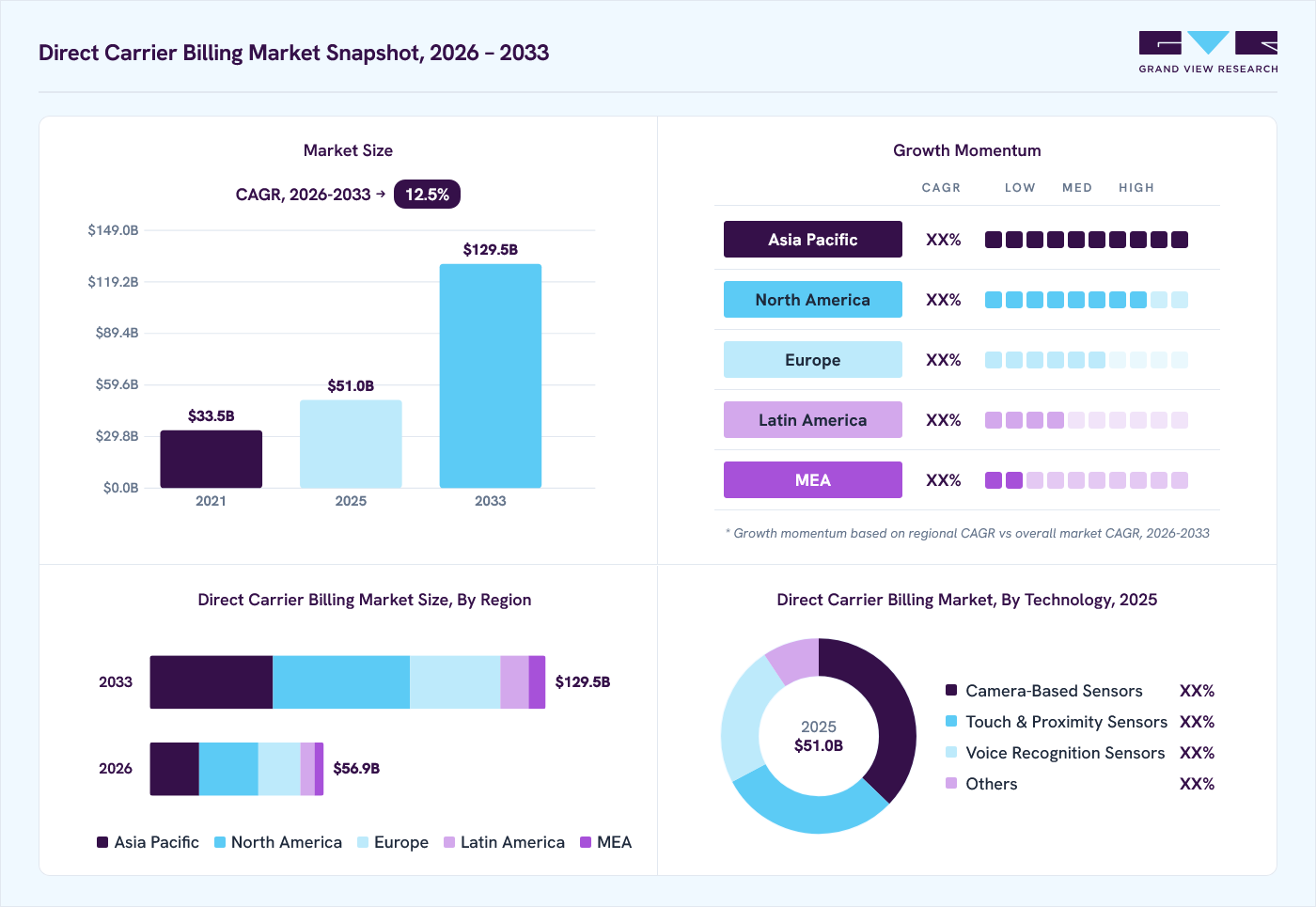 Source: Grand View Research, IR Documents, Primary Interviews, Paid DatabasesTo learn more about this report,
 Download Free Sample Report
Key Market Trends & Insights
- By content type: Gaming segment accounted for the largest share of 42.6% in 2025.
- By device platform: Android segment accounted for the largest share of 68.6% in 2025.
- By payment flow: One-off (event-based) segment accounted for the largest share of 62.3% in 2025.
- By operator type: Mobile Network Operators (MNOs) segment accounted for the largest share of 80.0% in 2025.
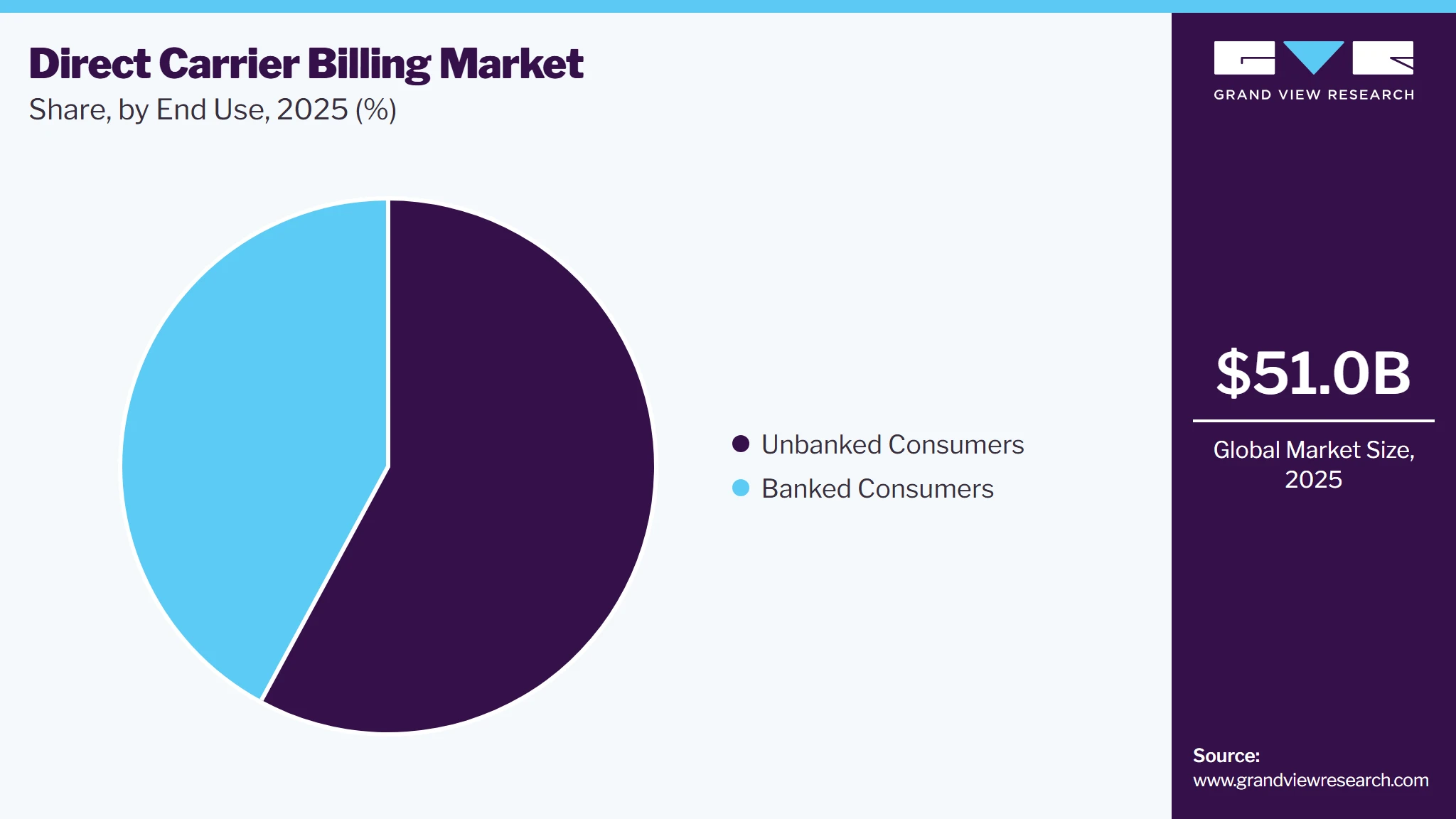
- By end user: Unbanked consumers segment dominated the market with largest share of 57.9% in 2025.
Regional Highlights
- Largest regional market: North America (33.9% revenue share, 2025)
- Fastest-growing regional market: Asia Pacific (highest CAGR, 2026-2033)
- By country: U.S. held the largest market share in 2025.
Market Size & Forecast
- Market size in 2025: USD 51.0 Billion
- Estimated market size in 2026: USD 56.9 Billion
- Projected market size by 2033: USD 129.5 Billion
- CAGR (2026-2033): 12.5%
Prism AI by Grand View Research Free to tryAsk a question about the direct carrier billing marketTry asking✓Every figure cited from GVR research Prefer the report? Download free sample →Increasing demand for convenient digital payment options is supporting market growth as consumers seek faster and simpler ways to complete online purchases. Direct carrier billing can reduce payment friction by allowing eligible users to authenticate transactions through their mobile operator. This is particularly relevant for digital services where users make frequent or low-value purchases. The convenience of carrier-based billing also supports adoption among consumers who may prefer not to use cards or other traditional payment methods.
The growing adoption of recurring billing models is shaping the market, as streaming, gaming, and other digital services increasingly operate on subscription models. Direct carrier billing allows eligible consumers to authorize recurring charges through their mobile accounts, supporting continuous access to digital services. This model can improve payment convenience while helping service providers maintain customer relationships. Growth in subscription-based digital consumption is expected to remain an important factor shaping carrier billing strategies.
 To learn more about this report, Download Free Sample Report
Consumer protection and payment transparency requirements are important regulatory considerations for the Direct Carrier Billing market. Regulators in different jurisdictions increasingly emphasize clear disclosure of pricing, billing frequency, subscription terms, cancellation procedures, and applicable charges. These requirements influence how operators and digital service providers obtain consumer authorization and communicate billing information. Compliance with transparency requirements is particularly crucial for recurring digital services
Limited transaction values and operator-specific billing constraints can restrict the suitability of direct carrier billing for certain digital purchases. Carrier billing is generally more relevant to digital services and transactions that fit within operator-defined billing conditions. Restrictions related to transaction limits, customer eligibility, or account types can reduce the range of services that can be supported. Such limitations may encourage consumers and merchants to use alternative payment methods for higher-value transactions.
Market Dynamics
The direct carrier billing market is being supported by rising digital content consumption, increasing mobile commerce, and growing demand for simple and accessible payment methods. Smartphone-led purchasing is expanding the relevance of carrier-based payments across gaming, streaming, music, publishing, ticketing, and other digital services. Improvements in payment connectivity, billing integration, transaction monitoring, and recurring payment capabilities are strengthening the functionality of direct carrier billing platforms. At the same time, regulatory requirements, consumer protection measures, and fraud prevention remain important considerations influencing market adoption.
The growing use of smartphones for digital entertainment and online services is increasing demand for payment methods that provide fast and convenient transaction experiences. Consumers increasingly expect payment processes to be completed with limited account creation, payment credential entry, and checkout steps. This trend is particularly relevant for mobile-first users who regularly purchase digital content through smartphones and applications. The expansion of gaming, streaming, digital publishing, and other mobile-enabled services is therefore creating a favorable environment for carrier-based payment solutions.
Direct carrier billing meets this demand by allowing consumers to complete purchases through their existing relationship with their mobile operator. Charges can be applied directly to postpaid bills or deducted from prepaid balances, reducing the need to use separate payment instruments. This approach can simplify checkout processes and improve accessibility across different consumer groups. Wider merchant integration, recurring billing capabilities, and improved operator connectivity are further supporting the adoption of direct carrier billing across digital services.
Direct carrier billing involves multiple stakeholders, including mobile operators, payment providers, merchants, and consumers, increasing the importance of regulatory compliance and transaction transparency. Requirements related to consumer authorization, disclosure of charges, refunds, billing controls, and fraud prevention can increase the complexity of implementation. Regulators in several markets have strengthened oversight of services involving mobile-based consumer charging, particularly where unauthorized transactions or unclear subscription practices may create consumer risks. These requirements can increase compliance responsibilities for service providers and merchants.
Regulatory differences across countries can further slow market expansion by requiring providers to adjust payment processes and operating procedures according to local requirements. Smaller service providers may face greater difficulties in managing compliance, monitoring, and dispute-resolution processes across multiple markets. The restraint can be more significant in tightly regulated regions and in segments involving recurring payments or subscription services. As a result, longer onboarding periods and higher operating requirements may moderate the speed of market penetration.
The increasing digital participation of consumers with limited access to traditional banking and card-based payment instruments is creating additional opportunities for direct carrier billing. Mobile subscriptions and prepaid accounts can provide an established payment relationship without requiring consumers to maintain conventional financial accounts. This creates opportunities for digital service providers to reach broader consumer groups in mobile-centric economies. Increasing smartphone adoption and expanding availability of digital services are further supporting this opportunity.
The market can also benefit from expansion into additional use cases beyond conventional digital content. Ticketing, transportation, applications, memberships, digital services, and other low-value transactions can provide additional avenues for carrier-based payments. Providers with strong operator integration, flexible payment infrastructure, fraud management, recurring billing capabilities, and broad merchant connectivity are well positioned to capture this opportunity. Expansion into emerging markets and broader acceptance among mobile-first consumers could drive higher transaction volumes and market penetration.
Market Concentration & Characteristics
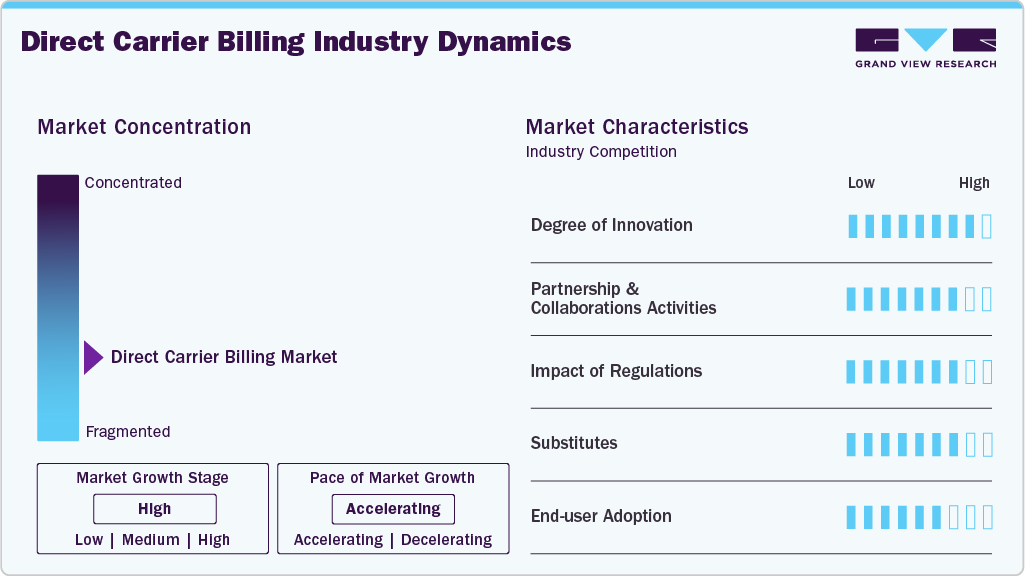
The direct carrier billing market is moderately fragmented, reflecting the presence of a broad mix of telecom operators, specialized billing aggregators, payment technology providers, and digital service platforms. Competition is distributed across global and regional participants rather than being controlled by a small number of dominant companies. Market participants compete through operator connectivity, geographic coverage, billing platform capabilities, transaction security, and integration with digital content and services. The market also benefits from partnerships between telecom operators, payment providers, and digital platforms, which allow participants to expand merchant access and strengthen their market presence. This combination of established operators and specialized providers supports a moderately fragmented competitive structure, with no single participant having complete control over the market.
 To learn more about this report, Download Free Sample Report
The market characteristics further indicate high innovation, strong partnership and collaboration activity, high regulatory impact, high availability of substitutes, and relatively high end-user adoption. Innovation remains important as providers enhance billing platforms, security, fraud management, and transaction capabilities to improve the digital payment experience. Partnerships are also significant because DCB providers depend on connectivity with mobile operators and digital content platforms to expand service coverage and transaction volumes. Regulatory requirements related to consumer protection, payment services, data privacy, and transaction transparency strongly influence market operations, while digital wallets, card payments, and other alternative payment methods create competitive pressure. Moreover, these characteristics indicate an actively evolving and competitive market with moderate fragmentation, rather than a highly concentrated structure.
Analyst Perspective
The direct carrier billing market is moving toward broader adoption as digital content consumption, mobile commerce, and demand for convenient alternative payment methods continue to expand. Growth is supported by increasing smartphone usage, subscription-based digital services, and the need to reach consumers beyond traditional card-based payment ecosystems. Technology development is increasingly focused on seamless APIs, recurring billing, transaction security, fraud monitoring, and improved operator integration. Future investment is expected to prioritize payment infrastructure, geographic expansion, merchant connectivity, and broader digital use cases. Competitive differentiation is increasingly influenced by platform scalability, operator relationships, compliance capabilities, and the ability to support diverse payment requirements.
Content Type Insights
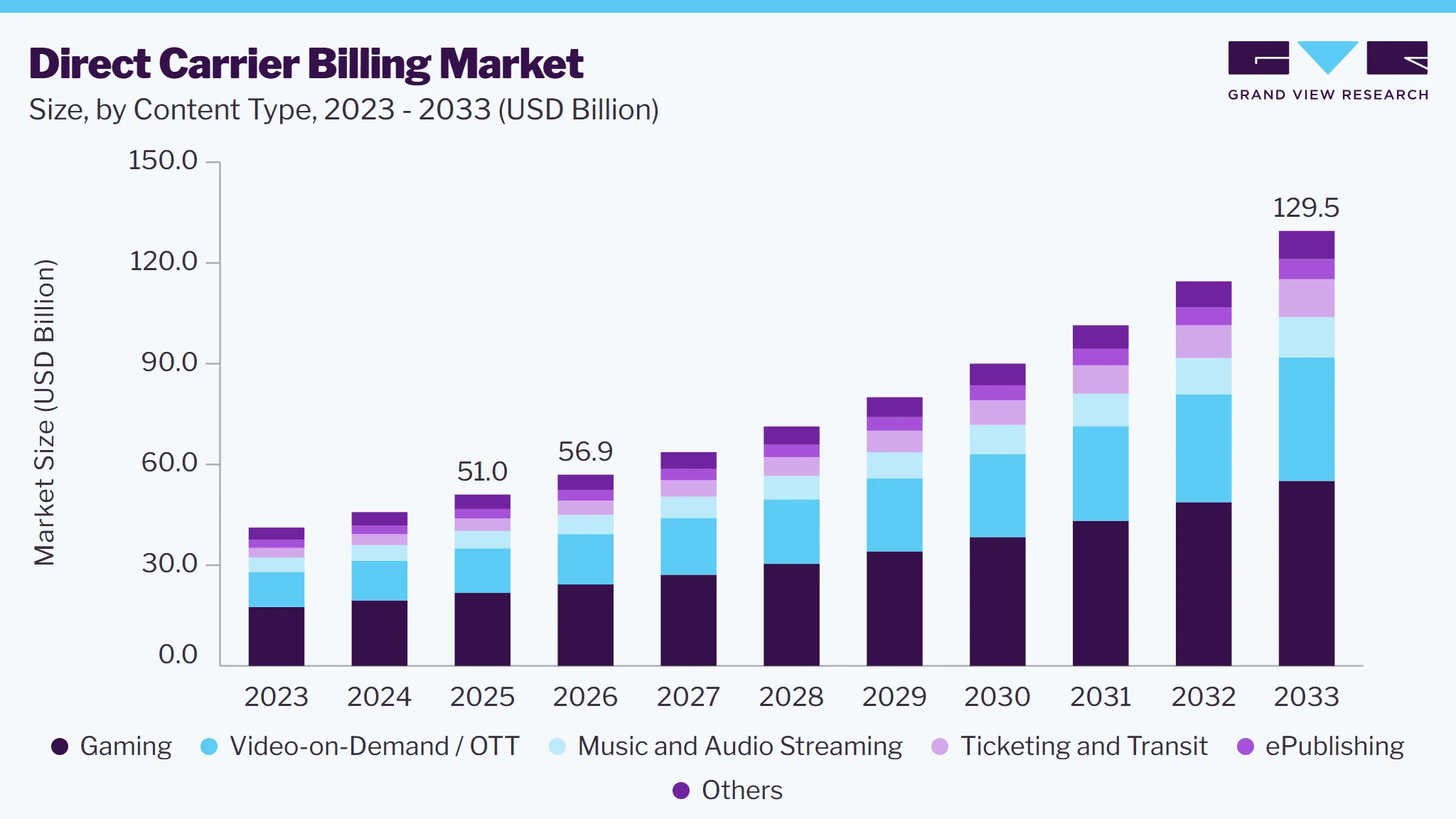
The gaming content type accounted for the largest share of 42.6% in 2025. Gaming is witnessing steady demand growth as mobile games increasingly incorporate in-app purchases, downloadable content, and other digital transactions. Carrier billing provides an additional payment option for users purchasing game-related content through supported mobile platforms. The high frequency of relatively small-value gaming transactions can support the suitability of carrier billing within this segment.
The ticketing and transit segment is expected to grow at a fastest CAGR during the forecast period. driven by the increasing adoption of digital ticketing and mobile-based payment solutions across public transportation networks. Direct Carrier Billing enables commuters to purchase bus, train, metro, and other transit tickets by charging the payment amount directly to their mobile phone bills or prepaid balances. The payment method reduces dependence on debit cards, credit cards, and separate digital wallets, offering a convenient payment option for commuters. Furthermore, the expansion of smart transportation infrastructure and increasing use of mobile applications for ticket booking are supporting segment growth.
Device Platform Insights
Android segment accounted for the largest share of 68.6% in 2025. Android remains the largest consumer base for Direct Carrier Billing due to its broad presence across smartphones and diverse price segments. The large installed base of Android devices provides digital service providers with access to a broad consumer population. Carrier billing integration with supported Android ecosystems can simplify payment for applications, games, subscriptions, and other digital content.
The iPhone Operating System segment is expected to grow at the fastest CAGR during the forecast period. The iPhone Operating System segment is supported by the strong digital services ecosystem associated with iPhone users. Direct carrier billing can provide an additional payment route where carrier billing is supported by the relevant operator and platform arrangements. Continued consumption of applications, subscriptions, entertainment, and other digital services on iPhones creates opportunities for carrier-based payment services.
Payment Flow Insights
The one-off (event-based) segment accounted for the largest share of 62.3% in 2025. One-off (event-based) continues to dominate the market owing to its digital transactions, in which consumers make individual purchases rather than committing to recurring charges. This payment flow applies to gaming purchases, digital content, applications, and other services that require occasional payments. The ability to complete transactions through mobile billing can reduce checkout steps and support convenient purchases.
The subscription / recurring segment is projected to grow at the fastest CAGR over the forecast period. Subscription and recurring payments are gaining importance as digital services are increasingly used monthly, periodically, or continuous payment models. direct carrier billing can allow eligible customers to authorize recurring charges through their mobile accounts. The growth of streaming, gaming memberships, and other subscription services creates opportunities for recurring carrier billing arrangements.
Operator Type Insights
The Mobile Network Operators (MNOs) operator type accounted for the largest share of 80.0% in 2025. Mobile Network Operators remain central to the direct carrier billing ecosystem because carrier billing transactions are processed through mobile network relationships. MNOs can leverage established customer accounts and billing infrastructure to support payments for eligible digital services. Partnerships between MNOs and digital content providers can expand the availability of carrier billing across applications and online platforms.
The Mobile Virtual Network Operators (MVNOs) segment is projected to grow at the fastest CAGR over the forecast period. MVNOs are thriving to the market by expanding mobile service availability through alternative operator models. Where billing capabilities and commercial arrangements support direct carrier billing, MVNOs can provide carrier-based payment options to their customer bases. Increasing competition and diversification within mobile services can create additional opportunities for carrier billing partnerships.
End Use Insights
The unbanked consumers segment dominated the market with a revenue share of 57.9% in 2025. Unbanked consumers owing to an important opportunity for direct carrier billing because the payment method can provide access to eligible digital purchases without requiring a conventional bank account or payment card. Mobile connectivity can therefore serve as an important channel for accessing digital services in markets with lower levels of traditional financial access. Expansion of mobile subscriptions and digital content consumption can support greater carrier billing adoption among this consumer group.
 To learn more about this report, Download Free Sample Report
The banked consumers segment is projected to grow at the fastest CAGR over the forecast period. Banked consumers can use direct carrier billing as an additional payment option alongside cards, bank transfers, and digital wallets. The convenience of charging eligible purchases to a mobile account can appeal to consumers seeking simpler payment experiences for digital services. Adoption within this segment is supported by frequent mobile usage and increasing consumption of subscription-based and digital entertainment services.
Regional Insights
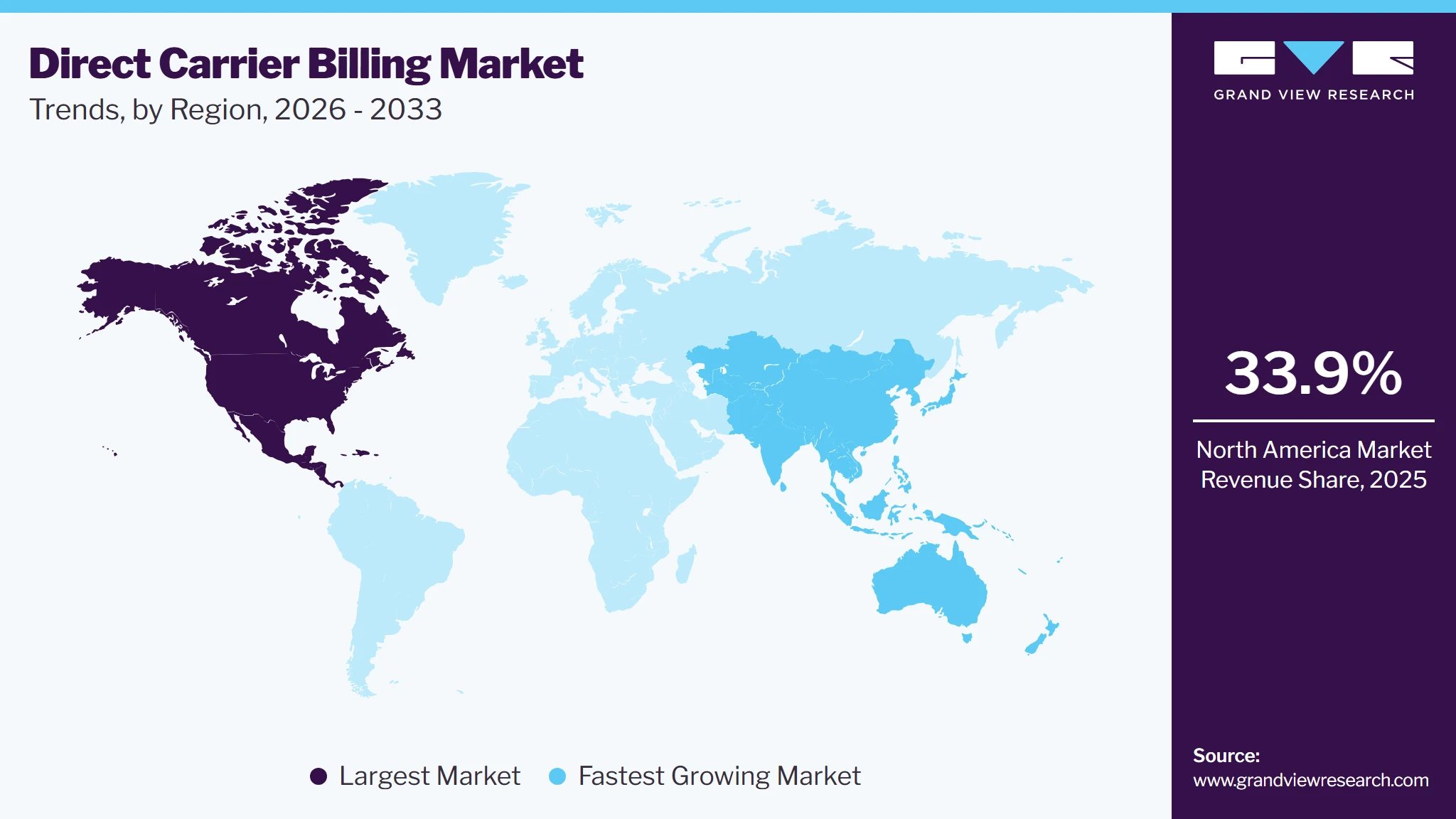
The North America direct carrier billing market has the largest amount of market share in the global market, with a revenue share of 33.9% in 2025, supported by high smartphone penetration, established digital payment infrastructure, and extensive consumption of gaming, streaming, and other digital services. The region's mature digital ecosystem provides opportunities for direct carrier billing through partnerships between mobile operators and digital service providers.
 To learn more about this report, Download Free Sample Report
U.S. Direct Carrier Billing Market Trends
The U.S. direct carrier billing industry held a dominant position in 2025, due to high adoption of smartphones, digital entertainment, gaming, and subscription services. Direct carrier billing can serve as an additional payment channel for eligible digital purchases, although competition from cards, digital wallets, and other established payment methods remains strong.
Asia Pacific Direct Carrier Billing Market Trends
The Asia Pacific direct carrier billing market is expected to grow at the fastest CAGR from 2026 to 2033. Asia-Pacific remains the largest regional market, due to its large mobile subscriber base, expanding smartphone adoption, and rapidly growing digital content consumption. The region also contains markets with varying levels of financial inclusion, creating opportunities for carrier billing to complement conventional payment methods.
China has a large mobile and digital services ecosystem, with extensive consumption of applications, gaming, entertainment, and other online services. The scale of mobile connectivity creates potential opportunities for carrier-based payment solutions, although competition from established digital payment ecosystems can influence adoption.
Japan has a mature telecommunications market and high consumer engagement with mobile applications, digital entertainment, and subscription services. Direct carrier billing can support convenient payments for eligible digital content, while established alternative payment methods and sophisticated consumer expectations create a competitive environment for carrier billing providers.
Europe Direct Carrier Billing Market Trends
Europe is projected to grow at a significant CAGR over the forecast period. Europe’s trend is shaped by the continent’s strict vehicle safety regulations and commitment to sustainability. Europe has a developed digital services ecosystem and widespread smartphone usage, supporting opportunities for direct carrier billing across gaming, streaming, applications, and other digital content. Regulatory requirements related to consumer protection, privacy, payment transparency, and recurring billing are important considerations for market participants operating across European countries.
Germany provides opportunities for direct carrier billing due to its large consumer base, developed telecommunications infrastructure, and increasing consumption of digital services. The market is influenced by strong requirements for data protection, payment security, and consumer transparency, which can shape the deployment of carrier-based billing services.
The U.K. represents an established digital economy with strong adoption of mobile services, online entertainment, and subscription-based platforms. Direct carrier billing can benefit from consumers' extensive use of mobile devices for digital content, while regulatory expectations around payment transparency and consumer protection influence market operations.
Key Direct Carrier Billing Company Insights
Key players operating in the direct carrier billing market include Boku Inc., Bango.net Limited, Digital Virgo, DIMOCO, Centili Group Ltd., Telenity, NTH Mobile, tpay, Fonix, and Nuvei. Key players in the direct carrier billing market are focusing on expanding mobile operator connectivity, strengthening merchant and digital service integrations, enhancing payment security and fraud prevention capabilities, and improving recurring billing solutions. Companies are also prioritizing geographic expansion, broader support for digital content categories, and integration of carrier billing with other alternative payment methods.
-
Boku Inc. is a global payments company that provides local payment solutions, including direct carrier billing, digital wallets, and account-to-account payment methods. The company enables merchants to accept carrier-based payments through mobile operator billing, supporting both transaction and subscription-based purchases. Its direct carrier billing services allow consumers to pay for digital content and eligible goods and services through their mobile accounts.
-
Bango.net Limited is a payment and subscription technology company that offers Direct Carrier Billing and other alternative payment solutions for digital content providers. The company provides an end-to-end DCB platform covering partner onboarding, payment routing, transaction processing, reconciliation, settlement, reporting, and analytics. Its services enable merchants and content providers to access mobile operator billing while supporting digital subscriptions and other mobile-based purchases.
Key Direct Carrier Billing Companies
The following key companies have been profiled for this study on the direct carrier billing market.
-
Boku Inc.
-
Bango.net Limited
-
Digital Virgo
-
DIMOCO
-
Centili Group Ltd.
-
telenity
-
NTH Mobile
-
tpay
-
Fonix.
-
Nuvei
Competitive Benchmarking
Operating Strategies
Competitive Edge
Weaknesses
Mature Players: Boku Inc., Bango.net Limited, Digital Virgo, DIMOCO
- Mature players in the direct carrier billing market are focus on expanding operator connectivity, merchant integration, international market coverage, and scalable payment infrastructure. These players also emphasize recurring billing, alternative payment capabilities, and support for multiple digital content categories.
- Mature companies gain a competitive advantage through broad market presence, established operator relationships, extensive merchant integration capabilities, and mature payment platforms strengthen their ability to support large-scale deployments.
- These companies often face challenges due to broad geographic and service coverage can increase operational complexity and make adaptation to highly localized market requirements more difficult.
Emerging Players: Centili Group Ltd., Telenity, NTH Mobile
- Emerging players in the direct carrier billing market are focus on specialized carrier billing infrastructure, operator integration, payment processing, subscription management, and targeted market opportunities. These companies generally emphasize flexible deployment and integration with merchants and mobile operators.
- Emerging companies gain market traction through focused product capabilities, flexible integration models, and specialization in carrier-based payment services can support faster adaptation to specific merchant or operator requirements.
- Emerging players face challenges due to comparatively narrower market coverage and portfolio breadth can reduce their ability to compete across diverse geographies and broader alternative payment ecosystems.
Recent Developments
-
In September 2025, telenity expanded the use of Direct Carrier Billing beyond traditional digital content to include transport, parking, bike rental, EV charging, and e-commerce. This expansion supports convenient micro-payments, wider consumer access, and new revenue opportunities for mobile operators.
-
In July 2025, Digital Virgo partnered with RMC BFM Group, a media company, to support the international distribution of its TV, radio, and streaming content through local telecom operators. The solution combines carrier billing and localized monetization to simplify consumer access and payment across international markets. This partnership expands the use of Direct Carrier Billing for streaming and premium media services, supporting broader content distribution and consumer access.
Direct Carrier Billing Market Report Scope
Report Attribute
Details
Market size in 2025
USD 51.0 billion
Estimated Market size in 2026
USD 56.9 billion
Projected Market size by 2033
USD 129.5 billion
Growth rate
CAGR of 12.5% from 2026 to 2033
Base year for estimation
2025
Historical data
2021 - 2024
Forecast period
2026 - 2033
Quantitative units
Revenue in USD billion and CAGR from 2026 to 2033
Report coverage
Revenue forecast, company ranking, competitive landscape, growth factors, and trends
Segments covered
Content type, device platform, payment flow, operator type, end use, region
Regional scope
North America, Europe, Asia Pacific, Latin America, MEA
Country scope
U.S., Canada, Mexico, Germany, U.K., France, China, Japan, India, South Korea, Australia, Brazil, KSA, UAE, and South Africa
Key companies profiled
Boku Inc.; Bango.net Limited; Digital Virgo; DIMOCO; Centili Group Ltd.; telenity; NTH Mobile; tpay; Fonix.; Nuvei
Customization scope
Free report customization (equivalent up to 8 analysts working days) with purchase. Addition or alteration to country, regional & segment scope.
Pricing and purchase options
Avail customized purchase options to meet your exact research needs. Explore purchase options
Global Direct Carrier Billing Market Report Segmentation
This report forecasts revenue growth at the global, regional, and country levels and provides an analysis of the latest industry trends in each of the sub-segments from 2021 to 2033. For this study, Grand View Research has segmented the global direct carrier billing market report based on content type, device platform, payment flow, operator type, end use and region:
-
Content Type Outlook (Revenue, USD Million, 2021 - 2033)
-
Gaming
-
Video-on-Demand / OTT
-
Music and Audio Streaming
-
ePublishing
-
Ticketing and Transit
-
Others
-
-
Device Platform Outlook (Revenue, USD Million, 2021 - 2033)
-
Android
-
Windows
-
iPhone Operating System
-
Others
-
-
Payment Flow Outlook (Revenue, USD Million, 2021 - 2033)
-
One-off (event-based)
-
Subscription / Recurring
-
-
Operator Type Outlook (Revenue, USD Million, 2021 - 2033)
-
Mobile Network Operators (MNOs)
-
Mobile Virtual Network Operators (MVNOs)
-
-
End Use Outlook (Revenue, USD Million, 2021 - 2033)
-
Banked Consumers
-
Unbanked Consumers
-
-
Regional Outlook (Revenue, USD Million, 2021 - 2033)
-
North America
-
U.S.
-
Canada
-
Mexico
-
-
Europe
-
Germany
-
U.K.
-
France
-
-
Asia Pacific
-
China
-
Japan
-
India
-
South Korea
-
Australia
-
-
Latin America
-
Brazil
-
-
Middle East and Africa (MEA)
-
KSA
-
UAE
-
South Africa
-
-
Research Methodology
The direct carrier billing market figures in this report are based on a proven research process that combines executive interviews with secondary research from proprietary databases, company filings, and recognized regulatory and institutional sources. Market size is built through value-chain sizing - reconciling supply-side and demand-side estimates - and triangulated with bottom-up and top-down approaches. Every estimate passes multiple levels of expert validation before publication, with each direct carrier billing segment quantified using the revenue-capture definitions in the table below.
Segment Definition
Content Type
Revenue capture definition
Gaming
The segment revenue is generated from carrier-billed payments for mobile games, game purchases, in-game items, virtual goods, game credits, upgrades, and other paid gaming content.
Video-on-Demand / OTT
The segment revenue is generated from carrier-billed payments for video streaming subscriptions, premium video access, digital rentals, content purchases, and other OTT services.
Music and Audio Streaming
The segment revenue is generated from carrier-billed payments for music streaming subscriptions, premium audio services, digital music purchases, podcasts, and other paid audio content.
ePublishing
The segment revenue is generated from carrier-billed payments for e-books, digital newspapers, magazines, premium articles, digital publications, and related subscription services.
Ticketing and Transit
The segment revenue is generated from carrier-billed payments for transport tickets, event tickets, parking services, mobility access, and other digitally purchased transportation or access services.
Others
The segment revenue is generated from carrier-billed payments for other eligible digital services, applications, memberships, donations, lifestyle services, and selected mobile-enabled purchases.
Segment Device Platform
Revenue capture definition
Android
The segment revenue is generated from direct carrier billing transactions conducted through Android smartphones, tablets, applications, app stores, and supported mobile web environments.
Windows
The segment revenue is generated from direct carrier billing transactions conducted through Windows-based computers, tablets, applications, and supported online service platforms.
iPhone Operating System
The segment revenue is generated from direct carrier billing transactions conducted through iOS smartphones, tablets, applications, and supported digital service environments.
Others
The segment revenue is generated from direct carrier billing transactions conducted through other supported operating systems, connected devices, and compatible digital platforms.
Payment Flow
Revenue capture definition
One-off (event-based)
The segment revenue is generated from individual carrier-billed transactions, including digital content purchases, gaming purchases, rentals, tickets, donations, and other non-recurring payments.
Subscription / Recurring
The segment revenue is generated from periodic carrier-billed charges for streaming services, digital content, memberships, applications, subscriptions, and other recurring services.
Operating Type
Revenue capture definition
Mobile Network Operators (MNOs)
The segment revenue is generated from direct carrier billing transactions processed through operators that own and manage mobile network infrastructure and maintain direct subscriber billing relationships.
Mobile Virtual Network Operators (MVNOs)
The segment revenue is generated from direct carrier billing transactions processed through mobile service providers operating through leased or hosted mobile network infrastructure.
End Use
Revenue capture definition
Banked Consumers
The segment revenue is generated from direct carrier billing transactions conducted by consumers with access to traditional banking or card-based payment methods who use carrier billing for convenience, speed, or simplified mobile checkout.
Unbanked Consumers
The segment revenue is generated from direct carrier billing transactions conducted by consumers without conventional banking or card access who use mobile operator billing or prepaid balances for eligible purchases.
Estimation Model
Layer No.
Layer Name
Key Question
Description
01
Addressable Mobile Consumer Base
What is the potential consumer base for Direct Carrier Billing?
This layer evaluates the mobile subscriber and smartphone user base that can potentially access carrier-based payment services. It considers postpaid and prepaid mobile accounts, mobile connectivity, and access to digital services. The assessment also considers consumer usage of smartphones and mobile applications. This establishes a broad addressable consumer pool for the market.
02
Eligible Digital Transaction Pool
What portion of digital spending can be processed through Direct Carrier Billing?
This layer identifies digital transactions that are suitable for carrier-based payment. It includes gaming, OTT, music, ePublishing, ticketing, transit, subscriptions, and other supported services. The assessment considers operator restrictions, merchant acceptance, transaction limits, and payment eligibility. The resulting pool represents the potential transaction base available to Direct Carrier Billing providers.
03
Direct Carrier Billing Adoption Rate
What proportion of eligible transactions is captured through DCB?
This layer estimates the share of eligible digital transactions completed using Direct Carrier Billing. Factors considered include consumer payment preferences, merchant acceptance, mobile operator availability, banking access, and checkout convenience. Adoption can vary considerably across regions and consumer groups based on payment infrastructure and digital service penetration. The resulting penetration estimate is applied to the eligible transaction pool.
04
Market Revenue Conversion
What revenue is captured from Direct Carrier Billing activity?
This layer converts estimated transaction activity into market revenue. It considers transaction frequency, average transaction values, recurring payment activity, and applicable market economics. The resulting revenue is evaluated across content type, device platform, payment flow, operator type, end use, and geography. Cross-validation across market participants and operating structures is used to improve the reliability of the final market estimate.
Delivered Customizations
This report has been delivered with the following In-depth customizations
Client Request
Customization Delivered
Value Adds
Digital Content / OTT Service Provider
Identified high-potential digital content categories for DCB adoption
Assessed recurring billing and one-off payment opportunities
Evaluated provider capabilities across operator connectivity, payment processing, and subscription management
Supported expansion of convenient mobile payment options
Improved digital subscription monetization opportunities
Enabled better selection of DCB technology and payment partners
Mobile Network Operator / Telecom Provider
Identified emerging non-digital DCB use cases
Evaluated merchant integration, billing infrastructure, and consumer protection requirements
Assessed opportunities for recurring and micro-payment services.
Supported diversification of operator revenue streams
Enabled expansion of DCB into new transaction categories
Strengthened customer engagement through simplified mobile payments
DCB Payment Platform / Aggregator
Developed comparative assessment of DCB platform capabilities
Identified opportunities for improving merchant and operator integration
Evaluated regional expansion potential based on market maturity, payment adoption, and regulatory conditions
Supported competitive positioning of DCB platforms
Identified scalable expansion opportunities across regions and use cases
Improved understanding of technology and service differentiation
About the Author(s)
IT Services & Applications Research Team
Technology · IT Services & ApplicationsThis report was authored by the it services & applications research team at Grand View Research - comprising two research analysts, one senior research analyst, and one industry expert - with specialized expertise in the it services & applications segment of the technology industry. All findings are based on proprietary technology databases, executive interviews, and regulatory analysis, subject to internal peer review prior to publication.
Last Updated:
Speak to Analyst

Customize this report to your needs - add regions, segments, or data points, with 20% free customization.
Or view our licence options:


ISO 9001:2015 & 27001:2022 Certified
We are GDPR and CCPA compliant! Your transaction & personal information is safe and secure. For more details, please read our privacy policy.


