
- Home
- »
- Advanced Interior Materials
- »
-
Direct Reduced Iron Market Size & Share Report, 2026-2033GVR Report cover

Direct Reduced Iron Market (2026 - 2033)
Size, Share & Trends Analysis Report By End Use (Steelmaking, Others), By Form (Cold Direct Reduced Iron (CDRI), Hot Direct Reduced Iron (CDRI), Hot Briquetted Iron (HBI) ), By Region, And Segment Forecasts
Market Size, 2025
$48.1BMarket Estimate, 2026
$51.9BMarket Forecast, 2033
$93.6BCAGR, 2026–2033
8.8%Direct Reduced Iron Market Summary
The global direct reduced iron market size was valued at USD 48.1 billion in 2025 and is projected to grow from USD 51.9 billion in 2026 to USD 93.6 billion by 2033, at a CAGR of 8.8% from 2026 to 2033. Asia Pacific dominated the market, accounting for the largest revenue share of 37.5% in 2025. As global infrastructure development accelerates and urbanization expands, particularly in emerging economies, the need for steel has surged, boosting the demand for DRI.
 Source: Grand View Research, IR Documents, Primary Interviews, Paid DatabasesTo learn more about this report,
 Download Free Sample Report
 Key Market Trends & Insights
- By end use: The steelmaking held the largest market revenue share of 84.0% in 2025.
- By form: The Cold Direct Reduced Iron (CDRI) segment held the revenue share of 43.0% in 2025.
Market Regional Highlights
- Largest regional market: Asia Pacific (37.5% revenue share, 2025)
- Fastest-growing regional market: Asia Pacific (highest CAGR, 2026-2033)
- By country: India held the largest market share in 2025
Market Size & Forecast
- Market size in 2025: USD 48.1 Billion
- Estimated market size in 2026: USD 51.9 Billion
- Projected market size by 2033: USD 93.6 Billion
- CAGR (2026-2033): 8.8%
Three ways to get this report
Buy it, customize it, or ask a question.Ask an Analyst
Analyst response in 1 business day
- AccessReport author, directly
- Reply timeWithin 1 working day
- No sales callDirect answer only
- FormatEmail reply
- CostFree, no cost
Get the Full Report
What the study covers
- FormatsPDF · Excel · Dashboard
- Timeline2026–2033 annual, 2025 base
- Coverage20+ countries, 5 regions
- Companies10+ key players profiled
Customize the Report
20% free customization
- IncludeCountries, segments, points
- TailorTo your product definition
- ExtendDeeper competitor detail
- OrA fully bespoke study
- Turnaround5–10 working days
This trend is further supported by the growing preference for DRI over traditional iron-making methods due to its lower carbon footprint and cost-effectiveness. With increasing awareness of climate change and stricter environmental regulations, steel manufacturers seek cleaner alternatives to conventional blast furnace processes. DRI production emits significantly lower carbon dioxide levels than traditional methods, making it an attractive option for companies aiming to reduce their environmental impact.
According to Midrex World Direct Reduction Statistics, world DRI production reached 135.7 million tons (Mt) in 2023, an increase of 6.5% from 127.4 Mt in 2022. Worldwide, DRI output has grown by approximately 25.6% in the last five years and by approximately 82% in the previous 10 years. Governments and organizations worldwide are also incentivizing the adoption of green technologies, further propelling the growth of the direct reduced iron industry. This shift toward sustainability aligns with global commitments to reduce greenhouse gas emissions and transition to a low-carbon economy.
 To learn more about this report, Download Free Sample Report
 Innovations in gas-based and coal-based reduction technologies have improved the efficiency and scalability of DRI production, making it more accessible to a wider range of manufacturers. In addition, the development of modular DRI plants has enabled smaller-scale producers to enter the market, further expanding its reach. These technological improvements have reduced production costs and enhanced DRI's quality and consistency, making it a more viable option for steelmakers. As a result, the adoption of DRI has increased across both developed and developing regions.
Market Dynamics
The market is growing due to rising steel demand from the construction, automotive, and industrial sectors. Increasing adoption of electric arc furnaces and the push for lower-carbon steel production are supporting DRI demand globally. Investments in hydrogen-based DRI technologies further drive market growth as steelmakers pursue decarbonization goals. However, fluctuations in iron ore and natural gas prices, along with the need for high-quality raw materials, remain key challenges for the industry.
The market is primarily driven by the growing global demand for steel, fueled by rapid urbanization, infrastructure development, industrial expansion, and increasing manufacturing activity. DRI is widely used as a high-quality iron feedstock in electric arc furnace steel production, making it an essential raw material for modern steelmaking. As countries invest heavily in transportation networks, residential and commercial construction, and industrial projects, the need for steel continues to rise, directly supporting demand for DRI.
According to the World Steel Association, India's crude steel production increased from 149.4 million tonnes in 2024 to 164.9 million tonnes in 2025, reflecting a growth of more than 10%. The association projects Indian steel demand to grow by approximately 9% in 2026, supported by strong infrastructure and manufacturing investments. This continued expansion in steel production is creating substantial demand for DRI as a key raw material in the steel value chain.
The DRI market is highly dependent on the availability and pricing of key raw materials such as iron ore and natural gas. Since natural gas serves as the primary reducing agent in most DRI production processes, fluctuations in energy prices can significantly increase operating costs and reduce profit margins. The capital-intensive nature of DRI plants and exposure to supply chain disruptions make it challenging for producers to maintain stable production economics, particularly in regions with limited access to low-cost energy resources. The International Energy Agency reported that global natural gas markets remained tight due to supply constraints, geopolitical tensions, and slower LNG supply growth, resulting in higher gas prices across major import markets.
The transition toward green steel production is creating significant growth opportunities for the DRI market. As governments and steel manufacturers work toward net-zero emission targets, hydrogen-based DRI (H-DRI) technology is gaining attention as a low-carbon alternative to traditional blast furnace steelmaking. Since DRI is a key feedstock for electric arc furnaces, the increasing adoption of EAF-based steel production and investments in sustainable steelmaking technologies are expected to drive long-term demand. Companies that can improve production efficiency and scale low-carbon DRI solutions are likely to benefit from this industry transition. A notable example is the European Union-backed HYBRIT initiative, led by SSAB, LKAB, and Vattenfall. In 2025, the project continued advancing hydrogen-based ironmaking technology capable of reducing steelmaking-related CO₂ emissions by up to 90% compared to conventional blast furnace routes.
Analyst Perspective
The market is witnessing strong growth as steel producers increasingly adopt cleaner and more efficient steelmaking routes. Rising steel demand from construction, infrastructure, automotive, and manufacturing sectors is driving DRI consumption, particularly in electric arc furnace operations. The market is also benefiting from growing investments in hydrogen-based DRI technologies and green steel production initiatives. In the long term, companies that can secure raw material supplies, improve production efficiency, and support low-carbon steelmaking are expected to gain a competitive advantage.
End Use Insights
DRI, also known as sponge iron, is a crucial feedstock in electric arc furnaces (EAFs) and other steelmaking processes due to its purity and efficiency. As global infrastructure development, particularly in emerging economies, accelerates, the need for steel in the construction, automotive, and manufacturing sectors has surged. DRI's role in enhancing the sustainability of steel production, with its lower carbon footprint compared to traditional blast furnace processes, has further driven its adoption.
The others segment, which encompasses foundry applications, ferroalloy production, and ductile iron manufacturing, is poised for steady growth due to its critical role in supporting diverse industrial processes. Foundries, which rely heavily on high-quality iron inputs for casting applications, are increasingly adopting DRI as a cost-effective and environmentally sustainable alternative to traditional pig iron and scrap. DRI's superior consistency and lower impurity levels make it an ideal feedstock for producing high-performance castings, particularly in the automotive, machinery, and construction industries.
Form Insights
CDRI is produced by reducing iron ore at relatively low temperatures, typically below the melting point of iron, using natural gas or hydrogen as reducing agents. This process produces a highly metalized product that can be directly used in EAFs for steel production. Total CDRI production in 2023 was 108.7 Mt. The growing emphasis on reducing carbon emissions in the steel industry has significantly boosted the demand for CDRI, as it generates substantially lower greenhouse gas emissions than blast furnace methods.
 To learn more about this report, Download Free Sample Report
 Hot Briquetted Iron (HBI) is anticipated to register the fastest CAGR over the forecast period. As steelmakers strive to reduce their carbon footprint, HBI offers a cleaner alternative to traditional iron-making processes, as its production generates fewer greenhouse gas emissions than pig iron or sinter feed. The increasing availability of natural gas and the development of hydrogen-based reduction technologies are expected to enhance the environmental benefits of HBI production further.
Regional Insights
Asia Pacific dominated the direct reduced iron market with the largest revenue share of 37.5% in 2025. The increasing demand for steel in rapidly industrializing economies such as India, China, and Southeast Asia proliferates the region's market. As these nations continue to invest in infrastructure development, urbanization, and manufacturing, the need for high-quality steel has surged. DRI, a crucial raw material for steel production, has seen a corresponding rise in demand. According to the Sponge Iron Manufacturers Association (SIMA) of India, the country maintained its position as the world's largest DRI producer, achieving a record output of 49.3 Mt in 2023.
 To learn more about this report, Download Free Sample Report
 India Direct Reduced Iron Market Trends
The direct reduced iron market in India held the largest share in the Asia Pacific region in 2025, supported by rising steel production, increasing use of electric and induction furnaces, and the availability of domestic iron ore and coal resources. Coal-based DRI remains dominant, while investments in gas-based and hydrogen-based reduction technologies are gaining attention as steelmakers pursue lower-emission production routes. As per the Ministry of Steel, India’s sponge iron production increased from 51.56 million tonnes in FY2023-24 to 55.76 million tonnes in FY2024-25, reflecting continued expansion in the country’s DRI production base.
North America Direct Reduced Iron Market Trends
The direct reduced iron market in North America is anticipated to grow at a significant CAGR during the forecast period. As North American economies rebound and infrastructure investments rise, the steel demand continues to expand, pushing steel manufacturers to explore efficient and sustainable production methods like DRI. According to the Midrex World Direct Reduction Statistics, North America accounted for 8.5% of global DRI production in 2023, with the United States being the largest producer in the region. The shift toward greener steelmaking processes has positioned DRI as vital in decarbonizing the steel industry.
The U.S. direct reduced iron market is anticipated to grow at a substantial CAGR during the forecast period. The shale gas revolution has positioned the U.S. as a global leader in natural gas production, providing a cost-effective and readily available reducing agent for DRI production. This economic advantage has spurred investments in DRI plants, particularly in regions with access to shale gas reserves. In addition, the potential to transition from natural gas to hydrogen as a reducing agent in the future further enhances the long-term viability of DRI, as hydrogen can be produced using renewable energy, enabling carbon-neutral steel production.
Europe Direct Reduced Iron Market Trends
The direct reduced iron market in Europe held a significant market share in 2025. The European Union (EU) has set some of the most stringent climate targets globally, including a commitment to achieving carbon neutrality by 2050. To meet these targets, the steel industry, one of the region's largest industrial emitters of CO2, must reduce its carbon footprint. DRI, particularly when produced using natural gas or hydrogen, offers a lower-carbon alternative to traditional blast furnace methods, which use coal and coke and release large quantities of CO2.
Latin America Direct Reduced Iron Market Trends
The direct reduced iron market in Latin America is anticipated to grow at a significant CAGR over the forecast period. The increasing demand for steel in the region, particularly as countries such as Brazil, Argentina, and Mexico continue to expand their infrastructure and manufacturing sectors, drives the market in the region. As the construction, automotive, and energy industries grow, the demand for high-quality steel products rises, prompting steelmakers to seek more efficient and cost-effective production methods.
Middle East & Africa Direct Reduced Iron Market Trends
The direct reduced iron market in MEA is home to some of the world's largest natural gas reserves, making it an ideal location for DRI production. Countries such as Qatar, Iran, and Saudi Arabia have an abundant and cost-effective natural gas supply, making DRI production economically viable and competitive.
Key Direct Reduced Iron Company Insights
Some of the key players operating in the market include Qatar Steel, Kobe Steel Ltd., and others.
- Qatar Steel is a leading steel manufacturing company based in Qatar, recognized for its commitment to quality and sustainability in the production of steel products. The company offers a range of products, including direct reduced iron, which is produced through innovative processes that prioritize efficiency and environmental responsibility.
- Kobe Steel Ltd. is one of Japan’s leading steelmakers and specializes in producing high-quality DRI using the MIDREX Process, primarily utilizing natural gas as a reducing agent. This method enhances the quality of the metallic product derived from iron ore and significantly reduces carbon emissions compared to traditional steelmaking processes.
Key Direct Reduced Iron Companies
The following key companies have been profiled for this study on the direct reduced iron market:
-
AM/NS India
-
ArcelorMittal
-
Jindal Shadeed Iron & Steel LLC
-
Khouzestan Steel Company
-
Kobe Steel, Ltd.
-
NUCOR
-
Qatar Steel
-
Tosyali Algeria A.S.
-
Welspun Group
Competitive Benchmarking
Category
Operating Strategies
Competitive Edge
Weakness
Established Players (ArcelorMittal; Nucor; Qatar Steel; Kobe Steel Ltd.; AM/NS India; Jindal Shadeed Iron & Steel LLC)
- Invest in large-scale DRI capacity expansion and integration with steelmaking operations.
- Focus on long-term iron ore and natural gas supply agreements to secure feedstock availability.
- Develop low-carbon steelmaking solutions, including hydrogen-based DRI technologies and EAF integration.
- Large-scale production capacity and strong financial resources.
- Integrated operations across the steel value chain, improving cost efficiency and supply security.
- Established customer relationships and global distribution networks.
- High capital expenditure requirements for plant expansion and modernization.
- Significant exposure to iron ore, natural gas, and energy price volatility.
- Complex operations and longer implementation timelines for new projects.
Emerging Players (Khouzestan Steel Company; Welspun Group; Tosyali Algeria A.S.)
- Focus on regional steel demand and export-oriented DRI production.
- Expand capacity through targeted investments in developing markets.
- Leverage proximity to raw material resources and strategic trade routes.
- Strong presence in regional markets with growing steel demand.
- Greater operational flexibility and faster decision-making.
- Competitive production costs in resource-rich regions.
- Limited global footprint and customer diversification compared to industry leaders.
- Smaller production capacities and lower economies of scale.
- Greater dependence on regional economic conditions and export markets.
Recent Developments
-
In August 2026, NEMO Industries selected Tenova’s ENERGIRON Zero Reformer technology for a new direct reduction plant in Louisiana, USA, as part of its Ironworks I project. The facility is designed to produce approximately 2.5 million tonnes per year of hot and cold DRI for pig iron production. The plant will incorporate Tenova’s HYTEMP system for hot DRI transport and will be designed to accommodate future hydrogen utilization and carbon capture technologies, supporting lower-carbon iron production.
-
In September 2025, Danieli, Kanthal, and EMSTEEL launched a pilot project for electric process-gas heating at a DRI plant in Abu Dhabi, UAE. The project features a 1.3-MW electric Process-Gas Heater based on Prothal® DH technology, designed to operate alongside the existing fired heater and reduce fossil-fuel use in the DRI process. Installation and commissioning are planned for 2026, supporting the progressive electrification and decarbonization of DRI production.
Direct Reduced Iron Market Report Scope
Report Attribute
Details
Market definition
The market size represents the apparent consumption of direct reduced iron in different end uses.
Market size in 2025
USD 48.1 billion
Estimated market size in 2026
USD 51.9 billion
Projected market size by 2033
USD 93.6 billion
Growth rate
CAGR of 8.8% from 2025 to 2033
Historical data
2021 - 2025
Forecast period
2026 - 2033
Quantitative units
Revenue in USD billion, volume in kilotons, and CAGR from 2026 to 2033
Report coverage
Volume forecast, revenue forecast, competitive landscape, growth factors, and trends
Segments covered
End use, form, region
Regional scope
North America; Europe; Asia Pacific; CSA; MEA
Country scope
U.S.; Canada; Mexico; Germany; Spain; Italy; China; India; Japan; Argentina
Key companies profiled
AM/NS India; ArcelorMittal; Jindal Shadeed Iron & Steel LLC; Khouzestan Steel Company; Kobe Steel, Ltd.; NUCOR; Qatar Steel; Tosyali Algeria A.S.; Welspun Group
Customization scope
Free report customization (equivalent up to 8 analysts working days) with purchase. Addition or alteration to country, regional & segment scope.
Pricing and purchase options
Avail customized purchase options to meet your exact research needs. Explore purchase options
Global Direct Reduced Iron Market Report Segmentation
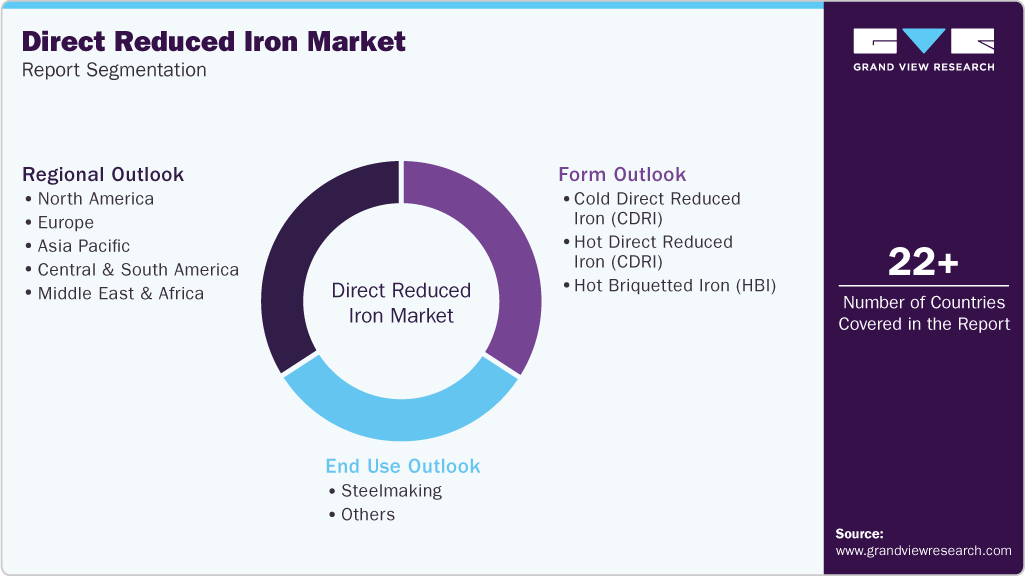
This report forecasts revenue and volume growth at global, regional, and country levels and provides an analysis of the latest industry trends in each of the sub-segments from 2021 to 2033. For this study, Grand View Research has segmented the global direct reduced iron market report based on end use, form, and region:
 To learn more about this report, Download Free Sample Report
 -
End Use Outlook (Volume, Kilotons; Revenue, USD Billion, 2021 - 2033)
-
Steelmaking
-
Others
-
-
Form Outlook (Volume, Kilotons; Revenue, USD Billion, 2021 - 2033)
-
Cold Direct Reduced Iron (CDRI)
-
Hot Direct Reduced Iron (CDRI)
-
Hot Briquetted Iron (HBI)
-
-
Regional Outlook (Volume, Kilotons; Revenue, USD Billion, 2021 - 2033)
-
-
North America
-
U.S.
-
Canada
-
Mexico
-
-
Europe
-
Italy
-
Germany
-
Spain
-
-
-
Asia Pacific
-
China
-
India
-
Japan
-
-
Central & South America
-
Argentina
-
-
Middle East & Africa
-
Research Methodology
The direct reduced iron market figures in this report are based on a proven research process that combines executive interviews with secondary research from proprietary databases, company filings, and recognized regulatory and institutional sources. Market size is built through value-chain sizing-reconciling supply-side and demand-side estimates-and triangulated with bottom-up and top-down approaches. Every estimate passes multiple levels of expert validation before publication, with each direct reduced iron segment quantified using the revenue-capture definitions in the table below.
Segment Definition
Segment - End Use
Revenue capture definition
Steelmaking
Revenue is generated from the consumption of Direct Reduced Iron (DRI) by steel producers using electric arc furnaces (EAFs), induction furnaces, and other steelmaking processes to manufacture crude and finished steel products.
Others
Revenue generated from the consumption of DRI in non-steelmaking applications, including foundry operations, ferroalloy production, and ductile iron manufacturing. In these applications, DRI is used as a charge material, metallic feedstock, or alloying agent to improve product quality, enhance process efficiency, and reduce impurities in the final output. Segment - Form
Revenue capture definition
Cold Direct Reduced Iron (CDRI)
Revenue is generated through the demand for cooled DRI used as a metallic feedstock in electric arc furnaces (EAFs), induction furnaces, foundries, and other steelmaking operations. Hot Direct Reduced Iron (HDRI)
Market value is derived from the demand for hot DRI directly charged into steelmaking furnaces to improve energy efficiency and productivity.
Hot Briquetted Iron (HBI)
Revenue is captured from the demand for densified DRI briquettes used as a premium iron-bearing feedstock in electric arc furnaces and blast furnace replacement applications Estimation Model
Layer Name
Key Question
Description
End-Use Demand Analysis
Where does DRI demand originate?
This stage evaluates demand from key end-use areas, mainly steelmaking, along with foundries, ferroalloy production, and ductile iron manufacturing. Steel production trends, EAF adoption, infrastructure activity, and industrial output are analyzed to identify the primary demand sources for DRI.
Steelmaking Route Assessment
Which steelmaking processes use DRI?
This stage identifies the steelmaking routes where DRI is consumed, especially electric arc furnaces, induction furnaces, and integrated DRI-EAF facilities. Demand is mapped across CDRI, HDRI, and HBI based on plant configuration, raw material requirements, and furnace technology.
DRI Consumption Analysis
How much DRI is consumed?
The estimated demand from end-use industries is translated into DRI consumption volumes. Consumption is quantified across steelmaking and other applications by evaluating steel output, metallic charge mix, DRI utilization rates, and substitution patterns with scrap, pig iron, and other iron-bearing materials.
Revenue Estimation
How much market revenue is generated?
The calculated DRI consumption volumes are converted into market revenue using average selling prices for CDRI, HDRI, and HBI. Pricing analysis considers factors such as iron content, product form, energy costs, transportation costs, trade flows, and regional supply-demand dynamics to determine overall market size and forecast growth.
Customization Table
Client Request
Customization Delivered
Value Adds
Cross-Segmentation Analysis
Conducted a detailed analysis of DRI demand across product forms (CDRI, HDRI, and HBI) and steelmaking application, evaluating consumption patterns, growth trends, and regional demand dynamics. The assessment identifies high-growth segment combinations and revenue-generating opportunities across the value chain.
Helps stakeholders understand cost drivers, evaluate procurement risks, and develop sourcing strategies to improve profitability and supply chain resilience.
Competitive Benchmarking
Evaluated leading DRI producers based on production capacity, geographic presence, product portfolio, technology adoption, raw material integration, sustainability initiatives, and strategic developments. The analysis compares market positioning and competitive strengths across key participants.
Enables stakeholders to understand the competitive landscape, identify industry best practices, benchmark performance, and assess strategic positioning against competitors.
Opportunity Assessment
Conducted a comprehensive assessment of emerging growth opportunities across green steel production, hydrogen-based DRI technologies, EAF expansion, infrastructure development, and high-growth steel-producing regions. The analysis includes market attractiveness, investment trends, and future demand outlook.
Helps stakeholders identify high-growth markets, evaluate investment opportunities, and formulate long-term growth strategies aligned with industry decarbonization and steel demand trends.
Frequently Asked Questions About This Report
Based on end-use, steelmaking accounted for largest revenue share of 83.7% in 2025.
Cold direct reduced iron (CDRI) accounted for largest revenue share of 78.8% in 2025 while hot briquetted iron (HBI) segment is expected to be the fastest-growing market.
The key players operating in the direct reduced iron market are Qatar Steel; Kobe Steel Ltd; ArcelorMittal; NUCOR; Khouzestan Steel Company; Welspun Group; Jindal Shadeed Iron & Steel LLC; AM/NS India; Tosyali Algeria A.S.; and others.
The direct reduced iron market is expected to grow at a compound annual growth rate of 8.9% from 2026 to 2033 to reach USD 93.5 billion by 2033.
The direct reduced iron market is primarily driven by rising global steel demand, increasing adoption of electric arc furnaces (EAFs), and growing investments in low-carbon and hydrogen-based steel production technologies.
The direct reduced iron market size was estimated at USD 48.9 billion in 2025 and is expected to reach USD 51.6 billion in 2026.
Asia Pacific dominated the market with revenue share of 58.9% in 2025.
About the Author(s)
Advanced Interior Materials Research Team
Advanced Materials · Advanced Interior MaterialsThis report was authored by the advanced interior materials research team at Grand View Research - comprising two research analysts, one senior research analyst, and one industry expert - with specialized expertise in the advanced interior materials segment of the advanced materials industry. All findings are based on proprietary advanced materials databases, executive interviews, and regulatory analysis, subject to internal peer review prior to publication.
Last Updated:
Speak to Analyst

Customize this report to your needs - add regions, segments, or data points, with 20% free customization.
Or view our licence options:


ISO 9001:2015 & 27001:2022 Certified
We are GDPR and CCPA compliant! Your transaction & personal information is safe and secure. For more details, please read our privacy policy.


