
- Home
- »
- Communication Services
- »
-
Dropshipping Market Size, Share, Growth Report, 2026-2033GVR Report cover
![Dropshipping Market (2026 - 2033)Report]()
Dropshipping Market (2026 - 2033)
Size, Share & Trends Analysis Report By Product (Toys, Hobby & DIY, Furniture & Appliances, Food & Personal Care, Electronics & Media, Fashion), By Region (North America, Europe, Asia Pacific, Latin America, MEA), And Segment Forecasts
Market Size, 2025
$464.4BMarket Estimate, 2026
$583.5BMarket Forecast, 2033
$2,180.8BCAGR, 2026–2033
20.7%Dropshipping Market Summary
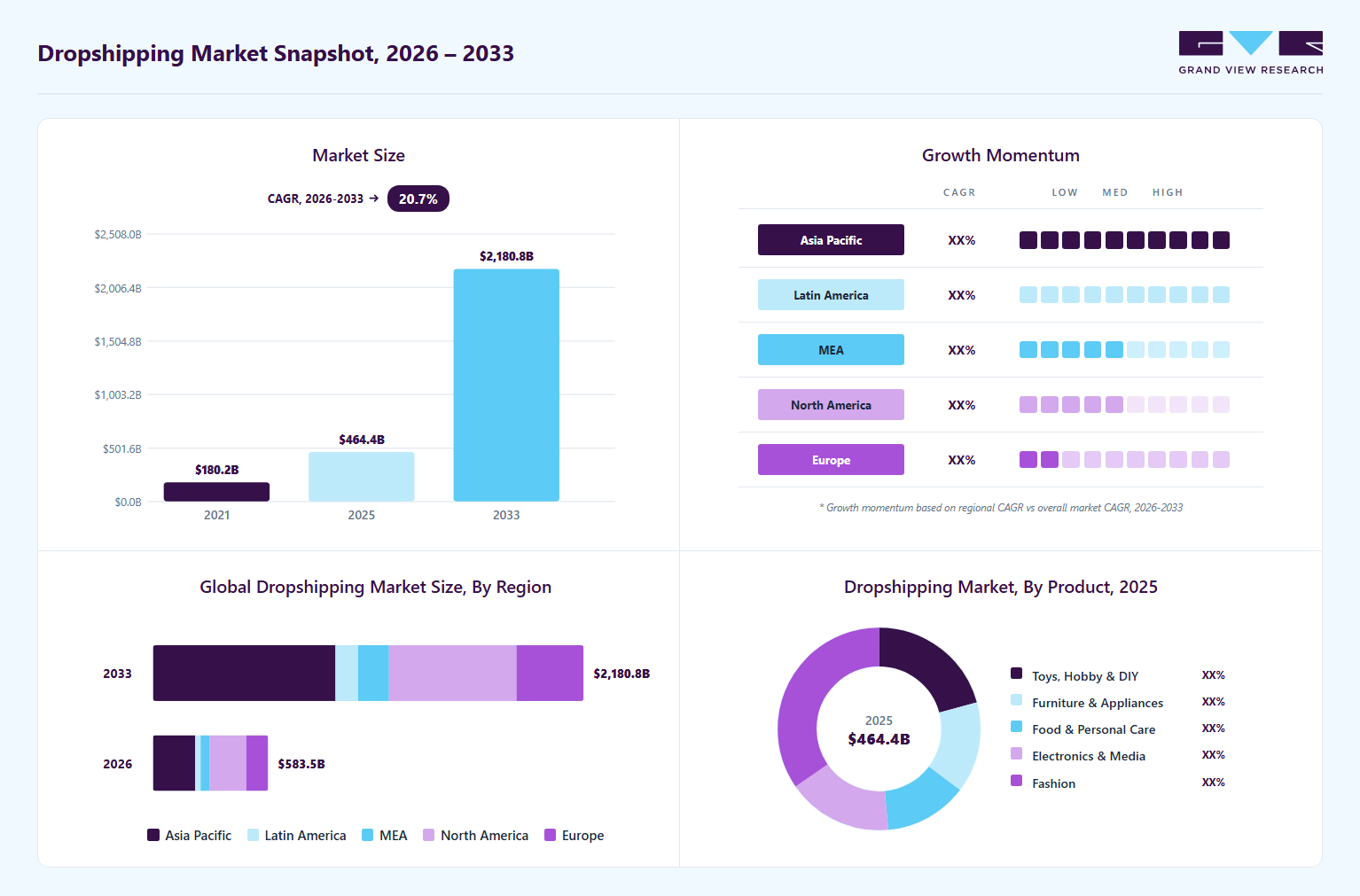
The global dropshipping market size was valued at USD 464.4 billion in 2025 and is projected to grow from USD 583.5 billion in 2026 to USD 2,180.8 billion in 2033, growing at a CAGR of 20.7% from 2026 to 2033. Asia Pacific dominated the dropshipping market with the largest revenue share of 36.0% in 2025. The growth of the market can be attributed tothe increasing penetration of e-commerce and digital payment solutions, enabling seamless transactions and global reach for retailers.
Key Market Trends & Insights
- By product: Fashion segment led the market with the largest revenue share of 37.4% in 2025.
- By product: Food & personal care segment is expected to grow at a significant CAGR of 16.7% over the forecast period.
Regional Highlights
- Largest regional market: Asia Pacific (36.0% revenue share, 2025)
- By country: The China held the largest market share in 2025.
Market Size & Forecast
- Market size in 2025: USD 464.4 Billion
- Estimated market size in 2026: USD 583.5 Billion
- Projected market size by 2033: USD 2,180.8 Billion
- CAGR (2026-2033): 20.7%
Three ways to get this report
Buy it, customize it, or ask a question.Get the Full Report
What the study covers
- FormatsPDF · Excel · Dashboard
- Timeline2026–2033 annual, 2025 base
- Coverage20+ countries, 5 regions
- Companies10+ key players profiled
Customize the Report
20% free customization
- IncludeCountries, segments, points
- TailorTo your product definition
- ExtendDeeper competitor detail
- OrA fully bespoke study
- Turnaround5–10 working days
Ask an Analyst
A direct answer, usually in 1 working day
- AccessReport author, directly
- Reply timeWithin 1 working day
- No sales callDirect answer only
- FormatEmail reply
- CostFree, no cost
Advancements in automation and AI-powered tools have further streamlined inventory management, order fulfillment, and customer service, reducing operational costs and barriers to entry. Moreover, the rising preference for low-capital business models among entrepreneurs, coupled with expanding supplier networks and faster shipping solutions, is fueling market expansion. The surge in consumer demand for diverse product options and personalized shopping experiences also drives the dropshipping industry growth.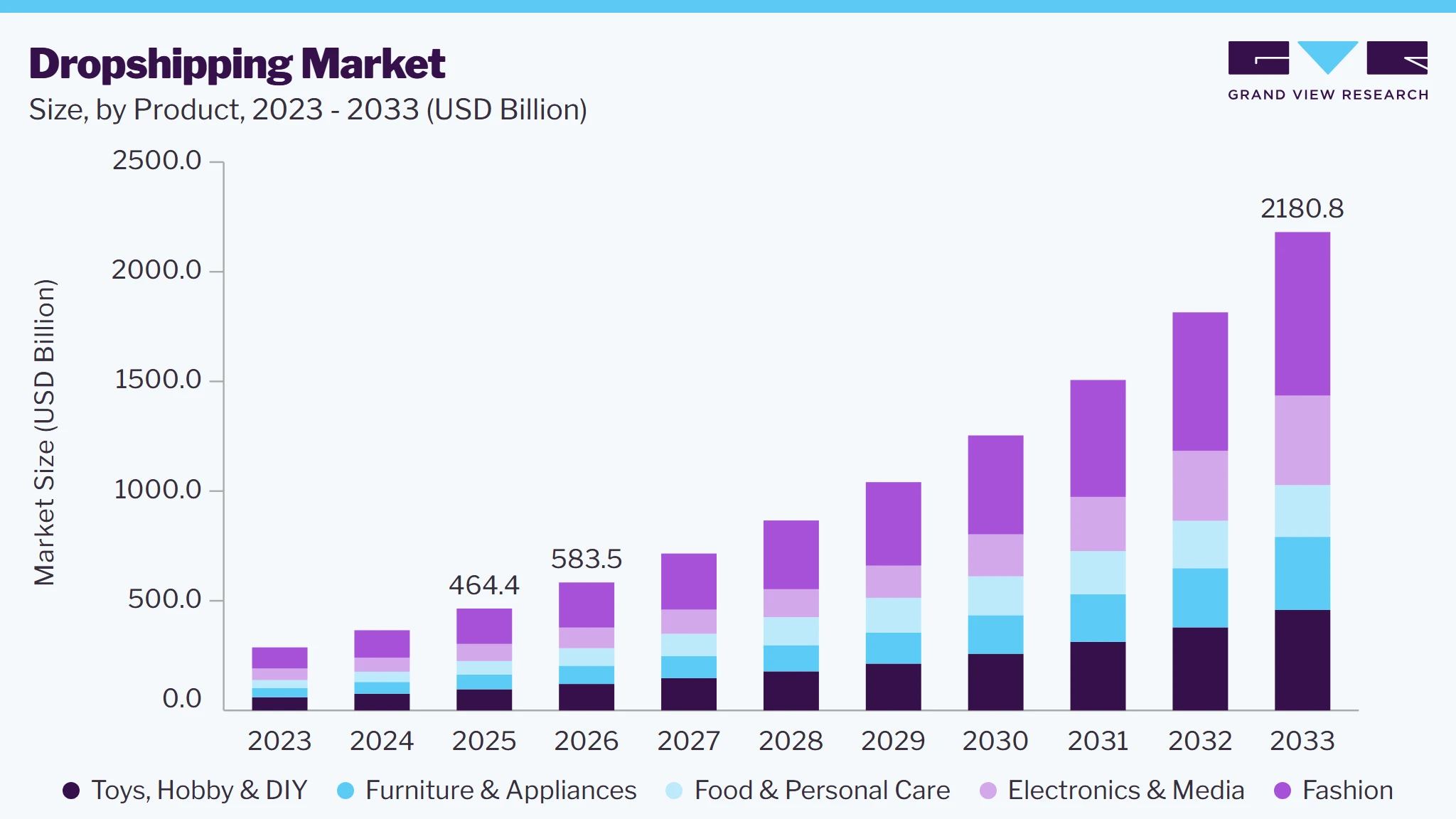
The rapid growth of e-commerce, driven by increasing internet penetration and smartphone usage, is the most significant factor fueling the dropshipping industry. Consumers worldwide are shifting toward online shopping, creating higher demand for flexible and scalable retail models like dropshipping. Simultaneously, advancements in digital payment solutions, including mobile wallets, cryptocurrency, and Buy Now, Pay Later (BNPL) options, have enhanced transaction security and convenience, encouraging more businesses and consumers to participate in the market.According to the European Union's survey statistics, 94% of households in the EU had internet access in 2024. The Netherlands and Luxembourg reported the highest connectivity rates at 99%, while Finland and Denmark also had strong household internet access, both reaching 97%.
Technological advancements, including automation and artificial intelligence (AI), have significantly streamlined dropshipping operations. AI-driven tools assist in product recommendations, dynamic pricing, fraud detection, and customer service, reducing manual workload and improving efficiency. Automated inventory management and order processing further minimize human errors and speed up fulfillment, making dropshipping more accessible and profitable for businesses of all sizes. Moreover, dropshipping has gained significant traction among entrepreneurs and small business owners due to its low initial investment and reduced financial risk. By eliminating the need for inventory management and warehousing, this business model enables individuals to establish and scale operations with minimal capital. The affordability and accessibility of dropshipping have contributed to the growth of solopreneurs and small-scale online retailers, driving market expansion.
The global supply chain has evolved to support dropshipping more effectively, with suppliers offering competitive pricing, streamlined logistics, and integrated shipping solutions. The rise of fulfillment centers, particularly from e-commerce giants such as Alibaba and Shopify, has led to reduced delivery times and improved customer satisfaction. In addition, innovations in last-mile delivery and third-party logistics (3PL) services are addressing previous concerns about shipping delays.
Market Dynamics
Dropshipping eliminates the need for inventory storage, warehouse management, and large procurement investments. Retailers can offer a broad range of products without maintaining stock, significantly reducing financial risks and operational expenses. This asset-light business model is particularly attractive to startups, SMEs, and independent entrepreneurs seeking scalable business opportunities with limited capital requirements.
The increasing penetration of e-commerce platforms and digital marketplaces is significantly driving the growth of the dropshipping market. Consumers are increasingly shifting toward online purchasing due to convenience, extensive product variety, and competitive pricing. Simultaneously, entrepreneurs and small businesses are adopting dropshipping models because they eliminate the need for inventory investments and warehousing infrastructure. According to the United Nations Conference on Trade and Development, global e-commerce sales have continued to grow as online retail becomes an integral part of consumer purchasing behavior. Additionally, the widespread availability of website-building platforms, digital payment systems, and social commerce channels has lowered entry barriers for new online retailers. The growing number of internet users and smartphone adoption worldwide is expected to further accelerate dropshipping business creation and market expansion.
Reliance on third-party suppliers remains one of the most significant challenges for dropshipping businesses. Retailers have limited control over inventory availability, product quality, packaging standards, and shipping timelines, which can directly impact customer satisfaction. Delays in order fulfillment, stock shortages, and inconsistent product quality may result in negative reviews and reduced customer loyalty. Furthermore, managing multiple suppliers across different countries increases operational complexity and exposes businesses to disruptions caused by geopolitical tensions, trade restrictions, and logistics bottlenecks. As customer expectations for faster deliveries continue to rise, maintaining a consistent brand experience becomes increasingly difficult for dropshipping retailers.
The integration of artificial intelligence (AI), automation tools, and social commerce platforms is creating substantial growth opportunities within the dropshipping market. AI-powered solutions help merchants identify trending products, optimize pricing, automate inventory synchronization, improve demand forecasting, and personalize marketing campaigns. According to industry estimates, social commerce sales are growing rapidly as consumers increasingly discover and purchase products through platforms such as Instagram, TikTok, and Facebook Shops. The growing adoption of influencer marketing and live-commerce strategies is enabling dropshipping businesses to reach highly targeted customer segments at relatively low acquisition costs. Additionally, advancements in automation are reducing operational workloads and improving scalability for merchants.
Analyst Perspective
The dropshipping market is positioned at the convergence of several long-term growth trends, including the continued expansion of e-commerce, increasing digital entrepreneurship, and the growing adoption of AI-driven commerce tools. The model's primary advantage lies in its asset-light structure, allowing merchants to launch and scale online businesses without significant inventory or warehousing investments. However, as competition intensifies and product differentiation becomes increasingly difficult, sustainable success will depend on the ability to build strong brand identities, leverage data analytics, and optimize customer acquisition channels. The most defensible competitive position will belong to platforms and merchants that integrate supplier management, fulfillment automation, social commerce, and personalized customer experiences into a seamless ecosystem. As consumer expectations for fast delivery and reliable service continue to rise, companies that successfully combine operational efficiency with brand-driven customer loyalty will be best positioned to capture long-term value in the evolving dropshipping landscape.
Product Insights
Based on product, the fashion segment led the market with the largest revenue share of 37.4% in 2025 and is expected to grow at a significant CAGR over the forecast period. The fashion industry is heavily influenced by fast-changing trends, making dropshipping an ideal model for retailers looking to quickly introduce new styles without holding inventory. Social media platforms, influencer marketing, and viral fashion trends drive consumer demand for fresh and affordable clothing. Dropshipping allows businesses to respond swiftly to these trends, reducing financial risks associated with unsold stock while maximizing profitability.
The food & personal care segment is expected to grow at a significant CAGR of 23.6% over the forecast period. Consumers are increasingly seeking organic, natural, and sustainable food and personal care products, and dropshipping allows retailers to quickly adapt to these trends by sourcing products from niche suppliers. In addition, the COVID-19 pandemic accelerated the shift toward online shopping, with more consumers purchasing groceries, vitamins, and personal care items online. Dropshipping enables retailers to offer a wide variety of products without the logistical challenges of traditional retail, further boosting its appeal.
Regional Insights
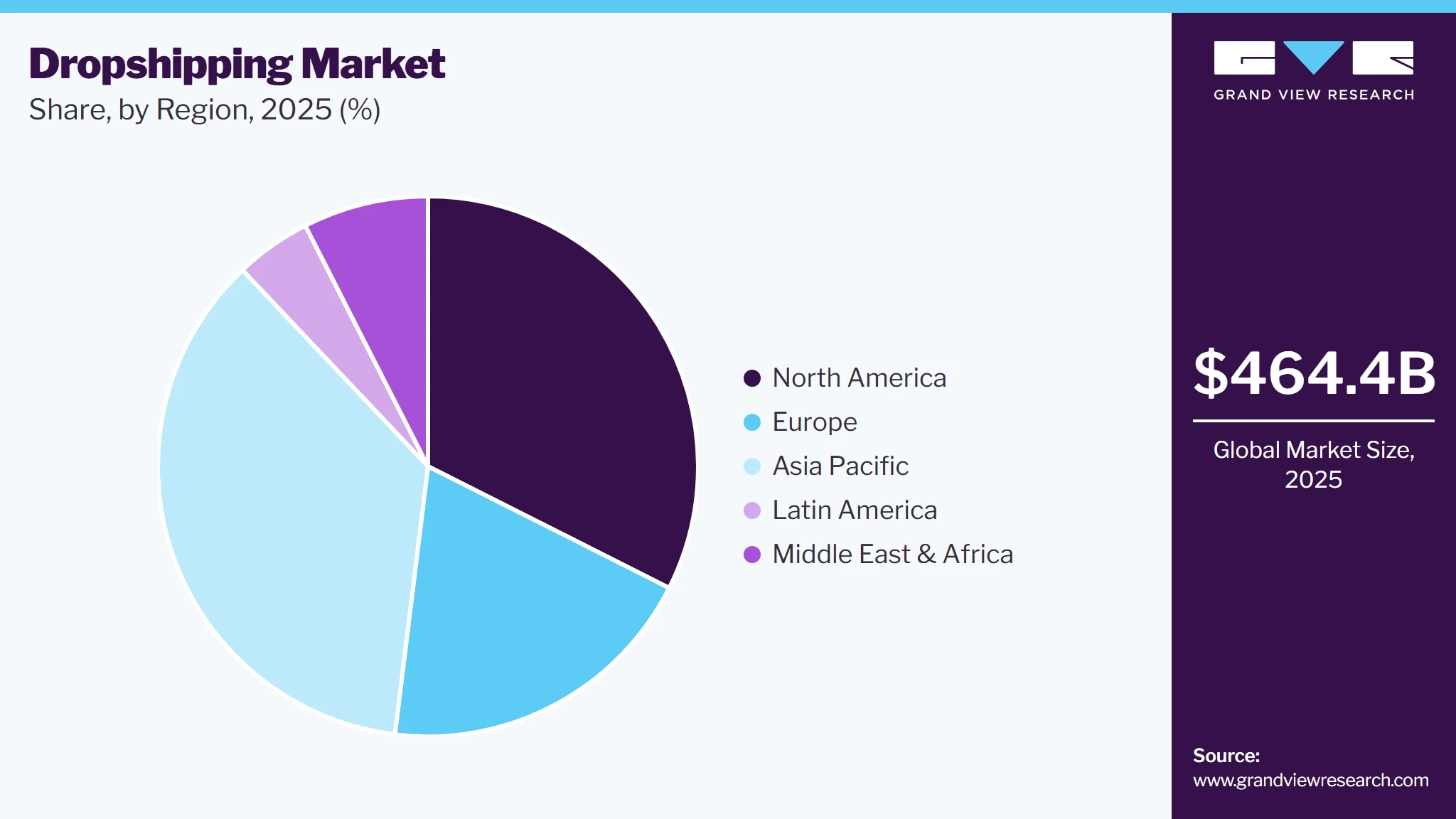
The North America dropshipping market held a revenue share of nearly 32.4% in 2025. In North America, dropshipping businesses are increasingly focusing on niche markets rather than general product categories. Retailers are targeting specialized segments like sustainable fashion, pet accessories, health & wellness products, and tech gadgets to differentiate themselves in a competitive market. Consumers are more inclined to shop from curated stores that cater to their specific interests, driving this trend.
U.S. Dropshipping Market Trends
The U.S. dropshipping market is expected to grow significantly at a CAGR of 18.9% from 2026 to 2033. Automation and AI are playing a crucial role in enhancing the dropshipping experience in the U.S. From AI-powered chatbots for customer service to predictive analytics for demand forecasting; technology is helping businesses improve efficiency. Automated inventory management and dynamic pricing tools also enable retailers to optimize margins and minimize stockouts.
Europe Dropshipping Market Trends
The dropshipping market in Europe is anticipated to grow at a significant CAGR from 2025 to 2030. European dropshipping businesses are increasingly sourcing products from local and EU-based suppliers to reduce shipping times and comply with import regulations. This shift is improving delivery speed, reducing reliance on Chinese suppliers, and helping businesses build trust with European customers by offering higher quality, locally made products.
The UK dropshipping industry is expected to grow rapidly in the coming years. There is increasing demand for eco-friendly products, plastic-free packaging, and ethically sourced goods across various categories, including fashion, home decor, and personal care. Dropshipping businesses that prioritize sustainability and transparency in their supply chain are seeing higher customer engagement and loyalty.
The Germany dropshipping market held a substantial market share in 2024. Germany has some of the strictest e-commerce and consumer protection laws in Europe, requiring dropshipping businesses to provide clear return policies, transparent pricing, and product warranties. Compliance with regulations like the Verpackungsgesetz (Packaging Act) and GDPR (General Data Protection Regulation) is essential for operating legally and maintaining consumer trust. Businesses that prioritize transparency and excellent customer service are more likely to thrive in this highly regulated market.
Asia Pacific Dropshipping Market Trends
Asia Pacific dominated the dropshipping market with the largest revenue share of 36.0% in 2025. The Asia Pacific (APAC) region is experiencing a boom in e-commerce, driven by increased internet penetration, mobile device usage, and the adoption of digital payment solutions. Consumers in countries like China, India, Japan, and Southeast Asia are increasingly shopping online, contributing to the expansion of the dropshipping market. The availability of various digital payment options, including mobile wallets, UPI (Unified Payments Interface), and QR code-based payments, is making transactions smoother and more accessible, further fueling market growth.

The Japan dropshipping industry is expected to grow rapidly in the coming years. Japan is known for its efficient logistics network, and consumer expectations for fast and reliable shipping are high. Dropshipping businesses that can partner with local or regional suppliers to offer quick shipping have a competitive edge in the Japanese market. Consumers in Japan are less tolerant of long shipping times, so reducing delivery durations is critical to meeting customer expectations and ensuring repeat business.
China Dropshipping Market Trends
The dropshipping market in the China held the largest share in the Asia Pacific region in 2025. Social commerce has exploded in China, with platforms like WeChat, Douyin, and Xiaohongshu (Little Red Book) playing a central role in e-commerce transactions. Dropshipping businesses can leverage these platforms for influencer marketing, live-stream shopping events, and direct sales. The ability to integrate shopping features directly into social media apps allows businesses to target millions of active users, boosting visibility and engagement. Influencers, known as KOLs (Key Opinion Leaders), are especially influential in driving purchasing decisions, particularly among younger consumers.
Key Dropshipping Company Insights
Key players operating in the global dropshipping industry are SaleHoo Group Limited, Printify, Wholesale2b, Megagoods Inc., and Shopify Inc. The key companies are focusing on various strategic initiatives, including new product development, partnerships & collaborations, and agreements to gain a competitive advantage over their rivals. The following are some instances of such initiatives.
-
In November 2024, Printify and Printful, a U.S.-based print product fulfillment company, officially merged and introduced their unified leadership team. This merger is expected to drive accelerated growth for both companies while expanding opportunities for millions of customers to scale their online businesses globally. Despite the integration, both brands will continue to operate independently, reinforcing Riga’s status as a hub for innovation and a key destination for tech investment.
-
In June 2023, Wholesale2b launched W2B AI, a cutting-edge tool designed to generate unique product titles and descriptions, helping brands enhance their online presence. This innovative AI-powered feature aims to improve search engine rankings, create more compelling ad copy, boost on-site conversions, and enhance customer readability. With W2B Dropship AI, businesses can craft distinctive content that strengthens their brand identity and enhances user experience.
Key Dropshipping Companies:
The following key companies have been profiled for this study on the dropshipping market.
-
AliDrop
-
Cin7 Americas, Inc.
-
Focus Technology Co., Ltd.
-
Inventory Source
-
Megagoods Inc.
-
MODALYST, INC.
-
Printify
-
SaleHoo Group Limited
-
Shopify Inc.
-
Sunrise Wholesale Merchandise LLC
-
Wholesale2B
Competitive Benchmarking
Category
Operating Strategies
Competitive Edge
Weakness
Established Players (Shopify, Alibaba Group, CJdropshipping, SaleHoo)
- Expand global supplier and fulfillment networks to improve delivery speed and product availability. Invest in AI-powered product discovery, inventory synchronization, automation tools, and cross-border commerce capabilities. Develop integrated ecosystems combining store creation, payments, logistics, and supplier management.
- Strong brand recognition, extensive supplier databases, large merchant ecosystems, and advanced automation capabilities.
- Ability to offer end-to-end solutions including storefront management, payment processing, and fulfillment support.
- Higher operational and compliance costs due to global regulatory requirements
- Higher operating costs associated with platform maintenance, regulatory compliance, and logistics partnerships. Dependence on third-party suppliers for product quality and fulfillment. Slower adaptation to highly specialized niche markets due to larger operational structures.
Emerging Players (Spocket, Zendrop, Modalyst, AutoDS)
- Focus on niche product categories, localized supplier networks, and faster delivery options. Leverage AI-driven automation, social commerce integrations, influencer marketing, and subscription-based service models. Offer specialized solutions for specific merchant segments and marketplaces
- Greater agility in launching new features and responding to evolving merchant needs.
- Ability to target underserved niches and provide personalized merchant experiences. Faster innovation cycles and flexible pricing structures attract small and medium-sized online sellers
- Limited financial resources and smaller supplier ecosystems compared to established competitors. Challenges in scaling globally and maintaining service consistency.
- Lower brand awareness and merchant trust may hinder customer acquisition and long-term retention
Dropshipping Market Report Scope
Report Attribute
Details
Market size value in 2025
USD 464.4 billion
Estimated market size in 2026
USD 583.5 billion
Projected market size by 2033
USD 2,180.8 billion
Growth rate
CAGR of 20.7% from 2026 to 2033
Base year for estimation
2025
Historical data
2021 - 2024
Forecast period
2026 - 2033
Quantitative units
Revenue in USD billion and CAGR from 2026 to 2033
Report coverage
Revenue forecast, company market share analysis, competitive landscape, growth factors, and trends
Segments covered
Product and Region
Regional scope
North America; Europe; Asia Pacific; Latin America; MEA
Country scope
U.S.; Canada; Mexico; Germany; UK; France; China; Japan; India; South Korea; Australia; Brazil; Saudi Arabia; South Africa; UAE
Key companies profiled
Shopify; Alibaba; Amazon; CJ Dropshipping; SaleHoo; Spocket; Printful; Zendrop; AutoDS; DSers
Customization scope
Free report customization (equivalent up to 8 analysts' working days) with purchase. Addition or alteration to country, regional & segment scope.
Pricing and purchase options
Avail customized purchase options to meet your exact research needs. Explore purchase options
Global Dropshipping Market Report Segmentation
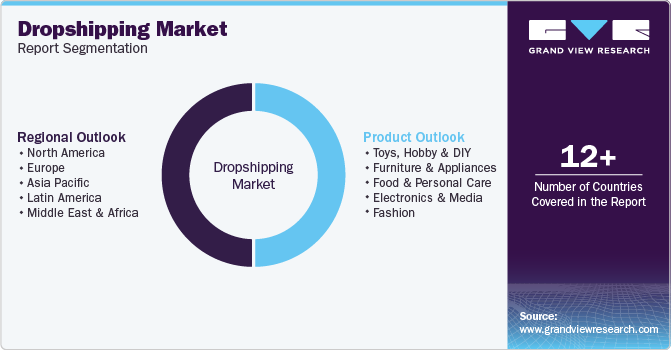
This report forecasts revenue growth at global, regional, and country levels and provides an analysis of the latest industry trends in each of the sub-segments from 2021 to 2033. For this study, Grand View Research has segmented the global dropshipping market report based on product and region.
-
Product Outlook (Revenue, USD Billion, 2021 - 2033)
-
Toys, Hobby & DIY
-
Furniture & Appliances
-
Food & Personal Care
-
Electronics & Media
-
Fashion
-
-
Regional Outlook (Revenue, USD Billion, 2021 - 2033)
-
North America
-
U.S.
-
Canada
-
Mexico
-
-
Europe
-
UK
-
Germany
-
France
-
-
Asia Pacific
-
China
-
India
-
Japan
-
Singapore
-
-
Latin America
-
Brazil
-
-
Middle East & Africa
-
UAE
-
Saudi Arabia
-
South Africa
-
-
Research Methodology
Segment Definition
Segment - Product
Revenue capture definition
Toys, Hobby & DIY
This segment includes products related to entertainment, recreation, crafts, and do-it-yourself projects. It covers toys for children, board games, hobby kits, arts and crafts supplies, model-building kits, gardening tools, sports accessories, and home improvement products.
Furniture & Appliances
This segment comprises household furniture and electrical appliances used in residential and commercial settings. It includes sofas, tables, chairs, beds, storage units, kitchen appliances, air purifiers, vacuum cleaners, lighting products, and other home essentials.
Food & Personal Care
This segment includes packaged food products, beverages, dietary supplements, skincare products, cosmetics, haircare products, personal hygiene items, and wellness products.
Electronics & Media
This category consists of consumer electronics, digital devices, and media-related products. It includes smartphones, laptops, tablets, headphones, smartwatches, gaming accessories, cameras, storage devices, software, books, music, and digital entertainment products.
Fashion
The fashion segment encompasses apparel, footwear, accessories, jewelry, watches, handbags, and other lifestyle products. It includes products for men, women, and children across various styles and price ranges. Fashion remains one of the largest dropshipping categories due to rapidly changing consumer trends, extensive product variety, and strong demand through social commerce and influencer-driven marketing channels.
Estimation Model
E-Commerce Merchant Base Layer
Addressable Market Layer
Active Dropshipping Transaction Layer
Monetization Layer
Who operates online retail businesses today?
Who can realistically be reached and served?
Who is actively generating dropshipping transactions?
How much revenue is generated from this demand?
Establish the total addressable universe by identifying online sellers operating through marketplaces, independent web stores, social commerce platforms, and cross-border e-commerce channels. This serves as the foundation for market sizing before dropshipping-specific filters are applied.
Refine the merchant base by identifying businesses that utilize or are willing to adopt inventory-light fulfillment models. Filters include business size, product category suitability, digital maturity, supplier accessibility, and cross-border selling capabilities.
Estimate annual transaction volume by evaluating active dropshipping merchants, average orders processed, product sourcing activity, supplier relationships, and order fulfillment frequency. This converts the addressable merchant base into measurable dropshipping activity.
Convert transaction activity into market revenue by applying platform subscription fees, transaction commissions, fulfillment charges, supplier service fees, advertising spend, automation software subscriptions, and value-added merchant services.
Delivered Customizations
This report has been delivered with the following In-depth customizations
Client Request
Customization Delivered
Value Adds
E-commerce Adoption & Online Entrepreneurship Trends
Conducted a focused analysis of global e-commerce expansion, online seller adoption, marketplace growth, digital payment penetration, and emerging dropshipping business models across key regions and industries.
Helps stakeholders identify high-growth geographies, evaluate merchant adoption patterns, and assess revenue opportunities arising from increasing online retail participation and cross-border commerce.
Social Commerce & Consumer Purchasing Behavior Analysis
Evaluated trends in social commerce, influencer-driven sales, mobile shopping adoption, customer acquisition strategies, and consumer buying preferences across major product categories including fashion, electronics, and personal care.
Provides insights into evolving customer behavior, effective sales channels, and emerging demand segments to support product positioning, marketing strategies, and customer engagement initiatives.
AI-Driven Commerce & Platform Competitiveness Assessment
Examined international sourcing trends, regional supplier hubs, import-export dynamics, localization strategies, and regulatory considerations impacting global dropshipping operations.
Enables stakeholders to identify attractive expansion markets, optimize sourcing strategies, and mitigate risks associated with international trade and supply chain dependencies.
Frequently Asked Questions About This Report
The global dropshipping market size was estimated at USD 464.4 billion in 2025 and is expected to reach USD 583.5 billion in 2026.
The global dropshipping market is expected to grow at a compound annual growth rate of 20.7% from 2026 to 2033 to reach USD 2,180.8 billion in 2033.
The fashion segment accounted for the largest revenue share of over 34.0% in 2025. The fashion industry is heavily influenced by fast-changing trends, making dropshipping an ideal model for retailers looking to quickly introduce new styles without holding inventory. Social media platforms, influencer marketing, and viral fashion trends drive consumer demand for fresh and affordable clothing. Dropshipping allows businesses to respond swiftly to these trends, reducing financial risks associated with unsold stock while maximizing profitability.
Some key players operating in the dropshipping market include Shopify; Alibaba; Amazon; CJ Dropshipping; SaleHoo; Spocket; Printful; Zendrop; AutoDS; DSers.
The increasing penetration of e-commerce platforms and digital marketplaces is significantly driving the growth of the dropshipping market. Consumers are increasingly shifting toward online purchasing due to convenience, extensive product variety, and competitive pricing.
The growing investment in regional warehouses and local fulfillment centers will drive the dropshipping market by enabling faster order delivery and improved customer experiences. Shorter shipping times will help merchants increase customer satisfaction, reduce cart abandonment rates, and compete more effectively with traditional e-commerce retailers offering rapid fulfillment services.
Asia Pacific dominated with a 36.0% revenue share in 2025.
Asia Pacific is the fastest-growing region over the forecast period.
The electronics & media is the fastest-growing segment in the dropshipping market.
About the Author(s)
Communication Services Research Team
Technology · Communication ServicesThis report was authored by the communication services research team at Grand View Research - comprising two research analysts, one senior research analyst, and one industry expert - with specialized expertise in the communication services segment of the technology industry. All findings are based on proprietary technology databases, executive interviews, and regulatory analysis, subject to internal peer review prior to publication.
Last Updated:
Speak to Analyst


Customize this report to your needs - add regions, segments, or data points, with 20% free customization.
Or view our licence options:


ISO 9001:2015 & 27001:2022 Certified
We are GDPR and CCPA compliant! Your transaction & personal information is safe and secure. For more details, please read our privacy policy.


