
- Home
- »
- Beauty & Personal Care
- »
-
Dry Shampoo Market Size And Share Report, 2026-2033GVR Report cover

Dry Shampoo Market (2026 - 2033)
Size, Share & Trends Analysis Report By Form (Spray, Powder, Others), By Distribution Channel (Online, Offline), By End-use (Men, Women, Children), By Region (North America, Europe, Asia Pacific, Latin America, MEA), And Segment Forecasts
Market Size, 2025
$4.5BMarket Estimate, 2026
$5.1BMarket Forecast, 2033
$11.7BCAGR, 2026–2033
12.7%Dry Shampoo Market Summary
The global dry shampoo market size was valued at USD 4.5 billion in 2025 and is projected to grow from USD 5.1 billion in 2026 to USD 11.7 billion by 2033, at a CAGR of 12.7% from 2026 to 2033. North America dominated the global market with the largest revenue share of 36.5% in 2025. This growth is attributed to several factors, including changing consumer lifestyles, growing awareness about advanced hair care products, and increasing popularity of waterless products.
 Source: Grand View Research, IR Documents, Primary Interviews, Paid DatabasesTo learn more about this report,
 Download Free Sample Report
 Key Market Trends & Insights
- By form: Spray segment led the market with the largest revenue share of 62.1% in 2025.
- By end-user: Women led the market with the largest revenue share of 61.2% in 2025.
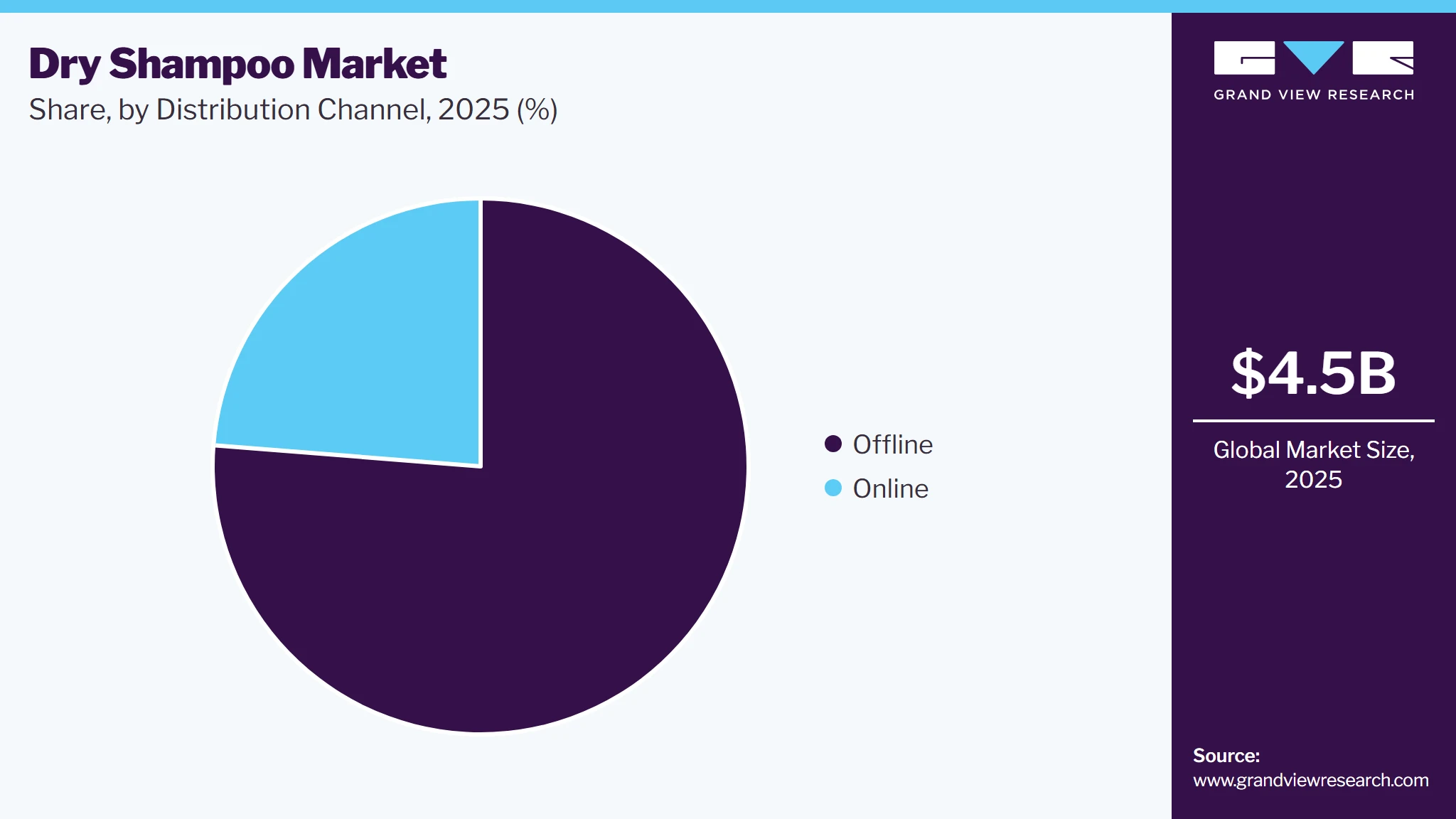
- By distribution channel: Offline segment led the market with the largest revenue share of 76.3% in 2025.
Regional Highlights
- Largest regional market: North America (36.5% revenue share, 2025)
- Fastest-growing regional market: Asia Pacific (highest CAGR, 2026-2033)
- By country: The dry shampoo market in the U.S. held the largest share in the North America region in 2025.
Market Size & Forecast
- Market size in 2025: USD 4.5 Billion
- Estimated market size in 2026: USD 5.1 Billion
- Projected market size by 2033: USD 11.7 Billion
- CAGR (2026-2033): 12.7%
Three ways to get this report
Buy it, customize it, or ask a question.Ask an Analyst
Analyst response in 1 business day
- AccessReport author, directly
- Reply timeWithin 1 working day
- No sales callDirect answer only
- FormatEmail reply
- CostFree, no cost
Get the Full Report
What the study covers
- FormatsPDF · Excel · Dashboard
- Timeline2026–2033 annual, 2025 base
- Coverage20+ countries, 5 regions
- Companies10+ key players profiled
Customize the Report
20% free customization
- IncludeCountries, segments, points
- TailorTo your product definition
- ExtendDeeper competitor detail
- OrA fully bespoke study
- Turnaround5–10 working days
As modern consumers lead busier lives, they seek fast and effective solutions for maintaining their hair without the need for traditional washing methods. Dry shampoo offers a practical alternative that allows users to refresh their hair quickly, making it particularly appealing to those with busy schedules. To learn more about this report, Download Free Sample Report
 The rising trend of sustainability and eco-consciousness among consumers is also contributing to the expansion of the dry shampoo industry, with several brands offering organic and sustainable products. Many individuals are becoming aware of the environmental impact of their personal care products and are opting for dry shampoo as a liquid-free solution. This shift is further fueled by concerns over water scarcity in various regions, prompting consumers to choose products that align with their requirements. For instance, in urban areas where water usage is heavily monitored, dry shampoo effectively helps maintain personal hygiene while reducing water consumption.
Moreover, the innovations in formulation leading to the launch of natural and organic dry shampoos and their easy availability have significantly influenced market dynamics. With increasing numbers of consumers avoiding synthetic chemicals due to awareness about their impact on health, hair care brands are developing products free from harmful ingredients such as parabens and sulfates. This shift toward natural products with the rising number of health-conscious consumers aligns with broader trends in the beauty industry that emphasize transparency and ingredient integrity. As a result, natural dry shampoos are gaining market share, appealing to a demographic prioritizing environmental sustainability.
Market Dynamics
The global dry shampoo market is gaining traction as consumers increasingly seek convenient, time-saving, and waterless hair care solutions. Dry shampoos help absorb excess oil, refresh hair between washes, add volume, and extend hairstyling longevity, making them highly suitable for busy lifestyles, travel, post-workout use, and on-the-go grooming. Rising awareness of scalp care, growing preference for low-maintenance beauty routines, and increasing adoption of premium personal care products are supporting market growth. In addition, the expansion of aerosol, powder, foam, and natural ingredient-based formats is widening consumer appeal. The growing influence of beauty influencers, social media trends, and e-commerce availability is expected to continue driving growth in the global dry shampoo market.
The increasing demand for quick, convenient, and easy-to-use hair care products is significantly driving the global dry shampoo market. Consumers with busy schedules are increasingly using dry shampoo to reduce frequent hair washing, manage oily scalp conditions, refresh hair after workouts, and maintain hairstyles for longer periods. This is particularly relevant among urban consumers, working professionals, students, travelers, and individuals with colored or treated hair, where frequent washing may lead to dryness, color fading, or styling damage.
Growing awareness regarding water conservation and sustainable beauty routines is also supporting product adoption. Dry shampoo enables hair refreshment without water, making it attractive in regions facing water scarcity and among consumers seeking eco-conscious personal care choices. The availability of products tailored for different hair types, scalp needs, fragrances, and tint options has further strengthened adoption. As a result, the market is expected to benefit from the rising preference for practical, portable, and multifunctional hair care solutions.
Product build-up and scalp sensitivity remain key restraints for the global dry shampoo market. Excessive or improper use of dry shampoo may leave residue on the scalp, clog pores, cause itchiness, or contribute to dryness, especially among consumers with sensitive scalp conditions. Since dry shampoo does not replace traditional cleansing, overdependence on the product can create negative perceptions regarding scalp hygiene and long-term hair health.
Concerns regarding aerosol propellants, synthetic fragrances, talc, alcohol content, and other chemical ingredients may also limit adoption among health-conscious consumers. In some markets, consumers are becoming more selective about product formulations and are shifting toward clean-label, dermatologically tested, non-aerosol, and natural alternatives. Premium dry shampoos with safer or plant-based formulations often carry higher prices, which may restrict adoption among price-sensitive consumers. These factors may limit repeat usage and create challenges for mass-market penetration.
The development of clean-label, scalp-friendly, and specialized dry shampoo formulations is creating substantial growth opportunities in the global dry shampoo market. Consumers are increasingly seeking products that not only absorb oil but also support scalp health, offer residue-free application, and suit specific hair colors and textures. This is encouraging manufacturers to introduce dry shampoos with natural starches, botanical extracts, fragrance-free options, tinted variants, non-aerosol packaging, and products designed for curly, textured, fine, oily, or color-treated hair.
The growing premiumization of hair care is also supporting opportunities for multifunctional dry shampoos that provide volume, texture, UV protection, anti-pollution benefits, and styling support. E-commerce, beauty subscription platforms, salon channels, and influencer-led marketing are improving product discovery across both developed and emerging markets. In addition, rising demand for sustainable packaging and travel-friendly formats is expected to support innovation. These developments are likely to strengthen the position of dry shampoo as a regular-use product within modern hair care routines.
Analyst Perspective
The dry shampoo market is positioned at the convergence of convenience-led personal care, time-efficient grooming routines, and rising consumer preference for waterless beauty solutions. Demand is being supported by urban consumers, frequent travelers, working professionals, and younger demographics seeking quick oil absorption, hair refreshment, and styling support between washes. The central competitive moat will belong to brands that combine residue-free formulations, scalp-friendly ingredients, aerosol-free formats, and clean-label positioning, thereby shifting dry shampoo from an occasional emergency-use product to a regular haircare routine essential.
Form Insights
Based on form, the spray segment led the market with the largest revenue share of 62.1% in 2025 due to its ease of application, as dry shampoo sprays are designed to deliver a fine mist that absorbs excess oil and refreshes hair without the need for water, making them ideal for busy lifestyles. This format also allows users to apply the product directly at the roots, providing instant results and volume, which is particularly appealing to consumers who prioritize time-saving solutions in their hair care routines. In addition, these products effectively absorb excess oil and sweat from the scalp, helping eliminate odor between washes. This makes them ideal for long days or post-workout refreshments.
The powder segment is expected to grow at the highest CAGR over the forecast period due to its increasing appeal among consumers seeking natural and chemical-free hair care solutions. Unlike sprays, powder dry shampoos are often formulated with organic ingredients, attracting individuals who prefer chemical-free personal care products. This segment allows for precise application, enabling users to target specific areas of the scalp and hair, ensuring even distribution and effective oil absorption. The fine powder not only cleanses but also adds texture and volume to the hair, making it easier to style thin hair and giving it a fuller appearance. For instance, Captain Blankenship, a company based in the U.S., offers powdered dry shampoos made from organic arrowroot and kaolin clay, which absorb oil and nourish the scalp. Growing preference for natural products is contributing to the rapid expansion of the powder segment in the dry shampoo industry.
Distribution Channel Insights
Based on the distribution channel, the offline segment led the market with the largest revenue share of 76.3% in 2025 due to consumers' preference for shopping channels that allow them to see, touch, and assess the quality of dry shampoos before purchasing in order to make the right buying decision. Offline retail spaces, such as supermarkets and specialty stores, provide immediate access to various brands and formulations, allowing for easy price comparisons and the opportunity to seek advice from knowledgeable staff. There are in-store promotions and expert recommendations that influence consumers' choices. This shopping experience is particularly important for personal care products, where consumers often want to ensure that they select the right product for their hair type and needs.
The online segment is expected to grow at the highest CAGR over the forecast period due to the increasing shift in consumer shopping habits toward e-commerce platforms. As more consumers, particularly millennials and younger generations, embrace online shopping, brands are enhancing their digital presence to meet this demand. Online retail offers significant advantages, such as easy access to various products, user reviews that aid decision-making, and convenient home delivery. Furthermore, promotional strategies such as discounts and special offers on brand websites attract more customers, further driving online sales.
End-use Insights
Based on end-user, women led the market with the largest revenue share of 61.2% in 2025 with the increasing number of working women and their need for fast and efficient hair care solutions. These products often come with pleasant fragrances that help mask odors, leaving hair smelling fresh without the need for a full wash. Many dry shampoos have travel-friendly packaging and are available in compact sizes that are easy to carry, making them perfect for travel or on-the-go touch-ups. Furthermore, dry shampoo helps maintain a polished look throughout the week, maintains vibrancy and longevity of hair color, and reduces the need for salon visits or professional blowouts, making it a cost-effective option for maintaining style between washes.
 To learn more about this report, Download Free Sample Report
 The men end use segment is expected to grow at the fastest CAGR over the forecast period due to the increasing acceptance of grooming products among men and the effectiveness of dry shampoos in managing oily hair and scalp. The rise of trendy hairstyles and the influence of social media have further fueled this acceptance, encouraging men to invest in hair care products that enhance their style while saving time. Regular use of dry shampoo allows men to prolong the time between washes and helps maintain their hairstyle in busy schedules.
Regional Insights
North America dominated the dry shampoo market with the largest revenue share of 36.5% in 2025, primarily due to the strong cultural emphasis on personal grooming and appearance in North America. Consumers actively seek products that enhance their beauty routines. Dry shampoo fits seamlessly into this culture by offering an instant solution for maintaining clean hair. Major beauty brands such as Batiste, Dove, and Living Proof have established significant market presence in North America, with marketing efforts and wide product availability contributing to high consumer awareness. In addition, dry shampoos are readily available across various retail channels, including drugstores, supermarkets, and specialty beauty shops. This accessibility encourages impulse purchases.
 To learn more about this report, Download Free Sample Report
 U.S. Dry Shampoo Market Trends
The dry shampoo market in the U.S. held the largest share in the North America region in 2025. U.S. dry shampoo market dominated North America, driven by strong consumer spending power in the U.S., which allows individuals to invest in personal care products. The U.S. brands are at the forefront of developing innovative formulations, targeting specific concerns (e.g., hydration, scalp health) with specialty ingredients. Furthermore, the rise of beauty influencers on platforms like Instagram and TikTok has significantly boosted the visibility of dry shampoo products, leading to increased consumer interest and acceptance among younger demographics. Moreover, several brands offer tinted dry shampoos specifically designed for darker hair colors to minimize visible residue and ensure seamless blending.
Asia Pacific Dry Shampoo Market Trends
Asia Pacific dry shampoo market is expected to grow at the highest CAGR over the forecast period due to rapid urbanization and changing consumer lifestyles, leading to the demand for convenient personal care products such as dry shampoo that fit into fast-paced daily routines. The expanding middle class population in many Asia Pacific countries and increased disposable income, have led to a surge in consumer spending on personal care products, including premium dry shampoos. The Asia Pacific region has a growing trend toward natural and organic personal care products, leading to increased demand for natural formulations in dry shampoos that are free from harmful chemicals.
China dominated the Asia Pacific dry shampoo market, driven by rapid urbanization, changing consumer lifestyles, and the country's bustling cities, characterized by fast-paced living. These factors have increased the demand for quick and effective personal care solutions, making dry shampoo an attractive option for busy individuals. With rising pollution levels in urban areas, consumers are increasingly concerned about the health of their hair and scalp. Dry shampoo provides a solution to hair damage caused by daily exposure to dust and pollution and helps maintain clean hair without frequent washes. For instance, many young professionals in cities such as Shanghai rely on dry shampoo to quickly refresh their hair before heading to work or social events, further driving the market growth.
Europe Dry Shampoo Market Trends
Europe's dry shampoo market is expected to grow significantly over the forecast period, driven by urban lifestyles becoming fast-paced and individuals looking for swift & efficient ways to maintain their appearance, saving the time consumed in traditional way of washing and styling hair. There is a significant trend of clean beauty in Europe, with consumers increasingly seeking products free from harsh chemicals. This has prompted brands to develop natural and organic dry shampoos that align with these values. Dry shampoos often feature scents that cater to regional preferences, incorporating floral or herbal notes popular among European consumers.
Key Dry Shampoo Company Insights
Procter & Gamble, Unilever, L'Oréal S.A., Church & Dwight Co., Inc., Henkel AG & Co. KGaA, Klorane, Revlon., Estée Lauder Companies Inc., Living Proof., and Amika. are among some of the key players in the dry shampoo industry. These companies employ various strategies to maintain a competitive edge, including launching innovative products that cater to diverse consumer preferences. They focus on developing natural formulations and multifunctional benefits to meet the rising demand for eco-friendly options.
-
Procter & Gamble offers a diverse range of dry shampoo products that cater to various consumer needs, focusing on formulations that provide effective oil absorption and refreshment without water. The company invests significantly in research & development to enhance product quality and introduce new variants, such as formulations with natural ingredients, which align with the growing consumer preference for eco-friendly solutions.
-
Unilever emphasizes the development of dry shampoos that offer both convenience and natural & organic ingredients. Its strategic initiatives primarily include expanding its product range and entering emerging markets, where rising disposable income is driving the demand for personal care products.
Key Dry Shampoo Companies:
The following key companies have been profiled for this study on the dry shampoo market.
-
Procter & Gamble
-
Unilever
-
L'Oréal S.A.
-
Church & Dwight Co., Inc.
-
Henkel AG & Co. KGaA
-
Klorane
-
Revlon.
-
Estée Lauder Companies Inc.
-
Living Proof.
-
Amika.
Competitive Benchmarking
Category
Operating Strategies
Competitive Edge
Weakness
Established Players
(Unilever, Procter & Gamble, L’Oréal, Church & Dwight, Henkel, Kao Corporation)
- Expand product portfolios across aerosol, powder, foam, and fragrance-led dry shampoo formats
- Strengthen retail penetration through supermarkets, beauty specialty stores, pharmacies, salons, and e-commerce platforms
- Invest in clean-label, talc-free, residue-free, scalp-friendly, and dark-hair-specific formulations
- Strong brand equity and wide consumer recognition across mass and premium hair care categories
- Large-scale manufacturing, marketing budgets, and established global distribution networks
- Ability to leverage existing shampoo, conditioner, and styling product portfolios for cross-selling
- Higher exposure to regulatory scrutiny around aerosol propellants, benzene contamination concerns, and ingredient safety
- Slower response to niche consumer preferences such as natural, vegan, refillable, and non-aerosol formats
- High dependence on mature retail channels and promotional pricing
Emerging Players
(Amantii, Touchstone Home Products, Art Fireplace Technology, Flamerite Fires, smaller DTC and regional brands)
- Focus on niche positioning such as clean beauty, scalp health, fragrance-free products, tinted formulas, and travel-friendly packaging
- Use digital-first sales, influencer marketing, subscription models, and direct-to-consumer channels
- Differentiate through natural ingredients, sustainable packaging, dermatology-backed claims, and premium salon-inspired branding
- Faster innovation in non-aerosol, powder-based, clean-label, and scalp-care formulations
- Stronger appeal among Gen Z and millennial consumers seeking convenience, sustainability, and ingredient transparency
- Ability to build loyal communities through social media and beauty content platforms
- Limited production scale and weaker bargaining power with retailers
- Lower brand trust compared to multinational personal care companies
- Higher customer acquisition costs and greater vulnerability to formulation, compliance, and supply chain issues
Recent Developments
-
In November 2024, Amika. launched Perk Up Ultra Oil Control dry shampoo and collaborated with a leading beauty agency to develop a comprehensive marketing campaign, while educating consumers about the new product’s benefits.
-
In March 2024, K18 Hair launched AirWash, a dry shampoo that uses innovative odorBIND smart-release biotechnology. This new non-aerosol formula is scalp-friendly and effectively eliminates odor. The product features translucent microbeads, which absorb additional oil without leaving a starchy buildup or white cast, making it suitable for all hair colors and types.
Dry Shampoo Market Report Scope
Report Attribute
Details
Market size in 2025
USD 4.5 billion
Estimated market size in 2026
USD 5.1 billion
Projected market size by 2033
USD 11.7 billion
Growth rate
CAGR of 12.7% from 2026 to 2033
Base year for estimation
2025
Historical data
2021 - 2024
Forecast period
2026 - 2033
Quantitative units
Revenue in USD million/billion and CAGR from 2026 to 2033
Report coverage
Revenue forecast, company ranking, competitive landscape, growth factors, and trends
Segments covered
Form, end-user, distribution channel, region
Regional scope
North America; Europe; Asia Pacific; Latin America; MEA
Country scope
U.S., Canada, Mexico, UK, Germany, Russia, Poland, Ukraine, Netherlands, Denmark, Norway, Sweden, Finland, Iceland, China, Japan, India, Australia, South Korea, Singapore, Brazil, South Africa
Key companies profiled
Procter & Gamble, Unilever, L'Oréal S.A., Church & Dwight Co., Inc., Henkel AG & Co. KGaA, Klorane, Revlon, Estée Lauder Companies Inc., Living Proof, and Amika.
Customization scope
Free report customization (equivalent to up to 8 analysts' working days) with purchase. Addition or alteration to country, regional & segment scope.
Pricing and purchase options
Avail customized purchase options to meet your exact research needs. Explore purchase options
Global Dry Shampoo Market Report Segmentation
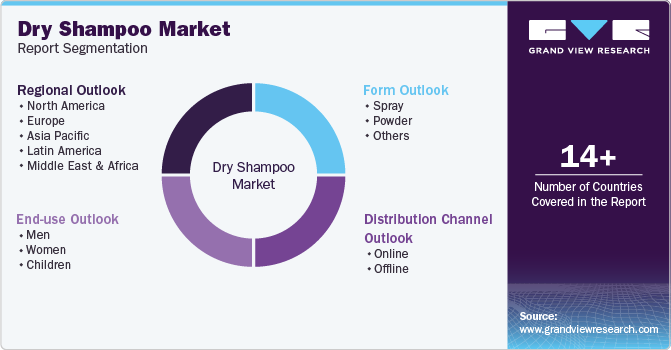
This report forecasts revenue growth at global, regional, and country levels and provides an analysis of the latest industry trends in each of the sub-segments from 2021 to 2033. For this study, Grand View Research has segmented the global dry shampoo industry report based on form, end-use, distribution channel, and region:
 To learn more about this report, Download Free Sample Report
 -
Form Outlook (Revenue, USD Million, 2021 - 2033)
-
Spray
-
Powder
-
Others
-
-
Distribution Channel Outlook (Revenue, USD Million, 2021 - 2033)
-
Online
-
Offline
-
-
End Use Outlook (Revenue, USD Million, 2021 - 2033)
-
Men
-
Women
-
Children
-
-
Regional Outlook (Revenue, USD Million, 2021 - 2033)
-
North America
-
U.S.
-
Canada
-
Mexico
-
-
Europe
-
UK
-
Germany
-
Russia
-
Poland
-
Ukraine
-
Netherlands
-
Denmark
-
Norway
-
Sweden
-
Finland
-
Iceland
-
-
Asia Pacific
-
China
-
Japan
-
India
-
Australia
-
South Korea
-
Singapore
-
-
Latin America
-
Brazil
-
-
Middle East and Africa (MEA)
-
South Africa
-
-
Research Methodology
Segment Definition
Segment - Distribution Channel
Revenue capture definition
Online
Online revenue in the dry shampoo market refers to sales generated through e-commerce marketplaces, brand websites, beauty retailer platforms, online pharmacies, and mobile shopping apps. It includes purchases of sprays, powders, foams, tinted variants, travel packs, and bundles driven by convenience, reviews, discounts, and wider product availability.
Offline
Offline revenue in the dry shampoo market refers to sales generated through physical retail stores such as supermarkets, pharmacies, beauty specialty stores, department stores, salons, and convenience stores. It includes in-store purchases driven by immediate availability, shelf visibility, promotions, impulse buying, and product trial preferences.
Estimation Model
Title
Guiding Question
Description
Target Consumer Layer
Who has a relevant haircare need?
Consumers with frequent haircare needs, oily scalp concerns, active lifestyles, limited wash frequency, travel requirements, salon-grooming preferences, and demand for quick-refresh personal care solutions.
Product Access Layer
Who can access dry shampoo products?
Region-specific retail availability, beauty store penetration, e-commerce access, pharmacy/supermarket distribution, urbanization, and premium haircare accessibility to estimate the reachable consumer pool.
Usage & Adoption Layer
Who actively uses dry shampoo?
Dry shampoo adoption benchmarks based on hair type suitability, grooming frequency, convenience-driven usage, fragrance preference, aerosol vs. non-aerosol acceptance, and repeat-purchase behavior.
Monetisation Layer
How much revenue is generated?
Active users multiplied by annual purchase frequency and blended ASP (average selling price) across aerosol sprays, powder formats, foam formats, tinted variants, and premium/salon-positioned products to estimate total market revenue.
Delivered Customizations
This report has been delivered with the following In-depth customizations
Client Request
Customization Delivered
Value Adds
Format, Ingredient & Product Positioning Trends
Conducted a focused assessment of dry shampoo demand across spray, powder, foam, and aerosol-free formats, covering oil absorption, scalp refreshment, fragrance-led positioning, travel convenience, and waterless haircare adoption trends.
Helps stakeholders identify high-growth product formats, evaluate clean-label and convenience-led demand, and prioritize formulations aligned with evolving haircare routines and sustainability expectations.
Consumer Usage, Hair Type & Premiumization Analysis
Evaluated consumer behavior across oily scalp management, post-workout usage, color-treated hair care, textured hair needs, volume enhancement, and between-wash styling preferences, along with demand for talc-free, benzene-free, natural, and premium salon-inspired products.
Provides insights into unmet consumer needs, price-tier opportunities, and differentiated product claims that can support brand positioning across mass, masstige, and premium dry shampoo segments.
Channel, Brand Competition & Regional Opportunity Assessment
Assessed distribution trends across supermarkets, beauty specialty stores, pharmacies, salons, online marketplaces, and brand-owned e-commerce, along with regional adoption differences and competitive activity among personal care and haircare brands.
Supports market entry, channel expansion, and product launch strategies by identifying high-potential retail channels, consumer segments, and whitespace opportunities in waterless and on-the-go haircare.
Frequently Asked Questions About This Report
North America dominated with a 36.5% revenue share in 2025.
Asia Pacific is the fastest-growing regional market.
Women led the market with the largest revenue share of 61.2% in 2025.
Offline segment led the market with the largest revenue share of 76.3% in 2025.
The global dry shampoo market size was valued at USD 4.5 billion in 2025 and is estimated at USD 5.1 billion in 2026.
The global dry shampoo market is expected to grow at a CAGR of 12.7% from 2026 to 2033, reaching USD 11.7 billion.
Spray segment led the market with the largest revenue share of 62.1% in 2025.
Key players in the dry shampoo market include Procter & Gamble, Unilever, L'Oréal S.A., Church & Dwight Co., Inc., Henkel AG & Co. KGaA, Klorane, Revlon, Estée Lauder Companies Inc., Living Proof, and Amika.
Key factors include rising demand for convenient, waterless hair care solutions, supported by busy lifestyles, travel needs, and product innovation in residue-free and natural formulations.
About the Author(s)
Beauty & Personal Care Research Team
Consumer Goods · Beauty & Personal CareThis report was authored by the beauty & personal care research team at Grand View Research - comprising two research analysts, one senior research analyst, and one industry expert - with specialized expertise in the beauty & personal care segment of the consumer goods industry. All findings are based on proprietary consumer goods databases, executive interviews, and regulatory analysis, subject to internal peer review prior to publication.
Last Updated:
Speak to Analyst

Customize this report to your needs - add regions, segments, or data points, with 20% free customization.
Or view our licence options:


ISO 9001:2015 & 27001:2022 Certified
We are GDPR and CCPA compliant! Your transaction & personal information is safe and secure. For more details, please read our privacy policy.


