
- Home
- »
- Advanced Interior Materials
- »
-
Dust Extractor Market Size, Share & Growth Report, 2033GVR Report cover

Dust Extractor Market (2026 - 2033)
Size, Share & Trends Analysis Report By Extractor Dust Class (Class L, Class M, Class H), By Equipment Type (Portable, Stationary), By End Use (Construction, Woodworking, Metalworking), By Region, And Segment Forecasts
Market Size, 2025
$2.8BMarket Estimate, 2026
$3.0BMarket Forecast, 2033
$4.5BCAGR, 2026–2033
6.2%Dust Extractor Market Summary
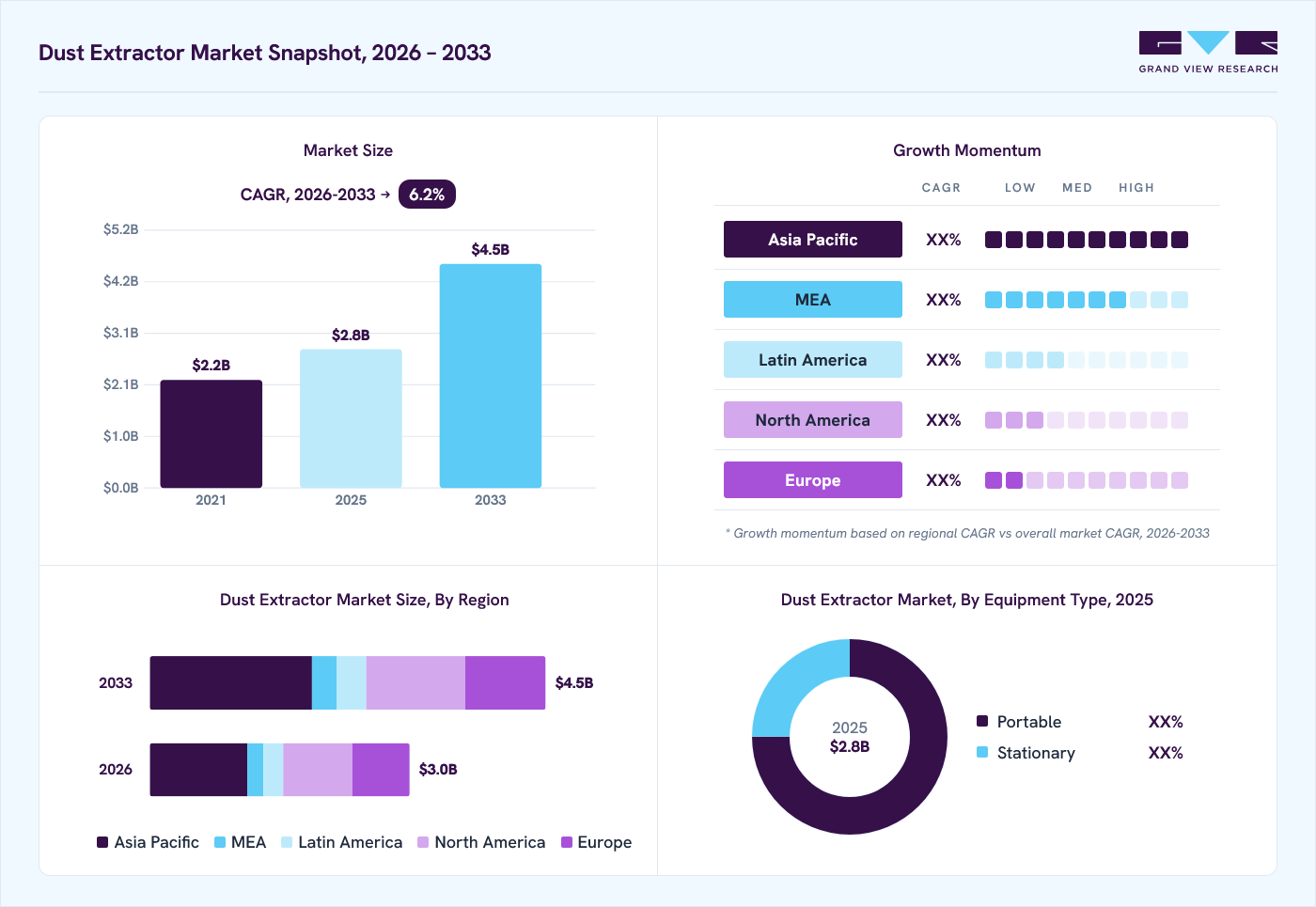
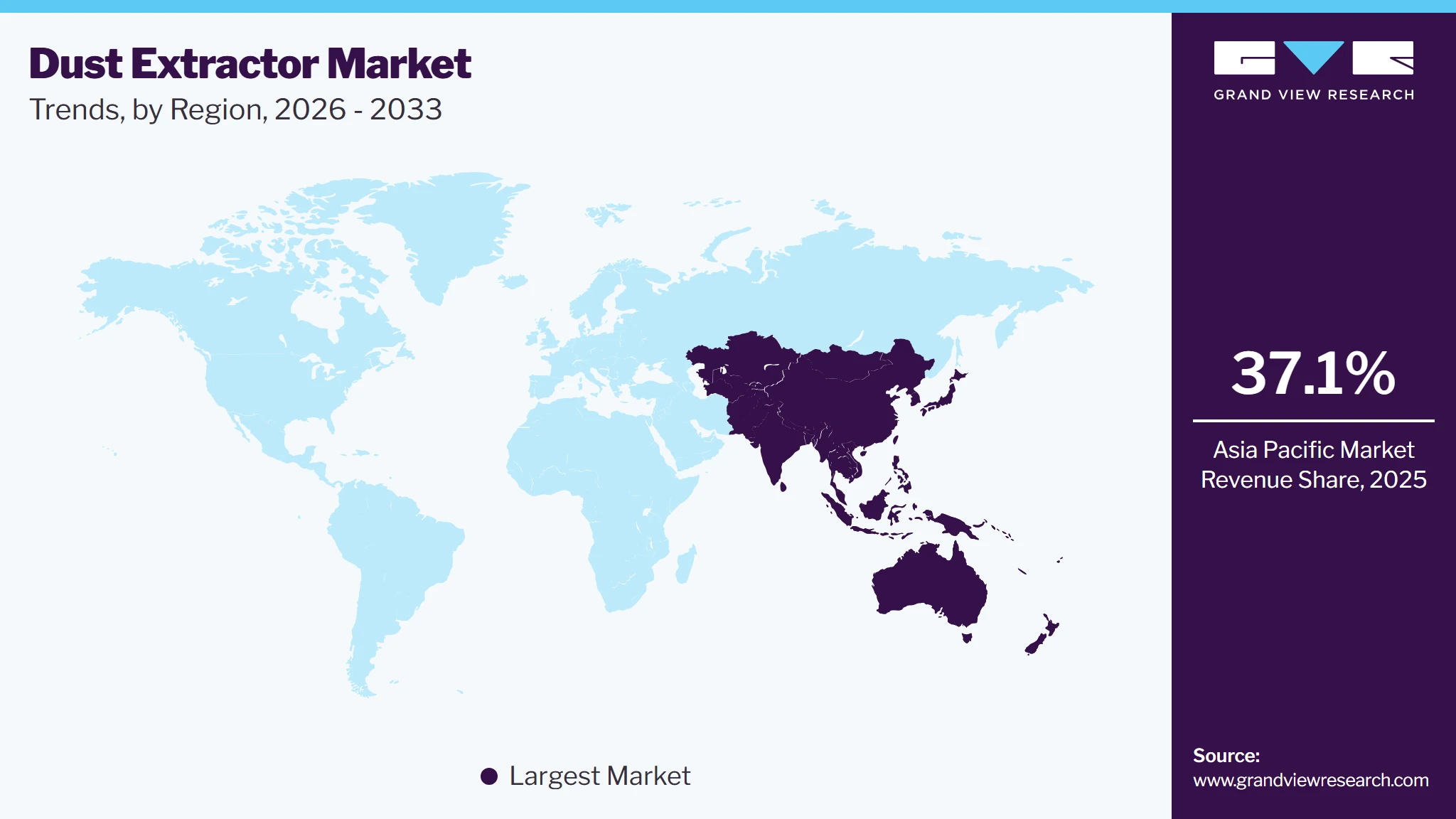
The global dust extractor market size was valued at USD 2.8 billion in 2025 and is projected to grow from USD 3.0 billion in 2026 to USD 4.5 billion by 2033, at a CAGR of 6.2% from 2026 to 2033. Asia Pacific dominated the global market, accounting for the largest revenue share of 37.1% in 2025. The market is expected to grow primarily due to rapid industrialization and expansion of manufacturing activities across China, India, Japan, and Southeast Asia. Increasing production in metalworking, woodworking, construction, automotive, and electronics industries is generating demand for dust extraction systems. Growing workplace safety requirements and efforts to control industrial airborne particles are further supporting regional adoption.
 Source: Grand View Research, IR Documents, Primary Interviews, Paid DatabasesTo learn more about this report,
 Download Free Sample Report
Key Market Trends & Insights
- By extractor dust class: Class M segment led the market with the largest revenue share of 45.9% in 2025.
- By equipment type: Portable dust extractor segment led the market with the largest revenue share of 75.0% in 2025.
- By end use: Metalworking segment is expected to grow at 7.5% CAGR during forecast period.
Regional Highlights
- Largest regional market: Asia Pacific (37.1% revenue share, 2025)
- By Country: The China held the largest market share in 2025.
Market Size & Forecast
- Market Size in 2025: USD 2.8 Billion
- Estimated Market Size in 2026: USD 3.0 Billion
- Projected Market Size by 2033: USD 4.5 Billion
- CAGR (2026-2033): 6.2%
GVR research-powered AIAsk Prism AI about the dust extractor marketGet cited answers from GVR research on market growth, segments, regulations and forecasts.Start with✓ Source-linked answers ✓ Market-specific context ✓ Traceable figuresExplore Prism AI ↗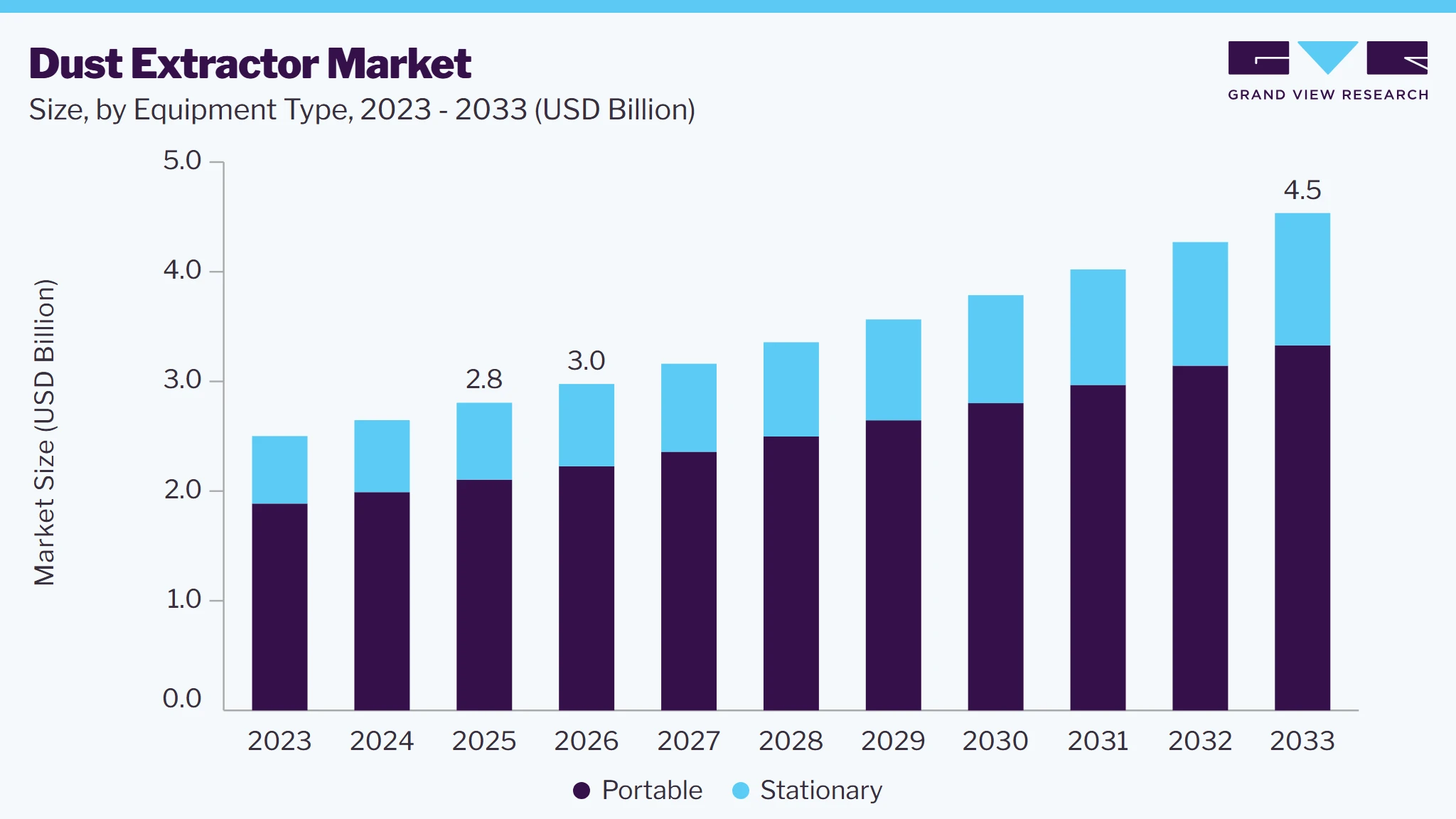 To learn more about this report, Download Free Sample Report
Manufacturers are increasingly adopting systems with higher filtration efficiency, automated filter cleaning, and improved airflow management to support continuous operations. Demand for portable and centralized extraction systems is also increasing based on application requirements. In addition, growing awareness of workplace air quality and the need to reduce equipment contamination are supporting adoption across industrial facilities.
Market Dynamics
The dust extractor market is shaped by increasing industrial production, workplace safety requirements, and growing emphasis on controlling airborne particles. Demand is rising across woodworking, metalworking, construction, automotive, food processing, and manufacturing industries. Technological developments in filtration, automated filter cleaning, energy-efficient motors, and compact extraction systems are influencing product adoption. However, high equipment and maintenance costs, application-specific requirements, and competition from alternative dust-control methods can restrict adoption.
Increasing workplace safety requirements are driving demand for dust extractors across industrial and commercial environments. Manufacturing activities such as cutting, grinding, sanding, drilling, and machining generate airborne particles that can affect worker health and contaminate production areas. Industries are therefore adopting dust extraction systems to capture particles at their source and maintain acceptable workplace air quality. Requirements for controlling employee exposure to hazardous dust are particularly supporting adoption in woodworking, metalworking, construction, and manufacturing facilities where continuous dust generation occurs.
Industrial extraction systems require significant investment in collectors, filtration units, ducting, fans, motors, controls, and installation. Operating expenses can also increase due to filter replacement, cleaning, energy consumption, and periodic maintenance. Facilities with limited budgets may postpone equipment upgrades or select lower-cost extraction solutions. Complex applications requiring specialized filtration or explosion-protection features can further increase overall system costs.
Manufacturers are developing variable-speed drives, efficient motors, automated airflow controls, and demand-based extraction systems that adjust operation according to production requirements. These technologies can reduce unnecessary fan operation and energy consumption while maintaining required dust capture performance. Adoption opportunities are particularly relevant for large manufacturing facilities with centralized extraction networks, where improvements in airflow management and system efficiency can generate measurable operating cost reductions.
Market Concentration & Characteristics
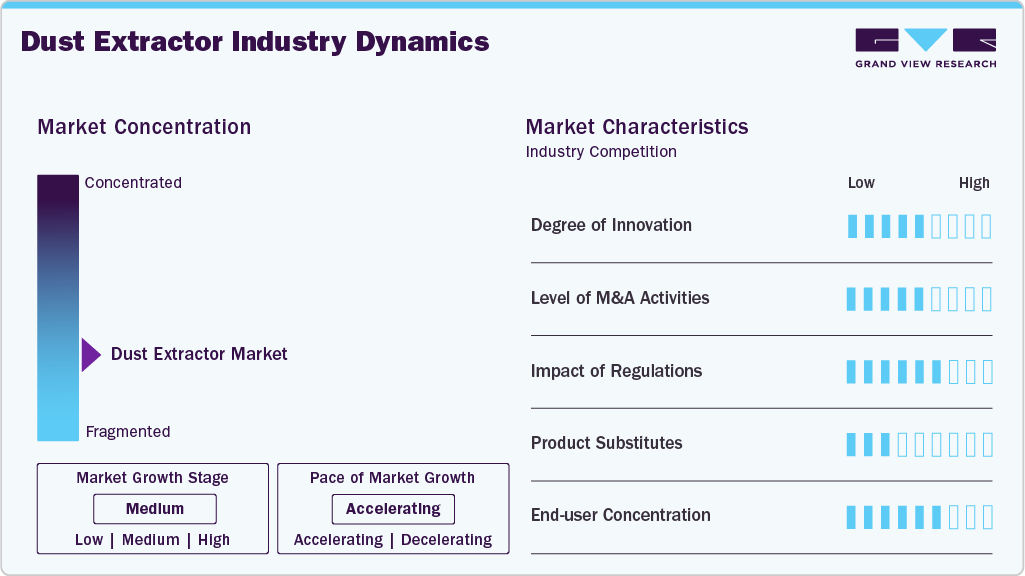
The dust extractor market is fragmented, with numerous global, regional, and specialized manufacturers competing across different applications and price ranges. Large companies offer broad product portfolios and integrated extraction systems, while smaller players focus on customized solutions for specific industries such as woodworking, metalworking, construction, and manufacturing. Regional manufacturers compete through application-specific designs, local distribution networks, pricing, and aftermarket services.
Innovation in the dust extractor market is moderate, driven by demand for higher filtration efficiency, improved airflow, lower energy consumption, and automated operation. Manufacturers are developing advanced filter media, automatic filter-cleaning mechanisms, variable-speed motors, compact systems, and connected monitoring technologies. HEPA and fine-particle filtration are gaining importance in applications involving hazardous dust. Product development is also focused on reducing noise and maintenance requirements.
 To learn more about this report, Download Free Sample Report
Regulations are significantly shaping the dust extractor market by establishing requirements for workplace air quality, worker exposure, filtration performance, and industrial emissions. Occupational safety regulations encourage industries to control airborne dust generated during manufacturing, woodworking, construction, and metalworking activities. Requirements for hazardous and combustible dust management are also increasing demand for suitable extraction and filtration systems. Compliance considerations influence equipment selection, system design, maintenance, and filtration technologies.
Analyst Perspective
The dust extractor market is influenced by increasing workplace dust-control requirements, expansion of manufacturing and construction activities, and the need to improve workplace air quality. Woodworking, metalworking, construction, furniture manufacturing, and other industrial activities generate airborne particles requiring effective extraction. Adoption of portable and stationary dust extractors, high-efficiency filtration, automatic filter-cleaning systems, and energy-efficient extraction technologies is supporting market development. Modernization of extraction equipment and increasing emphasis on worker exposure control are further creating demand for new and replacement dust extractors.
Extractor Dust Class Insights
Class M segment led the market in 2025 as industries increasingly require dust extractors capable of capturing medium-hazard particles generated during woodworking, construction, metalworking, and manufacturing activities. Class M systems provide higher filtration performance than standard extractors, supporting workplace dust-control requirements. Increasing awareness of occupational exposure risks and stricter workplace air-quality requirements are expected to encourage adoption across industrial applications.
The class H segment is expected to grow at 7.4% CAGR during forecast period due to increasing requirements for controlling high-hazard and potentially carcinogenic dust in specialized industrial applications. Class H extractors are used for materials such as asbestos, lead, mold, and certain hazardous fine particles. Growing occupational safety requirements and stricter exposure-control practices are encouraging industries handling hazardous materials to adopt high-efficiency extraction systems.
Equipment Type Insights
The portable segment dominated the market in 2025 as small and medium-sized workshops increasingly require flexible dust extraction for localized operations. Portable extractors can be moved between workstations and are suitable for woodworking, construction, repair, and metalworking activities. Their compact design, ease of installation, and ability to support multiple applications make them suitable for facilities where fixed extraction infrastructure is limited.
The stationary segment is expected to grow at 7.0% CAGR during forecast period due to increasing demand for centralized dust collection in large manufacturing and processing facilities. Stationary systems provide continuous extraction across multiple workstations and are suitable for high-volume operations generating substantial dust loads. Their integration with fixed ducting, automated filter cleaning, and production equipment supports consistent dust control in industrial environments.
End Use Insights
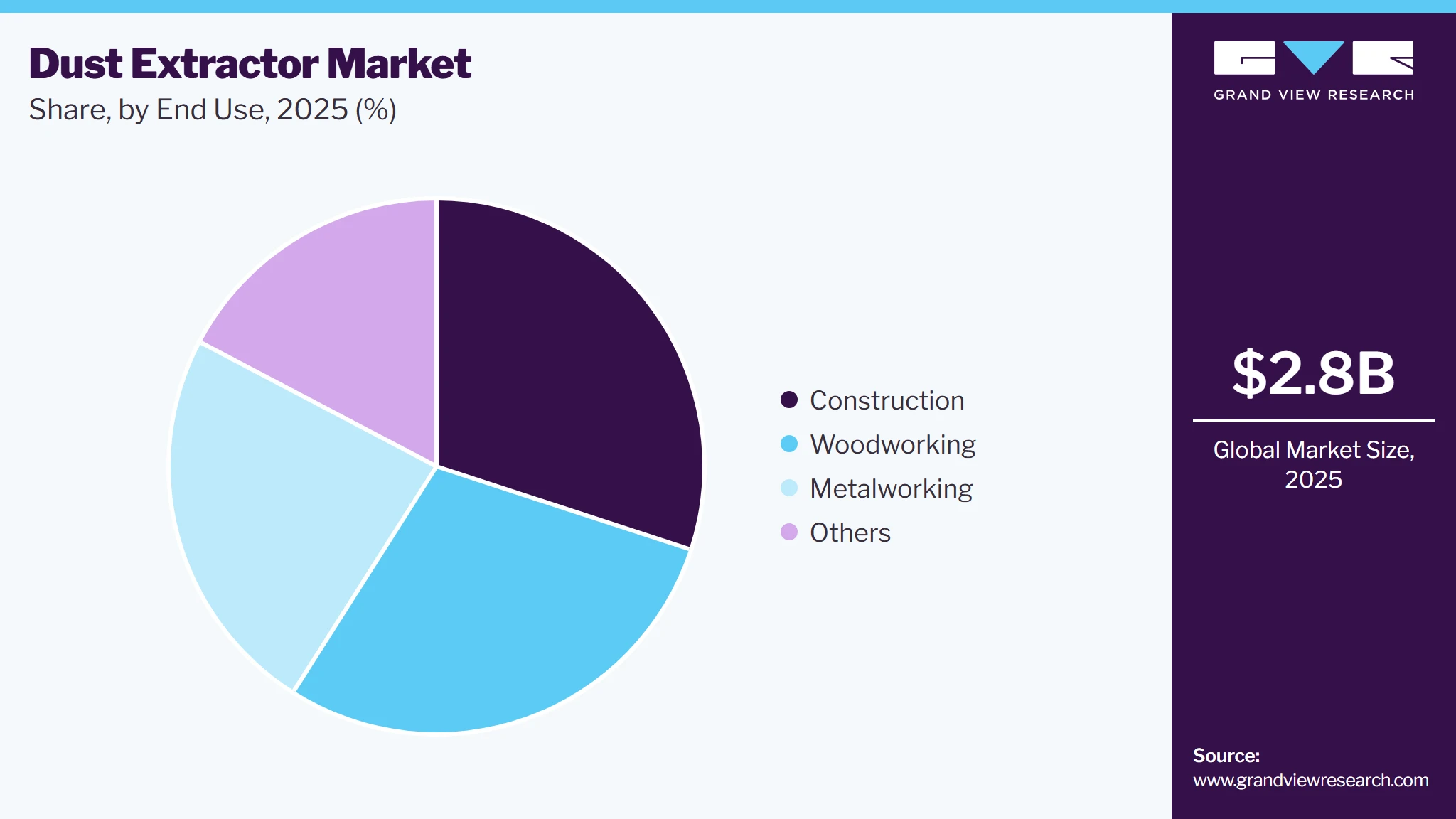
The construction segment led the market in 2025 holding 30% market share as activities such as concrete cutting, drilling, grinding, and surface preparation generate significant quantities of airborne dust. Increasing emphasis on worker exposure control is encouraging contractors to use dust extractors at job sites. Demand for portable extraction systems is particularly supported by their mobility and suitability for different construction tools and work locations.
 To learn more about this report, Download Free Sample Report
The metalworking segment is expected to grow due to increasing machining, grinding, cutting, and finishing activities that generate metal particles and fine dust. Manufacturers are adopting dust extraction systems to improve workplace air quality, protect machinery, and control airborne contaminants. Expansion of automotive, machinery, fabrication, and metal-processing industries is expected to increase demand for both portable and stationary extraction systems.
Regional Insights
North America dust extractor market is expected to grow due to established manufacturing, construction, woodworking, and metalworking industries. Demand is supported by workplace exposure-control requirements and increasing adoption of systems designed to capture fine and hazardous particles. Modernization of industrial facilities is also encouraging replacement of older extraction equipment with systems offering improved filtration and energy efficiency.
The U.S. dust extractor market is expected to grow primarily due to stringent workplace safety requirements and continued manufacturing activity. Industries such as construction, woodworking, metal fabrication, automotive, and aerospace generate substantial quantities of airborne dust and particles, creating demand for extraction systems. OSHA requirements concerning occupational exposure to respirable dust are encouraging businesses to improve dust-control practices. Investments in manufacturing facilities and equipment modernization are further supporting demand for portable and stationary dust extraction systems.
Asia Pacific Dust Extractor Market Trends
Asia Pacific is expected to experience strong growth in the dust extractor market due to rapid industrialization and expansion of manufacturing, construction, automotive, electronics, and metalworking activities. Increasing production volumes are generating greater quantities of airborne dust and industrial particles, creating demand for extraction systems. Workplace safety awareness is also increasing across major manufacturing economies. Investments in new production facilities and modernization of existing factories are supporting adoption of stationary and centralized extraction systems, while portable equipment is gaining use among smaller workshops and construction operators.
 To learn more about this report, Download Free Sample Report
China led the dust extractor market in Asia Pacific region due to its extensive manufacturing and metal-processing industries. Activities such as machining, welding, grinding, woodworking, and construction generate substantial airborne particles, increasing demand for dust-control equipment. Environmental and occupational safety requirements are encouraging manufacturers to improve workplace dust management. Expansion of automotive, machinery, electronics, and construction activities is further supporting equipment demand.
Expansion in manufacturing, construction, automotive, metalworking, and woodworking industries is fueling the dust extractor market in India. Activities such as cutting, grinding, drilling, and machining generate airborne dust, increasing the need for localized and centralized extraction systems. Growing attention to worker safety and workplace air quality is encouraging industrial facilities to adopt dust-control equipment.
Europe Dust Extractor Market Trends
Europe dust extractor market is expected to grow due to expansion of metalworking and manufacturing activities. Machining, grinding, cutting, and finishing processes generate metal particles and fine airborne dust, creating demand for effective extraction systems. Continued industrial production and modernization of manufacturing facilities are expected to support adoption of stationary and localized dust extraction equipment across European production environments.
Germany dust extractor market is expected to grow mainly due to strong metalworking and machinery manufacturing base. Processes including machining, grinding, cutting, and finishing generate airborne metal particles, increasing the need for industrial extraction systems. Germany’s continued machinery and automotive production is expected to support demand for dust extraction equipment used to maintain cleaner production environments and control particulate emissions.
The UK dust extractor market is expected to grow primarily due to woodworking activities. Cutting, sanding, drilling, and machining wood generate fine airborne particles, creating demand for effective dust extraction systems. The country’s furniture manufacturing, joinery, and woodworking businesses require extraction equipment to control airborne wood dust. Increasing attention to workplace exposure control is also supporting equipment adoption across workshops and production facilities.
Middle East & Africa Dust Extractor Market Trends
Middle East & Africa is expected to grow at 6.5% CAGR during forecast period. Increasing construction activities is driving the Middle East and Africa dust extractor market. Concrete cutting, drilling, grinding, and other construction processes generate substantial quantities of airborne dust. Increasing use of dust-control equipment at construction sites is supporting demand for portable extraction systems that can be moved between work areas and connected to dust-generating tools.
Saudi Arabia dust extractor market is expected to grow due to construction and infrastructure development. Activities such as concrete cutting, drilling, and surface grinding generate considerable airborne dust, creating demand for portable extraction systems. Contractors are increasingly using dust-control equipment to capture particles at the source and improve working conditions across construction sites.
Latin America Dust Extractor Market Trends
Latin America is expected to grow in dust extractor market due to expansion of metalworking activities. Machining, grinding, cutting, and finishing operations generate metal particles and fine dust, creating demand for extraction systems. Increasing industrial production and modernization of metal-processing facilities are expected to support adoption of dust extraction equipment for localized and centralized particle control.
Brazil dust extractor market is expected to grow primarily due to expansion of woodworking and furniture manufacturing. Cutting, sanding, and machining wood generate substantial quantities of fine airborne particles, creating demand for dust extraction systems. Increasing production activity within Brazil’s woodworking and furniture industries is expected to support adoption of stationary and portable extraction equipment.
Key Dust Extractor Company Insights
Some of the key players operating in the market include Nederman Holding AB, Camfil AB, Makita Corporation, Hilti Group, among others.
-
Camfil AB is a Swedish air filtration company that develops filtration and air-cleaning solutions for commercial, industrial, and cleanroom applications. Its product portfolio includes dust extraction and filtration systems designed to capture airborne particles generated during industrial processes. The company serves sectors such as manufacturing, pharmaceuticals, food processing, and other environments requiring controlled air quality.
-
Makita Corporation is a Japanese manufacturer of power tools and equipment, with a product portfolio that includes dust extraction systems and vacuum equipment. Its dust extractors are designed for use with power tools in construction, woodworking, and renovation applications. The company offers portable extraction units with features such as filtration systems, automatic filter cleaning, and compatibility with various power tools.
Key Dust Extractor Companies
The following key companies have been profiled for this study on the dust extractor market:
-
Nederman Holding AB
-
Camfil AB
-
ESTA Extraction technology
-
Festool GmbH
-
Bosch Power Tools
-
Makita Corporation
-
Hilti Group
-
Nilfisk Group
-
Dustcontrol AB
-
Ruwac Industriesauger GmbH
-
Starmix GmbH
-
Mirka Ltd.
-
Metabo GmbH
-
Milwaukee Tool
-
Husqvarna Group
Company Categorization
Operating Strategies
Competitive Edge
Weaknesses
Mature Players: Nederman Holding AB, Camfil AB, Festool GmbH, Bosch Power Tools, Makita Corporation, Hilti Group, Nilfisk Group
- Established dust extractor manufacturers focus on broad product portfolios, application-specific systems, product development, established distribution networks, and aftermarket services.
- They invest in filtration efficiency, automatic filter cleaning, energy-efficient motors, and tool integration to address construction, woodworking, metalworking, and industrial extraction requirements.
- Established players benefit from strong brand recognition, extensive distribution networks, established customer relationships, technical expertise, and broad product portfolios.
- Their experience across construction and industrial applications enables them to provide portable and stationary extraction equipment, accessories, replacement filters, and associated services to diverse customers.
- Established manufacturers face higher operating costs due to extensive manufacturing facilities, distribution networks, and organizational structures.
- Their broad product portfolios can also reduce flexibility for highly customized applications. Legacy product platforms require additional investment to incorporate advanced filtration, connectivity, and energy-efficiency technologies.
Emerging Players: ESTA Extraction Technology, Starmix GmbH
- Emerging dust extractor manufacturers generally focus on specialized applications, customized equipment, regional markets, and specific extraction requirements.
- They emphasize flexible manufacturing, competitive pricing, direct customer relationships, and focused product development.
- Emerging players can compete through specialized product designs, application-specific solutions, competitive pricing, shorter development cycles, and customer customization.
- Their smaller organizational structures can support faster responses to changing requirements.
- Emerging manufacturers generally have limited brand recognition, smaller distribution networks, and fewer established customer relationships.
- Restricted financial resources can constrain research, manufacturing expansion, and aftermarket support.
Recent Developments:
-
In March 2026, Makita introduced the VC013G, a 40VMax portable L-Class dust extractor within its XGT range designed for construction and worksite applications. It features automatic operation and provides high suction power, substantial airflow, and extended operating runtimes. Its cordless configuration improves mobility where access to fixed extraction systems or electrical outlets is limited.
-
In February 2026, Mirka introduced dust extractors DEXOS 1217X and DEXOS 1230X. The new models are designed for professional applications requiring effective dust control and integration with dust-free surface-finishing systems.
Dust Extractor Market Report Scope
Report Attribute
Details
Market size in 2025
USD 2.8 billion
Estimated market size in 2026
USD 3.0 billion
Projected market size by 2033
USD 4.5 billion
Growth rate
CAGR of 6.2% from 2026 to 2033
Base year for estimation
2025
Historical data
2021 - 2024
Forecast period
2026 - 2033
Quantitative units
Revenue in USD billion and CAGR from 2026 to 2033
Report coverage
Revenue forecast, company market position analysis, competitive landscape, growth factors, and trends
Segments covered
Equipment type, extractor dust class, end use, region
Regional scope
North America; Europe; Asia Pacific; Latin America; Middle East & Africa
Country scope
U.S.; Canada; Mexico; Germany; UK; Italy; Spain; France; China; Japan; India; Australia; South Korea; Brazil; Argentina; Saudi Arabia; UAE; South Africa
Key companies profiled
Nederman Holding AB; Camfil AB; ESTA Extraction technology; Festool GmbH; Bosch Power Tools; Makita Corporation; Hilti Group; Nilfisk Group; Dustcontrol AB; Ruwac Industriesauger GmbH; Starmix GmbH; Mirka Ltd.; Metabo GmbH; Milwaukee Tool; Husqvarna Group
Customization scope
Free report customization (equivalent up to 8 analysts working days) with purchase. Addition or alteration to country, regional & segment scope.
Pricing and purchase options
Avail customized purchase options to meet your exact research needs. Explore purchase options
Global Dust Extractor Market Report Segmentation
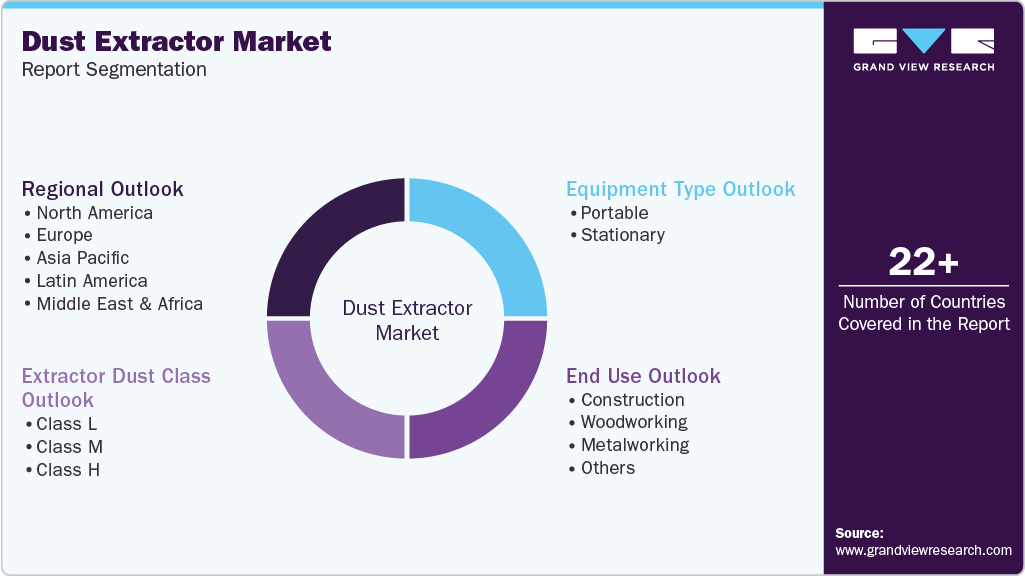
This report forecasts revenue growth at global, regional & country levels and provides an analysis on the industry trends in each of the sub-segments from 2021 to 2033. For this study, Grand View Research has segmented the global dust extractor market on the basis of equipment type, extractor dust class, end use, and region:
 To learn more about this report, Download Free Sample Report
-
Extractor Dust Class Outlook (Revenue, USD Billion, 2021 - 2033)
-
Class L
-
Class M
-
Class H
-
-
Equipment Type Outlook (Revenue, USD Billion, 2021 - 2033)
-
Portable
-
Stationary
-
-
End Use Outlook (Revenue, USD Billion, 2021 - 2033)
-
Construction
-
Woodworking
-
Metalworking
-
Others
-
-
Regional Outlook (Revenue, USD Billion, 2021 - 2033)
-
North America
-
U.S.
-
Canada
-
Mexico
-
-
Europe
-
Germany
-
France
-
UK
-
Spain
-
Italy
-
-
Asia Pacific
-
China
-
India
-
Japan
-
South Korea
-
Australia
-
-
Latin America
-
Brazil
-
Argentina
-
-
Middle East & Africa
-
Saudi Arabia
-
UAE
-
South Africa
-
-
Research Methodology
The dust extractor market figures in this report are based on a proven research process that combines executive interviews with secondary research from proprietary databases, company filings, and recognized regulatory and institutional sources. Market size is built through value-chain sizing—reconciling supply-side and demand-side estimates—and triangulated with bottom-up and top-down approaches. Every estimate passes multiple levels of expert validation before publication, with each dust extractor segment quantified using the revenue-capture
definitions in the table below.Segment Definition
Segment – Extractor Dust Class
Revenue Capture Definition
Class L
Revenue is generated from dust extractors classified as Class L, designed to capture low-hazard dust particles from general construction, maintenance, and industrial applications.
Class M
Revenue is derived from Class M dust extractors designed to capture medium-hazard dust, including particles generated during woodworking, construction, and metalworking activities.
Class H
Revenue is captured from Class H dust extractors designed for high-hazard dust, including hazardous, carcinogenic, or pathogenic particles requiring high-efficiency filtration and controlled disposal.
Segment –Equipment Type
Revenue Capture Definition
Portable
Revenue is obtained from portable dust extractors designed for mobility and localized dust extraction, commonly used with power tools across construction, woodworking, and metalworking applications.
Stationary
Revenue is generated from stationary dust extractors permanently installed within facilities, providing centralized or continuous dust extraction across multiple workstations and production processes.
Segment –
End Use
Revenue Capture Definition
Construction
Revenue is derived from dust extractors used at construction sites for capturing dust generated by concrete cutting, drilling, grinding, sanding, and other construction activities.
Woodworking
Revenue is captured from dust extractors used in woodworking operations to remove wood chips, sawdust, and fine particles generated during cutting, sanding, routing, and machining.
Metalworking
Revenue is generated from dust extractors used in metalworking applications to capture metal particles and fine dust produced during cutting, grinding, machining, and finishing processes.
Others
Revenue is obtained from dust extractors used across other applications, including manufacturing, automotive, furniture production, surface preparation, and industrial maintenance activities.
Estimation Model
Layer No.
Layer Name
Key Question
Description
01
Dust Generation & Industrial Activity Layer
Which activities generate demand for dust extractors?
The estimation begins by evaluating dust-generating activities across construction, woodworking, metalworking, manufacturing, automotive, and other end-use industries. Production activity, construction volumes, machining operations, cutting, grinding, sanding, and material processing establish the base demand for dust extraction equipment.
02
Extractor Dust Class & Equipment Type Layer
Which dust classes and equipment types drive market demand?
This layer refines demand by assessing Class L, Class M, and Class H dust extractors across portable and stationary equipment. Demand is evaluated based on dust hazard levels, filtration requirements, extraction capacity, application conditions, mobility requirements, and workplace safety considerations.
03
End-Use & Deployment Layer
What determines dust extractor utilization and installation?
Market demand is estimated through dust extractor deployment across construction, woodworking, metalworking, and other applications. Dust generation intensity, workplace exposure requirements, production processes, equipment usage, facility size, and construction activity influence new equipment installations and replacement demand.
04
Revenue Layer
How is total market revenue calculated?
Revenue is estimated by aggregating spending on dust extractors across extractor dust classes, equipment types, end-use industries, and regional markets. Equipment shipments, average selling prices, product specifications, installation requirements, replacement activity, and demand for portable and stationary systems are incorporated to validate total market revenue.
Delivered Customizations
We have successfully delivered the following deep-dive customizations:
Client Request
Customization Delivered
Value Adds
Regional Segmentation
Detailed regional analysis was conducted across North America, Europe, Asia Pacific, Latin America, and the Middle East & Africa, including country-level assessment for key markets such as the U.S., Germany, China, India, Brazil, and Saudi Arabia. The study evaluated manufacturing activity, construction development, woodworking and metalworking production, workplace safety requirements, industrial dust-generation activities, and equipment modernization influencing dust extractor demand.
Helped identify regional differences in dust extractor adoption, country-specific demand patterns, and markets with increasing requirements for workplace dust control.
Competitive benchmarking
Comprehensive benchmarking was carried out for major dust extractor market participants based on product portfolios, extractor classes, equipment types, filtration technologies, airflow capacity, suction performance, portability, automatic filter cleaning, application coverage, manufacturing capabilities, geographic presence, distribution networks, and aftermarket services.
Assisted clients in understanding competitor positioning, filtration and extraction capabilities, product differentiation, application coverage, geographic presence, and service offerings within the dust extractor market.
Opportunity assessment
In-depth opportunity assessment was conducted by analyzing construction, woodworking, metalworking, manufacturing, automotive, furniture production, and other dust-generating industries. The study evaluated opportunities related to portable and stationary extractors, Class M and Class H systems, high-efficiency filtration, automatic filter cleaning, energy-efficient motors, and advanced dust-control technologies.
Enabled clients to identify markets with increasing dust extractor demand and evaluate opportunities across end-use industries, extractor classes, equipment types, and regional markets.
Frequently Asked Questions About This Report
The portable segment led the market and accounted for 75.0% market revenue share in 2025.
The construction segment led the market and accounted for 30.0% market revenue share in 2025.
Some of the key players operating in the dust extractor include Nederman Holding AB, Camfil AB, ESTA Extraction technology, Festool GmbH, Bosch Power Tools, Makita Corporation, Hilti Group, Nilfisk Group, Dustcontrol AB, Ruwac Industriesauger GmbH, Starmix GmbH, Mirka Ltd., Metabo GmbH, Milwaukee Tool, Husqvarna Group
Key factors driving the dust extractor market include increasing workplace dust-control requirements, expansion of construction and manufacturing activities, rising awareness of occupational exposure risks, and demand for cleaner production environments. Increasing use of dust-generating processes such as cutting, grinding, sanding, and machining is further supporting equipment adoption.
The Asia Pacific region led the market and accounted for 37.1% of the global market revenue share in 2025.
The Middle East & Africa region is expected to grow at 6.5% CAGR during forecast period.
The global dust extractor market size was estimated at USD 2.8 billion in 2025 and is expected to reach USD 3.0 billion in 2026.
The dust extractor market, in terms of revenue, is expected to grow at a compound annual growth rate of 6.2% from 2026 to 2033 to reach USD 4.5 billion by 2033.
The class M segment led the market and accounted for 45.9% market revenue share in 2025.
About the Author(s)
Advanced Interior Materials Research Team
Advanced Materials · Advanced Interior MaterialsThis report was authored by the advanced interior materials research team at Grand View Research - comprising two research analysts, one senior research analyst, and one industry expert - with specialized expertise in the advanced interior materials segment of the advanced materials industry. All findings are based on proprietary advanced materials databases, executive interviews, and regulatory analysis, subject to internal peer review prior to publication.
Last Updated:
Speak to Analyst

Customize this report to your needs - add regions, segments, or data points, with 20% free customization.
Or view our licence options:


ISO 9001:2015 & 27001:2022 Certified
We are GDPR and CCPA compliant! Your transaction & personal information is safe and secure. For more details, please read our privacy policy.


