
- Home
- »
- Advanced Interior Materials
- »
-
Electrical Contactors Market Size Report, 2026-2033GVR Report cover
![Electrical Contactors Market (2026 - 2033)Report]()
Electrical Contactors Market (2026 - 2033)
Size, Share & Trends Analysis Report By Type (AC Contactors, DC Contactors), By End Use (Manufacturing & General Industrial, Automotive & EV, Power & Energy, Commercial, Transportation, Residential), By Region, And Segment Forecasts
Market Size, 2025
$1.5BMarket Estimate, 2026
$1.6BMarket Forecast, 2033
$2.4BCAGR, 2026–2033
6.1%Electrical Contactors Market Summary
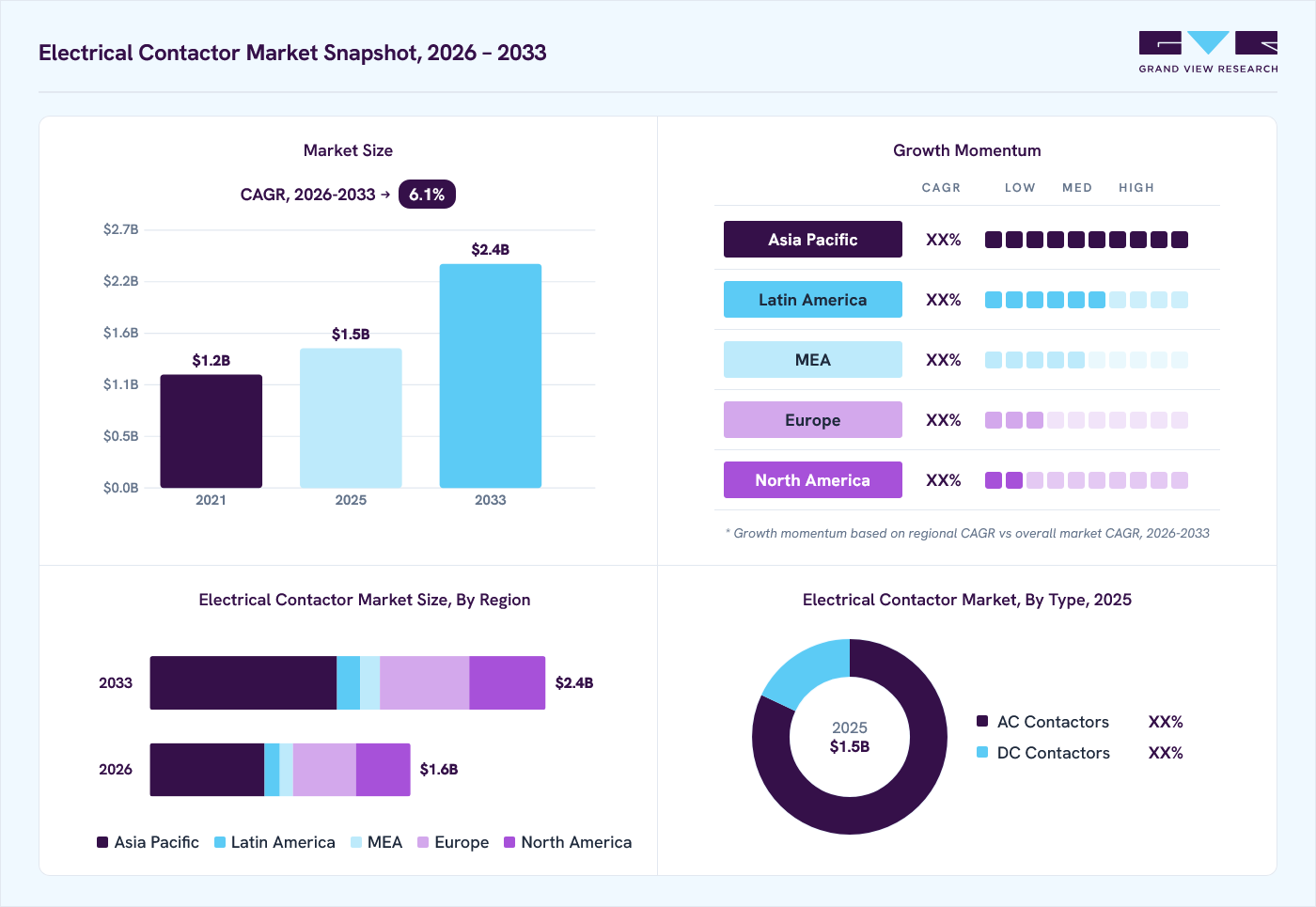
The global electrical contactors market size was valued at USD 1.5 billion in 2025 and is projected to grow from USD 1.6 billion in 2026 to USD 2.4 billion by 2033, at a CAGR of 6.1% from 2026 to 2033. Asia Pacific dominated the market, accounting for the revenue share of 43.5% in 2025. The market growth is driven by the expansion of industrial automation and electrification, rising EV production and charging infrastructure, investments in power generation and distribution, and increasing adoption of energy-efficient electrical systems.
Key Market Trends & Insights
- By type: The AC contactors segment held the largest market share of 82.0% in 2025.
- By end use: The manufacturing & general industrial segment accounted for the largest market revenue share of 48.0% in 2025.
Regional Highlights
- Largest regional market: Asia Pacific (43.5% revenue share, 2025)
- Fastest-growing regional market: Asia Pacific (highest CAGR, 2026-2033)
- By country: The China dominated the Asia Pacific with the largest revenue share in 2025.
Market Size & Forecast
- Market size in 2025: USD 1.5 Billion
- Estimated market size in 2026: USD 1.6 Billion
- Projected market size by 2033: USD 2.4 Billion
- CAGR (2026-2033): 6.1%
Three ways to get this report
Buy it, customize it, or ask a question.Get the Full Report
What the study covers
- FormatsPDF · Excel · Dashboard
- Timeline2026–2033 annual, 2025 base
- Coverage20+ countries, 5 regions
- Companies10+ key players profiled
Customize the Report
20% free customization
- IncludeCountries, segments, points
- TailorTo your product definition
- ExtendDeeper competitor detail
- OrA fully bespoke study
- Turnaround5–10 working days
Ask an Analyst
A direct answer, usually in 1 working day
- AccessReport author, directly
- Reply timeWithin 1 working day
- No sales callDirect answer only
- FormatEmail reply
- CostFree, no cost
The growing deployment of motor-driven equipment, industrial machinery, renewable energy systems, battery storage, and automated production lines is increasing demand for reliable switching and circuit-control components. Simultaneously, the transition toward electrified transportation and greater use of DC power systems is supporting demand for DC contactors, while commercial and residential construction and modernization of electrical infrastructure continue to sustain demand for AC contactors.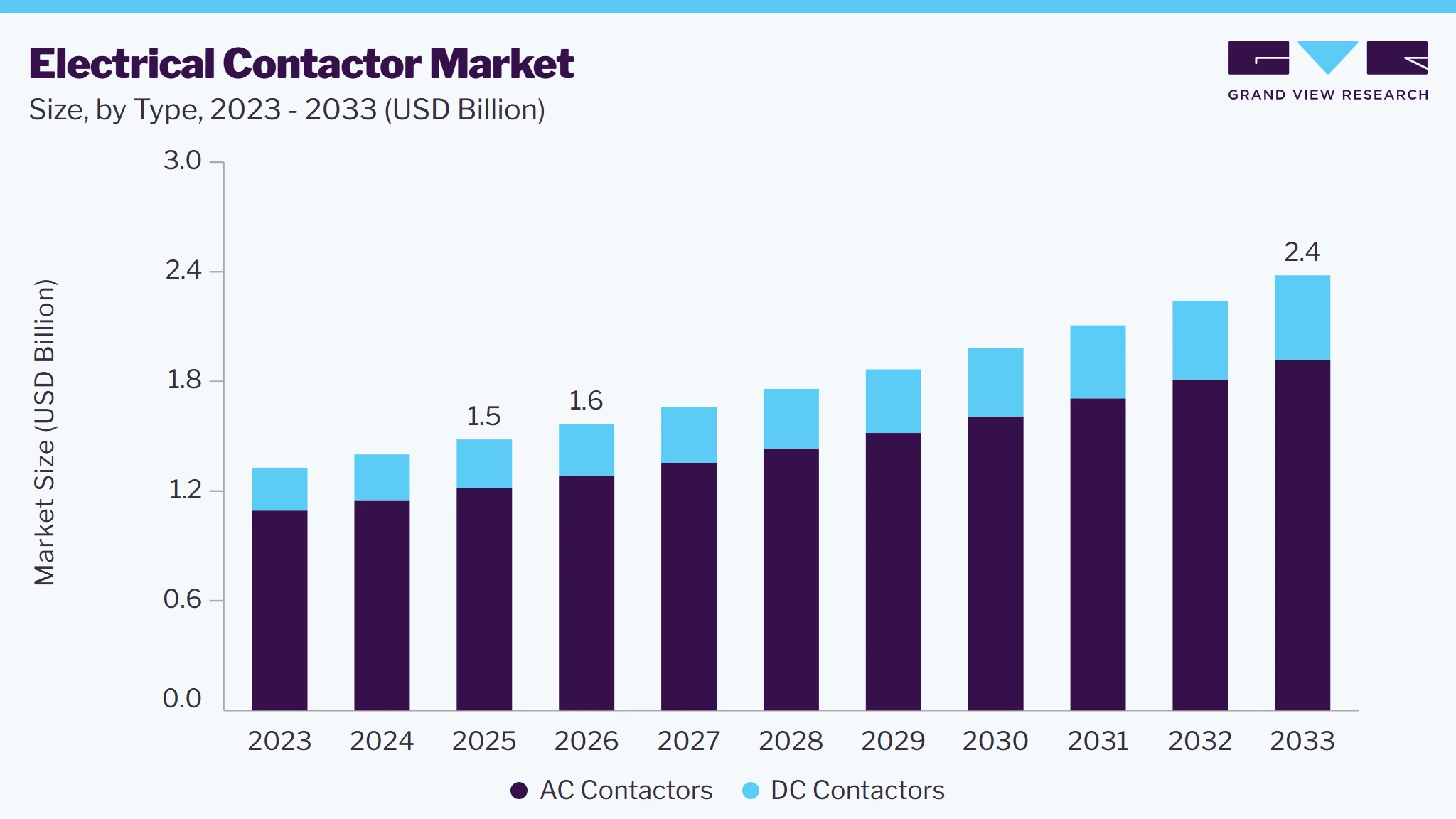
Market Dynamics
The electrical contactors industry is shaped by industrial electrification and automation, EV adoption, expansion of renewable energy and battery storage, and modernization of electrical infrastructure. The growing demand is also driven by the increasing need for power-management systems that require reliable, high-current switching. Product selection is further shaped by voltage and current ratings, switching frequency, electrical and mechanical life, compactness, arc suppression, environmental protection, and energy consumption. In addition, electrical safety standards, OEM qualification requirements, and the shift toward higher-voltage DC applications are influencing product design and creating opportunities for technologically advanced contactors.
The global market is driven by the growing shift toward automated manufacturing and electrically powered industrial operations, as manufacturers increasingly integrate robotic systems, electric motors, automated assembly lines, heating, ventilation, and air conditioning systems, and material-handling equipment to improve productivity and operational efficiency. These systems require reliable switching and isolation of electrical loads, supporting continued demand for AC and DC contactors. The shift toward automated and digitally controlled manufacturing is also increasing the need for compact, high-performance contactors capable of frequent switching and integration with modern control systems. At the same time, industrial electrification is expanding the application base for contactors across manufacturing and general industrial facilities, power systems, and energy-intensive equipment.
The increasing integration of switching, protection, sensing, and control functions within power electronics systems can limit the demand for standalone electrical contactors in certain applications. As industrial equipment, EV powertrains, charging systems, and energy-storage solutions become more electronically controlled, manufacturers are increasingly combining multiple electrical functions into compact, integrated architectures. This can reduce component count and create pressure on conventional contactors, particularly in applications where semiconductor-based switching can meet performance requirements. However, the impact is expected to remain application-specific, as electromechanical contactors continue to offer advantages in high-current applications requiring reliable physical isolation.
The rapid adoption of high-voltage DC contactors in EVs is creating a significant growth opportunity for the electrical contactors industry. EVs increasingly use high-voltage battery architectures to improve charging speed, power density, and overall vehicle efficiency, requiring contactors capable of safely switching and isolating high DC voltages and currents. Demand is expanding across battery packs, high-voltage distribution systems, fast-charging infrastructure, and related power-electronics equipment. The shift toward higher-voltage EV platforms and faster charging is consequently encouraging manufacturers to develop compact, high-current, low-power, sealed, high-voltage contactors that support both volume growth and higher-value product opportunities.
Market Concentration & Characteristics
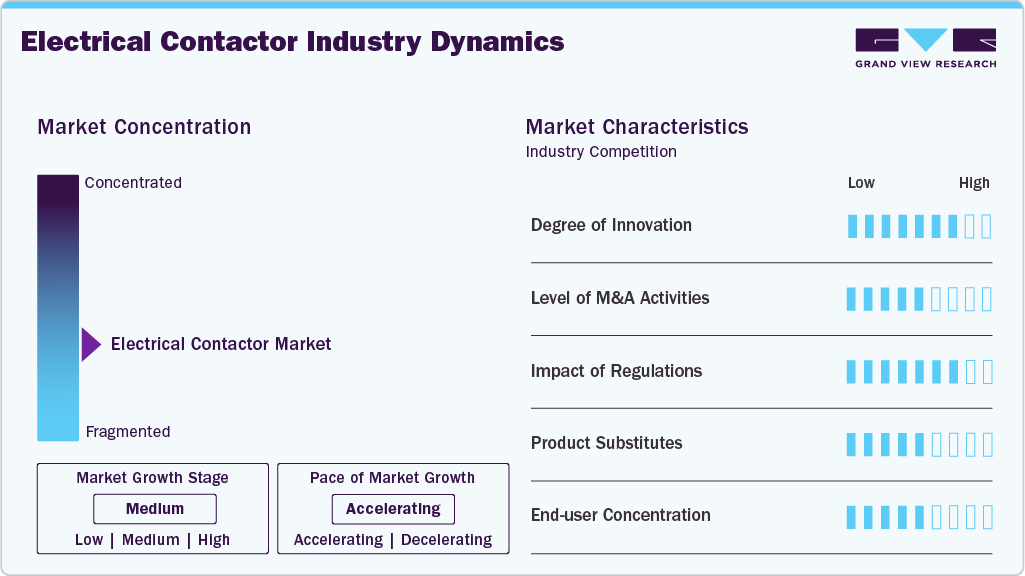
The market is moderately concentrated, with global players competing alongside regional and application-focused manufacturers. The top players benefit from broad product portfolios, established distribution networks, certification capabilities, and relationships with OEMs and industrial customers. Threat from alternatives is relatively limited, as contactors remain a cost-effective and proven solution for high-current switching and electrical isolation. However, solid-state relays and semiconductor-based switching can substitute for electromechanical contactors in selected applications where fast switching, high cycle life, or silent operation is prioritized.
Regulations and standards significantly influence product design and market entry, particularly in automotive, industrial, power, and residential applications. Requirements related to electrical safety, insulation, short-circuit performance, electromagnetic compatibility, and product certification increase qualification requirements and favor established manufacturers. The transition toward EVs, battery storage, renewable energy, and higher-voltage DC systems is also driving demand for contactors capable of handling higher voltages and currents while maintaining reliable arc suppression and electrical isolation.
Technology development and application-specific innovation are central to competitive strategies. Mature market players are investing in compact, high-current, low-power, sealed, and thermally optimized contactors, as well as features such as electronic economizers, auxiliary contacts, and smart monitoring. TE Connectivity, for instance, offers high-voltage contactors for EVs, charging infrastructure, BESS, and photovoltaic inverters, while other major players leverage their broader automation and power-management portfolios to bundle contactors with complementary solutions.
Analyst Perspective
The electrical contactors industry is being shaped by industrial electrification and automation, vehicle electrification, the expansion of charging infrastructure, renewable energy deployment, and battery energy storage. Demand is increasingly favoring high-voltage, high-current products with compact form factors, low power consumption, and enhanced reliability, particularly in EV, BESS, and power electronics applications. Market development is tempered by fluctuations in raw material prices, competition from solid-state switching technologies, and the integration of switching functions into broader power electronics architectures. Technological advancement is focused on high-voltage DC switching, improved arc-management, miniaturization, sealed construction, energy-efficient coils, and enhanced monitoring capabilities, while evolving safety and performance standards raise product qualification requirements.
Type Insights
The AC contactors segment led the market with the largest revenue share of 82.0% in 2025. AC contactors have broad application across motors, HVAC equipment, pumps, compressors, industrial machinery, lighting systems, and building equipment, making them a well-established component in electrical control systems. Demand is supported by continued industrial activity, commercial construction, equipment replacement, and expansion of automated machinery. The segment benefits from mature technology, standardized designs, and extensive compatibility with existing AC electrical infrastructure. However, growth is expected to be comparatively moderate as newer electrification applications increasingly require DC switching solutions.
The DC contactors segment is projected to grow at the fastest CAGR of 7.2% during the forecast period, as electrification expands across EVs, charging infrastructure, battery energy storage, renewable energy systems, and DC power applications. Increasing battery voltages and power levels require contactors capable of safely switching and isolating high DC currents, supporting demand for sealed, compact, high-voltage products with advanced arc-management capabilities.
End Use Insights
The manufacturing & general industrial segment led the market with the largest revenue share of 48.0% in 2025, driven by extensive material-handling systems and industrial control equipment. Moreover, increasing factory automation and electrification are driving demand for reliable switching and isolation components, while the modernization of manufacturing facilities supports replacement demand. The adoption of connected, energy-efficient equipment is also creating opportunities for higher-performance contactors compatible with modern control systems.
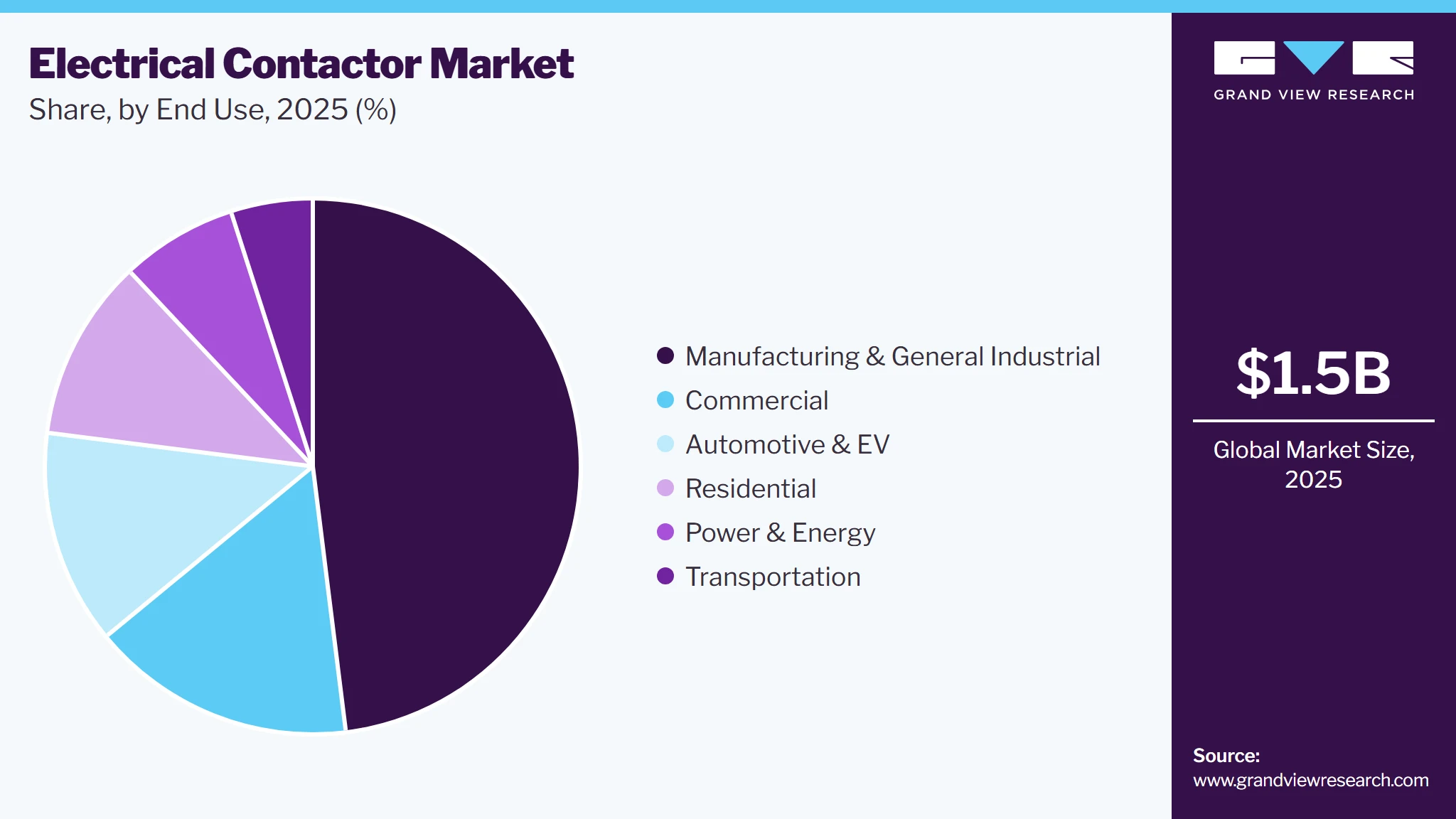
The automotive & EV segment is expected to grow at the fastest CAGR of 7.8% during the forecast period. The segment is driven by increasing vehicle electrification and the expansion of high-voltage electrical architectures. Contactors are critical for battery isolation, high-voltage power distribution, inverters, onboard charging, and DC fast-charging systems. The shift toward higher battery voltages, faster charging, and greater power density is increasing demand for high-voltage DC contactors with compact designs, low power consumption, high electrical endurance, and reliable arc suppression.
Regional Insights
The electrical contactors market in North America is characterized by a mature industrial base, high equipment replacement requirements, and increasing electrification of new infrastructure. Demand is relatively diversified across industrial machinery, commercial facilities, transportation, power systems, and emerging electrification applications. The region also benefits from well-developed electrical distribution channels and established OEM relationships, although higher project costs, trade-policy uncertainty, and supply-chain considerations can influence procurement decisions. The market is gradually shifting toward higher-performance contactors as customers place greater emphasis on reliability, energy efficiency, and system integration.
U.S. Electrical Contactors Market Trends
The electrical contactors market in the U.S. is shaped by its large installed base of industrial and commercial equipment and continued investment in domestic manufacturing capacity and critical infrastructure. The expansion of data centers, semiconductor and battery manufacturing, and electrified transportation is broadening the application base beyond traditional motor-control uses. At the same time, financing conditions, labor availability, input costs, and uncertainty around trade and industrial policy can affect the timing of capital-intensive projects. Established manufacturers benefit from extensive distribution networks and customer qualification, making the market relatively competitive and mature.
Europe Electrical Contactors Market Trends
The electrical contactors market in Europe is supported by a well-established industrial and automotive ecosystem, extensive electrical infrastructure, and the region's transition toward more electrified and energy-efficient systems. Replacement of aging equipment remains important alongside demand from newer applications associated with renewable power, electrified mobility, and energy management. Regulatory requirements around energy efficiency, product safety, and environmental performance also have a relatively strong influence on product selection and development. However, uneven industrial conditions across countries, elevated production costs, and pressure on European manufacturing competitiveness can constrain near-term equipment investment.
The Germany electrical contactors market held a significant market revenue share in Europe in 2025, because of its deep manufacturing ecosystem, sophisticated automation base, and concentration of automotive and electrical-equipment manufacturers. The market is transitioning alongside the broader restructuring of German industry, particularly as automotive production moves toward electrified platforms and manufacturers invest in more efficient production systems. Public investment and industrial-support measures provide some offset to weaker manufacturing conditions, while high energy costs, international competition, and the restructuring of the automotive supply chain remain challenges.
The electrical contactors market in Spain has a comparatively favorable market environment owing to strong investment in electricity generation, grid infrastructure, industrial facilities, and electrification projects. Its growing renewable-energy base is creating a broader ecosystem of power-conversion, storage, and grid-connected equipment, while industrial and infrastructure investment provides demand beyond traditional electrical applications. EU-supported investment continues to underpin project activity, although grid capacity, permitting timelines, and the pace of external industrial demand can affect project execution. The market therefore offers opportunities for contactor suppliers with exposure to both conventional electrical equipment and newer energy applications.
Asia Pacific Electrical Contactors Market Trends
The Asia Pacific electrical contactors market held the largest revenue share of 43.5% in 2025 and is anticipated to grow at the fastest CAGR during the forecast period, ranging from highly developed industrial markets to rapidly industrializing economies. The region combines substantial installed demand for conventional motor-control equipment with expanding applications in electric mobility, power electronics, renewable generation, and energy infrastructure. Local manufacturing capabilities and extensive component supply chains support competitive pricing and product availability, while strong regional competition places pressure on margins, particularly in standardized products. Market development therefore varies considerably according to industrial maturity, technology adoption, and infrastructure investment.
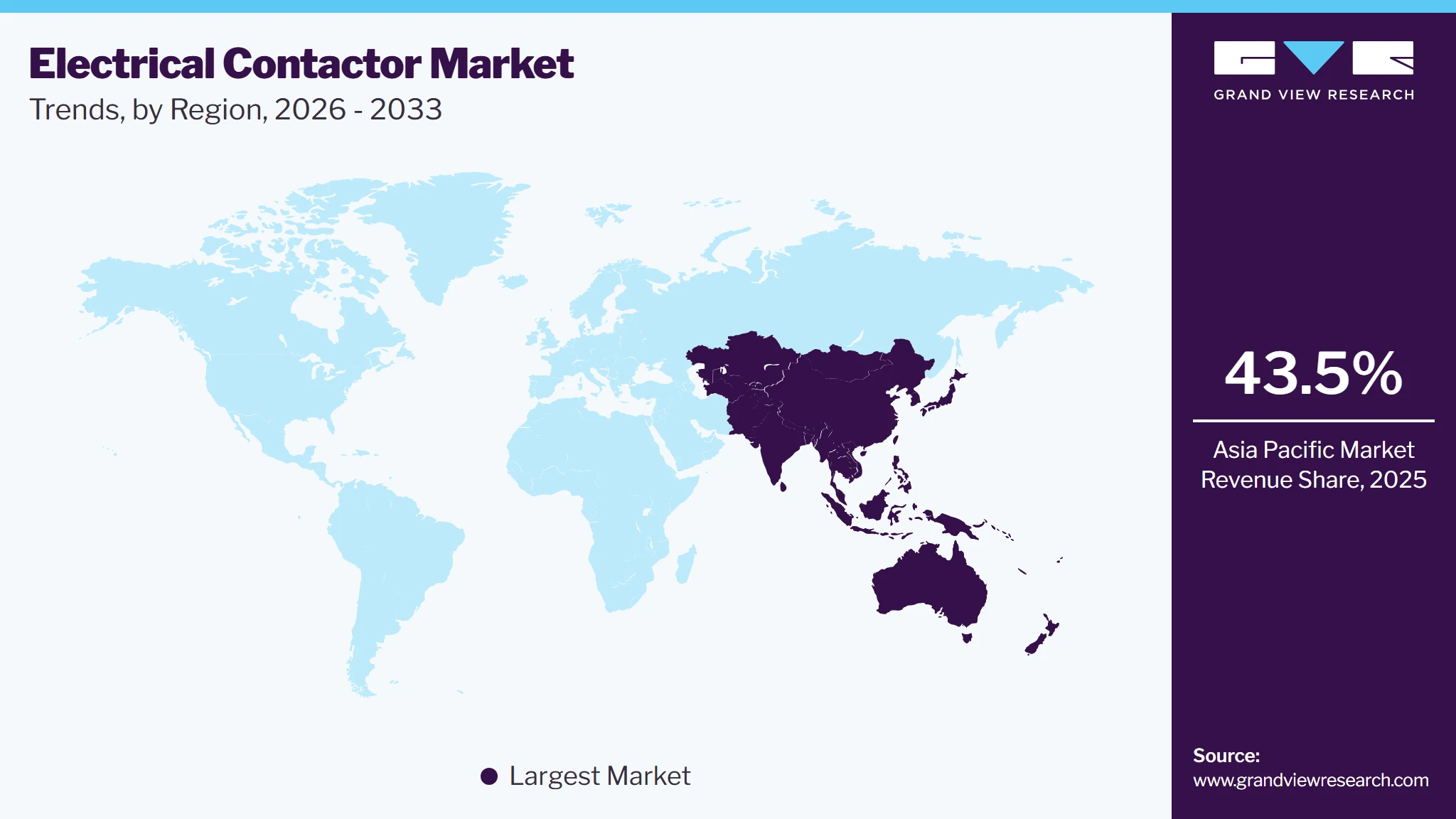
The China electrical contactors market accounted for the largest market revenue share in the Asia Pacific in 2025. The China market combines large-scale electrical equipment consumption with a deeply integrated domestic manufacturing and component ecosystem, making it both a major market and an important production base for contactors. Industrial upgrading, intelligent manufacturing, and the country's extensive electrified transportation and energy infrastructure are supporting continued demand for switching components. However, intense domestic competition and pricing pressure are significant characteristics of the market, while property-sector weakness and uneven industrial demand can affect investment across some end-use industries. Local suppliers are also increasingly capable of competing in technically demanding applications, raising the competitive intensity for international manufacturers.
The electrical contactors market in India is transitioning toward a larger and more diversified electrical equipment market, supported by manufacturing expansion, infrastructure development, rising equipment penetration, and increasing adoption of automation and electrified technologies. Growing domestic production and investment in power and transportation infrastructure are broadening the addressable customer base, while the market retains substantial room for replacement and first-time equipment adoption. Execution timelines, infrastructure availability, regulatory complexity, and cost sensitivity remain relevant challenges. Consequently, suppliers combining competitive pricing with localized distribution and technical support are well positioned to capture incremental demand.
Middle East & Africa Electrical Contactors Market Trends
The electrical contactors market in the Middle East & Africa remains less mature and more project-driven than North America, Europe, or Asia Pacific, with demand concentrated around infrastructure development, utilities, industrial facilities, commercial construction, and energy projects. Large-scale investments in electricity networks, renewable generation, water infrastructure, and new developments are creating pockets of strong demand, while market penetration varies substantially across countries. Dependence on imported electrical equipment, project-based procurement, and differences in technical standards and distribution infrastructure can increase supply-chain complexity. This creates opportunities for suppliers with strong regional partners and project-support capabilities.
The Saudi Arabia electrical contactors market is emerging as one of the region's more attractive markets as economic diversification and large-scale development programs expand the country's non-oil industrial and infrastructure base. New industrial facilities, utilities, commercial developments, digital infrastructure, and energy projects are broadening demand for low-voltage electrical equipment beyond conventional oil and gas applications. Government-led investment provides substantial project visibility, although procurement can remain sensitive to public spending cycles, oil-market conditions, and geopolitical developments. Suppliers with local partnerships, project-specification capabilities, and established access to contractors and system integrators are likely to have an advantage.
Latin America Electrical Contactors Market Trends
The electrical contactors market in Latin America is characterized by moderate industrialization, significant infrastructure requirements, and a comparatively high dependence on investment cycles. Demand is distributed across industrial equipment, commercial infrastructure, utilities, transportation, and electrical-system modernization, with renewable-energy projects providing an additional source of equipment demand. Regional growth is supported by gradual modernization of production facilities and electrical networks, but economic volatility, financing costs, and differences in infrastructure development between countries can produce uneven market performance. Distribution strength and competitive pricing remain particularly important for suppliers seeking broad regional coverage.
The Brazil electrical contactors market is supported by its broad industrial base, large electricity system, infrastructure requirements, and expanding investment in electrification and automation. Renewable generation and grid development provide a strong foundation for electrical-equipment demand, while industrial modernization creates opportunities across machinery and control applications. Market conditions are nevertheless influenced by interest rates, fiscal policy, inflation, and fluctuations in external demand, which can affect private-sector capital expenditure. Local market knowledge, established distribution, and the ability to compete on total installed cost are therefore important for suppliers operating in the country.
Key Electrical Contactors Company Insights
Some of the key players operating in the market include ABB and Siemens
-
ABB is a global technology company offering a broad electrification portfolio that includes contactors and related low-voltage control products, supported by its wider offering in electrical distribution, motor control, automation, power conversion, and energy management. Geographically, ABB maintains a broad international footprint, with locations and operating organizations across Europe, the Americas, and other major markets, supported by regional sales channels and value-added partners
-
Siemens is a global technology company with extensive activities across electrification, automation, industrial digitalization, and smart infrastructure. Its electrical portfolio includes SIRIUS contactors and motor-control products, covering applications ranging from industrial motors and machinery to building and infrastructure systems. Siemens supports these products through established regional organizations and sales platforms, including dedicated product and Industry Mall channels across markets such as Europe, North America, and Asia, giving it broad access to industrial customers and distribution networks.
Key Electrical Contactors Companies
The following key companies have been profiled for this study on the electrical contactors market.
-
Schneider Electric
-
Siemens
-
ABB
-
Eaton
-
Rockwell Automation
-
Mitsubishi Electric Corporation
-
Fuji Electric FA Components & Systems Co., Ltd
-
LS ELECTRIC Co., Ltd.
-
Legrand
-
CHINT Group Co., Ltd
-
Hager Group
-
Lovato Electric
-
FINDER S.p.A
-
WEG
-
BCH Electric Limited
Competitive Benchmarking
Category
Operating Strategies
Competitive Edge
Weakness
Established Players (e.g., Schneider Electric; Siemens; ABB)
- Develop ultrasonic cutting systems, generators, cutting heads, and specialized centrodes for diverse industrial end uses.
- Product development increasingly focuses on high-voltage DC contactors, compact designs, improved electrical endurance, low-power coils, and application-specific performance for EV, BESS, and industrial systems.
- Strengthen their overall market position by diverting their resources toward acquisitions.
- Established brands benefit from strong customer trust and proven reliability, which are particularly important for safety-critical switching applications.
- Extensive distributor and OEM networks provide superior access to industrial customers and geographically dispersed demand.
- Large-scale manufacturing and procurement provide economies of scale and greater supply-chain resilience than smaller competitors.
- Broad portfolios and global operating structures can result in higher overhead and less flexibility in highly price-sensitive contactor segments.
- Established brands may face margin pressure from lower-cost regional manufacturers in standardized AC contactors.
- Legacy product platforms can complicate technology transitions and portfolio rationalization as demand shifts toward high-voltage DC applications.
Emerging & Regional Players (e.g., Lovato Electric, FINDER S.p.A.)
- Specialist manufacturers typically concentrate on high-growth niches such as high-voltage DC contactors for EVs, charging infrastructure, BESS, solar inverters, and specialized industrial equipment.
- Geographic expansion is generally targeted toward a few end uses and industrial clusters rather than broad global coverage from the outset.
- Specialists can respond faster to emerging application requirements because of leaner organizational structures and narrower product focus.
- Lower operating overhead can provide greater pricing flexibility in targeted applications
- Concentration in emerging technologies allows specialists to build expertise and brand recognition within specific high-growth niches.
- Limited geographic distribution and service infrastructure can restrict access to smaller customers and dispersed aftermarket demand.
- Smaller production volumes generally yield fewer economies of scale and can increase exposure to component costs and supply chain fluctuations.
- Lower brand recognition and shorter operating histories can make customer qualification more difficult, particularly in automotive and safety-critical applications.
Recent Developments
-
In January 2026,Sensats Technologies introduced a series of high-voltage contactors titled STEV, designed to improve efficiency, safety, and switching performance across electric (BEV) and plug-in hybrid (PHEV) vehicle platforms. Designed for applications ranging from passenger vehicles to Class 8 heavy-duty trucks, these customizable contactors offer hermetically sealed ceramic construction, single- or dual-contactor configurations, continuous current ratings of 150-600 A, and short-circuit protection above 20 kA.
-
In July 2026,HIITIO broadened its low-voltage DC contactor range by introducing the HCD, ZJWP, and HCM1 series, offering expanded voltage, current, and coil configurations for EVs, forklifts, energy-storage systems, solar applications, and mobile industrial equipment. The new products feature high-current switching capabilities, enhanced arc suppression, environmental protection, and flexible mounting options, including magnetic blowout contacts and IP67-rated designs. The launch reinforces HIITIO’s focus on application-specific DC switching solutions for battery-powered and mobile equipment.
Electrical Contactors Market Report Scope
Report Attribute
Details
Market size in 2025
USD 1.5 billion
Estimated market size in 2026
USD 1.6 billion
Projected market size by 2033
USD 2.4 billion
Growth rate
CAGR of 6.1% from 2026 to 2033
Base year for estimation
2025
Historical data
2021 - 2024
Forecast period
2026 - 2033
Quantitative units
Revenue in USD billion and CAGR from 2026 to 2033
Report coverage
Revenue forecast, company ranking, competitive landscape, growth factors, and trends
Segments covered
Type, end use, region.
Regional scope
North America; Europe; Asia Pacific; Latin America; Middle East & Africa
Country scope
U.S.; Canada; Mexico; UK; Germany; France; Italy; Spain; China; Japan; India; Australia; South Korea; Brazil; Argentina; UAE; Saudi Arabia; South Africa
Key companies profiled
Schneider Electric; Siemens; ABB; Eaton; Rockwell Automation; Mitsubishi Electric Corporation; Fuji Electric FA Components & Systems Co., Ltd.; LS ELECTRIC Co., Ltd.; Legrand; CHINT Group Co., Ltd.; Hager Group; Lovato Electric; FINDER S.p.A.; WEG; BCH Electric Limited
Customization scope
Free report customization (equivalent up to 8 analysts working days) with purchase. Addition or alteration to country, regional & segment scope.
Pricing and purchase options
Avail customized purchase options to meet your exact research needs. Explore purchase options
Global Electrical Contactors Market Report Segmentation
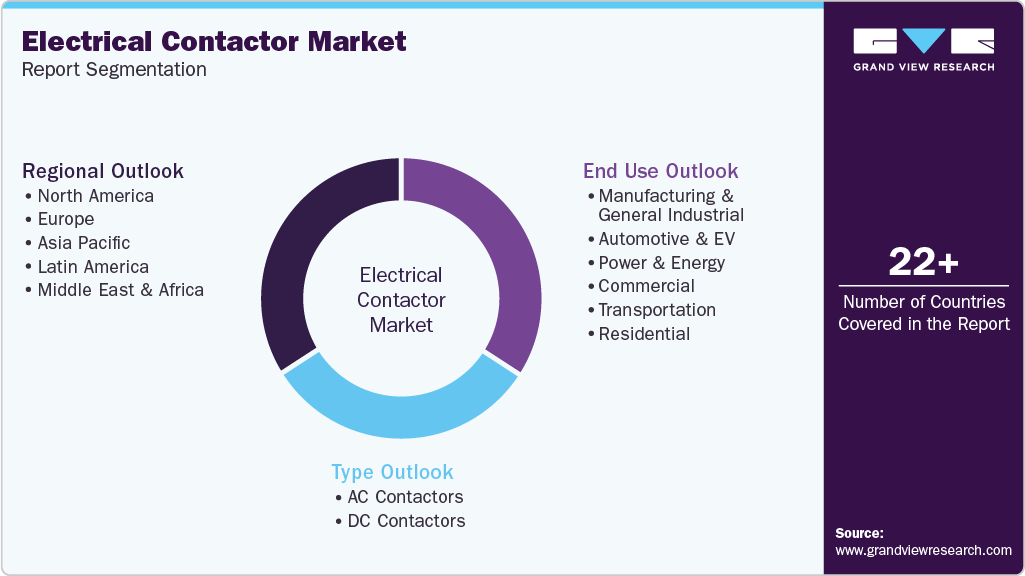
This report forecasts revenue growth at global, regional, and country levels and provides an analysis of the latest industry trends in each of the sub-segments from 2021 to 2033. For this study, Grand View Research has segmented the global electrical contactors market report based on type, end use, and region:
-
Type Outlook (Revenue, USD Billion, 2021 - 2033)
-
AC Contactors
-
DC Contactors
-
-
End Use Outlook (Revenue, USD Billion, 2021 - 2033)
-
Manufacturing & General Industrial
-
Automotive & EV
-
Power & Energy
-
Commercial
-
Transportation
-
Residential
-
-
Regional Outlook (Revenue, USD Billion, 2021 - 2033)
-
North America
-
U.S.
-
Canada
-
Mexico
-
-
Europe
-
Germany
-
Spain
-
France
-
Italy
-
UK
-
-
Asia Pacific
-
China
-
India
-
Japan
-
Australia
-
South Korea
-
-
Latin America
-
Brazil
-
Argentina
-
-
Middle East and Africa
-
Saudi Arabia
-
UAE
-
South Africa
-
-
Research Methodology
The electrical contactors market figures in this report are based on a proven research process that combines executive interviews with secondary research from proprietary databases, company filings, and recognized regulatory and institutional sources. Market size is built through value-chain sizing - reconciling supply-side and demand-side estimates - and triangulated with bottom-up and top-down approaches. Every estimate passes multiple levels of expert validation before publication, with each electrical contactors segment quantified using the revenue-capture definitions in the table below.
Segment Definition
Segment - Type
Revenue Capture Definition
AC Contactors
Revenue generated from the sale of electrical contactors designed for switching and controlling AC electrical loads, including motors, HVAC systems, pumps, compressors, lighting, and other AC-powered equipment.
DC Contactors
Revenue generated from the sale of electrical contactors designed for switching and controlling DC electrical loads, including electric vehicles, battery systems, EV charging systems, energy storage systems, and other DC-powered equipment.
Segment-End Use
Revenue Capture Definition
Manufacturing & General Industrial
Revenue generated from the sale of electrical contactors used in manufacturing and general industrial applications, including industrial machinery, motors, pumps, compressors, conveyors, production equipment, and process equipment.
Automotive & EV
Revenue generated from the sale of electrical contactors used in automotive and electric vehicle applications, including electric vehicles, hybrid vehicles, fuel-cell vehicles, EV charging systems, and automotive electrical systems.
Power & Energy
Revenue generated from the sale of electrical contactors used in power and energy applications, including power generation, renewable energy, solar, wind, battery energy storage, power distribution, and other energy systems.
Commercial
Revenue generated from the sale of electrical contactors used in commercial applications, including commercial HVAC systems, elevators, lighting, building equipment, offices, hotels, retail facilities, and other commercial buildings.
Transportation
Revenue generated from the sale of electrical contactors used in transportation applications, including railway, locomotives, metros, trams, and other transportation systems.
Residential
Revenue generated from the sale of electrical contactors used in residential applications, including residential HVAC, heating systems, appliances, lighting, pumps, and other residential electrical equipment.
Estimation Model
Layer No.
Layer Name
Key Question
Description
01
Industrial Demand Layer
What is the underlying demand for electrical contactors?
Assess demand for AC and DC contactors across manufacturing & general industrial, automotive & EV, power & energy, and other defined end uses. A top-down approach can use indicators such as industrial equipment investment, EV supply, charging infrastructure, renewable energy and BESS deployment, building construction, and electrical equipment expenditure. A bottom-up approach can estimate contactor demand from relevant equipment populations, contactors required per equipment/system, installation rates, utilization, and replacement cycles. Market-specific attachment rates, replacement periods, and contactor content per application should be developed rather than assumed.
02
Manufacturing & Equipment Demand Layer
How is contactor demand distributed across types, end uses, and geographies?
Develop AC vs. DC and end-use splits using application-level equipment demand, contactor specifications, product usage per system, and replacement requirements. Regional demand is estimated bottom-up from country-level EV production, industrial equipment installations, power projects, building stock, and other relevant demand proxies, then allocated to the defined regions/countries. Top-down will use regional industrial output, vehicle production, capital expenditure, electricity infrastructure investment, construction activity, and electrification trends.
03
Technology & Type Adoption Layer
What is being supplied, by whom, and through which channels?
Map major manufacturers of AC and DC contactors, their product portfolios, production locations, manufacturing capacity, geographic presence, and application exposure. Analyze OEM/direct sales, electrical distributors, system integrators, and aftermarket channels, while using import/export flows to identify cross-border supply. Company-level revenues are decomposed to the relevant contactor products rather than using total company sales. Production/shipment information, product availability, distributor portfolios, and regional presence provide a bottom-up supply estimate that can be compared with demand-side calculations.
04
Revenue Conversion Layer
How is market revenue estimated?
Reconcile the top-down demand, bottom-up demand, and supply-side estimates to establish the final electrical contactors market revenue. Validate the result against relevant company revenues, contactor shipment/production volumes where available, import/export data, industry expenditure, distributor sales, prevailing product prices, and AC/DC and application-level product mix. Forecasts will incorporate the validated outlook for EVs, industrial automation, power infrastructure, renewable energy, BESS, construction, and other relevant demand drivers, with market-specific assumptions for pricing, replacement, penetration, and technology mix explicitly developed and tested rather than invented.
Delivered Customizations
This report has been delivered with the following In-depth customizations
Client Request
Customization Delivered
Value Adds
Competitive Benchmarking
Benchmarked established and emerging market participants across product portfolios, AC/DC contactor capabilities, target applications, financial strength, geographic presence, technology positioning, and strategic initiatives to identify areas of competitive strength and gaps.
Helped the client identify competitive positioning gaps, assess relative strengths, and refine product, partnership, and market-expansion strategies.
Regional Segmentation
Assessed market demand across key regions by evaluating regional industrial activity, electrification trends, EV adoption, power infrastructure investment, and end-use requirements to differentiate mature demand centers from higher-growth markets
Enabled the client to prioritize regional expansion opportunities, allocate resources effectively, and align market-entry strategies with region-specific demand conditions.
Opportunity Assessment
Evaluated growth opportunities across contactor types, end-use applications, and emerging electrification areas by assessing demand drivers, technology shifts, adoption potential, and competitive intensity.
Supported investment prioritization and product-development decisions by highlighting attractive applications and opportunities with stronger long-term growth potential.
About the Author(s)
Advanced Interior Materials Research Team
Advanced Materials · Advanced Interior MaterialsThis report was authored by the advanced interior materials research team at Grand View Research - comprising two research analysts, one senior research analyst, and one industry expert - with specialized expertise in the advanced interior materials segment of the advanced materials industry. All findings are based on proprietary advanced materials databases, executive interviews, and regulatory analysis, subject to internal peer review prior to publication.
Last Updated:
Speak to Analyst


Customize this report to your needs - add regions, segments, or data points, with 20% free customization.
Or view our licence options:


ISO 9001:2015 & 27001:2022 Certified
We are GDPR and CCPA compliant! Your transaction & personal information is safe and secure. For more details, please read our privacy policy.


