
- Home
- »
- Medical Devices
- »
-
Emergency Medical Services Product Market Size, Growth Report, 2026-2033GVR Report cover

Emergency Medical Services Product Market (2026 - 2033)
Size, Share & Trends Analysis Report By Product, By End Use (Hospitals, Emergency Clinics, Ambulatory Surgical Centers), By Region, And Segment Forecasts
Market Size, 2025
$25.4BMarket Estimate, 2026
$27.1BMarket Forecast, 2033
$41.8BCAGR, 2026–2033
6.4%Emergency Medical Services Product Market Summary
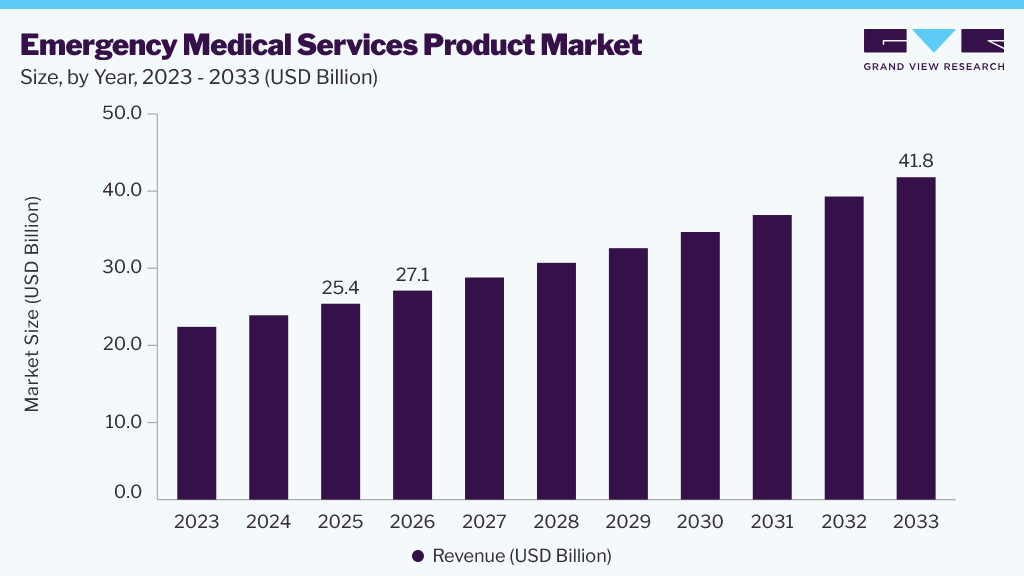
The global emergency medical services product market size was valued at USD 25.4 billion in 2025 and is projected to grow from USD 27.1 billion in 2026 to USD 41.8 billion by 2033, at a CAGR of 6.4% from 2026 to 2033. Europe dominated the market, accounting for a revenue share of 45.0% in the global market in 2025. Growing demand for rapid pre-hospital care, increasing emergency admissions, and the expanding burden of chronic diseases and trauma are encouraging healthcare providers to strengthen emergency response capabilities.
 Source: Grand View Research, IR Documents, Primary Interviews, Paid DatabasesTo learn more about this report,
 Download Free Sample Report
Key Market Trends & Insights
- By product: The life support & emergency resuscitation segment held the largest market share of around 34.5% in 2025.
- By end-use: The hospitals segment held the largest market share of more than 40.0% in 2025.
Regional Highlights
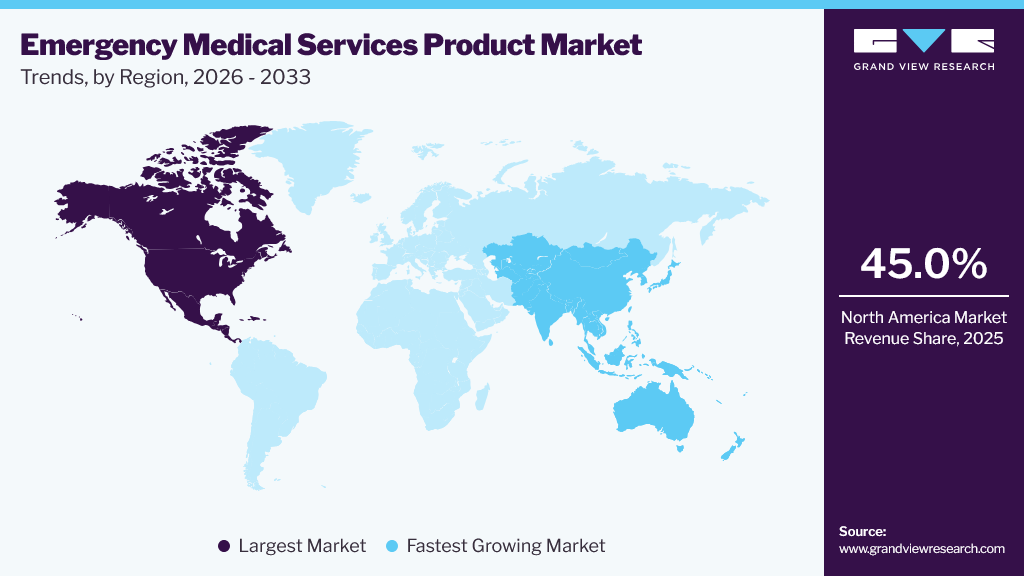
- Largest regional market: North America (45.0% revenue share, 2025)
- Fastest-growing regional market: Asia Pacific (highest CAGR, 2026-2033)
Market Size & Forecast
- Market size in 2025: USD 25.4 Billion
- Estimated market size in 2026: USD 27.1 Billion
- Projected market size by 2033: USD 41.8 Billion
- CAGR (2026-2033): 6.4%
Three ways to get this report
Buy it, customize it, or ask a question.Ask an Analyst
Analyst response in 1 business day
- AccessReport author, directly
- Reply timeWithin 1 working day
- No sales callDirect answer only
- FormatEmail reply
- CostFree, no cost
Get the Full Report
What the study covers
- FormatsPDF · Excel · Dashboard
- Timeline2026–2033 annual, 2025 base
- Coverage20+ countries, 5 regions
- Companies10+ key players profiled
Customize the Report
20% free customization
- IncludeCountries, segments, points
- TailorTo your product definition
- ExtendDeeper competitor detail
- OrA fully bespoke study
- Turnaround5–10 working days
Hospitals, ambulance services, and first responders continue investing in advanced emergency medical equipment to improve patient stabilization and clinical outcomes.
Continuous innovation in portable diagnostic devices, patient monitoring systems, defibrillators, ventilators, and connected emergency care technologies is transforming pre-hospital emergency services. For instance, in June 2025, Cardinal Health launched the Kendall DL Multi System, a continuous patient-monitoring solution designed to support emergency care by enabling real-time vital-sign monitoring and improving clinical workflows. The launch reflects the growing focus on advanced emergency medical technologies that enhance patient assessment and support faster clinical decision-making in emergency care settings.
The increasing incidence of trauma injuries, including traumatic brain injuries (TBI), is playing a crucial role in expanding the market and driving demand for emergency medical equipment. Furthermore, traumatic brain injuries contribute to hundreds of hospitalizations and deaths each day in the U.S., increasing the need for rapid emergency response systems and advanced emergency medical equipment. This growing trauma burden continues to support demand for emergency medical services (EMS) products.
In addition, increasing digitalization across healthcare and emergency response systems is enabling emergency medical equipment to incorporate advanced capabilities that improve the delivery of emergency care. Portable diagnostic devices, such as ultrasound and point-of-care testing (POCT), have significantly enhanced emergency treatment, particularly for trauma and internal injuries. Moreover, communication technologies, including mobile applications capable of transmitting ECG data and advanced dispatch systems with real-time navigation, are witnessing increasing adoption to improve coordination and response times. Other innovations, including IoT-enabled wearable devices, drones for emergency medical delivery, and automated external defibrillators (AEDs), are further supporting the evolution of emergency medical services and contributing to market growth.
Analyst Perspective
The emergency medical services products industry is transitioning from conventional emergency response toward technology-enabled pre-hospital care. Demand is no longer driven solely by trauma and accident cases but also by the growing need to manage cardiac events, stroke, respiratory emergencies, and an aging population requiring immediate medical intervention. Healthcare providers are increasingly prioritizing equipment that enables faster assessment, patient stabilization, and seamless communication between ambulances and hospitals. At the same time, governments across several countries are expanding emergency care infrastructure and modernizing ambulance fleets to improve response capabilities.
Product Insights
The life support & emergency resuscitation segment led the market with the largest revenue share of around 34.5% in 2025, owing to the critical role these products play in life-saving procedures and emergency care. These products are essential for managing cardiac arrest, respiratory failure, and other life-threatening conditions requiring immediate medical intervention. Demand for life support and emergency resuscitation equipment continues to increase with the rising incidence of cardiovascular diseases, trauma injuries, and medical emergencies worldwide. For instance, in March 2024, Stryker launched the LIFEPAK CR2 automated external defibrillator (AED) and Evacuation Chair at Criticare 2024. The LIFEPAK CR2 is designed to support rescuers in providing high-quality CPR and rapid defibrillation during rapid cardiac arrest, thereby strengthening emergency response capabilities in life-threatening situations.
The patient monitoring systems segment is expected to grow at the fastest CAGR during the forecast period, driven by the rising prevalence of chronic diseases, advancements in patient monitoring technologies, and the growing need for rapid and accurate patient assessment in emergency and critical care settings. Increasing adoption of connected monitoring solutions and the integration of artificial intelligence into patient monitoring technologies are further supporting clinical decision-making and improving emergency care workflows, contributing to the growth of this segment.
End Use Insights
The hospitals segment led the market with the largest revenue share of more than 40.0% in 2025, owing to the high volume of emergency admissions, the increasing incidence of trauma and cardiovascular emergencies, and the availability of advanced emergency care infrastructure. In addition, the growing elderly population and the rising burden of chronic diseases are increasing demand for emergency and critical care services across hospitals. Furthermore, continued investments in emergency departments, trauma centers, and critical care infrastructure are supporting the adoption of advanced emergency medical services products across hospital settings.
The ambulatory surgical centers (ASCs) segment is projected to grow at the fastest CAGR during the forecast period, driven by rising demand for outpatient surgical procedures, lower treatment costs than hospitals, and ongoing advancements in minimally invasive surgical technologies. Favorable reimbursement policies, improved healthcare accessibility, and the expansion of surgical services across ASCs are further supporting market growth. As these facilities continue to perform a broader range of procedures, demand for emergency medical equipment to manage perioperative and unexpected medical emergencies is expected to increase.
Regional Insights
North America dominated the global emergency medical services product market is with the largest revenue share of 45.0% in 2025, driven by the high prevalence of cardiovascular diseases and trauma cases, a well-established emergency healthcare infrastructure, and the widespread adoption of advanced emergency medical technologies. In addition, increasing investments in ambulance modernization, patient monitoring systems, and pre-hospital emergency care continue to support market growth in the region.
 To learn more about this report, Download Free Sample Report
U.S. Emergency Medical Services Product Market Trends
The emergency medical services product market in the U.S. accounted for the largest market revenue share in North America in 2025, driven by rising demand for emergency care for acute health conditions, ongoing advancements in medical technologies that enhance EMS product capabilities, increasing investment in emergency medical equipment, and the growing adoption of AI-enabled patient monitoring and emergency response solutions.
The Canada emergency medical services product market is expected to grow at a significant CAGR during the forecast period. Key factors supporting market growth include increasing public awareness of respiratory, cardiovascular, and other health conditions, rising government investments in healthcare infrastructure, and collaborative initiatives between public and private healthcare organizations.
Asia Pacific Emergency Medical Services Product Market Trends
The emergency medical services product market in the Asia Pacific is expected to grow at the fastest CAGR during the forecast period, driven by the expanding geriatric population, which is increasing the prevalence of chronic diseases requiring emergency medical intervention, including diabetes and respiratory disorders. Technological advancements, including IoT-enabled medical devices, are further supporting market growth. For instance, in February 2024, KORE collaborated with Medical Guardian and launched its eSIM-powered medical alert device. The MGMini personal emergency response system uses KORE OmniSIM IoT technology to provide uninterrupted 24/7 emergency-response connectivity, supporting timely emergency assistance for older adults.
The China emergency medical services product market held a substantial market share in the Asia Pacific in 2025, driven by technological advancements, including integrated mobile health solutions that enable real-time data transmission to paramedics and hospitals. In addition, rapid urbanization and healthcare infrastructure development are supporting the expansion of hospitals and trauma centers, thereby increasing demand for emergency medical services products.
Europe Emergency Medical Services Product Market Trends
The emergency medical services product market in Europe held a significant share in 2025. Market growth was supported by expanded training programs for emergency healthcare professionals, stringent regulatory standards for medical devices used in emergency care, and rising healthcare expenditure, which supported the adoption of advanced emergency medical technologies.
The UK emergency medical services product market is expected to grow at a substantial CAGR during the forecast period. The increasing incidence of trauma injuries and critical respiratory conditions, including acute respiratory distress syndrome (ARDS), chronic obstructive pulmonary disease (COPD), and pneumonia, is driving demand for emergency medical services products. In addition, government initiatives and investments in healthcare infrastructure, along with rising healthcare expenditure, continue to support market growth.
Key Emergency Medical Services Product Company Insights
The emergency medical services products industry is highly competitive, with leading manufacturers focusing on product innovation, portfolio expansion, and strategic partnerships to strengthen their market presence. Companies are investing in advanced emergency care technologies, portable diagnostic equipment, patient monitoring solutions, and trauma care devices to address the evolving requirements of pre-hospital and emergency healthcare providers.
Key Emergency Medical Services Product Companies
The following key companies have been profiled for this study on the global emergency medical services product market:
-
Stryker
-
Cardinal Health
-
McKesson Medical-Surgical Inc.
-
Henry Schein, Inc.
-
Medline Industries, Inc.
-
Bound Tree
-
ICU Medical, Inc.
-
GE HealthCare
-
BD
-
Penncare Inc.
Recent Developments
-
In April 2025, Henry Schein Medical showcased its expanded portfolio of emergency medical services (EMS) technologies, including portable ultrasound systems, point-of-care diagnostic solutions, patient monitoring devices, and inventory management technologies designed to support emergency medical providers and community paramedicine programs.
-
In May 2025, the Florida Department of Health partnered with Handtevy to deploy emergency resuscitation technology across rural EMS agencies, strengthening emergency response capabilities and improving access to advanced pre-hospital care.
-
In April 2024, Handtevy signed a partnership agreement with the EMS Division, which is part of the Indiana Department of Homeland Security. This collaboration aims to expand the adoption of the Handtevy Mobile Medication Dosing and Protocol Management System across EMS agencies in Indiana, which is expected to improve emergency response capabilities, reduce medication dosing errors, and enhance patient care for pediatric and adult patients.
-
In May 2024, Bound Tree Medical completed the acquisition of QuadMed, expanding its portfolio of emergency medical products and strengthening its supply capabilities for EMS agencies, fire departments, law enforcement organizations, military units, and healthcare providers.
-
In June 2024, Tri-Tech Forensics acquired SAM Medical, expanding its portfolio of emergency medical and trauma care products. The acquisition strengthens Tri-Tech's capabilities in emergency response and pre-hospital care solutions while broadening its medical device offering.
Emergency Medical Services Product Market Report Scope
Report Attribute
Details
Market size in 2025
USD 25.4 billion
Estimated market size in 2026
USD 27.1 billion
Projected market size by 2033
USD 41.8 billion
Growth rate
CAGR of 6.4% from 2026 to 2033
Base year for estimation
2025
Historical data
2021 – 2024
Forecast period
2026 – 2033
Quantitative units
Revenue in USD million/billion, and CAGR from 2026 to 2033
Report coverage
Revenue forecast, company ranking, competitive landscape, growth factors, and trends
Segments covered
Product, end-use, region
Regional scope
North America; Europe; Asia Pacific; Latin America; Middle East & Africa
Country scope
U.S.; Canada; Mexico; Germany; UK; France; Italy; Spain; Denmark; Sweden; Norway; China; Japan; India; South Korea; Australia; Thailand; Brazil; Argentina; Saudi Arabia; UAE; Kuwait; South Africa
Key companies profiled
Stryker; Cardinal Health.; McKesson Medical-Surgical Inc.; Henry Schein, Inc.; Medline Industries, Inc.; Bound Tree; ICU Medical, Inc.; GE HealthCare.; BD.; Penncare Inc.
Customization scope
Free report customization (equivalent up to 8 analysts working days) with purchase. Addition or alteration to country, regional & segment scope.
Pricing and purchase options
Avail of customized purchase options to meet your exact research needs. Explore purchase options
Global Emergency Medical Services Product Market Report Segmentation
This report forecasts revenue growth at global, regional, and country levels and provides an analysis of the latest industry trends in each of the sub-segments from 2021 to 2033. For this study, Grand View Research has segmented the global emergency medical services product market report based on product, end-use, and region:
-
Product Outlook (Revenue, USD Billion, 2021 - 2033)
-
Life Support & Emergency Resuscitation
-
Defibrillators
-
Endotracheal Tubes
-
Ventilators
-
Resuscitators
-
Laryngoscopes
-
-
Patient Monitoring Systems
-
Wound Care Consumables
-
Dressings & Bandages
-
Sutures & Staples
-
Others
-
-
Patient Handling Equipment
-
Medical Beds
-
Wheelchairs and Scooters
-
Other Equipment
-
-
Infection Control Supplies
-
Disinfectant and Cleaning Agents
-
Personal Protection Equipment
-
Others
-
-
Other EMS Products
-
-
End Use Outlook (Revenue, USD Billion, 2021 - 2033)
-
Hospitals
-
Emergency Clinics
-
Ambulatory Surgical Centers (ASCs)
-
-
Regional Outlook (Revenue, USD Billion, 2021 - 2033)
-
North America
-
U.S.
-
Canada
-
Mexico
-
-
Europe
-
Germany
-
UK
-
France
-
Italy
-
Spain
-
Denmark
-
Sweden
-
Norway
-
-
Asia Pacific
-
China
-
Japan
-
India
-
South Korea
-
Australia
-
Thailand
-
-
Latin America
-
Brazil
-
Argentina
-
-
Middle East and Africa (MEA)
-
Saudi Arabia
-
UAE
-
South Africa
-
Kuwait
-
-
Frequently Asked Questions About This Report
The global emergency medical services product market size was valued at USD 25.4 billion in 2025 and is estimated at USD 27.1 billion for 2026.
Key players in the market include Stryker; Cardinal Health.; McKesson Medical-Surgical Inc.; Henry Schein, Inc.; Medline Industries, Inc.; Bound Tree; ICU Medical, Inc.; GE HealthCare.; BD.; Penncare Inc., and others.
The global emergency medical services product market is expected to grow at a CAGR of 6.4% from 2026 to 2033, reaching USD 41.8 billion
Europe dominated with an 45.0% revenue share in 2025
The life support & emergency resuscitation emergency medical services product segment accounted for the largest revenue share of around 34.5% in 2025.
About the Author(s)
Medical Devices Research Team
Healthcare · Medical DevicesThis report was authored by the medical devices research team at Grand View Research - comprising two research analysts, one senior research analyst, and one industry expert - with specialized expertise in the medical devices segment of the healthcare industry. All findings are based on proprietary healthcare databases, executive interviews, and regulatory analysis, subject to internal peer review prior to publication.
Last Updated:
Speak to Analyst

Customize this report to your needs - add regions, segments, or data points, with 20% free customization.
Or view our licence options:


ISO 9001:2015 & 27001:2022 Certified
We are GDPR and CCPA compliant! Your transaction & personal information is safe and secure. For more details, please read our privacy policy.


