
- Home
- »
- Plastics, Polymers & Resins
- »
-
Epoxy Curing Agents Market Size And Share Report, 2033GVR Report cover

Epoxy Curing Agents Market (2026 - 2033)
Size, Share & Trends Analysis Report By Product (Amine, Anhydrides), By Application (Paints & Coatings, Electronics, Wind Energy, Construction, Composites), By Region, And Segment Forecasts
Market Size, 2025
$4.1BMarket Estimate, 2026
$4.3BMarket Forecast, 2033
$6.9BCAGR, 2026–2033
6.8%Epoxy Curing Agents Market Summary
The global epoxy curing agents market size was valued at USD 4.1 billion in 2025 and is projected to grow from USD 4.3 billion in 2026 to USD 6.9 billion in 2033, at a CAGR of 6.8% from 2026 to 2033. Asia Pacific dominated the market with a revenue share of 45.5% in 2025. This growth is attributed to the increasing use of epoxy curing agent in various applications such as construction, wind energy, adhesives, coatings, composite and electrical and electronics industries are driving the market.
Key Market Trends & Insights
- By product: The amine segment held the largest revenue share of 52.5% in 2025.
- By application: The paints & coatings held the largest revenue share of 33.0% in 2025.
Regional Highlights
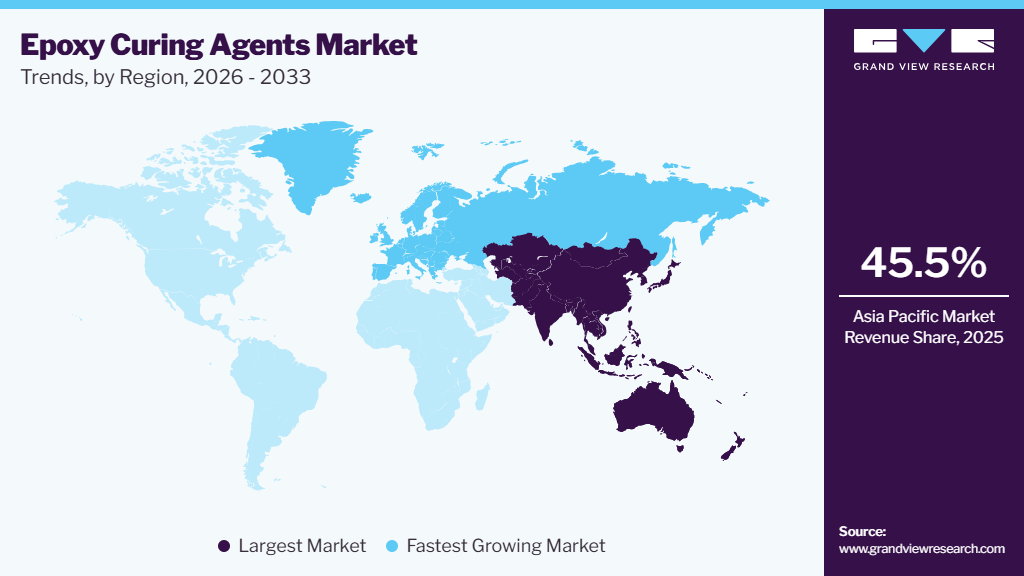
- Largest regional market: Asia Pacific (Approximately 45.5% revenue share, 2025)
- Fastest growing regional market: Europe (highest CAGR, 2026-2033)
Market Size & Forecast
- Market size in 2025: USD 4.1 Billion
- Estimated market size in 2026: USD 4.3 Billion
- Projected market size by 2033: USD 6.9 Billion
- CAGR (2026-2033): 6.8%
Prism AI by Grand View Research Free to tryAsk a question about the epoxy curing agents marketTry asking✓Every figure cited from GVR research Prefer the report? Download free sample →
Epoxy curing agents are essential additives used alongside epoxy polymers to produce high-quality end products. They retain outstanding adhesive properties even after curing. These agents offer remarkable resistance to chemicals, strong mechanical durability, and electrical insulation capabilities. For instance, in April 2026, Evonik expanded its epoxy curing agent portfolio with new curing technologies designed to deliver rapid curing, enhanced corrosion protection, excellent barrier properties, and reliable performance under demanding environmental conditions, further improving the durability and performance of epoxy systems used in protective and industrial coatings. Curing epoxy resin is exothermic, which can lead to excessive heat if not adequately managed.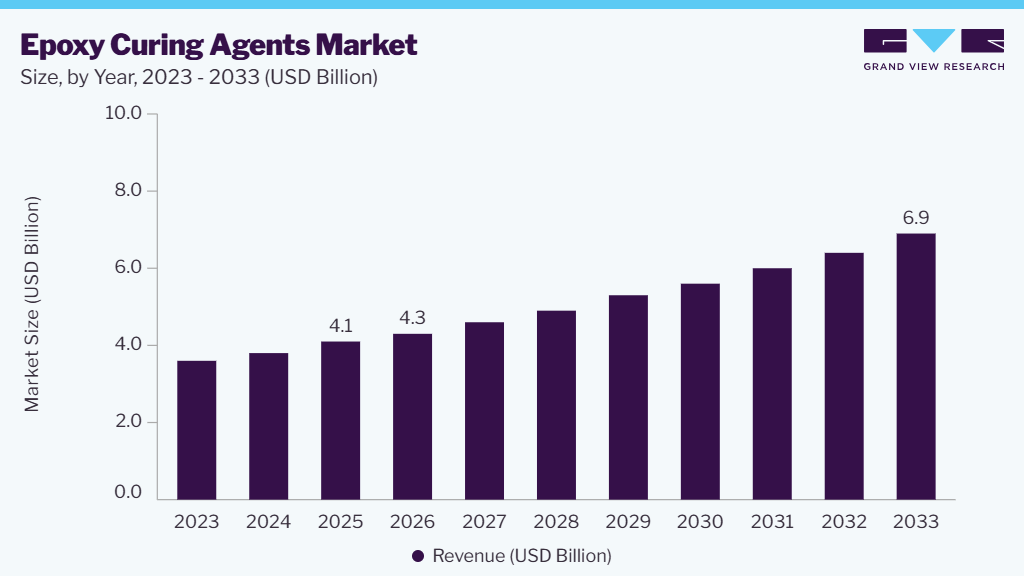 Source: Grand View Research, IR Documents, Primary Interviews, Paid DatabasesTo learn more about this report,
 Download Free Sample Report
The sustained growth in wind energy production has prompted higher demand for durable, lightweight, high-performing materials. Consequently, this has led to greater use of resin-curing agents, spurring manufacturers to innovate and create more advanced products. These advanced curing agents offer better flow properties and quicker cure times, contributing to decreased blade production time, reduced weight, and lower costs.
As a result, employing epoxy resins and their curing agents has significantly reduced production, maintenance, and repair costs. The wind energy sector significantly uses composite materials, especially for fabricating rotor blades. The relentless need for advanced composite materials is driven by the necessity to endure extreme forces and environmental stress. Epoxy-based resins are predominantly chosen for crafting wind rotor blades. Leveraging these resins and curing agents, manufacturers can produce blades that are larger, more robust, and lighter, markedly elevating efficiency levels.
Numerous applications within the automotive industry leverage epoxy resins and curing agents. These applications range from protective coatings and adhesives to lightweight composite materials. Epoxy-based coatings are vital in offering unmatched protection against rust and corrosion. Such coatings are utilized in most of today's automobiles, nearly 90%. These coatings undergo a curing process, which enhances their resistance to UV light and other forms of damage. Beyond their role in adhesion, epoxy resins are used to create lightweight composite components, parts for electric and hybrid vehicles, suspension elements, structures that bear loads, and drive shafts. The ability of epoxies to strongly adhere to different materials is notable. With an increasing push towards reducing the weight of vehicles, materials such as plastics and aluminum are becoming more prevalent in automotive part construction. This shift is, in effect, boosting the demand for epoxy-curing agents.
The global emphasis on environmental sustainability and reduced carbon footprint fosters the development of eco-friendly epoxy curing agents. The demand for green, sustainable solutions aligns with market trends, offering manufacturers opportunities to meet eco-conscious consumer preferences and regulatory requirements effectively. Robust economic growth in emerging markets presents a substantial opportunity for market expansion. Increasing construction activities and infrastructure development in these regions demand epoxy-curing agents, creating market penetration and growth avenues.
Analyst Perspective
The epoxy curing agents market is poised for steady growth, driven by demand from paints and coatings, construction, electronics, composites, and wind energy. The need for materials offering mechanical strength, chemical resistance, thermal stability, and long-term durability is accelerating adoption of advanced curing agents. Renewable energy expansion, especially wind power, is boosting demand for agents used in lightweight, strong composite components such as turbine blades. Manufacturers are developing fast-curing, low-VOC, and bio-based products to improve efficiency and meet environmental regulations and sustainability requirements. Infrastructure investment, urbanization, and industrial growth in emerging economies also create opportunities for innovation and supporting long-term market expansion.
Product Insights
Amine dominated the market, accounting for approximately 52.5% of revenue in 2025. Amines are commonly used as curing agents for epoxy resins due to their ability to form a cross-linked, thermoset polymer matrix, which enhances the mechanical and thermal properties of the cured epoxy. This reaction occurs when amine groups react with epoxide groups in the epoxy resin, yielding a highly durable, chemically resistant material. The choice of amine, whether aliphatic, cycloaliphatic, or aromatic, affects the curing time, flexibility, and final properties of the epoxy, making it versatile for various applications. For instance, in March 2025, a new amine-based epoxy hardener was introduced for epoxy resin systems, enabling up to 90.0% lower VOC emissions while delivering high durability, excellent flow properties, and enhanced mechanical performance for flooring, wind energy, electrical, composites, and adhesive applications.
Anhydrides are used as curing agents in epoxy resin systems and serve a critical role in determining the final properties of the cured material. By reacting with epoxy groups, they create highly cross-linked polymers, resulting in materials that exhibit excellent thermal and chemical resistance. This makes anhydride-cured epoxies suitable for applications requiring high-performance characteristics, including coatings, adhesives, and composites in various industries such as aerospace, automotive, and electronics.
Application Insights
Paints & coatings dominated the market, accounting for approximately 33.0% in 2025. Epoxy curing agents play a critical role in the performance of paints and coatings. These agents facilitate cross-linking, turning liquid epoxy resins into solid, durable finishes. This transformation enhances the mechanical properties, chemical resistance, and durability of the coating, making it suitable for a range of applications, from industrial flooring to corrosion protection. Different types of curing agents can adjust the cure time, temperature, and final properties of the epoxy coating to meet specific requirements. For instance, in April 2025, industry participants collaborated to develop lower-carbon, high-performance coating formulations that combine advanced resin and mineral technologies, reflecting the growing emphasis on durable and sustainable paints and coatings.
In wind energy, epoxy curing agents play a crucial role in enhancing the durability and performance of wind turbine blades. These agents are used in the manufacturing process of the blades, facilitating the hardening of the epoxy resin, which ultimately contributes to the blade's strength and weather resistance. This is vital, as it ensures the turbines can withstand high winds and harsh environmental conditions, improving their efficiency and lifespan. Using specific curing agents enables tailored properties in composite materials used in blades, optimizing them for their critical role in wind energy generation.
Regional Insights
Asia Pacific epoxy curing agents marketdominated the global market, accounting for 45.5% of the market share in 2025. This growth is attributed to increasing usage of the product in the electrical and electronics industry. The rising construction activity in emerging economies such as China, India, Japan, South Korea, and Australia is expected to further drive the Asia Pacific market. For instance, in November 2025, India introduced a five-year anti-dumping duty on liquid epoxy resin imports to strengthen domestic supply for construction, electrical and electronics, coatings, and industrial manufacturing industries, highlighting the region's expanding demand for epoxy materials driven by infrastructure and industrial growth.
 To learn more about this report, Download Free Sample Report
Epoxy curing agents market in China dominated the market, accounting for approximately 39.0% of the market share in 2025. This growth is attributed to the increasing demand in the country's product market. The rise in demand is due to the rising construction activity in the country. China’s construction industry is growing, leading to a rise in demand for the product market in the region.
Europe Epoxy Curing Agents Market Trends
The epoxy curing agents market is expected to grow at the fastest CAGR over the forecast period. Europe plays a significant role in the market, with countries such as Germany, the UK, France, Italy, Spain, Russia, the Netherlands, and Belgium being key contributors. The region's market dynamics are influenced by factors such as rising construction activity, which is driving increased demand in the product market. For instance, in November 2025, the distribution network for epoxy resins and hardeners was expanded across the UK and Ireland to strengthen the regional supply of materials for coatings, composites, adhesives, construction, and electrical applications, reflecting the increasing demand for high-performance epoxy products across Europe.
North America Epoxy Curing Agents Market Trends
The epoxy curing agents market in North America is expected to grow due to the region's expanding construction industry. This growth is likely to lead to increased demand for the product which is used in paints and coatings in the region. For instance, in April 2026, a next-generation ultra-low-emission epoxy curing agent was introduced for protective and marine coating, enabling high-solids formulations with lower VOC emissions, faster curing at low temperatures, and enhanced corrosion resistance, supporting the growing demand for high-performance and sustainable coating technologies across North America.
Key Epoxy Curing Agents Company Insights
Some of the key players operating in the global epoxy curing agent market include
-
BASF SE operates through six business segments, namely chemicals, materials, industrial solutions, surface technologies, nutrition & care, and agricultural solutions. The products offered by the company find application in industries such as agriculture, construction, pharmaceuticals, energy & power, home care & nutrition, automotive & transportation, rubber & plastics, leather & textiles, and personal care & hygiene. The company has a global presence.
-
Evonik Industries AG is predominantly owned by the RAG Foundation. The company manufactures polymers. It has five divisions, namely Specialty Additives, Nutrition and Care, Smart Materials, Performance Materials, and Technology and Infrastructure. The company caters to end-use markets such as consumer & personal care, paints & coatings, agriculture, plastics & rubber, construction, pharmaceuticals, electrical & electronics, renewable energies, paper & printing, metal & oil, automotive & mechanical engineering, and food & animal feed. It has set up production facilities at 102 locations in 27 countries.
Huntsman Advanced Materials and Mitsubishi Chemical Company. There are some emerging market participants in the global epoxy curing agents market.
-
Huntsman Advanced Materials is a global manufacturer specializing in organic chemical products. The company's main activities involve producing and distributing various chemicals and formulations, including maleic anhydride, amines, epoxy-based polymer formulations, MDI, textile chemicals, and dyes. These products find applications in multiple industries, such as adhesives, aerospace, personal care and hygiene, automotive, construction, consumer products, digital inks, electronics, power generation, medical, packaging, coatings, synthetic fiber, and textile chemicals. Huntsman has a global presence and reaches its diverse customers through a global network of administrative, research and development, and manufacturing units.
-
Mitsubishi Chemical Group Corp (MCGC) is a manufacturer and distributor of chemicals. The company offers various products and services, including high-performance chemicals, advanced polymers, high-performance films, advanced moldings and composites, carbon, petrochemicals, methyl methacrylate, industrial gases, and environmental and living solutions. Its clientele spans various sectors: mobility, environment and new energy, information technology, electronics and display, medical, food and packaging, bioproducts, healthcare, and labels and films. With a global presence, the company serves customers worldwide.
Key Epoxy Curing Agents Companies
The following key companies have been profiled for this study on the epoxy curing agents market.
-
Atul Limited
-
BASF SE
-
Cardolite Corporation
-
Evonik Industries
-
Grasim Industries Limited (India) and Aditya Birla Chemicals (Thailand)
-
Westlake
-
Huntsman Corporation
-
Kukdo Chemical Co., Ltd.
-
Mitsubishi Chemical Corporation
-
Olin Corporation
Recent Developments
-
In December 2025, iGM Resins entered into an exclusive distribution partnership with IDCC Global Chem Pvt. Ltd. for the Indian market, effective January 2026. The partnership expands access to iGM Resins' portfolio of photoinitiators, energy-curing resins, and specialty additives, strengthening regional supply, technical support, and customer service for coatings, inks, and adhesives applications across India.
-
In July 2025, Evonik transitioned all of its global epoxy curing agent production facilities to operate on 100% renewable electricity. The initiative is expected to reduce Scope 1 and 2 emissions by approximately 30% annually while supporting the sustainable production of epoxy curing agents used in coatings, construction, adhesives, and high-performance composites.
-
In June 2025, Aditya Birla Advanced Materials acquired Cargill’s specialty chemical manufacturing facility in Dalton, Georgia, U.S., strengthening its advanced materials portfolio and expanding production of formulated resins, epoxy curing agents, reactive diluents, and polyaspartic resins. The acquisition also includes plans to more than double the facility’s production capacity over the next two years while supporting the development of next-generation materials for coatings, renewable energy, automotive, and aerospace applications.
-
In April 2024, Evonik announced the launch of its new range of curing agents with the introduction of Ancamine 2844, a groundbreaking hardener for epoxy cures designed specifically for use in multi-component spray processes. This advanced, high-performance aliphatic amine hardener provides extremely rapid curing and accelerates property development under both low and high temperatures.
Epoxy Curing Agents Market Report Scope
Report Attribute
Details
Market size in 2025
USD 4.1 billion
Estimated market size in 2026
USD 4.3 billion
Projected market size by 2033
USD 6.9 billion
Growth rate
CAGR of 6.8% from 2026 to 2033
Base year for estimation
2025
Historical data
2021 – 2024
Forecast period
2026 – 2033
Quantitative units
Volume in kilotons, revenue in USD billion, and CAGR from 2026 to 2033
Report coverage
Volume and Revenue forecast, company ranking, competitive landscape, growth factors, and trends
Segments covered
Product, application, region
Regional scope
North America; Europe; Asia Pacific; Central & South America; Middle East & Africa
Country scope
U.S.; Canada; Mexico; Germany; UK; France; Italy; Spain; China; India; Japan; South Korea; Australia; Brazil; Argentina; Saudi Arabia; South Africa
Key companies profiled
Westlake; Olin Corporation; Huntsman Corporation; Evonik Industries; BASF SE; Atul Limited; Mitsubishi Chemical Corporation; Cardolite Corporation; Grasim Industries Limited (India) and Aditya Birla Chemicals (Thailand) Pvt. Ltd; Kukdo Chemical Co., Ltd.
Customization scope
Free report customization (equivalent up to 8 analysts working days) with purchase. Addition or alteration to country, regional & segment scope.
Pricing and purchase options
Avail of customized purchase options to meet your exact research needs. Explore purchase options
Global Epoxy Curing Agents Market Report Segmentation
This report forecasts revenue growth at global, regional, and country levels and provides an analysis of the latest industry trends and opportunities in each of the sub-segments from 2021 to 2033. For this study, Grand View Research has segmented the global epoxy curing agents market report based on product, application, and region:
- Product Outlook (Volume, Kilotons, Revenue, USD Billion, 2021 - 2033)
- Amine
- Anhydrides
- Other Products
- Application Outlook (Volume, Kilotons, Revenue, USD Billion, 2021 - 2033)
- Paints & Coatings
- Electronics
- Wind Energy
- Construction
- Composites
- Other Applications
- Regional Outlook (Volume, Kilotons, Revenue, USD Billion, 2021 - 2033)
- North America
- U.S.
- Canada
- Mexico
- Europe
- Germany
- UK
- France
- Italy
- Spain
- Asia Pacific
- China
- Japan
- India
- South Korea
- Australia
- Central & South America
- Brazil
- Argentina
- Middle East and Africa
- Saudi Arabia
- South Africa
- North America
Frequently Asked Questions About This Report
The global epoxy curing agents market size was valued at USD 4.1 billion in 2025 and is estimated at USD 4.3 billion for 2026.
The global epoxy curing agents market is expected to grow at a CAGR of 6.8% from 2026 to 2033, reaching USD 6.9 billion by 2033
Asia Pacific dominated with approximately 45.5% revenue share in 2025. This growth is attributed to increasing usage of the product in the electrical and electronics industry. The rising construction activity in emerging economies such as China, India, Japan, South Korea, Australia is expected to further drive the Asia-Pacific market.
Key players in the market are Westlake, Olin Corporation, Huntsman Corporation, Evonik Industries, BASF SE, Atul Limited, Mitsubishi Chemical Corporation, Cardolite Corporation, Grasim Industries Limited (India) and Aditya Birla Chemicals (Thailand) Pvt. Ltd, and Kukdo Chemical Co., Ltd., and others.
The Amine segment accounted for the largest revenue share of approximately 52.5% in 2025.
About the Author(s)
Plastics, Polymers & Resins Research Team
Bulk Chemicals · Plastics, Polymers & ResinsThis report was authored by the plastics, polymers & resins research team at Grand View Research - comprising two research analysts, one senior research analyst, and one industry expert - with specialized expertise in the plastics, polymers & resins segment of the bulk chemicals industry. All findings are based on proprietary bulk chemicals databases, executive interviews, and regulatory analysis, subject to internal peer review prior to publication.
Last Updated:
Speak to Analyst

Customize this report to your needs - add regions, segments, or data points, with 20% free customization.
Or view our licence options:


ISO 9001:2015 & 27001:2022 Certified
We are GDPR and CCPA compliant! Your transaction & personal information is safe and secure. For more details, please read our privacy policy.


