
- Home
- »
- Advanced Interior Materials
- »
-
ESG Compliance In Mining Market Size, Share Report, 2033GVR Report cover

ESG Compliance In Mining Market (2026 - 2033)
Size, Share & Trends Analysis Report By Component (Environmental Compliance, Social Compliance, Governance & Reporting), By Metal Type (Base Metals, Precious Metals, Energy & Battery Metals, Ferrous Metals), By Region, And Segment Forecasts
Market Size, 2025
$4.8BMarket Estimate, 2026
$5.2BMarket Forecast, 2033
$9.6BCAGR, 2026–2033
9.1%ESG Compliance In Mining Market Summary
The global ESG compliance in mining market size was valued at USD 4.8 billion in 2025 and is projected to grow from USD 5.2 billion in 2026 to USD 9.6 billion by 2033, growing at a CAGR of 9.1% from 2026 to 2033. Asia Pacific dominated the market, accounting for the largest global share of 39.1% in 2025. The increasing emphasis on environmental, social, and governance (ESG) compliance in mining is largely driven by regulatory pressure and evolving government policies.
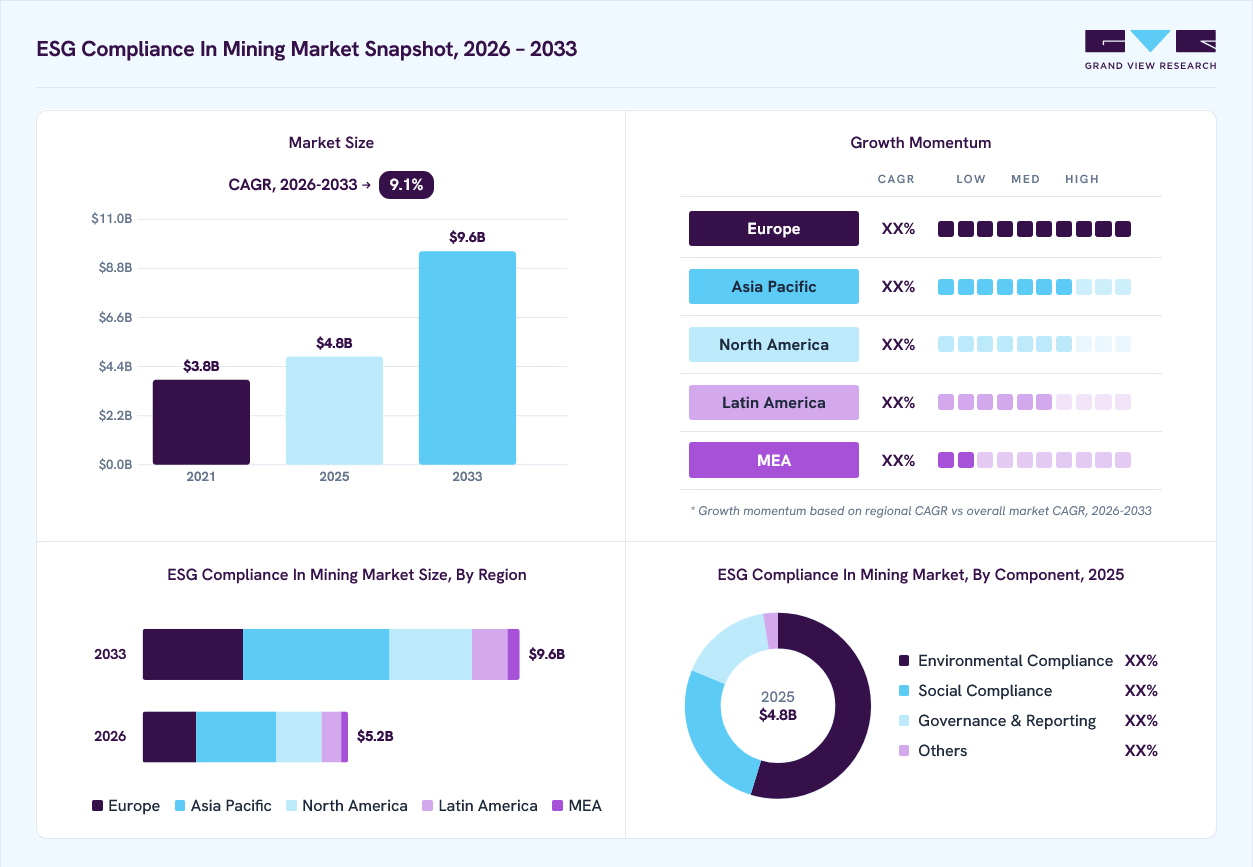 Source: Grand View Research, IR Documents, Primary Interviews, Paid DatabasesTo learn more about this report,
 Download Free Sample Report
Key Market Trends & Insights
- By components: Environmental compliance segment held the largest share of 54.7% in 2025.
- By metal type: Base metal segment held the largest revenue share of 44.0% in 2025.
Regional Highlights
- Largest regional market: Asia Pacific (39.1% revenue share, 2025)
- By country: China held the largest share of Asia Pacific in 2025.
Market Size & Forecast
- Market size in 2025: USD 4.8 Billion
- Estimated market size in 2026: USD 5.2 Billion
- Projected market size by 2033: USD 9.6 Billion
- CAGR (2026-2033): 9.1%
Three ways to get this report
Buy it, customize it, or ask a question.Ask an Analyst
Analyst response in 1 business day
- AccessReport author, directly
- Reply timeWithin 1 working day
- No sales callDirect answer only
- FormatEmail reply
- CostFree, no cost
Get the Full Report
What the study covers
- FormatsPDF · Excel · Dashboard
- Timeline2026–2033 annual, 2025 base
- Coverage20+ countries, 5 regions
- Companies10+ key players profiled
Customize the Report
20% free customization
- IncludeCountries, segments, points
- TailorTo your product definition
- ExtendDeeper competitor detail
- OrA fully bespoke study
- Turnaround5–10 working days
Mining companies face stricter environmental regulations and labor standards across key markets, which necessitate adherence to ESG principles. Countries and regions are imposing emissions, waste management, water usage, and social responsibility guidelines, prompting companies to integrate ESG frameworks into their operations to avoid penalties, maintain licenses, and secure operational continuity. Compliance has become essential for sustaining long-term mining activities, and companies are proactively adopting ESG strategies to meet local and international standards.Investor demand represents another critical driver of ESG adoption in the mining sector. Institutional investors, asset managers, and sustainable investment funds increasingly prioritize companies demonstrating strong ESG practices. Mining companies with robust ESG compliance are viewed as lower-risk investments, enhancing their access to capital and improving stock performance. Firms failing to meet ESG criteria often face divestment or limited financing opportunities, making ESG compliance a key factor for attracting and retaining investors. The link between responsible mining practices and financial performance has pushed companies to integrate ESG initiatives into their core strategies.
 To learn more about this report, Download Free Sample Report
Consumer awareness and societal expectations are influencing mining companies to adopt ESG practices. End-users, particularly in electronics, automotive, and construction industries, demand responsibly sourced raw components. Ethical sourcing and transparency in supply chains are increasingly important for brand reputation and market positioning. Mining companies prioritizing ESG compliance can enhance their credibility, strengthen relationships with downstream partners, and secure long-term contracts with buyers who require evidence of sustainable practices. Public perception and the pressure from advocacy groups further reinforce the need for ESG alignment.
Technological advancements are also shaping the ESG landscape in mining. Adopting digital tools, AI, and IoT solutions enables companies to monitor environmental impacts, track resource usage, and ensure worker safety more efficiently. Innovations in waste management, water recycling, and emission reduction technologies allow mining operations to meet compliance standards while improving operational efficiency. Integrating ESG-focused technologies supports risk mitigation, reduces operational costs, and provides measurable reporting that satisfies stakeholders and regulators.
Global competition and market differentiation are motivating mining firms to enhance ESG compliance. Companies with strong ESG credentials can gain a competitive advantage by appealing to environmentally conscious investors and buyers, while those lagging risk reputational damage and potential exclusion from global supply chains. ESG compliance has become a benchmark for operational excellence, influencing mergers, acquisitions, and partnerships. Firms leverage ESG performance to demonstrate sustainability leadership, attract talent, and foster innovation, ultimately positioning themselves as resilient and forward-looking players in the global mining market.
Market Dynamics
The ESG compliance in mining market is experiencing strong growth due to increasing environmental regulations, rising investor focus on sustainable mining practices, and growing demand for transparent ESG reporting across the global mining industry. Mining companies are increasingly adopting ESG compliance solutions to monitor environmental performance, improve workplace safety, strengthen community engagement, and enhance corporate governance. Additionally, the expansion of critical mineral mining for clean energy technologies, coupled with digitalization and real-time environmental monitoring, is further supporting market growth.
The growing implementation of stringent environmental regulations and sustainability frameworks is a major driver of ESG compliance in mining market. Governments and regulatory authorities worldwide are mandating stricter standards for greenhouse gas emissions, water management, waste disposal, mine rehabilitation, and biodiversity conservation. At the same time, institutional investors, financial institutions, and customers are increasingly incorporating ESG performance into investment decisions and procurement strategies.
Mining companies are investing in ESG software platforms, environmental monitoring systems, sustainability reporting tools, and governance frameworks to ensure compliance with international standards and improve operational transparency. The increasing demand for responsibly sourced critical minerals used in electric vehicles, renewable energy systems, and battery technologies is further accelerating ESG adoption across mining operations. As regulatory scrutiny and stakeholder expectations continue to increase, demand for ESG compliance solutions is expected to grow steadily throughout the forecast period.
The significant investment required to implement comprehensive ESG compliance programs remains a key restraint for the market. Mining companies often face substantial costs associated with deploying environmental monitoring technologies, digital reporting platforms, third-party audits, workforce training, and sustainability initiatives. Moreover, the absence of globally harmonized ESG reporting standards and the frequent evolution of regional regulations create compliance complexities, particularly for multinational mining companies operating across multiple jurisdictions.
The increasing adoption of digital technologies presents significant opportunities for ESG compliance in the mining market. Artificial intelligence, IoT-enabled environmental sensors, satellite monitoring, blockchain-based traceability, and advanced data analytics are enabling mining companies to automate ESG data collection, improve reporting accuracy, and strengthen regulatory compliance. In addition, the global transition toward clean energy and electric mobility is driving demand for responsibly sourced critical minerals such as lithium, nickel, cobalt, copper, and graphite.
Analyst Perspective
The ESG compliance in mining market is expected to witness steady growth, driven by stricter environmental regulations, increasing investor focus on sustainable mining, and rising demand for transparent ESG reporting. Growing adoption of digital monitoring technologies, ESG management platforms, and responsible sourcing practices for critical minerals is further supporting market expansion, while evolving regulatory frameworks and sustainability commitments continue to accelerate investment in ESG compliance solutions across the mining industry.
Component Insights
Based on components, the environmental compliance segment led the market with the largest revenue share of 54.7% in 2025. The growth of the environmental compliance segment is primarily driven by stricter regulations and policies aimed at reducing mining operations' environmental footprint. Governments and regulatory bodies enforce emissions, effluent management, waste disposal, and land reclamation standards, which compel mining companies to implement advanced environmental management systems.
The governance & reporting segment is anticipated to register the fastest CAGR over the forecast period due to increasing demands for transparency and accountability from investors, regulators, and other stakeholders. Mining companies are under pressure to provide clear, standardized, and verifiable reports on their environmental, social, and governance performance. Strong governance frameworks help organizations manage risks, prevent corruption, ensure ethical business practices, and align with global reporting standards, making governance and reporting a critical aspect of ESG compliance.
Metal Type Insights
Based on metal type, the base metal segment led the market with the largest revenue share of 44.0% in 2025. The growth of the base metals is primarily fueled by the increasing demand for environmentally and socially responsible production of metals such as copper, nickel, and aluminum. Mining companies are under rising pressure from investors, governments, and stakeholders to adopt sustainable practices that reduce carbon emissions, minimize water usage, and ensure proper waste management.
 To learn more about this report, Download Free Sample Report
The ferrous metals segment is anticipated to grow significantly over the forecast period, driven by the global emphasis on sustainable steel and iron production. Steel and other ferrous metals are critical to construction, transportation, and manufacturing sectors, which makes their production a major contributor to environmental impact. Mining companies are increasingly adopting ESG-compliant practices, such as reducing greenhouse gas emissions, implementing energy-efficient technologies, and ensuring responsible land and waste management, to meet regulatory standards and societal expectations. These initiatives help companies maintain operational licenses, attract investors, and enhance their reputation for sustainability.
Regional Insights
Asia Pacific dominated the ESG compliance in mining market with the largest revenue share of 39.1% in 2025. The Asia Pacific ESG compliance in mining industry is driven by tightening environmental regulations, rapid industrialization, and increasing awareness of sustainable resource management. Governments in countries such as China, Australia, and India enforce policies that demand greater accountability in carbon emissions, waste disposal, and biodiversity protection.
 To learn more about this report, Download Free Sample Report
North America ESG Compliance In Mining Market Trends
The ESG compliance in mining industry in North America is driven by strong regulatory pressure, investor expectations, and corporate accountability measures. Governments in the United States and Canada have introduced stringent environmental standards that require mining companies to monitor carbon emissions, rehabilitate mining sites, and adopt cleaner extraction technologies. The U.S. Environmental Protection Agency (EPA) and Natural Resources Canada are actively promoting frameworks that encourage transparency in reporting sustainability metrics. Institutional investors in the region are also directing funds toward companies with clear ESG commitments, recognizing that sustainable operations reduce long-term risks and enhance brand reputation in a resource-sensitive market.
U.S. ESG Compliance In Mining Market Trends
The U.S. ESG compliance in mining industry is primarily driven by evolving federal regulations, investor scrutiny, and public demand for sustainable resource development. Agencies such as the EPA and the Department of Energy (DOE) are implementing stricter environmental standards that compel mining operators to adopt sustainable methods for waste management, water conservation, and carbon emission reduction. The Inflation Reduction Act and other federal initiatives also encourage cleaner mining operations through incentives for low-carbon technologies and domestic production of critical minerals.
Europe ESG Compliance In Mining Market Trends
The ESG compliance in mining industry in Europe is primarily driven by stringent environmental regulations, ambitious climate targets, and the European Union’s Green Deal initiatives. European governments enforce policies requiring mining companies to minimize carbon emissions, ensure efficient energy use, and restore mined lands to ecological stability. The Corporate Sustainability Reporting Directive (CSRD) and other EU frameworks are compelling firms to disclose detailed ESG metrics, which has increased transparency and accountability across the industry.
Middle East & Africa ESG Compliance In Mining Market Trends
The Middle East and Africa ESG compliance in mining industry is driven by the growing commitment to diversifying economies, attracting foreign investment, and enhancing sustainability in resource extraction. Governments in Saudi Arabia, the UAE, and South Africa are adopting ESG-focused mining regulations emphasizing environmental protection, water conservation, and efficient energy use. National strategies like Saudi Vision 2030 and the UAE’s Net Zero 2050 initiative encourage mining companies to adopt cleaner technologies and sustainable resource management.
Latin America ESG Compliance In Mining Market Trends
The ESG compliance in mining industry in Latin America is strongly influenced by increasing regulatory enforcement, rising investor expectations, and heightened environmental awareness among local communities. Governments in Chile, Peru, and Brazil are strengthening environmental laws to ensure responsible mining practices that limit deforestation, water contamination, and carbon emissions.
Key ESG Compliance In Mining Company Insights
Some of the key players operating in the market include Anglo American plc, Agnico Eagle Mines Limited, and others.
-
Agnico Eagle Mines Limited is a prominent Canadian gold mining company with operations in Canada, Finland, Australia, and Mexico. Founded in 1957, it focuses on high-quality gold assets while emphasizing operational efficiency, safety, and responsible mining practices. The company integrates environmental stewardship, community engagement, and sustainable resource management into its core operations, maintaining strong relationships with local and Indigenous communities.
-
Anglo American plc is a global diversified mining company headquartered in London, United Kingdom. It produces commodities including copper, platinum, iron ore, and diamonds. Established in 1917, it operates across Africa, Europe, the Americas, and Australia. Through its FutureSmart Mining program, it focuses on technological innovation, energy efficiency, and sustainable resource extraction. The company’s ESG compliance strategy emphasizes carbon neutrality by 2040, reduction of freshwater usage, and biodiversity conservation.
Key ESG Compliance in Mining Companies:
The following key companies have been profiled for this study on the ESG compliance in mining market.
-
Agnico Eagle Mines Limited
-
Anglo American plc
-
Barrick Gold Corporation
-
BHP Group
-
Boliden AB
-
Fortescue Metals Group
-
Kirkland Lake Gold
-
Newmont Corporation
-
Rio Tinto
-
Teck Resources Limited
Competitive Benchmarking
Category
Operating Strategies
Competitive Edge
Weakness
Established Players (e.g., BHP Group, Rio Tinto, Anglo American plc, Fortescue Metals Group, Newmont Corporation)
- Integrate ESG principles into core mining operations through investments in decarbonization, water stewardship, tailings management, biodiversity conservation, and digital ESG reporting.
- Deploy enterprise-wide ESG management platforms, environmental monitoring systems, and governance frameworks to meet evolving regulatory requirements.
- Strengthen responsible sourcing initiatives and supply chain transparency while aligning with global sustainability standards.
- Invest in renewable energy projects, mine rehabilitation, and community development programs to improve ESG performance and stakeholder confidence.
- Strong financial resources to implement comprehensive ESG strategies across global operations.
- Established governance frameworks, sustainability reporting capabilities, and access to advanced digital technologies.
- Strong relationships with governments, investors, and downstream customers seeking responsibly sourced minerals.
- Ability to leverage operational scale to accelerate ESG innovation and regulatory compliance.
- Significant capital expenditure required for large-scale ESG implementation and environmental improvements.
- Complex compliance obligations across multiple jurisdictions with evolving ESG regulations.
- Legacy mining assets may require substantial investment to meet modern sustainability standards.
- Greater exposure to reputational risks arising from environmental incidents or community-related issues.
Emerging & Regional Players (e.g., Boliden AB, Barrick Gold Corporation, Teck Resources Limited, Agnico Eagle Mines Limited, Kirkland Lake Gold)
- Focus on strengthening ESG performance through targeted environmental compliance initiatives, safety improvements, and community engagement programs.
- Adopt digital ESG reporting platforms and third-party certification to meet customer and investor expectations.
- Prioritize responsible mining practices for critical minerals and precious metals while improving operational efficiency.
- Collaborate with technology providers, consultants, and industry organizations to accelerate ESG implementation.
- Greater operational flexibility in implementing site-specific ESG initiatives.
- Faster adoption of specialized sustainability technologies and digital compliance tools.
- Strong regional stakeholder engagement and responsiveness to local regulatory requirements.
- Ability to differentiate through responsible sourcing and sustainable mining practices.
- Limited financial and technical resources compared to global mining leaders.
- Higher compliance costs relative to operational scale.
- Greater dependence on external ESG consultants, technology providers, and certification agencies.
- Limited geographic diversification increases exposure to regional regulatory and commodity market fluctuations.
Recent Development
-
In September 2025, India’s mining industry witnessed legal reform and sustainable accountability as courts, regulators, and states advanced major ESG-linked compliance measures. For instance, Maharashtra moved ahead with GIS-based forest mapping in alignment with national conservation rules.
ESG Compliance In Mining Market Report Scope
Report Attribute
Details
Market definition
The market size represents the total value of products, services, and technologies purchased by mining companies to achieve ESG compliance.
Market size value in 2025
USD 4.8 billion
Market size value in 2026
USD 5.2 billion
Revenue forecast in 2033
USD 9.6 billion
Growth rate
CAGR of 9.1% from 2026 to 2033
Base year for estimation
2025
Historical data
2021 - 2024
Forecast period
2026 - 2033
Quantitative units
Revenue in USD million/billion, and CAGR from 2026 to 2033
Report coverage
Revenue forecast, company ranking, competitive landscape, growth factors, and trends
Segments covered
Metal type, component, region
Regional scope
North America; Europe; Asia Pacific; Latin America; Middle East & Africa
Country scope
U.S.; Canada; Mexico; Germany; UK; France; China; India; Japan; Brazil; Saudi Arabia, UAE
Key companies profiled
BHP Group; Rio Tinto; Anglo American plc; Boliden AB; Fortescue Metals Group; Newmont Corporation; Barrick Gold Corporation; Teck Resources Limited; Agnico Eagle Mines Limited; Kirkland Lake Gold
Customization scope
Free report customization (equivalent up to 8 analysts' working days) with purchase addition or alteration to country, regional & segment scope.
Pricing and purchase options
Avail customized purchase options to meet your exact research needs. Explore purchase options
Global ESG Compliance In Mining Market Report Segmentation
This report forecasts revenue growth at global, regional, and country levels and provides an analysis of the latest industry trends in each of the sub-segments from 2021 to 2033. For this study, Grand View Research has segmented the global ESG compliance in mining market report on the basis of component, metal type, and region.
 To learn more about this report, Download Free Sample Report
-
Component Outlook (Revenue, USD Million, 2021 - 2033)
-
Environmental Compliance
-
Social Compliance
-
Governance & Reporting
-
Others
-
-
Metal Type Outlook (Revenue, USD Million, 2021 - 2033)
-
Base Metals
-
Precious Metals
-
Energy & Battery Metals
-
Ferrous Metals
-
Others
-
-
Regional Outlook (Revenue, USD Million, 2021 - 2033)
-
North America
-
U.S.
-
Canada
-
Mexico
-
-
Europe
-
Germany
-
UK
-
France
-
-
Asia Pacific
-
China
-
India
-
Japan
-
-
Latin America
-
Brazil
-
-
Middle East & Africa
-
Saudi Arabia
-
UAE
-
-
Research Methodology
The ESG compliance in mining market figures in this report are based on a proven research process that combines executive interviews with secondary research from proprietary databases, company filings, and recognized regulatory and institutional sources. Market size is built through value-chain sizing - reconciling supply-side and demand-side estimates - and triangulated with bottom-up and top-down approaches. Every estimate passes multiple levels of expert validation before publication, with each ESG compliance in mining segment quantified using the revenue-capture definitions in the table below.
Segment Definition
Component
Revenue Capture Definition
Environmental Compliance
This segment includes revenue generated from solutions and services that help mining companies monitor and comply with environmental regulations. It covers environmental monitoring systems, emissions management, water and wastewater management, tailings monitoring, waste management, biodiversity assessment, carbon accounting, land rehabilitation solutions, and related consulting, software, and reporting services.
Social Compliance
This segment comprises revenue generated from solutions and services supporting social responsibility and stakeholder engagement in mining operations. It includes worker health and safety management systems, community engagement platforms, human rights due diligence, labor compliance, indigenous relations, diversity and inclusion programs, social impact assessments, and associated consulting and reporting services.
Governance & Reporting
This segment includes revenue generated from ESG governance software, sustainability reporting platforms, regulatory compliance management, risk management systems, internal audit solutions, board governance tools, anti-corruption compliance, third-party assurance, ESG data management, and reporting services aligned with global sustainability frameworks.
Others
This segment consists of revenue generated from additional ESG-related offerings, including ESG training, certification, supply chain traceability solutions, ESG strategy consulting, climate risk assessment, digital twins, AI-based ESG analytics, and other specialized compliance solutions not covered under the above categories.
Metal Type
Revenue Capture Definition
Base Metals
This segment includes revenue generated from ESG compliance solutions and services deployed across the mining of base metals such as copper, aluminum, zinc, lead, and nickel. Revenue is derived from environmental monitoring, sustainability reporting, community engagement, governance compliance, and regulatory management solutions implemented at base metal mining operations.
Precious Metals
This segment comprises revenue generated from ESG compliance solutions used in gold, silver, platinum, and palladium mining operations. Revenue includes software, consulting, auditing, environmental monitoring, responsible sourcing verification, and sustainability reporting services supporting ESG compliance throughout precious metal extraction and processing activities.
Energy & Battery Metals
This segment includes revenue generated from ESG compliance solutions supporting the mining of lithium, cobalt, graphite, manganese, and other battery and energy-transition minerals. Revenue is derived from digital ESG platforms, carbon management, water stewardship, traceability systems, environmental monitoring, and governance solutions that enable the responsible sourcing of critical minerals.
Ferrous Metals
This segment consists of revenue generated from ESG compliance solutions deployed across iron ore, manganese, and other ferrous metal mining operations. Revenue includes environmental compliance systems, occupational health and safety solutions, governance platforms, sustainability reporting, and regulatory compliance services designed for ferrous mining companies.
Others
This segment includes revenue generated from ESG compliance solutions supporting the mining of industrial minerals, rare earth elements, gemstones, and other specialty minerals. Revenue covers environmental, social, and governance software, consulting, certification, monitoring, and compliance services tailored to these mining operations.
Estimation Model
Layer Name
Key Question
Description
Mining ESG Demand Base Layer
What forms the demand base?
Identify demand for ESG compliance solutions generated from mining operations across base metals, precious metals, ferrous metals, energy & battery metals, and other minerals. Assess demand for environmental compliance, social responsibility, governance, sustainability reporting, occupational health & safety, and regulatory compliance solutions. Analyze the influence of mining investments, expansion of critical mineral projects, evolving ESG regulations, investor expectations, and corporate sustainability initiatives on overall market demand.
Solution Provider & Service Supply Layer
Where are ESG compliance solutions supplied from?
Evaluate the supply ecosystem of ESG compliance products, services, and technologies provided by software vendors, environmental consulting firms, certification bodies, audit & assurance providers, engineering companies, and environmental monitoring technology providers. Analyze regional availability of ESG platforms, digital monitoring systems, consulting capabilities, regulatory expertise, and implementation services. Assess the role of technology providers, sustainability consultants, IoT solution providers, and third-party verification organizations in delivering ESG compliance solutions to mining companies globally.
ESG Solution Adoption Layer
How extensively are ESG compliance solutions adopted?
Analyze the adoption intensity of ESG compliance solutions across environmental compliance, social compliance, governance & reporting, carbon management, water stewardship, biodiversity monitoring, tailings management, community engagement, occupational health & safety, and supply chain traceability. Evaluate adoption based on mining company size, mineral type, regulatory requirements, sustainability commitments, digital transformation initiatives, and regional compliance standards.
Revenue Layer
How is market revenue generated?
Market revenue is quantified through the purchase of ESG compliance products, software, consulting services, environmental monitoring technologies, auditing, certification, reporting platforms, and governance solutions by mining companies. Revenue generation is influenced by the scope of ESG implementation, digital technology adoption, regulatory compliance requirements, third-party assurance services, sustainability reporting obligations, and long-term ESG management programs. Increasing regulatory scrutiny, investor demand for responsible mining, digital ESG transformation, and sustainable sourcing initiatives continue to drive overall market value.
Delivered Customizations
This report has been delivered with the following In-depth customizations
Client Request
Customization Delivered
Value Adds
ESG Software Vendor Landscape
Evaluation of leading ESG software providers based on platform capabilities, deployment models, AI integration, reporting features, and mining-specific functionalities.
Assisted in vendor selection and digital ESG implementation planning.
Cross-Segmentation
Comprehensive evaluation of the market across multiple segments and sub-segments to identify key revenue pockets and growth opportunities.
Assisted in prioritizing target segments and optimizing product and market strategies.
Competitive Benchmarking
Comparative assessment of key market participants based on product/service portfolio, geographic presence, strategic initiatives, and competitive positioning.
Supported competitive intelligence, market positioning, and strategic decision-making.
Frequently Asked Questions About This Report
Australia dominated the Asia Pacific market with a revenue share of 45.4% in 2025.
Europe is expected to register the fastest CAGR of 9.4% over the forecast period.
Based on process, the base metal segment led the market with the largest revenue share of 44.0% in 2025.
Based on components, the environmental compliance segment led the market with the largest revenue share of 54.7% in 2025.
Some of the key vendors in the global environmental, social, and governance (ESG) compliance in mining market are BHP Group, Rio Tinto, Anglo American plc, Boliden AB, Fortescue Metals Group, Newmont Corporation, Barrick Gold Corporation, Teck Resources Limited, Agnico Eagle Mines Limited, Kirkland Lake Gold, among others.
Asia Pacific dominated the environmental, social, and governance (ESG) compliance in mining market with the largest revenue share of 39.1% in 2025.
The ESG compliance in mining market size was valued at USD 4.8 billion in 2025 and is estimated at USD 5.2 billion in 2026.
Environmental, social, and governance (ESG) compliance in mining market is expected to grow at a compound annual growth rate of 9.1% from 2026 to 2033 to reach USD 9.6 billion by 2033.
The environmental, social, and governance (ESG) compliance in mining market is driven by increasing environmental regulations, rising investor demand for sustainable mining practices, and growing adoption of digital ESG monitoring and reporting solutions.
About the Author(s)
Advanced Interior Materials Research Team
Advanced Materials · Advanced Interior MaterialsThis report was authored by the advanced interior materials research team at Grand View Research - comprising two research analysts, one senior research analyst, and one industry expert - with specialized expertise in the advanced interior materials segment of the advanced materials industry. All findings are based on proprietary advanced materials databases, executive interviews, and regulatory analysis, subject to internal peer review prior to publication.
Last Updated:
Speak to Analyst

Customize this report to your needs - add regions, segments, or data points, with 20% free customization.
Or view our licence options:


ISO 9001:2015 & 27001:2022 Certified
We are GDPR and CCPA compliant! Your transaction & personal information is safe and secure. For more details, please read our privacy policy.


