
- Home
- »
- Next Generation Technologies
- »
-
Explosive Trace Detection Market Size, Growth Report, 2026-2033GVR Report cover

Explosive Trace Detection Market (2026 - 2033)
Size, Share & Trends Analysis Report By Product (Handheld, Portable/Movable, Fixed Point/Standalone), By Technology, By End Use, By Region And Segment Forecasts
Market Size, 2025
$1.7BMarket Estimate, 2026
$1.9BMarket Forecast, 2033
$3.3BCAGR, 2026–2033
8.4%Explosive Trace Detection Market Summary
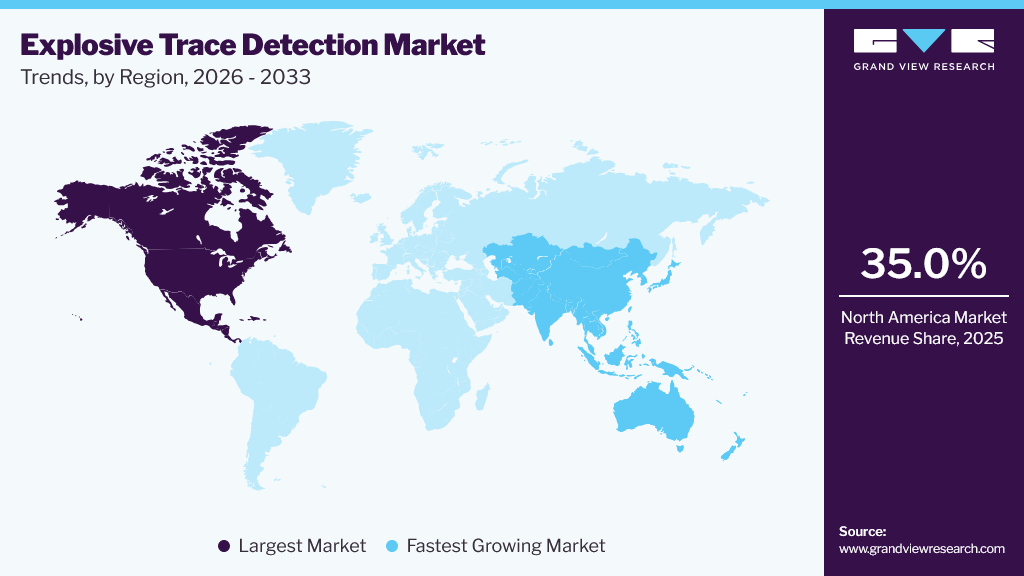
The global explosive trace detection market size was valued at USD 1.7 billion in 2025 and is projected to grow from USD 1.9 billion in 2026 to USD 3.3 billion in 2033, at a CAGR of 8.4% from 2026 to 2033. The North America dominated the market, accounting for a revenue share of 35.0% in 2025. Governments and international organizations implement regulations and standards to ensure public safety, particularly in transportation and critical infrastructure. Regulations mandating the use of ETD systems in airports, border security, and other sensitive areas are driving market growth. Compliance with these regulations necessitates adopting advanced detection systems, increasing the demand for ETD technologies.
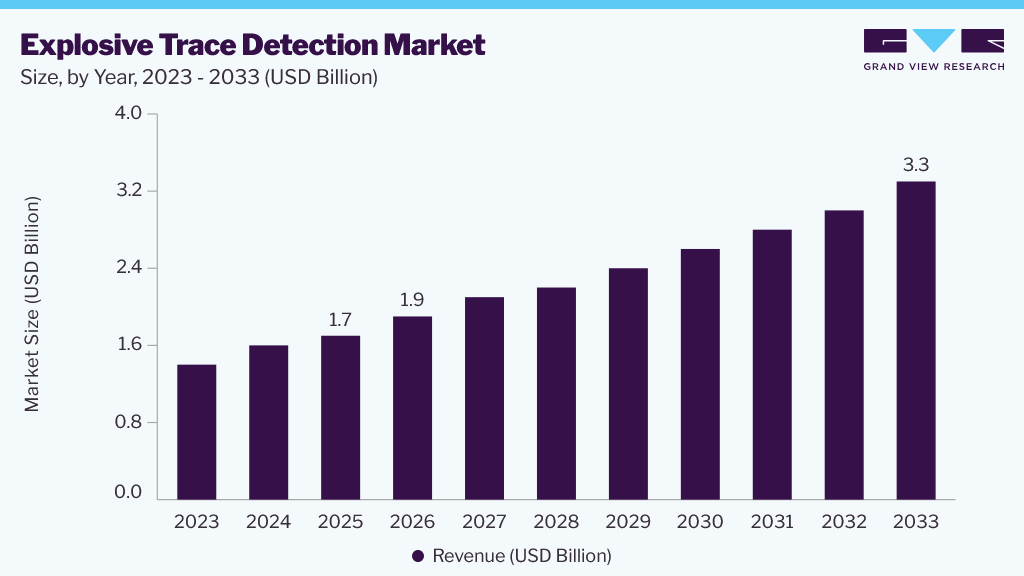 Source: Grand View Research, IR Documents, Primary Interviews, Paid DatabasesTo learn more about this report,
 Download Free Sample Report
 Key Market Trends & Insights
- By product: The handheld segment held the largest market share of around 39.0% in 2025.
- By Technology: The colorimetric segment held the largest market share of around 30.5% in 2025.
- By end use: The defense segment held the largest market share of around 40.0% in 2025.
Regional Highlights
- Largest regional market: North America (35.0% revenue share, 2025)
- Fastest-growing regional market: Asia Pacific (highest CAGR, 2026-2033)
Market Size & Forecast
- Market size in 2025: USD 1.7 Billion
- Estimated market size in 2026: USD 1.9 Billion
- Projected market size by 2033: USD 3.3 Billion
- CAGR (2026-2033): 8.4%
Three ways to get this report
Buy it, customize it, or ask a question.Ask an Analyst
A direct answer, usually in 1 working day
- AccessReport author, directly
- Reply timeWithin 1 working day
- No sales callDirect answer only
- FormatEmail reply
- CostFree, no cost
Get the Full Report
What the study covers
- FormatsPDF · Excel · Dashboard
- Timeline2026–2033 annual, 2025 base
- Coverage20+ countries, 5 regions
- Companies10+ key players profiled
Customize the Report
20% free customization
- IncludeCountries, segments, points
- TailorTo your product definition
- ExtendDeeper competitor detail
- OrA fully bespoke study
- Turnaround5–10 working days
The global market for explosive trace detection (ETD) is witnessing steady growth as governments, airports, border control agencies, and critical infrastructure operators continue strengthening security measures against evolving explosive threats. Increasing passenger traffic, cross-border trade, and stricter aviation security regulations are driving investments in advanced screening technologies capable of rapidly detecting trace amounts of explosive materials. For instance, in February 2025, Southampton Airport began a new phase of its Next Generation Security Screening project by installing advanced security checkpoint scanners to improve screening efficiency and accommodate rising passenger volumes. Continued modernization of airport security infrastructure is expected to support broader adoption of advanced explosive detection technologies.
Technological advancements are further transforming the ETD market through improvements in detection sensitivity, analysis speed, portability, and automated threat identification. Integration of artificial intelligence, enhanced analytical software, and user-friendly sampling technologies is improving operational efficiency while reducing false alarms. These innovations enable security personnel to conduct faster and more accurate screening across aviation, border security, and defense applications.
In addition, increasing investments in protecting government facilities, transportation networks, public venues, and other high-risk infrastructure are creating sustained demand for explosive trace detection systems. The growing frequency of international sporting events, political summits, and large public gatherings is prompting security agencies to deploy advanced screening technologies to strengthen threat detection while maintaining efficient passenger and visitor movement.
Analyst Perspective
The explosive trace detection market is increasingly shaped by evolving security threats, stricter regulatory requirements, and continuous advancements in detection technologies. Security agencies are prioritizing rapid, accurate, and non-intrusive screening solutions that can identify trace explosive residues at airports, border crossings, government facilities, and critical infrastructure. Technological innovations, including enhanced detection sensitivity, artificial intelligence-assisted analytics, and portable screening systems, are improving operational efficiency while reducing inspection time. In addition, rising investments in transportation security, defense modernization, and public safety initiatives are encouraging broader deployment of advanced ETD solutions. Companies that deliver reliable, high-performance, and easily deployable detection systems are expected to strengthen their competitive position as security requirements continue to evolve.
Product Insights
By product, the handheld segment held the largest market share, at around 39.0%, in 2025. Handheld explosive trace detection (ETD) systems are widely adopted for their rapid, on-site screening and high operational flexibility across airports, border checkpoints, military operations, law enforcement, and critical infrastructure. Their compact design, ease of operation, and ability to perform non-invasive inspections make them well suited for dynamic security environments where mobility and quick response are essential. For instance, in April 2024, GreyScan Detection announced that the U.S. Transportation Security Administration (TSA) validated the GreyScan ETD-100 Inorganic Explosives Trace Detector. The portable solution enhances screening efficiency through rapid analysis, high sensitivity, and user-friendly operation, supporting wider adoption of handheld ETD technologies.
The portable/movable segment is expected to register the fastest CAGR during the forecast period. Increasing deployment of temporary security checkpoints, border surveillance operations, and large public events is driving demand for transportable ETD systems that can be rapidly deployed across multiple locations. These solutions provide greater operational flexibility while supporting evolving security requirements in both civilian and defense applications.
Technology Insights
By technology, the colorimetric segment accounted for around 30.5% of market revenue in 2025. Colorimetric detection technologies remain widely adopted due to their simplicity, rapid response time, and cost-effectiveness for field screening applications. Their ability to identify trace explosive residues through visible chemical reactions enables security personnel to perform quick preliminary assessments with minimal training. The technology continues to be used across defense, law enforcement, and transportation security where rapid screening is essential.
The ion mobility spectrometry (IMS) segment is expected to register the fastest CAGR during the forecast period. Increasing demand for high-sensitivity detection and rapid analytical performance is accelerating the adoption of IMS-based ETD systems across aviation security, border control, and critical infrastructure protection. IMS technology delivers highly accurate identification of trace explosive particles while minimizing inspection time and false alarms. For instance, in November 2025, Smiths Detection launched the IONSCAN 600, an explosive trace detector that received ECAC/EU G1 approval for passenger and cargo screening. The approval reinforces the growing adoption of IMS technology for high-throughput aviation security applications.
End use Insights
By end use, the defense segment held the largest market share, at around 40.0%, in 2025. Defense organizations remain the largest users of explosive trace detection systems due to the continuous need to identify explosives, improvised explosive devices (IEDs), ammunition, and hazardous materials during military operations and force protection activities. Increasing investments in border security, counter-terrorism operations, and defense modernization programs continue to strengthen demand for advanced ETD technologies capable of delivering reliable detection under challenging operating conditions.
The commercial segment is expected to register the fastest CAGR during the forecast period. Expansion of airport infrastructure, commercial complexes, entertainment venues, transportation hubs, and large public facilities is increasing demand for advanced security screening solutions. Facility operators are investing in ETD systems to strengthen visitor safety, comply with evolving security regulations, and improve threat detection while maintaining efficient passenger and visitor flow. Growing investment in public safety infrastructure continues to support adoption across commercial environments.
Regional Insights
North America explosive trace detection dominated the market, accounting for a revenue share of 35.0% of revenue in 2025. The region’s borders require robust security measures to prevent the smuggling of explosives and other illegal materials. Advanced ETD systems are deployed at border checkpoints to check vehicles, cargo, and individuals for explosive materials. Focusing on border security and preventing illegal activities drives demand for ETD technologies in border security applications. For instance, in October 2025, Smiths Detection introduced an advanced baggage and air cargo screening solution designed to support current U.S. Transportation Security Administration (TSA) standards. The solution enhances explosive detection capabilities across airport and cargo screening operations, supporting continued adoption of advanced ETD technologies throughout North America.
 To learn more about this report, Download Free Sample Report
 U.S. Explosive Trace Detection Market Trends
The U.S. explosive trace detection industry accounted for the largest share of the North American market in 2025. Growing investments in integrated security infrastructure and increasing adoption of layered screening technologies across airports, government facilities, and critical infrastructure continue to support market growth. The integration of ETD systems with surveillance, access control, and centralized security platforms is improving threat detection capabilities while strengthening national security operations.
Europe Explosive Trace Detection Market Trends
Europe explosive trace detection industry is expected to witness significant growth during the forecast period, supported by increasing investments in aviation security, border surveillance, and protection of public infrastructure. The region continues to strengthen security measures across airports, railway stations, ports, and major public venues to address evolving security threats while complying with stringent regulatory standards. Growing deployment of intelligent screening technologies is further supporting the adoption of advanced explosive trace detection systems.
The UK explosive trace detection industry is projected to grow steadily during the forecast period. Continuous collaboration between security technology providers and aviation authorities is accelerating the deployment of next-generation screening solutions. For instance, in August 2024, Smiths Detection partnered with SeeTrue to integrate AI-based threat detection software into its CT security checkpoint systems. The collaboration enhances automated threat identification and strengthens airport security screening through advanced artificial intelligence capabilities.
Asia Pacific Explosive Trace Detection Market Trends
The Asia-Pacific explosive trace detection industry is expected to grow at the fastest CAGR during the forecast period. driven by rapid expansion of airport infrastructure, rising passenger traffic, and increasing investments in transportation security across emerging economies. Governments throughout the region are modernizing aviation security systems and strengthening border protection to address growing security requirements associated with urbanization, international travel, and expanding trade activities. These developments continue to accelerate demand for advanced ETD solutions.
China explosive trace detection industry is expected to witness significant market growth during the forecast period. Increasing investments in smart city infrastructure, commercial complexes, transportation hubs, and critical public facilities are encouraging wider deployment of advanced security screening technologies. Rising emphasis on public safety, coupled with expanding surveillance and integrated security systems, continues to support adoption of explosive trace detection solutions across commercial and government sectors.
Key Explosive Trace Detection Market Company Insights
The explosive trace detection industry is highly competitive, with companies focusing on developing high-sensitivity detection technologies, AI-enabled screening capabilities, portable trace detection systems, and integrated security solutions. Market participants are strengthening their positions through product innovation, regulatory approvals, strategic collaborations, and expansion across aviation, border security, defense, and critical infrastructure applications.
Key Explosive Trace Detection Companies
The following key companies have been profiled for this study on the explosive trace detection market:
-
Analogic Corporation
-
Autoclear
-
Bruker
-
DetectaChem
-
Teledyne FLIR LLC
-
Smiths Detection Group Ltd.
-
Westminster Group Plc
-
OSI Systems, Inc.
Recent Developments
-
In August 2025, Bruker announced that it had secured multiple long-term contracts for its explosive trace detection (ETD) solutions across the aviation and defense sectors. The agreements include deployments of DE-tector flex ETD systems at major international airports, air cargo facilities, and defense organizations, strengthening Bruker's global presence in aviation security and expanding the adoption of advanced explosive trace detection technologies.
-
In February 2024, the U.S. Transportation Security Administration (TSA) donated four explosive trace detection (ETD) systems to the Airports Authority of Trinidad and Tobago (AATT). The deployment strengthens aviation security screening capabilities by enhancing the detection of explosive materials at airport checkpoints and supporting international aviation security cooperation.
-
In April 2024, the Transportation Security Administration's Innovation Task Force approved GreyScan Detection's ETD-100 Inorganic Explosives Trace Detector for demonstration purposes. The detector was developed to identify explosive compositions, including inorganic materials.
Explosive Trace Detection Market Report Scope
Report Attribute
Details
Market size in 2025
USD 1.7 billion
Estimated market size in 2026
USD 1.9 billion
Projected market size by 2033
USD 3.3 billion
Growth rate
CAGR of 8.4% from 2026 to 2033
Base year for estimation
2025
Historical data
2021 – 2024
Forecast period
2026 – 2033
Quantitative units
Revenue in USD billion and CAGR from 2026 to 2033
Report coverage
Revenue forecast, company ranking, competitive landscape, growth factors, and trends
Segments covered
Product, technology, end use, region
Regional Scope
North America; Europe; Asia Pacific; Latin America; MEA
Country Scope
U.S.; Canada; Mexico; UK; Germany; France; Japan; China; India; Australia; South Korea; Brazil; South Africa; Saudi Arabia; UAE
Key companies profiled
Analogic Corporation; Autoclear; Bruker; DetectaChem; Teledyne FLIR LLC; Smiths Detection Group Ltd.; Westminster Group Plc; OSI Systems, Inc.; Others.
Customization scope
Free report customization (equivalent up to 8 analysts working days) with purchase. Addition or alteration to country, regional & segment scope.
Pricing and purchase options
Avail of customized purchase options to meet your exact research needs. Explore purchase options
Explosive Trace Detection Market Report Segmentation
This report forecasts revenue growth at global, regional, and country levels and provides an analysis of the latest industry trends in each of the sub-segments from 2021 to 2033. For this study, Grand View Research has segmented the explosive trace detection market report based on product, technology, end use, and region.
-
Product Outlook (Revenue, USD Billion, 2021 - 2033)
-
Handheld
-
Portable/ Movable
-
Fixed Point/ Standalone
-
-
Technology Outlook (Revenue, USD Billion, 2021 - 2033)
-
Chemiluminescence
-
Thermo- redox
-
Amplifying Fluorescent Polymer
-
Mass Spectrometry
-
Ion Mobility Spectrometry
-
Colorimetrics and Automated Colorimetric
-
-
End Use Outlook (Revenue, USD Billion, 2021 - 2033)
-
Commercial
-
Defense
-
Public Safety & Law Enforcement
-
Others
-
-
Regional Outlook (Revenue, USD Billion, 2021 - 2033)
-
North America
-
U.S.
-
Canada
-
Mexico
-
-
Europe
-
UK
-
Germany
-
France
-
-
Asia Pacific
-
Japan
-
China
-
India
-
Australia
-
South Korea
-
-
Latin America
-
Brazil
-
-
MEA
-
South Africa
-
South Arabia
-
UAE
-
-
Frequently Asked Questions About This Report
The global explosive trace detection market size was valued at USD 1.7 billion in 2025 and is estimated at USD 1.9 billion in 2026
The global explosive trace detection market is expected to grow at a CAGR of 8.4% from 2026 to 2033, reaching USD 3.3 billion
North America dominated with an approximately 35.0% revenue share in 2025. This is attributable to the wide presence of prominent explosive trace detector providers, such as Autoclear, LLC and L3 Technologies, Inc.
Key players in the market include Analogic Corporation, Autoclear, Bruker, DetectaChem., Teledyne FLIR LLC, Smiths Detection Group Ltd., Westminster Group Plc, OSI Systems, Inc., and others
The handheld explosive trace detection segment accounted for the largest revenue share, at around 39.0%, in 2025.
About the Author(s)
Next Generation Technologies Research Team
Technology · Next Generation TechnologiesThis report was authored by the next generation technologies research team at Grand View Research - comprising two research analysts, one senior research analyst, and one industry expert - with specialized expertise in the next generation technologies segment of the technology industry. All findings are based on proprietary technology databases, executive interviews, and regulatory analysis, subject to internal peer review prior to publication.
Last Updated:
Speak to Analyst

Customize this report to your needs - add regions, segments, or data points, with 20% free customization.
Or view our licence options:


ISO 9001:2015 & 27001:2022 Certified
We are GDPR and CCPA compliant! Your transaction & personal information is safe and secure. For more details, please read our privacy policy.


