
- Home
- »
- Homecare & Decor
- »
-
External Blinds Market Size, Growth Report, 2026-2033GVR Report cover
![External Blinds Market (2026 - 2033)Report]()
External Blinds Market (2026 - 2033)
Size, Share & Trends Analysis Report By Product (Roller Blinds, Venetian Blinds), By Material (Metal, Wood), By Application (Residential, Commercial), By Operating System, By Installation, By Region, And Segment Forecasts
Market Size, 2025
$12.4BMarket Estimate, 2026
$13.0BMarket Forecast, 2033
$18.8BCAGR, 2026–2033
5.4%External Blinds Market Summary
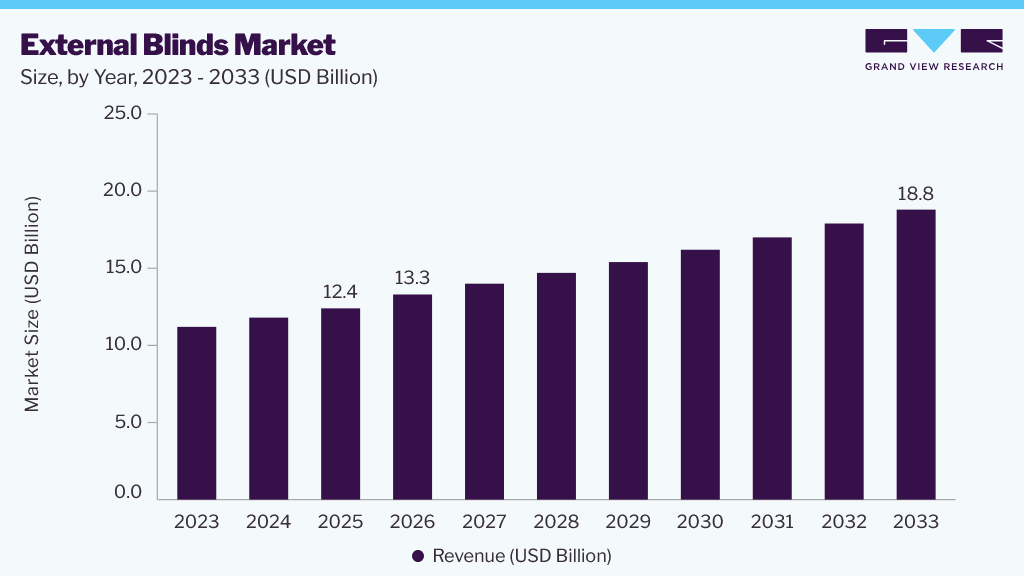
The global external blinds market size was valued at USD 12.4 billion in 2025 and is projected to grow from USD 13.0 billion in 2026 to USD 18.8 billion by 2033, at a CAGR of 5.4% from 2026 to 2033. The North America market dominated the market, accounting for a revenue share of 40.5% in 2025. The increasing emphasis on energy-efficient building designs and indoor thermal comfort is driving the adoption of external blinds across residential and commercial buildings. External blinds help regulate solar heat gain, reduce glare, improve occupant comfort, and support energy conservation by limiting the need for cooling during warm weather.
Key Market Trends & Insights
- By product: The roller blinds segment dominated the market, with a revenue share of approximately 32.5% in 2025.
- By material: The metal segment held the largest market share of over 37.0% in 2025.
- By application: The residential segment held the largest market share of over 55.0% in 2025.
- By operating system: The manual operating system segment held the largest revenue share of over 65.0% in 2025.
- By installation: The retrofit segment held the largest revenue share of over 71.5% in 2025.
Regional Highlights
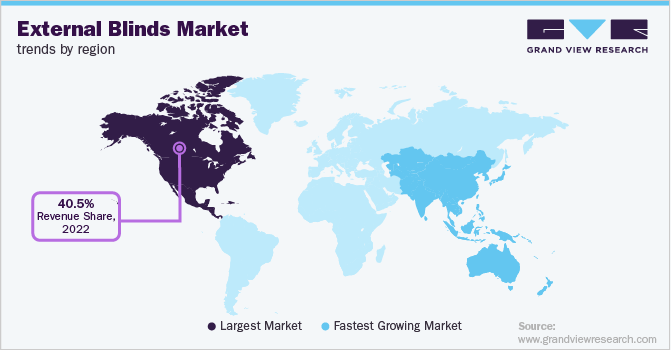
- Largest regional market: North America (40.5% revenue share, 2025)
- Fastest-growing regional market: Asia Pacific (highest CAGR, 2026-2033)
Market Size & Forecast
- Market size in 2025: USD 12.4 Billion
- Estimated market size in 2026: USD 13.0 Billion
- Projected market size by 2033: USD 18.8 Billion
- CAGR (2026-2033): 5.4%
The increasing focus on energy-efficient buildings, occupant comfort, and modern façade aesthetics is supporting the adoption of external blinds across residential and commercial properties. External blinds help control solar heat gain, reduce glare, enhance privacy, and improve indoor comfort while contributing to lower energy consumption. Commercial establishments such as offices, hotels, restaurants, and retail spaces are increasingly incorporating external shading systems to complement building designs and improve occupant experience.
Growing construction activity, renovation projects, and modernization of residential and commercial buildings are further contributing to product demand. In addition, the adoption of motorized and automated shading systems is increasing as smart building technologies become more prevalent. External blinds are increasingly being integrated with building automation systems to improve lighting control and indoor environmental management. Rising urbanization, expanding housing stock, and increasing investment in sustainable building solutions continue to support demand for external blinds across developed and emerging economies.
Market Dynamics
The external blinds market is witnessing steady growth, supported by increasing demand for energy-efficient building solutions and improved indoor comfort across residential and commercial properties. The rising adoption of solar shading systems to reduce heat gain, glare, and energy consumption is driving product demand. In addition, growing construction and renovation activities, along with increasing preference for aesthetically appealing building exteriors, are supporting market expansion. The adoption of motorized and automated shading solutions is further driving the use of external blinds in modern building environments.
The increasing focus on reducing building energy consumption is driving the adoption of external blinds across residential and commercial properties. External blinds help limit solar heat gain before sunlight reaches the glazing, reducing indoor temperatures and lowering reliance on air-conditioning systems. Building owners and developers are increasingly incorporating external shading solutions as part of broader energy-efficiency and sustainable building strategies. The ability of external blinds to improve thermal comfort while maintaining access to natural daylight is further contributing to their adoption across modern building projects.
The growing emphasis on building performance and overheating mitigation is further supporting product demand. Rising awareness about the growing importance of external shading solutions in helping buildings comply with evolving energy-efficiency and overheating regulations, including requirements for building performance and thermal comfort, is driving the market growth. In addition, the role of external blinds and solar shading systems in reducing cooling loads and improving occupant comfort is crucial. The increasing incorporation of solar shading measures into sustainable building designs continues to support demand for external blinds across various end-use applications.
Motorized external blinds rely on electronic and mechanical components such as motors, sensors, controllers, and automated operating systems to ensure smooth operation. These components are continuously exposed to outdoor conditions, including dust, moisture, wind, and temperature variations, which can affect performance over time. As a result, periodic inspection, servicing, and component replacement may be required to maintain operational reliability. Maintenance requirements can be particularly significant in large commercial installations that operate numerous automated shading systems.
In addition, technical issues with motors, sensors, control systems, or connectivity may result in operational disruptions and additional servicing requirements. Building owners and facility managers may also incur higher maintenance and repair costs compared to manually operated shading systems. The need for ongoing maintenance, specialized technical support, and replacement of system components can increase the overall cost of ownership, creating adoption challenges in cost-sensitive applications.
Expansion of green buildings and retrofit projects is creating opportunities for external blinds across residential and commercial buildings. Building owners and developers are increasingly incorporating external shading systems to improve thermal performance, reduce solar heat gain, and support energy-efficiency objectives. External blinds are also being used in renovation and retrofit projects to enhance building comfort and reduce cooling requirements without major structural modifications. For example, in 2025, WAREMA highlighted its curtain wall construction solution with integrated exterior shading systems for modular buildings, designed to address overheating and improve building performance. The growing focus on sustainable construction and energy-efficient building upgrades is expected to increase the adoption of external blinds across new-build and retrofit applications.
Analyst Perspective
The external blinds industry is increasingly influenced by the convergence of energy efficiency requirements, climate-responsive building design, and the growing adoption of smart building technologies. The strongest competitive positioning is likely to emerge among manufacturers capable of combining solar shading performance, automation capabilities, and architectural aesthetics within a single solution. As building owners prioritize lower cooling loads, occupant comfort, and sustainable building operations, external blinds are evolving from a façade accessory to an active building performance component. The ability to integrate with building management systems and retrofit existing structures is expected to differentiate long-term market leaders.
Product Insights
By product, the roller blinds segment led the market with the largest revenue share of approximately 32.5% in 2025. The widespread adoption of roller blinds across residential, commercial, hospitality, and office buildings is contributing to the segment's leading position. Roller blinds offer a simple design, ease of installation, effective solar shading, and compatibility with a wide range of architectural styles. Their availability across different materials, colors, and operating mechanisms has increased their application across both new construction and renovation projects. In addition, the growing demand for cost-effective exterior shading solutions continues to support product adoption across diverse end-use environments.
The venetian blinds segment is expected to grow at the fastest CAGR over the forecast period. Adjustable slat designs offer greater control over daylight, glare reduction, ventilation, and privacy than many conventional shading solutions. The growing preference for flexible lighting management systems in commercial buildings, offices, educational institutions, and modern residential developments is driving demand for these products. In addition, the growing adoption of automated shading technologies and smart building systems is increasing the utilization of motorized Venetian blinds across energy-efficient building projects. The ability to combine solar control with architectural aesthetics is expected to contribute to the segment's growth during the forecast period.
Application Insights
By application, the residential application segment led the market with the largest revenue share of over 55.0% in 2025. Increasing residential construction activity and the expansion of urban housing developments are contributing to product demand across the segment. Homeowners are increasingly incorporating external blinds to improve solar protection, privacy, thermal comfort, and the overall appearance of residential properties. Rising expenditure on home improvement and outdoor living spaces is further supporting adoption. In addition, the growing popularity of smart home technologies is increasing demand for automated shading solutions. For instance, in March 2025, SwitchBot launched adjustable smart roller shades compatible with major smart home ecosystems. The product allows users to automate window shading through connected home platforms and smart devices. The launch reflects the increasing integration of automated shading solutions with smart home technologies. The growing integration of smart shading technologies into modern homes continues to reinforce the segment's leading position.
The commercial segment is expected to grow at the fastest CAGR over the forecast period. Expansion of hotels, office buildings, retail centers, restaurants, healthcare facilities, and educational institutions is increasing demand for external shading solutions. Commercial property owners are increasingly using external blinds to manage solar heat gain, improve occupant comfort, and enhance building aesthetics. According to Lodging Econometrics, in 2025, the global hotel construction pipeline reached a record high of 15,871 projects, indicating continued expansion of hospitality infrastructure worldwide. Such construction activity is increasing the demand for exterior shading and façade solutions across commercial buildings. The growing emphasis on energy-efficient building operations and modern façade design is expected to drive segment growth over the forecast period.
Operating System Insights
By operating system, the manual segment led the market, with a revenue share of over 65.0% in 2025. Manual external blinds continue to witness widespread adoption due to their lower installation costs, ease of operation, and minimal maintenance requirements compared to motorized alternatives. These systems are commonly used across residential properties and small commercial establishments where affordability and operational simplicity remain important purchasing considerations. In addition, manual blinds are available across a broad range of designs, materials, and configurations, supporting their adoption across various building types. The cost advantages and widespread availability of manually operated solutions continue to contribute to the segment's leading position.
The automatic operating system segment is expected to grow at the fastest CAGR over the forecast period. Increasing adoption of smart home technologies and building automation systems is driving demand for motorized external blinds. Automated shading systems enable remote operation, scheduled control, and integration with lighting, climate control, and building management platforms. For instance, in January 2025, Somfy expanded its smart shading portfolio with solutions designed to integrate with connected home ecosystems and automated building controls. The growing emphasis on convenience, energy management, and intelligent building operation is expected to increase the adoption of automated external blind systems across residential and commercial properties.
Installation Insights
By installation, the retrofit segment led the market, accounting for over 71.5% of revenue in 2025. Rising investment in home improvement and building renovation is driving demand for external blinds across existing residential and commercial properties. Property owners are increasingly incorporating external shading solutions to improve thermal comfort, reduce solar heat gain, and enhance building aesthetics without undertaking major structural modifications. Retrofit installations also offer a cost-effective way to improve building energy performance. According to the Joint Center for Housing Studies of Harvard University, spending on home renovation and repair increased in 2025, reflecting continued investment in housing upgrades and modernization projects. These trends continue to reinforce the segment's growth.
New construction installation type is expected to grow at a significant CAGR over the forecast period. Increasing residential, commercial, hospitality, and mixed-use construction activities are creating opportunities to install external blinds during the building design stage. Architects and developers are increasingly incorporating external shading systems to improve building performance, occupant comfort, and façade aesthetics. The growing integration of energy-efficient design features in newly constructed buildings is expected to contribute to segment growth during the forecast period.
Material Insights
By material, the metal segment led the market with the largest revenue share of over 37.0% in 2025. Metal external blinds are widely utilized across residential, commercial, and institutional buildings due to their durability, weather resistance, and long service life. Materials such as aluminum are commonly preferred for exterior applications because they can withstand prolonged exposure to sunlight, moisture, and varying environmental conditions while requiring relatively low maintenance. In addition, metal blinds are available in a wide range of designs, making them suitable for modern architectural applications.
The wood segment is expected to grow at the fastest CAGR over the forecast period. The growing preference for natural materials and premium exterior design solutions is driving the adoption of wood-based external blinds across residential and hospitality applications. Wood offers a distinctive appearance and complements architectural styles that emphasize natural and sustainable design elements. In addition, increasing investment in luxury housing developments, outdoor living spaces, and high-end renovation projects is supporting product demand. The growing focus on aesthetic enhancement and premium building materials is expected to contribute to segment growth during the forecast period.
Regional Insights
North America external blinds industry dominated the global market with the revenue share of 40.5% in 2025. Energy efficiency regulations, rising expenditure on home improvement projects, and increasing adoption of outdoor living concepts are influencing demand for external blinds across the region. Property owners are increasingly incorporating exterior shading systems to improve thermal comfort, reduce cooling requirements, and enhance façade aesthetics. The region also benefits from a well-established residential remodeling industry and growing investment in energy-efficient building upgrades. The U.S. Department of Energy identifies window covering systems as an effective approach for limiting unwanted solar heat gain and improving building energy performance. The growing emphasis on sustainable, energy-conscious building solutions continues to reinforce regional demand for external blinds.
Asia Pacific External Blinds Market Trends
The Asia Pacific external blinds industry is expected to grow at the fastest CAGR over the forecast period. Rapid urbanization, expanding residential construction, and rising investments in commercial infrastructure are driving demand for external blinds across the region. Construction activity remains strong across residential developments, hotels, office buildings, educational institutions, and mixed-use projects, creating opportunities for exterior shading solutions. Rising household incomes and changing consumer preferences are also increasing expenditure on modern home improvement and building enhancement products. In addition, growing awareness of energy-efficient building practices and the increasing adoption of contemporary architectural designs are driving the use of external blinds as an alternative to traditional window coverings. The continued expansion of construction activity and evolving building design preferences are expected to drive regional growth over the forecast period.
Key External Blinds Company Insights
The market is characterized by a few established players and new entrants. Many big players are increasing their focus on the growing trend of external blinds. Players in the market are diversifying their service offerings to maintain market share.
Key External Blinds Companies
The following key companies have been profiled for this study on the external blinds market:
-
Alulux GmbH
-
Griesser AG
-
Country Blinds Pty Ltd
-
Hunter Douglas
-
MHZ Hachtel GmbH & Co. KG
-
NEVA
-
Schenker Storen
-
Serge Ferrari S.A.S.
-
Verano
-
WAREMA Renkhoff SE
Recent Developments
-
In February 2025, Universal Electronics Inc. announced a collaboration with Somfy to develop next-generation smart shading solutions. The partnership is focused on expanding connected window covering technologies and improving integration with smart home ecosystems. The initiative reflects growing industry focus on automated and intelligent shading systems.
-
In April 2025, Somfy unveiled its Top-Down Bottom-Up 45 WireFree Zigbee motor. The solution enables independent control of shade positioning through a single motorized system and expands the company's portfolio of automated shading technologies. The launch reflects ongoing innovation in smart, connected window-covering solutions.
External Blinds Market Report Scope
Report Attribute
Details
Market size in 2025
USD 12.4 billion
Estimated Market size in 2026
USD 13.0 billion
Projected Market size by 2033
USD 18.8 billion
Growth rate
CAGR of 5.4% from 2026 to 2033
Base year for estimation
2025
Actual data
2021 – 2024
Forecast period
2026 – 2033
Quantitative units
Revenue in USD billion and CAGR from 2026 to 2033
Report coverage
Revenue forecast, company ranking, competitive landscape, growth factors, and trends
Segments covered
Product, material, application, operating system, installation, region
Regional Scope
North America; Europe; Asia Pacific; Central & South America; Middle East & Africa
Country scope
U.S.; Canada; Mexico; UK; Germany; France; Italy; Spain; China; India; Japan; Australia & New Zealand, South Korea; Brazil; Argentina, South Africa, UAE
Key companies profiled
Alulux GmbH; Griesser AG; Country Blinds Pty Ltd; Hunter Douglas; MHZ Hachtel GmbH & Co. KG; NEVA; Schenker Storen; Serge Ferrari S.A.S.; Verano; WAREMA Renkhoff SE.
Customization scope
Free report customization (equivalent up to 8 analysts working days) with purchase. Addition or alteration to country, regional & segment scope.
Pricing and purchase options
Avail of customized purchase options to meet your exact research needs. Explore purchase options
External Blinds Market Report Segmentation
This report forecasts revenue growth at global, regional, and country levels and provides an analysis of the latest trends in each of the sub-segments from 2021 to 2033. For this study, Grand View Research has segmented the global external blinds market report based on product, material, application, operating system, installation, and region:
-
Product Outlook (Revenue, USD Billion,2021 - 2033)
-
Roller Blinds
-
Venetian Blinds
-
Vertical Blinds
-
Panel Blinds
-
Corded Blinds
-
Others
-
-
Material Outlook (Revenue, USD Billion, 2021 - 2033)
-
Metal
-
Wood
-
Plastic
-
Others
-
-
Application Outlook (Revenue, USD Billion, 2021 - 2033)
-
Residential
-
Commercial
-
-
Operating System Outlook (Revenue, USD Billion, 2021 - 2033)
-
Automatic
-
Manual
-
-
Installation Outlook (Revenue, USD Billion, 2021 - 2033)
-
New Construction
-
Retro-fit
-
-
Regional Outlook (Revenue, USD Billion, 2021 - 2033)
-
North America
-
U.S.
-
Canada
-
-
Europe
-
UK
-
Germany
-
France
-
-
Asia Pacific
-
China
-
India
-
Japan
-
-
Central & South America
-
Brazil
-
-
Middle East & Africa (MEA)
-
South Africa
-
-
Frequently Asked Questions About This Report
The global external blinds market size was valued at USD 12.4 billion in 2025 and is estimated at USD 13.0 billion in 2026.
The global external blinds market is expected to grow at a CAGR of 5.4% from 2026 to 2033, reaching USD 18.8 billion
North America dominated with approximately 40.5% revenue share in 2025.
The roller blinds external blinds market segment accounted for the largest revenue share of approximately 32.5% in 2025.
Key players in the market include Alulux GmbH; Griesser AG; Country Blinds Pty Ltd; Hunter Douglas; MHZ Hachtel GmbH & Co. KG; NEVA; Schenker Storen; Serge Ferrari S.A.S.; Verano; WAREMA Renkhoff SE, and others.
About the Author(s)
Homecare & Decor Research Team
Consumer Goods · Homecare & DecorThis report was authored by the homecare & decor research team at Grand View Research - comprising two research analysts, one senior research analyst, and one industry expert - with specialized expertise in the homecare & decor segment of the consumer goods industry. All findings are based on proprietary consumer goods databases, executive interviews, and regulatory analysis, subject to internal peer review prior to publication.
Last Updated:
Speak to Analyst


Customize this report to your needs — add regions, segments, or data points, with 20% free customization.
Or view our licence options:


ISO 9001:2015 & 27001:2022 Certified
We are GDPR and CCPA compliant! Your transaction & personal information is safe and secure. For more details, please read our privacy policy.


